Report on Indian Automobile Industry analysis
Report Submitted to: Dr. Anirban Ghatak
As a Part of CIA III of Managerial Economics (MBA 135)
Submitted by:
Cyril Tony (1627813)
Mobin Kurain (1627818)
Mohit Garg (1627820)
Akshita (1627839)
Neethu Tom (1627853)
Priyanka Golchha (1627856)
1 MBA K
Industry Overview
Any industry relating with making or has any connection with motor vehicles, then that
is an automobile industry. They are mainly involved in the design, marketing, development,
selling and manufacturing of motor vehicles. It does not include automobile repair
shops and motor fuel filling stations.
International Automobile Market Overview:
The worldwide automotive industry has enjoyed growth and profitability for a long
period. Yet anything about the future cannot be predicted. Irregularity of global markets is the
basic challenge. The annual sales in North America is expected to grow up to 16 million cars
from 13 million. However, the European outlook is facing tough time as it is overcoming from
a slump in sales for the last six years. Sales have raised in Russia as well as South America
which was earlier down by about 25 percent and 15 percent, respectively. Meanwhile, the
performance of the Indian market has become unpredictable. Growth in China Automobile
Market has been reduced, even after investments in the future forecasted demand. Industry
leaders have to take steps in the near future to overcome these challenges.
Indian Automobile Market Overview
India also is a prominent auto exporter. It contributes around 7.1% of entire GDP. Two
wheeler industry has 81% of the market share. Overall passenger vehicle segment constitutes
about 13% of the market share. As of 2015, 39% of Hatchback cars sold in global market are
manufactured in India. Due to increase in the young population and middle class, two wheeler
segment is the leader of the Indian Automobile market with 83% of the market share as of 2015
financial year analysis. The passenger vehicle segment constitutes about 15% market share.
India has expected a strong increase in export in the coming future. In Financial year 2015, the
export of commercial vehicles registered is about 18.36%. India is also expected by the
Government of India is to lead the automobile market globally by 2020. Commercial vehicles
maintained its goodwill therefore their demand grew by 17.36%. The industry has received a
Foreign Direct Investment (FDI) worth US14.32 billion dollars within financial year 2015.
Government of India aims to make India as the hub for global manufacturing and Research and
Development.
Foreign Investors
 Suzuki (Japan)
 Nissan (Japan)
 Piaggio (Italy)
 Volkswagen (Germany)
 Renault (France)
 Hyundai (South Korea)
 General Motors (USA)
 BMW (Germany)
 Ford (USA)
 Toyota (Japan)
MAJOR PLAYERS
MAHINDRA & MAHINDRA
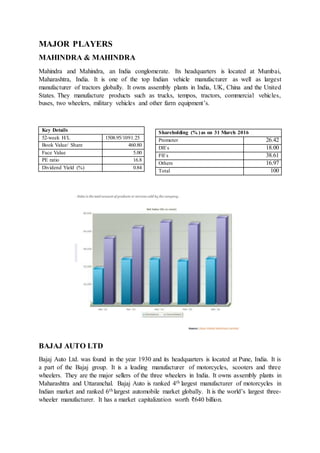
Mahindra and Mahindra, an India conglomerate. Its headquarters is located at Mumbai,
Maharashtra, India. It is one of the top Indian vehicle manufacturer as well as largest
manufacturer of tractors globally. It owns assembly plants in India, UK, China and the United
States. They manufacture products such as trucks, tempos, tractors, commercial vehicles,
buses, two wheelers, military vehicles and other farm equipment’s.
BAJAJ AUTO LTD
Bajaj Auto Ltd. was found in the year 1930 and its headquarters is located at Pune, India. It is
a part of the Bajaj group. It is a leading manufacturer of motorcycles, scooters and three
wheelers. They are the major sellers of the three wheelers in India. It owns assembly plants in
Maharashtra and Uttaranchal. Bajaj Auto is ranked 4th largest manufacturer of motorcycles in
Indian market and ranked 6th largest automobile market globally. It is the world’s largest three-
wheeler manufacturer. It has a market capitalization worth ₹640 billion.
Key Details
52-week H/L 1508.95/1091.25
Book Value/ Share 460.80
Face Value 5.00
PE ratio 16.8
Dividend Yield (%) 0.84
Shareholding (% )as on 31 March 2016
Promoter 26.42
DII`s 18.00
FII`s 38.61
Others 16.97
Total 100
ESCORTSLTD
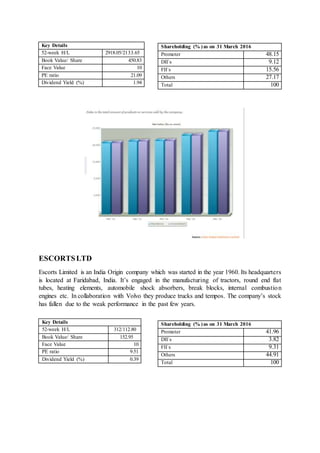
Escorts Limited is an India Origin company which was started in the year 1960. Its headquarters
is located at Faridabad, India. It’s engaged in the manufacturing of tractors, round end flat
tubes, heating elements, automobile shock absorbers, break blocks, internal combustion
engines etc. In collaboration with Volvo they produce trucks and tempos. The company’s stock
has fallen due to the weak performance in the past few years.
Key Details
52-week H/L 2918.05/2133.65
Book Value/ Share 450.83
Face Value 10
PE ratio 21.09
Dividend Yield (%) 1.94
Shareholding (% )as on 31 March 2016
Promoter 48.15
DII`s 9.12
FII`s 15.56
Others 27.17
Total 100
Key Details
52-week H/L 312/112.80
Book Value/ Share 152.95
Face Value 10
PE ratio 9.51
Dividend Yield (%) 0.39
Shareholding (% )as on 31 March 2016
Promoter 41.96
DII`s 3.82
FII`s 9.31
Others 44.91
Total 100
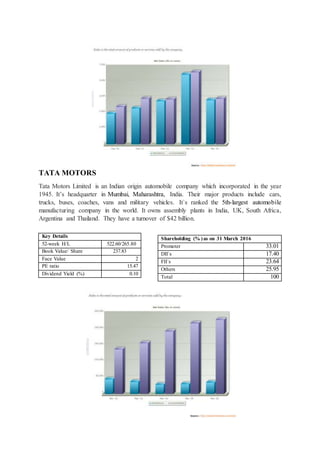
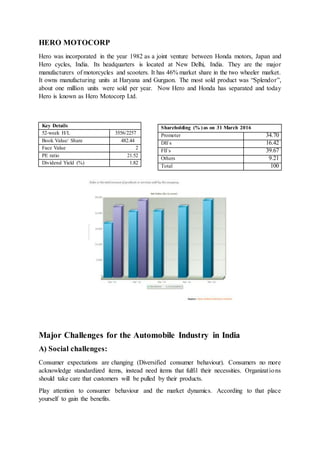
TATA MOTORS
Tata Motors Limited is an Indian origin automobile company which incorporated in the year
1945. It’s headquarter in Mumbai, Maharashtra, India. Their major products include cars,
trucks, buses, coaches, vans and military vehicles. It`s ranked the 5th-largest automobile
manufacturing company in the world. It owns assembly plants in India, UK, South Africa,
Argentina and Thailand. They have a turnover of $42 billion.
Key Details
52-week H/L 522.60/265.80
Book Value/ Share 237.83
Face Value 2
PE ratio 15.47
Dividend Yield (%) 0.10
Shareholding (% )as on 31 March 2016
Promoter 33.01
DII`s 17.40
FII`s 23.64
Others 25.95
Total 100
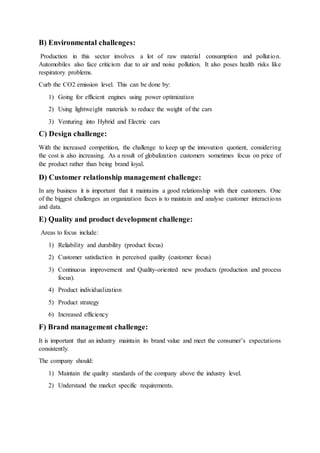
HERO MOTOCORP
Hero was incorporated in the year 1982 as a joint venture between Honda motors, Japan and
Hero cycles, India. Its headquarters is located at New Delhi, India. They are the major
manufacturers of motorcycles and scooters. It has 46% market share in the two wheeler market.
It owns manufacturing units at Haryana and Gurgaon. The most sold product was “Splendor”,
about one million units were sold per year. Now Hero and Honda has separated and today
Hero is known as Hero Motocorp Ltd.
Major Challenges for the Automobile Industry in India
A) Social challenges:
Consumer expectations are changing (Diversified consumer behaviour). Consumers no more
acknowledge standardized items, instead need items that fulfil their necessities. Organizations
should take care that customers will be pulled by their products.
Play attention to consumer behaviour and the market dynamics. According to that place
yourself to gain the benefits.
Key Details
52-week H/L 3556/2257
Book Value/ Share 482.44
Face Value 2
PE ratio 21.52
Dividend Yield (%) 1.82
Shareholding (% )as on 31 March 2016
Promoter 34.70
DII`s 16.42
FII`s 39.67
Others 9.21
Total 100
B) Environmental challenges:
Production in this sector involves a lot of raw material consumption and pollution.
Automobiles also face criticism due to air and noise pollution. It also poses health risks like
respiratory problems.
Curb the CO2 emission level. This can be done by:
1) Going for efficient engines using power optimization
2) Using lightweight materials to reduce the weight of the cars
3) Venturing into Hybrid and Electric cars
C) Design challenge:
With the increased competition, the challenge to keep up the innovation quotient, considering
the cost is also increasing. As a result of globalization customers sometimes focus on price of
the product rather than being brand loyal.
D) Customer relationship management challenge:
In any business it is important that it maintains a good relationship with their customers. One
of the biggest challenges an organization faces is to maintain and analyse customer interactions
and data.
E) Quality and product development challenge:
Areas to focus include:
1) Reliability and durability (product focus)
2) Customer satisfaction in perceived quality (customer focus)
3) Continuous improvement and Quality-oriented new products (production and process
focus).
4) Product individualization
5) Product strategy
6) Increased efficiency
F) Brand management challenge:
It is important that an industry maintain its brand value and meet the consumer’s expectations
consistently.
The company should:
1) Maintain the quality standards of the company above the industry level.
2) Understand the market specific requirements.
Future Trends in Indian automobile industry.
Automobile industry in India is one of the competitive and emerging market industries of the
world. Indian Automobile industry contributes to 22 percent of the country’s manufacturing
GDP. The increasing GDP of India ensures that the automobile industry will always retain at
times slow but a constant growth. The Indian Automobile industry is stood as the 7th largest
industry globally which have a producing capacity of over 17 million vehicles of which over 2
million vehicles are exported. The Indian automobile sector has the capability and potential to
dominate the world automobile industry with suitable investment opportunities and new
innovations and projects.
The road ahead for Indian automobile industry.
 Automobile Sector in India is expected to become the third largest sector by increasing
its production capacity in the next 5 years.
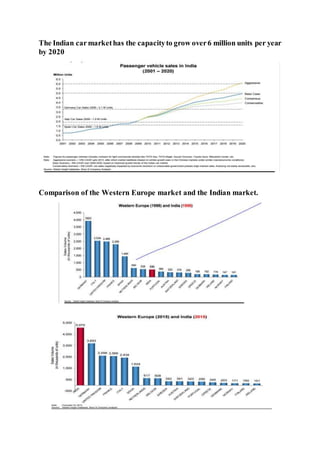
 The Indian automobile sector has the capacity to expand over 6 million units per year
by 2020.
 The strong support from the government ensures that India would be an important
technical and scientific research and development center for automobile industry and
in establishing NATRIP centers.
 The major global car companies have begun investing in Indian market to utilize the
growing domestic demand. These manufacturing companies are also start developing
the export-oriented production centers with in the country to take advantage of India`s
growing market.
 The arrival of large automotive bands in the country: Pune-Mumbai-Aurangabad-
Nashik in western India, Gurgaon-Faridabad-Delhi in the northern part of India,
Kolkata-Jamshedpur in the eastern part and the Bengaluru- Hosur-Chennai in southern
part of the country respectively.
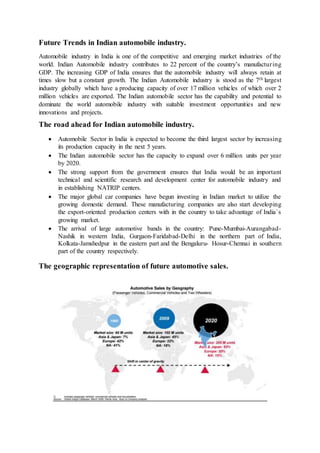
The geographic representation of future automotive sales.
The Indian car markethas the capacityto grow over6 million units per year
by 2020
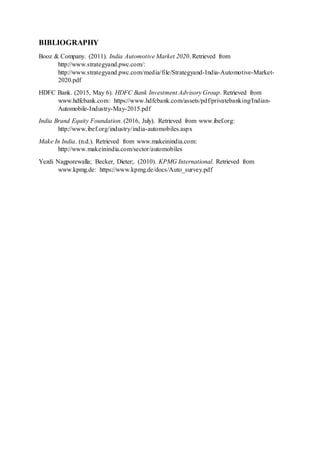
Comparison of the Western Europe market and the Indian market.
BIBLIOGRAPHY
Booz & Company. (2011). India Automotive Market 2020. Retrieved from
http://www.strategyand.pwc.com/:
http://www.strategyand.pwc.com/media/file/Strategyand-India-Automotive-Market-
2020.pdf
HDFC Bank. (2015, May 6). HDFC Bank Investment Advisory Group. Retrieved from
www.hdfcbank.com: https://www.hdfcbank.com/assets/pdf/privatebanking/Indian-
Automobile-Industry-May-2015.pdf
India Brand Equity Foundation. (2016, July). Retrieved from www.ibef.org:
http://www.ibef.org/industry/india-automobiles.aspx
Make In India. (n.d.). Retrieved from www.makeinindia.com:
http://www.makeinindia.com/sector/automobiles
Yezdi Nagporewalla; Becker, Dieter;. (2010). KPMG International. Retrieved from
www.kpmg.de: https://www.kpmg.de/docs/Auto_survey.pdf

Report on Automobile Industry Analysis

  • 1.
    Report on IndianAutomobile Industry analysis Report Submitted to: Dr. Anirban Ghatak As a Part of CIA III of Managerial Economics (MBA 135) Submitted by: Cyril Tony (1627813) Mobin Kurain (1627818) Mohit Garg (1627820) Akshita (1627839) Neethu Tom (1627853) Priyanka Golchha (1627856) 1 MBA K
  • 2.
    Industry Overview Any industryrelating with making or has any connection with motor vehicles, then that is an automobile industry. They are mainly involved in the design, marketing, development, selling and manufacturing of motor vehicles. It does not include automobile repair shops and motor fuel filling stations. International Automobile Market Overview: The worldwide automotive industry has enjoyed growth and profitability for a long period. Yet anything about the future cannot be predicted. Irregularity of global markets is the basic challenge. The annual sales in North America is expected to grow up to 16 million cars from 13 million. However, the European outlook is facing tough time as it is overcoming from a slump in sales for the last six years. Sales have raised in Russia as well as South America which was earlier down by about 25 percent and 15 percent, respectively. Meanwhile, the performance of the Indian market has become unpredictable. Growth in China Automobile Market has been reduced, even after investments in the future forecasted demand. Industry leaders have to take steps in the near future to overcome these challenges. Indian Automobile Market Overview India also is a prominent auto exporter. It contributes around 7.1% of entire GDP. Two wheeler industry has 81% of the market share. Overall passenger vehicle segment constitutes about 13% of the market share. As of 2015, 39% of Hatchback cars sold in global market are manufactured in India. Due to increase in the young population and middle class, two wheeler segment is the leader of the Indian Automobile market with 83% of the market share as of 2015 financial year analysis. The passenger vehicle segment constitutes about 15% market share. India has expected a strong increase in export in the coming future. In Financial year 2015, the export of commercial vehicles registered is about 18.36%. India is also expected by the Government of India is to lead the automobile market globally by 2020. Commercial vehicles maintained its goodwill therefore their demand grew by 17.36%. The industry has received a Foreign Direct Investment (FDI) worth US14.32 billion dollars within financial year 2015. Government of India aims to make India as the hub for global manufacturing and Research and Development. Foreign Investors  Suzuki (Japan)  Nissan (Japan)  Piaggio (Italy)  Volkswagen (Germany)  Renault (France)  Hyundai (South Korea)  General Motors (USA)  BMW (Germany)  Ford (USA)  Toyota (Japan)
  • 3.
    MAJOR PLAYERS MAHINDRA &MAHINDRA Mahindra and Mahindra, an India conglomerate. Its headquarters is located at Mumbai, Maharashtra, India. It is one of the top Indian vehicle manufacturer as well as largest manufacturer of tractors globally. It owns assembly plants in India, UK, China and the United States. They manufacture products such as trucks, tempos, tractors, commercial vehicles, buses, two wheelers, military vehicles and other farm equipment’s. BAJAJ AUTO LTD Bajaj Auto Ltd. was found in the year 1930 and its headquarters is located at Pune, India. It is a part of the Bajaj group. It is a leading manufacturer of motorcycles, scooters and three wheelers. They are the major sellers of the three wheelers in India. It owns assembly plants in Maharashtra and Uttaranchal. Bajaj Auto is ranked 4th largest manufacturer of motorcycles in Indian market and ranked 6th largest automobile market globally. It is the world’s largest three- wheeler manufacturer. It has a market capitalization worth ₹640 billion. Key Details 52-week H/L 1508.95/1091.25 Book Value/ Share 460.80 Face Value 5.00 PE ratio 16.8 Dividend Yield (%) 0.84 Shareholding (% )as on 31 March 2016 Promoter 26.42 DII`s 18.00 FII`s 38.61 Others 16.97 Total 100
  • 4.
    ESCORTSLTD Escorts Limited isan India Origin company which was started in the year 1960. Its headquarters is located at Faridabad, India. It’s engaged in the manufacturing of tractors, round end flat tubes, heating elements, automobile shock absorbers, break blocks, internal combustion engines etc. In collaboration with Volvo they produce trucks and tempos. The company’s stock has fallen due to the weak performance in the past few years. Key Details 52-week H/L 2918.05/2133.65 Book Value/ Share 450.83 Face Value 10 PE ratio 21.09 Dividend Yield (%) 1.94 Shareholding (% )as on 31 March 2016 Promoter 48.15 DII`s 9.12 FII`s 15.56 Others 27.17 Total 100 Key Details 52-week H/L 312/112.80 Book Value/ Share 152.95 Face Value 10 PE ratio 9.51 Dividend Yield (%) 0.39 Shareholding (% )as on 31 March 2016 Promoter 41.96 DII`s 3.82 FII`s 9.31 Others 44.91 Total 100
  • 5.
    TATA MOTORS Tata MotorsLimited is an Indian origin automobile company which incorporated in the year 1945. It’s headquarter in Mumbai, Maharashtra, India. Their major products include cars, trucks, buses, coaches, vans and military vehicles. It`s ranked the 5th-largest automobile manufacturing company in the world. It owns assembly plants in India, UK, South Africa, Argentina and Thailand. They have a turnover of $42 billion. Key Details 52-week H/L 522.60/265.80 Book Value/ Share 237.83 Face Value 2 PE ratio 15.47 Dividend Yield (%) 0.10 Shareholding (% )as on 31 March 2016 Promoter 33.01 DII`s 17.40 FII`s 23.64 Others 25.95 Total 100
  • 6.
    HERO MOTOCORP Hero wasincorporated in the year 1982 as a joint venture between Honda motors, Japan and Hero cycles, India. Its headquarters is located at New Delhi, India. They are the major manufacturers of motorcycles and scooters. It has 46% market share in the two wheeler market. It owns manufacturing units at Haryana and Gurgaon. The most sold product was “Splendor”, about one million units were sold per year. Now Hero and Honda has separated and today Hero is known as Hero Motocorp Ltd. Major Challenges for the Automobile Industry in India A) Social challenges: Consumer expectations are changing (Diversified consumer behaviour). Consumers no more acknowledge standardized items, instead need items that fulfil their necessities. Organizations should take care that customers will be pulled by their products. Play attention to consumer behaviour and the market dynamics. According to that place yourself to gain the benefits. Key Details 52-week H/L 3556/2257 Book Value/ Share 482.44 Face Value 2 PE ratio 21.52 Dividend Yield (%) 1.82 Shareholding (% )as on 31 March 2016 Promoter 34.70 DII`s 16.42 FII`s 39.67 Others 9.21 Total 100
  • 7.
    B) Environmental challenges: Productionin this sector involves a lot of raw material consumption and pollution. Automobiles also face criticism due to air and noise pollution. It also poses health risks like respiratory problems. Curb the CO2 emission level. This can be done by: 1) Going for efficient engines using power optimization 2) Using lightweight materials to reduce the weight of the cars 3) Venturing into Hybrid and Electric cars C) Design challenge: With the increased competition, the challenge to keep up the innovation quotient, considering the cost is also increasing. As a result of globalization customers sometimes focus on price of the product rather than being brand loyal. D) Customer relationship management challenge: In any business it is important that it maintains a good relationship with their customers. One of the biggest challenges an organization faces is to maintain and analyse customer interactions and data. E) Quality and product development challenge: Areas to focus include: 1) Reliability and durability (product focus) 2) Customer satisfaction in perceived quality (customer focus) 3) Continuous improvement and Quality-oriented new products (production and process focus). 4) Product individualization 5) Product strategy 6) Increased efficiency F) Brand management challenge: It is important that an industry maintain its brand value and meet the consumer’s expectations consistently. The company should: 1) Maintain the quality standards of the company above the industry level. 2) Understand the market specific requirements.
  • 8.
    Future Trends inIndian automobile industry. Automobile industry in India is one of the competitive and emerging market industries of the world. Indian Automobile industry contributes to 22 percent of the country’s manufacturing GDP. The increasing GDP of India ensures that the automobile industry will always retain at times slow but a constant growth. The Indian Automobile industry is stood as the 7th largest industry globally which have a producing capacity of over 17 million vehicles of which over 2 million vehicles are exported. The Indian automobile sector has the capability and potential to dominate the world automobile industry with suitable investment opportunities and new innovations and projects. The road ahead for Indian automobile industry.  Automobile Sector in India is expected to become the third largest sector by increasing its production capacity in the next 5 years.  The Indian automobile sector has the capacity to expand over 6 million units per year by 2020.  The strong support from the government ensures that India would be an important technical and scientific research and development center for automobile industry and in establishing NATRIP centers.  The major global car companies have begun investing in Indian market to utilize the growing domestic demand. These manufacturing companies are also start developing the export-oriented production centers with in the country to take advantage of India`s growing market.  The arrival of large automotive bands in the country: Pune-Mumbai-Aurangabad- Nashik in western India, Gurgaon-Faridabad-Delhi in the northern part of India, Kolkata-Jamshedpur in the eastern part and the Bengaluru- Hosur-Chennai in southern part of the country respectively. The geographic representation of future automotive sales.
  • 9.
    The Indian carmarkethas the capacityto grow over6 million units per year by 2020 Comparison of the Western Europe market and the Indian market.
  • 10.
    BIBLIOGRAPHY Booz & Company.(2011). India Automotive Market 2020. Retrieved from http://www.strategyand.pwc.com/: http://www.strategyand.pwc.com/media/file/Strategyand-India-Automotive-Market- 2020.pdf HDFC Bank. (2015, May 6). HDFC Bank Investment Advisory Group. Retrieved from www.hdfcbank.com: https://www.hdfcbank.com/assets/pdf/privatebanking/Indian- Automobile-Industry-May-2015.pdf India Brand Equity Foundation. (2016, July). Retrieved from www.ibef.org: http://www.ibef.org/industry/india-automobiles.aspx Make In India. (n.d.). Retrieved from www.makeinindia.com: http://www.makeinindia.com/sector/automobiles Yezdi Nagporewalla; Becker, Dieter;. (2010). KPMG International. Retrieved from www.kpmg.de: https://www.kpmg.de/docs/Auto_survey.pdf