Arran Johal Thomas Aveling Dissolution rate of tablets
Medway school of pharmacy
Page 1 of 18
Report
Personal statement
Applying for the Nuffield research placement helped me gain confidence in my
ambition in life and follow my path I want to go down that or a similar route. I was
fortunate to receive a placement in pharmacy at the Medway school of pharmacy
which was a massive opportunity for me to explore my path I have chosen, now
completing the placement I have now learnt a lot more with great hands on experience
thanks to Nuffield, which I am very thankful to the co-ordinator for organising this for
me.
I feel I have gained a lot of experience in the field and I feel that myself have gained
self-confidence and great interpersonal skills.
I felt the work placement was interesting and engaging as the placement itself was a
different source of pharmacy that I did not know much about which was clarified by a
student from the pharmacy who assisted me in my project, the research undertaken
was part of technical research in pharmacy which includes being very hands on with
the work on hand and learning through doing practical’s to which I have done, I learnt
specifically with this research that the main aim is to gather lots of data into
dissolution of tablets when using different factors and how this affects the percentage
(%) rate in a given time.
I learnt about different complex apparatus that I had never come across before and
was very intrigued by the physicality of them, I enjoyed carrying out the practicals
although at many of times the practicals were the same with minimal change to the
procedures the work did become repetitive. I didn’t at first know the exact nature of
the experiment and how we could conclude such results therefore I feel maybe a little
more discussions would of made the project more understandable, as I have never
carried out anything into pharmacy before and I felt lots of pressure to just deliver
results on just beginning. Therefore this made my first couple of days very hard to
cope however as time progressed I understood the project a little more with more
practise.
Arran Johal Thomas Aveling Dissolution rate of tablets
Medway school of pharmacy
Page 2 of 18
Index
# Page Name
1 Personal statement
2 Index/Introduction
3 Methodology
4
5 1st part of project
6 2nd part of project
7
8 USP & Cars Index
9 3rd part of project
10 4th part of project
11 Control and Results/discussions
12 Results/discussions
13
14
15
16
17 Conclusion
18 Evaluation
Introduction
We set out to find how to improve the poorly solubility present in absorbent drug, we
found out to achieving this that the rate of oral absorption is controlled by the
dissolution rate in the gastrointestinal. The poor dissolution rate of water-insoluble
drugs is a major problem in the pharmaceutical industry, we set out to try and solve
this problem using a technique called liquisolid which currently is a good prospect to
achieving the desired solubility in drugs. We used different variations to keep on
improving the dissolution we used 4 main variations;
1.) Changed different surface areas
2.) Changed different excipients
3.) Changed different ratios
4.) Changed different co-solvents
In addition we used different ratios of carrier to coating materials to see what is the
best ratio to use with combination of liquisolid formulations containing the fixed drug
ibuprofen into the simulated gastric fluid (PH 1.2 at 37’C) the drug variation was
from (20% to 25%) which was prepared.
Arran Johal Thomas Aveling Dissolution rate of tablets
Medway school of pharmacy
Page 3 of 18
Methodology
We used the technique of liquisolid this involved using the term “liquid medication “
which essentially is the drug with a combination of powder form in what is known as
bulk material, the bulk material does play a part in the dissolution rate. The term
liquid medication means an oily liquid drug which is prepared in a formulation which
in-turn can then be transferred into a free flowing, compressible powder. In the
process of using the bulk material we used selected powder excipients (carrier) and
the commonly used coating material (aerosil), which was used in the process of
making the powder which is a new promising technique. This is undergoing many
tests to see whether this method can be good for determining an successful dissolution
with optimum dissolution rate, this was part of my overall aim finding the best ways
of achieving an increase in dissolution rate using different formulations with bulk and
liquid medication.
Once converted into a powder form a dissolution test was runned for a period of 2
hours per dissolution, the dissolution took up to 6 powder intake per container which
meant that I could test each formulation 6 times each to ensure I had valid and reliable
data. In the process of making the liqusolid powder, I started to make the various
powder with some practice of the various apparatus I had to use to get the logic and
theory behind what I am doing to ensure I knew the true purpose of the dissolution
process. In addition to this I used various analysis apparatus to make sure that my
results again were reliable and valid not just in the digestive system but also what it
would be like to use in a wide industry for manufacturers to produce my formulation.
In the process of the formulation making I had to first gather a suitable carrier and
coating material. Which was going to be used as my bulk for the formulation to
ensure that the drug would more suitably dissolve in the digestive system. This should
not have an effect to the patient, once both material were collected with a given ratio
i.e. 20g of carrier material : 2g of coating material. I had to measure each material
using a measuring balance, which I used for measuring out anything in grams. Before
use I had to tear it to (0) in which I used a weighing boat to measure everything in
powder form. this made it easier to measuring in the balance which was one of two
used in the process. I had to use the other measuring balance which measured in
milligrams (mg) which came in handy for using the drug formulation (commonly
measured in mg).
Once I had placed both materials into a suitable sized container, I had to use the next
piece of apparatus called a large blending machine this ensured the bulk material both
in powder form were mixed together very well, to make the best powder possible. The
standard time for blending was 10 minutes per cycle. At this moment when using the
blender I used my time effectively to go to the next stage which was obtaining a
beaker with a automatic stirring tablet. This was a better form of using for mixing the
pure drug, the constant drug I used throughout the whole experiment was ibuprofen in
its pure form. I placed the beaker onto the measuring balance to which I had to weigh
out a certain amount of what is known to be a co-solvent which was used to dissolve
the drug to create a liquid medication. On my first variation I used a 4g co-solvent
known by the name of Poly (ethene) Glycol in which I used an accurate pipette to
Arran Johal Thomas Aveling Dissolution rate of tablets
Medway school of pharmacy
Page 4 of 18
measure this out into the beaker. Once I had done this I used an automatic stirrer
tablet to stir the liquid with the drug ibuprofen to which I also weighed out a certain
amount i.e. 1g ibuprofen. The automatic stirrer rotated according to a rotor to which I
could set at a fixed rate, once the entire drug had dissolved into the liquid “liquid
medication” had formed in the beaker it turned out to be colourless all the time.
Once the colourless liquid medication had been formed, I used my bulk material
(coating matieral and carrier) and weighed out a certain balanced proportion typically
10g, I placed the 10g into my next apparatus called the mortal and pestle which I used
to manually blend the liquid medication with the bulk material.
This point was crucial for the main purpose of the dissolution to try and obtain the
highest amount of the drug formed in the liquid medication with bulk material, I had
to manually get the portions just right which is why I used an accurate pipette to
measure out an accurate amount of the drug to the powder. I weighed out the liquid
medication before and after use in the bulk material to know how much drug I have
used at this point. I had to be extremely careful on how much I used as if I added to
much I would face a powder that does not flow and has extremely sticky material
property which was no longer a powder. If I added not so much I realise I could have
added more liquid medication to gain the best optimal drug percentage to use in a
calculation. In theory the more drug the powder can absorb the better the bulk
material is therefore more suitable for the dissolution test as having the most drug
percentage is key to knowing how much drug the bulk material can absorb meaning it
is more suitable purposed for the dissolution apparatus.
In addition to making the formulation I had to weigh out a control, what this
comprised was the bulk material (carrier + coating material) with a known amount of
pure drug (Ibuprofen) which was blended together using the machine. I had to obtain
the correct amount of drug according to the amount of liquid medication I had used
for the liquid medication as the control will contain no liquid medication just the pure
drug. The amount of drug will vary depending on what variation I used therefore
being accurate is crucial which is why I used a balance that used milligrams instead of
grams for accuracy.
Once the formulation and the control were finished blending my next job was to carry
out further calculations to known how much grams I had to weigh of each liquid
medication and control in order to deliver the correct doses into the machine. This
mimicked the human body’s digestive system which Is why the machine was set to
37’C (36.5’C minuim) before the test was started in which I had to wait each time for
it to heat up when I refilled the machines vessels manually, while doing this I had to
make sure that the machines apparatus were clean and that no drug was left over from
the previous sample. This is where I used methanol which I used to clean out the
stirring rods and then clean the filters in which pumped my sample to be read by the
machine, as a safety precaution safety gloves were worn at this procedure to ensure
that no methanol irritated the skin. When they had been cleaned I then had to wait
until they dried and then use a clean tissue paper to wipe them so that they would not
affect my results in which more time had to be spent to ensure that the machine was in
working condition and that the standard procedures were met.
Arran Johal Thomas Aveling Dissolution rate of tablets
Medway school of pharmacy
Page 5 of 18
Once the doses were weighed and the machine had been cleaned I then had to place
he doses on top of the machine ready to be dropped but before that can happen the
machine had to run some tests to ensure that there were no communication failures.
This would disrupt the process to which the filters had to run a few tests to see
whether the machine could pick up an average reading of zero from each vessel. This
ensured they were working, this was completed by sample pumping the machine. This
had to be done approaxmaitly three times before dissolution could take place, once
they read a reading of roughly zero the machine was ready to take the doses and run
the dissolution.
I had to drop the doses into a hole which had a platform with a lever in which had to
be forced in to initiate the drop. Once this happened the dissolution was ready, the
rods stirred the powder for 2 hours in each of the six vessels which were labelled 1-6
(with 1-3 being liquid medication & 3-6 being the control). Every 2 minutes the
samples were read by the filters which picked the readings up and sent them to the
machine which plotted a curved graphed to which was analysed later. To seek further
trends these dots on the graph represented how fast the drug was being dissolved in a
specified time therefore the quicker the drug was dissolved the better the performance
the better the dissolution.
I had come across repeating the methodology for over 30 times with control and
formulation both being at the forefront of what I had to prepare, I used different
formulations each time with different variations to gain the best dissolution to which
at the end I had compared each of the best and worst to make comparisons with each
other. This helped me to know what was best at dissolving and other things like which
made the best tablet, flow ability for manufacturing, what was the highest amount of
drug/liquid medication the bulk materials could absorb etc.
In my 1st few days of work experience and after a few practices of the machinery and
how it all works and comes together with the help of the doctor and student I was
ready to carry out my project. I started to understand at this point my main purpose
for the project and what I had set out to achieve. I had good practices skills from
before during my a level with my chemistry however some of the equipment I had to
use where very different and more technical than what I had come across before.
Therefore I made sure in the 1st few days that I had some practice and any difficult
were accomplished before moving onto the project.
1.) Change of coating material
My 1st part of the project was to set out the investigation into the bulk material itself
(at this investigation it was the type of coating material I was using) the coating
material I was asked to carry out was the compound aerosil (also known as fume
silica product). There are many forms and types of aerosil with specific numbering to
know the different sizes and the molecular weight of the sample itself. The coating
material was my 1st investigation which was going to be with the constant carrier
avicel with a simple ratio of 10:1 (11g) in total. While I was investigating the aerosil
the doctor had told me about the different types of aerosil in which they come in
different pharmacopeia standards (regulation board for the pharmaceutical industry)
and that the results I was going to be investigating will be very important towards the
end. The aerosil I was investigating was ranging from 50 to 380 they included with
different grade:-
Arran Johal Thomas Aveling Dissolution rate of tablets
Medway school of pharmacy
Page 6 of 18
- Ox 50
- 130
- 200
- 300
- 380
Each procedure was repeated using the same methodology, I encountered a problem
with using these variations and that was will there be enough, this was encountered
during my blending process to which I had to add 10g to the mortal and pestle and
then add liquid medication I realised I did not have enough for the control. I kept the
same constant ratio 10:1 each time so I doubled them making it 20g of avicel to 2g of
aerosil making it still the ratio (10:1). Once the ratio was correct I used the 1st carrier
HPMC this carrier was used when I started to mix in the blender and once I weighed
the correct proportion. I then used the mortal and pestle to which with the aerosil my
next problem was encountered by the HPMC and aerosil. In the mortal and pestle
manually blended with liquid medication bit by bit, the HPMC didn’t seem to absorb
much of the liquid medication which means it is not a good absorbent one minute
later the powder turned into a big ball of dough.
I then had to go back to the plan and realise what to do next, we tried a different
carrier which was called avicel, we then used this and it seemed to mix together with
the aerosil very well. So we decided to use this as a constant. Once the aerosil and
ratio and carrier was correct we then planned out how to test our project this was set
to stick with the plan in finding the best aersosil type.
We had our first formulation with aerosil 200 we then set out to test this with a
machine called the dissolution machine what this tells us is how fast the powder will
dissolve in the stomach/digestive system then I used the constant drug which was
fixed at 50mg of the drug. The reason for this was that we did not want to overdose
the machine which mimicked the body so precision was key. The machine pumped
the solution every 2 minutes and recorded the data onto the graph, the data showed
whether or not the solution had been dissolved or dissolving this created a graph using
the numbers however it had to be interpreted later on. Our first dissolution was going
well we obtained interesting results to which we wanted to carry out further.
We carried out 4 more aerosil types with the same avicel, we wanted to find the best
and worst dissolution to which we had to interrupt from the data. Once this had been
obtained we then had to move on to our next set of testing’s.
2.)Change of Excipient
Once the best and worst had been obtained the second testing was carried out using
the same procedures however we found a trend in the data showing that consistently a
clear curve of highest to lowest was obtained. We found that the biggest surface area
showed the worst performance in terms of dissolution and the smallest the best so
what we did was carried out mostly the smallest surface area which was ox 50 to our
next set of testing’s. Our next step was simple find the best excipient (carrier) to go
with the ox 50. In total we tested 9 different excipients including the avicel in total
Arran Johal Thomas Aveling Dissolution rate of tablets
Medway school of pharmacy
Page 7 of 18
using the same procedures which was blend, manually mix and weighing out the
doses.
We collected a number of different excipients which came to 9 to which we kept all
ratios constant (20g of carrier to 2g of coating material), the list of carriers was:
-avicel
-Lactose
-Mannitol
-Sorbitol
-Xylisorb
-Dextrose
-Ttrehalose 1200
-Sucrose
-glucosamine
These carriers were selected and we wanted to carry out these procedures using
everything constant to keep our results fair and reliable also to make everything clear
and precise regarding our findings. All of these carriers had different properties as
being incredibly smooth when manually mixing our incredibly tough. This factor is
very important as it usually tells you how it should behave in the dissolution machine.
As each property was different we needed to be careful not to add to much liquid
medication or otherwise It won’t dissolve very much and it won’t be very good in
terms of our results. As finding how much liquid medication it can hold and stopping
at that point this was when the powder form had changed into a puffy powder form
which was the end point. Theoretically the more liquid medication absorbed by the
excipient means it is better, this was due to each one of them having different water
solubility with different hydroscopic levels. This gives different results due to the
different sizes of the particles therefore in terms of comparison it made it easier to
know what is best and what is not.
A problem was encountered which we was highlighted in our results as ox 50 showed
fantastic results the best of them all with dramatic peaks compared to the rest. What
the doctor realised that the pump sample initially may have been altered but we found
out in fact that there were no filters to pump the sample through towards the machine
instead just molecules passed through the sample inlet. So we wanted to repeat the
tests with filters to see how to carry out the next lot of carriers whether or not to use
filters so we repeated the ox 50 only.
We weighed out the doses again, then washed and refilled the beakers and carried out
the procedures again this time with filters. What we had found was that the filters did
affect the rate of the peak which came out to be less higher then without filters. Which
meant there must have been a previous sample that interacted with our sample which
gave way to the large jump. So we wanted to find realistic results so we swapped to
using the filters which still gave a trend just less jump to which we decided to carry
out as they were fairer.
We initially wanted to carry out the procedure just to see what is the best however as
there were lots of excipients to test we wanted to see the best and worst, as we did
everything the same it made it that easier to say what was the best and worst so that is
Arran Johal Thomas Aveling Dissolution rate of tablets
Medway school of pharmacy
Page 8 of 18
what we did. We found that the best was sorbitol and the worst was lactose which was
very good for us as I was told by the PHD student that lactose is used in
manufacturing due to its favourable property’s. However we saw that sorbitol was the
best so we wondered why do they use lactose. So at this stage we wanted to purely
test these two to find out first why and can we change manufacturers to undertake
tests into sorbitol as we found it to be the best so we wanted to conduct further trials
to justify our findings.
Before conducting further trials on just sorbitol and lactose we wanted to find out why
they use lactose in manufacturing for it being the worst but claimed to have good
properties. When it doesn’t dissolve as fast as sorbitol which is the main aim in
finding the best dissolution for poor insoluble drugs. So what we did was used some
analysis on all of our formulations to make sure they are accurate;
The Different types of analysis that had to be done for each formulation are:-
Ultra spectrophotometer (USP)
ultraviolet-visible spectrophotometry (UV-Vis or UV/Vis) refers to absorption
spectroscopy or reflectance spectroscopy in the ultraviolet-visible spectral region,
This means it uses light in the visible and adjacent (near-UV and near-infrared (NIR))
ranges. The absorption or reflectance in the visible range directly affects the perceived
colour of the chemicals involved. In this region of the electromagnetic spectrum,
molecules undergo electronic transitions. Absorption spectroscopy refers to
spectroscopic techniques that measure the absorption of radiation, as a function of
frequency or wavelength, due to its interaction with a sample. The sample absorbs
energy, i.e., photons, from the radiating field. The intensity of the absorption varies as
a function of frequency, and this variation is the absorption spectrum. Absorption
spectroscopy is performed across the electromagnetic spectrum. What it means is how
much of the powder sample can dissolved in its highest percentage of drug, usually
using a liquid to dissolve in such as methanol (safety precaution being that I had to
use gloves as it is corrosive) which is very strong and pure this should correspond to
the highest percentage of the dissolution machine this analysis tells you whether the
results recorded are correct or not as for all of the expcients are different and absorb
different amounts of liquid medication it should be shown on the data fdorm the
absoprancbe rate number being higher or lower.
The (USP) gives an absoprnace reading which is known as the potency (how much it
can dissolve altogether) these readings was varied from lactose to sorbitol which had
to be more discovered by using these two in different situations i.e. different liquid
medication compared to the original can give a better spread of data.
http://en.wikipedia.org/wiki/Ultraviolet%E2%80%93visible_spectroscopy
some content of this source was used from wikipedia
Cars Index
This measures the flow of the powder including when liquids are added to stop the
flow, what flow essentially means is how it enables the powder normally within
manufacturing flows within the inisturstments it is used to make it, it can also mean
Arran Johal Thomas Aveling Dissolution rate of tablets
Medway school of pharmacy
Page 9 of 18
how well it flows within the body and how good it is during time in the digestive
system how well it flows through the bloodstream etc. in this case using liquid
medication you would expect the more liquid medication the worse the flow ability
however it doesn’t mean it is best for manufacturing it just means it is harder to
produce on a large scale.
It Is tested by using a simple measuring cylinder (10ml) then weighing it and then
make it to zero and add the powder till it reaches the 10 ml if not enough powder as
much as possible then record the number and tap the measuring cylinder with the
powder under something tough e.g. books for approx. 100 times and then stop then
record the number received it should work out that the lower it goes the better the
flowbaility of the powder as the percentage will be higher. I had to do this for all of
my formulations; it should be that the more liquid medication the worse the flow
ability however as the properties of the expuepents are all different therefore different
results will be obtained.
When the results came through the results came out reasonably well as the flow
ability for lactose was the highest of them all due to the liquid medication absorbed
being low. But the properties of lactose being in the industry scale being large means
it can adapt to larger scales as its percentage of flow ability is high. Sorbitol on the
other hand was the lowest of them all which was very interesting to know as it was
the highest at absorbing liquid medication therefore on a larger manufacturing lactose
would have the upper hand. However if in industry they had found a way to resolve
this problem then sorbitol would be better as it absorb the most liquid medication and
it can dissolve better from the data of the dissolution machine.
3.)Change of Ratios
The next testing’s I carried out was found from finding the best and worst excipient
which we found out to be sorbitol and lactose. So we then carried out further testing’s
purely using these results for the manufacturing reasoning to which we found very
interesting to discover. The next part was the ratio’s to which before were kept
constant to be fair and reliable, now knowing the results our next step was to try
different ratios using the best and worst excipient. In addition to this we used the best
and worst aerosil to give better spread of data, we mainly wanted to see the different
ratios which includes;
- (10:1) 20g of carrier (sorbitol or lactose) + 2g of aerosil (Ox 50 or 380)
- (5:1) 20g of carrier (sorbitol or lactose) + 4g of aerosil (ox 50 or 380)
- (20:0) 20g of carrier with no aerosil
We wanted to find out for the next step whether or not the change in ratio would make
a difference. This includes not using aerosil and using best and worst aerosil to see if
there would be a trend. We were doing the same procedure in terms of mixture and
weighing the constant 50mg for patients also the same thing we did was using the
same amount of drug which was 20%. Using the best and worst excipient helps us
make justification and why this may be, using different ratios helps us make trends.
This constant best and worst idea is very good for us to compare the sets of data and
see any trends which are good for justifying.
Arran Johal Thomas Aveling Dissolution rate of tablets
Medway school of pharmacy
Page 10 of 18
What we found out is that there was a trend by using the amount of aerosil and that
was due to the amount of liquid medication from the bulk dramatically decreased. As
for the no aerosil type the material could not absorb much of the liquid medication
this was both for sorbitol and lactose. There was another trend that was the aerosil
changed the dissolution. This was a surprise as using none of it gave poor results and
having more of it gave better results which was very interesting. This trend helped us
realise the next step will be important as we again found the best and worst ratios, it
seemed to all come together as a whole collection. The best being the (5:1) ratio and
the worst being the (20:0) ratio this was found for both lactose and sorbitol which was
good to know for creating a good set of results.
4.)Change of Liquid medication
The final and most important stage was finding the best liquid medication essentially
the drug in liquid form finding its best with the constant ibuprofen also trying to
finding ways of optimising the amount of drug used. Again using the best and worst
form the previous set of results which was sorbitol and lactose with the best and worst
ratio (20:0 and 5:1) also the best and worst aerosil type (Ox 50 and 380) so our aim
was clear to try and find the best and worst liquid medication. We tested a range of
different liquid medication;
-Propylene glycol (PG)
-Propyl (ethane) glycol 200 (PEG 200)
-Glycerol
-Mix of both (Glycerol/PG)
-Mix of both (PEG 200/PG)
As we started with the constant liquid medication which was (PG) we wanted to start
a different one using the exact same method to be reliable as we had our sets of results
but we wanted to find the best at optimising the drug. The PHD student said that we
should try Glycerol as he had tried this before and it seemed to give good results so
we started with that we tried the exact same procedures using sorbitol and lactose. At
first the glycerol itself was very gloopy and I tried to use the pipette to get it out but it
was getting stuck to the gooey liquid. Instead I manually poured it into the beaker as
this was easier once 4g was measured out I then went to add in a tiny bit of ibupfen
(100mg) approx less than 5% did not dissolve and it got stuck in the solution. Then
we decided to use a ratio of (50:50) of glycerol and PG which should be better at
dissolving so I decided to do this however I tried this it was better but not good as it
only dissolved 50% of the drug (1g of ibuprofen) which again had to be discarded.
I did not give up and persisted to try a different way and that was use a higher
percentage of PG (3g of PG to 1g of Glycerol) as before it seemed to be better so that
is why I decided to use it. Thankfully it worked so I had a result from glycerol this
was for both sorbitol and lactose even though it was much harder and longer to
dissolve compared to the standard PG. It was difficult but after time gradually passing
it managed to dissolve. After finding success with (3g to 1g) we tried (3.5g to 0.5g)
which again was a good success less than the first but again it took time for it to
dissolve I realised how just a little bit can make a big difference to which I learnt.
Arran Johal Thomas Aveling Dissolution rate of tablets
Medway school of pharmacy
Page 11 of 18
The next was PEG 200 which seemed to be promising for both sorbitol and lactose so
I decided to use it by itself. As I wanted to incorporate the best and worst procedure I
decided to incorporate the (ratios and aerosil types) so for PEG 200 I wanted to make
sure the theme carried on. The reason is, to show how after so many procedures it has
all come together and keeping the methodology the exact same. So I started
optimising the liquid medications much that I could use a little more drug to see what
would happen.
So starting with lactose and sorbitol I used aerosil 380 and 20:0 ratio with PEG 200 I
tried the constant drug first to see whether or not more drug could be added for next
time. I found out that maybe a little more drug could be added to the bulk as it was
still a little powdery so I did so, for this formulation which was sorbitol + aerosil ox
50 + Peg 200 (it came to 272.6 mg more drug, this demonstrates how I have been
careful and found a way of optimising the drug) this was a great success for me as
optimising the drug is a very hard skill.
The results seemed good for Peg 200 but not as good as PG so then we decided to do
another mixture. Which was PEG 200 50% with PG 50% to see what would happen,
this time I could not optimise the drug much but I still tried and got 96 mg. The result
being it was still good but not as good as just PG which was interesting to know the
impact of two mixtures affecting the overall result.
Control
For all of these formulations we prepared controls which meant no liquid medication
just the pure carrier with aerosil (coating material) with pure drug ibuprofen. As they
vary dependant on the use of liquid medication for each formulation. I had to use a
numerous amount of calculation to obtain an optimal amount of the drug to use for
every mimicked patient (50 mg). This was a hard and crucial step to get right and at
the start during the practice I came to the understanding of why I am doing this and
how this can benefit me in my understanding. As I was both told by the doctor and the
PhD student the best way of learning is by doing it for yourself so my first
formulation calculation I had help with the res, I had to do on my own which involved
other skills such as maths. This was a new way of learning for me but after a few days
and a few trials I understood how to use the liqusoilid process and gain the correct
amount of drug needed for the control.
The control gave some interesting results between all of my formulations to which
was good to try out as I had to prepare 3 samples each of both the formulation itself
and 3 samples of control to gain accuracy and any wrong readings can be distributed
across the range. This did take a lot of time but with some patience I found in my
results it helped clarify things better for me.
Results & discussions
As I have done a lot of formulations I have had to combine these together for a little
summary indicated by graphs, I have been helped doing this by the PHD student who
while I was working helped me bring it together. This helped me to know what
direction should I go down next each week. Once the information via the data had
been received it was easier to know what to do next this includes the formulation,
Arran Johal Thomas Aveling Dissolution rate of tablets
Medway school of pharmacy
Page 12 of 18
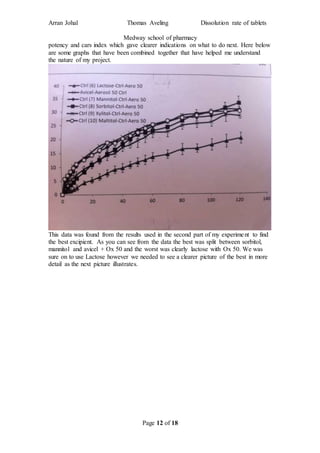
potency and cars index which gave clearer indications on what to do next. Here below
are some graphs that have been combined together that have helped me understand
the nature of my project.
This data was found from the results used in the second part of my experiment to find
the best excipient. As you can see from the data the best was split between sorbitol,
mannitol and avicel + Ox 50 and the worst was clearly lactose with Ox 50. We was
sure on to use Lactose however we needed to see a clearer picture of the best in more
detail as the next picture illustrates.
Arran Johal Thomas Aveling Dissolution rate of tablets
Medway school of pharmacy
Page 13 of 18
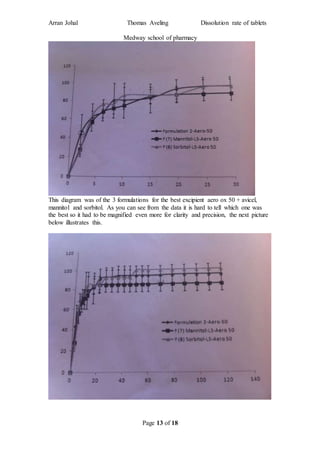
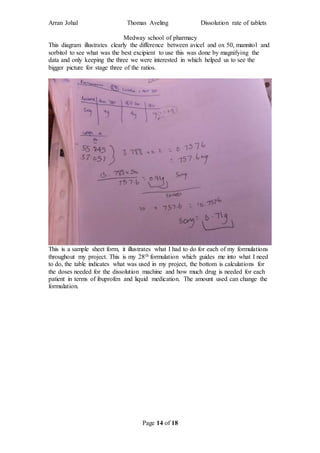
This diagram was of the 3 formulations for the best excipient aero ox 50 + avicel,
mannitol and sorbitol. As you can see from the data it is hard to tell which one was
the best so it had to be magnified even more for clarity and precision, the next picture
below illustrates this.
Arran Johal Thomas Aveling Dissolution rate of tablets
Medway school of pharmacy
Page 14 of 18
This diagram illustrates clearly the difference between avicel and ox 50, mannitol and
sorbitol to see what was the best excipient to use this was done by magnifying the
data and only keeping the three we were interested in which helped us to see the
bigger picture for stage three of the ratios.
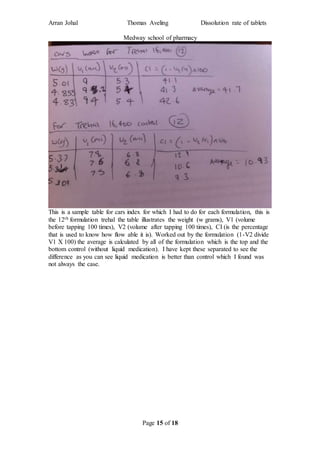
This is a sample sheet form, it illustrates what I had to do for each of my formulations
throughout my project. This is my 28th formulation which guides me into what I need
to do, the table indicates what was used in my project, the bottom is calculations for
the doses needed for the dissolution machine and how much drug is needed for each
patient in terms of ibuprofen and liquid medication. The amount used can change the
formulation.
Arran Johal Thomas Aveling Dissolution rate of tablets
Medway school of pharmacy
Page 15 of 18
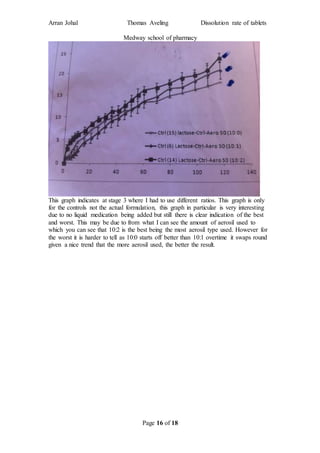
This is a sample table for cars index for which I had to do for each formulation, this is
the 12th formulation trehal the table illustrates the weight (w grams), V1 (volume
before tapping 100 times), V2 (volume after tapping 100 times), CI (is the percentage
that is used to know how flow able it is). Worked out by the formulation (1-V2 divide
V1 X 100) the average is calculated by all of the formulation which is the top and the
bottom control (without liquid medication). I have kept these separated to see the
difference as you can see liquid medication is better than control which I found was
not always the case.
Arran Johal Thomas Aveling Dissolution rate of tablets
Medway school of pharmacy
Page 16 of 18
This graph indicates at stage 3 where I had to use different ratios. This graph is only
for the controls not the actual formulation, this graph in particular is very interesting
due to no liquid medication being added but still there is clear indication of the best
and worst. This may be due to from what I can see the amount of aerosil used to
which you can see that 10:2 is the best being the most aerosil type used. However for
the worst it is harder to tell as 10:0 starts off better than 10:1 overtime it swaps round
given a nice trend that the more aerosil used, the better the result.
Arran Johal Thomas Aveling Dissolution rate of tablets
Medway school of pharmacy
Page 17 of 18
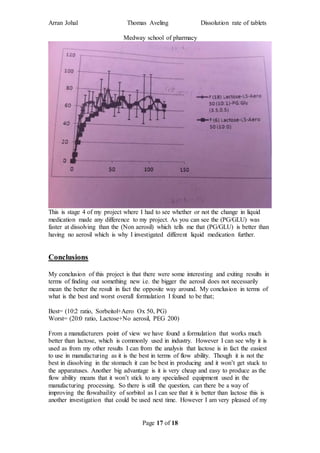
This is stage 4 of my project where I had to see whether or not the change in liquid
medication made any difference to my project. As you can see the (PG/GLU) was
faster at dissolving than the (Non aerosil) which tells me that (PG/GLU) is better than
having no aerosil which is why I investigated different liquid medication further.
Conclusions
My conclusion of this project is that there were some interesting and exiting results in
terms of finding out something new i.e. the bigger the aerosil does not necessarily
mean the better the result in fact the opposite way around. My conclusion in terms of
what is the best and worst overall formulation I found to be that;
Best= (10:2 ratio, Sorbeitol+Aero Ox 50, PG)
Worst= (20:0 ratio, Lactose+No aerosil, PEG 200)
From a manufacturers point of view we have found a formulation that works much
better than lactose, which is commonly used in industry. However I can see why it is
used as from my other results I can from the analysis that lactose is in fact the easiest
to use in manufacturing as it is the best in terms of flow ability. Though it is not the
best in dissolving in the stomach it can be best in producing and it won’t get stuck to
the apparatuses. Another big advantage is it is very cheap and easy to produce as the
flow ability means that it won’t stick to any specialised equipment used in the
manufacturing processing. So there is still the question, can there be a way of
improving the flowabaility of sorbitol as I can see that it is better than lactose this is
another investigation that could be used next time. However I am very pleased of my
Arran Johal Thomas Aveling Dissolution rate of tablets
Medway school of pharmacy
Page 18 of 18
work and what I have achieved, working up front and carrying out my own research
was pleasing, very hard but rewarding to see good results in the end.
There are good results found here which at first was unexpected and never thought of
but it all lead towards the end point of discovering something new in research which
is what all researchers want to do, find something new.
Evaluation
An evaluation for this project is definitely for someone else to look into the flow
ability and investigate further micro-scopic formulations to see what is the best. I have
conducted research independently to see what formulations I can conduct in an order
to find the best and worst.
I have conducted research into powders however questions into other type of
production such as tablets and capsules can be looked into to see any difference to my
project as it can make a difference to the overall project in terms of what to find out.
I would recommend if this work was to be done differently maybe in a bigger team
where others can share views and opinions on what to do next as in industry, it has to
be done in a group decisions. This allows others to decide whether or not to carry out
other excipients or test other liquid medication to see whether it can be absorbed In
anyways better i.e. instead of liquid if there are any powder forms that could
potentially be used to make medicines. I believe the way I carried out my research
was important for gaining skills that I have already obtained and now needing to
develop them skills in the practical life to which, I believe this project has done for
me.
My results were good I found the best and worst type of coating material, the best and
worst type of carrier, the best and worst type of ratio and the best and worst liquid
medication. All this together helped me make a successful project with good
intentions and support from the staff who made this experience possible. Thanks to
those who made my time there most useful, the skills I have gained will go a long way
in whichever career path I take.

Report for nuffield research

  • 1.
    Arran Johal ThomasAveling Dissolution rate of tablets Medway school of pharmacy Page 1 of 18 Report Personal statement Applying for the Nuffield research placement helped me gain confidence in my ambition in life and follow my path I want to go down that or a similar route. I was fortunate to receive a placement in pharmacy at the Medway school of pharmacy which was a massive opportunity for me to explore my path I have chosen, now completing the placement I have now learnt a lot more with great hands on experience thanks to Nuffield, which I am very thankful to the co-ordinator for organising this for me. I feel I have gained a lot of experience in the field and I feel that myself have gained self-confidence and great interpersonal skills. I felt the work placement was interesting and engaging as the placement itself was a different source of pharmacy that I did not know much about which was clarified by a student from the pharmacy who assisted me in my project, the research undertaken was part of technical research in pharmacy which includes being very hands on with the work on hand and learning through doing practical’s to which I have done, I learnt specifically with this research that the main aim is to gather lots of data into dissolution of tablets when using different factors and how this affects the percentage (%) rate in a given time. I learnt about different complex apparatus that I had never come across before and was very intrigued by the physicality of them, I enjoyed carrying out the practicals although at many of times the practicals were the same with minimal change to the procedures the work did become repetitive. I didn’t at first know the exact nature of the experiment and how we could conclude such results therefore I feel maybe a little more discussions would of made the project more understandable, as I have never carried out anything into pharmacy before and I felt lots of pressure to just deliver results on just beginning. Therefore this made my first couple of days very hard to cope however as time progressed I understood the project a little more with more practise.
  • 2.
    Arran Johal ThomasAveling Dissolution rate of tablets Medway school of pharmacy Page 2 of 18 Index # Page Name 1 Personal statement 2 Index/Introduction 3 Methodology 4 5 1st part of project 6 2nd part of project 7 8 USP & Cars Index 9 3rd part of project 10 4th part of project 11 Control and Results/discussions 12 Results/discussions 13 14 15 16 17 Conclusion 18 Evaluation Introduction We set out to find how to improve the poorly solubility present in absorbent drug, we found out to achieving this that the rate of oral absorption is controlled by the dissolution rate in the gastrointestinal. The poor dissolution rate of water-insoluble drugs is a major problem in the pharmaceutical industry, we set out to try and solve this problem using a technique called liquisolid which currently is a good prospect to achieving the desired solubility in drugs. We used different variations to keep on improving the dissolution we used 4 main variations; 1.) Changed different surface areas 2.) Changed different excipients 3.) Changed different ratios 4.) Changed different co-solvents In addition we used different ratios of carrier to coating materials to see what is the best ratio to use with combination of liquisolid formulations containing the fixed drug ibuprofen into the simulated gastric fluid (PH 1.2 at 37’C) the drug variation was from (20% to 25%) which was prepared.
  • 3.
    Arran Johal ThomasAveling Dissolution rate of tablets Medway school of pharmacy Page 3 of 18 Methodology We used the technique of liquisolid this involved using the term “liquid medication “ which essentially is the drug with a combination of powder form in what is known as bulk material, the bulk material does play a part in the dissolution rate. The term liquid medication means an oily liquid drug which is prepared in a formulation which in-turn can then be transferred into a free flowing, compressible powder. In the process of using the bulk material we used selected powder excipients (carrier) and the commonly used coating material (aerosil), which was used in the process of making the powder which is a new promising technique. This is undergoing many tests to see whether this method can be good for determining an successful dissolution with optimum dissolution rate, this was part of my overall aim finding the best ways of achieving an increase in dissolution rate using different formulations with bulk and liquid medication. Once converted into a powder form a dissolution test was runned for a period of 2 hours per dissolution, the dissolution took up to 6 powder intake per container which meant that I could test each formulation 6 times each to ensure I had valid and reliable data. In the process of making the liqusolid powder, I started to make the various powder with some practice of the various apparatus I had to use to get the logic and theory behind what I am doing to ensure I knew the true purpose of the dissolution process. In addition to this I used various analysis apparatus to make sure that my results again were reliable and valid not just in the digestive system but also what it would be like to use in a wide industry for manufacturers to produce my formulation. In the process of the formulation making I had to first gather a suitable carrier and coating material. Which was going to be used as my bulk for the formulation to ensure that the drug would more suitably dissolve in the digestive system. This should not have an effect to the patient, once both material were collected with a given ratio i.e. 20g of carrier material : 2g of coating material. I had to measure each material using a measuring balance, which I used for measuring out anything in grams. Before use I had to tear it to (0) in which I used a weighing boat to measure everything in powder form. this made it easier to measuring in the balance which was one of two used in the process. I had to use the other measuring balance which measured in milligrams (mg) which came in handy for using the drug formulation (commonly measured in mg). Once I had placed both materials into a suitable sized container, I had to use the next piece of apparatus called a large blending machine this ensured the bulk material both in powder form were mixed together very well, to make the best powder possible. The standard time for blending was 10 minutes per cycle. At this moment when using the blender I used my time effectively to go to the next stage which was obtaining a beaker with a automatic stirring tablet. This was a better form of using for mixing the pure drug, the constant drug I used throughout the whole experiment was ibuprofen in its pure form. I placed the beaker onto the measuring balance to which I had to weigh out a certain amount of what is known to be a co-solvent which was used to dissolve the drug to create a liquid medication. On my first variation I used a 4g co-solvent known by the name of Poly (ethene) Glycol in which I used an accurate pipette to
  • 4.
    Arran Johal ThomasAveling Dissolution rate of tablets Medway school of pharmacy Page 4 of 18 measure this out into the beaker. Once I had done this I used an automatic stirrer tablet to stir the liquid with the drug ibuprofen to which I also weighed out a certain amount i.e. 1g ibuprofen. The automatic stirrer rotated according to a rotor to which I could set at a fixed rate, once the entire drug had dissolved into the liquid “liquid medication” had formed in the beaker it turned out to be colourless all the time. Once the colourless liquid medication had been formed, I used my bulk material (coating matieral and carrier) and weighed out a certain balanced proportion typically 10g, I placed the 10g into my next apparatus called the mortal and pestle which I used to manually blend the liquid medication with the bulk material. This point was crucial for the main purpose of the dissolution to try and obtain the highest amount of the drug formed in the liquid medication with bulk material, I had to manually get the portions just right which is why I used an accurate pipette to measure out an accurate amount of the drug to the powder. I weighed out the liquid medication before and after use in the bulk material to know how much drug I have used at this point. I had to be extremely careful on how much I used as if I added to much I would face a powder that does not flow and has extremely sticky material property which was no longer a powder. If I added not so much I realise I could have added more liquid medication to gain the best optimal drug percentage to use in a calculation. In theory the more drug the powder can absorb the better the bulk material is therefore more suitable for the dissolution test as having the most drug percentage is key to knowing how much drug the bulk material can absorb meaning it is more suitable purposed for the dissolution apparatus. In addition to making the formulation I had to weigh out a control, what this comprised was the bulk material (carrier + coating material) with a known amount of pure drug (Ibuprofen) which was blended together using the machine. I had to obtain the correct amount of drug according to the amount of liquid medication I had used for the liquid medication as the control will contain no liquid medication just the pure drug. The amount of drug will vary depending on what variation I used therefore being accurate is crucial which is why I used a balance that used milligrams instead of grams for accuracy. Once the formulation and the control were finished blending my next job was to carry out further calculations to known how much grams I had to weigh of each liquid medication and control in order to deliver the correct doses into the machine. This mimicked the human body’s digestive system which Is why the machine was set to 37’C (36.5’C minuim) before the test was started in which I had to wait each time for it to heat up when I refilled the machines vessels manually, while doing this I had to make sure that the machines apparatus were clean and that no drug was left over from the previous sample. This is where I used methanol which I used to clean out the stirring rods and then clean the filters in which pumped my sample to be read by the machine, as a safety precaution safety gloves were worn at this procedure to ensure that no methanol irritated the skin. When they had been cleaned I then had to wait until they dried and then use a clean tissue paper to wipe them so that they would not affect my results in which more time had to be spent to ensure that the machine was in working condition and that the standard procedures were met.
  • 5.
    Arran Johal ThomasAveling Dissolution rate of tablets Medway school of pharmacy Page 5 of 18 Once the doses were weighed and the machine had been cleaned I then had to place he doses on top of the machine ready to be dropped but before that can happen the machine had to run some tests to ensure that there were no communication failures. This would disrupt the process to which the filters had to run a few tests to see whether the machine could pick up an average reading of zero from each vessel. This ensured they were working, this was completed by sample pumping the machine. This had to be done approaxmaitly three times before dissolution could take place, once they read a reading of roughly zero the machine was ready to take the doses and run the dissolution. I had to drop the doses into a hole which had a platform with a lever in which had to be forced in to initiate the drop. Once this happened the dissolution was ready, the rods stirred the powder for 2 hours in each of the six vessels which were labelled 1-6 (with 1-3 being liquid medication & 3-6 being the control). Every 2 minutes the samples were read by the filters which picked the readings up and sent them to the machine which plotted a curved graphed to which was analysed later. To seek further trends these dots on the graph represented how fast the drug was being dissolved in a specified time therefore the quicker the drug was dissolved the better the performance the better the dissolution. I had come across repeating the methodology for over 30 times with control and formulation both being at the forefront of what I had to prepare, I used different formulations each time with different variations to gain the best dissolution to which at the end I had compared each of the best and worst to make comparisons with each other. This helped me to know what was best at dissolving and other things like which made the best tablet, flow ability for manufacturing, what was the highest amount of drug/liquid medication the bulk materials could absorb etc. In my 1st few days of work experience and after a few practices of the machinery and how it all works and comes together with the help of the doctor and student I was ready to carry out my project. I started to understand at this point my main purpose for the project and what I had set out to achieve. I had good practices skills from before during my a level with my chemistry however some of the equipment I had to use where very different and more technical than what I had come across before. Therefore I made sure in the 1st few days that I had some practice and any difficult were accomplished before moving onto the project. 1.) Change of coating material My 1st part of the project was to set out the investigation into the bulk material itself (at this investigation it was the type of coating material I was using) the coating material I was asked to carry out was the compound aerosil (also known as fume silica product). There are many forms and types of aerosil with specific numbering to know the different sizes and the molecular weight of the sample itself. The coating material was my 1st investigation which was going to be with the constant carrier avicel with a simple ratio of 10:1 (11g) in total. While I was investigating the aerosil the doctor had told me about the different types of aerosil in which they come in different pharmacopeia standards (regulation board for the pharmaceutical industry) and that the results I was going to be investigating will be very important towards the end. The aerosil I was investigating was ranging from 50 to 380 they included with different grade:-
  • 6.
    Arran Johal ThomasAveling Dissolution rate of tablets Medway school of pharmacy Page 6 of 18 - Ox 50 - 130 - 200 - 300 - 380 Each procedure was repeated using the same methodology, I encountered a problem with using these variations and that was will there be enough, this was encountered during my blending process to which I had to add 10g to the mortal and pestle and then add liquid medication I realised I did not have enough for the control. I kept the same constant ratio 10:1 each time so I doubled them making it 20g of avicel to 2g of aerosil making it still the ratio (10:1). Once the ratio was correct I used the 1st carrier HPMC this carrier was used when I started to mix in the blender and once I weighed the correct proportion. I then used the mortal and pestle to which with the aerosil my next problem was encountered by the HPMC and aerosil. In the mortal and pestle manually blended with liquid medication bit by bit, the HPMC didn’t seem to absorb much of the liquid medication which means it is not a good absorbent one minute later the powder turned into a big ball of dough. I then had to go back to the plan and realise what to do next, we tried a different carrier which was called avicel, we then used this and it seemed to mix together with the aerosil very well. So we decided to use this as a constant. Once the aerosil and ratio and carrier was correct we then planned out how to test our project this was set to stick with the plan in finding the best aersosil type. We had our first formulation with aerosil 200 we then set out to test this with a machine called the dissolution machine what this tells us is how fast the powder will dissolve in the stomach/digestive system then I used the constant drug which was fixed at 50mg of the drug. The reason for this was that we did not want to overdose the machine which mimicked the body so precision was key. The machine pumped the solution every 2 minutes and recorded the data onto the graph, the data showed whether or not the solution had been dissolved or dissolving this created a graph using the numbers however it had to be interpreted later on. Our first dissolution was going well we obtained interesting results to which we wanted to carry out further. We carried out 4 more aerosil types with the same avicel, we wanted to find the best and worst dissolution to which we had to interrupt from the data. Once this had been obtained we then had to move on to our next set of testing’s. 2.)Change of Excipient Once the best and worst had been obtained the second testing was carried out using the same procedures however we found a trend in the data showing that consistently a clear curve of highest to lowest was obtained. We found that the biggest surface area showed the worst performance in terms of dissolution and the smallest the best so what we did was carried out mostly the smallest surface area which was ox 50 to our next set of testing’s. Our next step was simple find the best excipient (carrier) to go with the ox 50. In total we tested 9 different excipients including the avicel in total
  • 7.
    Arran Johal ThomasAveling Dissolution rate of tablets Medway school of pharmacy Page 7 of 18 using the same procedures which was blend, manually mix and weighing out the doses. We collected a number of different excipients which came to 9 to which we kept all ratios constant (20g of carrier to 2g of coating material), the list of carriers was: -avicel -Lactose -Mannitol -Sorbitol -Xylisorb -Dextrose -Ttrehalose 1200 -Sucrose -glucosamine These carriers were selected and we wanted to carry out these procedures using everything constant to keep our results fair and reliable also to make everything clear and precise regarding our findings. All of these carriers had different properties as being incredibly smooth when manually mixing our incredibly tough. This factor is very important as it usually tells you how it should behave in the dissolution machine. As each property was different we needed to be careful not to add to much liquid medication or otherwise It won’t dissolve very much and it won’t be very good in terms of our results. As finding how much liquid medication it can hold and stopping at that point this was when the powder form had changed into a puffy powder form which was the end point. Theoretically the more liquid medication absorbed by the excipient means it is better, this was due to each one of them having different water solubility with different hydroscopic levels. This gives different results due to the different sizes of the particles therefore in terms of comparison it made it easier to know what is best and what is not. A problem was encountered which we was highlighted in our results as ox 50 showed fantastic results the best of them all with dramatic peaks compared to the rest. What the doctor realised that the pump sample initially may have been altered but we found out in fact that there were no filters to pump the sample through towards the machine instead just molecules passed through the sample inlet. So we wanted to repeat the tests with filters to see how to carry out the next lot of carriers whether or not to use filters so we repeated the ox 50 only. We weighed out the doses again, then washed and refilled the beakers and carried out the procedures again this time with filters. What we had found was that the filters did affect the rate of the peak which came out to be less higher then without filters. Which meant there must have been a previous sample that interacted with our sample which gave way to the large jump. So we wanted to find realistic results so we swapped to using the filters which still gave a trend just less jump to which we decided to carry out as they were fairer. We initially wanted to carry out the procedure just to see what is the best however as there were lots of excipients to test we wanted to see the best and worst, as we did everything the same it made it that easier to say what was the best and worst so that is
  • 8.
    Arran Johal ThomasAveling Dissolution rate of tablets Medway school of pharmacy Page 8 of 18 what we did. We found that the best was sorbitol and the worst was lactose which was very good for us as I was told by the PHD student that lactose is used in manufacturing due to its favourable property’s. However we saw that sorbitol was the best so we wondered why do they use lactose. So at this stage we wanted to purely test these two to find out first why and can we change manufacturers to undertake tests into sorbitol as we found it to be the best so we wanted to conduct further trials to justify our findings. Before conducting further trials on just sorbitol and lactose we wanted to find out why they use lactose in manufacturing for it being the worst but claimed to have good properties. When it doesn’t dissolve as fast as sorbitol which is the main aim in finding the best dissolution for poor insoluble drugs. So what we did was used some analysis on all of our formulations to make sure they are accurate; The Different types of analysis that had to be done for each formulation are:- Ultra spectrophotometer (USP) ultraviolet-visible spectrophotometry (UV-Vis or UV/Vis) refers to absorption spectroscopy or reflectance spectroscopy in the ultraviolet-visible spectral region, This means it uses light in the visible and adjacent (near-UV and near-infrared (NIR)) ranges. The absorption or reflectance in the visible range directly affects the perceived colour of the chemicals involved. In this region of the electromagnetic spectrum, molecules undergo electronic transitions. Absorption spectroscopy refers to spectroscopic techniques that measure the absorption of radiation, as a function of frequency or wavelength, due to its interaction with a sample. The sample absorbs energy, i.e., photons, from the radiating field. The intensity of the absorption varies as a function of frequency, and this variation is the absorption spectrum. Absorption spectroscopy is performed across the electromagnetic spectrum. What it means is how much of the powder sample can dissolved in its highest percentage of drug, usually using a liquid to dissolve in such as methanol (safety precaution being that I had to use gloves as it is corrosive) which is very strong and pure this should correspond to the highest percentage of the dissolution machine this analysis tells you whether the results recorded are correct or not as for all of the expcients are different and absorb different amounts of liquid medication it should be shown on the data fdorm the absoprancbe rate number being higher or lower. The (USP) gives an absoprnace reading which is known as the potency (how much it can dissolve altogether) these readings was varied from lactose to sorbitol which had to be more discovered by using these two in different situations i.e. different liquid medication compared to the original can give a better spread of data. http://en.wikipedia.org/wiki/Ultraviolet%E2%80%93visible_spectroscopy some content of this source was used from wikipedia Cars Index This measures the flow of the powder including when liquids are added to stop the flow, what flow essentially means is how it enables the powder normally within manufacturing flows within the inisturstments it is used to make it, it can also mean
  • 9.
    Arran Johal ThomasAveling Dissolution rate of tablets Medway school of pharmacy Page 9 of 18 how well it flows within the body and how good it is during time in the digestive system how well it flows through the bloodstream etc. in this case using liquid medication you would expect the more liquid medication the worse the flow ability however it doesn’t mean it is best for manufacturing it just means it is harder to produce on a large scale. It Is tested by using a simple measuring cylinder (10ml) then weighing it and then make it to zero and add the powder till it reaches the 10 ml if not enough powder as much as possible then record the number and tap the measuring cylinder with the powder under something tough e.g. books for approx. 100 times and then stop then record the number received it should work out that the lower it goes the better the flowbaility of the powder as the percentage will be higher. I had to do this for all of my formulations; it should be that the more liquid medication the worse the flow ability however as the properties of the expuepents are all different therefore different results will be obtained. When the results came through the results came out reasonably well as the flow ability for lactose was the highest of them all due to the liquid medication absorbed being low. But the properties of lactose being in the industry scale being large means it can adapt to larger scales as its percentage of flow ability is high. Sorbitol on the other hand was the lowest of them all which was very interesting to know as it was the highest at absorbing liquid medication therefore on a larger manufacturing lactose would have the upper hand. However if in industry they had found a way to resolve this problem then sorbitol would be better as it absorb the most liquid medication and it can dissolve better from the data of the dissolution machine. 3.)Change of Ratios The next testing’s I carried out was found from finding the best and worst excipient which we found out to be sorbitol and lactose. So we then carried out further testing’s purely using these results for the manufacturing reasoning to which we found very interesting to discover. The next part was the ratio’s to which before were kept constant to be fair and reliable, now knowing the results our next step was to try different ratios using the best and worst excipient. In addition to this we used the best and worst aerosil to give better spread of data, we mainly wanted to see the different ratios which includes; - (10:1) 20g of carrier (sorbitol or lactose) + 2g of aerosil (Ox 50 or 380) - (5:1) 20g of carrier (sorbitol or lactose) + 4g of aerosil (ox 50 or 380) - (20:0) 20g of carrier with no aerosil We wanted to find out for the next step whether or not the change in ratio would make a difference. This includes not using aerosil and using best and worst aerosil to see if there would be a trend. We were doing the same procedure in terms of mixture and weighing the constant 50mg for patients also the same thing we did was using the same amount of drug which was 20%. Using the best and worst excipient helps us make justification and why this may be, using different ratios helps us make trends. This constant best and worst idea is very good for us to compare the sets of data and see any trends which are good for justifying.
  • 10.
    Arran Johal ThomasAveling Dissolution rate of tablets Medway school of pharmacy Page 10 of 18 What we found out is that there was a trend by using the amount of aerosil and that was due to the amount of liquid medication from the bulk dramatically decreased. As for the no aerosil type the material could not absorb much of the liquid medication this was both for sorbitol and lactose. There was another trend that was the aerosil changed the dissolution. This was a surprise as using none of it gave poor results and having more of it gave better results which was very interesting. This trend helped us realise the next step will be important as we again found the best and worst ratios, it seemed to all come together as a whole collection. The best being the (5:1) ratio and the worst being the (20:0) ratio this was found for both lactose and sorbitol which was good to know for creating a good set of results. 4.)Change of Liquid medication The final and most important stage was finding the best liquid medication essentially the drug in liquid form finding its best with the constant ibuprofen also trying to finding ways of optimising the amount of drug used. Again using the best and worst form the previous set of results which was sorbitol and lactose with the best and worst ratio (20:0 and 5:1) also the best and worst aerosil type (Ox 50 and 380) so our aim was clear to try and find the best and worst liquid medication. We tested a range of different liquid medication; -Propylene glycol (PG) -Propyl (ethane) glycol 200 (PEG 200) -Glycerol -Mix of both (Glycerol/PG) -Mix of both (PEG 200/PG) As we started with the constant liquid medication which was (PG) we wanted to start a different one using the exact same method to be reliable as we had our sets of results but we wanted to find the best at optimising the drug. The PHD student said that we should try Glycerol as he had tried this before and it seemed to give good results so we started with that we tried the exact same procedures using sorbitol and lactose. At first the glycerol itself was very gloopy and I tried to use the pipette to get it out but it was getting stuck to the gooey liquid. Instead I manually poured it into the beaker as this was easier once 4g was measured out I then went to add in a tiny bit of ibupfen (100mg) approx less than 5% did not dissolve and it got stuck in the solution. Then we decided to use a ratio of (50:50) of glycerol and PG which should be better at dissolving so I decided to do this however I tried this it was better but not good as it only dissolved 50% of the drug (1g of ibuprofen) which again had to be discarded. I did not give up and persisted to try a different way and that was use a higher percentage of PG (3g of PG to 1g of Glycerol) as before it seemed to be better so that is why I decided to use it. Thankfully it worked so I had a result from glycerol this was for both sorbitol and lactose even though it was much harder and longer to dissolve compared to the standard PG. It was difficult but after time gradually passing it managed to dissolve. After finding success with (3g to 1g) we tried (3.5g to 0.5g) which again was a good success less than the first but again it took time for it to dissolve I realised how just a little bit can make a big difference to which I learnt.
  • 11.
    Arran Johal ThomasAveling Dissolution rate of tablets Medway school of pharmacy Page 11 of 18 The next was PEG 200 which seemed to be promising for both sorbitol and lactose so I decided to use it by itself. As I wanted to incorporate the best and worst procedure I decided to incorporate the (ratios and aerosil types) so for PEG 200 I wanted to make sure the theme carried on. The reason is, to show how after so many procedures it has all come together and keeping the methodology the exact same. So I started optimising the liquid medications much that I could use a little more drug to see what would happen. So starting with lactose and sorbitol I used aerosil 380 and 20:0 ratio with PEG 200 I tried the constant drug first to see whether or not more drug could be added for next time. I found out that maybe a little more drug could be added to the bulk as it was still a little powdery so I did so, for this formulation which was sorbitol + aerosil ox 50 + Peg 200 (it came to 272.6 mg more drug, this demonstrates how I have been careful and found a way of optimising the drug) this was a great success for me as optimising the drug is a very hard skill. The results seemed good for Peg 200 but not as good as PG so then we decided to do another mixture. Which was PEG 200 50% with PG 50% to see what would happen, this time I could not optimise the drug much but I still tried and got 96 mg. The result being it was still good but not as good as just PG which was interesting to know the impact of two mixtures affecting the overall result. Control For all of these formulations we prepared controls which meant no liquid medication just the pure carrier with aerosil (coating material) with pure drug ibuprofen. As they vary dependant on the use of liquid medication for each formulation. I had to use a numerous amount of calculation to obtain an optimal amount of the drug to use for every mimicked patient (50 mg). This was a hard and crucial step to get right and at the start during the practice I came to the understanding of why I am doing this and how this can benefit me in my understanding. As I was both told by the doctor and the PhD student the best way of learning is by doing it for yourself so my first formulation calculation I had help with the res, I had to do on my own which involved other skills such as maths. This was a new way of learning for me but after a few days and a few trials I understood how to use the liqusoilid process and gain the correct amount of drug needed for the control. The control gave some interesting results between all of my formulations to which was good to try out as I had to prepare 3 samples each of both the formulation itself and 3 samples of control to gain accuracy and any wrong readings can be distributed across the range. This did take a lot of time but with some patience I found in my results it helped clarify things better for me. Results & discussions As I have done a lot of formulations I have had to combine these together for a little summary indicated by graphs, I have been helped doing this by the PHD student who while I was working helped me bring it together. This helped me to know what direction should I go down next each week. Once the information via the data had been received it was easier to know what to do next this includes the formulation,
  • 12.
    Arran Johal ThomasAveling Dissolution rate of tablets Medway school of pharmacy Page 12 of 18 potency and cars index which gave clearer indications on what to do next. Here below are some graphs that have been combined together that have helped me understand the nature of my project. This data was found from the results used in the second part of my experiment to find the best excipient. As you can see from the data the best was split between sorbitol, mannitol and avicel + Ox 50 and the worst was clearly lactose with Ox 50. We was sure on to use Lactose however we needed to see a clearer picture of the best in more detail as the next picture illustrates.
  • 13.
    Arran Johal ThomasAveling Dissolution rate of tablets Medway school of pharmacy Page 13 of 18 This diagram was of the 3 formulations for the best excipient aero ox 50 + avicel, mannitol and sorbitol. As you can see from the data it is hard to tell which one was the best so it had to be magnified even more for clarity and precision, the next picture below illustrates this.
  • 14.
    Arran Johal ThomasAveling Dissolution rate of tablets Medway school of pharmacy Page 14 of 18 This diagram illustrates clearly the difference between avicel and ox 50, mannitol and sorbitol to see what was the best excipient to use this was done by magnifying the data and only keeping the three we were interested in which helped us to see the bigger picture for stage three of the ratios. This is a sample sheet form, it illustrates what I had to do for each of my formulations throughout my project. This is my 28th formulation which guides me into what I need to do, the table indicates what was used in my project, the bottom is calculations for the doses needed for the dissolution machine and how much drug is needed for each patient in terms of ibuprofen and liquid medication. The amount used can change the formulation.
  • 15.
    Arran Johal ThomasAveling Dissolution rate of tablets Medway school of pharmacy Page 15 of 18 This is a sample table for cars index for which I had to do for each formulation, this is the 12th formulation trehal the table illustrates the weight (w grams), V1 (volume before tapping 100 times), V2 (volume after tapping 100 times), CI (is the percentage that is used to know how flow able it is). Worked out by the formulation (1-V2 divide V1 X 100) the average is calculated by all of the formulation which is the top and the bottom control (without liquid medication). I have kept these separated to see the difference as you can see liquid medication is better than control which I found was not always the case.
  • 16.
    Arran Johal ThomasAveling Dissolution rate of tablets Medway school of pharmacy Page 16 of 18 This graph indicates at stage 3 where I had to use different ratios. This graph is only for the controls not the actual formulation, this graph in particular is very interesting due to no liquid medication being added but still there is clear indication of the best and worst. This may be due to from what I can see the amount of aerosil used to which you can see that 10:2 is the best being the most aerosil type used. However for the worst it is harder to tell as 10:0 starts off better than 10:1 overtime it swaps round given a nice trend that the more aerosil used, the better the result.
  • 17.
    Arran Johal ThomasAveling Dissolution rate of tablets Medway school of pharmacy Page 17 of 18 This is stage 4 of my project where I had to see whether or not the change in liquid medication made any difference to my project. As you can see the (PG/GLU) was faster at dissolving than the (Non aerosil) which tells me that (PG/GLU) is better than having no aerosil which is why I investigated different liquid medication further. Conclusions My conclusion of this project is that there were some interesting and exiting results in terms of finding out something new i.e. the bigger the aerosil does not necessarily mean the better the result in fact the opposite way around. My conclusion in terms of what is the best and worst overall formulation I found to be that; Best= (10:2 ratio, Sorbeitol+Aero Ox 50, PG) Worst= (20:0 ratio, Lactose+No aerosil, PEG 200) From a manufacturers point of view we have found a formulation that works much better than lactose, which is commonly used in industry. However I can see why it is used as from my other results I can from the analysis that lactose is in fact the easiest to use in manufacturing as it is the best in terms of flow ability. Though it is not the best in dissolving in the stomach it can be best in producing and it won’t get stuck to the apparatuses. Another big advantage is it is very cheap and easy to produce as the flow ability means that it won’t stick to any specialised equipment used in the manufacturing processing. So there is still the question, can there be a way of improving the flowabaility of sorbitol as I can see that it is better than lactose this is another investigation that could be used next time. However I am very pleased of my
  • 18.
    Arran Johal ThomasAveling Dissolution rate of tablets Medway school of pharmacy Page 18 of 18 work and what I have achieved, working up front and carrying out my own research was pleasing, very hard but rewarding to see good results in the end. There are good results found here which at first was unexpected and never thought of but it all lead towards the end point of discovering something new in research which is what all researchers want to do, find something new. Evaluation An evaluation for this project is definitely for someone else to look into the flow ability and investigate further micro-scopic formulations to see what is the best. I have conducted research independently to see what formulations I can conduct in an order to find the best and worst. I have conducted research into powders however questions into other type of production such as tablets and capsules can be looked into to see any difference to my project as it can make a difference to the overall project in terms of what to find out. I would recommend if this work was to be done differently maybe in a bigger team where others can share views and opinions on what to do next as in industry, it has to be done in a group decisions. This allows others to decide whether or not to carry out other excipients or test other liquid medication to see whether it can be absorbed In anyways better i.e. instead of liquid if there are any powder forms that could potentially be used to make medicines. I believe the way I carried out my research was important for gaining skills that I have already obtained and now needing to develop them skills in the practical life to which, I believe this project has done for me. My results were good I found the best and worst type of coating material, the best and worst type of carrier, the best and worst type of ratio and the best and worst liquid medication. All this together helped me make a successful project with good intentions and support from the staff who made this experience possible. Thanks to those who made my time there most useful, the skills I have gained will go a long way in whichever career path I take.