REPORT


AN ANALYSIS OF STAFF
  TURNOVER AT THE
   TROPICAL VIEW
INTERNATIONAL HOTEL


IMPACT ON EFFICIENCY
ACKNOWLEDGEMENT


I am very grateful Mrs. Nikunj Agarwal for giving me the opportunity of working in this
project and give me useful instruction .


I extend my regards and sincere thanks to Dr. Taruna Gautam with who support &
effort, I completed my project.
Also I am thankful to the management and my fellow colleges for making my project
duration a memorable and fruitful one.
CONTENTS


1. Introduction

      •Need of the study

      •Scope of the study

2. Research methodology

      •Objective of the study

      •Research methodology (Sample size, Instrument used, Methods of data

      collection)

      •Scope of the study

      •limitations

6. Descriptive work

7. Data Analysis

8. Suggestion and Conclusions

9. Bibliography

10. References

11.Appendices

12. Checklist of the items in the project
CHAPTER ONE


 1.0    Introduction – Introductory Remarks

  ABSTRACT

  Employee retention is a process in which the employees are encouraged to remain with
  the organization for the maximum period of time or until the completion of the project.
Employee retention is beneficial for the organization as well as the employee.
  Employees today are different. They are not the ones who don’t have good opportunities
  in hand. As soon as they feel dissatisfied with the current employer or the job, they
  switch over to the next job. It is the responsibility of the employer to retain their best
  employees. If they don’t, they would be left with no good employees. A good employer
  should know how to attract and retain its employees. ost employees feel that they are
  worth more than they are actually paid. There is a natural disparity between what people
  think they should be paid and whatorganizations spend in compensation. When the
  difference becomes too great and another opportunity occurs, turnover can result. Pay is
  defined as the wages, salary, or compensation given to an employee in exchange for
  services the employee performs for the organization. Pay is more than "dollars and
  cents;" it also acknowledges the worth and value of the human contribution. What people
  are paid has been shown to have a clear, reliable impact on turnover in numerous
  studies. Employees comprise the most vital assets of the company. In a work place
  where employees are not able to use their full potential and not heard and valued, they
  are likely to leave because of stress and frustration. In a transparent environment while
  employees get a sense of achievement and belongingness from a healthy work
  environment, the company is benefited with a stronger, reliable work-force harbouring
  bright new ideas for its growth Blog Online And Earn Money.


 1.2     Background of the Problem


 1.3     Statement of the Problem


 1.4    Purpose of the Research
 1.5   Research question/Hypothesis


 1.6   Statement of objectives of the Research


 1.7   Significance of the Study


 1.8   Assumption


 1.9   Limitations
CHAPTER TWO


 2.0         Background
                 Literature Review


                 Definition of Terms


                      CHAPTER THREE


 3.0         Methodology


        o Restate purpose & Research Question(s) &/or null Hypothesis


        o Define the population & sampling method(s)
o Instrumentation (include copy in appendix)


        o Procedure & Time Frame


                      CHAPTER FOUR


 4.0          Result


        o Data analysis & findings


                      CHAPTER FIVE
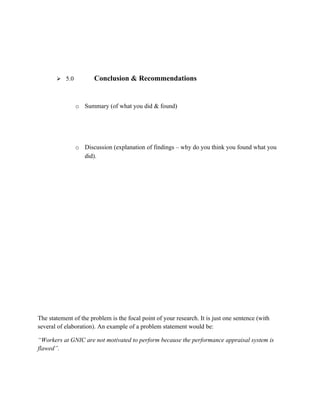
 5.0           Conclusion & Recommendations


               o Summary (of what you did & found)


               o Discussion (explanation of findings – why do you think you found what you
                 did).


The statement of the problem is the focal point of your research. It is just one sentence (with
several of elaboration). An example of a problem statement would be:

“Workers at GNIC are not motivated to perform because the performance appraisal system is
flawed”.
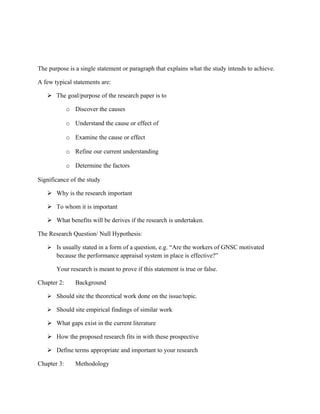
The purpose is a single statement or paragraph that explains what the study intends to achieve.

A few typical statements are:

    The goal/purpose of the research paper is to

             o Discover the causes

             o Understand the cause or effect of

             o Examine the cause or effect

             o Refine our current understanding

             o Determine the factors

Significance of the study

    Why is the research important

    To whom it is important

    What benefits will be derives if the research is undertaken.

The Research Question/ Null Hypothesis:

    Is usually stated in a form of a question, e.g. “Are the workers of GNSC motivated
       because the performance appraisal system in place is effective?”

       Your research is meant to prove if this statement is true or false.

Chapter 2:      Background

    Should site the theoretical work done on the issue/topic.

    Should site empirical findings of similar work

    What gaps exist in the current literature

    How the proposed research fits in with these prospective

    Define terms appropriate and important to your research

Chapter 3:      Methodology
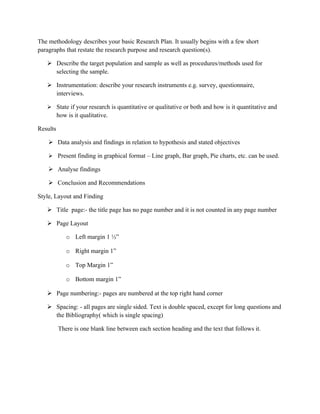
The methodology describes your basic Research Plan. It usually begins with a few short
paragraphs that restate the research purpose and research question(s).

    Describe the target population and sample as well as procedures/methods used for
     selecting the sample.

    Instrumentation: describe your research instruments e.g. survey, questionnaire,
     interviews.

    State if your research is quantitative or qualitative or both and how is it quantitative and
          how is it qualitative.

Results

     Data analysis and findings in relation to hypothesis and stated objectives

     Present finding in graphical format – Line graph, Bar graph, Pie charts, etc. can be used.

     Analyse findings

     Conclusion and Recommendations

Style, Layout and Finding

    Title page:- the title page has no page number and it is not counted in any page number

    Page Layout

              o Left margin 1 ½”

              o Right margin 1”

              o Top Margin 1”

              o Bottom margin 1”

    Page numbering:- pages are numbered at the top right hand corner

    Spacing: - all pages are single sided. Text is double spaced, except for long questions and
     the Bibliography( which is single spacing)

          There is one blank line between each section heading and the text that follows it.
 Font Face & Size: -

      o Any easily readable font is acceptable the font should be 11-14pts.

      o The same font must be used throughout the research paper, except for Tables &
        Graphs, chapters, Titles and Headings.

 The research paper should be between 2000-4000 words excluding Table of contents,
  Acknowledgement, Bibliography and Appendix.

Report

  • 1.
    REPORT AN ANALYSIS OFSTAFF TURNOVER AT THE TROPICAL VIEW INTERNATIONAL HOTEL IMPACT ON EFFICIENCY
  • 2.
    ACKNOWLEDGEMENT I am verygrateful Mrs. Nikunj Agarwal for giving me the opportunity of working in this project and give me useful instruction . I extend my regards and sincere thanks to Dr. Taruna Gautam with who support & effort, I completed my project.
  • 3.
    Also I amthankful to the management and my fellow colleges for making my project duration a memorable and fruitful one.
  • 4.
    CONTENTS 1. Introduction •Need of the study •Scope of the study 2. Research methodology •Objective of the study •Research methodology (Sample size, Instrument used, Methods of data collection) •Scope of the study •limitations 6. Descriptive work 7. Data Analysis 8. Suggestion and Conclusions 9. Bibliography 10. References 11.Appendices 12. Checklist of the items in the project
  • 5.
    CHAPTER ONE  1.0 Introduction – Introductory Remarks ABSTRACT Employee retention is a process in which the employees are encouraged to remain with the organization for the maximum period of time or until the completion of the project.
  • 6.
    Employee retention isbeneficial for the organization as well as the employee. Employees today are different. They are not the ones who don’t have good opportunities in hand. As soon as they feel dissatisfied with the current employer or the job, they switch over to the next job. It is the responsibility of the employer to retain their best employees. If they don’t, they would be left with no good employees. A good employer should know how to attract and retain its employees. ost employees feel that they are worth more than they are actually paid. There is a natural disparity between what people think they should be paid and whatorganizations spend in compensation. When the difference becomes too great and another opportunity occurs, turnover can result. Pay is defined as the wages, salary, or compensation given to an employee in exchange for services the employee performs for the organization. Pay is more than "dollars and cents;" it also acknowledges the worth and value of the human contribution. What people are paid has been shown to have a clear, reliable impact on turnover in numerous studies. Employees comprise the most vital assets of the company. In a work place where employees are not able to use their full potential and not heard and valued, they are likely to leave because of stress and frustration. In a transparent environment while employees get a sense of achievement and belongingness from a healthy work environment, the company is benefited with a stronger, reliable work-force harbouring bright new ideas for its growth Blog Online And Earn Money.  1.2 Background of the Problem  1.3 Statement of the Problem  1.4 Purpose of the Research
  • 7.
     1.5 Research question/Hypothesis  1.6 Statement of objectives of the Research  1.7 Significance of the Study  1.8 Assumption  1.9 Limitations
  • 8.
    CHAPTER TWO  2.0 Background  Literature Review  Definition of Terms CHAPTER THREE  3.0 Methodology o Restate purpose & Research Question(s) &/or null Hypothesis o Define the population & sampling method(s)
  • 9.
    o Instrumentation (includecopy in appendix) o Procedure & Time Frame CHAPTER FOUR  4.0 Result o Data analysis & findings CHAPTER FIVE
  • 10.
     5.0 Conclusion & Recommendations o Summary (of what you did & found) o Discussion (explanation of findings – why do you think you found what you did). The statement of the problem is the focal point of your research. It is just one sentence (with several of elaboration). An example of a problem statement would be: “Workers at GNIC are not motivated to perform because the performance appraisal system is flawed”.
  • 11.
    The purpose isa single statement or paragraph that explains what the study intends to achieve. A few typical statements are:  The goal/purpose of the research paper is to o Discover the causes o Understand the cause or effect of o Examine the cause or effect o Refine our current understanding o Determine the factors Significance of the study  Why is the research important  To whom it is important  What benefits will be derives if the research is undertaken. The Research Question/ Null Hypothesis:  Is usually stated in a form of a question, e.g. “Are the workers of GNSC motivated because the performance appraisal system in place is effective?” Your research is meant to prove if this statement is true or false. Chapter 2: Background  Should site the theoretical work done on the issue/topic.  Should site empirical findings of similar work  What gaps exist in the current literature  How the proposed research fits in with these prospective  Define terms appropriate and important to your research Chapter 3: Methodology
  • 12.
    The methodology describesyour basic Research Plan. It usually begins with a few short paragraphs that restate the research purpose and research question(s).  Describe the target population and sample as well as procedures/methods used for selecting the sample.  Instrumentation: describe your research instruments e.g. survey, questionnaire, interviews.  State if your research is quantitative or qualitative or both and how is it quantitative and how is it qualitative. Results  Data analysis and findings in relation to hypothesis and stated objectives  Present finding in graphical format – Line graph, Bar graph, Pie charts, etc. can be used.  Analyse findings  Conclusion and Recommendations Style, Layout and Finding  Title page:- the title page has no page number and it is not counted in any page number  Page Layout o Left margin 1 ½” o Right margin 1” o Top Margin 1” o Bottom margin 1”  Page numbering:- pages are numbered at the top right hand corner  Spacing: - all pages are single sided. Text is double spaced, except for long questions and the Bibliography( which is single spacing) There is one blank line between each section heading and the text that follows it.
  • 13.
     Font Face& Size: - o Any easily readable font is acceptable the font should be 11-14pts. o The same font must be used throughout the research paper, except for Tables & Graphs, chapters, Titles and Headings.  The research paper should be between 2000-4000 words excluding Table of contents, Acknowledgement, Bibliography and Appendix.