R
Workplace Retention
Make it work for you
Summary Report
Project Director:
Jason Dunstone
Managing Director
Project Manager:
Rikki-Lee Schmitt
+61 [0]8 8232 3355
Data collected:
July - September 2007
For the full report visit
www.sagreat.com.au
or www.aimsa.com.au
or contact Square Holes Pty Ltd
Square Holes Pty Ltd
8-10 Regent Street North
Adelaide South Australia 5000
www.squareholes.com
Overview ................................................................................1
Conclusions ............................................................................2
Aspects impacting job satisfaction............................................. 3
Aspects impacting job loyalty.................................................... 4
Top 10 retention strategies....................................................... 5
Lower priority retention strategies............................................. 6
Employers of choice................................................................. 6
Other key findings ................................................................... 7
What are the key messages to South Australian employers?........ 7
Appendices .............................................................................8
Top 20 Retention Strategies by Industry.................................... 9
About Square Holes ............................................................... 12
This report is provided for information purposes only. Except to the extent permitted by law, no part of this report may be reproduced, published,
adapted, distributed, stored in a retrieval system, transmitted or communicated for any commercial purpose (including education or training) without
the prior written approval of Square Holes Pty Ltd. Any reference to the research findings contained in this report should state 'Source: report on
Workplace Retention (2007) by Squares Holes Pty Ltd, SA Great and Australian Institute of Management SA' [Report SA Great summary]
intelligence
knowledgebut
The true sign of
is
not
Albert Einstein
1
Overview
Now more than ever, employee retention in the workplace is a hot topic.
There is little if any current research available about what South
Australian employers can do to retain and entice good staff. While some
research has been conducted previously about the needs of younger
South Australian professionals, the focus has been on social and economic
issues such as ‘affordable living’ and a ‘good place to raise a family’.
The current research by Square Holes working with SA Great and the
Australian Institute of Management [AIM] seeks deeper insight and
valuable actionable directions for employers.
The workplace retention research project commenced with a series of
targeted focus groups, held to allow some initial brainstorming of the
topic amongst young people representing professional services, science
and technology and trades. These were moderated at Square Holes’
Adelaide CBD research facility by Rikki-Lee Schmitt with the support of
Jason Dunstone. The focus groups provided valuable guidance for the
survey questionnaire development.
The second stage of the project was an internet survey of 800 South
Australian employees aged under 40. This included 181 expatriate South
Australians currently working interstate or overseas. The survey was open
to all levels of an organisation, ranging from administration to upper
management. It attracted open and honest feedback from a wide
selection of younger people.
SA Great, AIM and Square Holes are thrilled with the response the survey
generated, and are appreciative of the enthusiastic support. Those
involved in the research were invited to attend a cocktail function on the
15th
of October 2007 to hear the preliminary findings first hand and to
offer additional feedback.
The results of the survey were presented at a business luncheon on the
31st
of October 2007 at the Hyatt Regency Ballroom in Adelaide. The
event also involved a panel discussion facilitated by Phil Speakman,
Chairman Morton Phillips, and included:
Joanne Fox, Manager, People & Performance, Santos Ltd
John Chaplin, Director, Fusion
Peter de Cure, People, Performance & Culture Executive Partner, KPMG
Jason Dunstone, Managing Director, Square Holes Pty Ltd
Copyright 2007 Australia Square Holes Pty Ltd, SA Great and Australian Institute of Management SA
2
Conclusions
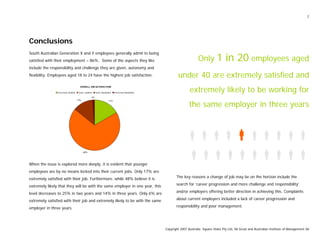
South Australian Generation X and Y employees generally admit to being
satisfied with their employment – 86%. Some of the aspects they like
include the responsibility and challenge they are given, autonomy and
flexibility. Employees aged 18 to 24 have the highest job satisfaction.
OVERALL JOB SATISFACTION
2%
13% 17%
68%
Extremely satisfied Quite satisfied Quite dissatisfied Extremely dissatisfied
When the issue is explored more deeply, it is evident that younger
employees are by no means locked into their current jobs. Only 17% are
extremely satisfied with their job. Furthermore, while 48% believe it is
extremely likely that they will be with the same employer in one year, this
level decreases to 25% in two years and 14% in three years. Only 6% are
extremely satisfied with their job and extremely likely to be with the same
employer in three years.
Only 1 in 20 employees aged
under 40 are extremely satisfied and
extremely likely to be working for
the same employer in three years
The key reasons a change of job may be on the horizon include the
search for ‘career progression and more challenge and responsibility’
and/or employers offering better direction in achieving this. Complaints
about current employers included a lack of career progression and
responsibility and poor management.
Copyright 2007 Australia Square Holes Pty Ltd, SA Great and Australian Institute of Management SA
3
Aspects impacting job satisfaction
The focus group stage of the research revealed seven areas as
fundamental in job satisfaction …
pay and salary package;
training and development;
responsibility and challenge;
employer image;
work-life balance;
management culture; and
work environment.
These areas formed the basis of the online survey questionnaire designed
by Square Holes in collaboration with SA Great and the Australian
Institute of Management [AIM]. The questionnaire explored satisfaction,
loyalty, issues relating to each of the seven fundamental areas and other
associated questions. One of the priorities of the survey analysis was to
illustrate the impact each of the seven areas has on overall job
satisfaction and loyalty [i.e. likelihood of being in same job in 3 years].
As indicated by the Job Satisfaction Impact Scoreboard to the right
‘management culture’ and ‘responsibility & challenge’ have the greatest
impact on overall job satisfaction, closely followed by ‘work environment’.
It is interesting that ‘pay and salary package’ has a relatively low impact
on overall job satisfaction. Also of interest is the comparatively low level
of satisfaction with the management culture of current employers.
Job Satisfaction Impact Scoreboard
NB: Size of squares and pie graphs indicate level of correlation with overall job satisfaction
Management Culture
Salary Package
Work-Life Balance
Training & Development
Responsibility & Challenge
Company Image
Work Environment
Satisfied with current employer in key areas
NB: Percentages indicate the actual level of satisfaction with the different areas
Management Culture
66%
Responsibility & Challenge
78%
Company Image
83%81% Salary Package
Work Environment
Training & Development
82% 74%
Work-Life Balance
81%
Copyright 2007 Australia Square Holes Pty Ltd, SA Great and Australian Institute of Management SA
4
The research illustrates that satisfaction is a combination of satisfaction
with a variety of aspects of a younger employee’s job, yet some aspects
have a greater impact. A 100% improvement in satisfaction with the
management culture of an employer will, based on the survey data, result
in a 48% increase in overall job satisfaction. In comparison, a 100%
improvement in the pay and salary package will only increase overall job
satisfaction by 30%. This may be logical, yet clearly illustrates that you
cannot increase a disgruntled employee’s job satisfaction by improving
their pay in isolation.
Aspects impacting job loyalty
Further evidence of how difficult it is to retain good younger staff is in the
survey finding that there is not a direct correlation between overall job
satisfaction and staff loyalty [i.e. likely to be with the same employer in
three years]. It is vital that employers are strategic and invest
appropriately to minimise employee resignations and churn, and maximise
staff focus on medium to longer term objectives.
A 100% increase in overall job
satisfaction will increase staff loyalty
by only 27%.
The importance of a robust ‘management culture’ once again surfaces
when we analyse the impact of the seven key aspects of job satisfaction
on staff loyalty [i.e. likely to be with the same employer in three years].
Based on the survey data, a 100% improvement in satisfaction with an
employer’s management culture will increase staff loyalty by 27%.
‘Company image’, ‘work environment’ and ‘training and development’
have the next greatest impacts on loyalty. Interestingly, based on the
survey data, a 100% increase in the pay and salary package of an
employee will only increase loyalty by 19%.
Job Loyalty Impact Scoreboard
Management Culture
Salary Package
Work-Life Balance
Training & Development
Responsibility & Challenge
Company Image
Work Environment
NB: Size of squares and completeness of pie graphs indicate level of correlation with
likelihood of being with current employer in three years
Copyright 2007 Australia Square Holes Pty Ltd, SA Great and Australian Institute of Management SA
5
Some other interesting findings illustrate that pay and salary package,
while important, has limited impact on retention. This includes a smaller
proportion of younger employees believing that their pay is below the
industry average [24%], compared with the six other areas of job
satisfaction. There are clearly other areas of job satisfaction with greater
need of strategic focus and consideration by South Australian employers.
Employer Performing Below Industry Average
Top 10 retention strategies
Throughout the survey the younger employees were asked to indicate
from extensive lists under each of the seven areas of job satisfaction
which of these their current employers offer them and which would assist
with retaining them in their current job or attract them to another
employer.
When we look at the 6% of younger people interviewed who are
extremely satisfied and extremely likely to be with the same employer in
three years some interesting messages emerge for employers. Aspects of
their pay and salary package differ little from other less satisfied and loyal
younger employees. They are satisfied because their employers have
management who place trust and respect in their employees’ abilities and
encourage team work and creativity. Company reputation is important
and the employers are contributors to the community. A comfortable,
casual and friendly work environment is also fundamental.
35%
Management Culture
24%
Salary Package
44%
Work-Life Balance
34%
Training & Development
42%
Responsibility & Challenge
55%
Company Image
47%
Work Environment
The top 10 aspects of younger employees nominated would encourage
them to stay with an employer or move to another revolve mainly around
management culture, responsibility and challenge and work environment.
A clear career direction and pathway is important, as is intelligent,
innovative, trustworthy and respected management. Also the way staff
are treated is essential to business success.
1. a management style that you respect
73%
2. future opportunity for advancement and more responsibility
70%
3. reward you for successfully completing complex tasks
68%
4. places its employees needs as essential to business success
68%
5. a casual and friendly work environment
68%
6. has a reasonable view of hours worked in an average week
67%
7. forward thinking and innovative management
67%
8. well respected and intelligent management
66%
9. trustworthy management
65%
10. allows working from home
65%
Copyright 2007 Australia Square Holes Pty Ltd, SA Great and Australian Institute of Management SA
6
Lower priority retention strategies
It is important to stress that none of the list of aspects relating to pay or
salary package featured in the top 10 factors that would attract or retain
younger employees. This is unlikely to infer that pay and salary package
are not important in job satisfaction and retention, but it does indicate
that unless issues such as management culture and career progression
are addressed adequately there is no point focusing on financial
enticements.
Evidence of this is also provided when we present the bottom ten aspects
that would encourage younger people to stay with an employer or move
to another. There is a high prominence of aspects relating to pay and
salary package. These may be desirable, but less likely to retain or attract
staff than the earlier mentioned factors.
gift vouchers
11%
job share
14%
reimbursement expense account
16%
blackberry paid by employer
16%
school fee subsidy
17%
discount programs
18%
relocation allowance
18%
company paid credit card
19%
working outside
20%
equity or shares in the business
20%
Employers of choice
When asked for suggestions for employers of choice, those involved
nominated employers based on a belief that these organisations
encourage creativity, treat staff with respect, recognise and reward
performance, and offer career progression. A national or even global
focus is desired - i.e. not SA centric.
“They provide their employees with
flexibility, a great work environment
that encourages creativity and
development” [referring to Google]
Google attracted the highest level of nominations [36 of the 800 people
surveyed]. They were believed to be an employer offering a creative
environment encouraging innovation and forward thinking among
employees. Google is considered to treat staff as assets and in turn
creates an efficient, productive and dynamic team.
The only other employers named by ten or more of the younger
employees involved were BHP Billiton [18], Virgin [13] and Macquarie
Bank [12].
Copyright 2007 Australia Square Holes Pty Ltd, SA Great and Australian Institute of Management SA
7
Other key findings
Half [49%] of the younger people surveyed had previously worked outside of
South Australia - 26% interstate and 23% overseas - for an average of two
years.
Prominent reasons for working in SA include study/education access and
enjoying the arts/festivals/events. Family and friends living in South Australia
is also important as is the easy lifestyle offered in this "good size city".
Of the 800 people interviewed, 181 are expatriate South Australians currently
working interstate [91%] or overseas [9%]. They have been doing so for an
average of 4.5 years.
The main reason for the expatriates working outside of the State is for better
career opportunity and progression than they believe is possible in South
Australia. In saying this, there is typically openness to considering working in
SA in the future. Greater opportunity for career advancement than perceived
to currently exist, being less SA-centric, illustrating strong industry growth
and being an employer of choice is important. There was also a view that
South Australian management are overly restrictive and conservative in
offering senior and quality jobs to younger employees. The expatriates were
on a higher pay level than local employees, but often less satisfied in their
current jobs that their South Australian based colleagues.
One in five of the people interviewed have children [21%], with this level only
10% for expatriates. The parents are seeking a reasonable view of hours
worked in an average week from employers [75%]; a supportive policy for
time off for sick children [70%]; a family friendly policy [69%]; ability to work
from home [69%]; and flexibility in hours to fit with picking up/dropping off
children [68%].
There were some differences when we compare different age groups,
expatriates and other segments of the survey sample, yet these were
typically minor.
What are the key messages to South Australian employers?
Management culture is the area of greatest weakness yet it has the
strongest impact on overall job satisfaction and retention. Generation X and Y
employees are demanding a management style that they respect and
managers who work with staff in a friendly manner. It is also important that
management treat staff as individuals and place employees' needs as
essential to business success.
Younger South Australian employees and expatriate South Australians
working elsewhere believe that management needs to take a long hard
look at themselves and take more responsibility in attracting and retain the
best. Attempting to shift the blame is viewed as unacceptable.
Disputing the myth that the new generation of employees are about ‘I want it
now’, this research illustrates intelligent and ambitious hard workers. They
are prepared to wait for financial and other rewards of success, yet are
highly confident and will leave employers unwilling to nurture and
provide future opportunity for advancement and more responsibility. A
career pathway is essential.
Adequate investment in retaining quality younger employees is
important. They demand proper selection and training of management,
workplace design that encourages productivity and creativity, career training
and development and other support. It's not just a job or about the money.
Only one in twenty are extremely satisfied and extremely likely to be with the
same employer in three years. With job satisfaction not directly linked with
loyalty, the strategic focus should be on minimising the churn.
Strategic focus on the employer's company image is important. While this
did not emerge as one of the top areas impacting job satisfaction, it did have
the second largest impact on staff loyalty [following management culture]. It
is also the area in which the largest proportion believes their employer is
below the industry average [55% believed this]. This should include ensuring
the vision/mission engages younger staff, contributing to the community and
being a visible and well know employer.
Copyright 2007 Australia Square Holes Pty Ltd, SA Great and Australian Institute of Management SA
Appendices
9
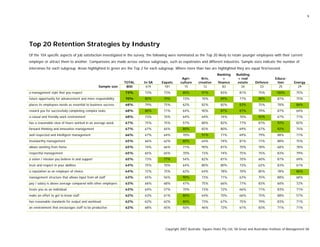
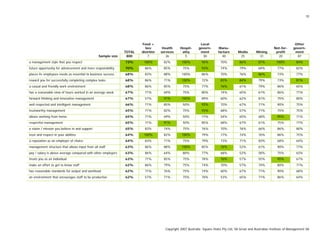
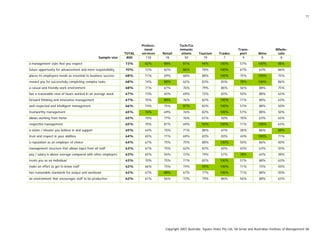
Top 20 Retention Strategies by Industry
Of the 104 specific aspects of job satisfaction investigated in the survey, the following were nominated as the Top 20 likely to retain younger employees with their current
employer or attract them to another. Comparisons are made across various subgroups, such as expatriates and different industries. Sample sizes indicate the number of
interviews for each subgroup. Areas highlighted in green are the Top 2 for each subgroup. Where more than two are highlighted they are equal first/second.
TOTAL In SA Expats
Agri-
culture
Arts,
creative
Banking
+
finance
Building
+ real
estate Defence
Educa-
tion Energy
Sample size 800 619 181 15 12 83 34 23 25 29
a management style that you respect 73% 73% 73% 80% 91% 83% 81% 75% 100% 75%
future opportunity for advancement and more responsibility 70% 80% 79% 73% 70% 89% 77% 88% 87% 75%
places its employees needs as essential to business success 68% 79% 75% 62% 82% 82% 83% 75% 78% 86%
reward you for successfully completing complex tasks 68% 80% 71% 64% 90% 87% 87% 79% 87% 64%
a casual and friendly work environment 68% 73% 76% 64% 64% 74% 70% 92% 67% 71%
has a reasonable view of hours worked in an average week 67% 75% 75% 57% 80% 82% 77% 87% 92% 82%
forward thinking and innovative management 67% 67% 65% 80% 82% 80% 69% 67% 92% 75%
well respected and intelligent management 66% 67% 64% 70% 91% 71% 69% 79% 88% 71%
trustworthy management 65% 66% 62% 80% 64% 74% 81% 71% 88% 75%
allows working from home 65% 74% 66% 71% 90% 81% 70% 78% 68% 78%
respectful management 65% 65% 65% 70% 73% 74% 75% 75% 83% 79%
a vision / mission you believe in and support 65% 73% 77% 54% 82% 81% 70% 60% 87% 69%
trust and respect in your abilities 64% 75% 70% 64% 80% 80% 73% 63% 83% 61%
a reputation as an employer of choice 64% 72% 75% 62% 64% 78% 70% 85% 78% 86%
management structure that allows input from all staff 63% 65% 56% 90% 73% 71% 63% 75% 88% 68%
pay / salary is above average compared with other employers 63% 66% 68% 47% 75% 66% 77% 83% 60% 72%
treats you as an individual 63% 64% 57% 70% 73% 72% 66% 71% 83% 71%
make an effort to get to know staff 62% 63% 61% 80% 64% 70% 66% 75% 88% 57%
has reasonable standards for output and workload 62% 62% 62% 80% 73% 67% 75% 79% 83% 71%
an environment that encourages staff to be productive 62% 68% 65% 50% 46% 72% 61% 83% 71% 71%
Copyright 2007 Australia Square Holes Pty Ltd, SA Great and Australian Institute of Management SA
10
TOTAL
Food +
bev
distrbtn
Health
services
Hospit-
ality
Local
govern-
ment
Manu-
facture Media Mining
Not-for-
profit
Other
govern-
ment
Sample size 800 7 36 5 30 40 25 31 20 87
a management style that you respect 73% 100% 82% 100% 96% 70% 86% 87% 100% 84%
future opportunity for advancement and more responsibility 70% 86% 85% 75% 93% 74% 79% 69% 77% 82%
places its employees needs as essential to business success 68% 83% 88% 100% 86% 70% 76% 86% 73% 77%
reward you for successfully completing complex tasks 68% 86% 71% 100% 72% 83% 84% 79% 73% 81%
a casual and friendly work environment 68% 86% 85% 75% 77% 76% 61% 79% 86% 65%
has a reasonable view of hours worked in an average week 67% 71% 69% 75% 80% 74% 65% 61% 86% 71%
forward thinking and innovative management 67% 57% 91% 100% 89% 60% 62% 81% 75% 80%
well respected and intelligent management 66% 71% 85% 50% 93% 70% 67% 71% 90% 75%
trustworthy management 65% 71% 82% 75% 93% 68% 57% 71% 75% 75%
allows working from home 65% 71% 69% 50% 77% 54% 65% 68% 95% 71%
respectful management 65% 71% 91% 50% 85% 68% 67% 61% 75% 77%
a vision / mission you believe in and support 65% 83% 74% 75% 76% 70% 76% 66% 86% 80%
trust and respect in your abilities 64% 100% 82% 100% 79% 77% 74% 76% 86% 75%
a reputation as an employer of choice 64% 83% 71% 75% 79% 73% 71% 83% 68% 64%
management structure that allows input from all staff 63% 86% 88% 100% 85% 76% 52% 61% 90% 77%
pay / salary is above average compared with other employers 63% 86% 64% 80% 77% 68% 52% 58% 75% 63%
treats you as an individual 63% 71% 85% 75% 78% 76% 57% 55% 95% 67%
make an effort to get to know staff 62% 86% 79% 75% 74% 70% 57% 74% 80% 71%
has reasonable standards for output and workload 62% 71% 76% 75% 74% 60% 67% 71% 90% 68%
an environment that encourages staff to be productive 62% 57% 71% 75% 70% 53% 65% 71% 86% 64%
Copyright 2007 Australia Square Holes Pty Ltd, SA Great and Australian Institute of Management SA
11
TOTAL
Profess-
ional
services Retail
Tech/Co
mmunic
ations Tourism Trades
Trans-
port Wine
Whole-
sale
Sample size 800 118 18 50 19 7 9 8 8
a management style that you respect 73% 82% 88% 81% 94% 100% 57% 100% 88%
future opportunity for advancement and more responsibility 70% 72% 82% 86% 78% 100% 67% 63% 86%
places its employees needs as essential to business success 68% 71% 69% 68% 88% 100% 75% 100% 75%
reward you for successfully completing complex tasks 68% 74% 88% 62% 83% 83% 78% 100% 86%
a casual and friendly work environment 68% 71% 67% 76% 79% 86% 56% 88% 75%
has a reasonable view of hours worked in an average week 67% 73% 65% 69% 72% 83% 50% 88% 63%
forward thinking and innovative management 67% 70% 88% 76% 82% 100% 71% 88% 63%
well respected and intelligent management 66% 74% 75% 81% 82% 100% 57% 88% 50%
trustworthy management 65% 76% 69% 76% 82% 100% 57% 88% 50%
allows working from home 65% 70% 77% 76% 61% 50% 70% 63% 63%
respectful management 65% 70% 81% 69% 94% 100% 71% 100% 63%
a vision / mission you believe in and support 65% 64% 75% 71% 88% 67% 38% 86% 88%
trust and respect in your abilities 64% 65% 71% 69% 83% 83% 44% 100% 71%
a reputation as an employer of choice 64% 67% 75% 75% 88% 100% 50% 86% 50%
management structure that allows input from all staff 63% 67% 75% 62% 82% 83% 43% 63% 50%
pay / salary is above average compared with other employers 63% 65% 56% 72% 79% 57% 78% 63% 38%
treats you as an individual 63% 70% 75% 71% 82% 100% 57% 88% 63%
make an effort to get to know staff 62% 66% 75% 74% 94% 100% 71% 75% 50%
has reasonable standards for output and workload 62% 67% 88% 67% 77% 100% 71% 88% 50%
an environment that encourages staff to be productive 62% 61% 56% 72% 79% 86% 56% 88% 63%
Copyright 2007 Australia Square Holes Pty Ltd, SA Great and Australian Institute of Management SA
About Square Holes
Square Holes works
with an impressive and
diverse list of blue-
chip commercial and
government clients.
Marketing and business
intelligence services
are provided based on surveys, focus groups, other
methods of gathering insight and, on this, imagination
to guide our clients in brand and product innovation,
sales growth and obtaining business targets.
Some of Square Holes’ recent clients have
included the SA Department of Health, The Cancer
Council South Australia, SafeWork SA, Mamee
Noodles, Coopers Brewery, Adam Internet and the
AFL and SANFL. Other sectors with strong
experience include banking and finance; professional
services; real estate and development; retail; and
wine. Topics explored include advertising; brand
reengineering; customer satisfaction; employer
branding; new market entry; product and service
development; tailored trend watching or cool hunting;
and strategy planning and refinement.
Square Holes is proudly based in Adelaide with a
national client base. Our in-house consultant and field
teams provide first-class qualitative and quantitative
research services. The unique CBD based office
incorporates modern group discussion, client
viewing and survey facilities.
Square Holes offers tailored consulting services
and a suite of innovative tools we have developed
for clients. For more information or to arrange a
no obligation meeting contact Jason Dunstone
on +61[0]8 8232 3355 or jasond@squareholes.com
Research: Using research as a strategic tool is our
passion and we do this well. From continuous weekly
tracking to ensure time-sensitive responsiveness
to less frequent monitors; and ad hoc studies to
explore opportunities.
Insight: Square Holes designs, implements and
manages tailored consumer, customer and staff insight
programs for clients. We create cultures of innovation.
Evaluation: Square Holes educates and designs client
specific programs to guide marketing and other strategy
planning, refinement, monitoring and reflection. We
create cultures of learning and continuous improvement.
Wisdom: Square Holes employs inventive approaches
to work with clients to guide staff in the search for
opportunities to be more innovative and continuously
improve. We aim to foster wisdom within our clients.
Information Management: Square Holes works
with clients to develop simple yet powerful systems
to collect information and plant seeds of creativity
and innovation.
Round Pegs: Quality research data and support, when
strategic input is not required. Services include internet,
telephone and face-to-face surveys; recruitment; statistical
analysis; transcribing; and other research support.

Report 070707 summary

  • 1.
    R Workplace Retention Make itwork for you Summary Report Project Director: Jason Dunstone Managing Director Project Manager: Rikki-Lee Schmitt +61 [0]8 8232 3355 Data collected: July - September 2007 For the full report visit www.sagreat.com.au or www.aimsa.com.au or contact Square Holes Pty Ltd Square Holes Pty Ltd 8-10 Regent Street North Adelaide South Australia 5000 www.squareholes.com
  • 2.
    Overview ................................................................................1 Conclusions ............................................................................2 Aspectsimpacting job satisfaction............................................. 3 Aspects impacting job loyalty.................................................... 4 Top 10 retention strategies....................................................... 5 Lower priority retention strategies............................................. 6 Employers of choice................................................................. 6 Other key findings ................................................................... 7 What are the key messages to South Australian employers?........ 7 Appendices .............................................................................8 Top 20 Retention Strategies by Industry.................................... 9 About Square Holes ............................................................... 12 This report is provided for information purposes only. Except to the extent permitted by law, no part of this report may be reproduced, published, adapted, distributed, stored in a retrieval system, transmitted or communicated for any commercial purpose (including education or training) without the prior written approval of Square Holes Pty Ltd. Any reference to the research findings contained in this report should state 'Source: report on Workplace Retention (2007) by Squares Holes Pty Ltd, SA Great and Australian Institute of Management SA' [Report SA Great summary]
  • 3.
    intelligence knowledgebut The true signof is not Albert Einstein
  • 4.
    1 Overview Now more thanever, employee retention in the workplace is a hot topic. There is little if any current research available about what South Australian employers can do to retain and entice good staff. While some research has been conducted previously about the needs of younger South Australian professionals, the focus has been on social and economic issues such as ‘affordable living’ and a ‘good place to raise a family’. The current research by Square Holes working with SA Great and the Australian Institute of Management [AIM] seeks deeper insight and valuable actionable directions for employers. The workplace retention research project commenced with a series of targeted focus groups, held to allow some initial brainstorming of the topic amongst young people representing professional services, science and technology and trades. These were moderated at Square Holes’ Adelaide CBD research facility by Rikki-Lee Schmitt with the support of Jason Dunstone. The focus groups provided valuable guidance for the survey questionnaire development. The second stage of the project was an internet survey of 800 South Australian employees aged under 40. This included 181 expatriate South Australians currently working interstate or overseas. The survey was open to all levels of an organisation, ranging from administration to upper management. It attracted open and honest feedback from a wide selection of younger people. SA Great, AIM and Square Holes are thrilled with the response the survey generated, and are appreciative of the enthusiastic support. Those involved in the research were invited to attend a cocktail function on the 15th of October 2007 to hear the preliminary findings first hand and to offer additional feedback. The results of the survey were presented at a business luncheon on the 31st of October 2007 at the Hyatt Regency Ballroom in Adelaide. The event also involved a panel discussion facilitated by Phil Speakman, Chairman Morton Phillips, and included: Joanne Fox, Manager, People & Performance, Santos Ltd John Chaplin, Director, Fusion Peter de Cure, People, Performance & Culture Executive Partner, KPMG Jason Dunstone, Managing Director, Square Holes Pty Ltd Copyright 2007 Australia Square Holes Pty Ltd, SA Great and Australian Institute of Management SA
  • 5.
    2 Conclusions South Australian GenerationX and Y employees generally admit to being satisfied with their employment – 86%. Some of the aspects they like include the responsibility and challenge they are given, autonomy and flexibility. Employees aged 18 to 24 have the highest job satisfaction. OVERALL JOB SATISFACTION 2% 13% 17% 68% Extremely satisfied Quite satisfied Quite dissatisfied Extremely dissatisfied When the issue is explored more deeply, it is evident that younger employees are by no means locked into their current jobs. Only 17% are extremely satisfied with their job. Furthermore, while 48% believe it is extremely likely that they will be with the same employer in one year, this level decreases to 25% in two years and 14% in three years. Only 6% are extremely satisfied with their job and extremely likely to be with the same employer in three years. Only 1 in 20 employees aged under 40 are extremely satisfied and extremely likely to be working for the same employer in three years The key reasons a change of job may be on the horizon include the search for ‘career progression and more challenge and responsibility’ and/or employers offering better direction in achieving this. Complaints about current employers included a lack of career progression and responsibility and poor management. Copyright 2007 Australia Square Holes Pty Ltd, SA Great and Australian Institute of Management SA
  • 6.
    3 Aspects impacting jobsatisfaction The focus group stage of the research revealed seven areas as fundamental in job satisfaction … pay and salary package; training and development; responsibility and challenge; employer image; work-life balance; management culture; and work environment. These areas formed the basis of the online survey questionnaire designed by Square Holes in collaboration with SA Great and the Australian Institute of Management [AIM]. The questionnaire explored satisfaction, loyalty, issues relating to each of the seven fundamental areas and other associated questions. One of the priorities of the survey analysis was to illustrate the impact each of the seven areas has on overall job satisfaction and loyalty [i.e. likelihood of being in same job in 3 years]. As indicated by the Job Satisfaction Impact Scoreboard to the right ‘management culture’ and ‘responsibility & challenge’ have the greatest impact on overall job satisfaction, closely followed by ‘work environment’. It is interesting that ‘pay and salary package’ has a relatively low impact on overall job satisfaction. Also of interest is the comparatively low level of satisfaction with the management culture of current employers. Job Satisfaction Impact Scoreboard NB: Size of squares and pie graphs indicate level of correlation with overall job satisfaction Management Culture Salary Package Work-Life Balance Training & Development Responsibility & Challenge Company Image Work Environment Satisfied with current employer in key areas NB: Percentages indicate the actual level of satisfaction with the different areas Management Culture 66% Responsibility & Challenge 78% Company Image 83%81% Salary Package Work Environment Training & Development 82% 74% Work-Life Balance 81% Copyright 2007 Australia Square Holes Pty Ltd, SA Great and Australian Institute of Management SA
  • 7.
    4 The research illustratesthat satisfaction is a combination of satisfaction with a variety of aspects of a younger employee’s job, yet some aspects have a greater impact. A 100% improvement in satisfaction with the management culture of an employer will, based on the survey data, result in a 48% increase in overall job satisfaction. In comparison, a 100% improvement in the pay and salary package will only increase overall job satisfaction by 30%. This may be logical, yet clearly illustrates that you cannot increase a disgruntled employee’s job satisfaction by improving their pay in isolation. Aspects impacting job loyalty Further evidence of how difficult it is to retain good younger staff is in the survey finding that there is not a direct correlation between overall job satisfaction and staff loyalty [i.e. likely to be with the same employer in three years]. It is vital that employers are strategic and invest appropriately to minimise employee resignations and churn, and maximise staff focus on medium to longer term objectives. A 100% increase in overall job satisfaction will increase staff loyalty by only 27%. The importance of a robust ‘management culture’ once again surfaces when we analyse the impact of the seven key aspects of job satisfaction on staff loyalty [i.e. likely to be with the same employer in three years]. Based on the survey data, a 100% improvement in satisfaction with an employer’s management culture will increase staff loyalty by 27%. ‘Company image’, ‘work environment’ and ‘training and development’ have the next greatest impacts on loyalty. Interestingly, based on the survey data, a 100% increase in the pay and salary package of an employee will only increase loyalty by 19%. Job Loyalty Impact Scoreboard Management Culture Salary Package Work-Life Balance Training & Development Responsibility & Challenge Company Image Work Environment NB: Size of squares and completeness of pie graphs indicate level of correlation with likelihood of being with current employer in three years Copyright 2007 Australia Square Holes Pty Ltd, SA Great and Australian Institute of Management SA
  • 8.
    5 Some other interestingfindings illustrate that pay and salary package, while important, has limited impact on retention. This includes a smaller proportion of younger employees believing that their pay is below the industry average [24%], compared with the six other areas of job satisfaction. There are clearly other areas of job satisfaction with greater need of strategic focus and consideration by South Australian employers. Employer Performing Below Industry Average Top 10 retention strategies Throughout the survey the younger employees were asked to indicate from extensive lists under each of the seven areas of job satisfaction which of these their current employers offer them and which would assist with retaining them in their current job or attract them to another employer. When we look at the 6% of younger people interviewed who are extremely satisfied and extremely likely to be with the same employer in three years some interesting messages emerge for employers. Aspects of their pay and salary package differ little from other less satisfied and loyal younger employees. They are satisfied because their employers have management who place trust and respect in their employees’ abilities and encourage team work and creativity. Company reputation is important and the employers are contributors to the community. A comfortable, casual and friendly work environment is also fundamental. 35% Management Culture 24% Salary Package 44% Work-Life Balance 34% Training & Development 42% Responsibility & Challenge 55% Company Image 47% Work Environment The top 10 aspects of younger employees nominated would encourage them to stay with an employer or move to another revolve mainly around management culture, responsibility and challenge and work environment. A clear career direction and pathway is important, as is intelligent, innovative, trustworthy and respected management. Also the way staff are treated is essential to business success. 1. a management style that you respect 73% 2. future opportunity for advancement and more responsibility 70% 3. reward you for successfully completing complex tasks 68% 4. places its employees needs as essential to business success 68% 5. a casual and friendly work environment 68% 6. has a reasonable view of hours worked in an average week 67% 7. forward thinking and innovative management 67% 8. well respected and intelligent management 66% 9. trustworthy management 65% 10. allows working from home 65% Copyright 2007 Australia Square Holes Pty Ltd, SA Great and Australian Institute of Management SA
  • 9.
    6 Lower priority retentionstrategies It is important to stress that none of the list of aspects relating to pay or salary package featured in the top 10 factors that would attract or retain younger employees. This is unlikely to infer that pay and salary package are not important in job satisfaction and retention, but it does indicate that unless issues such as management culture and career progression are addressed adequately there is no point focusing on financial enticements. Evidence of this is also provided when we present the bottom ten aspects that would encourage younger people to stay with an employer or move to another. There is a high prominence of aspects relating to pay and salary package. These may be desirable, but less likely to retain or attract staff than the earlier mentioned factors. gift vouchers 11% job share 14% reimbursement expense account 16% blackberry paid by employer 16% school fee subsidy 17% discount programs 18% relocation allowance 18% company paid credit card 19% working outside 20% equity or shares in the business 20% Employers of choice When asked for suggestions for employers of choice, those involved nominated employers based on a belief that these organisations encourage creativity, treat staff with respect, recognise and reward performance, and offer career progression. A national or even global focus is desired - i.e. not SA centric. “They provide their employees with flexibility, a great work environment that encourages creativity and development” [referring to Google] Google attracted the highest level of nominations [36 of the 800 people surveyed]. They were believed to be an employer offering a creative environment encouraging innovation and forward thinking among employees. Google is considered to treat staff as assets and in turn creates an efficient, productive and dynamic team. The only other employers named by ten or more of the younger employees involved were BHP Billiton [18], Virgin [13] and Macquarie Bank [12]. Copyright 2007 Australia Square Holes Pty Ltd, SA Great and Australian Institute of Management SA
  • 10.
    7 Other key findings Half[49%] of the younger people surveyed had previously worked outside of South Australia - 26% interstate and 23% overseas - for an average of two years. Prominent reasons for working in SA include study/education access and enjoying the arts/festivals/events. Family and friends living in South Australia is also important as is the easy lifestyle offered in this "good size city". Of the 800 people interviewed, 181 are expatriate South Australians currently working interstate [91%] or overseas [9%]. They have been doing so for an average of 4.5 years. The main reason for the expatriates working outside of the State is for better career opportunity and progression than they believe is possible in South Australia. In saying this, there is typically openness to considering working in SA in the future. Greater opportunity for career advancement than perceived to currently exist, being less SA-centric, illustrating strong industry growth and being an employer of choice is important. There was also a view that South Australian management are overly restrictive and conservative in offering senior and quality jobs to younger employees. The expatriates were on a higher pay level than local employees, but often less satisfied in their current jobs that their South Australian based colleagues. One in five of the people interviewed have children [21%], with this level only 10% for expatriates. The parents are seeking a reasonable view of hours worked in an average week from employers [75%]; a supportive policy for time off for sick children [70%]; a family friendly policy [69%]; ability to work from home [69%]; and flexibility in hours to fit with picking up/dropping off children [68%]. There were some differences when we compare different age groups, expatriates and other segments of the survey sample, yet these were typically minor. What are the key messages to South Australian employers? Management culture is the area of greatest weakness yet it has the strongest impact on overall job satisfaction and retention. Generation X and Y employees are demanding a management style that they respect and managers who work with staff in a friendly manner. It is also important that management treat staff as individuals and place employees' needs as essential to business success. Younger South Australian employees and expatriate South Australians working elsewhere believe that management needs to take a long hard look at themselves and take more responsibility in attracting and retain the best. Attempting to shift the blame is viewed as unacceptable. Disputing the myth that the new generation of employees are about ‘I want it now’, this research illustrates intelligent and ambitious hard workers. They are prepared to wait for financial and other rewards of success, yet are highly confident and will leave employers unwilling to nurture and provide future opportunity for advancement and more responsibility. A career pathway is essential. Adequate investment in retaining quality younger employees is important. They demand proper selection and training of management, workplace design that encourages productivity and creativity, career training and development and other support. It's not just a job or about the money. Only one in twenty are extremely satisfied and extremely likely to be with the same employer in three years. With job satisfaction not directly linked with loyalty, the strategic focus should be on minimising the churn. Strategic focus on the employer's company image is important. While this did not emerge as one of the top areas impacting job satisfaction, it did have the second largest impact on staff loyalty [following management culture]. It is also the area in which the largest proportion believes their employer is below the industry average [55% believed this]. This should include ensuring the vision/mission engages younger staff, contributing to the community and being a visible and well know employer. Copyright 2007 Australia Square Holes Pty Ltd, SA Great and Australian Institute of Management SA
  • 11.
  • 12.
    9 Top 20 RetentionStrategies by Industry Of the 104 specific aspects of job satisfaction investigated in the survey, the following were nominated as the Top 20 likely to retain younger employees with their current employer or attract them to another. Comparisons are made across various subgroups, such as expatriates and different industries. Sample sizes indicate the number of interviews for each subgroup. Areas highlighted in green are the Top 2 for each subgroup. Where more than two are highlighted they are equal first/second. TOTAL In SA Expats Agri- culture Arts, creative Banking + finance Building + real estate Defence Educa- tion Energy Sample size 800 619 181 15 12 83 34 23 25 29 a management style that you respect 73% 73% 73% 80% 91% 83% 81% 75% 100% 75% future opportunity for advancement and more responsibility 70% 80% 79% 73% 70% 89% 77% 88% 87% 75% places its employees needs as essential to business success 68% 79% 75% 62% 82% 82% 83% 75% 78% 86% reward you for successfully completing complex tasks 68% 80% 71% 64% 90% 87% 87% 79% 87% 64% a casual and friendly work environment 68% 73% 76% 64% 64% 74% 70% 92% 67% 71% has a reasonable view of hours worked in an average week 67% 75% 75% 57% 80% 82% 77% 87% 92% 82% forward thinking and innovative management 67% 67% 65% 80% 82% 80% 69% 67% 92% 75% well respected and intelligent management 66% 67% 64% 70% 91% 71% 69% 79% 88% 71% trustworthy management 65% 66% 62% 80% 64% 74% 81% 71% 88% 75% allows working from home 65% 74% 66% 71% 90% 81% 70% 78% 68% 78% respectful management 65% 65% 65% 70% 73% 74% 75% 75% 83% 79% a vision / mission you believe in and support 65% 73% 77% 54% 82% 81% 70% 60% 87% 69% trust and respect in your abilities 64% 75% 70% 64% 80% 80% 73% 63% 83% 61% a reputation as an employer of choice 64% 72% 75% 62% 64% 78% 70% 85% 78% 86% management structure that allows input from all staff 63% 65% 56% 90% 73% 71% 63% 75% 88% 68% pay / salary is above average compared with other employers 63% 66% 68% 47% 75% 66% 77% 83% 60% 72% treats you as an individual 63% 64% 57% 70% 73% 72% 66% 71% 83% 71% make an effort to get to know staff 62% 63% 61% 80% 64% 70% 66% 75% 88% 57% has reasonable standards for output and workload 62% 62% 62% 80% 73% 67% 75% 79% 83% 71% an environment that encourages staff to be productive 62% 68% 65% 50% 46% 72% 61% 83% 71% 71% Copyright 2007 Australia Square Holes Pty Ltd, SA Great and Australian Institute of Management SA
  • 13.
    10 TOTAL Food + bev distrbtn Health services Hospit- ality Local govern- ment Manu- facture MediaMining Not-for- profit Other govern- ment Sample size 800 7 36 5 30 40 25 31 20 87 a management style that you respect 73% 100% 82% 100% 96% 70% 86% 87% 100% 84% future opportunity for advancement and more responsibility 70% 86% 85% 75% 93% 74% 79% 69% 77% 82% places its employees needs as essential to business success 68% 83% 88% 100% 86% 70% 76% 86% 73% 77% reward you for successfully completing complex tasks 68% 86% 71% 100% 72% 83% 84% 79% 73% 81% a casual and friendly work environment 68% 86% 85% 75% 77% 76% 61% 79% 86% 65% has a reasonable view of hours worked in an average week 67% 71% 69% 75% 80% 74% 65% 61% 86% 71% forward thinking and innovative management 67% 57% 91% 100% 89% 60% 62% 81% 75% 80% well respected and intelligent management 66% 71% 85% 50% 93% 70% 67% 71% 90% 75% trustworthy management 65% 71% 82% 75% 93% 68% 57% 71% 75% 75% allows working from home 65% 71% 69% 50% 77% 54% 65% 68% 95% 71% respectful management 65% 71% 91% 50% 85% 68% 67% 61% 75% 77% a vision / mission you believe in and support 65% 83% 74% 75% 76% 70% 76% 66% 86% 80% trust and respect in your abilities 64% 100% 82% 100% 79% 77% 74% 76% 86% 75% a reputation as an employer of choice 64% 83% 71% 75% 79% 73% 71% 83% 68% 64% management structure that allows input from all staff 63% 86% 88% 100% 85% 76% 52% 61% 90% 77% pay / salary is above average compared with other employers 63% 86% 64% 80% 77% 68% 52% 58% 75% 63% treats you as an individual 63% 71% 85% 75% 78% 76% 57% 55% 95% 67% make an effort to get to know staff 62% 86% 79% 75% 74% 70% 57% 74% 80% 71% has reasonable standards for output and workload 62% 71% 76% 75% 74% 60% 67% 71% 90% 68% an environment that encourages staff to be productive 62% 57% 71% 75% 70% 53% 65% 71% 86% 64% Copyright 2007 Australia Square Holes Pty Ltd, SA Great and Australian Institute of Management SA
  • 14.
    11 TOTAL Profess- ional services Retail Tech/Co mmunic ations TourismTrades Trans- port Wine Whole- sale Sample size 800 118 18 50 19 7 9 8 8 a management style that you respect 73% 82% 88% 81% 94% 100% 57% 100% 88% future opportunity for advancement and more responsibility 70% 72% 82% 86% 78% 100% 67% 63% 86% places its employees needs as essential to business success 68% 71% 69% 68% 88% 100% 75% 100% 75% reward you for successfully completing complex tasks 68% 74% 88% 62% 83% 83% 78% 100% 86% a casual and friendly work environment 68% 71% 67% 76% 79% 86% 56% 88% 75% has a reasonable view of hours worked in an average week 67% 73% 65% 69% 72% 83% 50% 88% 63% forward thinking and innovative management 67% 70% 88% 76% 82% 100% 71% 88% 63% well respected and intelligent management 66% 74% 75% 81% 82% 100% 57% 88% 50% trustworthy management 65% 76% 69% 76% 82% 100% 57% 88% 50% allows working from home 65% 70% 77% 76% 61% 50% 70% 63% 63% respectful management 65% 70% 81% 69% 94% 100% 71% 100% 63% a vision / mission you believe in and support 65% 64% 75% 71% 88% 67% 38% 86% 88% trust and respect in your abilities 64% 65% 71% 69% 83% 83% 44% 100% 71% a reputation as an employer of choice 64% 67% 75% 75% 88% 100% 50% 86% 50% management structure that allows input from all staff 63% 67% 75% 62% 82% 83% 43% 63% 50% pay / salary is above average compared with other employers 63% 65% 56% 72% 79% 57% 78% 63% 38% treats you as an individual 63% 70% 75% 71% 82% 100% 57% 88% 63% make an effort to get to know staff 62% 66% 75% 74% 94% 100% 71% 75% 50% has reasonable standards for output and workload 62% 67% 88% 67% 77% 100% 71% 88% 50% an environment that encourages staff to be productive 62% 61% 56% 72% 79% 86% 56% 88% 63% Copyright 2007 Australia Square Holes Pty Ltd, SA Great and Australian Institute of Management SA
  • 15.
    About Square Holes SquareHoles works with an impressive and diverse list of blue- chip commercial and government clients. Marketing and business intelligence services are provided based on surveys, focus groups, other methods of gathering insight and, on this, imagination to guide our clients in brand and product innovation, sales growth and obtaining business targets. Some of Square Holes’ recent clients have included the SA Department of Health, The Cancer Council South Australia, SafeWork SA, Mamee Noodles, Coopers Brewery, Adam Internet and the AFL and SANFL. Other sectors with strong experience include banking and finance; professional services; real estate and development; retail; and wine. Topics explored include advertising; brand reengineering; customer satisfaction; employer branding; new market entry; product and service development; tailored trend watching or cool hunting; and strategy planning and refinement. Square Holes is proudly based in Adelaide with a national client base. Our in-house consultant and field teams provide first-class qualitative and quantitative research services. The unique CBD based office incorporates modern group discussion, client viewing and survey facilities. Square Holes offers tailored consulting services and a suite of innovative tools we have developed for clients. For more information or to arrange a no obligation meeting contact Jason Dunstone on +61[0]8 8232 3355 or jasond@squareholes.com Research: Using research as a strategic tool is our passion and we do this well. From continuous weekly tracking to ensure time-sensitive responsiveness to less frequent monitors; and ad hoc studies to explore opportunities. Insight: Square Holes designs, implements and manages tailored consumer, customer and staff insight programs for clients. We create cultures of innovation. Evaluation: Square Holes educates and designs client specific programs to guide marketing and other strategy planning, refinement, monitoring and reflection. We create cultures of learning and continuous improvement. Wisdom: Square Holes employs inventive approaches to work with clients to guide staff in the search for opportunities to be more innovative and continuously improve. We aim to foster wisdom within our clients. Information Management: Square Holes works with clients to develop simple yet powerful systems to collect information and plant seeds of creativity and innovation. Round Pegs: Quality research data and support, when strategic input is not required. Services include internet, telephone and face-to-face surveys; recruitment; statistical analysis; transcribing; and other research support.