Generational Trends in Education
Jason Dunstone
Founder and Managing Director
Square Holes
www.linkedin.com/in/jasondunstone
6 September 2013
1
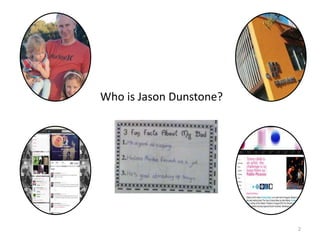
Who is Jason Dunstone?
2
No brand, issue, school or uni is an island!
3
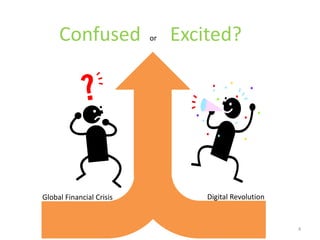
Digital RevolutionGlobal Financial Crisis
orConfused Excited?
4
“There is a lack of
confidence and lack of a
burning platform to do
something from both
consumers and business.
Business is saying ‘I’m
stable I can keep going like
this but if I take a risk...’”
[SA Business] 5
GFC
“It’s pretty tough”
6
GFC
iTunes launched January 2001… now 800 app downloads per second
[2B+ per month!]
Facebook launched February 2004… now 1B+ active users
iPhone launched June 2007… now 1.5B+ users
7
“I can do so much more over the Internet
without having to call a company”
“Technology does not make life better, just
destroys a sense of community by fabricating a
sense of informal non face-to-face socialisation”
“It has connected me with people who have impacted greatly on my life”
“My laptop opens the world to me”
“Performing every day tasks online - banking,
shopping, research”
“Keep in touch with family”
“Better connectivity to family & friends when travelling”
“Finding better-priced goods and services
through the Internet”
“I like
researching
family
history - and
technology
has allowed
me to do
this from my
own home”
“Allowed to me to apply for lots of jobs online”
“Has freed up some of my time” “Feel safer”
“Lose weight”
“Banking on the move”
8
“History is more or less
bunk. It's tradition. We don't
want tradition. We want to
live in the present and the
only history that is worth a
tinker's dam is the history
we made today”
Henry Ford [Industrialist]
“There are only patterns, patterns on
top of patterns, patterns that affect
other patterns. Patterns hidden by
patterns. Patterns within patterns. If
you watch close, history does nothing
but repeat itself. What we call chaos is
just patterns we haven't recognized.
What we call random is just patterns we
can't decipher. What we can't
understand we call nonsense.
What we can't read we call gibberish.”
Chuck Palahniuk [Author]
9
5 things that haven’t changed
1. Family is the biggest passion of Australians
2. Word-of-mouth is the most trusted marketing
3. People still watch TV
4. Donors give to what they care about
5. Life wasn’t meant to be easy
10
What is the one thing you ‘love’ above all else?
11
Passions
44% ‘love’ their FRIENDS
82% ‘love’ their FAMILY
Good food 40%
Travel Oz 26%
Travel O/S 30%
Internet 22%
Reading 24%
Eating out 23%
Movies 24%
Relaxing 21%
New things 21%
12
13
“I see the core unit as more
important than everything
else in my life. It comes
before jobs and finances, it
comes before everything.
Everything comes second to
my family.” 14
Selecting a school …
15
1. Consistent carers / teachers
[64% extremely important, 96% overall]
2. Class size
[62% extremely important, 94% overall]
3. Open spaces / play grounds
[52% extremely, 93% overall]
4. Up to date facilities [43%, 91% ]
5. Extracurricular activities [30%, 78%]
6. Academic record of school [28%, 79%]
7. Location of school / centre [25%, 72%]
8. Family or friends recommendation
[16%, 65%]
9. Ability to stay in one facility
kindergarten-12 [13%, 37%]
10.Prestige of school [7%, 32%]
High importance
Moderate importance
Low importance
16
4%
5%
7%
12%
8%
14%
17%
17%
15%
23%
22%
21%
18%
26%
35%
57%
4%
6%
7%
13%
15%
15%
19%
18%
20%
19%
26%
23%
27%
31%
34%
57%
5%
8%
11%
18%
24%
23%
21%
26%
28%
25%
31%
34%
35%
39%
37%
62%
5%
6%
8%
15%
16%
18%
20%
21%
21%
24%
26%
27%
27%
32%
36%
58%
Where I went to school [old scholar]
Prestige of school
Ability to stay in one facility from
kindergarten to yr 12
Sporting facilities and opportunities
Play equipment / play grounds
Extracurricular activities offered
My experience with the teachers / school
community
Cost [affordability]
Open spaces for children to play
Academic record of a school
Family or friends recommendation
Up to date facilities
Consistent carers/ teachers for children
from day to day
The class size
Reputation of school
Location of a school / centre- close to
home or work
KEY INFLUENCES IN CHOOSING A SCHOOL
Total [n=1201] 0-5 years [n=656] 6-11 years [n=743] 12-18 years [n=867]
17
“The private system
the facilities are
just to die for,
however, the actual
teaching is no
better or worse
than you get in a
State school.”
“Dedicated teachers
who genuinely want
to see children learn
and grow and
become the best
they can be, to be
encouraging and
patient and giving
of heart.”
“If you go back to the old saying that a person
doesn’t raise your child the community does. You
have to get everyone involved.” 18
Media – old and new …
19
Parents do this at least weekly …
97% watch TV at least weekly
92% email
89% radio
66% read local newspaper
61% use a smart phone
60% use social media
30% use a tablet / IPad
20
41% access school
website at least
each term
41% likely to follow
school on social media
such as Facebook 21
“I don’t know if it’s just
our generation, but we
look at Facebook as a
fun thing not as a way
of telling me about
important things.”
22
“Technology is evolving and
this is how the world is going,
so we need to put effort into
something different, and you
know, heaps of teachers are
resistant to it because it’s time,
it’s confidence, it’s
understanding how to use it.”
[Primary school teacher] 23
Early childhood
• Intimate
• Highly involved
parents
• A few carers
Primary school
• Parents
transitioning to
less teacher
contact
• Students start to
have more
teachers
High school
• Formal
• Passive parents
• Many teachers
24
Early childhood Primary school High school
Teachers
Gaining parent trust
Need to be available
Give feedback
Mixed parent engagement
Mixed parent expectations
Intense
Formal
Through administration
Parents
Involved
Friendly
Drop-off / pick-up
Personal
Individualised
Community
Involved
Depends on the teacher
Depends on the principal
Developing
Drop-off / pick-up
Passive
Not engaged
Don’t ask
Formal
Parent – teacher relationships
25
Communication at schools
Number of Mediums + Parent Distance
Early childhood Primary school High school
Primarymediums
Blog
Chart (sign-in/out)
Communications book
Email
Face-to-face
Phone call
Photos
Pigeon hole
SMS
Communications book
Diary
Edmodo
Email
Events
Face-to-face
Forms
Newsletter
Online/email newsletter
Phone call
SMS
Social media
Website
Word of Mouth
DayMap
Diaries
Edmodo
Email
Facebook
Face-to-face
LearnLink
Letters
Moodle
Newsletter
Online/email newsletter
Phone call
Portal login
SMS
Website
26
Current perceptions of technology availability
Classroom Teachers [personal use] Parents [home]
Device
Early
childhood
Primary
school
High
school
Early
childhood
Primary
school
High
school
Early
childhood
Primary
school
High
school
Desktop
Computer
5 5 9
Laptop 5 11 21
Smartphone 3 8 19
iPhone 3 7 13
Tablet 3 0 4
iPad 3 1 5
Internet
Not available High availability
27
[Educational]
ABC Kids, ABC Reading Eggs,
ColourMatch, Cool Math Games, Google
Earth, Google Maps, Jolly Phonics,
Leapfrog, Mathletics, Maths Workout,
Maths Online, Memory Games, Sightwords,
Star Walk, Typing, YouTube
[Operational]
Facebook, Skype, Twitter
[Support]
Beyond Blue
[Services]
CFS, Family Assistant, Immunisation,
Medical Assist, School Library Association
Types of apps:
Parents
28
Types of apps:
Teachers
[Educational]
BurstMode, Click View, Dartfish, Flash
Cards, Letter School, Pearson, Story Book,
The Wrong Book,
YouTube
[Operational]
Attendance Tracker, Class Dojo
DayMap, Drop Box
Edmodo, Gmail, Google drive
Learn Link, Moodle, Skool Bag,
StudyLab, Vivo, Weebly, Word Press
[Support]
Drug Free
[Services]
29
Early Childhood Primary school High school
Teachers
Enhance learning
Finding quality of apps
Come up to speed – wi-fi etc
Teaching and learning apps
Sharing between centre and home life
Better alignment of parent expectations
Having teachers on the ‘front line’ making
decisions
Making teachers more accountable
[making ‘good teachers’]
Making the teacher workload more relevant
Safety alerts to parents
Training
Universal consistency
A ‘running’ grade
An ‘Adelaide Now’ style of school newsfeed
Consistency
Empowering keen staff
Improving attendance
Keeping parents engaged
Policies
Removing ‘clunkyness’
Social media
Technology for staff
Uploading by students/teachers
Parents
Teacher profiles
Community and social sharing of events
Consistency
Continuity from care to home
Forums
Need feedback from kids that is accurate
Online booking of teachers
Points/topics to talk about with children
Real-time notifications
Regular updates
Time saving
Absentees
Broader offering
Calendars & reminders of dates
Child progress
Diary interaction
Homework assignments
Curriculum
Issues management
Opportunities to volunteer
Reporting bullying
Sharing content
Teacher booking service
Absentees
Access to teachers
App version of a portal website
Calendar
Child progress
Curriculum
Events and meetings coming up
Helping students to plan
Reporting bullying
30
Education and marketing
31
“If you are not relevant you are invisible”
“If you are not sincere I can’t trust you”
32
Brand building
Demonstration
Usage
Advocacy
Marketing from the outside in,
and inside out …
33
Brand building
Demonstration
Mass media
Open days
Success stories
Philosophy
Visibility
Facts
34
Demonstration
Usage
Advocacy
Word-of-mouth
Word-of-mouth continues to be the most relied upon and
trusted form of marketing and nine in ten share …
98% verbally
20% via email
12% Facebook
02% Twitter
Much of the
strategic
challenge is
how to
generate
positive
word-of-
mouth
35
Usage
Advocacy
Developing a strong school ‘community’
Around 35% parents
have a strong
connection
50% engaged, but
open to alternative
15% unengaged
Alumni
Parents
Students
Teachers
Leader
In addition to positive
word-of-mouth, these are
the future donors,
bequests and supporters. 36
Brand building
Demonstration
Usage
Advocacy
Mass media
Word-of-mouth
Marketing from the outside in,
and inside out …
37
There is indication that consumer
confidence may be improving, but
life will continue to be tough.
Fears of increasing household and
other bills impact confidence and
the willingness to lock into
expensive items, donations and
other discretionary spending.
38
Dreamers Jo Average Survivors Carefree
A bit about me …
My mind is firmly set
on the future – living
the dream.
Experiencing life,
learning new things
and chilling out.
I’m a typical person.
My family is
important to me, yet
I also love new
experiences.
I’m on a lower than
average income just
getting by how best I
can. My family is
important
I’m older focused on
my family. Other
loves include new
experiences, and
time to relax.
Segment size 29% 48% 11% 12%
Age Skewed to younger Spread across Spread across Skewed to older
Confidence High Moderate Low Mod-High
Experiences 73% 78% 28% 71%
Personal Growth 32% 38% 13% 35%
Time Out 55% 51% 33% 55%
Active Lifestyle 34% 39% 14% 29%
Escape 24% 33% 18% 6%
Family 47% 87% 50% 92%
39
“That love that is
there and it just
grows, you’d die
for your kids.”
40
Generational Trends in Education
Jason Dunstone
Founder and Managing Director
Square Holes
www.linkedin.com/in/jasondunstone
6 September 2013
41

Education connect

  • 1.
    Generational Trends inEducation Jason Dunstone Founder and Managing Director Square Holes www.linkedin.com/in/jasondunstone 6 September 2013 1
  • 2.
    Who is JasonDunstone? 2
  • 3.
    No brand, issue,school or uni is an island! 3
  • 4.
    Digital RevolutionGlobal FinancialCrisis orConfused Excited? 4
  • 5.
    “There is alack of confidence and lack of a burning platform to do something from both consumers and business. Business is saying ‘I’m stable I can keep going like this but if I take a risk...’” [SA Business] 5
  • 6.
  • 7.
    GFC iTunes launched January2001… now 800 app downloads per second [2B+ per month!] Facebook launched February 2004… now 1B+ active users iPhone launched June 2007… now 1.5B+ users 7
  • 8.
    “I can doso much more over the Internet without having to call a company” “Technology does not make life better, just destroys a sense of community by fabricating a sense of informal non face-to-face socialisation” “It has connected me with people who have impacted greatly on my life” “My laptop opens the world to me” “Performing every day tasks online - banking, shopping, research” “Keep in touch with family” “Better connectivity to family & friends when travelling” “Finding better-priced goods and services through the Internet” “I like researching family history - and technology has allowed me to do this from my own home” “Allowed to me to apply for lots of jobs online” “Has freed up some of my time” “Feel safer” “Lose weight” “Banking on the move” 8
  • 9.
    “History is moreor less bunk. It's tradition. We don't want tradition. We want to live in the present and the only history that is worth a tinker's dam is the history we made today” Henry Ford [Industrialist] “There are only patterns, patterns on top of patterns, patterns that affect other patterns. Patterns hidden by patterns. Patterns within patterns. If you watch close, history does nothing but repeat itself. What we call chaos is just patterns we haven't recognized. What we call random is just patterns we can't decipher. What we can't understand we call nonsense. What we can't read we call gibberish.” Chuck Palahniuk [Author] 9
  • 10.
    5 things thathaven’t changed 1. Family is the biggest passion of Australians 2. Word-of-mouth is the most trusted marketing 3. People still watch TV 4. Donors give to what they care about 5. Life wasn’t meant to be easy 10
  • 11.
    What is theone thing you ‘love’ above all else? 11
  • 12.
    Passions 44% ‘love’ theirFRIENDS 82% ‘love’ their FAMILY Good food 40% Travel Oz 26% Travel O/S 30% Internet 22% Reading 24% Eating out 23% Movies 24% Relaxing 21% New things 21% 12
  • 13.
  • 14.
    “I see thecore unit as more important than everything else in my life. It comes before jobs and finances, it comes before everything. Everything comes second to my family.” 14
  • 15.
  • 16.
    1. Consistent carers/ teachers [64% extremely important, 96% overall] 2. Class size [62% extremely important, 94% overall] 3. Open spaces / play grounds [52% extremely, 93% overall] 4. Up to date facilities [43%, 91% ] 5. Extracurricular activities [30%, 78%] 6. Academic record of school [28%, 79%] 7. Location of school / centre [25%, 72%] 8. Family or friends recommendation [16%, 65%] 9. Ability to stay in one facility kindergarten-12 [13%, 37%] 10.Prestige of school [7%, 32%] High importance Moderate importance Low importance 16
  • 17.
    4% 5% 7% 12% 8% 14% 17% 17% 15% 23% 22% 21% 18% 26% 35% 57% 4% 6% 7% 13% 15% 15% 19% 18% 20% 19% 26% 23% 27% 31% 34% 57% 5% 8% 11% 18% 24% 23% 21% 26% 28% 25% 31% 34% 35% 39% 37% 62% 5% 6% 8% 15% 16% 18% 20% 21% 21% 24% 26% 27% 27% 32% 36% 58% Where I wentto school [old scholar] Prestige of school Ability to stay in one facility from kindergarten to yr 12 Sporting facilities and opportunities Play equipment / play grounds Extracurricular activities offered My experience with the teachers / school community Cost [affordability] Open spaces for children to play Academic record of a school Family or friends recommendation Up to date facilities Consistent carers/ teachers for children from day to day The class size Reputation of school Location of a school / centre- close to home or work KEY INFLUENCES IN CHOOSING A SCHOOL Total [n=1201] 0-5 years [n=656] 6-11 years [n=743] 12-18 years [n=867] 17
  • 18.
    “The private system thefacilities are just to die for, however, the actual teaching is no better or worse than you get in a State school.” “Dedicated teachers who genuinely want to see children learn and grow and become the best they can be, to be encouraging and patient and giving of heart.” “If you go back to the old saying that a person doesn’t raise your child the community does. You have to get everyone involved.” 18
  • 19.
    Media – oldand new … 19
  • 20.
    Parents do thisat least weekly … 97% watch TV at least weekly 92% email 89% radio 66% read local newspaper 61% use a smart phone 60% use social media 30% use a tablet / IPad 20
  • 21.
    41% access school websiteat least each term 41% likely to follow school on social media such as Facebook 21
  • 22.
    “I don’t knowif it’s just our generation, but we look at Facebook as a fun thing not as a way of telling me about important things.” 22
  • 23.
    “Technology is evolvingand this is how the world is going, so we need to put effort into something different, and you know, heaps of teachers are resistant to it because it’s time, it’s confidence, it’s understanding how to use it.” [Primary school teacher] 23
  • 24.
    Early childhood • Intimate •Highly involved parents • A few carers Primary school • Parents transitioning to less teacher contact • Students start to have more teachers High school • Formal • Passive parents • Many teachers 24
  • 25.
    Early childhood Primaryschool High school Teachers Gaining parent trust Need to be available Give feedback Mixed parent engagement Mixed parent expectations Intense Formal Through administration Parents Involved Friendly Drop-off / pick-up Personal Individualised Community Involved Depends on the teacher Depends on the principal Developing Drop-off / pick-up Passive Not engaged Don’t ask Formal Parent – teacher relationships 25
  • 26.
    Communication at schools Numberof Mediums + Parent Distance Early childhood Primary school High school Primarymediums Blog Chart (sign-in/out) Communications book Email Face-to-face Phone call Photos Pigeon hole SMS Communications book Diary Edmodo Email Events Face-to-face Forms Newsletter Online/email newsletter Phone call SMS Social media Website Word of Mouth DayMap Diaries Edmodo Email Facebook Face-to-face LearnLink Letters Moodle Newsletter Online/email newsletter Phone call Portal login SMS Website 26
  • 27.
    Current perceptions oftechnology availability Classroom Teachers [personal use] Parents [home] Device Early childhood Primary school High school Early childhood Primary school High school Early childhood Primary school High school Desktop Computer 5 5 9 Laptop 5 11 21 Smartphone 3 8 19 iPhone 3 7 13 Tablet 3 0 4 iPad 3 1 5 Internet Not available High availability 27
  • 28.
    [Educational] ABC Kids, ABCReading Eggs, ColourMatch, Cool Math Games, Google Earth, Google Maps, Jolly Phonics, Leapfrog, Mathletics, Maths Workout, Maths Online, Memory Games, Sightwords, Star Walk, Typing, YouTube [Operational] Facebook, Skype, Twitter [Support] Beyond Blue [Services] CFS, Family Assistant, Immunisation, Medical Assist, School Library Association Types of apps: Parents 28
  • 29.
    Types of apps: Teachers [Educational] BurstMode,Click View, Dartfish, Flash Cards, Letter School, Pearson, Story Book, The Wrong Book, YouTube [Operational] Attendance Tracker, Class Dojo DayMap, Drop Box Edmodo, Gmail, Google drive Learn Link, Moodle, Skool Bag, StudyLab, Vivo, Weebly, Word Press [Support] Drug Free [Services] 29
  • 30.
    Early Childhood Primaryschool High school Teachers Enhance learning Finding quality of apps Come up to speed – wi-fi etc Teaching and learning apps Sharing between centre and home life Better alignment of parent expectations Having teachers on the ‘front line’ making decisions Making teachers more accountable [making ‘good teachers’] Making the teacher workload more relevant Safety alerts to parents Training Universal consistency A ‘running’ grade An ‘Adelaide Now’ style of school newsfeed Consistency Empowering keen staff Improving attendance Keeping parents engaged Policies Removing ‘clunkyness’ Social media Technology for staff Uploading by students/teachers Parents Teacher profiles Community and social sharing of events Consistency Continuity from care to home Forums Need feedback from kids that is accurate Online booking of teachers Points/topics to talk about with children Real-time notifications Regular updates Time saving Absentees Broader offering Calendars & reminders of dates Child progress Diary interaction Homework assignments Curriculum Issues management Opportunities to volunteer Reporting bullying Sharing content Teacher booking service Absentees Access to teachers App version of a portal website Calendar Child progress Curriculum Events and meetings coming up Helping students to plan Reporting bullying 30
  • 31.
  • 32.
    “If you arenot relevant you are invisible” “If you are not sincere I can’t trust you” 32
  • 33.
  • 34.
    Brand building Demonstration Mass media Opendays Success stories Philosophy Visibility Facts 34
  • 35.
    Demonstration Usage Advocacy Word-of-mouth Word-of-mouth continues tobe the most relied upon and trusted form of marketing and nine in ten share … 98% verbally 20% via email 12% Facebook 02% Twitter Much of the strategic challenge is how to generate positive word-of- mouth 35
  • 36.
    Usage Advocacy Developing a strongschool ‘community’ Around 35% parents have a strong connection 50% engaged, but open to alternative 15% unengaged Alumni Parents Students Teachers Leader In addition to positive word-of-mouth, these are the future donors, bequests and supporters. 36
  • 37.
  • 38.
    There is indicationthat consumer confidence may be improving, but life will continue to be tough. Fears of increasing household and other bills impact confidence and the willingness to lock into expensive items, donations and other discretionary spending. 38
  • 39.
    Dreamers Jo AverageSurvivors Carefree A bit about me … My mind is firmly set on the future – living the dream. Experiencing life, learning new things and chilling out. I’m a typical person. My family is important to me, yet I also love new experiences. I’m on a lower than average income just getting by how best I can. My family is important I’m older focused on my family. Other loves include new experiences, and time to relax. Segment size 29% 48% 11% 12% Age Skewed to younger Spread across Spread across Skewed to older Confidence High Moderate Low Mod-High Experiences 73% 78% 28% 71% Personal Growth 32% 38% 13% 35% Time Out 55% 51% 33% 55% Active Lifestyle 34% 39% 14% 29% Escape 24% 33% 18% 6% Family 47% 87% 50% 92% 39
  • 40.
    “That love thatis there and it just grows, you’d die for your kids.” 40
  • 41.
    Generational Trends inEducation Jason Dunstone Founder and Managing Director Square Holes www.linkedin.com/in/jasondunstone 6 September 2013 41