Page Replacement
CS 537 - Introduction to Operating Systems
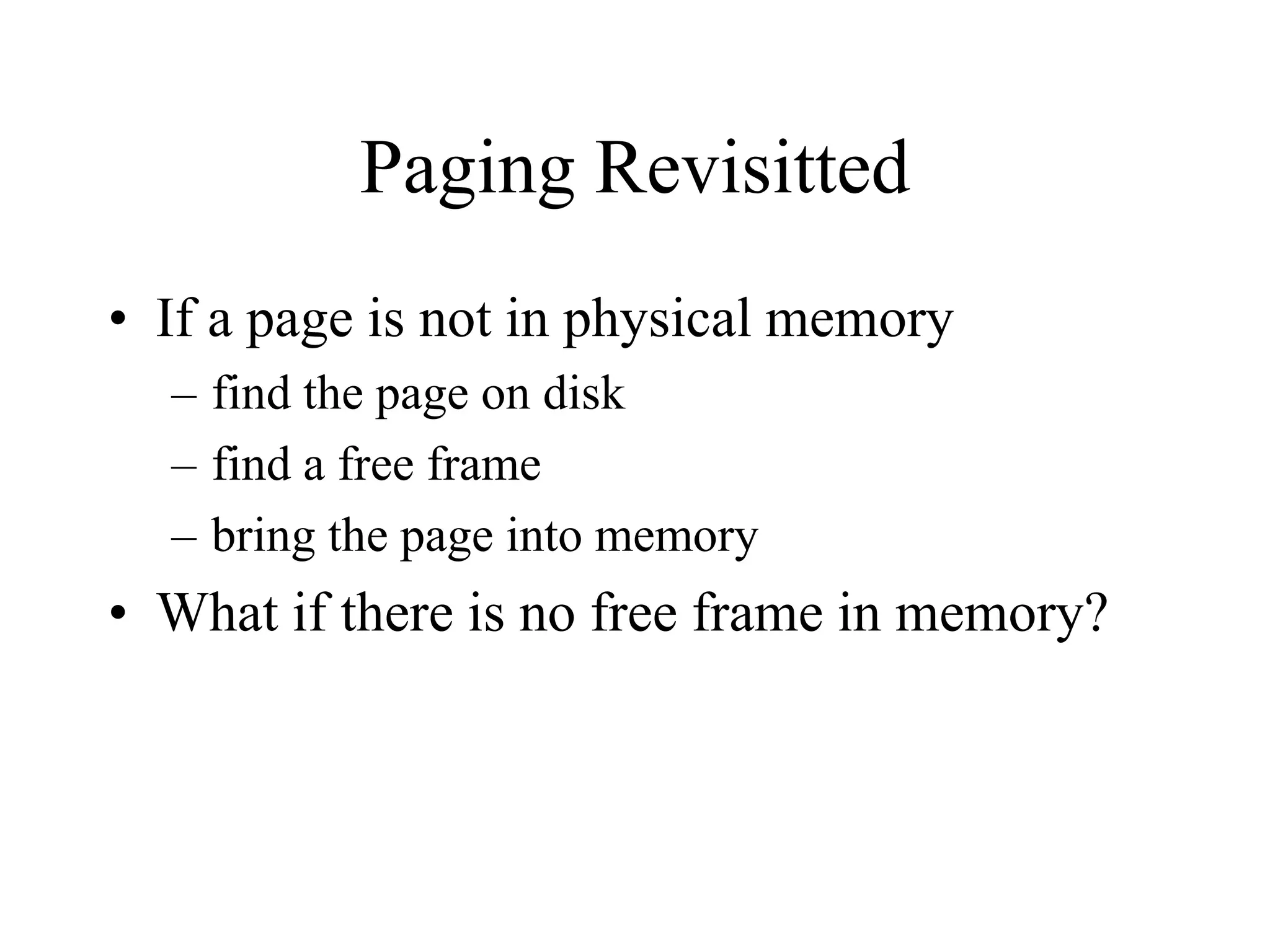
Paging Revisitted
• If a page is not in physical memory
– find the page on disk
– find a free frame
– bring the page into memory
• What if there is no free frame in memory?
Page Replacement
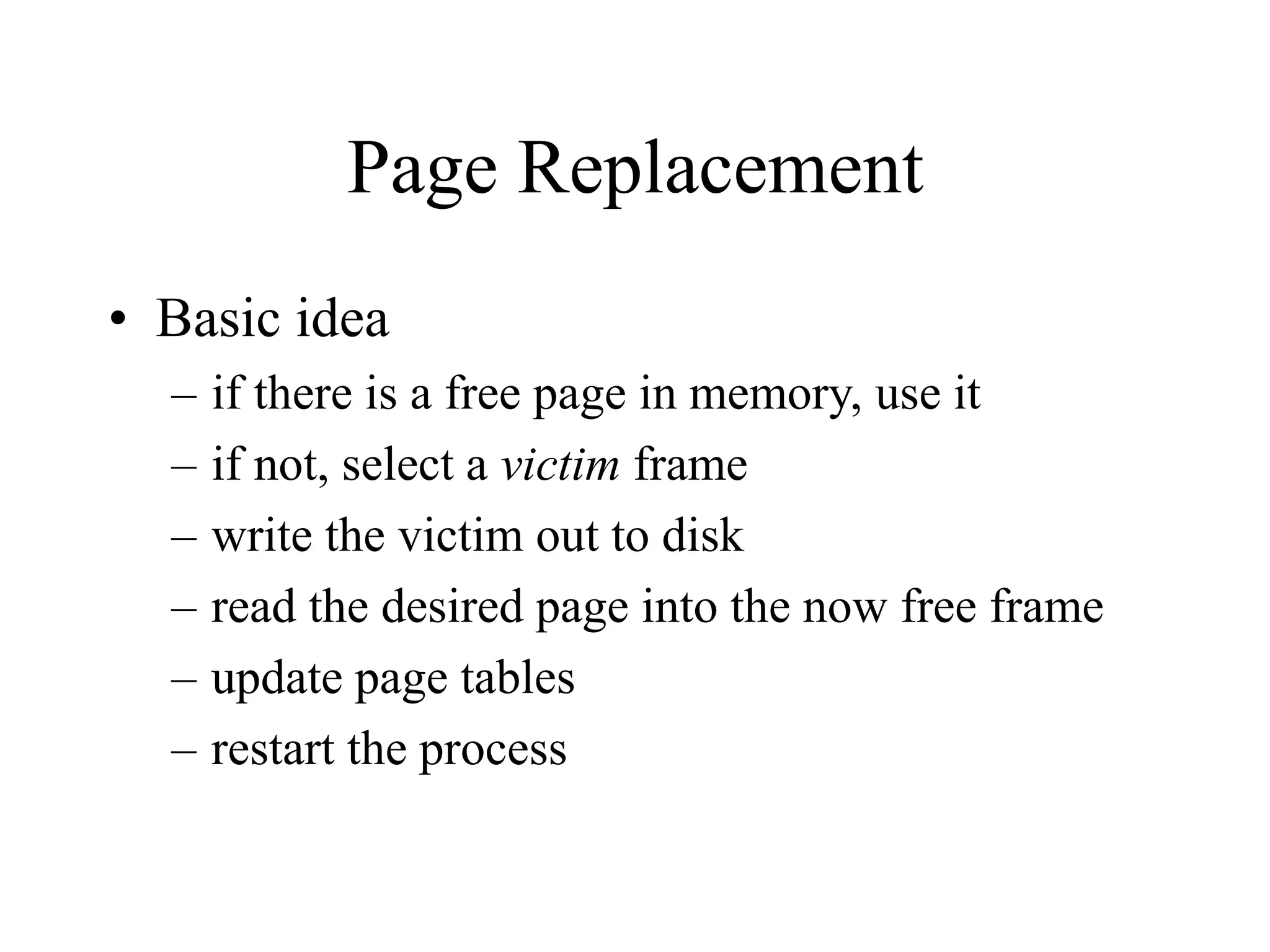
• Basic idea
– if there is a free page in memory, use it
– if not, select a victim frame
– write the victim out to disk
– read the desired page into the now free frame
– update page tables
– restart the process
Page Replacement
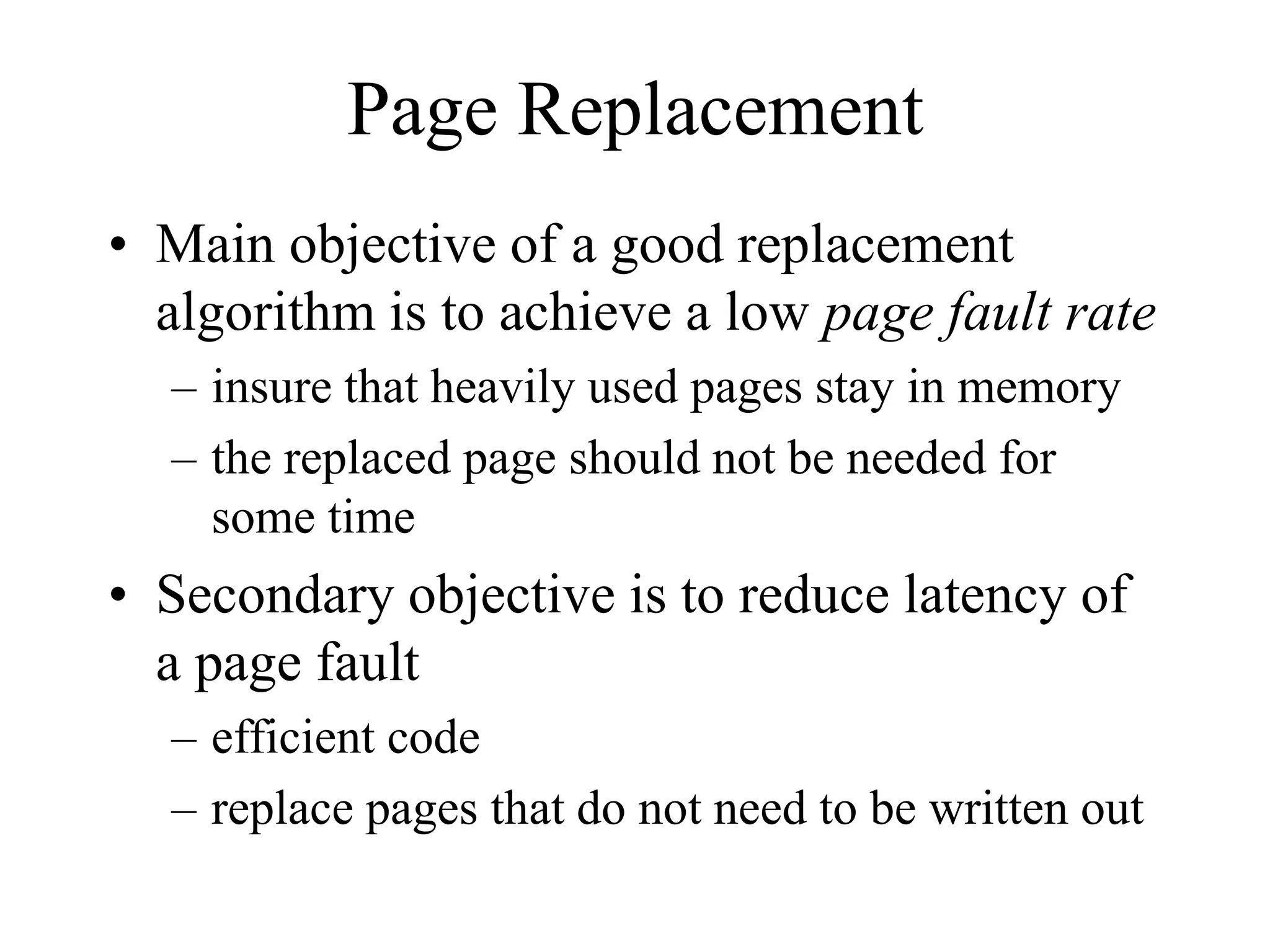
• Main objective of a good replacement
algorithm is to achieve a low page fault rate
– insure that heavily used pages stay in memory
– the replaced page should not be needed for
some time
• Secondary objective is to reduce latency of
a page fault
– efficient code
– replace pages that do not need to be written out
Reference String
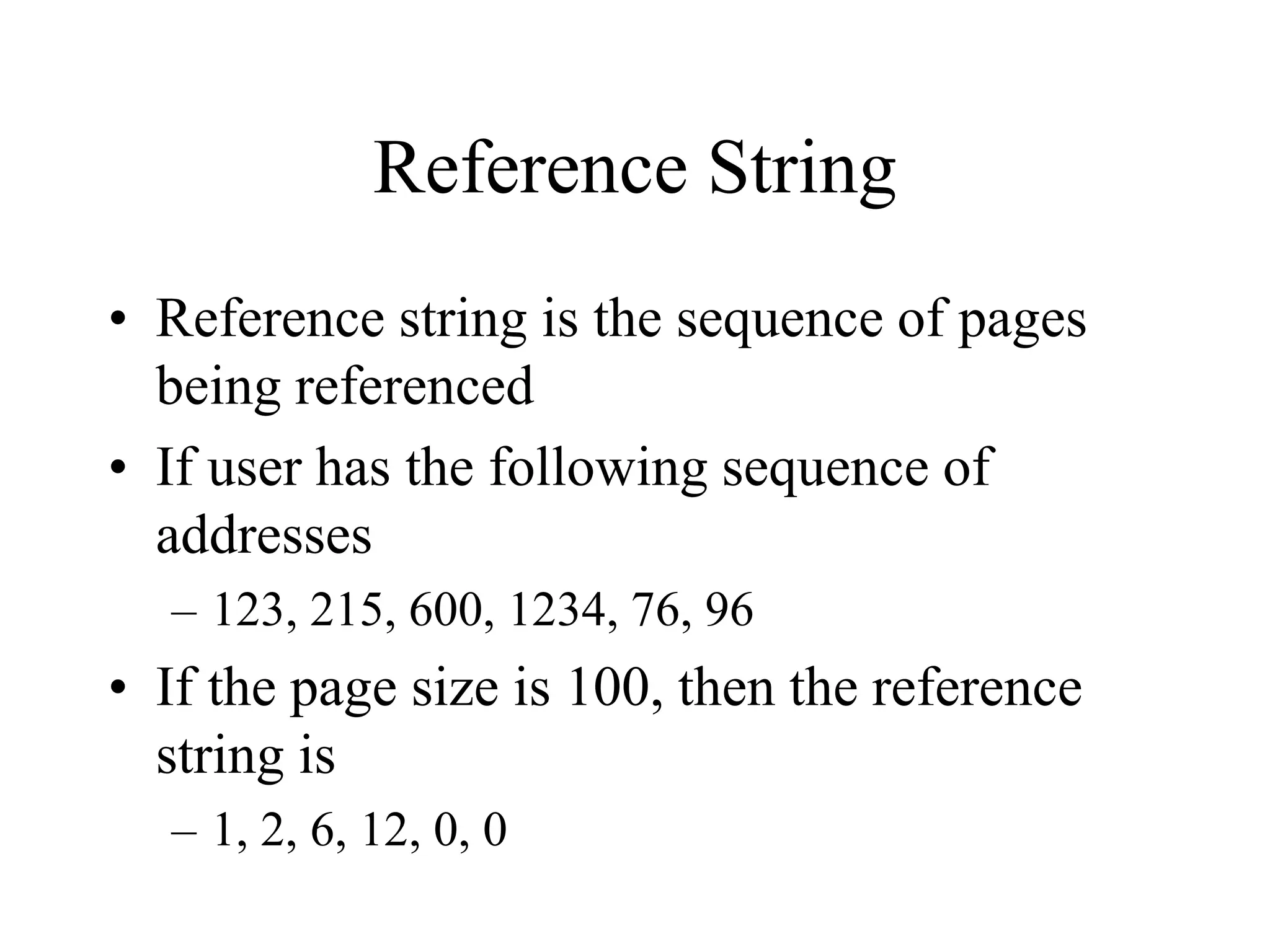
• Reference string is the sequence of pages
being referenced
• If user has the following sequence of
addresses
– 123, 215, 600, 1234, 76, 96
• If the page size is 100, then the reference
string is
– 1, 2, 6, 12, 0, 0
First-In, First-Out (FIFO)
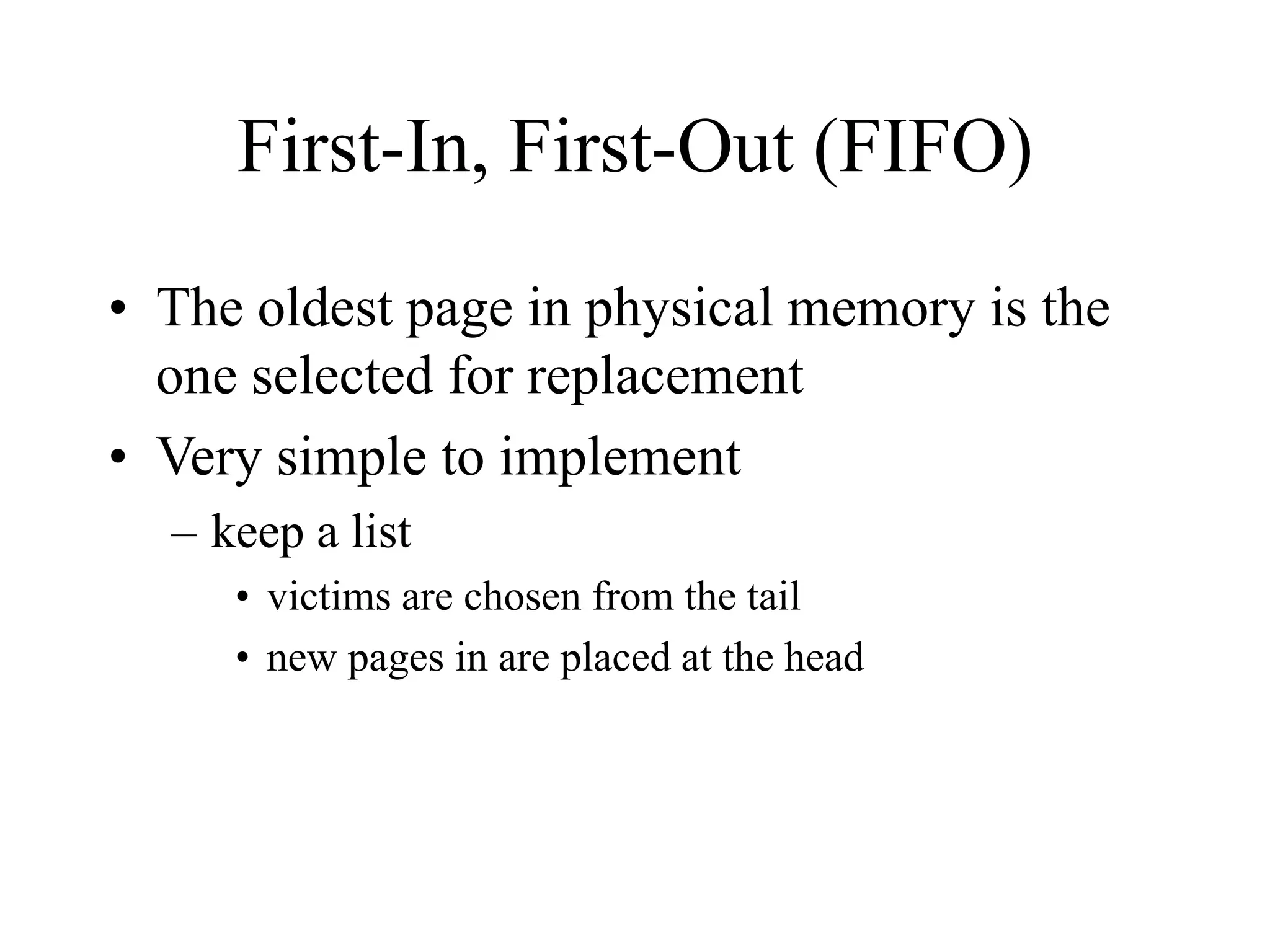
• The oldest page in physical memory is the
one selected for replacement
• Very simple to implement
– keep a list
• victims are chosen from the tail
• new pages in are placed at the head
FIFO
0
2
1
6
4
2
1
6
4
0
1
6
4
0
3
6
4
0
3
1
2
0
3
1
4 0 3 1 2
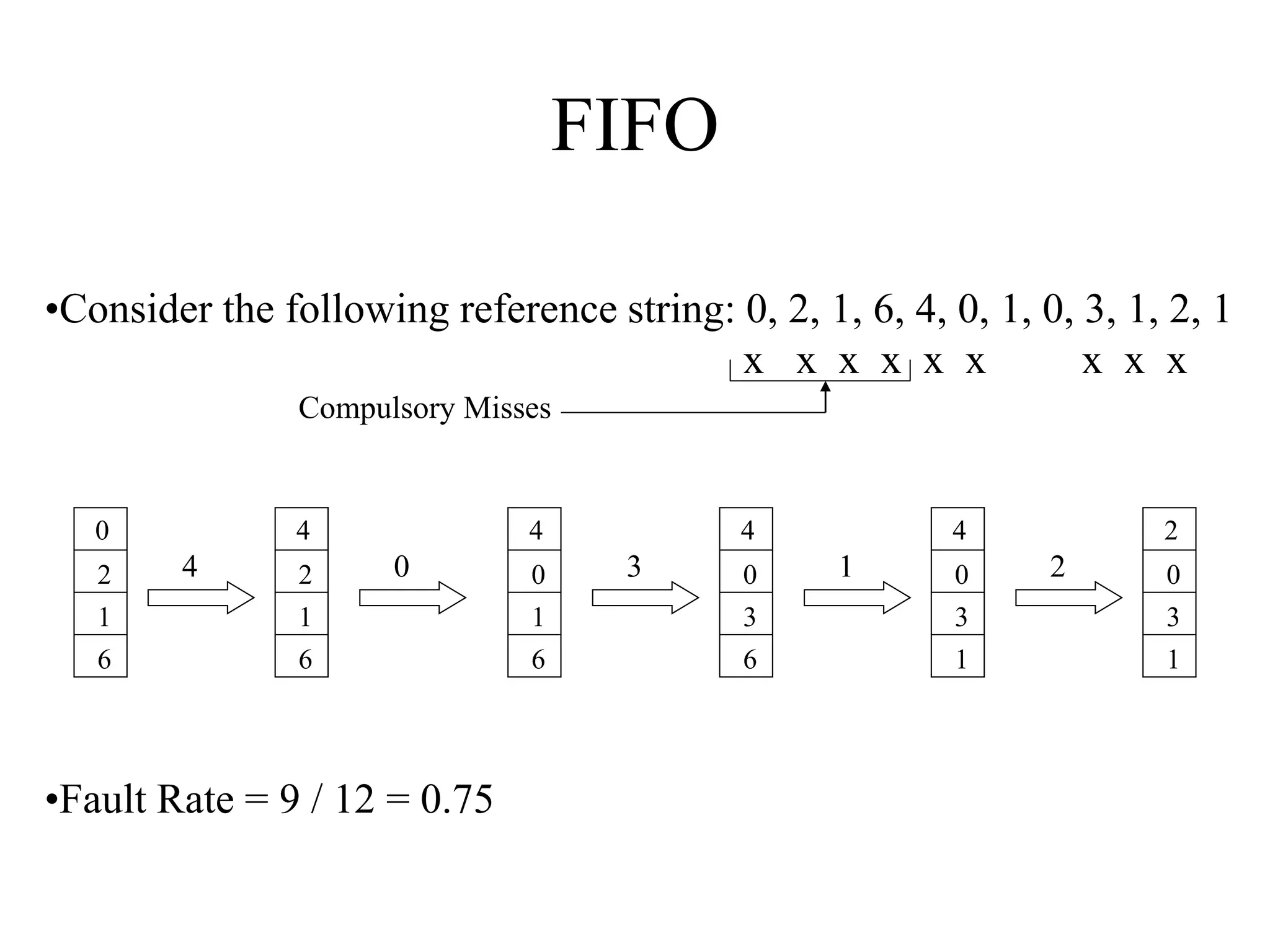
•Fault Rate = 9 / 12 = 0.75
•Consider the following reference string: 0, 2, 1, 6, 4, 0, 1, 0, 3, 1, 2, 1
x x x x x x x x x
Compulsory Misses
FIFO Issues
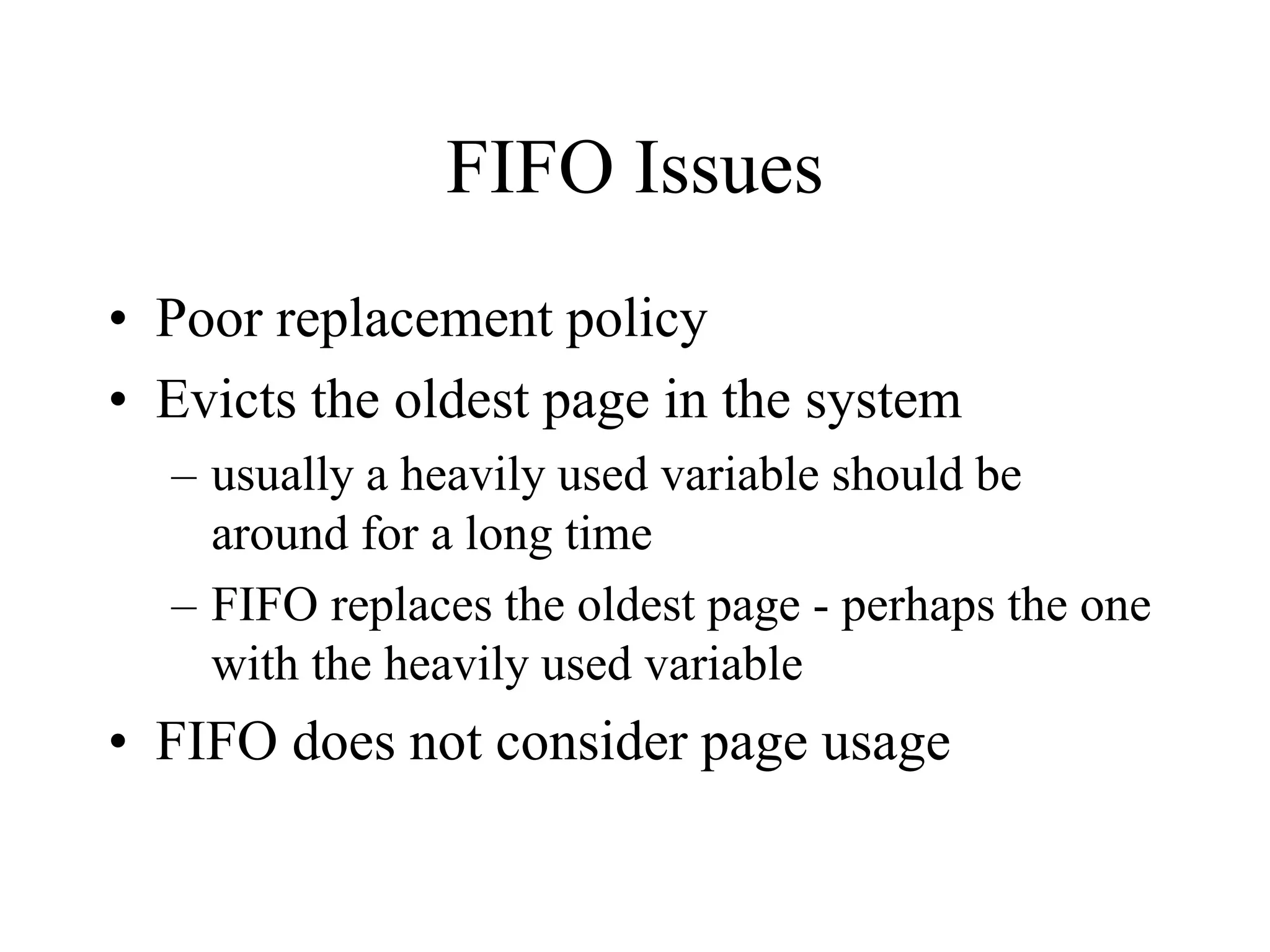
• Poor replacement policy
• Evicts the oldest page in the system
– usually a heavily used variable should be
around for a long time
– FIFO replaces the oldest page - perhaps the one
with the heavily used variable
• FIFO does not consider page usage
Optimal Page Replacement
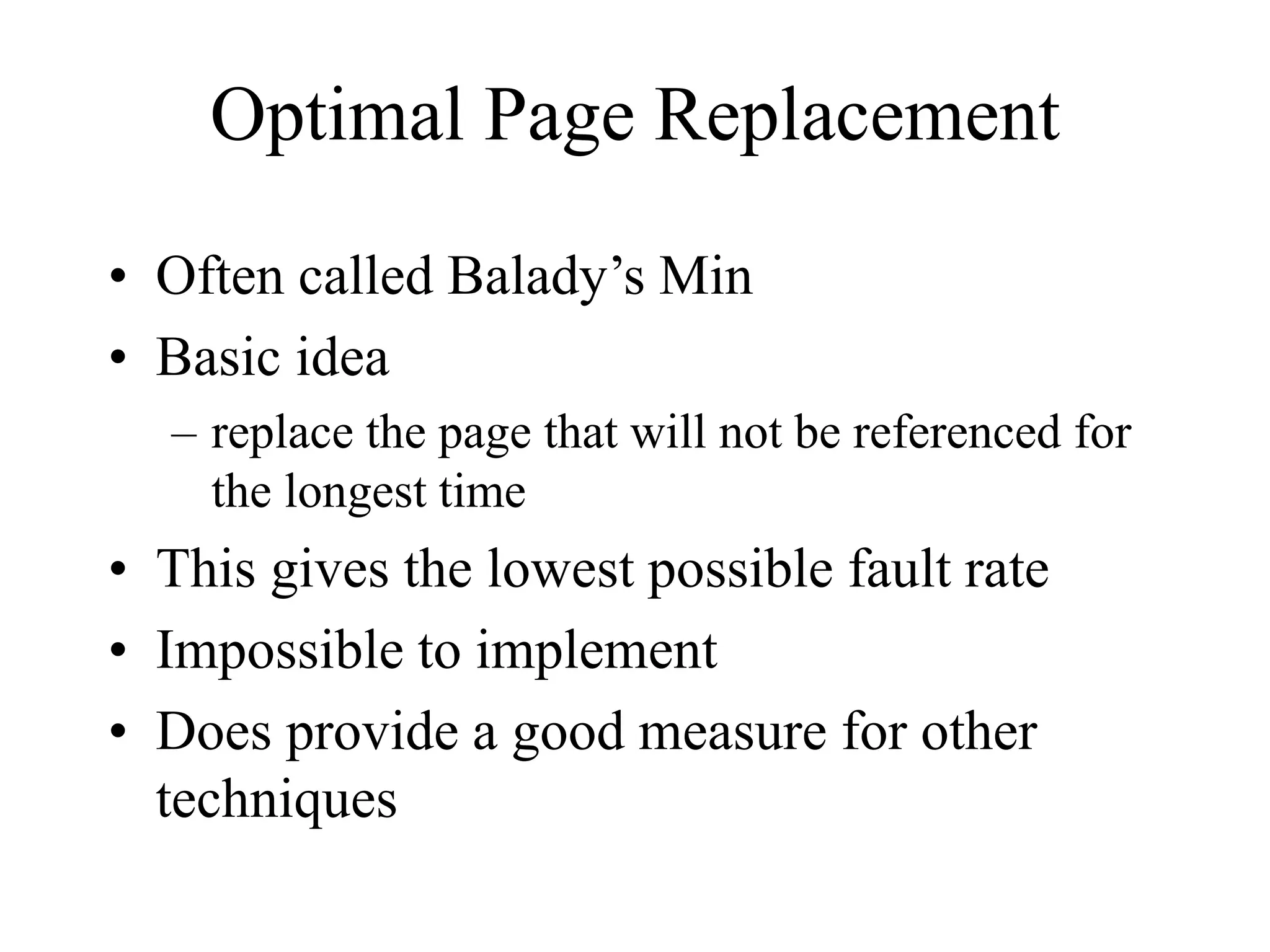
• Often called Balady’s Min
• Basic idea
– replace the page that will not be referenced for
the longest time
• This gives the lowest possible fault rate
• Impossible to implement
• Does provide a good measure for other
techniques
Optimal Page Replacement
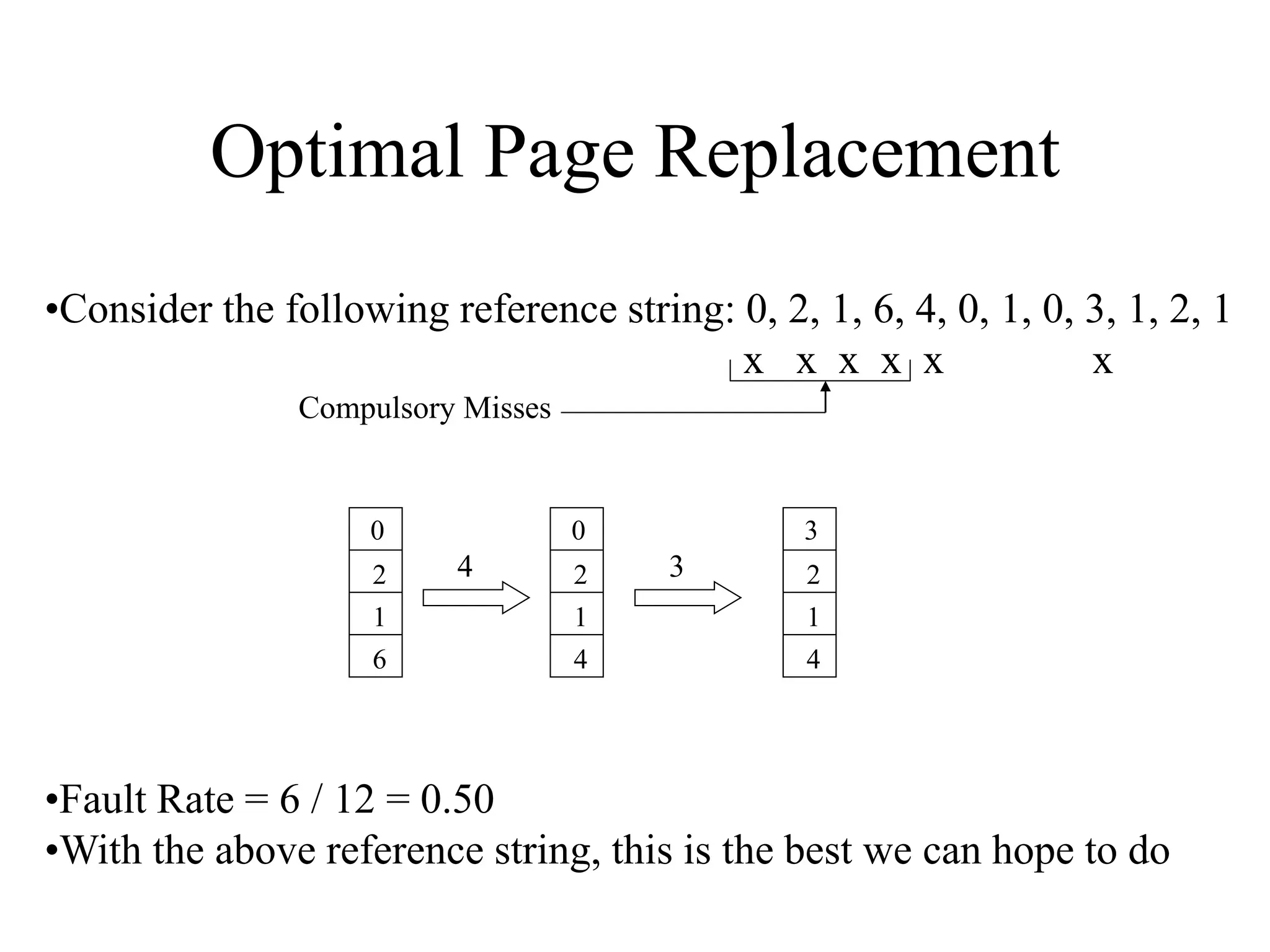
•Consider the following reference string: 0, 2, 1, 6, 4, 0, 1, 0, 3, 1, 2, 1
x x x x x x
Compulsory Misses
0
2
1
6
0
2
1
4
3
2
1
4
4 3
•Fault Rate = 6 / 12 = 0.50
•With the above reference string, this is the best we can hope to do
Least Recently Used (LRU)
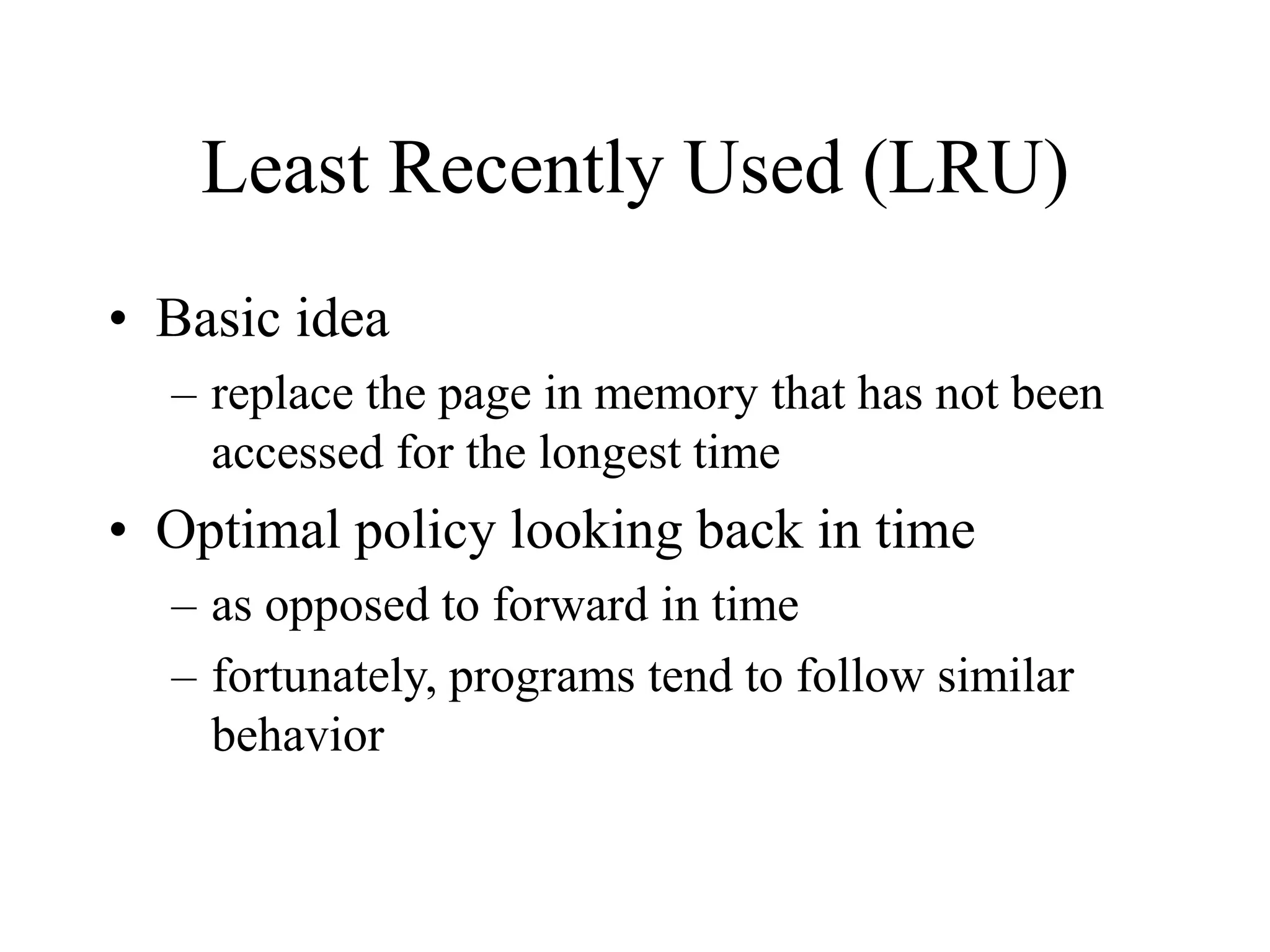
• Basic idea
– replace the page in memory that has not been
accessed for the longest time
• Optimal policy looking back in time
– as opposed to forward in time
– fortunately, programs tend to follow similar
behavior
LRU
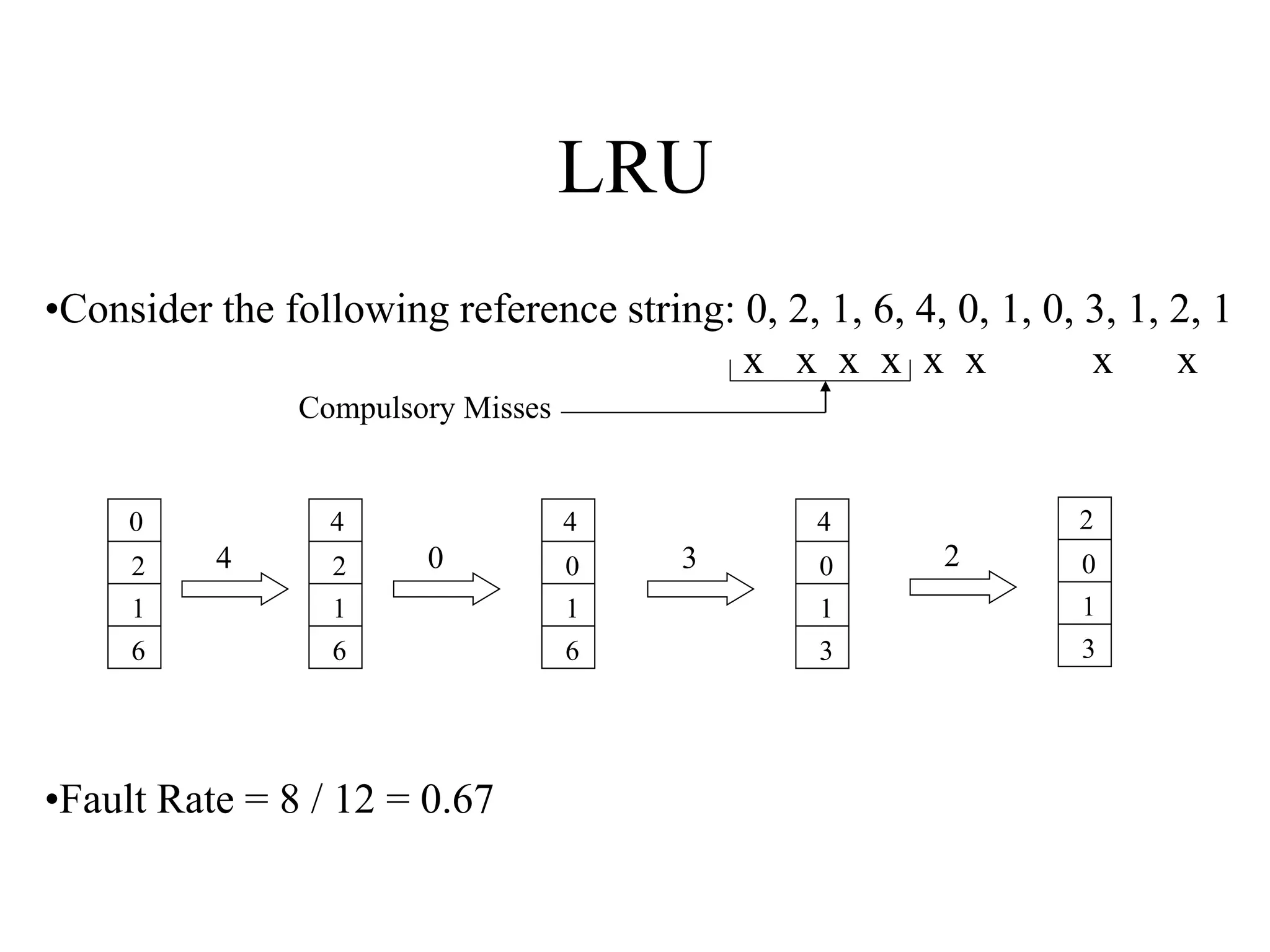
•Consider the following reference string: 0, 2, 1, 6, 4, 0, 1, 0, 3, 1, 2, 1
x x x x x x x x
Compulsory Misses
0
2
1
6
4
2
1
6
4
0
1
6
4 0
•Fault Rate = 8 / 12 = 0.67
4
0
1
3
3
2
0
1
3
2
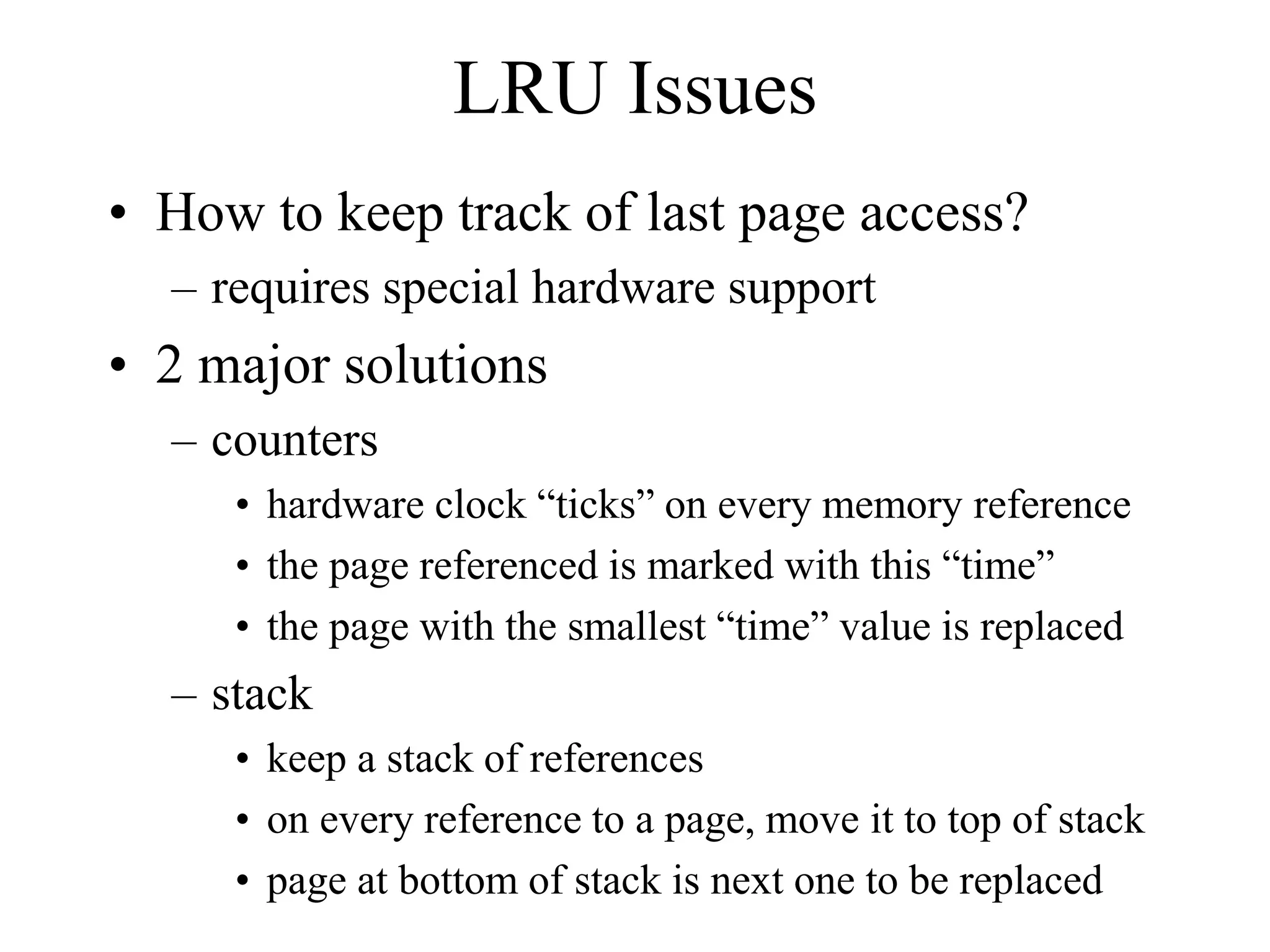
LRU Issues
• How to keep track of last page access?
– requires special hardware support
• 2 major solutions
– counters
• hardware clock “ticks” on every memory reference
• the page referenced is marked with this “time”
• the page with the smallest “time” value is replaced
– stack
• keep a stack of references
• on every reference to a page, move it to top of stack
• page at bottom of stack is next one to be replaced
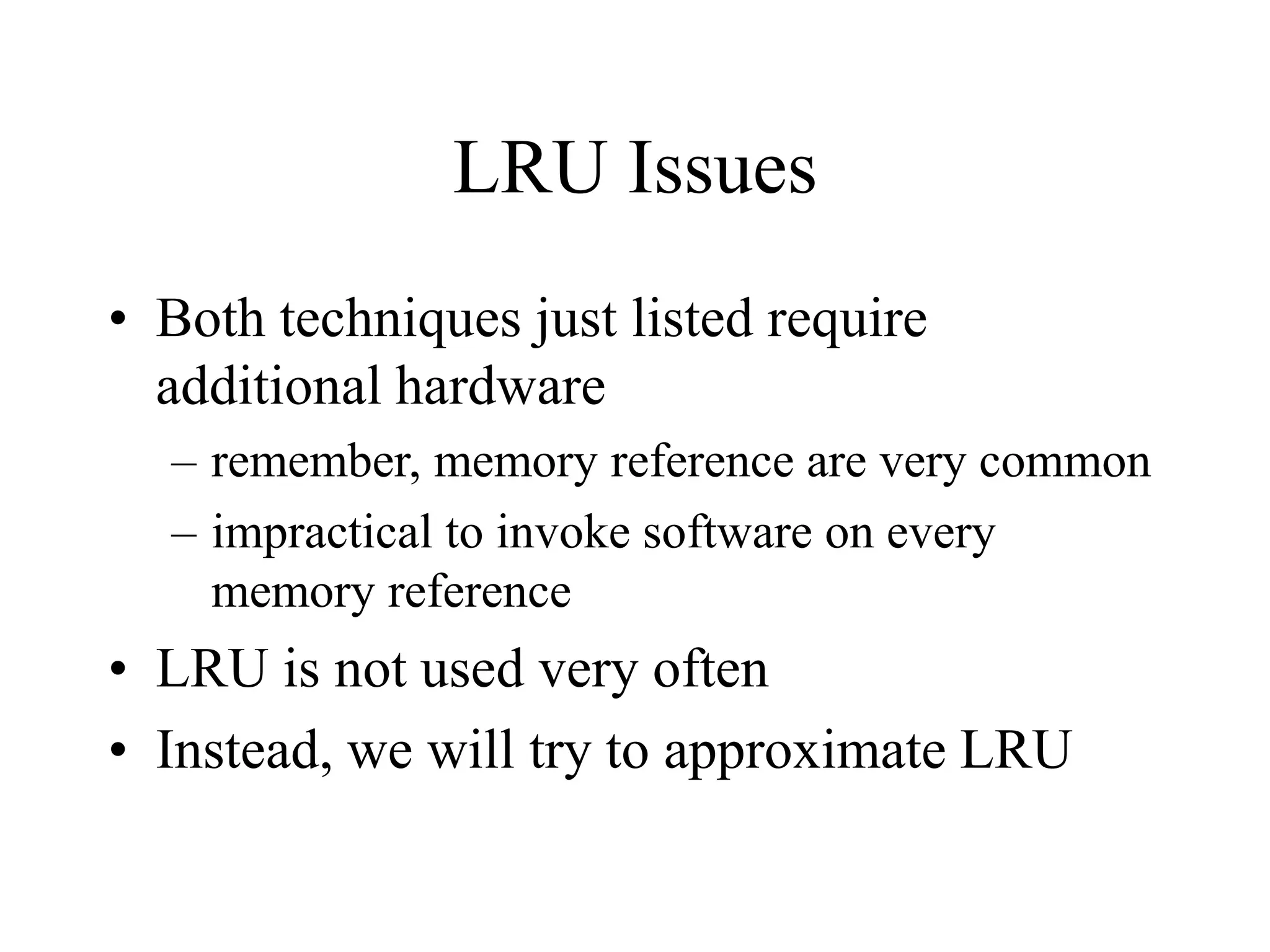
LRU Issues
• Both techniques just listed require
additional hardware
– remember, memory reference are very common
– impractical to invoke software on every
memory reference
• LRU is not used very often
• Instead, we will try to approximate LRU
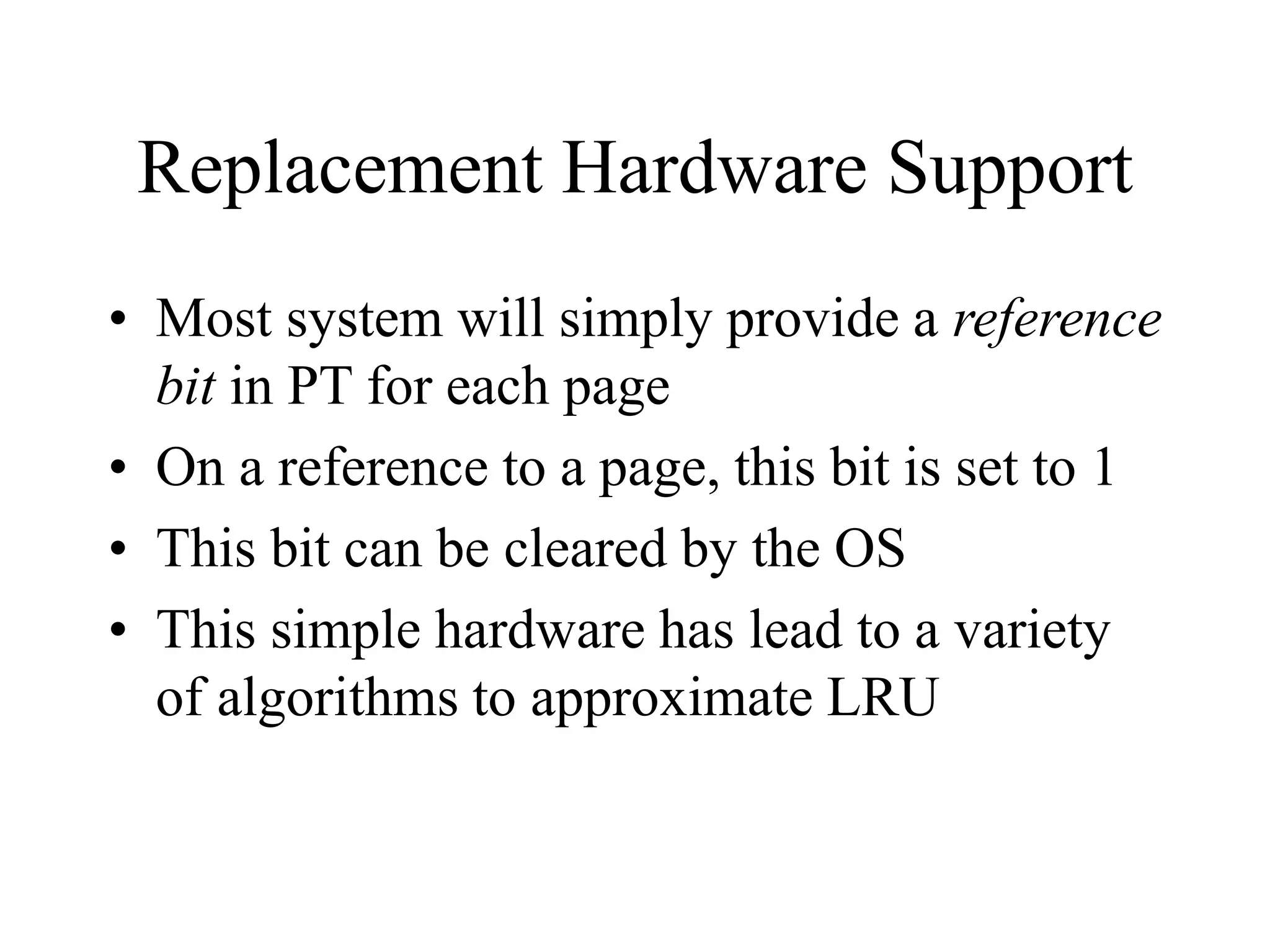
Replacement Hardware Support
• Most system will simply provide a reference
bit in PT for each page
• On a reference to a page, this bit is set to 1
• This bit can be cleared by the OS
• This simple hardware has lead to a variety
of algorithms to approximate LRU
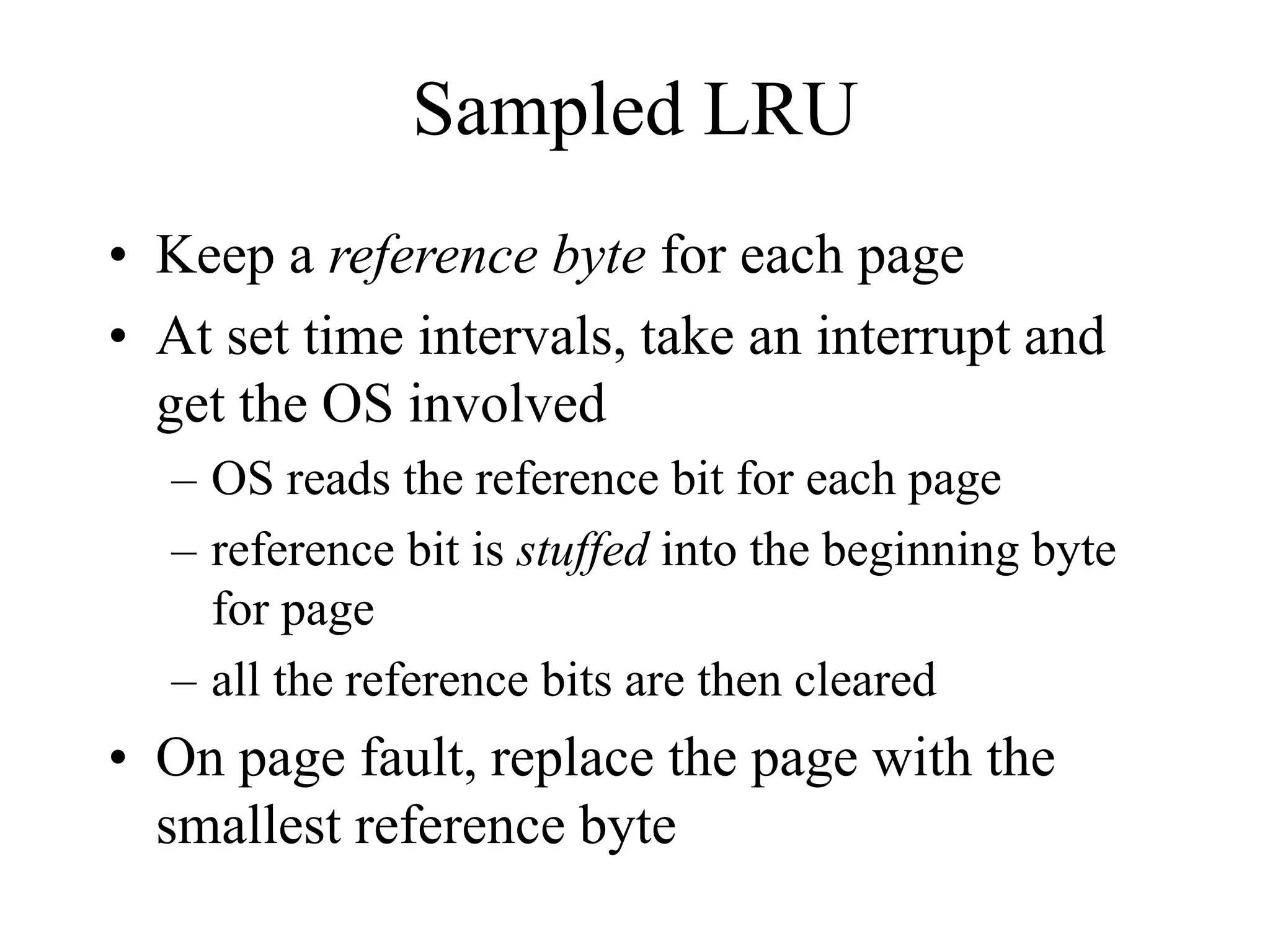
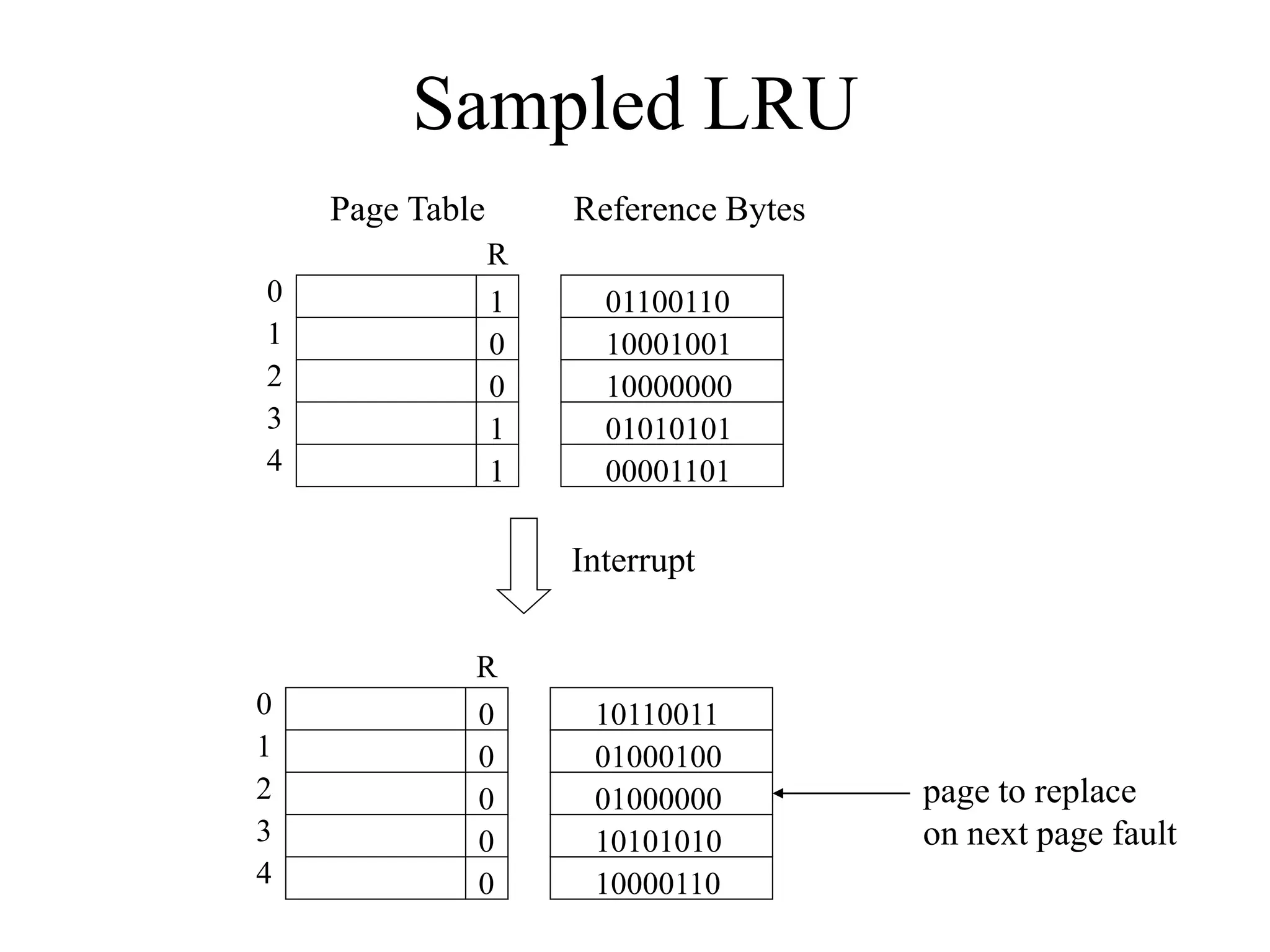
Sampled LRU
• Keep a reference byte for each page
• At set time intervals, take an interrupt and
get the OS involved
– OS reads the reference bit for each page
– reference bit is stuffed into the beginning byte
for page
– all the reference bits are then cleared
• On page fault, replace the page with the
smallest reference byte
Sampled LRU
R
0
1
2
3
4
1
1
1
0
0
01100110
10001001
10000000
01010101
00001101
Interrupt
R
0
1
2
3
4
0
0
0
0
0
10110011
01000100
01000000
10101010
10000110
Page Table Reference Bytes
page to replace
on next page fault
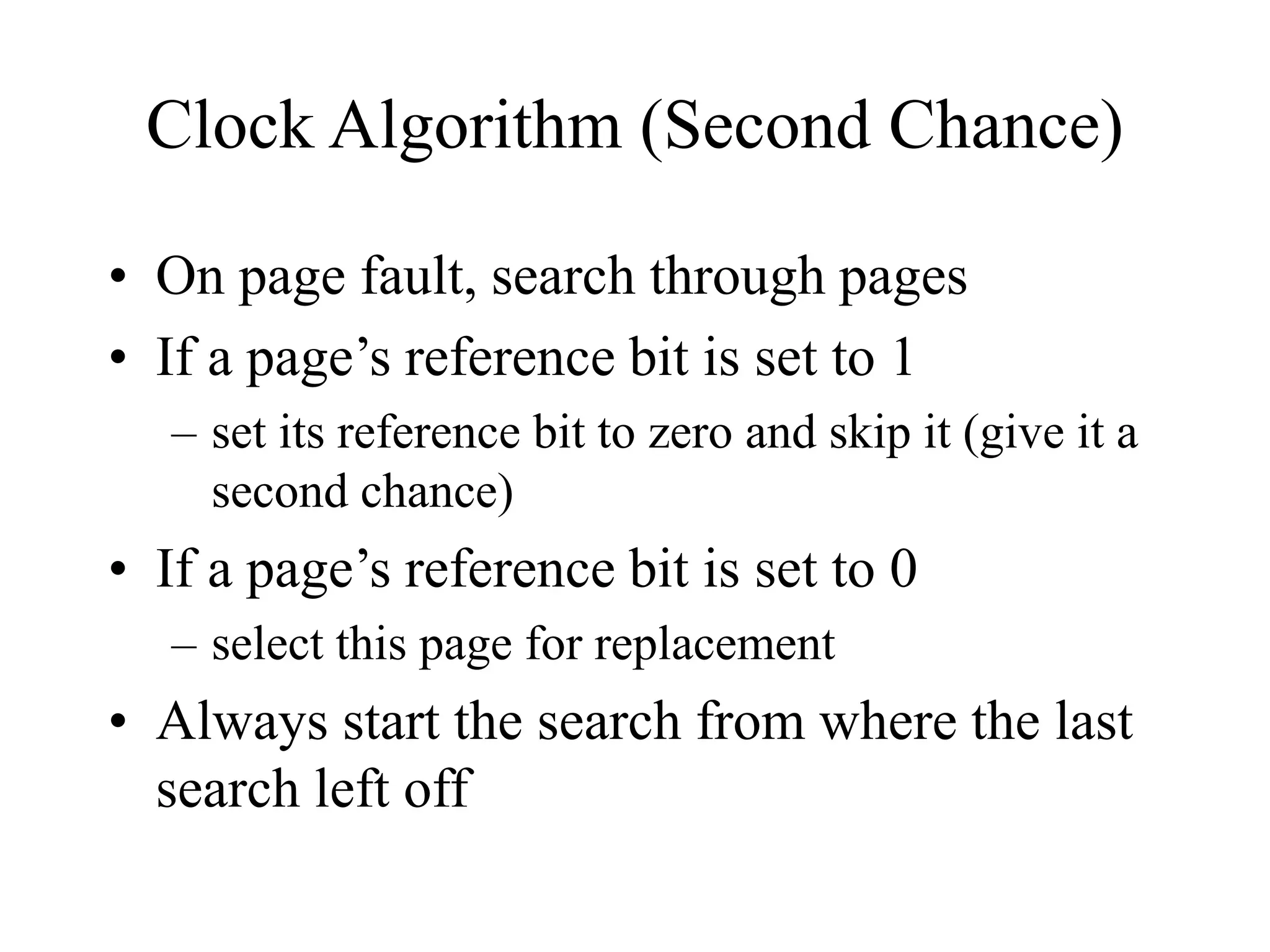
Clock Algorithm (Second Chance)
• On page fault, search through pages
• If a page’s reference bit is set to 1
– set its reference bit to zero and skip it (give it a
second chance)
• If a page’s reference bit is set to 0
– select this page for replacement
• Always start the search from where the last
search left off
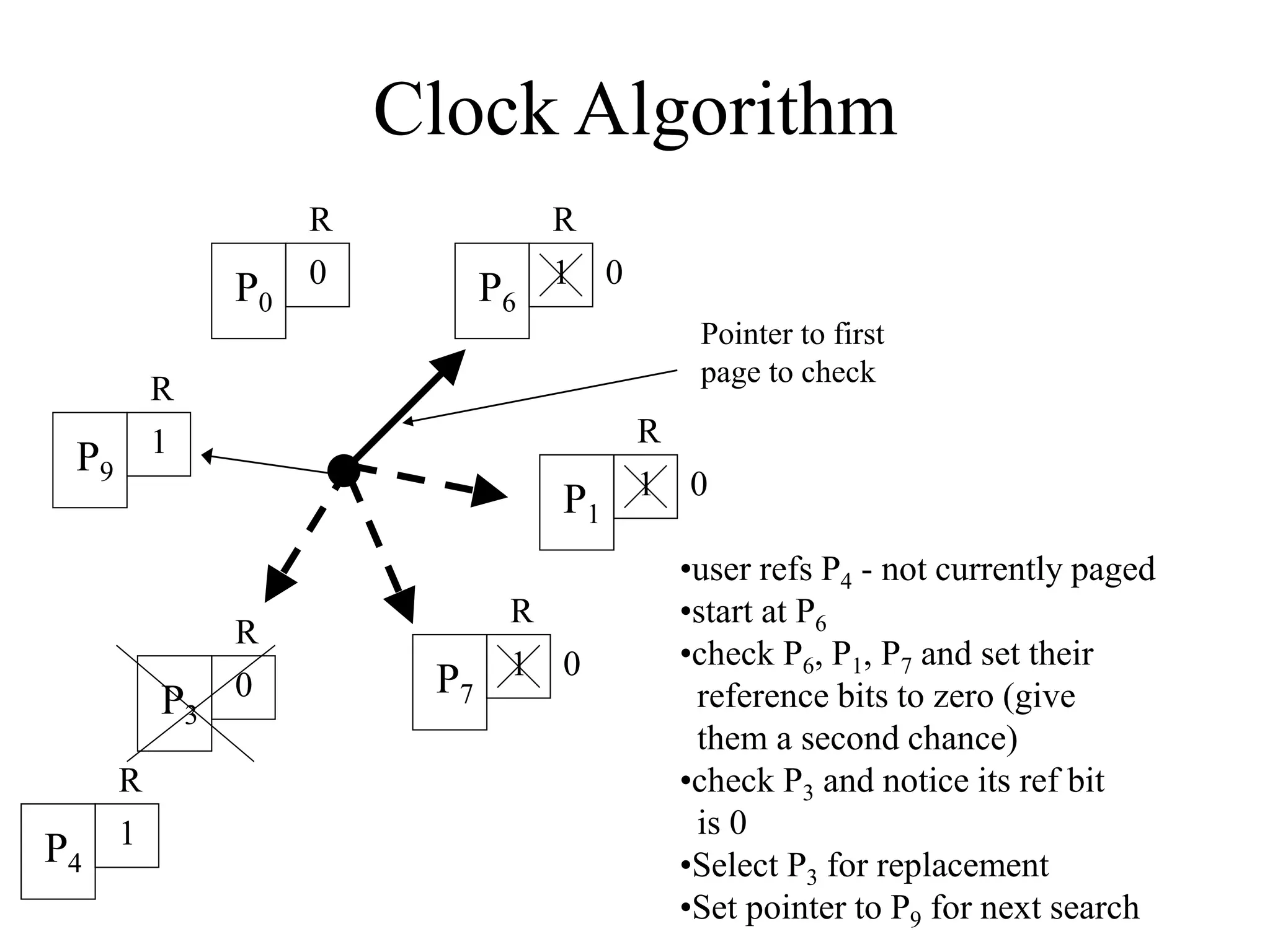
Clock Algorithm
R
1
P6
R
1
P1
R
1
P7
R
0
P3
R
1
P9
R
0
P0
Pointer to first
page to check
•user refs P4 - not currently paged
•start at P6
•check P6, P1, P7 and set their
reference bits to zero (give
them a second chance)
•check P3 and notice its ref bit
is 0
•Select P3 for replacement
•Set pointer to P9 for next search
0
0
0
R
1
P4
Dirty Pages
• If a page has been written to, it is dirty
• Before a dirty page can be replaced it must
be written to disk
• A clean page does not need to be written to
disk
– the copy on disk is already up-to-date
• We would rather replace an old, clean page
than and old, dirty page
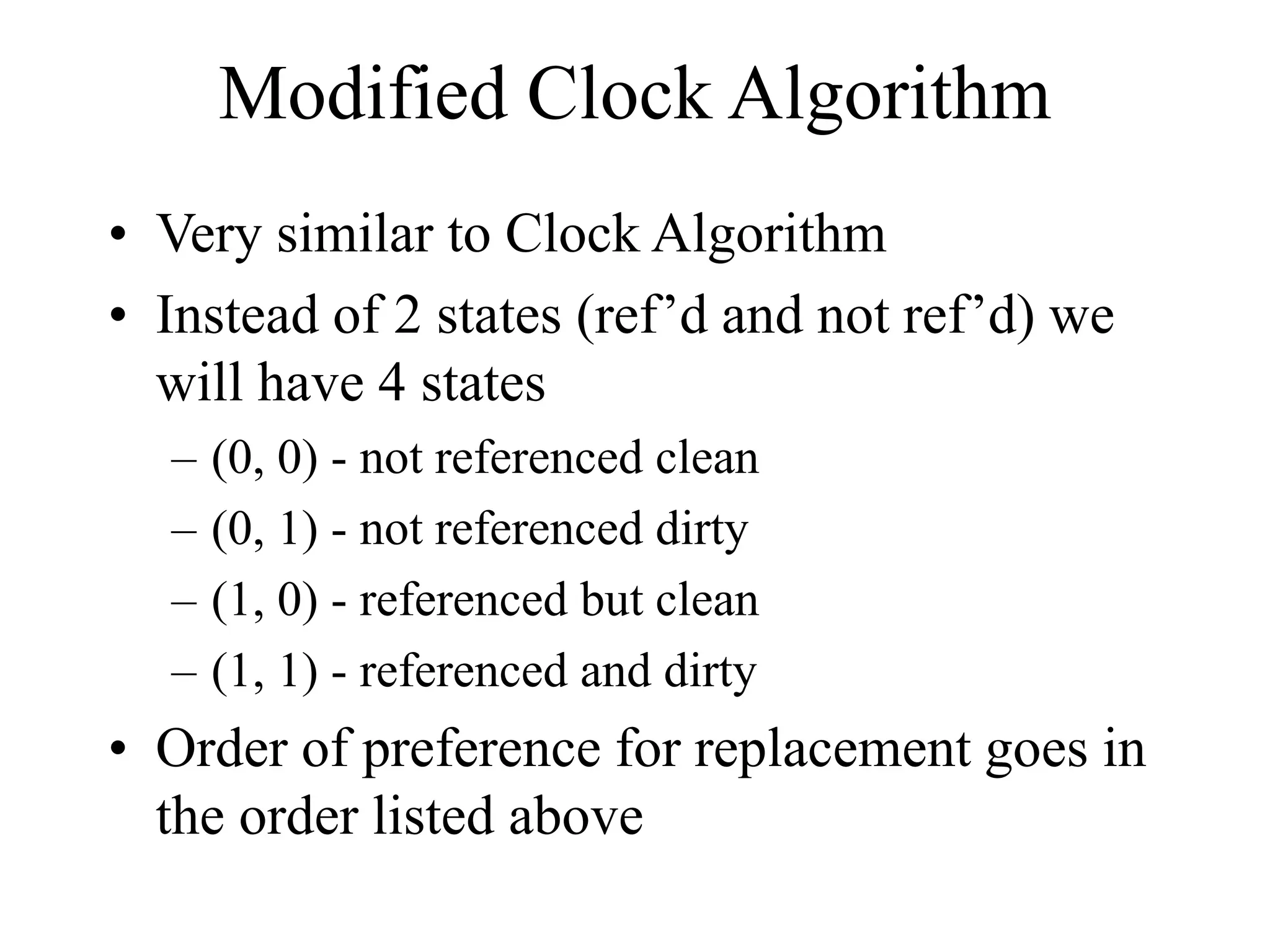
Modified Clock Algorithm
• Very similar to Clock Algorithm
• Instead of 2 states (ref’d and not ref’d) we
will have 4 states
– (0, 0) - not referenced clean
– (0, 1) - not referenced dirty
– (1, 0) - referenced but clean
– (1, 1) - referenced and dirty
• Order of preference for replacement goes in
the order listed above
Modified Clock Algorithm
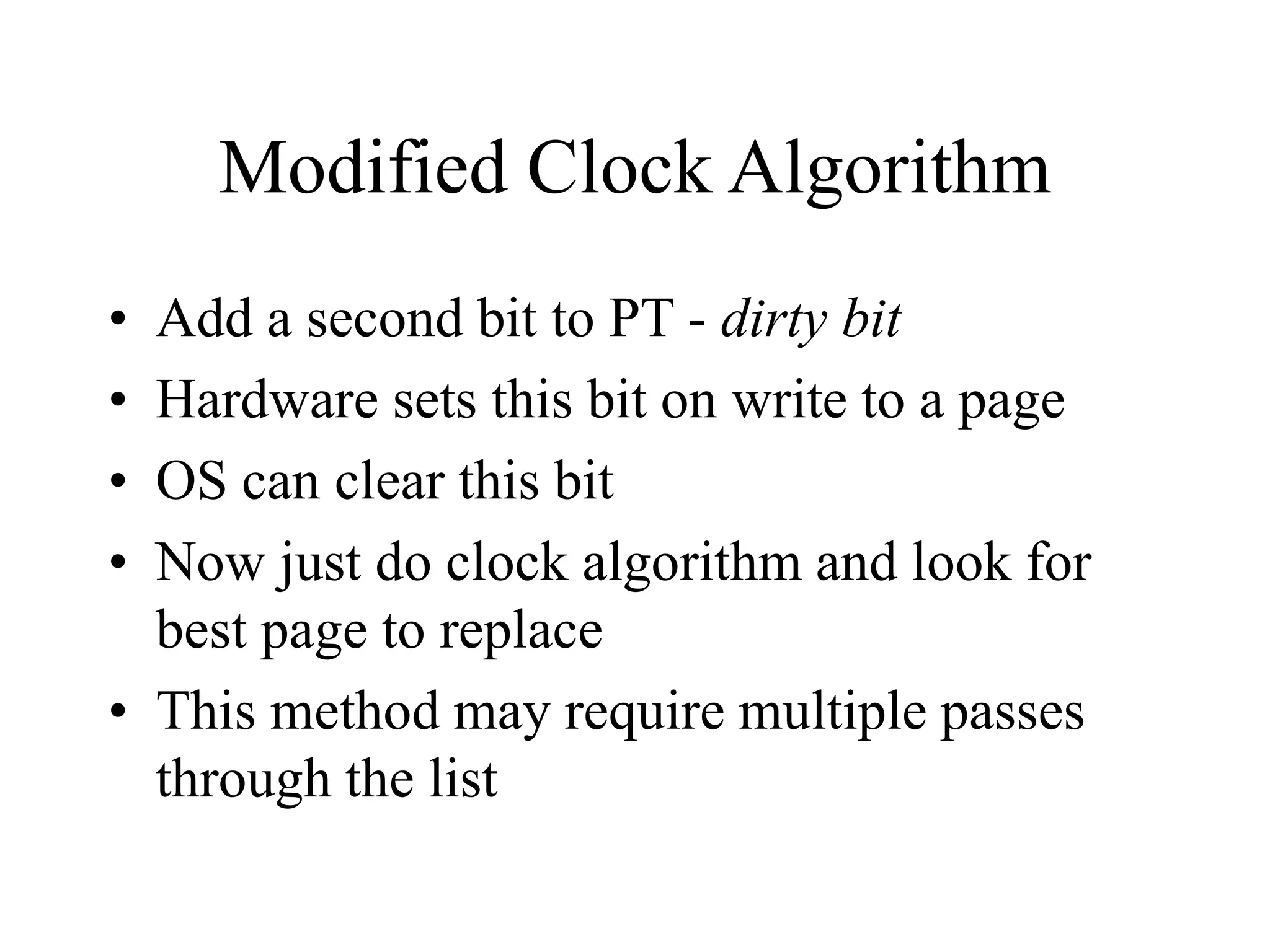
• Add a second bit to PT - dirty bit
• Hardware sets this bit on write to a page
• OS can clear this bit
• Now just do clock algorithm and look for
best page to replace
• This method may require multiple passes
through the list
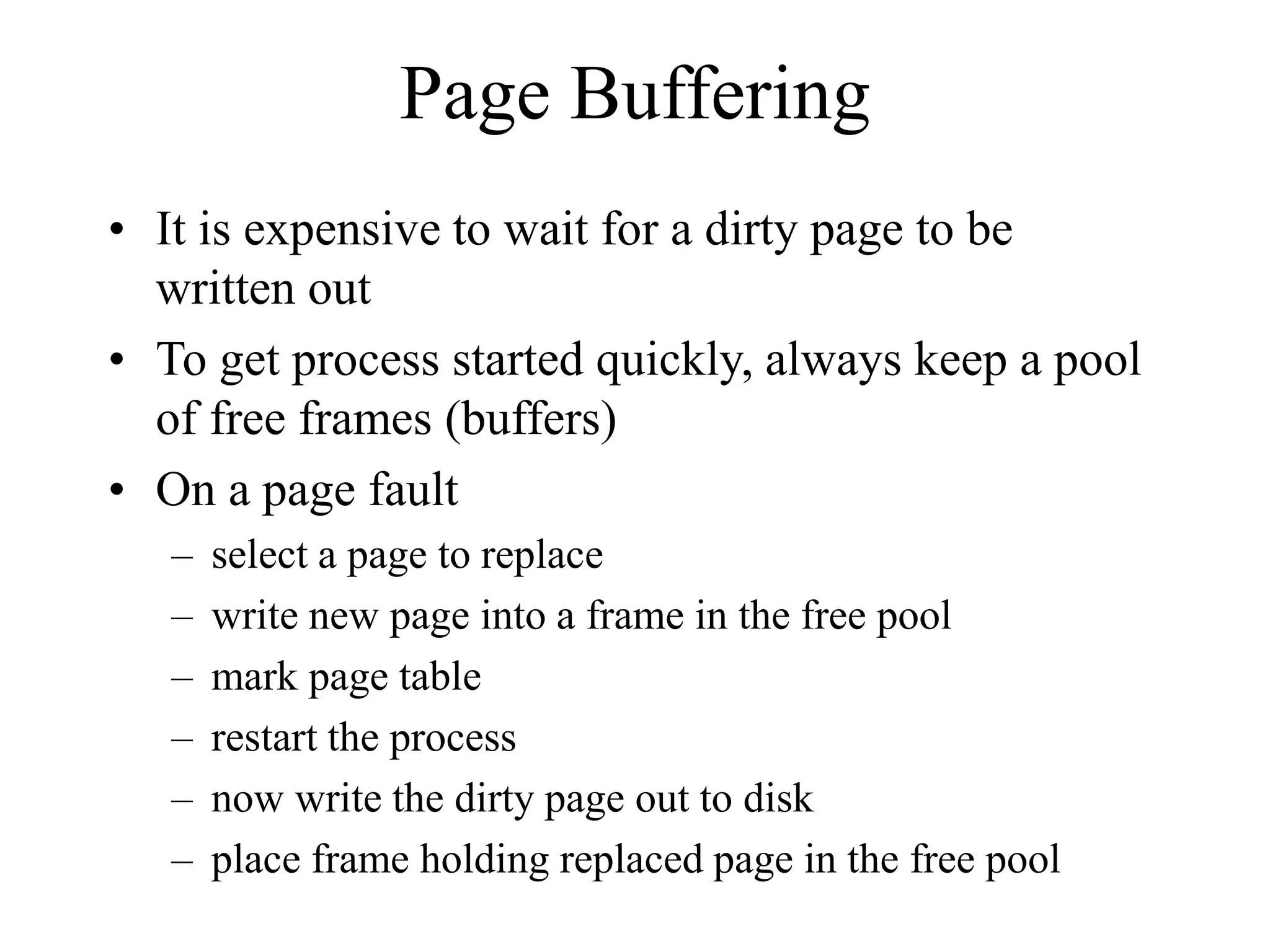
Page Buffering
• It is expensive to wait for a dirty page to be
written out
• To get process started quickly, always keep a pool
of free frames (buffers)
• On a page fault
– select a page to replace
– write new page into a frame in the free pool
– mark page table
– restart the process
– now write the dirty page out to disk
– place frame holding replaced page in the free pool

Replacement.ppt operating system in BCA cu

  • 1.
    Page Replacement CS 537- Introduction to Operating Systems
  • 2.
    Paging Revisitted • Ifa page is not in physical memory – find the page on disk – find a free frame – bring the page into memory • What if there is no free frame in memory?
  • 3.
    Page Replacement • Basicidea – if there is a free page in memory, use it – if not, select a victim frame – write the victim out to disk – read the desired page into the now free frame – update page tables – restart the process
  • 4.
    Page Replacement • Mainobjective of a good replacement algorithm is to achieve a low page fault rate – insure that heavily used pages stay in memory – the replaced page should not be needed for some time • Secondary objective is to reduce latency of a page fault – efficient code – replace pages that do not need to be written out
  • 5.
    Reference String • Referencestring is the sequence of pages being referenced • If user has the following sequence of addresses – 123, 215, 600, 1234, 76, 96 • If the page size is 100, then the reference string is – 1, 2, 6, 12, 0, 0
  • 6.
    First-In, First-Out (FIFO) •The oldest page in physical memory is the one selected for replacement • Very simple to implement – keep a list • victims are chosen from the tail • new pages in are placed at the head
  • 7.
    FIFO 0 2 1 6 4 2 1 6 4 0 1 6 4 0 3 6 4 0 3 1 2 0 3 1 4 0 31 2 •Fault Rate = 9 / 12 = 0.75 •Consider the following reference string: 0, 2, 1, 6, 4, 0, 1, 0, 3, 1, 2, 1 x x x x x x x x x Compulsory Misses
  • 8.
    FIFO Issues • Poorreplacement policy • Evicts the oldest page in the system – usually a heavily used variable should be around for a long time – FIFO replaces the oldest page - perhaps the one with the heavily used variable • FIFO does not consider page usage
  • 9.
    Optimal Page Replacement •Often called Balady’s Min • Basic idea – replace the page that will not be referenced for the longest time • This gives the lowest possible fault rate • Impossible to implement • Does provide a good measure for other techniques
  • 10.
    Optimal Page Replacement •Considerthe following reference string: 0, 2, 1, 6, 4, 0, 1, 0, 3, 1, 2, 1 x x x x x x Compulsory Misses 0 2 1 6 0 2 1 4 3 2 1 4 4 3 •Fault Rate = 6 / 12 = 0.50 •With the above reference string, this is the best we can hope to do
  • 11.
    Least Recently Used(LRU) • Basic idea – replace the page in memory that has not been accessed for the longest time • Optimal policy looking back in time – as opposed to forward in time – fortunately, programs tend to follow similar behavior
  • 12.
    LRU •Consider the followingreference string: 0, 2, 1, 6, 4, 0, 1, 0, 3, 1, 2, 1 x x x x x x x x Compulsory Misses 0 2 1 6 4 2 1 6 4 0 1 6 4 0 •Fault Rate = 8 / 12 = 0.67 4 0 1 3 3 2 0 1 3 2
  • 13.
    LRU Issues • Howto keep track of last page access? – requires special hardware support • 2 major solutions – counters • hardware clock “ticks” on every memory reference • the page referenced is marked with this “time” • the page with the smallest “time” value is replaced – stack • keep a stack of references • on every reference to a page, move it to top of stack • page at bottom of stack is next one to be replaced
  • 14.
    LRU Issues • Bothtechniques just listed require additional hardware – remember, memory reference are very common – impractical to invoke software on every memory reference • LRU is not used very often • Instead, we will try to approximate LRU
  • 15.
    Replacement Hardware Support •Most system will simply provide a reference bit in PT for each page • On a reference to a page, this bit is set to 1 • This bit can be cleared by the OS • This simple hardware has lead to a variety of algorithms to approximate LRU
  • 16.
    Sampled LRU • Keepa reference byte for each page • At set time intervals, take an interrupt and get the OS involved – OS reads the reference bit for each page – reference bit is stuffed into the beginning byte for page – all the reference bits are then cleared • On page fault, replace the page with the smallest reference byte
  • 17.
  • 18.
    Clock Algorithm (SecondChance) • On page fault, search through pages • If a page’s reference bit is set to 1 – set its reference bit to zero and skip it (give it a second chance) • If a page’s reference bit is set to 0 – select this page for replacement • Always start the search from where the last search left off
  • 19.
    Clock Algorithm R 1 P6 R 1 P1 R 1 P7 R 0 P3 R 1 P9 R 0 P0 Pointer tofirst page to check •user refs P4 - not currently paged •start at P6 •check P6, P1, P7 and set their reference bits to zero (give them a second chance) •check P3 and notice its ref bit is 0 •Select P3 for replacement •Set pointer to P9 for next search 0 0 0 R 1 P4
  • 20.
    Dirty Pages • Ifa page has been written to, it is dirty • Before a dirty page can be replaced it must be written to disk • A clean page does not need to be written to disk – the copy on disk is already up-to-date • We would rather replace an old, clean page than and old, dirty page
  • 21.
    Modified Clock Algorithm •Very similar to Clock Algorithm • Instead of 2 states (ref’d and not ref’d) we will have 4 states – (0, 0) - not referenced clean – (0, 1) - not referenced dirty – (1, 0) - referenced but clean – (1, 1) - referenced and dirty • Order of preference for replacement goes in the order listed above
  • 22.
    Modified Clock Algorithm •Add a second bit to PT - dirty bit • Hardware sets this bit on write to a page • OS can clear this bit • Now just do clock algorithm and look for best page to replace • This method may require multiple passes through the list
  • 23.
    Page Buffering • Itis expensive to wait for a dirty page to be written out • To get process started quickly, always keep a pool of free frames (buffers) • On a page fault – select a page to replace – write new page into a frame in the free pool – mark page table – restart the process – now write the dirty page out to disk – place frame holding replaced page in the free pool