Sector Profile


  Namrata Sundaresan
  Tel: +91 98401 84541               Renewable Energy
  Email:namrata.sundaresan
  @ibipartners.com
                                     The renewable energy sector in India is poised for strong growth as the
  Giju Mathew                        government seeks to harness renewable energy sources to bridge the
  Tel: +91 99164 80277               energy gap and reduce dependence on fossil fuels. Large, unexploited
  Email:giju.mathew@ibipart
  ners.com
                                     domestic resources and a favourably aligned regulatory environment
                                     further encourage investments in this sector.

   Industry facts                    According to the UN World Economic and Social Survey 2009, India is the
                                     most developed renewable energy market in South Asia with an annual
    Total installed power           turnover of about $500 million. The report states that India’s generation
     generation capacity –           of power through renewable energy sources is only a fraction of the
     1,61,352 MW                     estimated total economic potential of 100,000 MW.
    Share of renewable
     energy – 17,222 MW
                                     Government initiatives such as the National Electricity Policy and the
                                     Renewable Energy Plan 2012 have helped India become the country with
     (10 percent)
                                     the most developed and diversified renewable energy market in South
                                     Asia.

                                     Why India for renewable energy investment?
   Industry sub-segments

    Solar Energy                    Renewable energy is growing rapidly in India. With an installed capacity of
       o Solar Thermal               17.2 GW, renewables (excluding large hydro) account for about 10 percent
       o Solar Photovoltaic
                                     of India’s overall power generation capacity.
   Wind
                                     According to E&Y’s renewable energy index (May 2010), which takes into
   Ocean Thermal Energy              account various factors governing renewable energy growth in a country,
   Biomass                           India is ranked 4th overall. Depletion of fossil fuels and the need for energy
   Geothermal                        security in addition to abundant natural resources and strong economic
   Small Hydro                       growth drive the need for renewable energy in the country.
   Wave Energy
   Tidal Energy                      Rapid economic development and increasing population is driving the
                                     demand for energy in India. A sustained 8 percent GDP growth in India
                                     requires an annual increase of total primary energy supply from 2.2
                                     percent to 5.1 percent. Harnessing renewable energy sources is expected
   Attractive states for             to help India cut emissions without compromising on economic growth.
   investing
   Wind Energy:
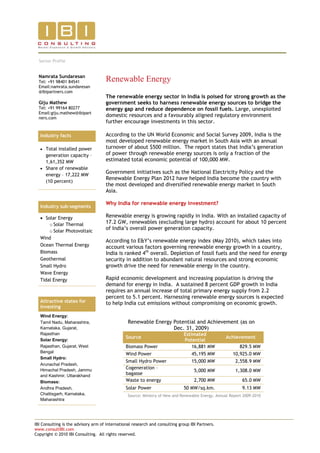
   Tamil Nadu, Maharashtra,                      Renewable Energy Potential and Achievement (as on
   Karnataka, Gujarat,                                            Dec. 31, 2009)
   Rajasthan                                                                  Estimated
                                                Source                                             Achievement
   Solar Energy:                                                              Potential
   Rajasthan, Gujarat, West                     Biomass Power                     16,881 MW                829.5 MW
   Bengal                                       Wind Power                        45,195 MW            10,925.0 MW
   Small Hydro:
                                                Small Hydro Power                 15,000 MW             2,558.9 MW
   Arunachal Pradesh,
                                                Cogeneration –
   Himachal Pradesh, Jammu                                                          5,000 MW            1,308.0 MW
   and Kashmir, Uttarakhand                     bagasse
   Biomass:                                     Waste to energy                     2,700 MW                65.0 MW
   Andhra Pradesh,                              Solar Power                   50 MW/sq.km.                  9.13 MW
   Chattisgarh, Karnataka,                       Source: Ministry of New and Renewable Energy, Annual Report 2009-2010
   Maharashtra


IBI Consulting is the advisory arm of international research and consulting group IBI Partners.
www.consultIBI.com
Copyright © 2010 IBI Consulting. All rights reserved.
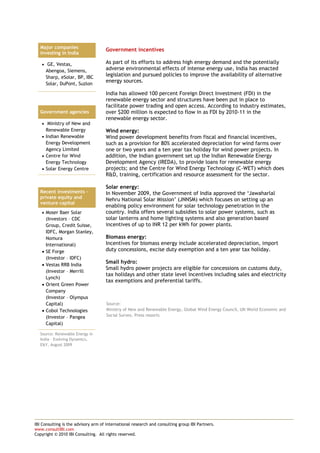
Major companies
                                     Government incentives
   investing in India

    GE, Vestas,                     As part of its efforts to address high energy demand and the potentially
       Abengoa, Siemens,             adverse environmental effects of intense energy use, India has enacted
       Sharp, eSolar, BP, IBC        legislation and pursued policies to improve the availability of alternative
       Solar, DuPont, Suzlon
                                     energy sources.

                                     India has allowed 100 percent Foreign Direct Investment (FDI) in the
                                     renewable energy sector and structures have been put in place to
                                     facilitate power trading and open access. According to industry estimates,
   Government agencies               over $200 million is expected to flow in as FDI by 2010-11 in the
                                     renewable energy sector.
    Ministry of New and
       Renewable Energy              Wind energy:
    Indian Renewable                Wind power development benefits from fiscal and financial incentives,
     Energy Development              such as a provision for 80% accelerated depreciation for wind farms over
     Agency Limited                  one or two years and a ten year tax holiday for wind power projects. In
    Centre for Wind                 addition, the Indian government set up the Indian Renewable Energy
     Energy Technology               Development Agency (IREDA), to provide loans for renewable energy
    Solar Energy Centre             projects; and the Centre for Wind Energy Technology (C-WET) which does
                                     R&D, training, certification and resource assessment for the sector.

                                     Solar energy:
   Recent investments –              In November 2009, the Government of India approved the ‘Jawaharlal
   private equity and                Nehru National Solar Mission’ (JNNSM) which focuses on setting up an
   venture capital
                                     enabling policy environment for solar technology penetration in the
    Moser Baer Solar                country. India offers several subsidies to solar power systems, such as
       (Investors – CDC              solar lanterns and home lighting systems and also generation based
       Group, Credit Suisse,         incentives of up to INR 12 per kWh for power plants.
       IDFC, Morgan Stanley,
       Nomura                        Biomass energy:
       International)                Incentives for biomass energy include accelerated depreciation, import
      SE Forge                      duty concessions, excise duty exemption and a ten year tax holiday.
       (Investor – IDFC)
                                     Small hydro:
      Vestas RRB India
                                     Small hydro power projects are eligible for concessions on customs duty,
       (Investor – Merrill
                                     tax holidays and other state level incentives including sales and electricity
       Lynch)
                                     tax exemptions and preferential tariffs.
      Orient Green Power
       Company
       (Investor – Olympus
       Capital)                      Source:
      Cobol Technologies            Ministry of New and Renewable Energy, Global Wind Energy Council, UN World Economic and
       (Investor – Pangea            Social Survey, Press reports
       Capital)

   Source: Renewable Energy in
   India – Evolving Dynamics,
   E&Y, August 2009


IBI Consulting is the advisory arm of international research and consulting group IBI Partners.
www.consultIBI.com
Copyright © 2010 IBI Consulting. All rights reserved.

Renewable Energy in India

  • 1.
    Sector Profile Namrata Sundaresan Tel: +91 98401 84541 Renewable Energy Email:namrata.sundaresan @ibipartners.com The renewable energy sector in India is poised for strong growth as the Giju Mathew government seeks to harness renewable energy sources to bridge the Tel: +91 99164 80277 energy gap and reduce dependence on fossil fuels. Large, unexploited Email:giju.mathew@ibipart ners.com domestic resources and a favourably aligned regulatory environment further encourage investments in this sector. Industry facts According to the UN World Economic and Social Survey 2009, India is the most developed renewable energy market in South Asia with an annual  Total installed power turnover of about $500 million. The report states that India’s generation generation capacity – of power through renewable energy sources is only a fraction of the 1,61,352 MW estimated total economic potential of 100,000 MW.  Share of renewable energy – 17,222 MW Government initiatives such as the National Electricity Policy and the Renewable Energy Plan 2012 have helped India become the country with (10 percent) the most developed and diversified renewable energy market in South Asia. Why India for renewable energy investment? Industry sub-segments  Solar Energy Renewable energy is growing rapidly in India. With an installed capacity of o Solar Thermal 17.2 GW, renewables (excluding large hydro) account for about 10 percent o Solar Photovoltaic of India’s overall power generation capacity. Wind According to E&Y’s renewable energy index (May 2010), which takes into Ocean Thermal Energy account various factors governing renewable energy growth in a country, Biomass India is ranked 4th overall. Depletion of fossil fuels and the need for energy Geothermal security in addition to abundant natural resources and strong economic Small Hydro growth drive the need for renewable energy in the country. Wave Energy Tidal Energy Rapid economic development and increasing population is driving the demand for energy in India. A sustained 8 percent GDP growth in India requires an annual increase of total primary energy supply from 2.2 percent to 5.1 percent. Harnessing renewable energy sources is expected Attractive states for to help India cut emissions without compromising on economic growth. investing Wind Energy: Tamil Nadu, Maharashtra, Renewable Energy Potential and Achievement (as on Karnataka, Gujarat, Dec. 31, 2009) Rajasthan Estimated Source Achievement Solar Energy: Potential Rajasthan, Gujarat, West Biomass Power 16,881 MW 829.5 MW Bengal Wind Power 45,195 MW 10,925.0 MW Small Hydro: Small Hydro Power 15,000 MW 2,558.9 MW Arunachal Pradesh, Cogeneration – Himachal Pradesh, Jammu 5,000 MW 1,308.0 MW and Kashmir, Uttarakhand bagasse Biomass: Waste to energy 2,700 MW 65.0 MW Andhra Pradesh, Solar Power 50 MW/sq.km. 9.13 MW Chattisgarh, Karnataka, Source: Ministry of New and Renewable Energy, Annual Report 2009-2010 Maharashtra IBI Consulting is the advisory arm of international research and consulting group IBI Partners. www.consultIBI.com Copyright © 2010 IBI Consulting. All rights reserved.
  • 2.
    Major companies Government incentives investing in India  GE, Vestas, As part of its efforts to address high energy demand and the potentially Abengoa, Siemens, adverse environmental effects of intense energy use, India has enacted Sharp, eSolar, BP, IBC legislation and pursued policies to improve the availability of alternative Solar, DuPont, Suzlon energy sources. India has allowed 100 percent Foreign Direct Investment (FDI) in the renewable energy sector and structures have been put in place to facilitate power trading and open access. According to industry estimates, Government agencies over $200 million is expected to flow in as FDI by 2010-11 in the renewable energy sector.  Ministry of New and Renewable Energy Wind energy:  Indian Renewable Wind power development benefits from fiscal and financial incentives, Energy Development such as a provision for 80% accelerated depreciation for wind farms over Agency Limited one or two years and a ten year tax holiday for wind power projects. In  Centre for Wind addition, the Indian government set up the Indian Renewable Energy Energy Technology Development Agency (IREDA), to provide loans for renewable energy  Solar Energy Centre projects; and the Centre for Wind Energy Technology (C-WET) which does R&D, training, certification and resource assessment for the sector. Solar energy: Recent investments – In November 2009, the Government of India approved the ‘Jawaharlal private equity and Nehru National Solar Mission’ (JNNSM) which focuses on setting up an venture capital enabling policy environment for solar technology penetration in the  Moser Baer Solar country. India offers several subsidies to solar power systems, such as (Investors – CDC solar lanterns and home lighting systems and also generation based Group, Credit Suisse, incentives of up to INR 12 per kWh for power plants. IDFC, Morgan Stanley, Nomura Biomass energy: International) Incentives for biomass energy include accelerated depreciation, import  SE Forge duty concessions, excise duty exemption and a ten year tax holiday. (Investor – IDFC) Small hydro:  Vestas RRB India Small hydro power projects are eligible for concessions on customs duty, (Investor – Merrill tax holidays and other state level incentives including sales and electricity Lynch) tax exemptions and preferential tariffs.  Orient Green Power Company (Investor – Olympus Capital) Source:  Cobol Technologies Ministry of New and Renewable Energy, Global Wind Energy Council, UN World Economic and (Investor – Pangea Social Survey, Press reports Capital) Source: Renewable Energy in India – Evolving Dynamics, E&Y, August 2009 IBI Consulting is the advisory arm of international research and consulting group IBI Partners. www.consultIBI.com Copyright © 2010 IBI Consulting. All rights reserved.