Remote management
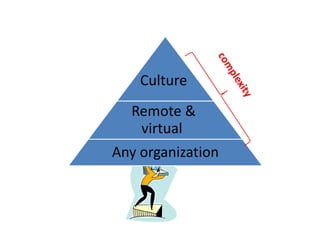
Culture
  Remote &
   virtual
Any organization
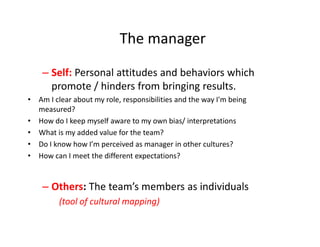
The manager

    – Self: Personal attitudes and behaviors which
      promote / hinders from bringing results.
• Am I clear about my role, responsibilities and the way I'm being
  measured?
• How do I keep myself aware to my own bias/ interpretations
• What is my added value for the team?
• Do I know how I’m perceived as manager in other cultures?
• How can I meet the different expectations?


    – Others: The team’s members as individuals
         (tool of cultural mapping)
The Virtual Team
– Basics of building a new team/ developing existing
  team:
– Communicate the new team's purpose & Form together the team's
  shared objectives
– Identify challenges in two levels: task and relationships
– Decide on framework/ processes to overcome challenges
– Team’s new culture (tool of new team cultural)
Interface back with organization

What challenges you expect in implementing
the new culture into the organization?
No team is an island…
     Back to the organization reality:
• Communicate to the team’s strongest interfaces
  about the expectations/ requests from them, and
  develop a dialogue.
• Negotiate where/ when needed
• Act as a role model
So…What can we advise Assi?
• Manager:
  – self awareness, flexibility, on- going improvement
  – Identifying team member’s expectations (cultural
    differences)
• Team:
  – Strong structure, organized processes + defined
    mechanism for communication and conflict resolution
  – Create a new team culture
• Organization:
  – Set realistic expectations
  – Communicate, negotiate and be a role model .
Food for thought …
    Questions to be asked by team’s members…
•   What does it mean to be managed remotely?
•   What do should I except from my remote manager?
•   What are my responsibilities?
•   What are the main cross cultural challenges of
    working remotely?

Remote management

  • 1.
  • 2.
    Culture Remote& virtual Any organization
  • 3.
    The manager – Self: Personal attitudes and behaviors which promote / hinders from bringing results. • Am I clear about my role, responsibilities and the way I'm being measured? • How do I keep myself aware to my own bias/ interpretations • What is my added value for the team? • Do I know how I’m perceived as manager in other cultures? • How can I meet the different expectations? – Others: The team’s members as individuals (tool of cultural mapping)
  • 5.
    The Virtual Team –Basics of building a new team/ developing existing team: – Communicate the new team's purpose & Form together the team's shared objectives – Identify challenges in two levels: task and relationships – Decide on framework/ processes to overcome challenges – Team’s new culture (tool of new team cultural)
  • 6.
    Interface back withorganization What challenges you expect in implementing the new culture into the organization?
  • 7.
    No team isan island… Back to the organization reality: • Communicate to the team’s strongest interfaces about the expectations/ requests from them, and develop a dialogue. • Negotiate where/ when needed • Act as a role model
  • 8.
    So…What can weadvise Assi? • Manager: – self awareness, flexibility, on- going improvement – Identifying team member’s expectations (cultural differences) • Team: – Strong structure, organized processes + defined mechanism for communication and conflict resolution – Create a new team culture • Organization: – Set realistic expectations – Communicate, negotiate and be a role model .
  • 9.
    Food for thought… Questions to be asked by team’s members… • What does it mean to be managed remotely? • What do should I except from my remote manager? • What are my responsibilities? • What are the main cross cultural challenges of working remotely?