Opportunities for Knowledge
Management in the Open Access
Environment
Leslie Chan
Center for Critical Development Studies
Bioline International
University of Toronto Scarborough
Department of Library and Information
Science
University of Kerela
Dec. 17, 2012
“we willingly serve as the
corrections officers for
corporate information
prisons.”
Barbara Fister, Trumping ownership with open
access: a manifesto
Library Journal, 4/1/2010
http://www.libraryjournal.com/article/CA6723666.html?nid=2671&rid=##reg_visitor_id##&so
urce=title
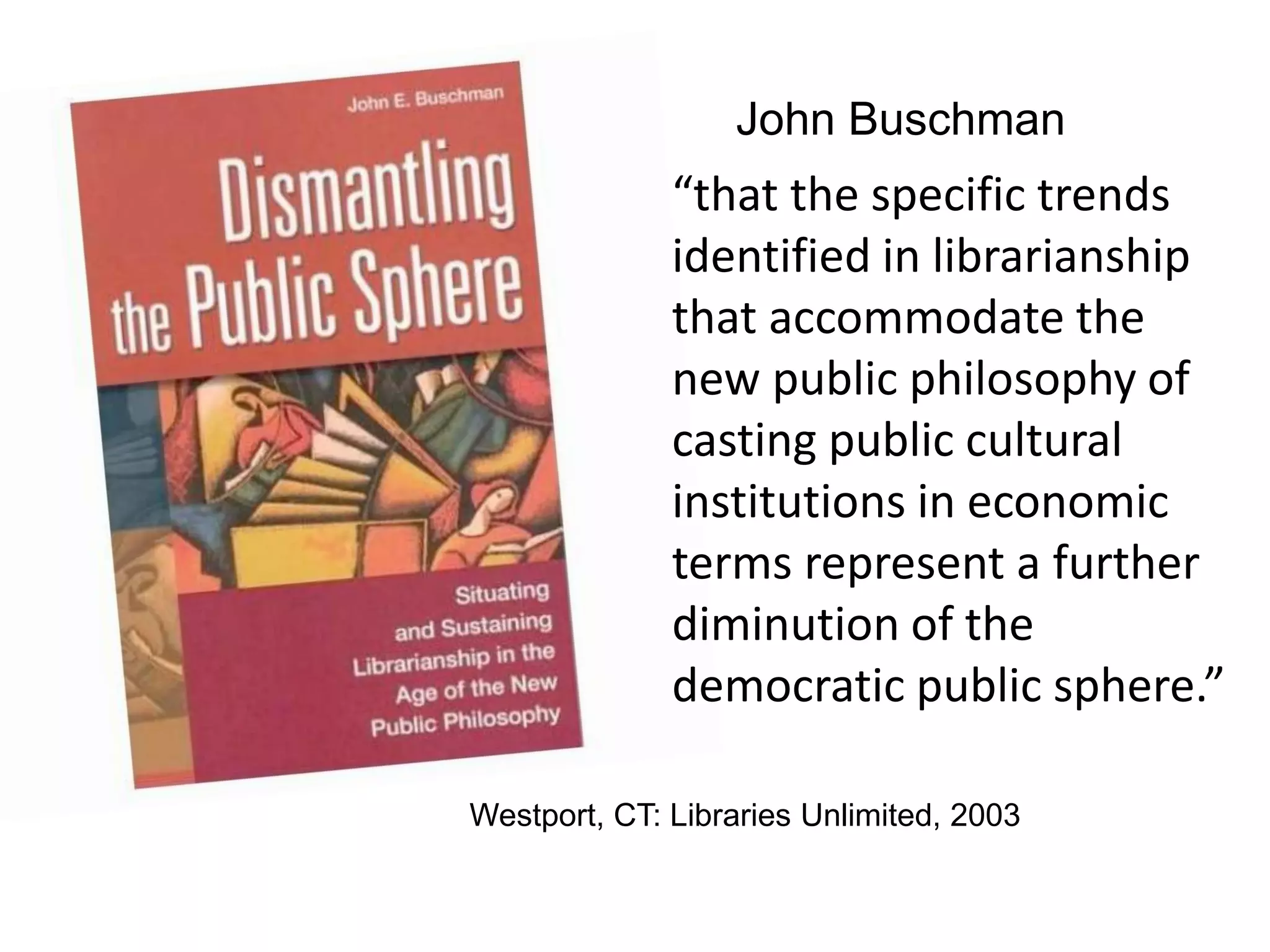
John Buschman
Westport, CT: Libraries Unlimited, 2003
“that the specific trends
identified in librarianship
that accommodate the
new public philosophy of
casting public cultural
institutions in economic
terms represent a further
diminution of the
democratic public sphere.”
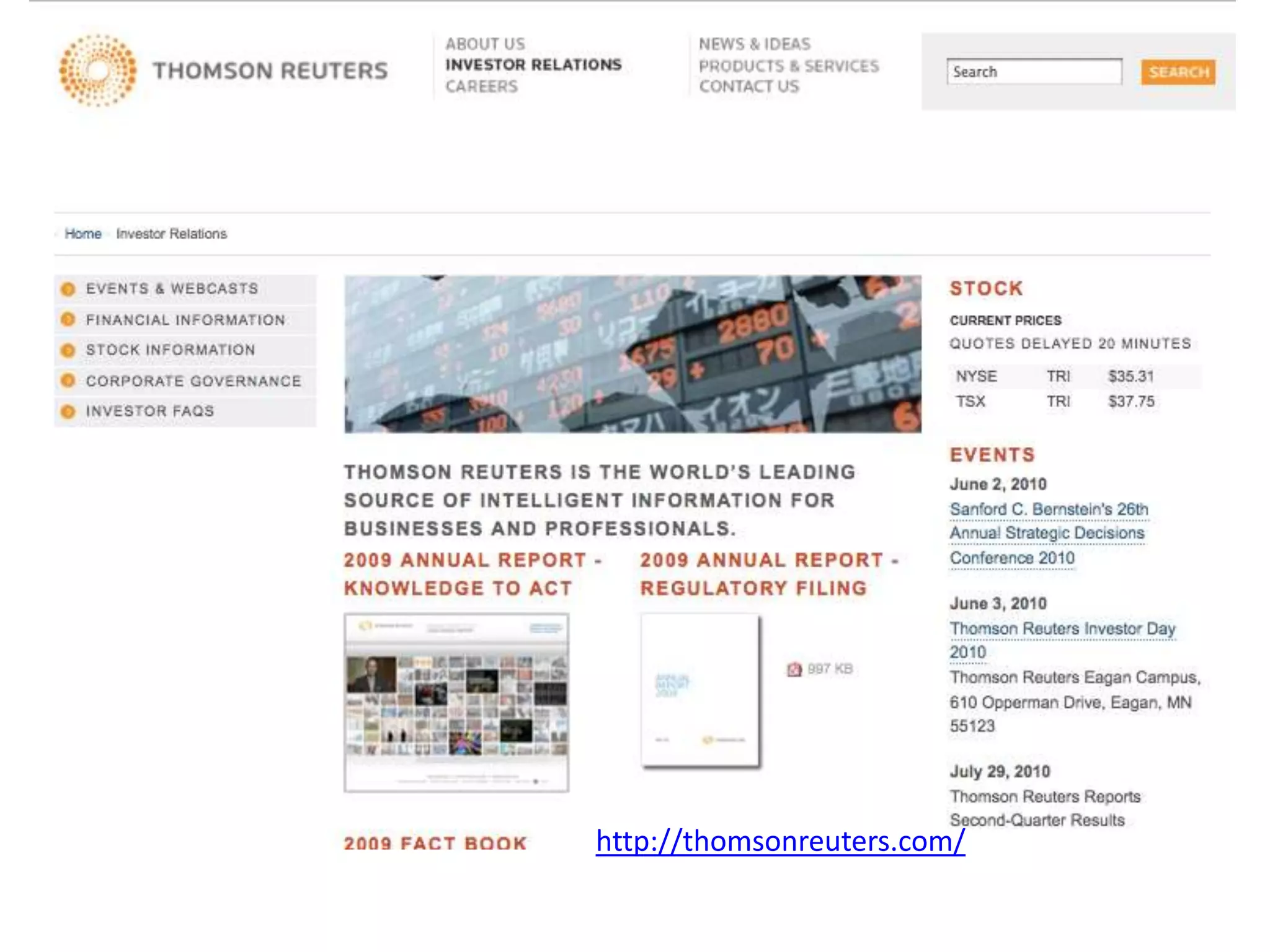
http://thomsonreuters.com/
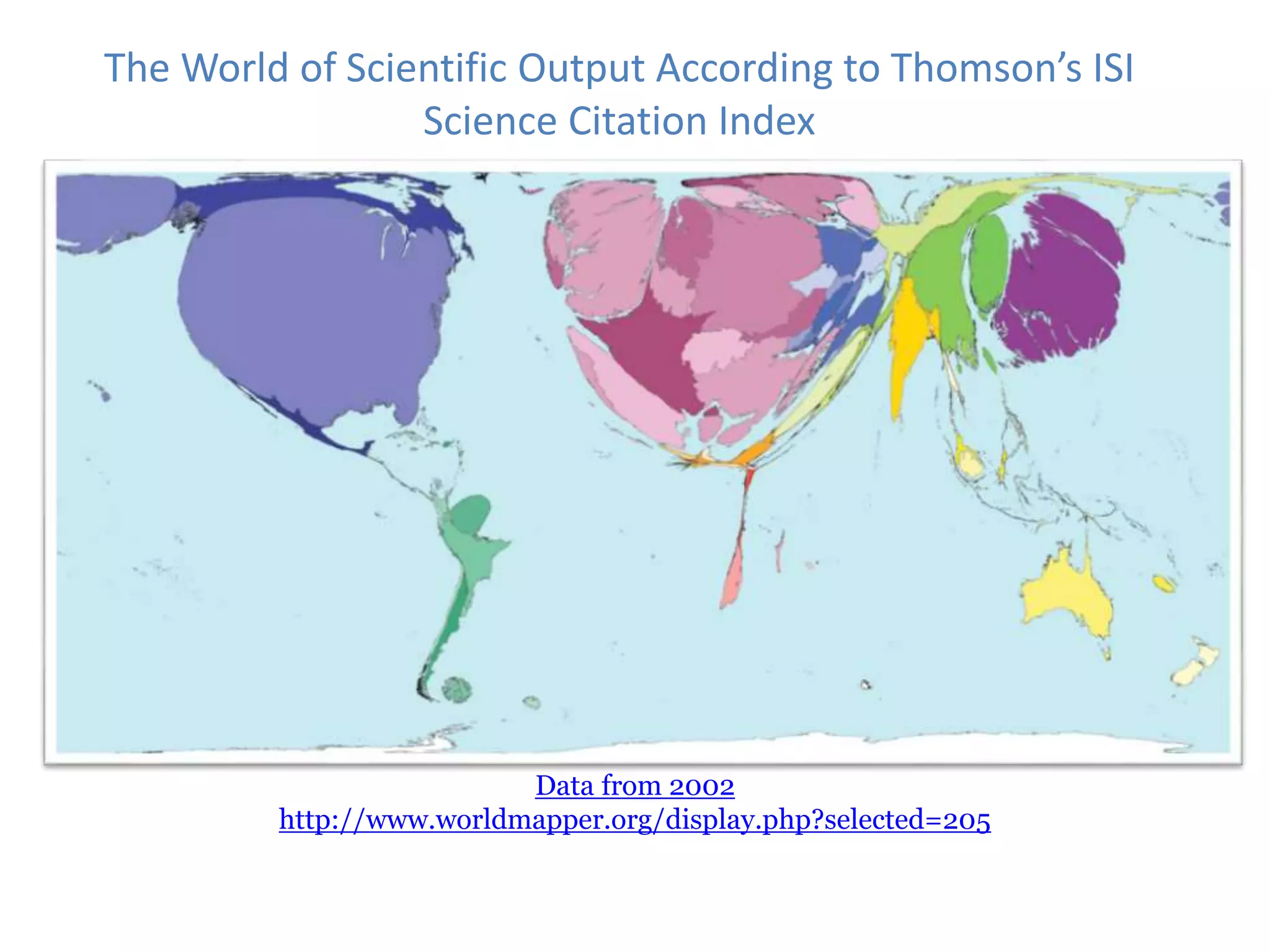
The World of Scientific Output According to Thomson’s ISI
Science Citation Index
Data from 2002
http://www.worldmapper.org/display.php?selected=205
Agenda
• What is Open Access and its key benefits
• Growth of OA in the last ten years
• Key trends and developments
– Global and Local trends
New and Exciting Developments
• Areas that are still deficient
• Opportunities for Information and Library
Professionals
Key Messages
• Open Access as a philosophical principle and a set of
practical tools
• Emerging countries like India should pay attention to Open
Access
• Importance for the public, for education, and for
development
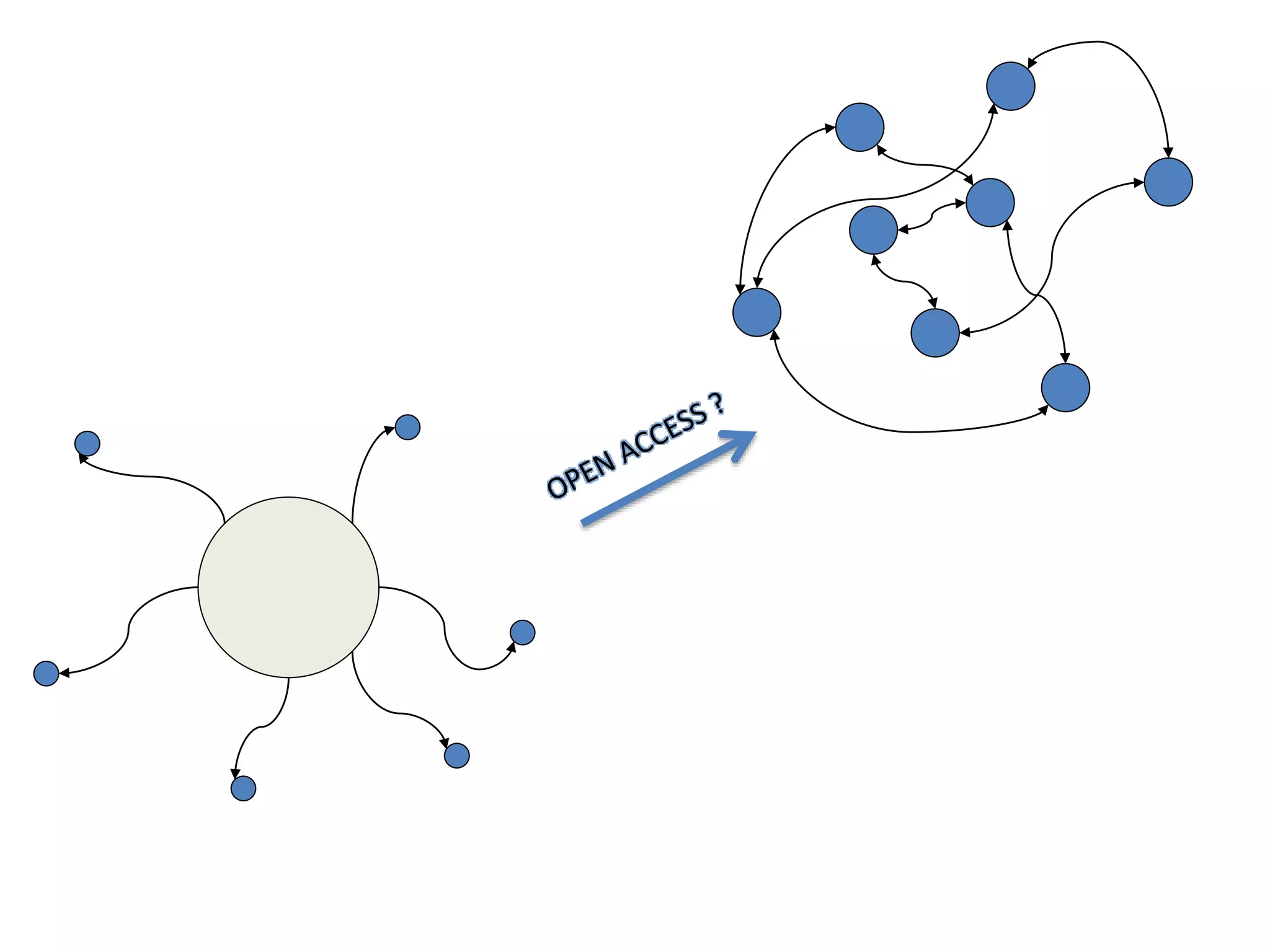
• “Journal” no longer serves the needs of networked
scholarship
• From “Wealth of Nations” to “Wealth of Networks”
• Need to think of new and equitable ways to support research
access and dissemination
OA does not only remove or reduce price
barriers for researchers in developing countries,
it offers a more equitable model for the
exchange of knowledge as a global public good
(the philosophical dimension)
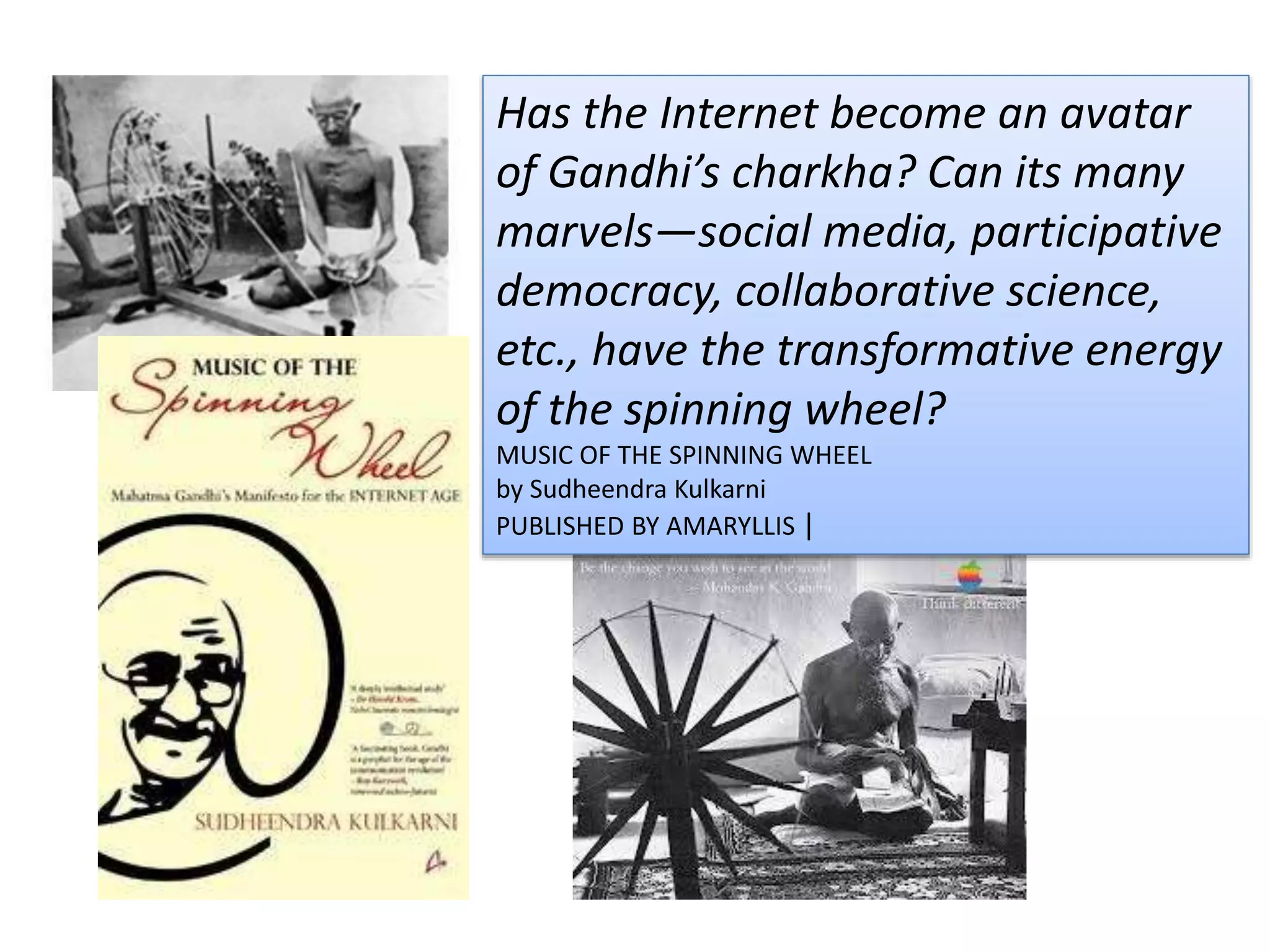
Has the Internet become an avatar
of Gandhi’s charkha? Can its many
marvels—social media, participative
democracy, collaborative science,
etc., have the transformative energy
of the spinning wheel?
MUSIC OF THE SPINNING WHEEL
by Sudheendra Kulkarni
PUBLISHED BY AMARYLLIS |
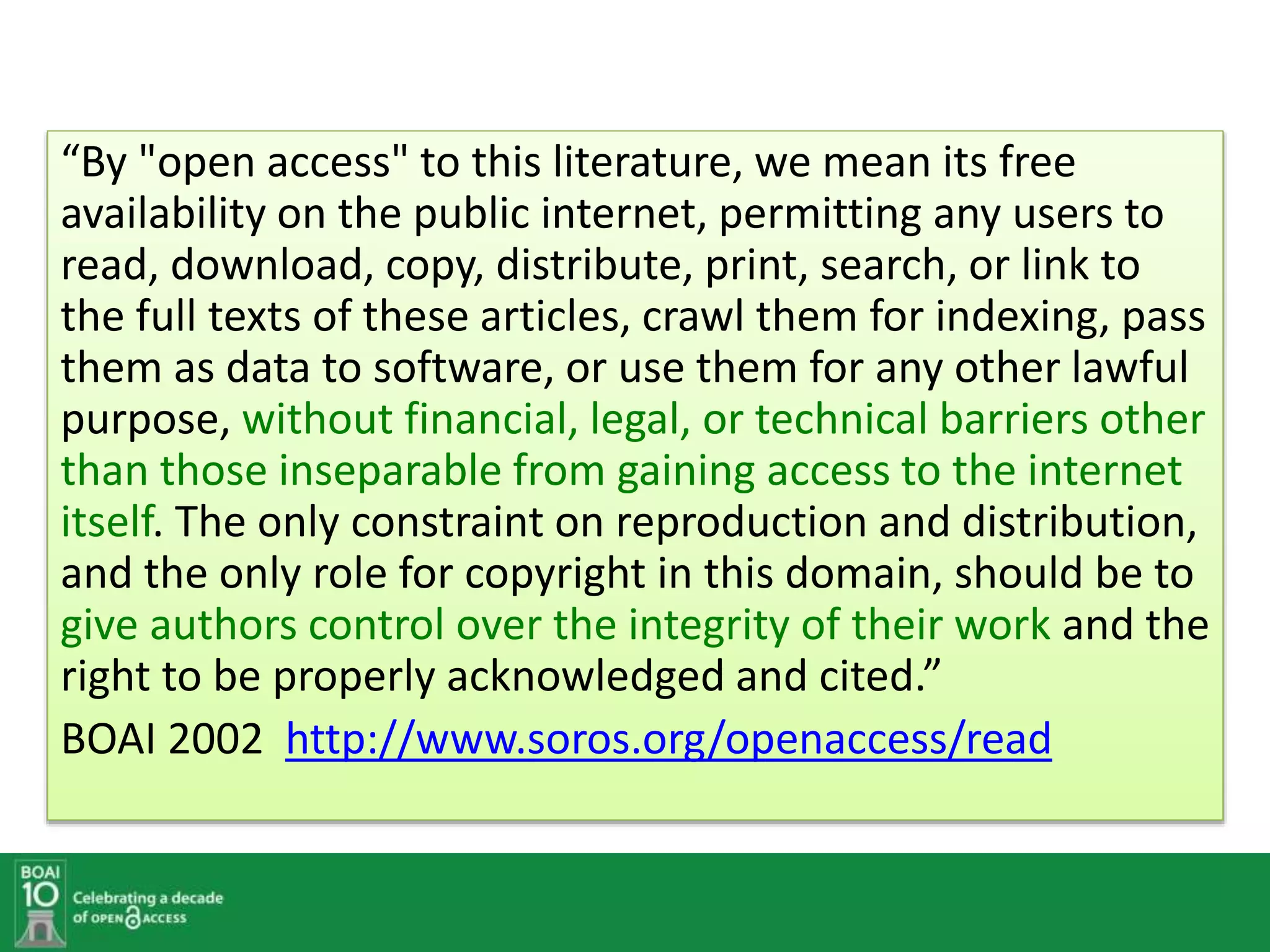
“By "open access" to this literature, we mean its free
availability on the public internet, permitting any users to
read, download, copy, distribute, print, search, or link to
the full texts of these articles, crawl them for indexing, pass
them as data to software, or use them for any other lawful
purpose, without financial, legal, or technical barriers other
than those inseparable from gaining access to the internet
itself. The only constraint on reproduction and distribution,
and the only role for copyright in this domain, should be to
give authors control over the integrity of their work and the
right to be properly acknowledged and cited.”
BOAI 2002 http://www.soros.org/openaccess/read
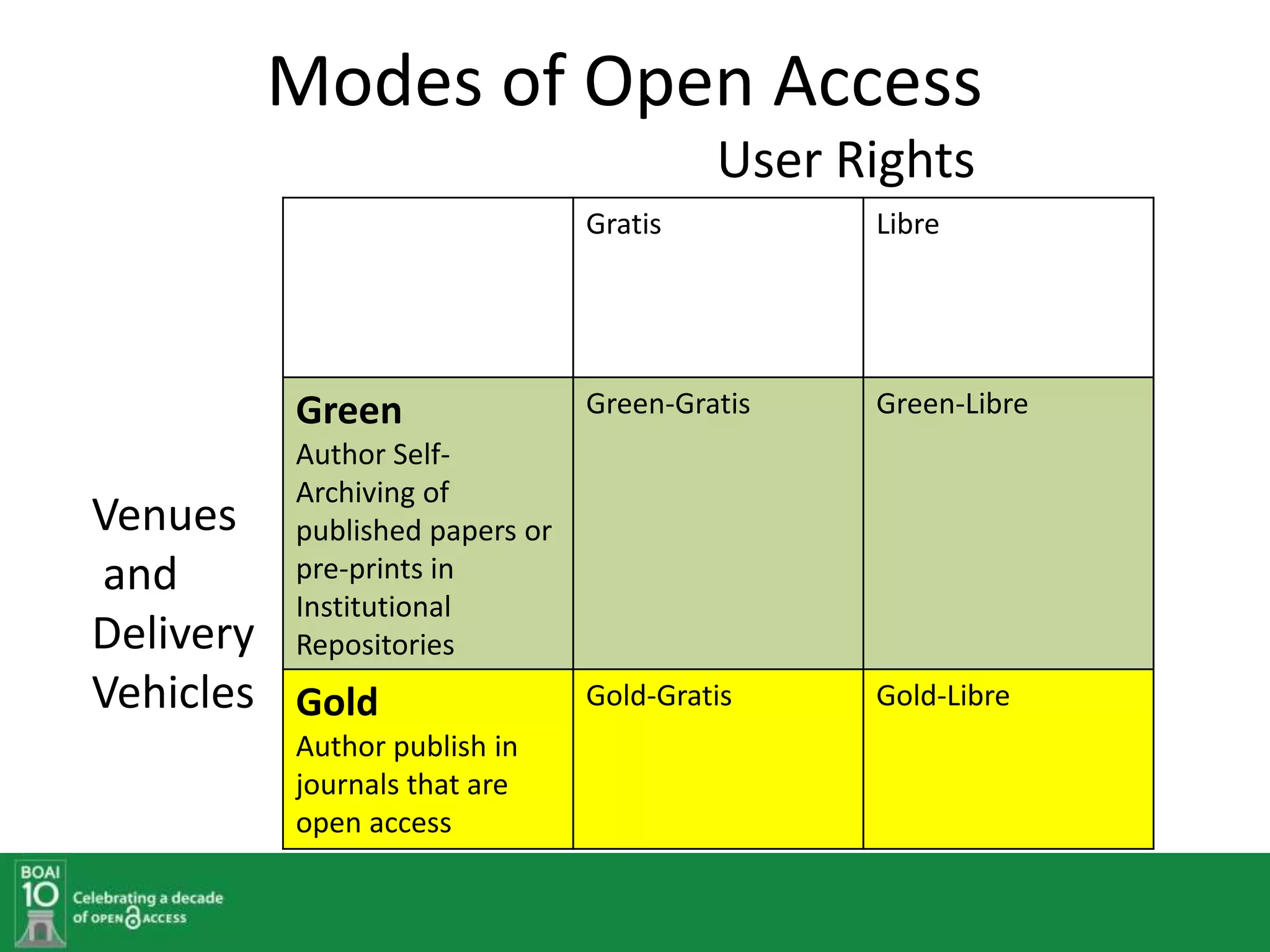
Modes of Open Access
Gratis Libre
Green
Author Self-
Archiving of
published papers or
pre-prints in
Institutional
Repositories
Green-Gratis Green-Libre
Gold
Author publish in
journals that are
open access
Gold-Gratis Gold-Libre
User Rights
Venues
and
Delivery
Vehicles
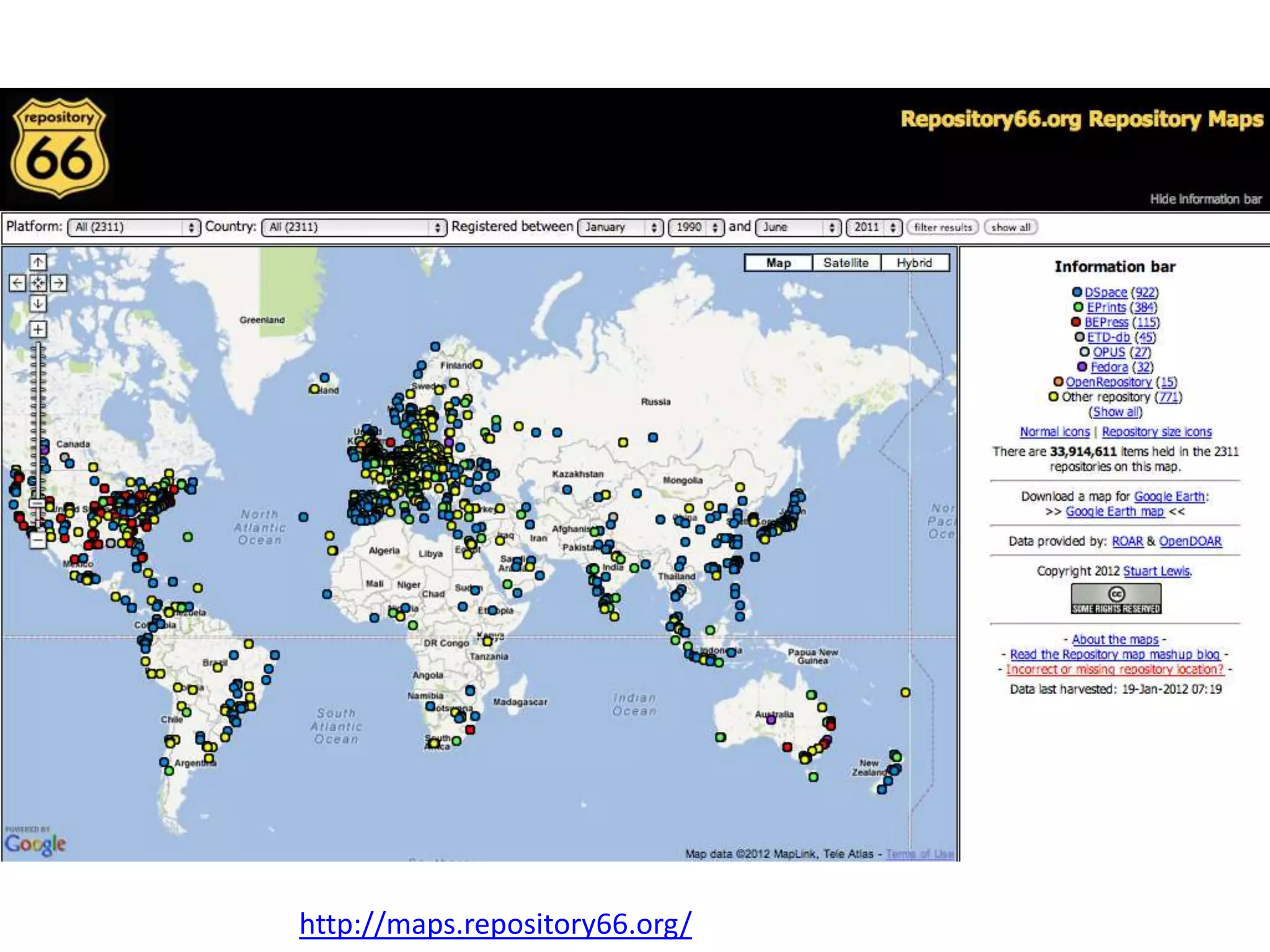
http://maps.repository66.org/
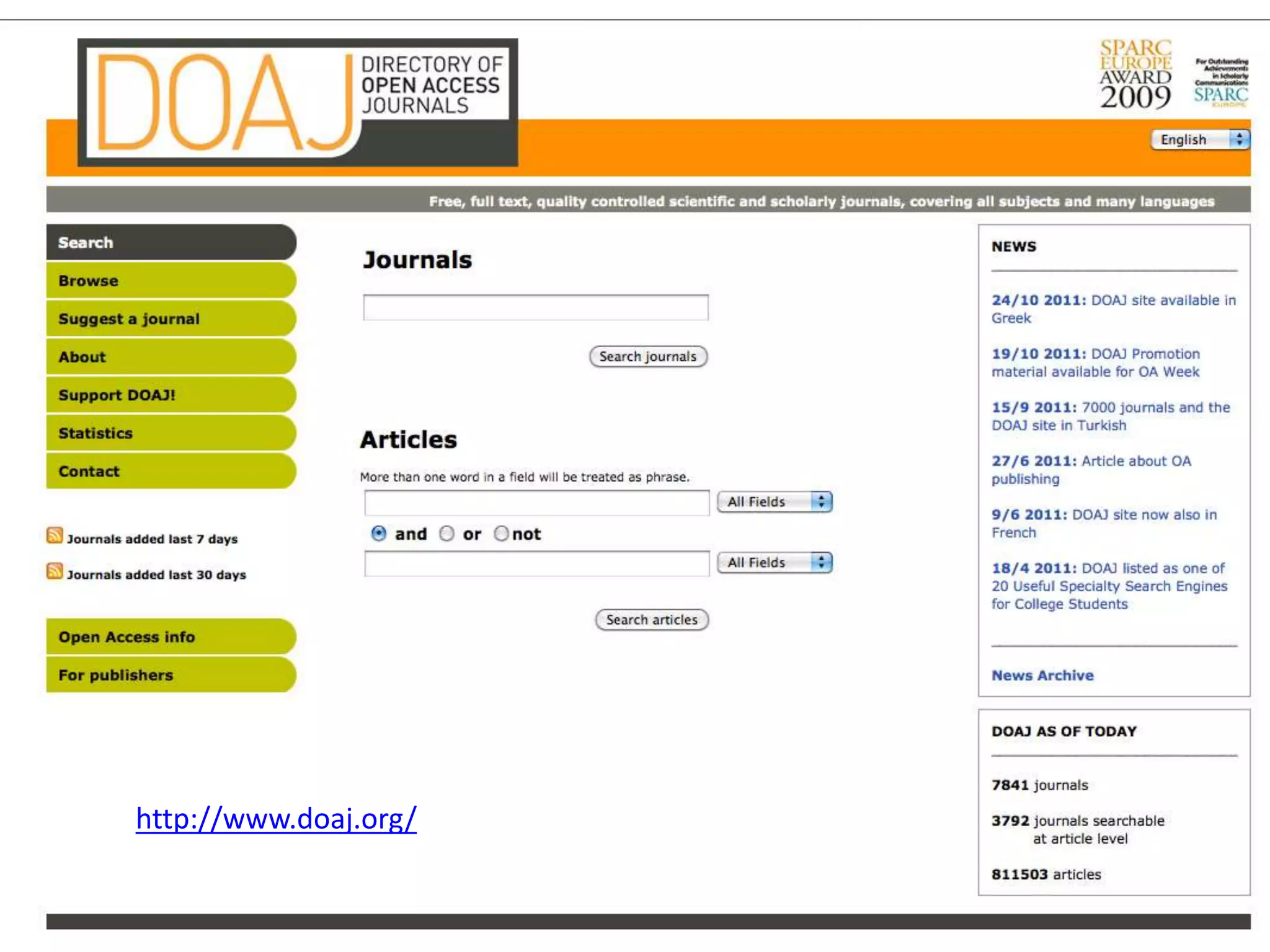
http://www.doaj.org/
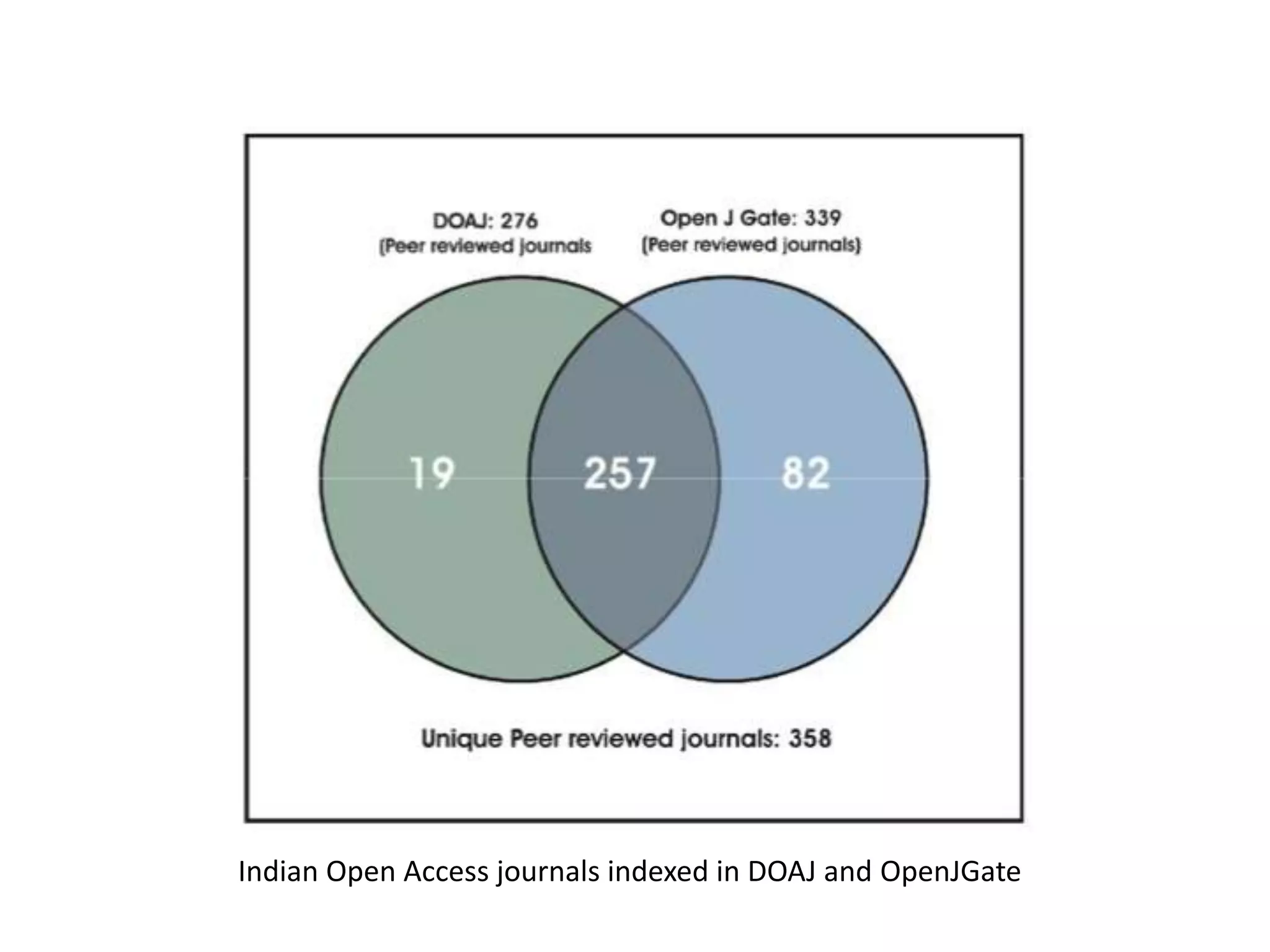
Indian Open Access journals indexed in DOAJ and OpenJGate
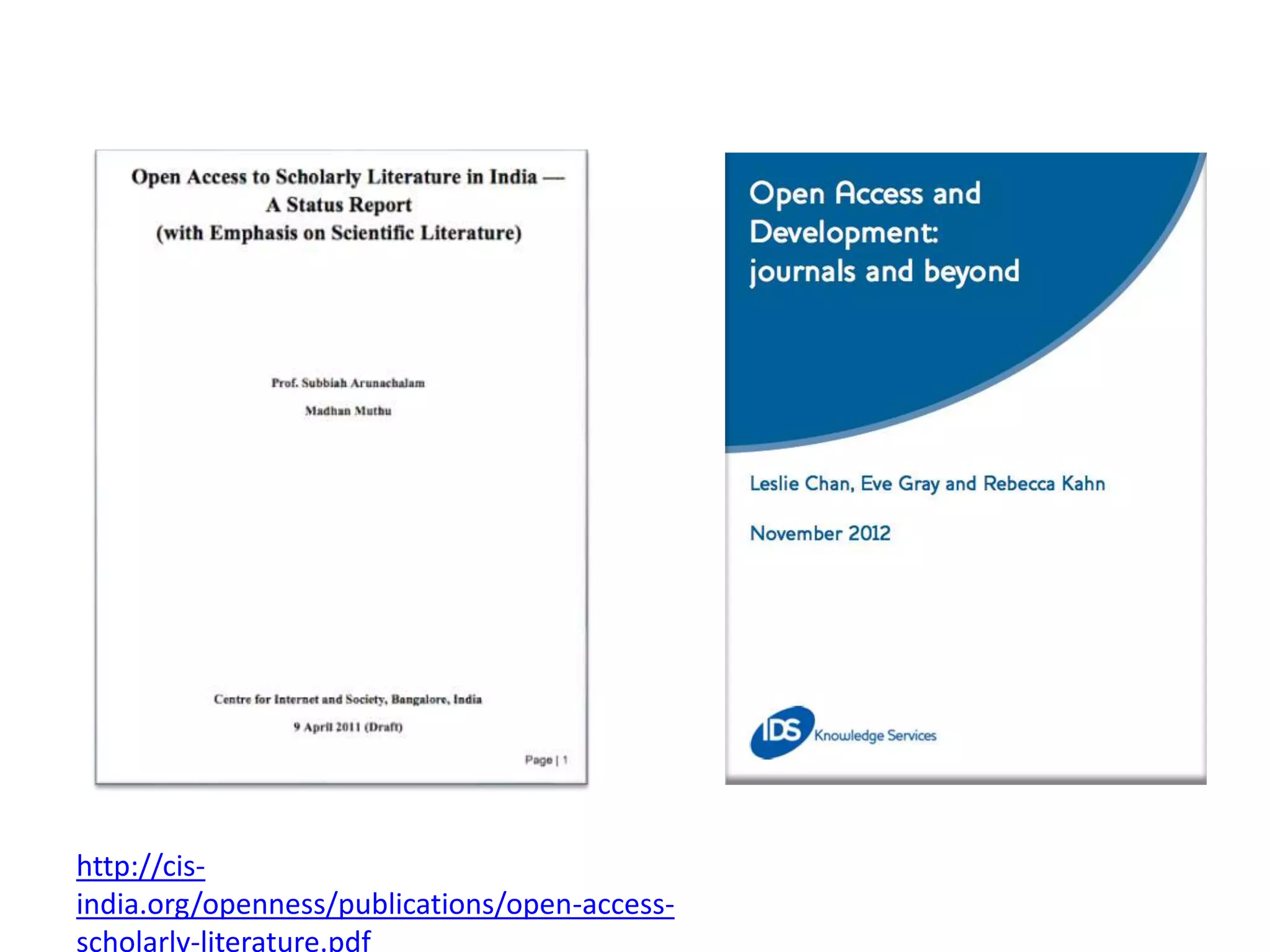
http://cis-
india.org/openness/publications/open-access-
scholarly-literature.pdf
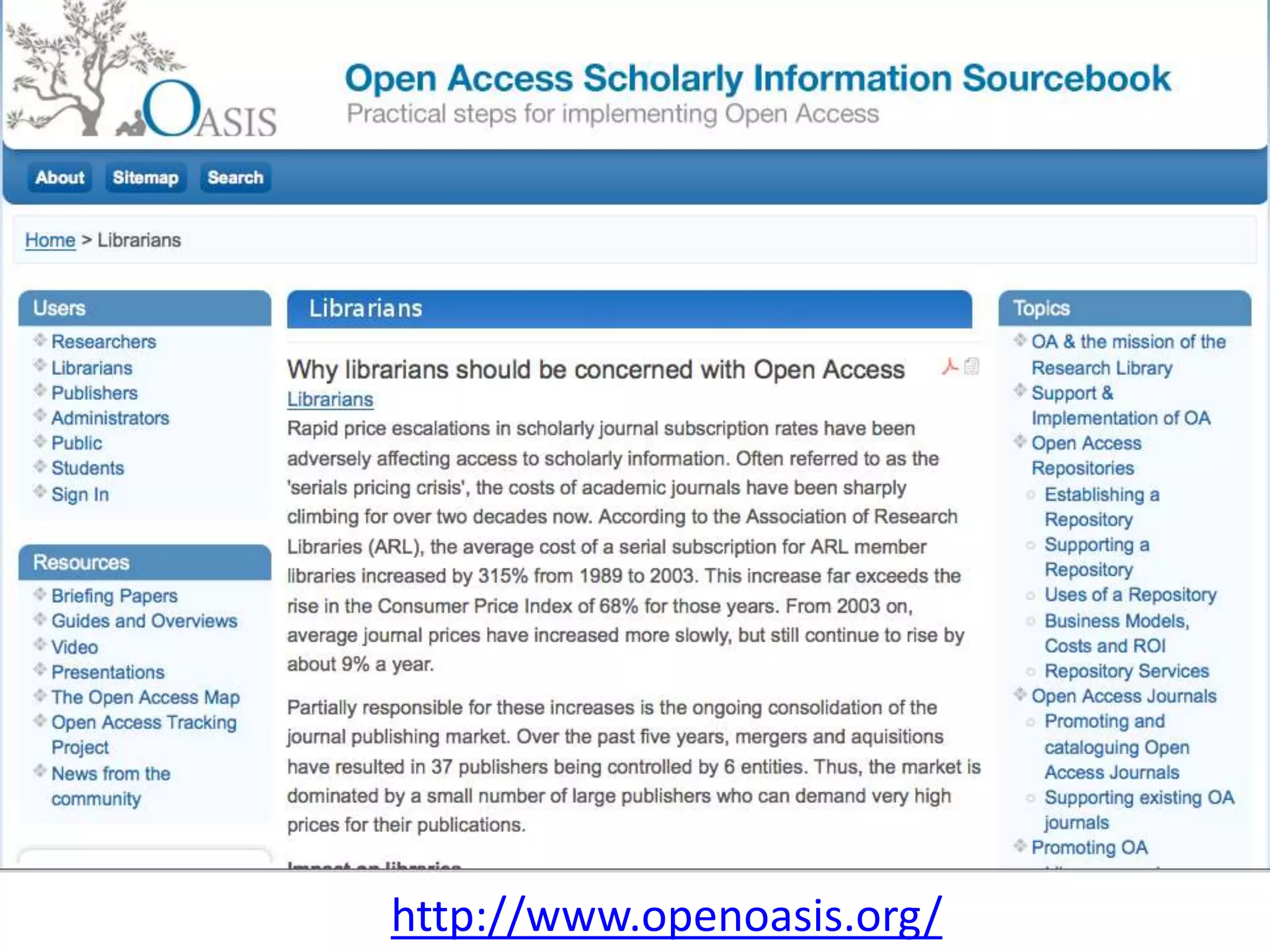
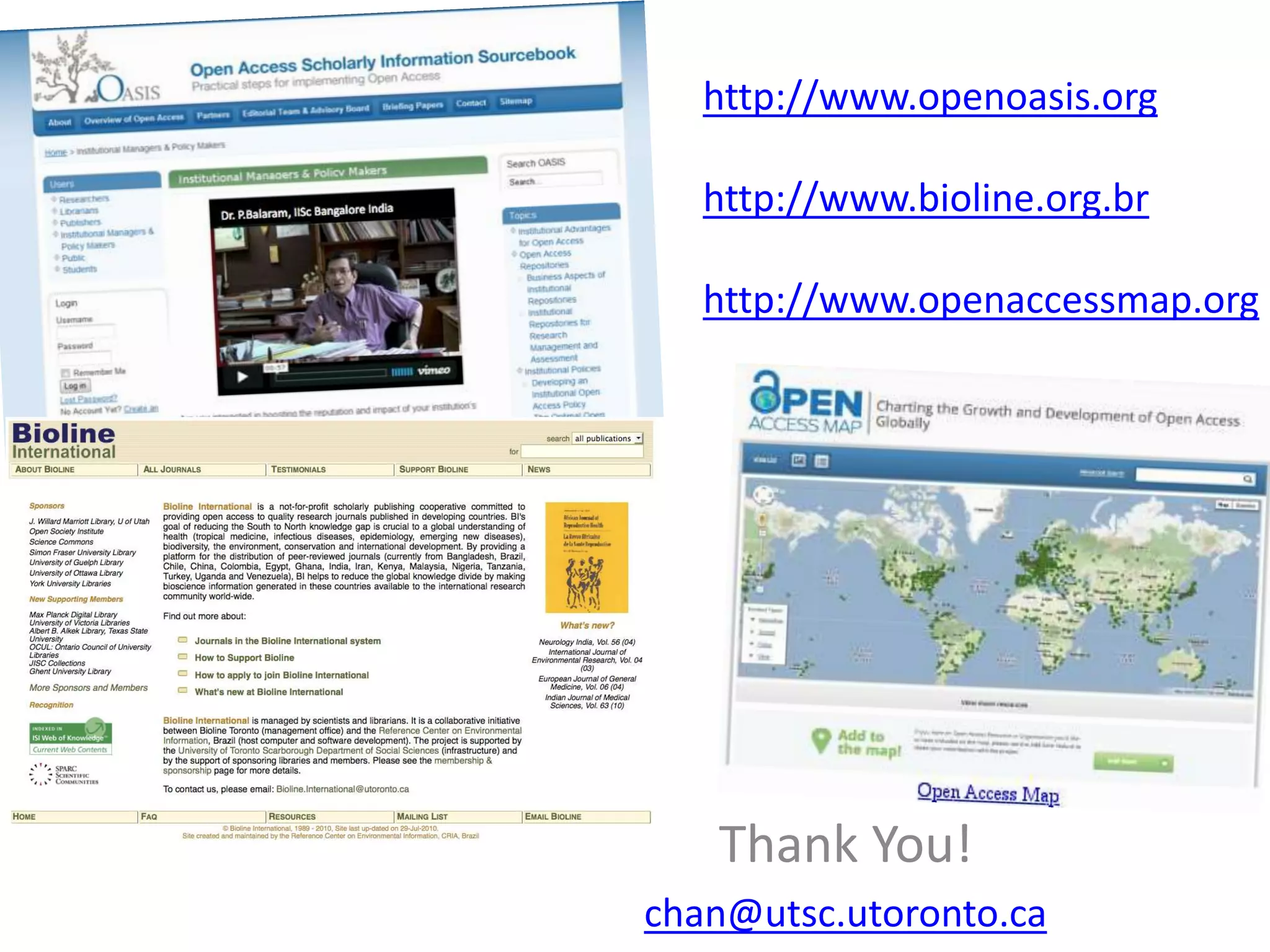
http://www.openoasis.org/
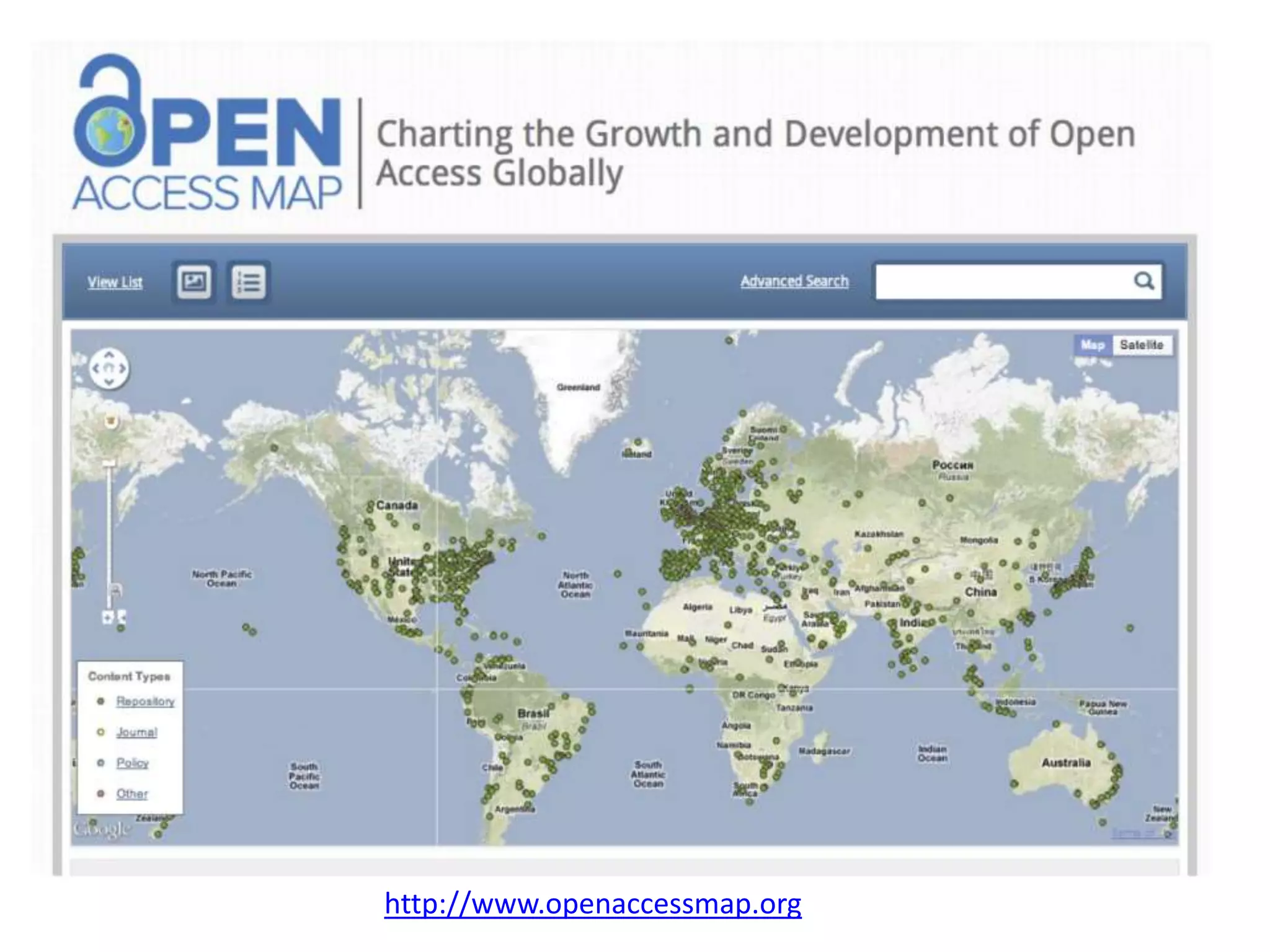
http://www.openaccessmap.org
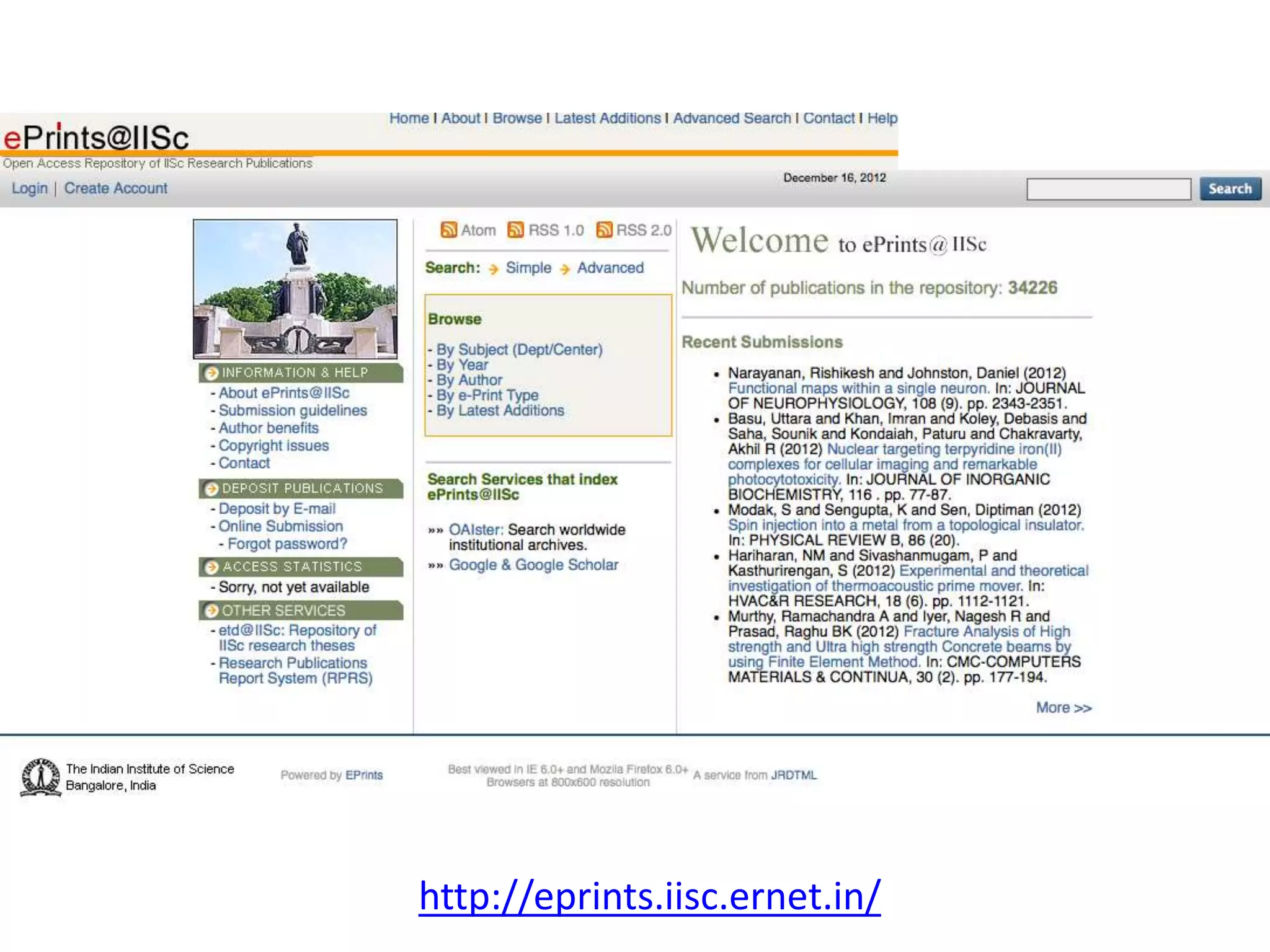
http://eprints.iisc.ernet.in/
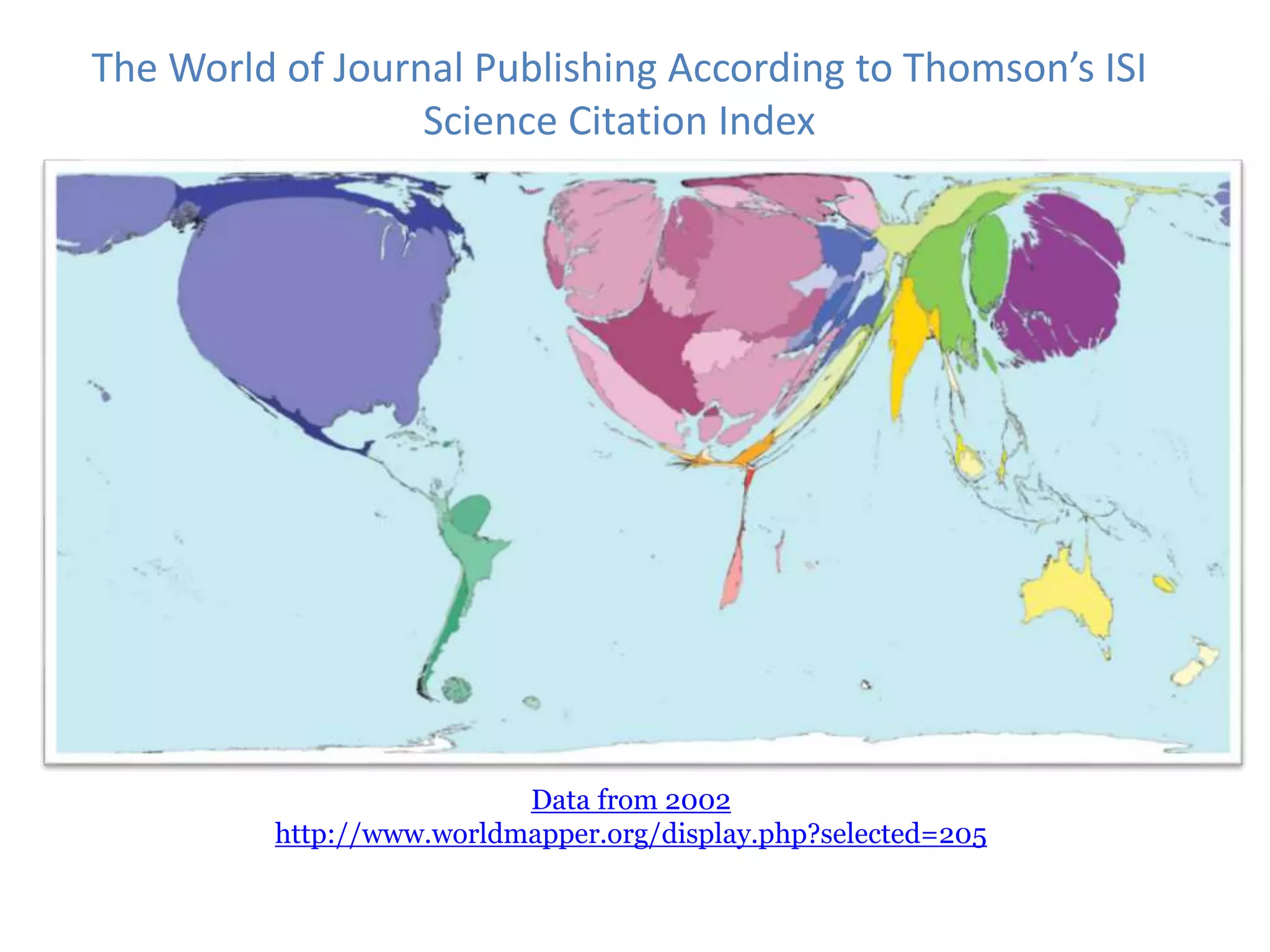
The World of Journal Publishing According to Thomson’s ISI
Science Citation Index
Data from 2002
http://www.worldmapper.org/display.php?selected=205
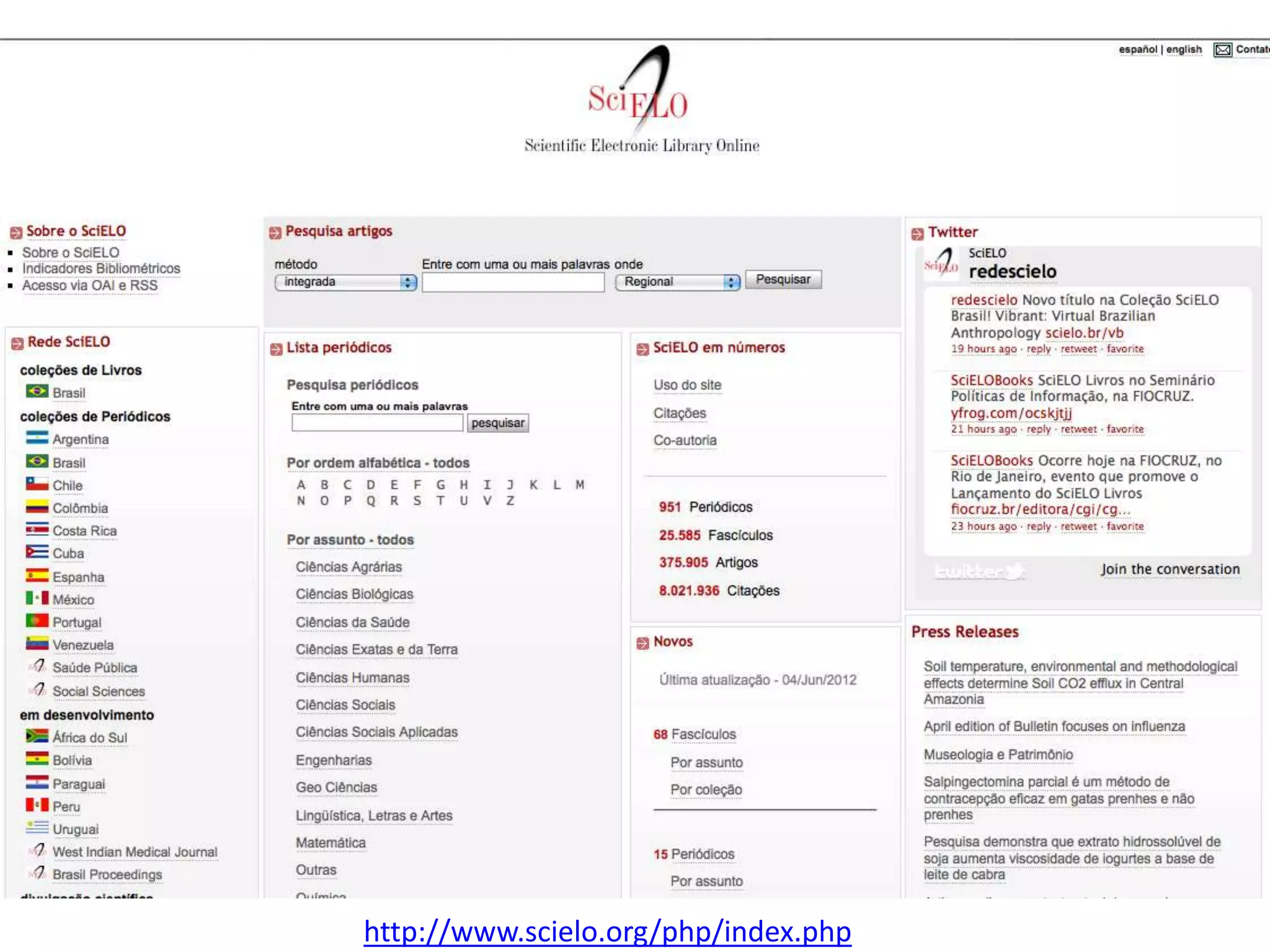
http://www.scielo.org/php/index.php
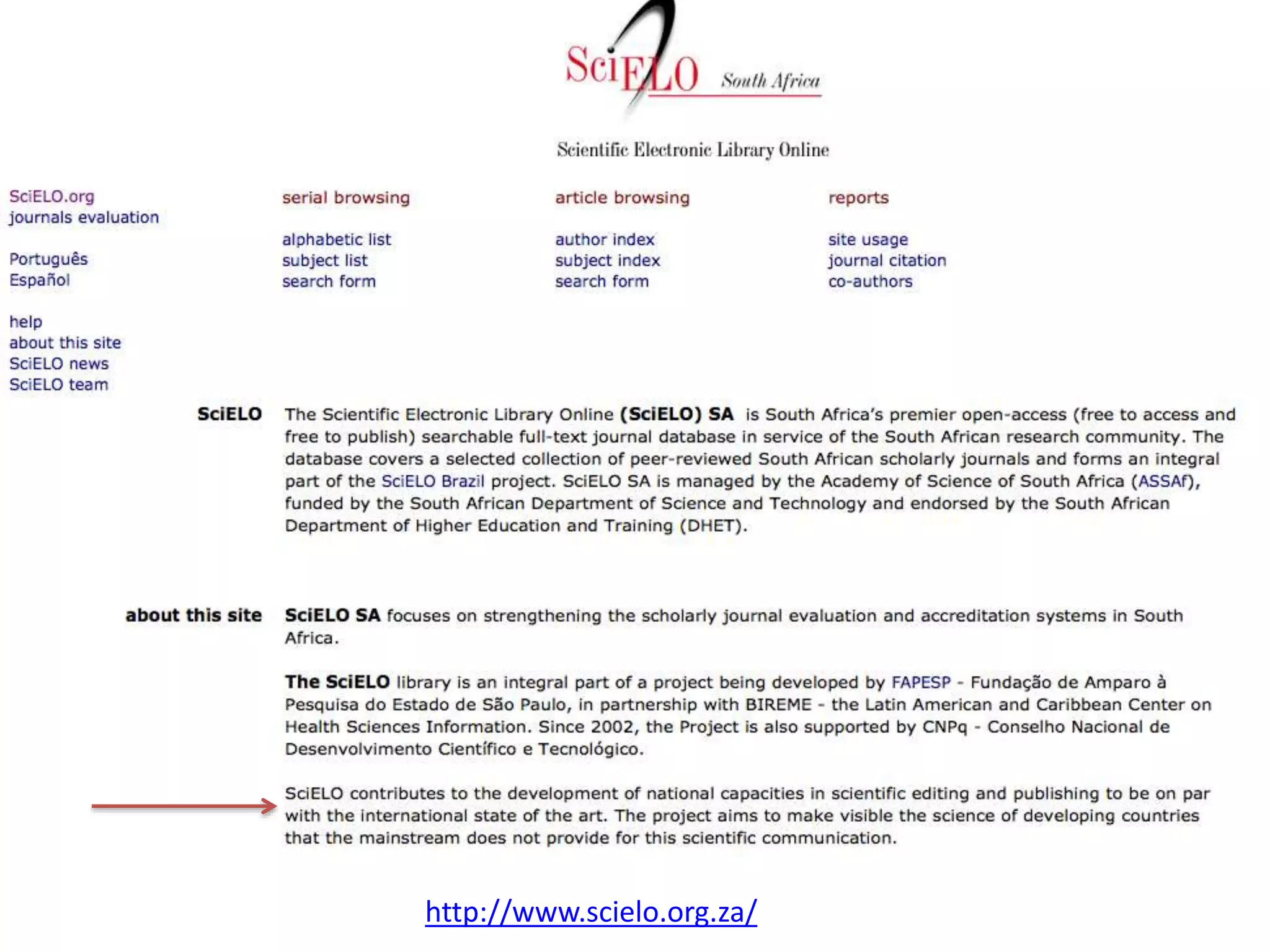
http://www.scielo.org.za/
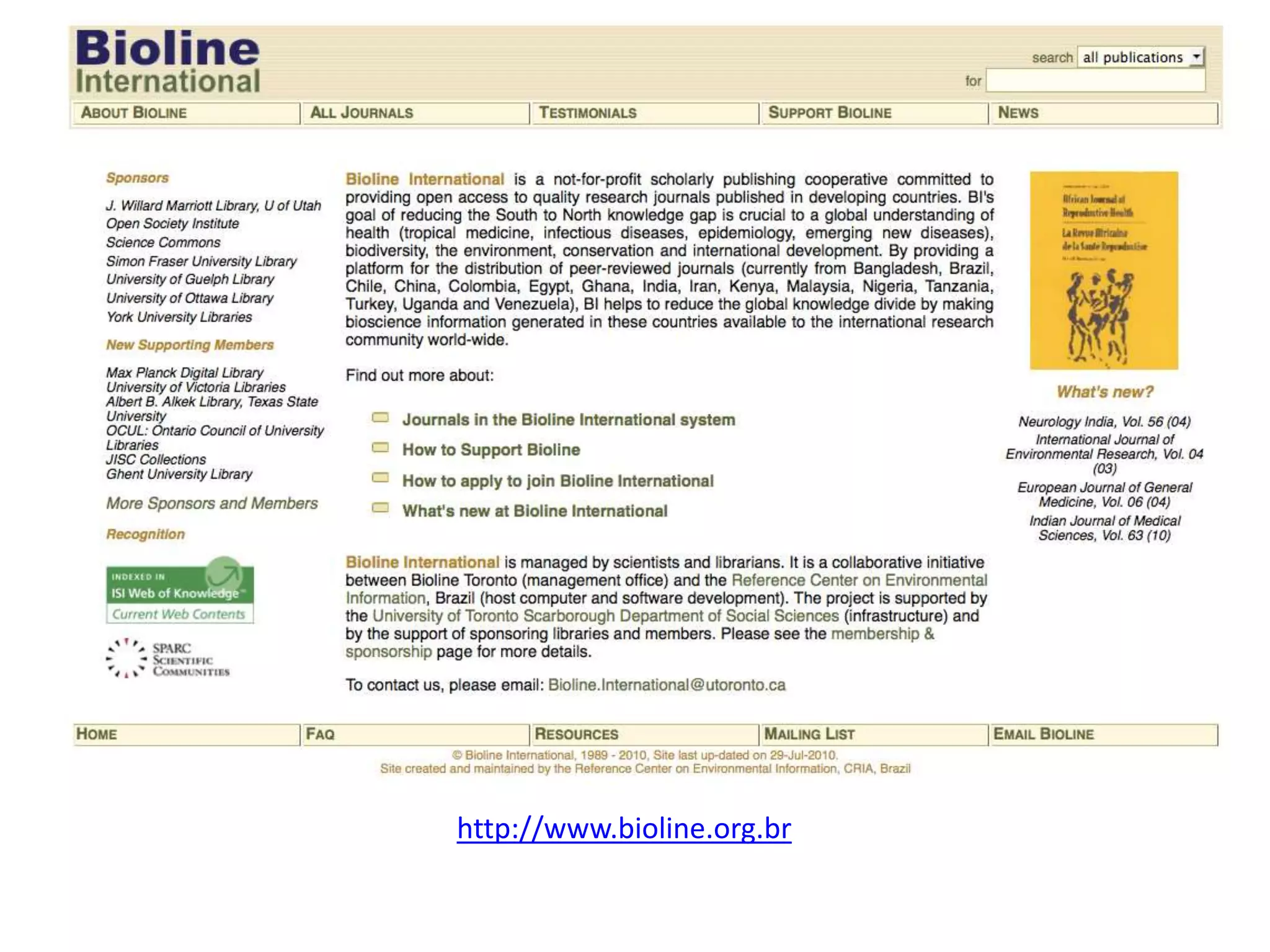
http://www.bioline.org.br
Some Key Trends in OA
Institutional and Funder Mandates
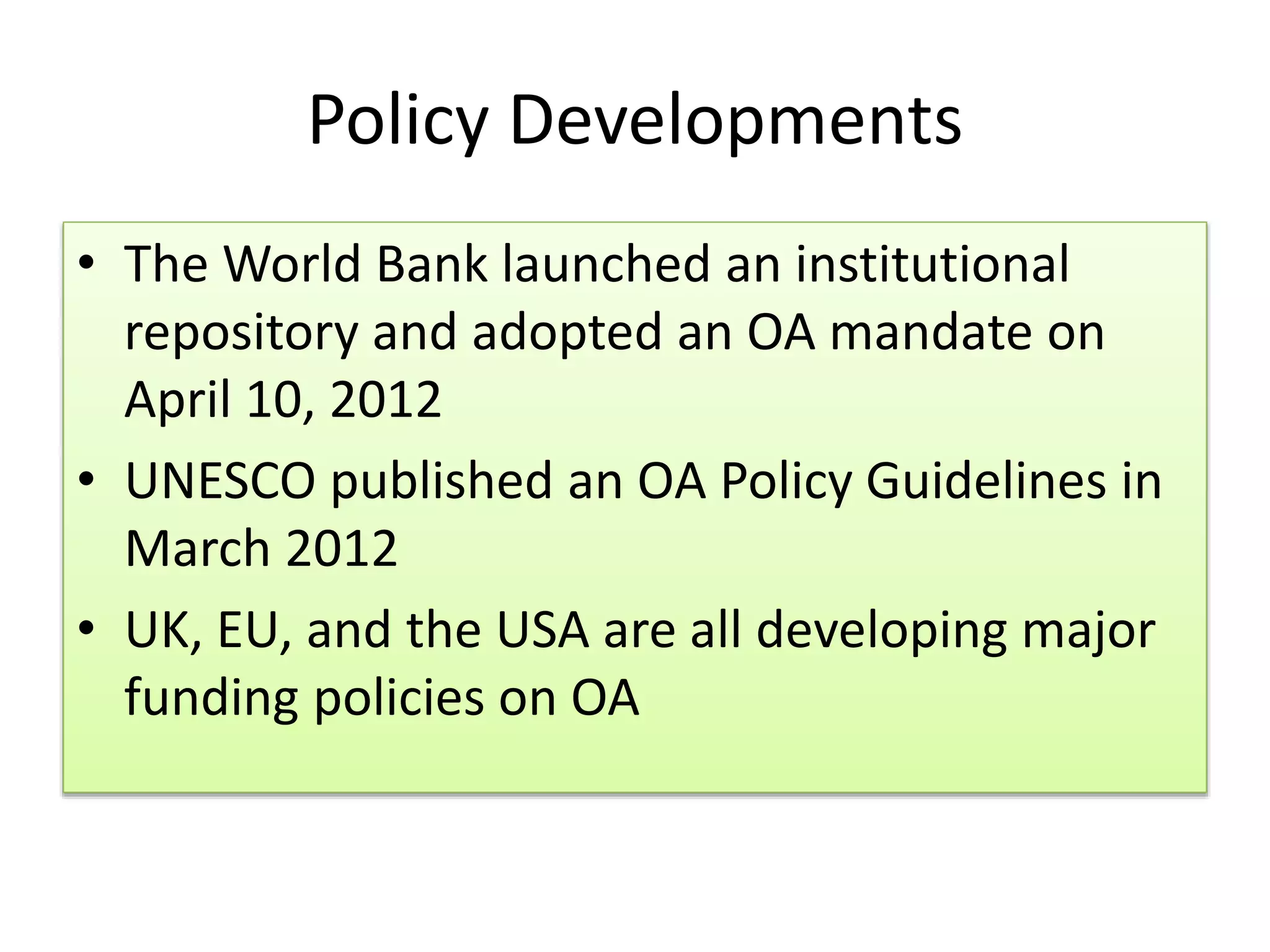
Policy Developments
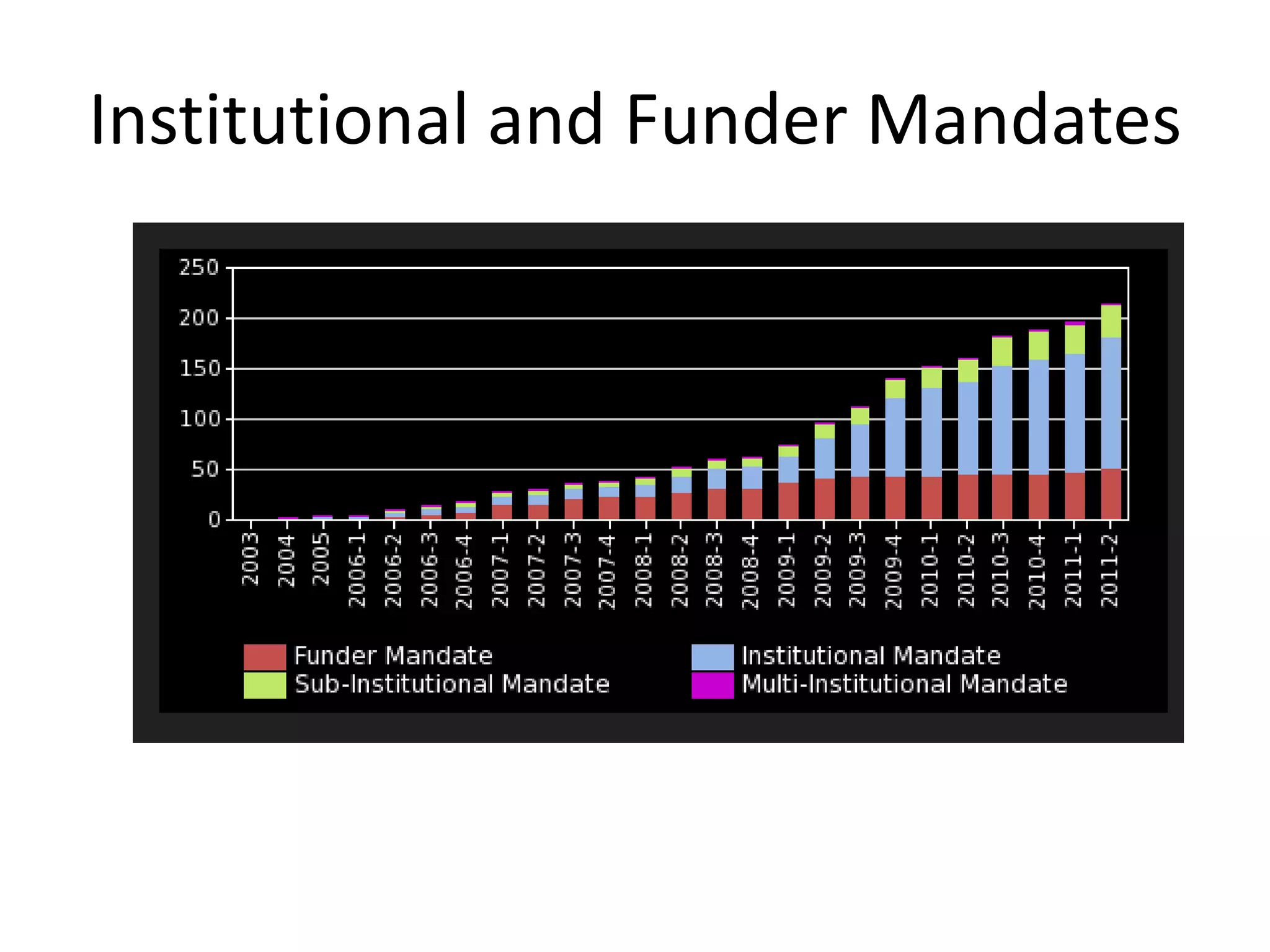
• The World Bank launched an institutional
repository and adopted an OA mandate on
April 10, 2012
• UNESCO published an OA Policy Guidelines in
March 2012
• UK, EU, and the USA are all developing major
funding policies on OA
New Ways of thinking about Scholarly
Communications
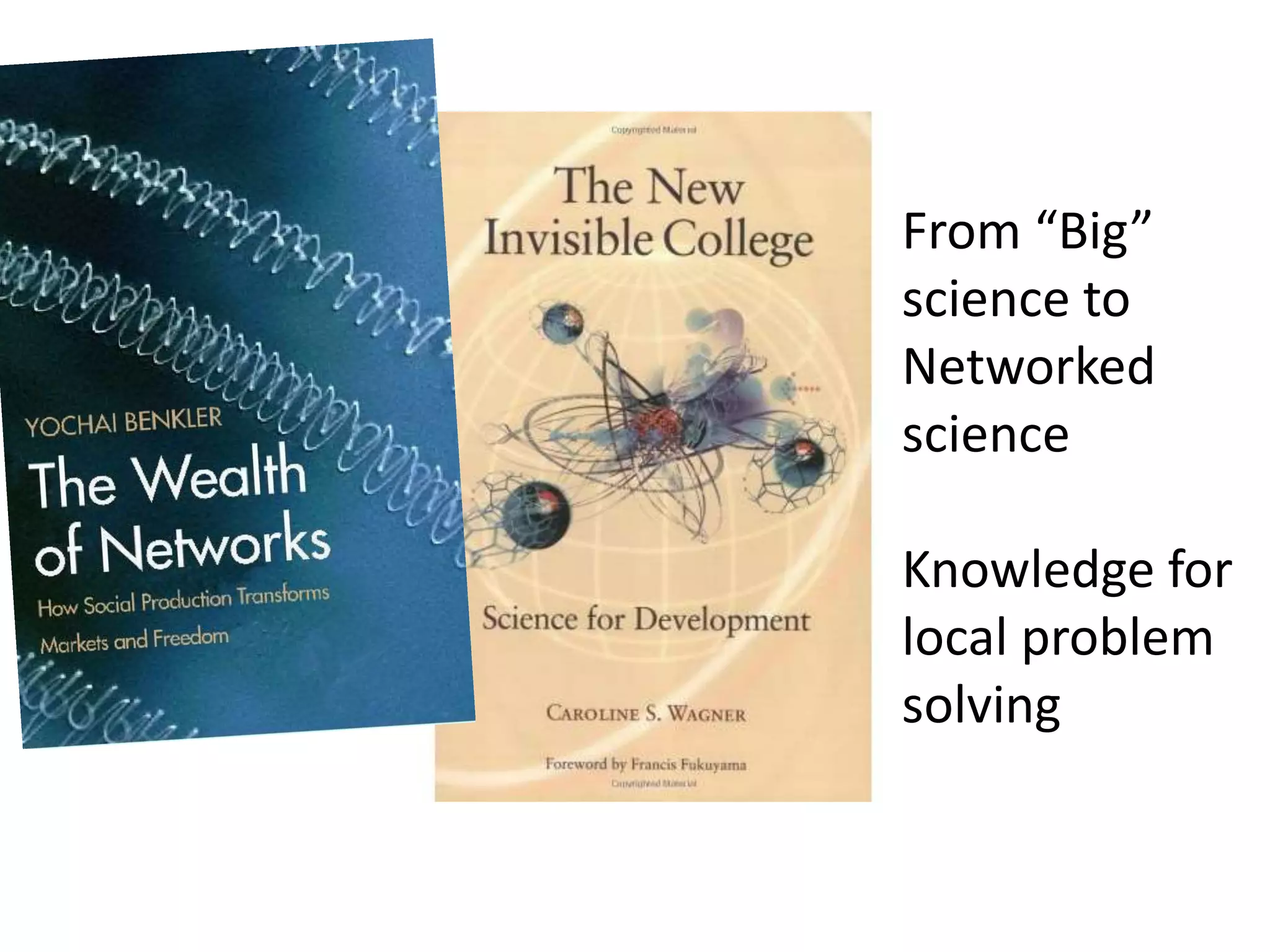
From “Big”
science to
Networked
science
Knowledge for
local problem
solving
Ithaka Faculty Survey 2009
“Basic scholarly information use
practices have shifted rapidly in recent
years and, as a result, the academic
library is increasingly being
disintermediated from the discovery
process, risking irrelevance in one of
its core areas.“
http://www.ithaka.org/ithaka-s-r/research/faculty-surveys-2000-2009/faculty-survey-2009
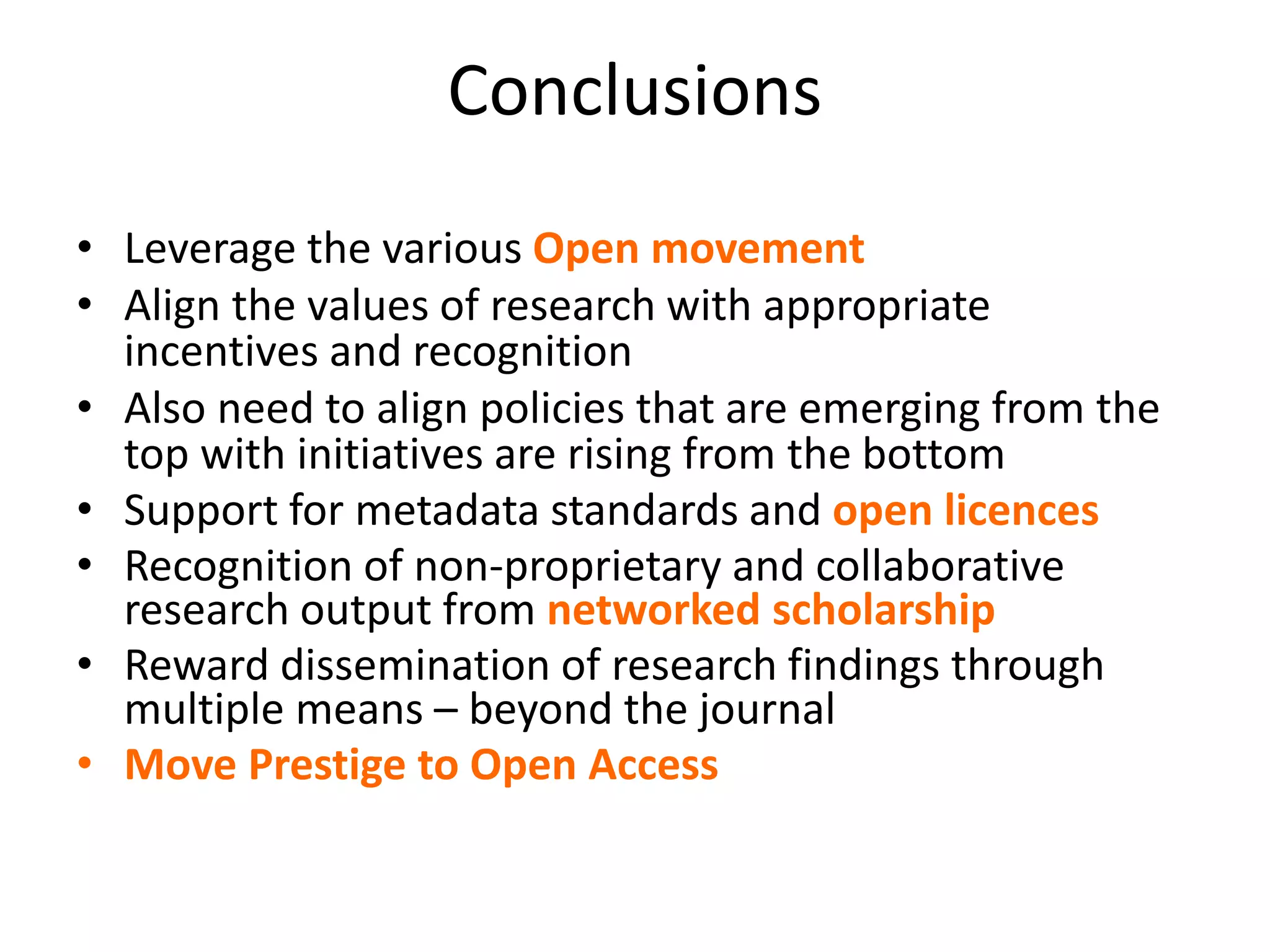
Conclusions
• Leverage the various Open movement
• Align the values of research with appropriate
incentives and recognition
• Also need to align policies that are emerging from the
top with initiatives are rising from the bottom
• Support for metadata standards and open licences
• Recognition of non-proprietary and collaborative
research output from networked scholarship
• Reward dissemination of research findings through
multiple means – beyond the journal
• Move Prestige to Open Access
Thank You!
chan@utsc.utoronto.ca
http://www.openoasis.org
http://www.bioline.org.br
http://www.openaccessmap.org

Opportunities for Knowledge Management in the Open Access Environment

  • 1.
    Opportunities for Knowledge Managementin the Open Access Environment Leslie Chan Center for Critical Development Studies Bioline International University of Toronto Scarborough Department of Library and Information Science University of Kerela Dec. 17, 2012
  • 6.
    “we willingly serveas the corrections officers for corporate information prisons.” Barbara Fister, Trumping ownership with open access: a manifesto Library Journal, 4/1/2010 http://www.libraryjournal.com/article/CA6723666.html?nid=2671&rid=##reg_visitor_id##&so urce=title
  • 7.
    John Buschman Westport, CT:Libraries Unlimited, 2003 “that the specific trends identified in librarianship that accommodate the new public philosophy of casting public cultural institutions in economic terms represent a further diminution of the democratic public sphere.”
  • 8.
  • 9.
    The World ofScientific Output According to Thomson’s ISI Science Citation Index Data from 2002 http://www.worldmapper.org/display.php?selected=205
  • 10.
    Agenda • What isOpen Access and its key benefits • Growth of OA in the last ten years • Key trends and developments – Global and Local trends New and Exciting Developments • Areas that are still deficient • Opportunities for Information and Library Professionals
  • 11.
    Key Messages • OpenAccess as a philosophical principle and a set of practical tools • Emerging countries like India should pay attention to Open Access • Importance for the public, for education, and for development • “Journal” no longer serves the needs of networked scholarship • From “Wealth of Nations” to “Wealth of Networks” • Need to think of new and equitable ways to support research access and dissemination
  • 12.
    OA does notonly remove or reduce price barriers for researchers in developing countries, it offers a more equitable model for the exchange of knowledge as a global public good (the philosophical dimension)
  • 13.
    Has the Internetbecome an avatar of Gandhi’s charkha? Can its many marvels—social media, participative democracy, collaborative science, etc., have the transformative energy of the spinning wheel? MUSIC OF THE SPINNING WHEEL by Sudheendra Kulkarni PUBLISHED BY AMARYLLIS |
  • 14.
    “By "open access"to this literature, we mean its free availability on the public internet, permitting any users to read, download, copy, distribute, print, search, or link to the full texts of these articles, crawl them for indexing, pass them as data to software, or use them for any other lawful purpose, without financial, legal, or technical barriers other than those inseparable from gaining access to the internet itself. The only constraint on reproduction and distribution, and the only role for copyright in this domain, should be to give authors control over the integrity of their work and the right to be properly acknowledged and cited.” BOAI 2002 http://www.soros.org/openaccess/read
  • 15.
    Modes of OpenAccess Gratis Libre Green Author Self- Archiving of published papers or pre-prints in Institutional Repositories Green-Gratis Green-Libre Gold Author publish in journals that are open access Gold-Gratis Gold-Libre User Rights Venues and Delivery Vehicles
  • 16.
  • 17.
  • 18.
    Indian Open Accessjournals indexed in DOAJ and OpenJGate
  • 19.
  • 20.
  • 21.
  • 22.
  • 26.
    The World ofJournal Publishing According to Thomson’s ISI Science Citation Index Data from 2002 http://www.worldmapper.org/display.php?selected=205
  • 27.
  • 28.
  • 29.
  • 30.
  • 33.
  • 34.
    Policy Developments • TheWorld Bank launched an institutional repository and adopted an OA mandate on April 10, 2012 • UNESCO published an OA Policy Guidelines in March 2012 • UK, EU, and the USA are all developing major funding policies on OA
  • 36.
    New Ways ofthinking about Scholarly Communications
  • 37.
  • 39.
    Ithaka Faculty Survey2009 “Basic scholarly information use practices have shifted rapidly in recent years and, as a result, the academic library is increasingly being disintermediated from the discovery process, risking irrelevance in one of its core areas.“ http://www.ithaka.org/ithaka-s-r/research/faculty-surveys-2000-2009/faculty-survey-2009
  • 41.
    Conclusions • Leverage thevarious Open movement • Align the values of research with appropriate incentives and recognition • Also need to align policies that are emerging from the top with initiatives are rising from the bottom • Support for metadata standards and open licences • Recognition of non-proprietary and collaborative research output from networked scholarship • Reward dissemination of research findings through multiple means – beyond the journal • Move Prestige to Open Access
  • 42.

Editor's Notes

  • #2 2012 marks the tenth anniversary of the Budapest Open Access Initiative, a declaration that provided a formal definition of Open Access (OA) and a set of strategies for archiving OA. This talk begins with a review of the major milestones of achievement over the last decade, both globally and with specific attention to OA initiatives in India, followed by identification of key areas of research communication that remained to be improved. These areas include infrastructural development for e-research, more diverse and transparent metrics for evaluating scholarship, funding and institutional policy alignment, and new forms of scholarly practices and representation. Examples from these areas will be highlighted, with emphasis on areas of collaboration between information scientists, library professionals, and scholars from various fields.
  • #8 “that the specific trends identified in librarianship that accommodate the new public philosophy of casting public cultural institutions in economic terms represent a further diminution of the democratic public sphere.”“vision of a library democratically connected to its community (be it a university, school, or town/city), engaging it in a rational dialogue about what it should be in light of democratic public purposes, and the need to provide alternatives and alternative spaces in a culture dominated by information capitalism and media image and spectacle (p. 180).”Buschman discusses how the library has moved from a model of contributing to the public good to one dictated by economics; he also analyzes how a focus on "customer-driven" librarianship is eroding the profession's historic role in supporting democracyDismantling the Public Sphere is a call to action to protect information - an essential public good - from slipping out of the hands of ordinary citizens and a call to defend the traditional and vital role of librarianship in a democratic society“New Public Philosophy”ideas generated by the advisors of Margaret Thatcher and Ronald Reagen can be dignified by such a word, holds that there is no such thing as the 'public good', that market forces should determine all allocation of resources, and that 'business knows best'.The ideology of rentlentless growth as measured by GDPPrivitization and deregulation Subprime mortages'new public philosophy' text: the rhetoric is that of the market—readers become 'customers' and, in the UK, the concept of delivering 'best value' for the spend on public libraries, dominates management thinking.The public sphereHabermas's concept of the public sphere is of the sphere of non-governmental opinion forming, created in the emerging bourgeois society of the 18th century. For Habermas, the public sphere was formed through communication, with the newspaper press acting as the agent of the public sphere. Libraries, then, especially public libraries, also emerge as agents of the public sphere—they constitute one of the agencies through which the communication of ideas of the public sphere may be made.Quality', as Bushman notes, is defined solely by 'customer satisfaction'.Value for money
  • #14 internet as an avatar of the charkhathe Gandhian vision seeks to relocate the place of science and its practical uses in the overall terrain of human affairs where it can promote mankind’s holistic progress, and not be used for exploitation and violence. The Mahatma elevates science to a higher level of human pursuit and imparts to it a nobler purpose that is consistent with both mankind’s needs and the Divine Law
  • #16 Green OA is OA delivered by repositories, regardless of peer-review status, gratis/libre status, funding model, embargo period, and so on. Gold OA is OA delivered by journals, regardless of peer-review methods, gratis/libre status, business model, and so on. It should be clear that the green/gold distinction is not the same as the gratis/libre distinction. Green/gold is about venues or vehicles, while gratis/libre is about user rights. For better or worse, there are four cases to keep distinct:  gratis green, gratis gold, libre green, and libre gold.
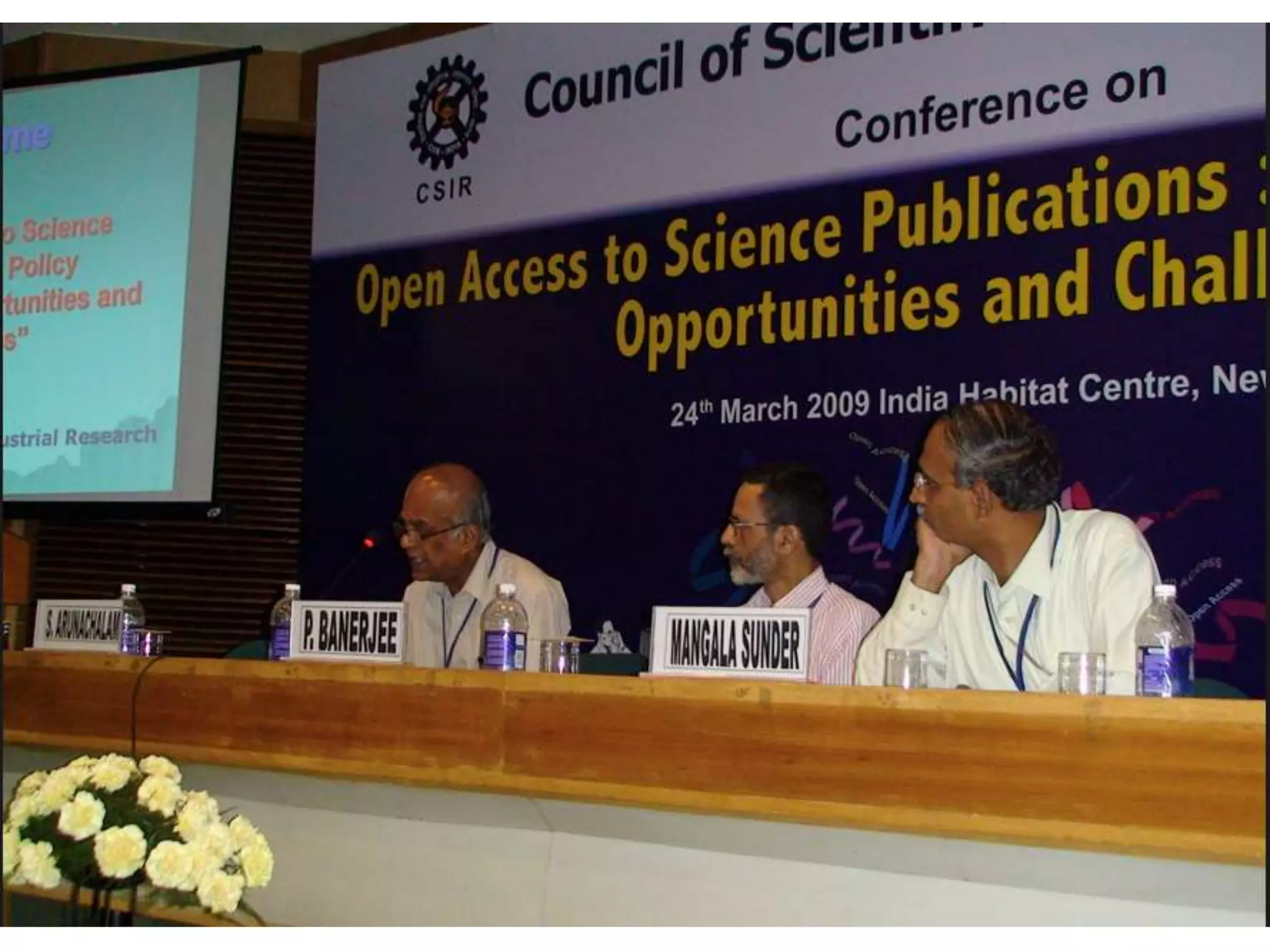
  • #20 Rights-Based Approaches in Open Access – an Indian Case StudyIn 2010, India became one of 135 countries in the world to make education a fundamental right when it passed the Right to Education Act (RTE).1 The objective of this case study is to establish the link between this constitutional right and open access to educational and research materials.This case study was carried out by the Centre for Internet and Society, Bangalore. The team included Professor SubbiahArunachalam, MadhanMuthu, Tom Dane, Sunil Abraham and PraneshRakesh.
  • #27 metrics of total publications and citations.Top 15 countries account for 82% of total publicationsAuthor with African institutional affiliation account for less than 1% of global output, and S. Africa has the highest output. The rest are “invisible”Consequence of trying to publish in “International” journal results in neglect of important local problems and solutions that are appropriate for local conditions.
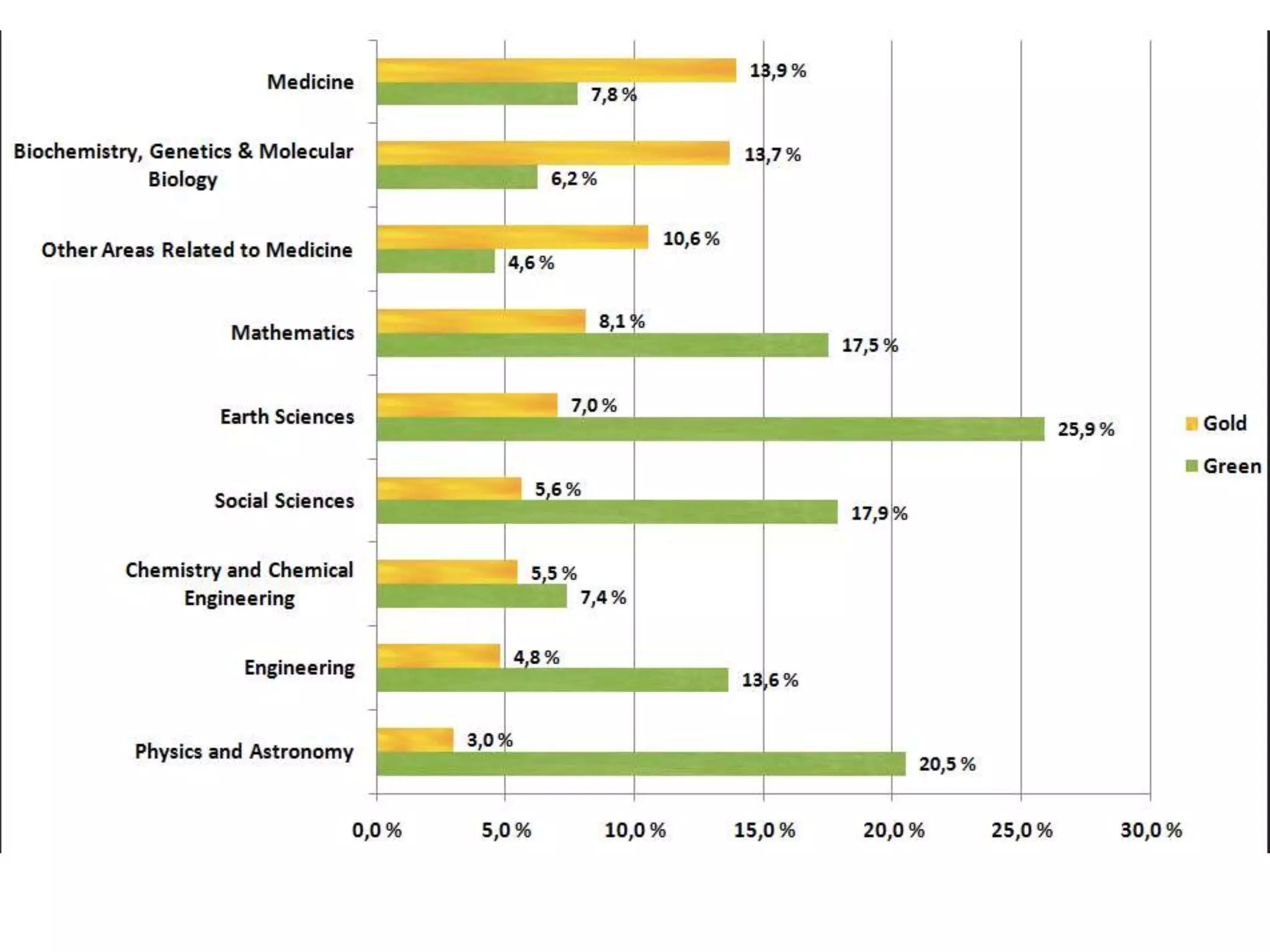
  • #32 http://upload.wikimedia.org/wikipedia/commons/thumb/9/94/OA_by_Discipline.png/800px-OA_by_Discipline.png
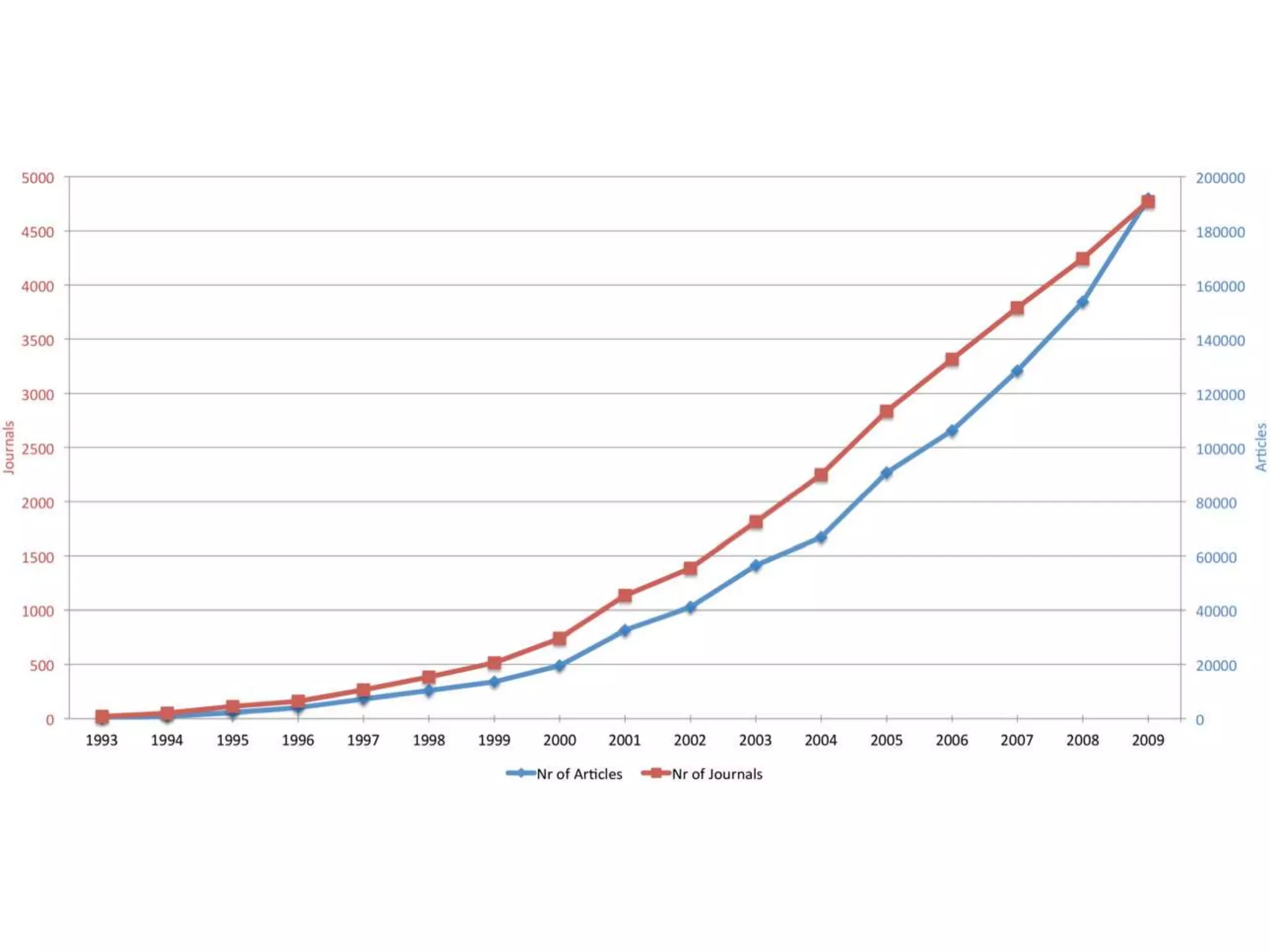
  • #33 Laakso M, Welling P, Bukvova H, Nyman L, Björk B-C, et al. 2011 The Development of Open Access Journal Publishing from 1993 to 2009. PLoS ONE 6(6): e20961. doi:10.1371/journal.pone.0020961Björk B-C, Welling P, Laakso M, Majlender P, Hedlund T, et al. 2010 Open Access to the Scientific Journal Literature: Situation 2009. PLoS ONE 5(6): e11273. doi:10.1371/journal.pone.0011273
  • #34 http://upload.wikimedia.org/wikipedia/commons/c/c6/Roarmap1aug2011.png
  • #35 The World Bank launched an institutional repository and adopted an OA mandate on April 10, 2012.http://go.worldbank.org/VOS0JQ0VK0http://go.worldbank.org/GWQP2I5FD0Here are the libre features of the new policy:  when Bank research is published by the Bank itself, then copies must be disseminated through the institutional repository under CC-BY licenses. This policy applies to books as well as articles. When Bank research is published by external publishers, the preprints or working papers must be in the repository under CC-BY licenses. The final versions of the peer-reviewed manuscripts must be in the repository under CC-BY-NC-ND licenses, unless the publisher can be persuaded to allow a more liberal license.http://documents.worldbank.org/curated/en/2012/04/16200740/world-bank-open-access-policy-formal-publicationsAlso see the policy FAQ and repository FAQ.http://siteresources.worldbank.org/EXTWBP/Resources/Open_Access_FAQ_External.pdfhttps://openknowledge.worldbank.org/faqThe new OA policy follows on the bank's open data policy from April 2010.http://go.worldbank.org/CA21J2H0A0
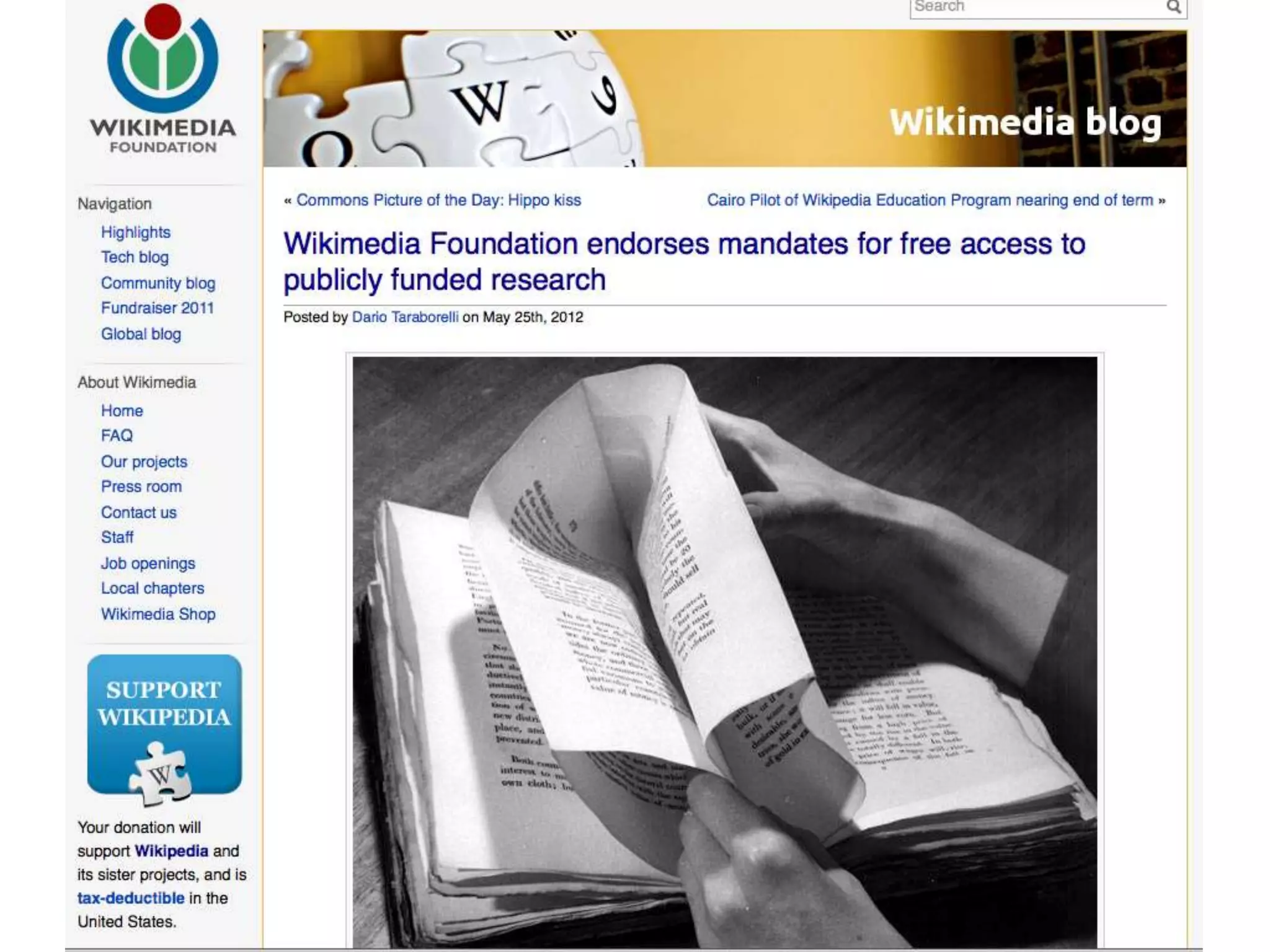
  • #36 http://blog.wikimedia.org/2012/05/25/wikimedia-foundation-endorses-mandates-for-free-access-to-publicly-funded-research/
  • #38 he New Invisible College, Caroline Wagner combines quantitative data and extensive interviews to map the emergence of global science networks and trace the dynamics driving their growth. She argues that the shift from big science to global networks creates unprecedented opportunities for developing countries to tap science's potential. Rather than squander resources in vain efforts to mimic the scientific establishments of the twentieth century, developing country governments can leverage networks by creating incentives for top-notch scientists to focus on research that addresses their concerns and by finding ways to tie knowledge to local problem solving. T
  • #40 The 2010 report on faculty attitudes reveals that the "gateway" function of libraries has steadily declined, the "archive" function has remained about the same in importance to faculty over time, but that the library as "buyer" remains farand away the most crucial function. Newer roles in supporting teaching and research have gained some traction but have not come close to challenging the more traditional functions in importance to most faculty.The irony is that the more the OA movement succeeds, the more the remaining primary role of library as "buyer" will erode. And it seems likely that to the extent specialized search services increase in importance, they will be developed along disciplinary lines, perhaps by professional societies, as the2010 report shows that this is the way that scholars continue to choose to organize their professional lives.“. If and when those journals migrate to OA, the library will no longer be needed to provide such access.” Sandy ThatcherOA will lead to the demise of the library because it’s role as the “buying club” will be greatly diminished when more and more journals move to OA