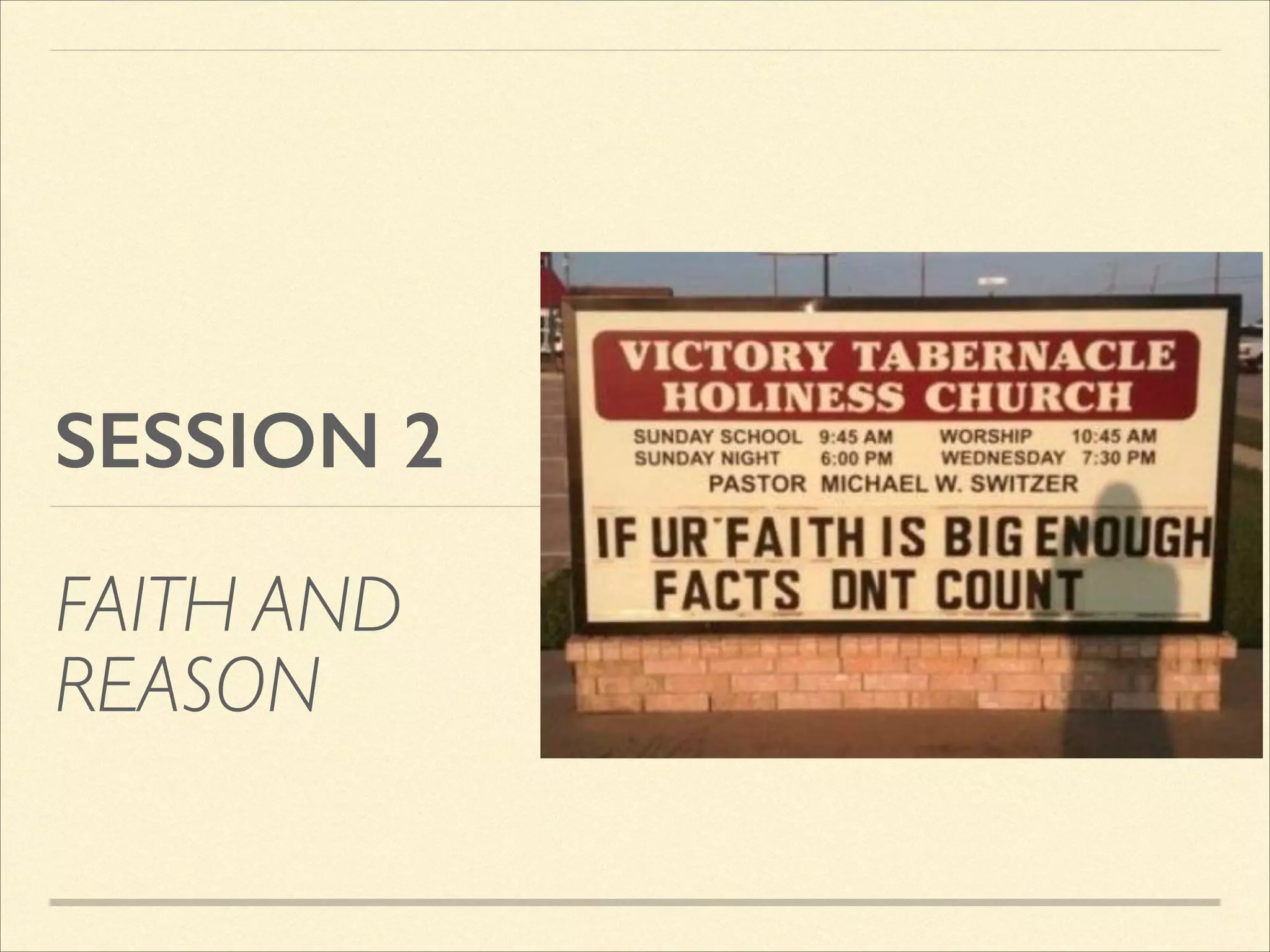


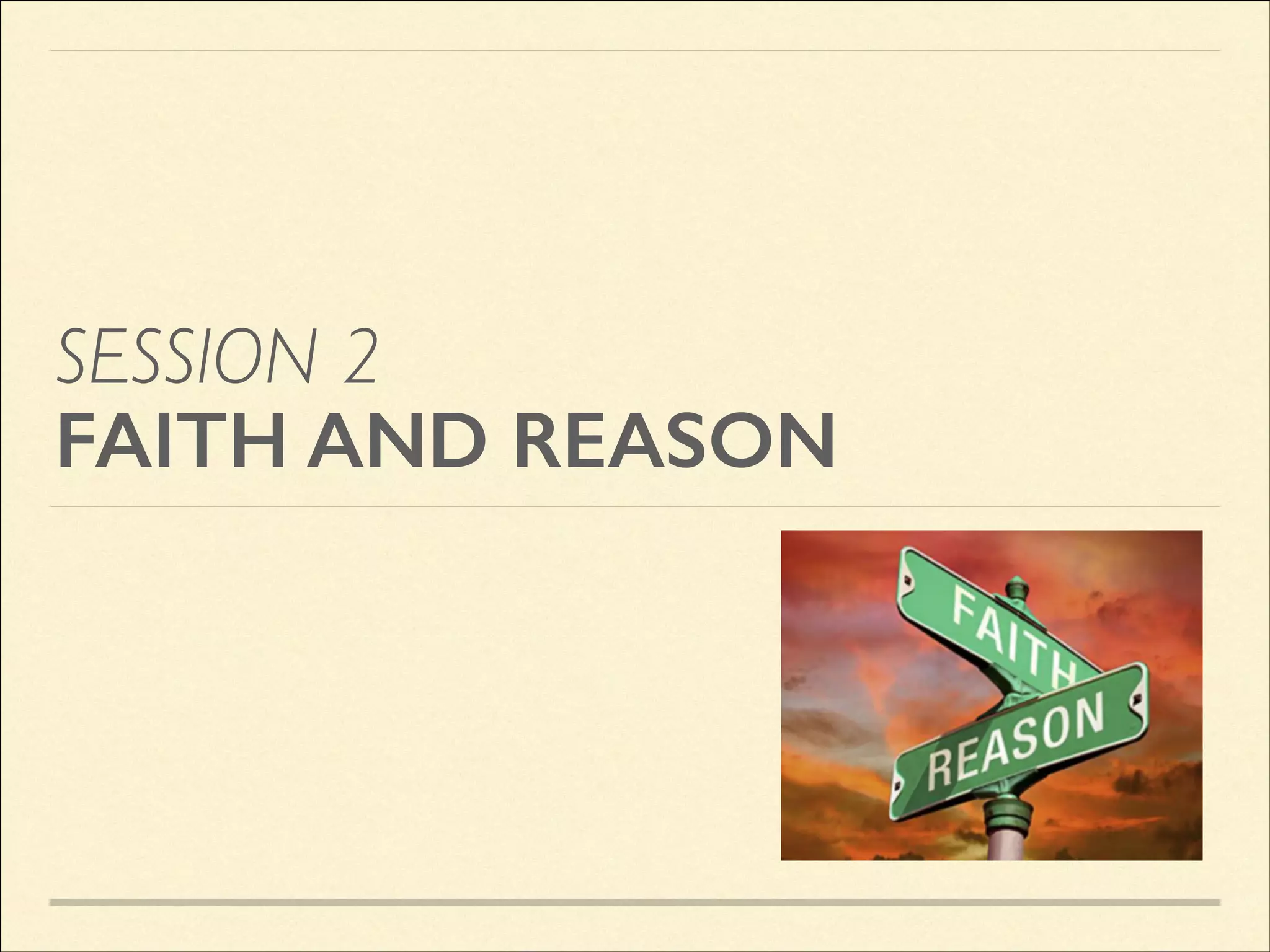
SESSION 2
FAITH AND
REASON
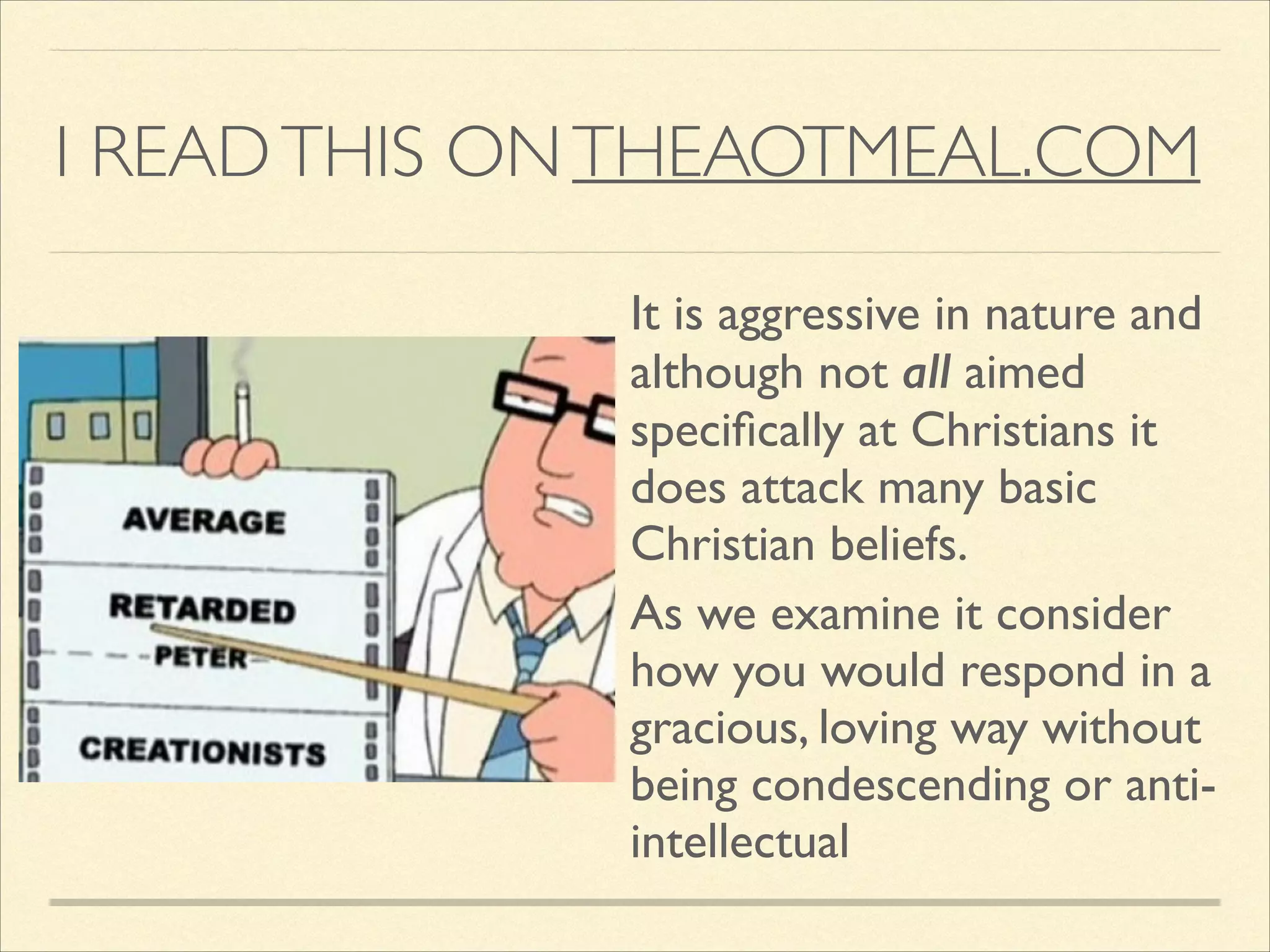
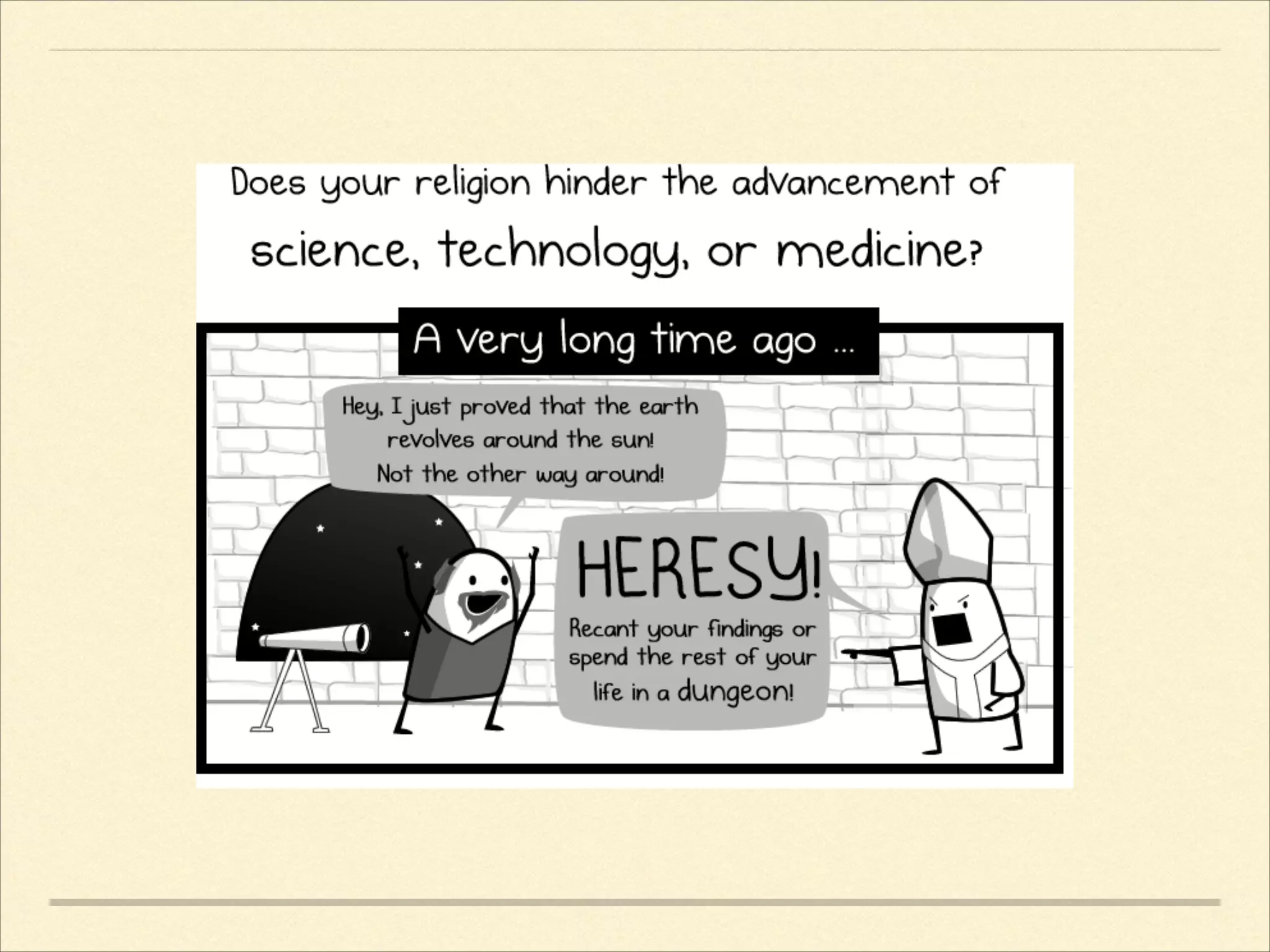
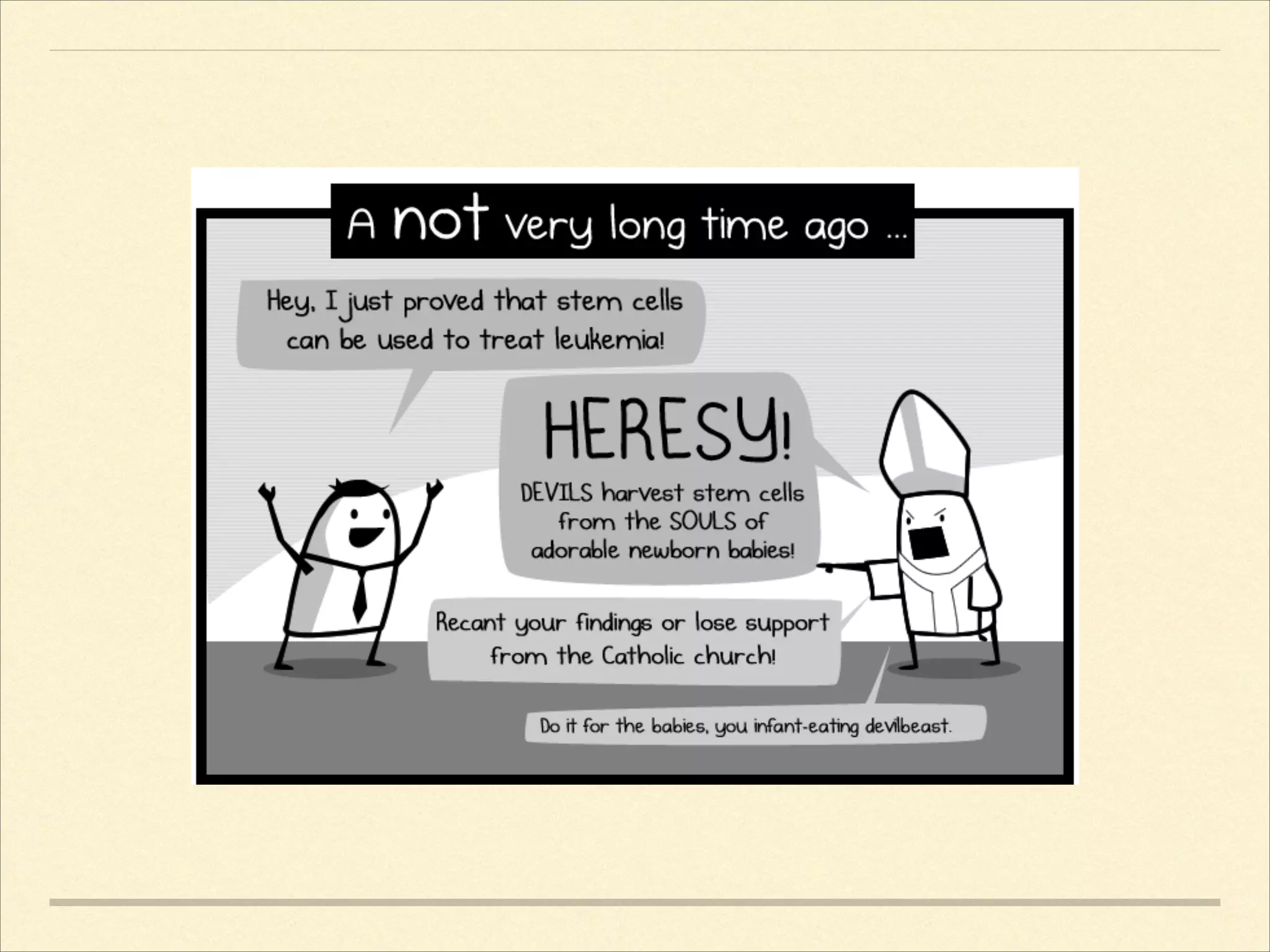
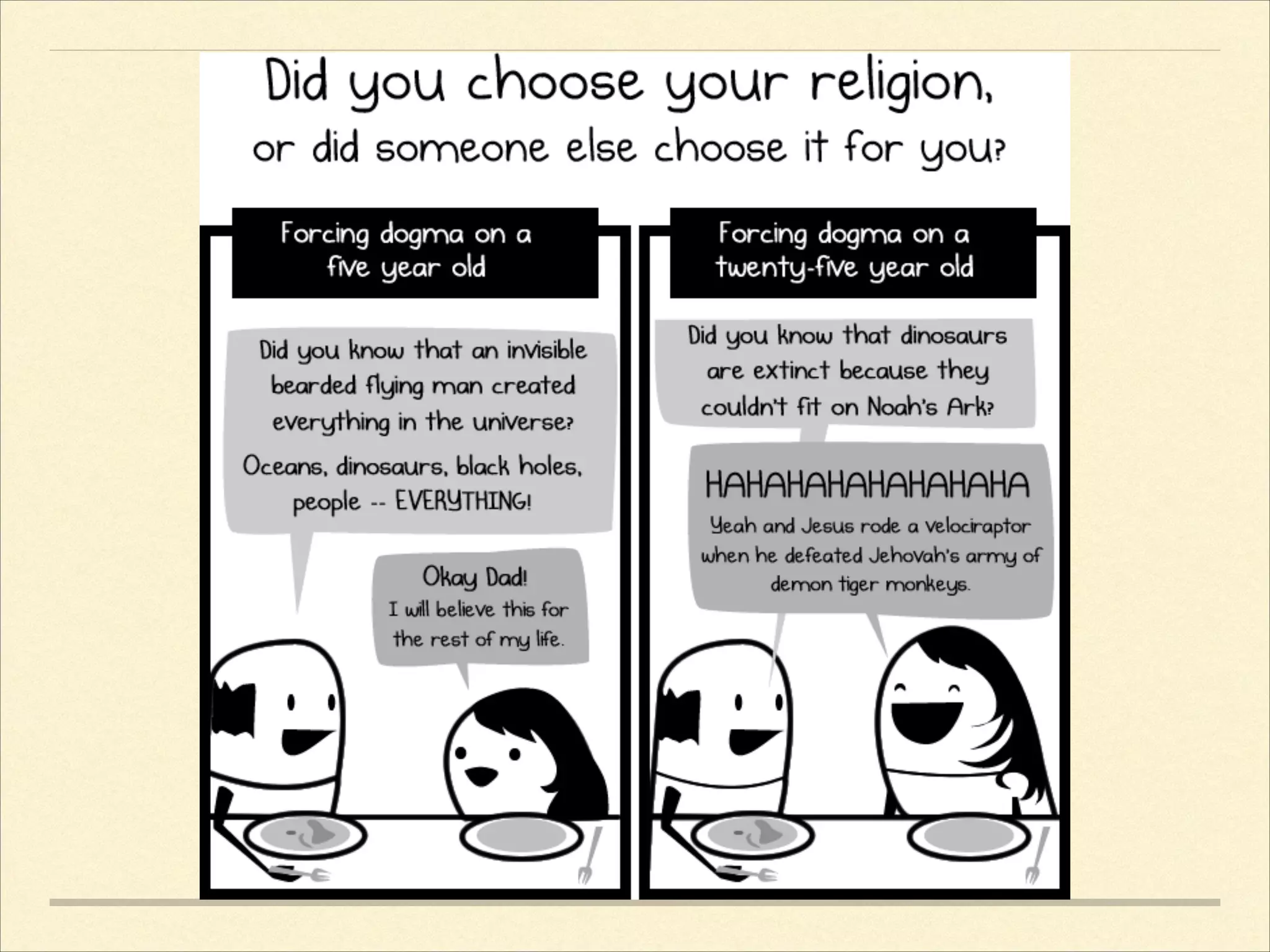
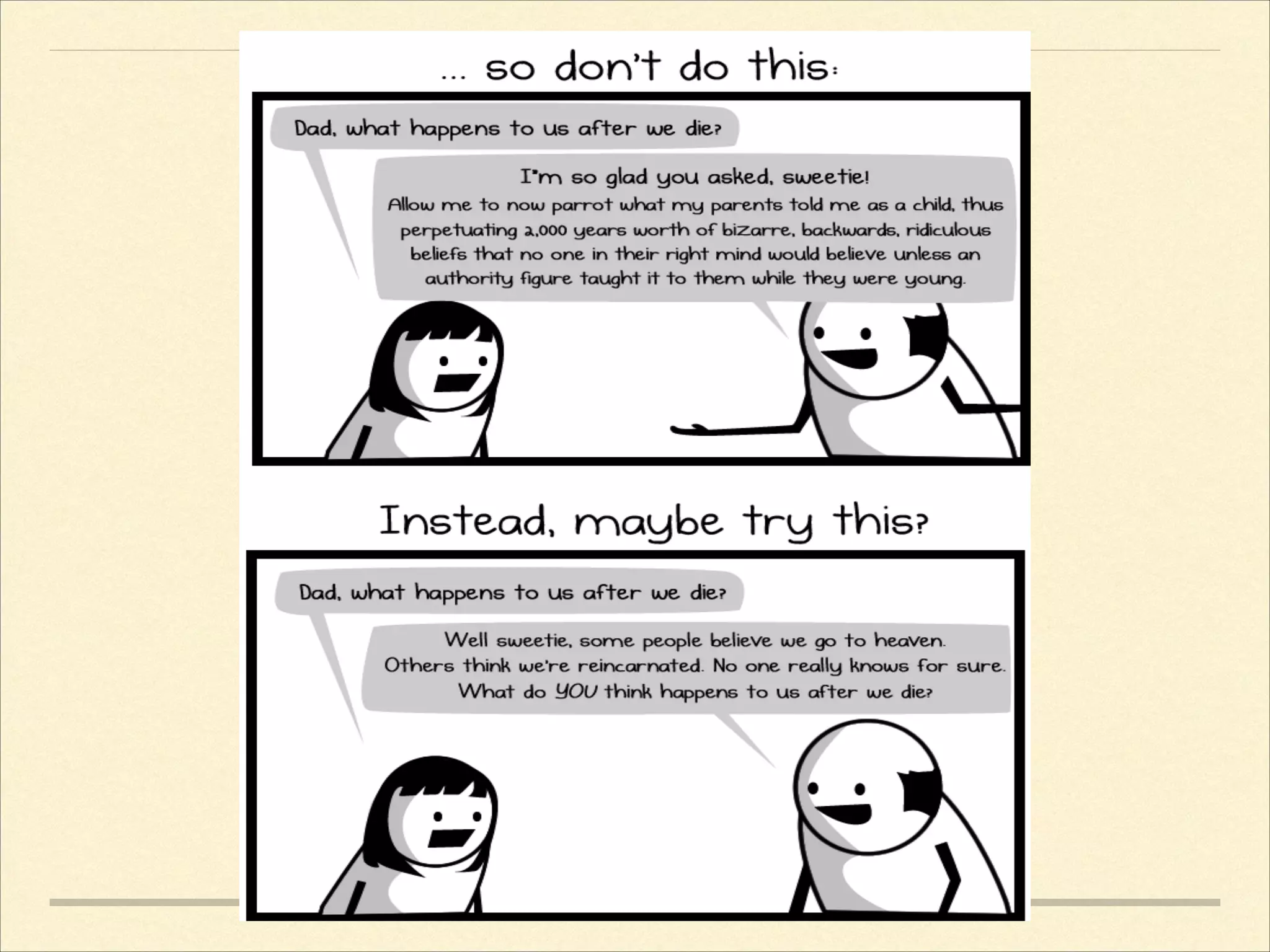
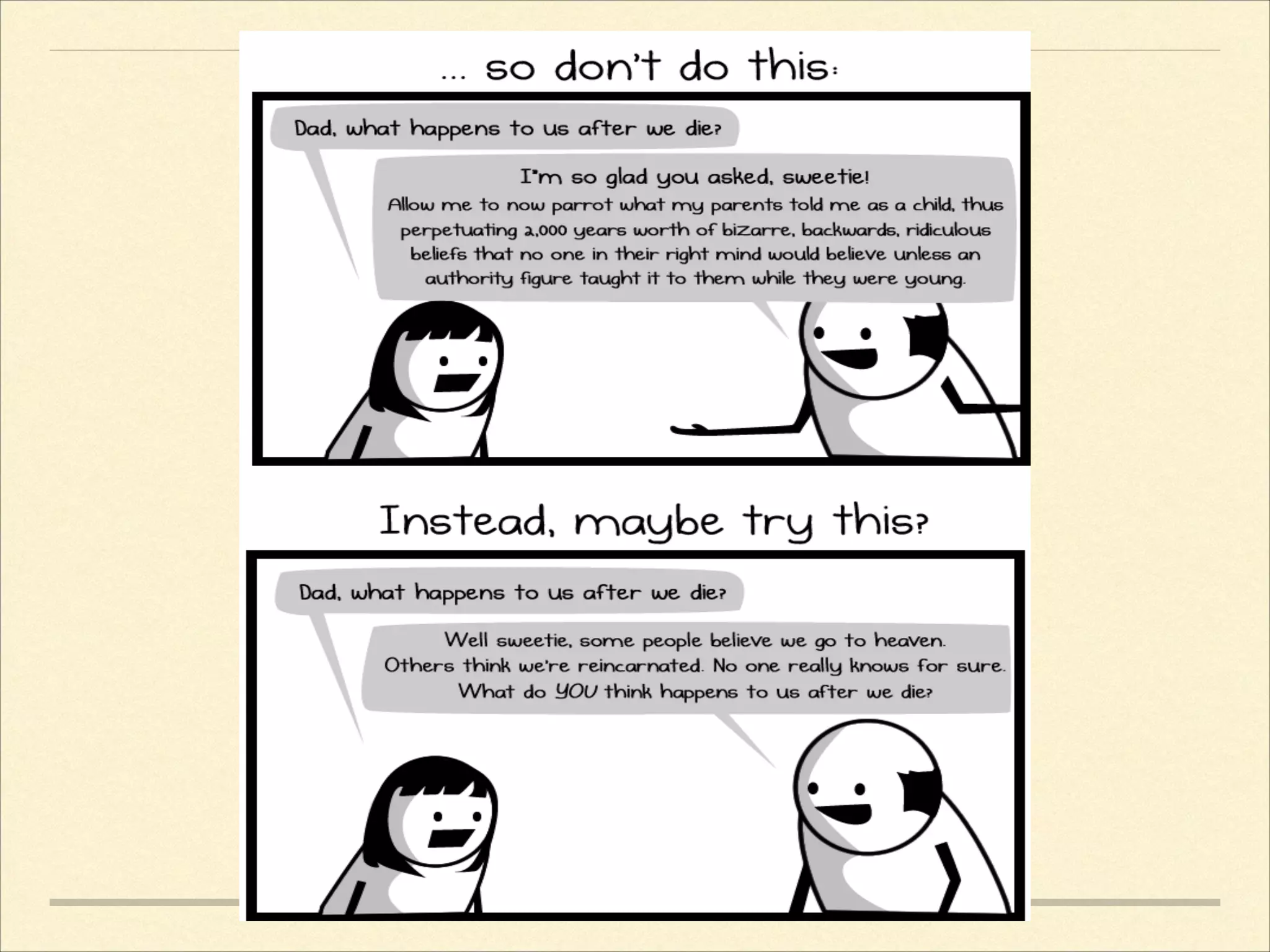
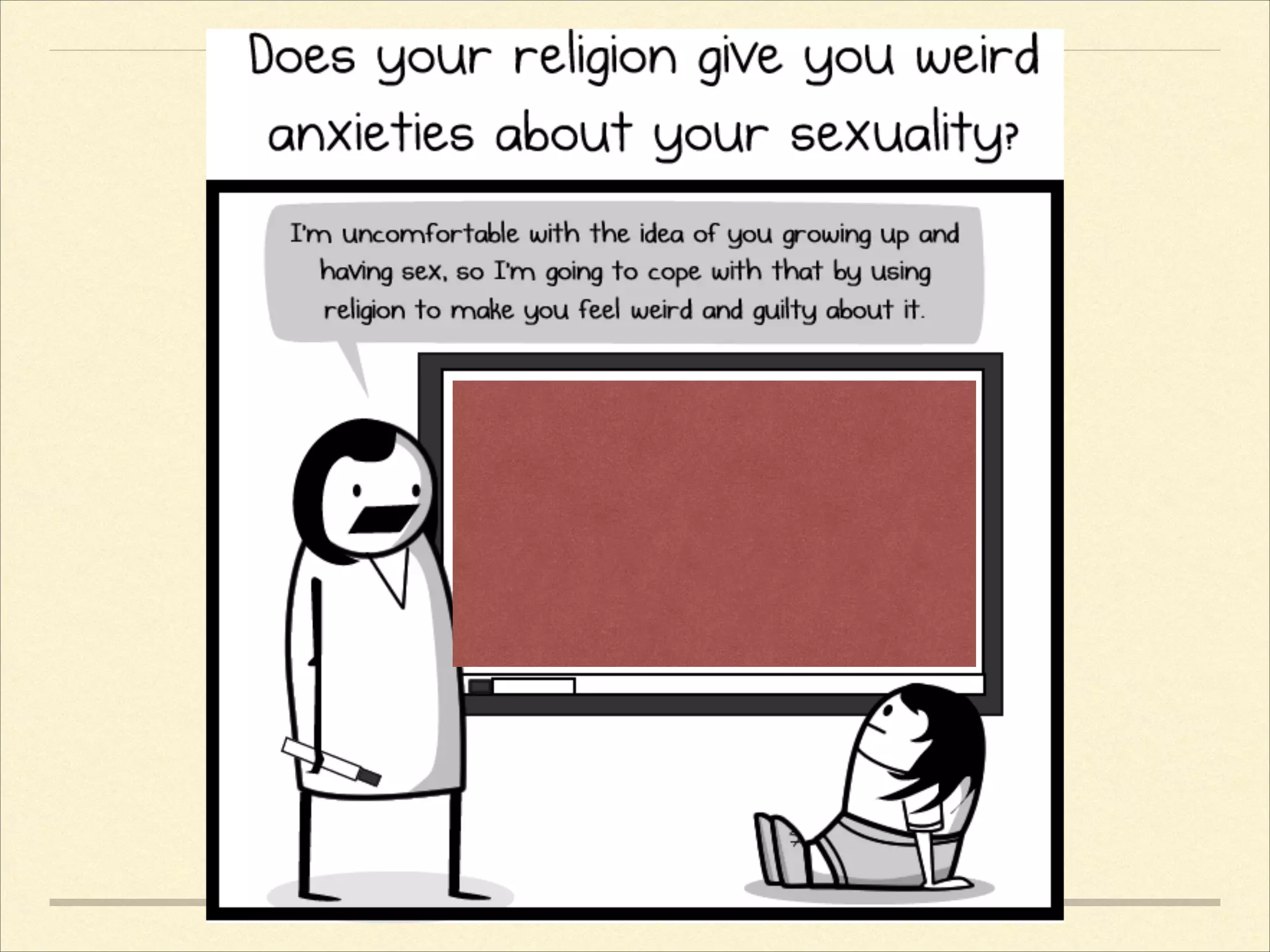
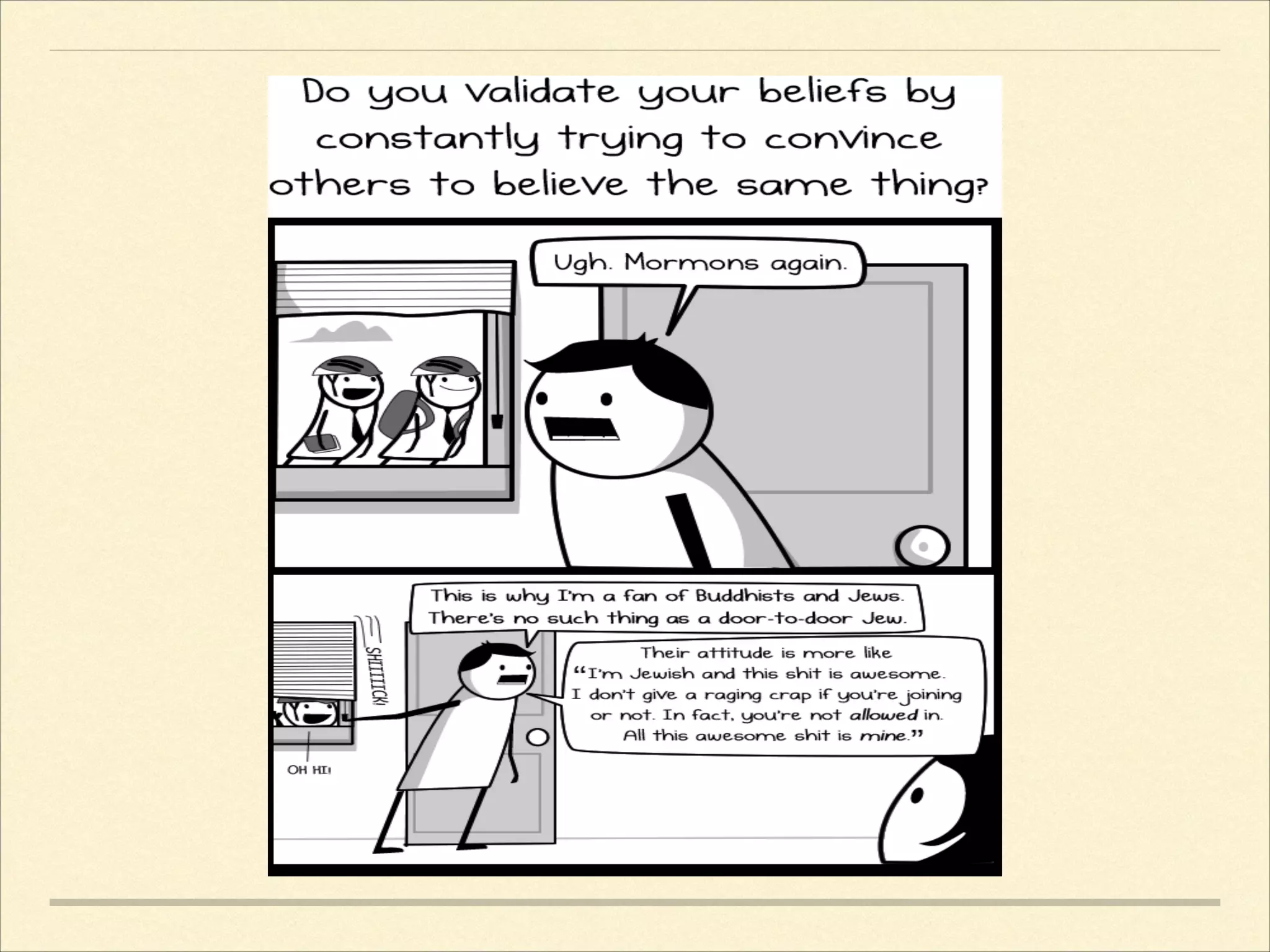
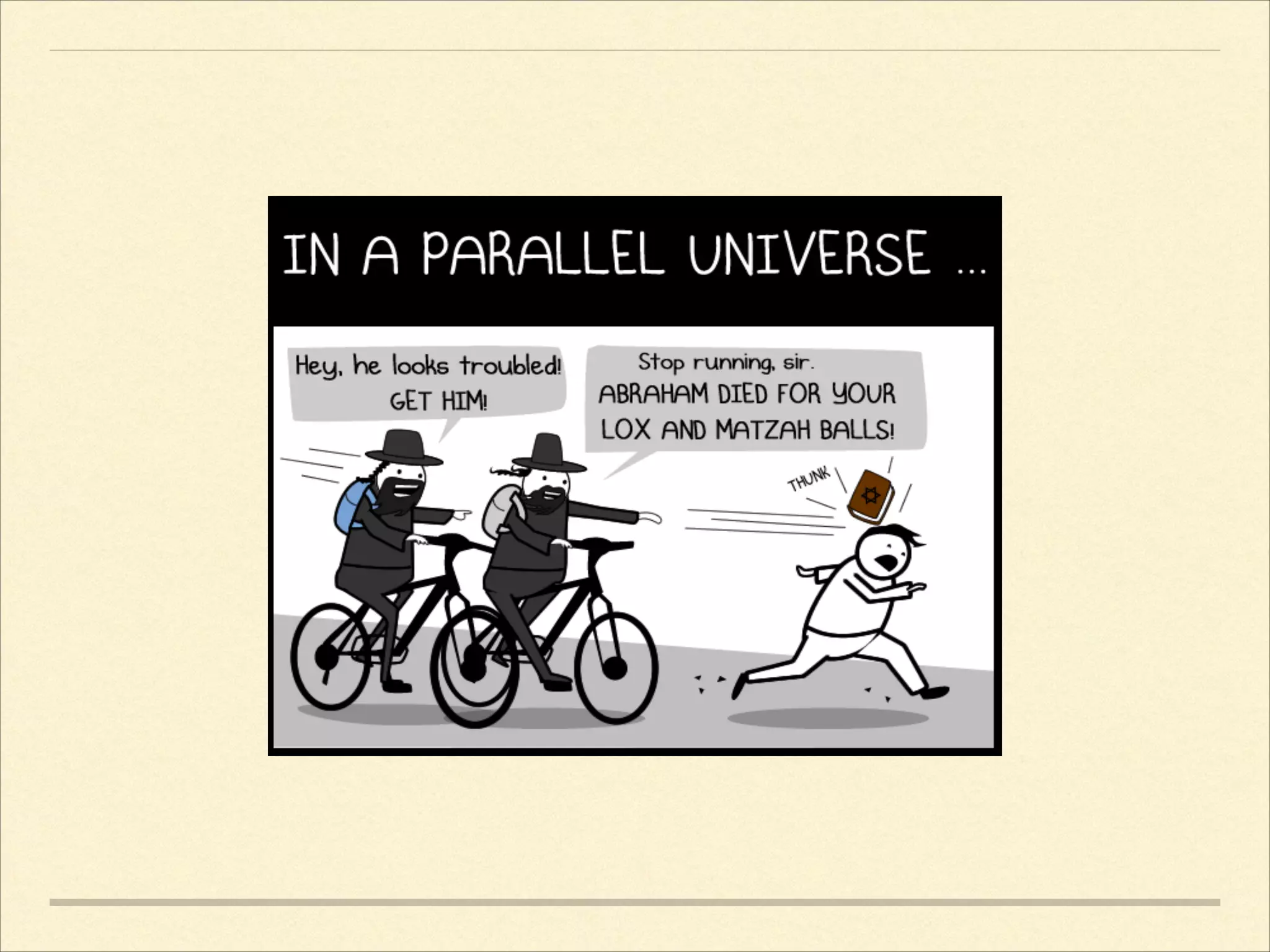
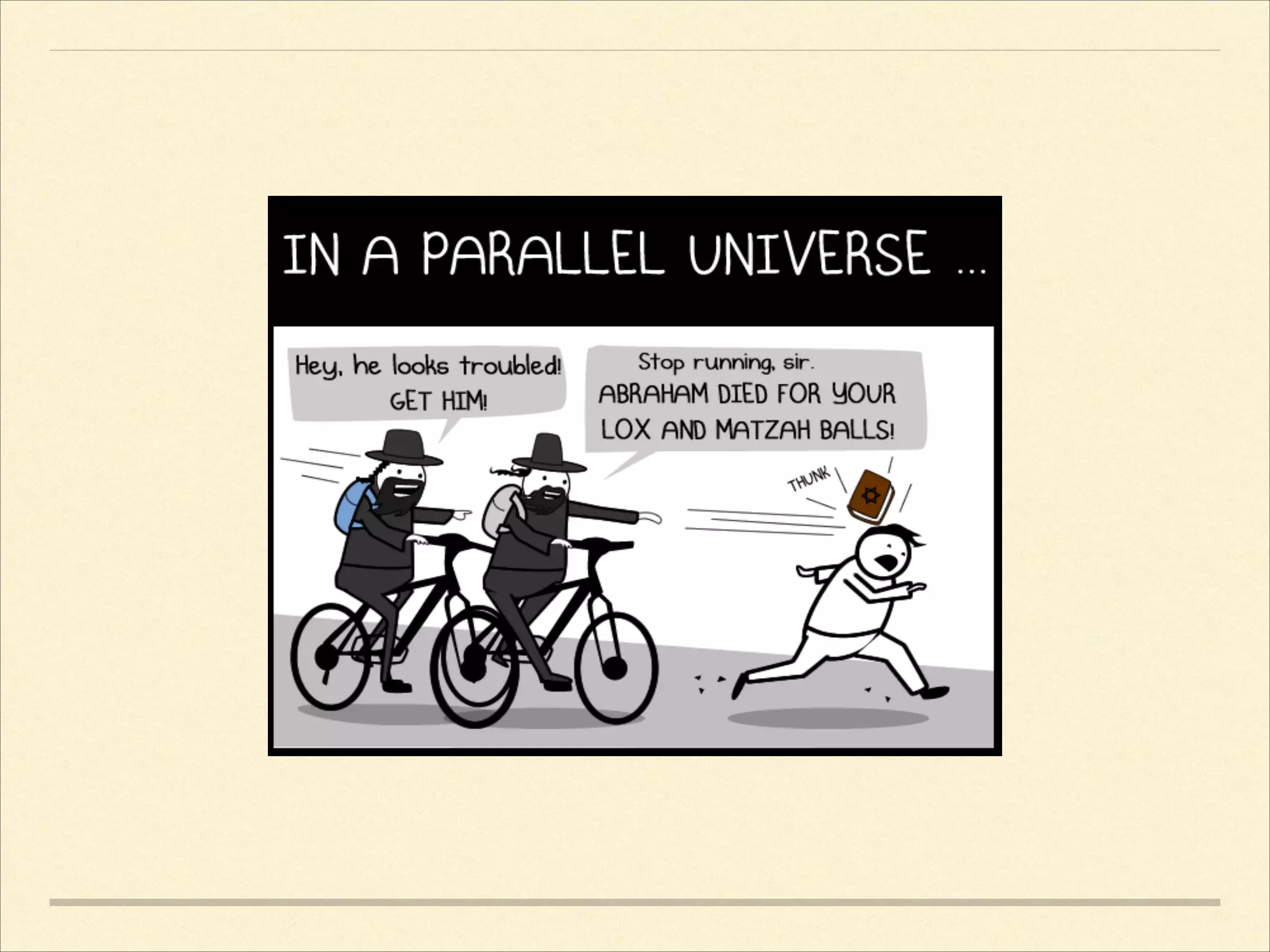
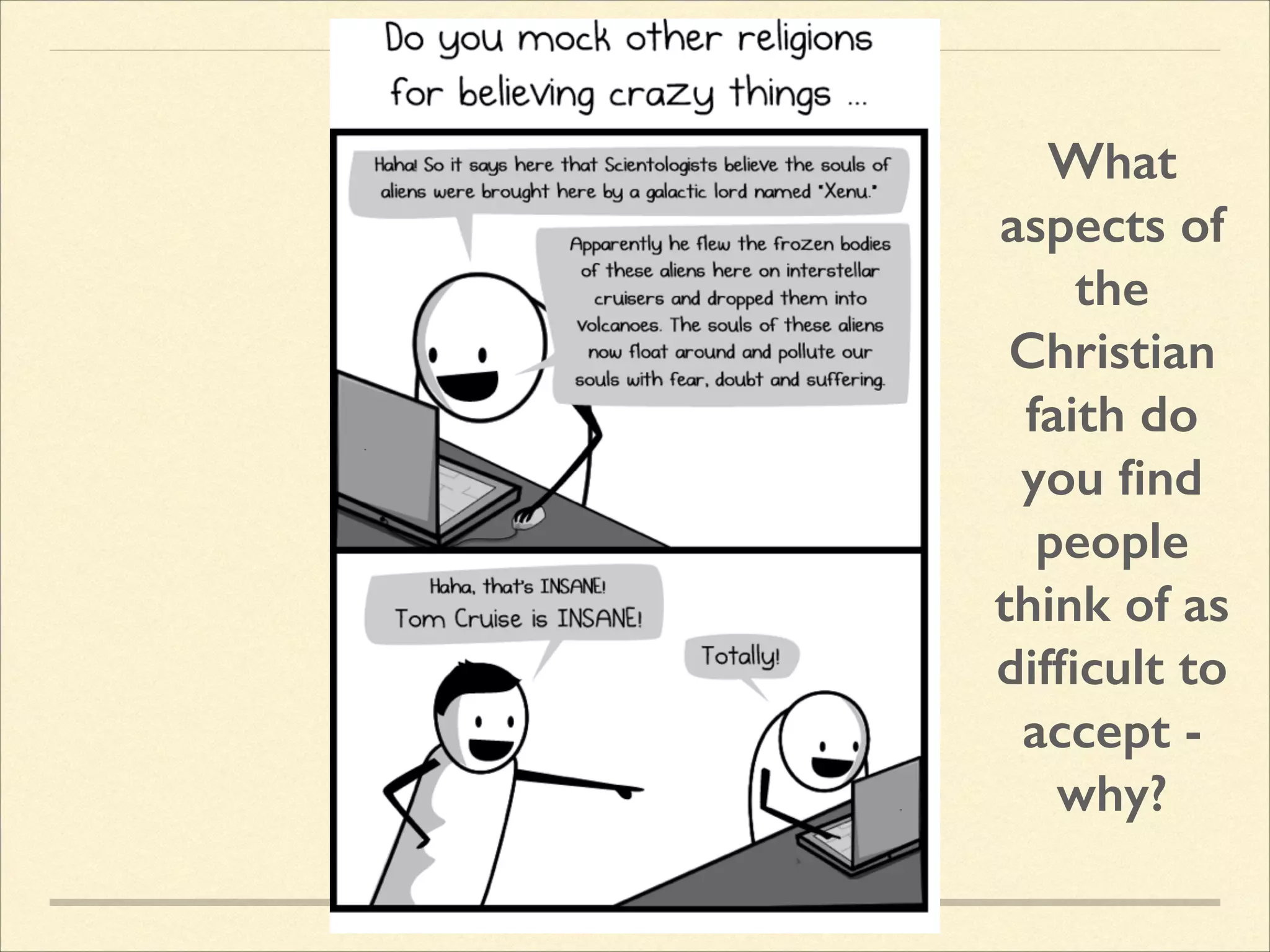
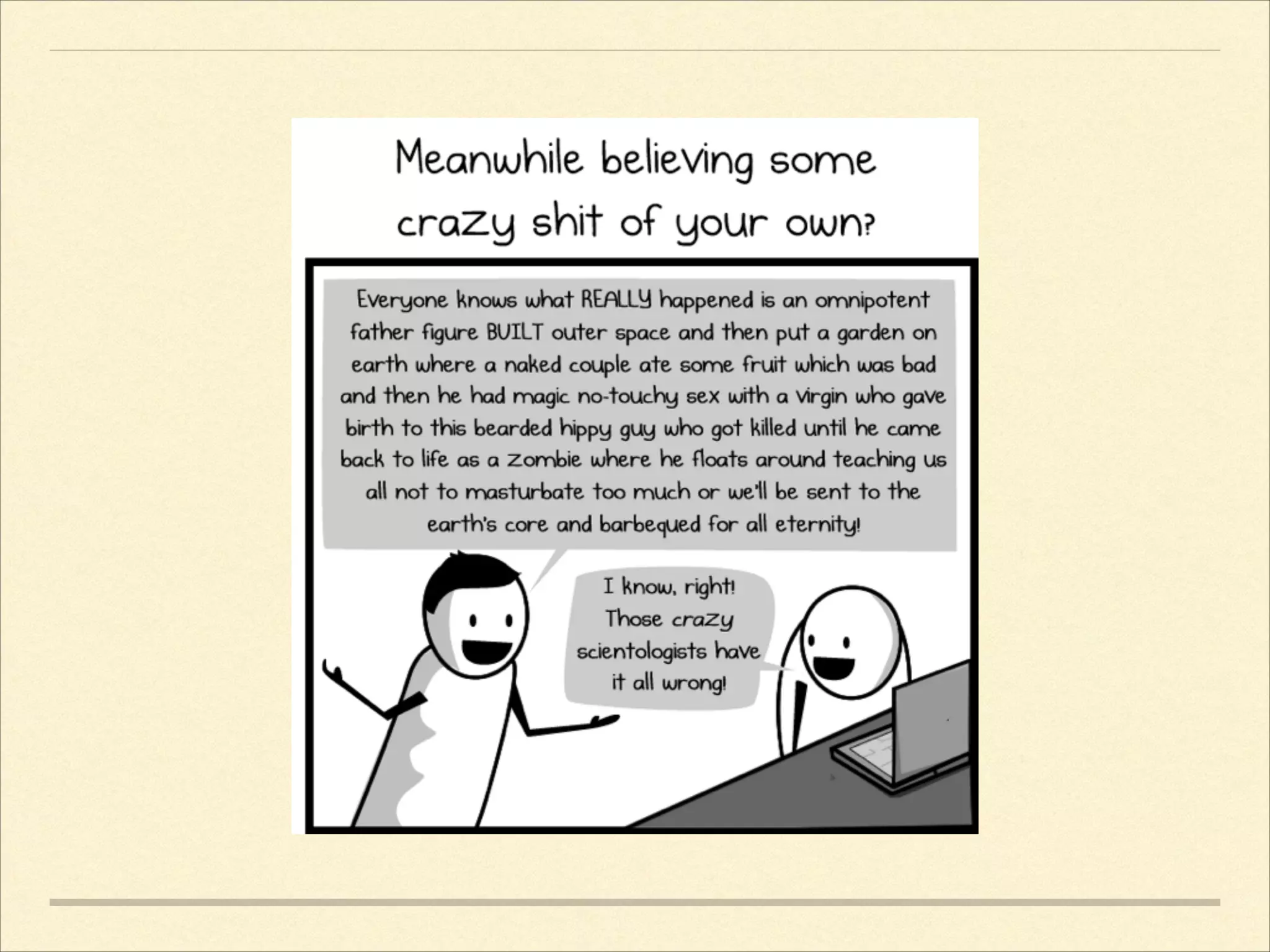
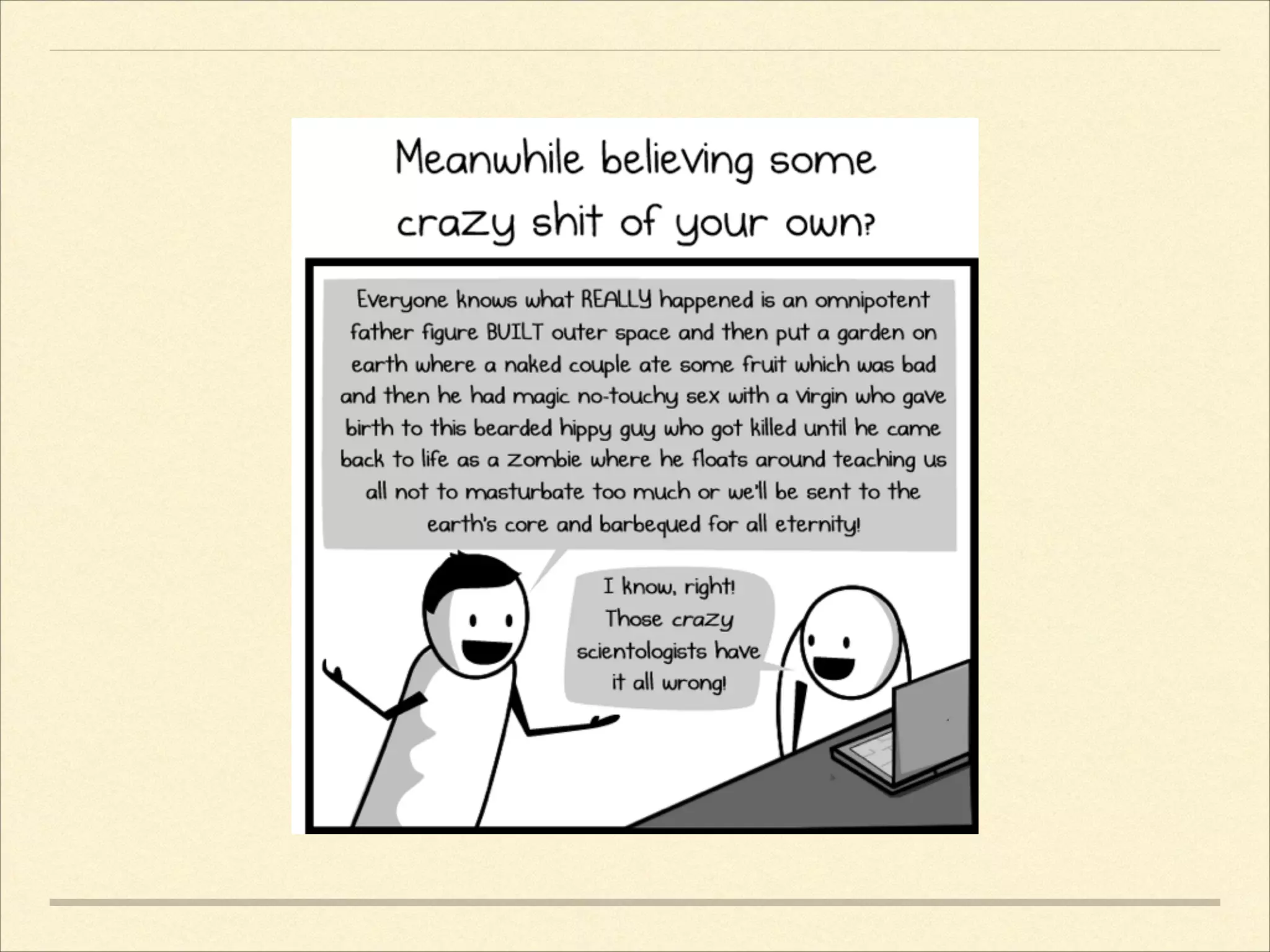
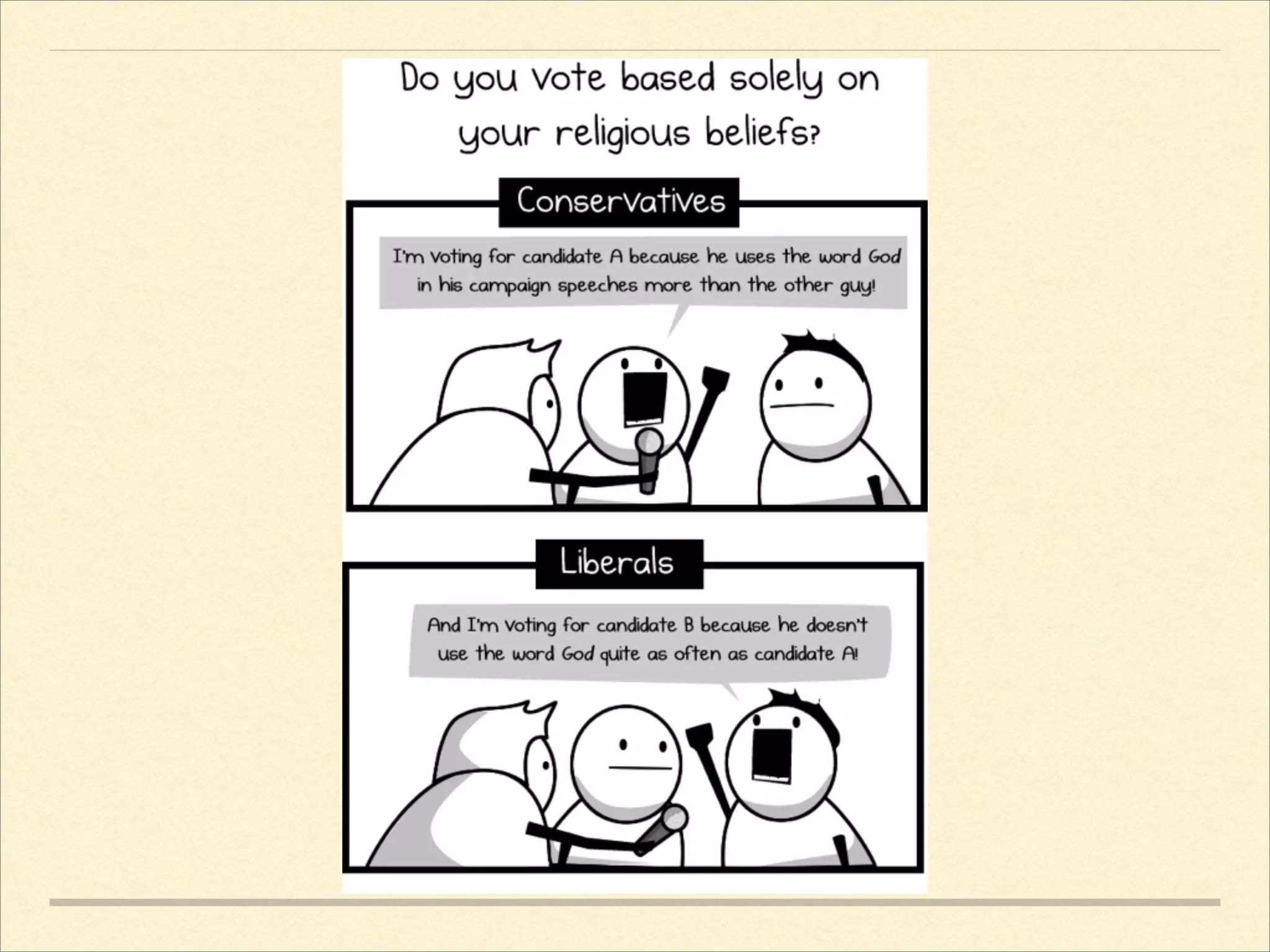
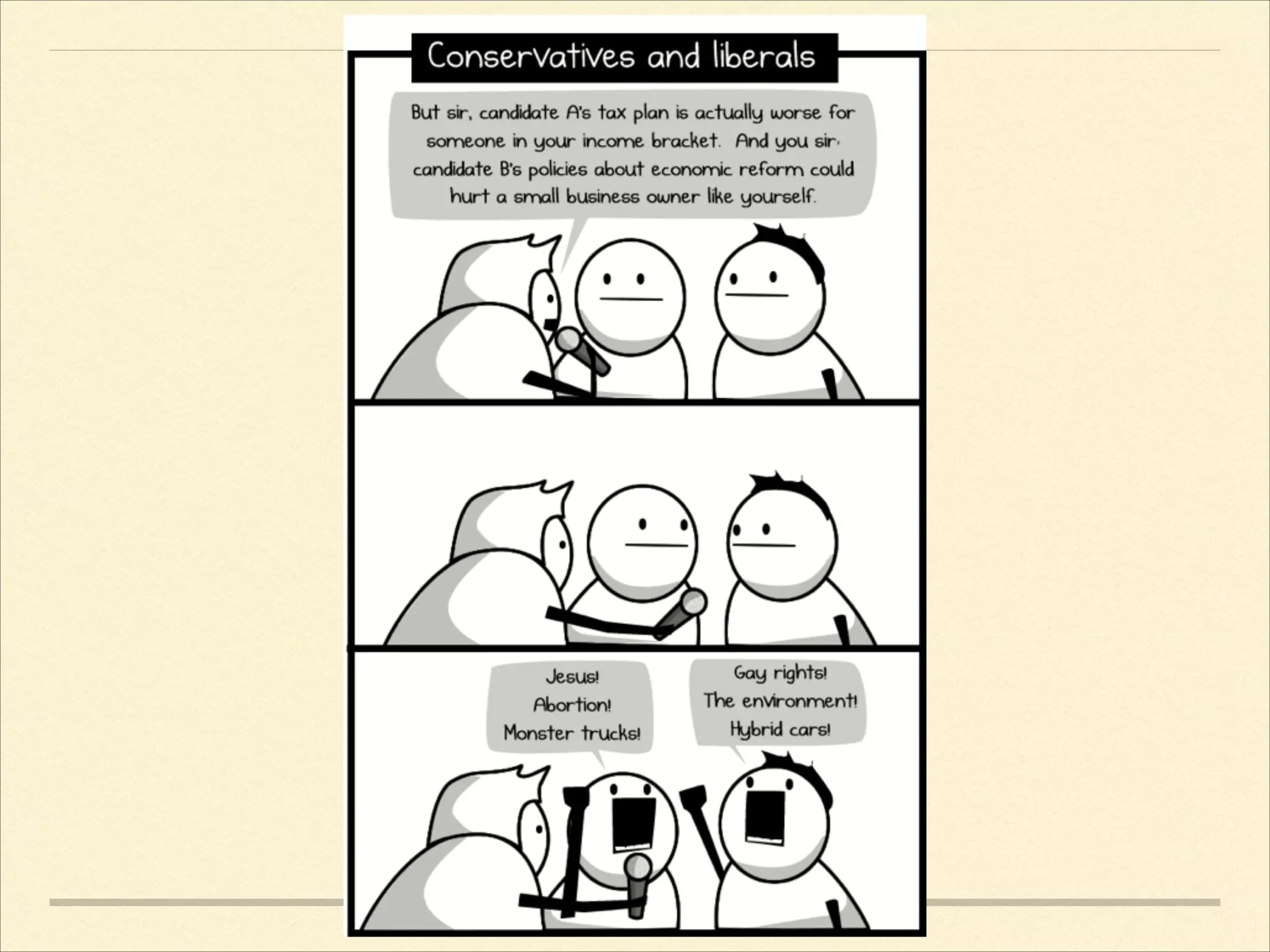
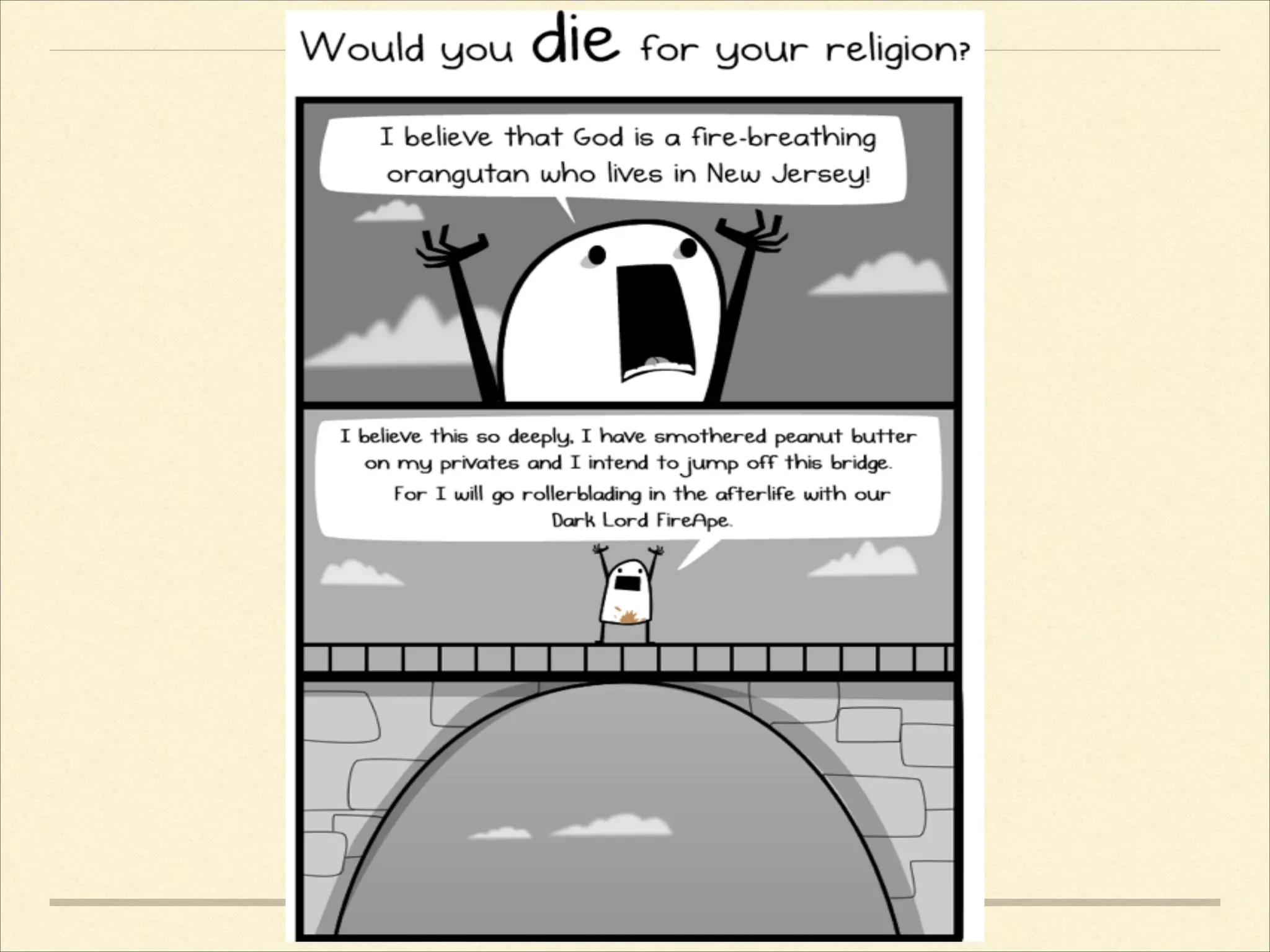
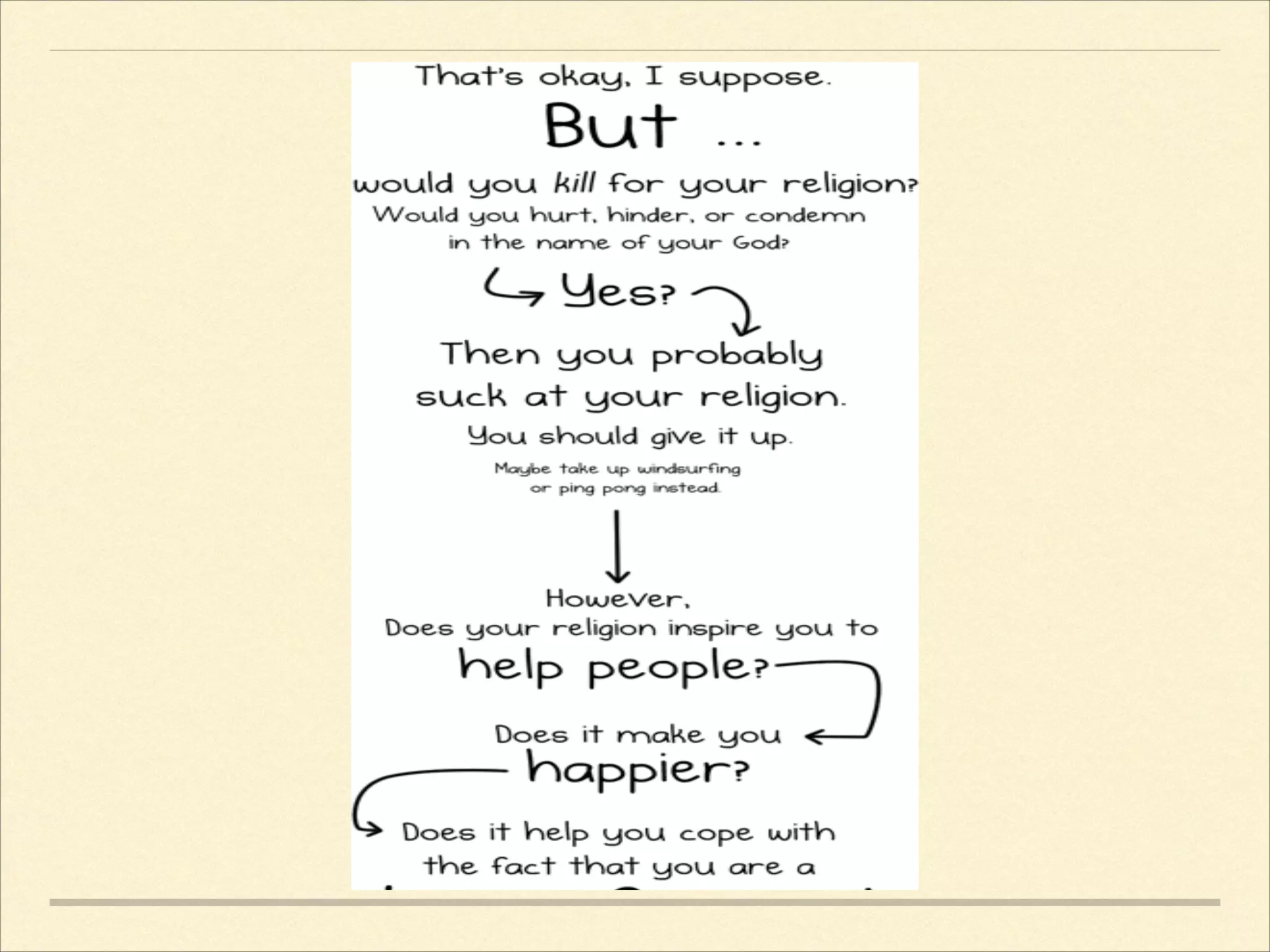
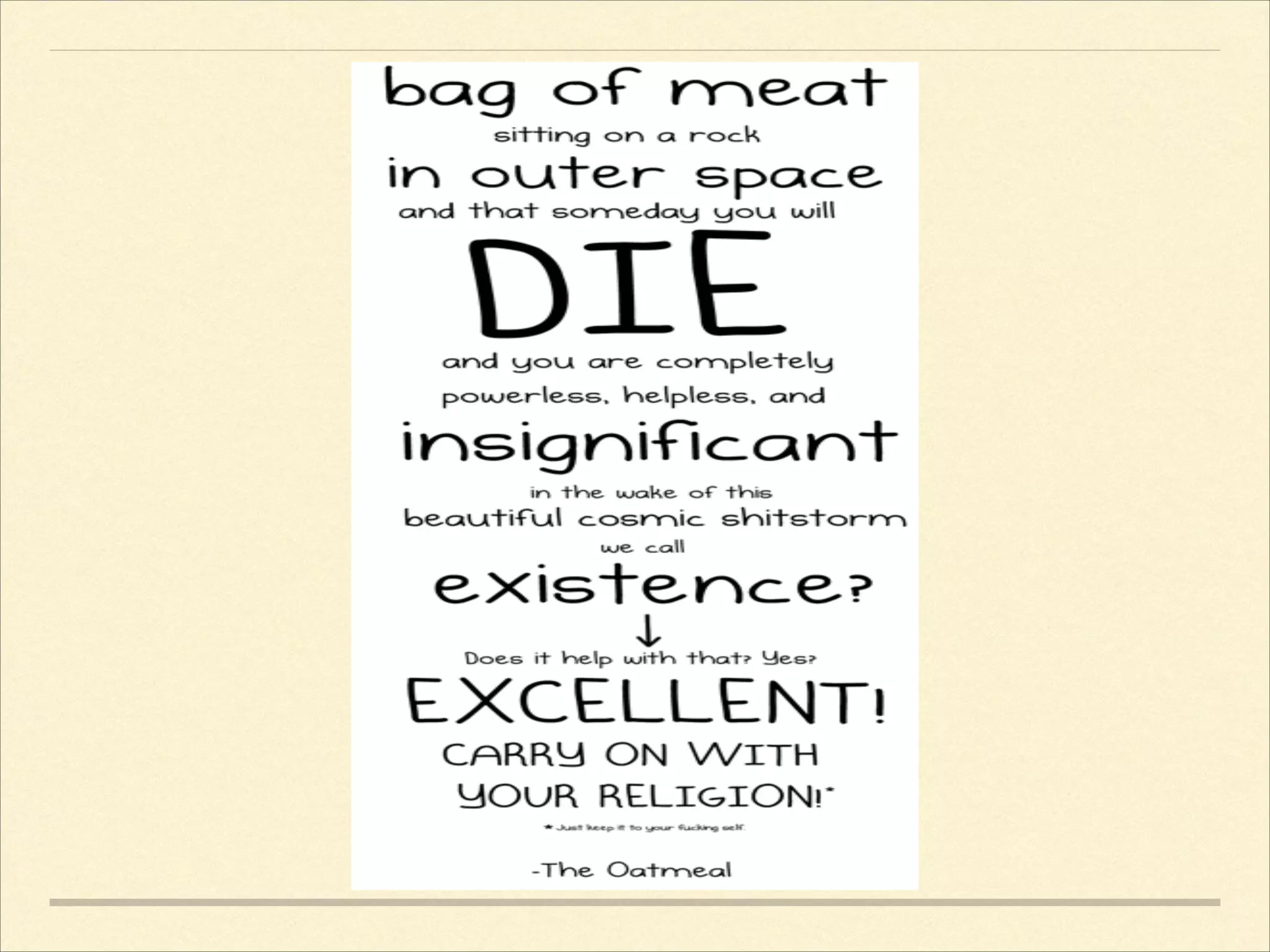
I READ THIS ON THEAOTMEAL.COM
It is aggressive in nature and
although not all aimed
specifically at Christians it
does attack many basic
Christian beliefs.	

As we examine it consider
how you would respond in a
gracious, loving way without
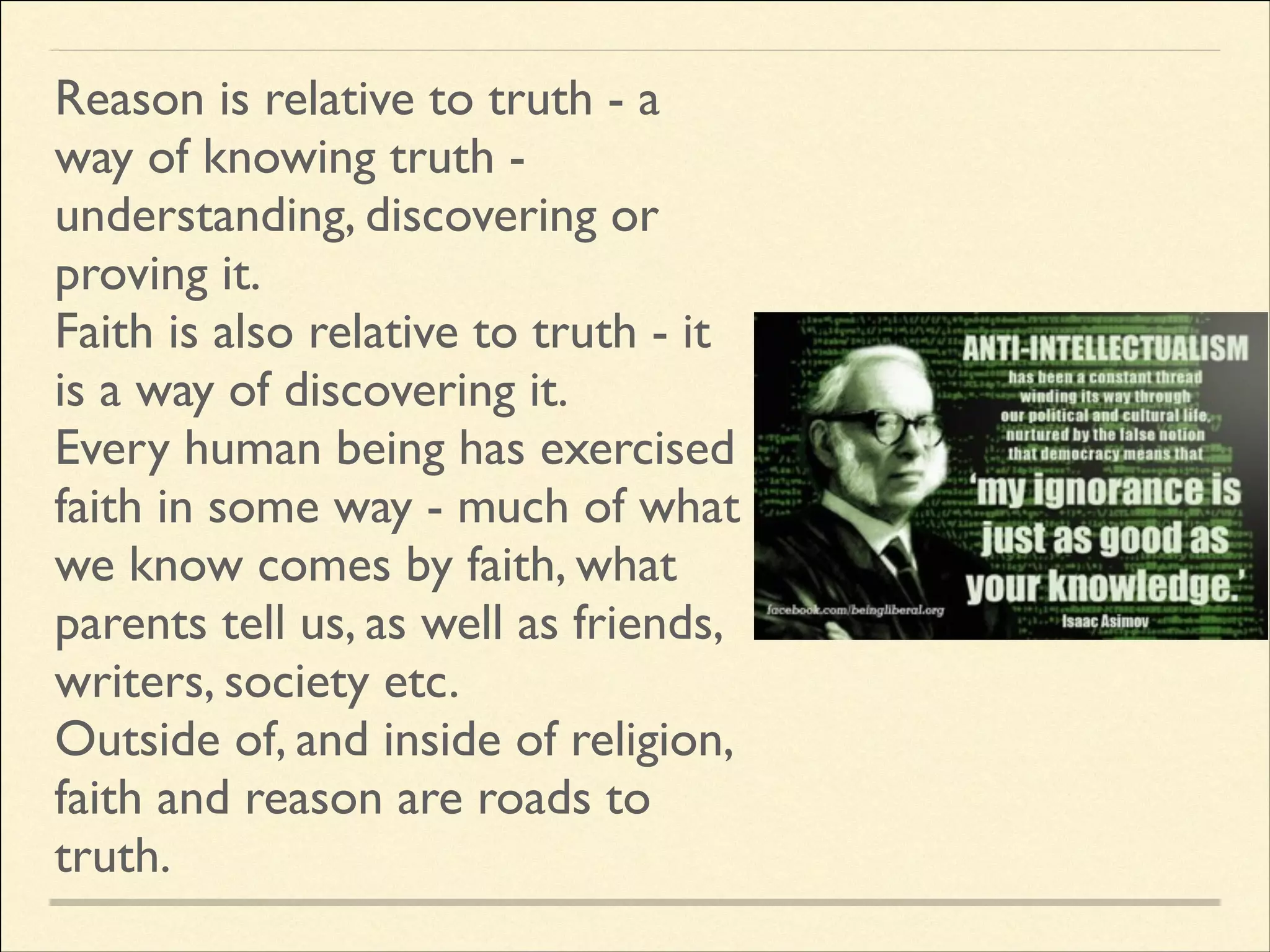
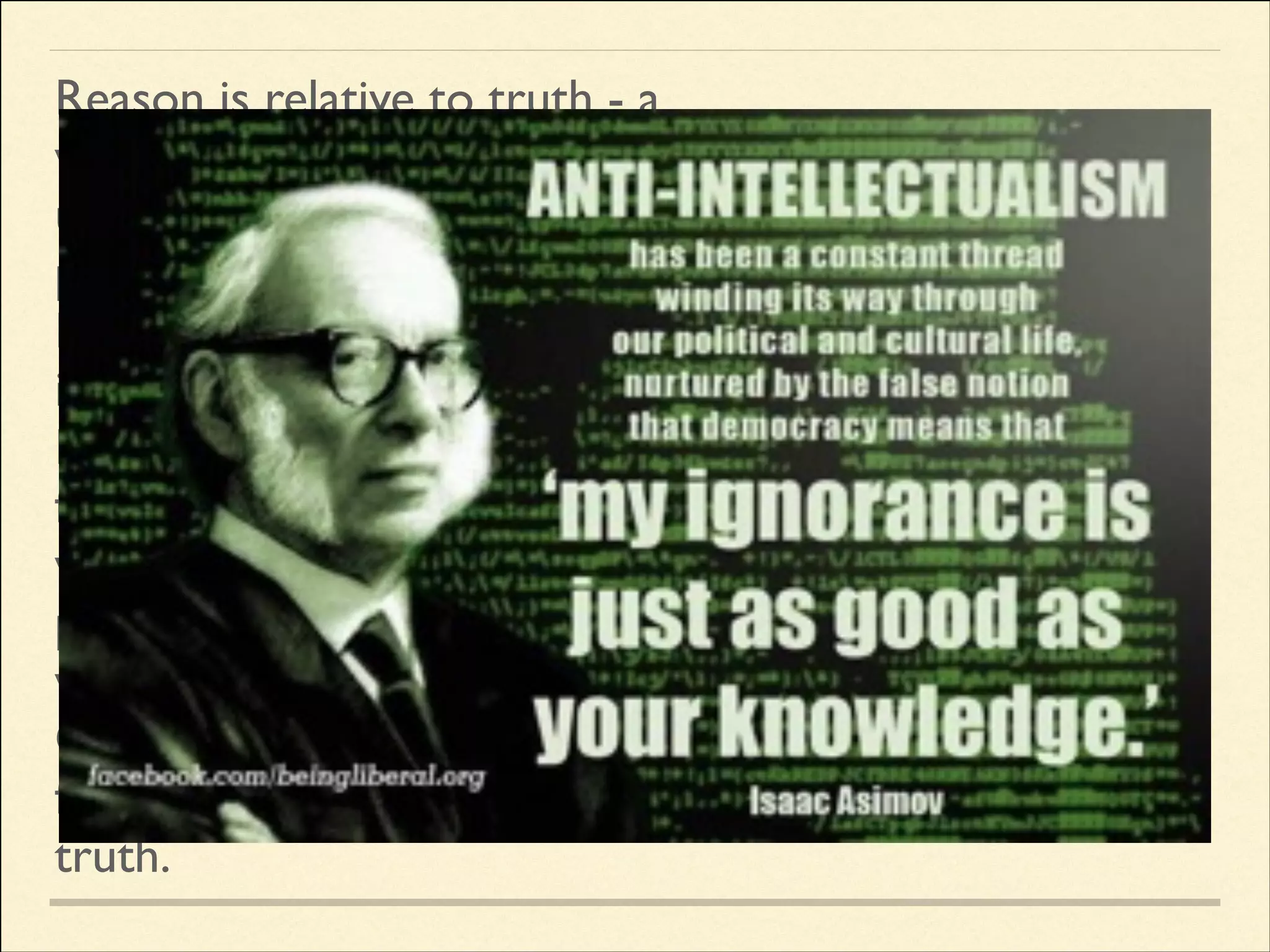
being condescending or antiintellectual
What
aspects of
the
Christian
faith do
you find
people
think of as
difficult to
accept why?
SESSION 2
FAITH AND REASON
This section is of vital
importance in apologetics:	

If faith and reason cannot be
brought together then
apologetics is impossible.
apologetics is the attempt to
After all we defend faith
with reasons weapons.
DEFINING FAITH
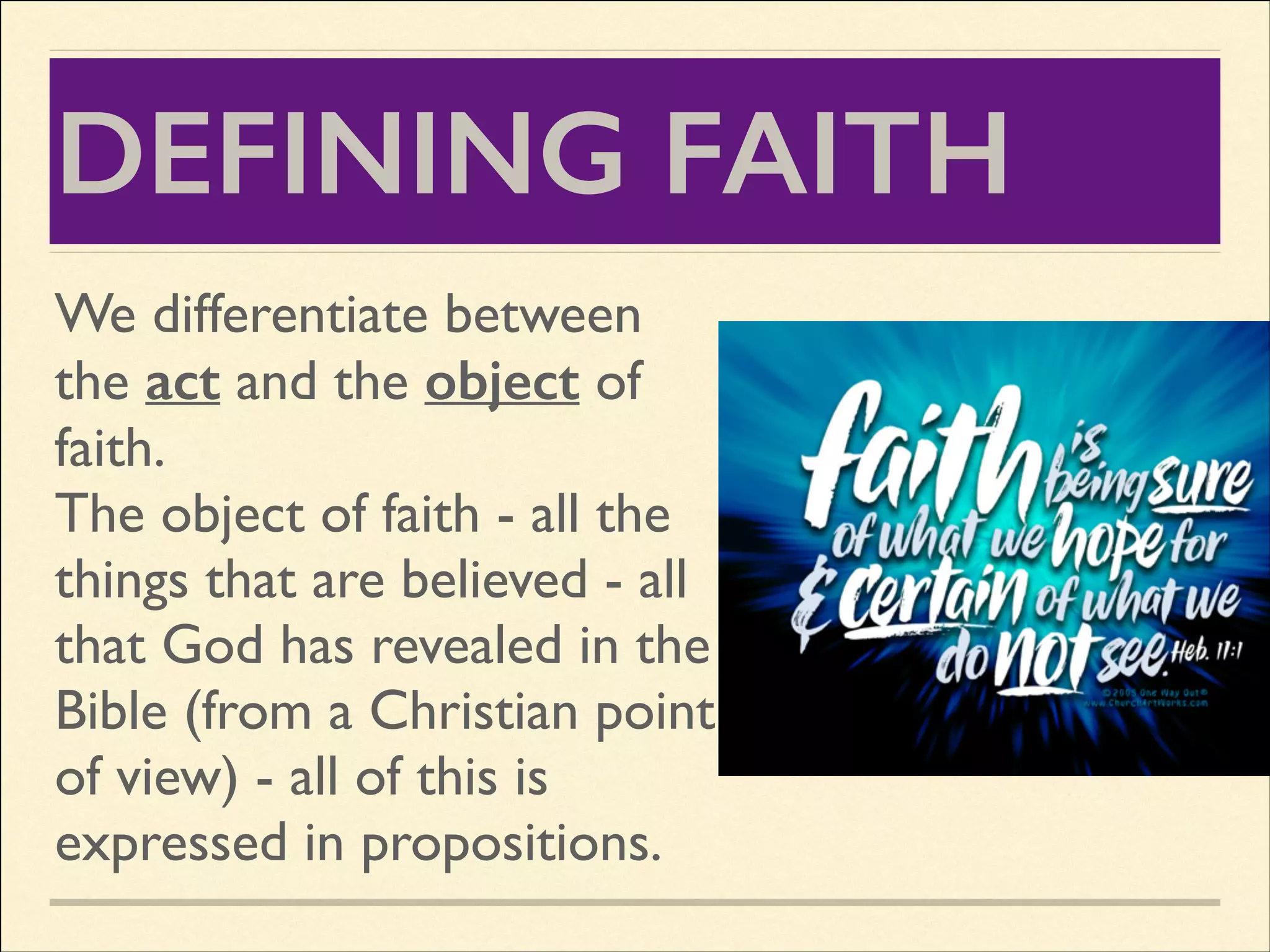
We differentiate between
the act and the object of
faith.	

The object of faith - all the
things that are believed - all
that God has revealed in the
Bible (from a Christian point
of view) - all of this is
expressed in propositions.
DEFINING FAITH
We differentiate between
propositionthe object sh
the act and |ˌpräpəˈzi of
ən|	

faith.	

A statement or assertion
The object of faith - all the
things that are believed - all
that expresses a judgment
that God hasthe
or opinion : revealed in the
Bible (from a that all men
proposition Christian point
of view) - all equal. is
are created of this
expressed in propositions.
DEFINING FAITH
We differentiate between
the act and the object of
faith.	

The object of faith - all the
things that are believed - all
that God has revealed in the
Bible (from a Christian point
of view) - all of this is
expressed in propositions.
We have many propositions but only one object of faith,
ultimately this is not the Word
of God, but God himself. 	

The propositions point
beyond themselves to God “A finger is good for pointing at
the moon, but woe to him who
mistakes the finger for the
moon” [Zen saying]	

The propositions are a way of
knowing and telling what we
believe about God.
The act of faith is more than
just believing. There are
many things we believe in life
- but we would not
necessarily die for them. 	

Kreeft suggests that
Religious faith is something
we are prepared to die for and to live every moment
for. Faith is more, and
stronger, than belief.
4 aspects of religious faith.	

1. Emotional faith - trust,
assurance, confidence in a
person - it includes the
biblical ideas of hope and
peace.	

2. Intellectual faith - is
belief, formulated in
propositions and creeds.
4 aspects of religious faith.	

1. Emotional faith - trust,
assurance, confidence in a
person - it includes the
biblical ideas of hope and
peace.	

2. Intellectual faith - is
belief, formulated in
propositions and creeds.
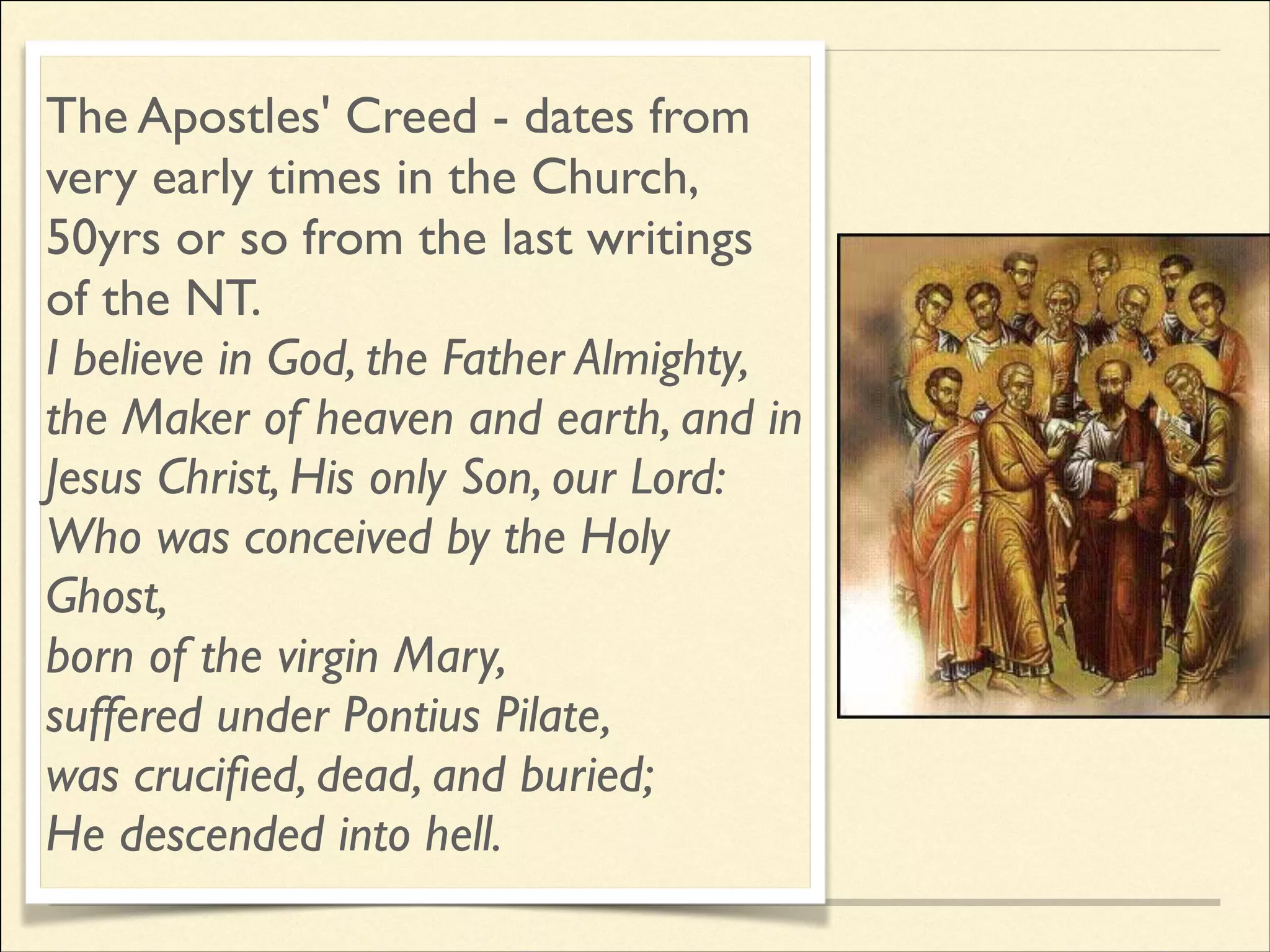
The Apostles' Creed - dates from
very early times in the Church,
50yrs or so from the last writings
of the NT.	

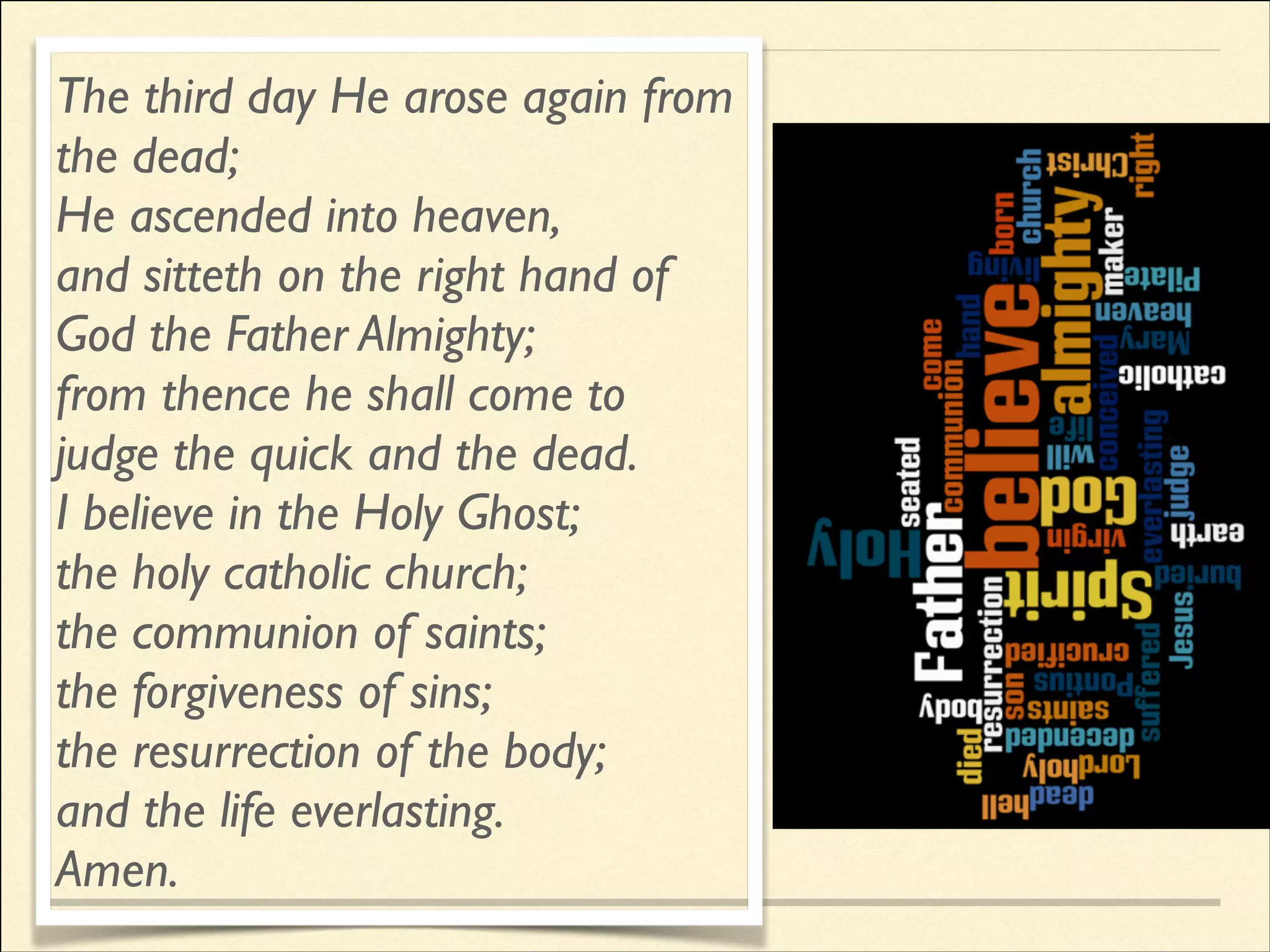
I believe in God, the Father Almighty,
the Maker of heaven and earth, and in
Jesus Christ, His only Son, our Lord:	

Who was conceived by the Holy
Ghost,	

born of the virgin Mary,	

suffered under Pontius Pilate,	

was crucified, dead, and buried;	

He descended into hell.
The third day He arose again from
the dead;	

He ascended into heaven,	

and sitteth on the right hand of
God the Father Almighty;	

from thence he shall come to
judge the quick and the dead.	

I believe in the Holy Ghost;	

the holy catholic church;	

the communion of saints;	

the forgiveness of sins;	

the resurrection of the body;	

and the life everlasting.	

Amen.
3. Volitional faith - an act of the will choosing
to obey God’s will - this is faithfulness which is
shown in good works	

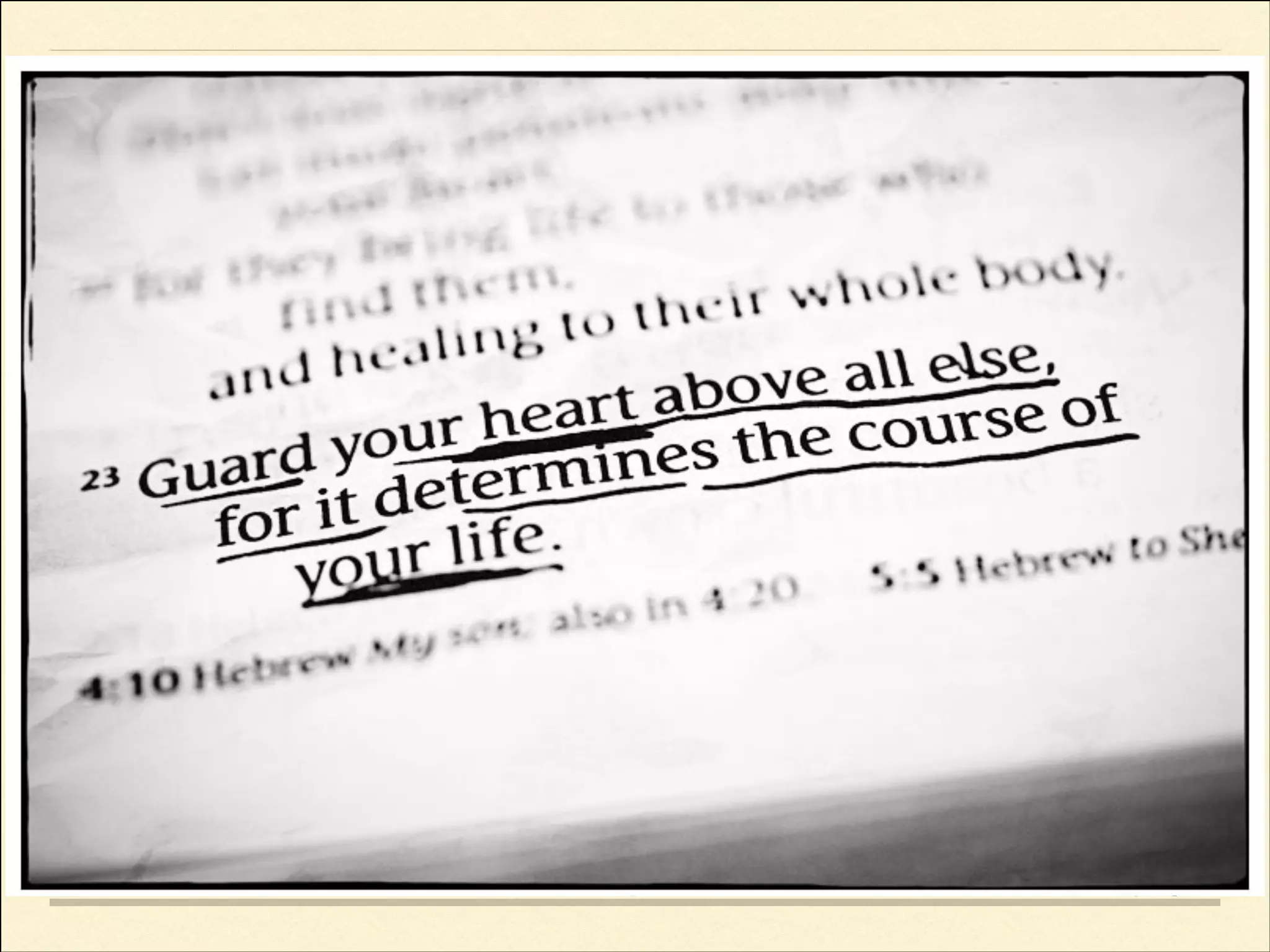
4. Faith begins in our heart - a term used in
scripture - not meaning sentiment, feeling or
emotion but the centre of our soul, of our
being.	

Proverbs 4:23
3. Volitional faith - an act of the will choosing
to obey God’s will - this is faithfulness which is
shown in good works	

4. Faith begins in our heart - a term used in
scripture - not meaning sentiment, feeling or
emotion but the centre of our soul, of our
being.	

Proverbs 4:23
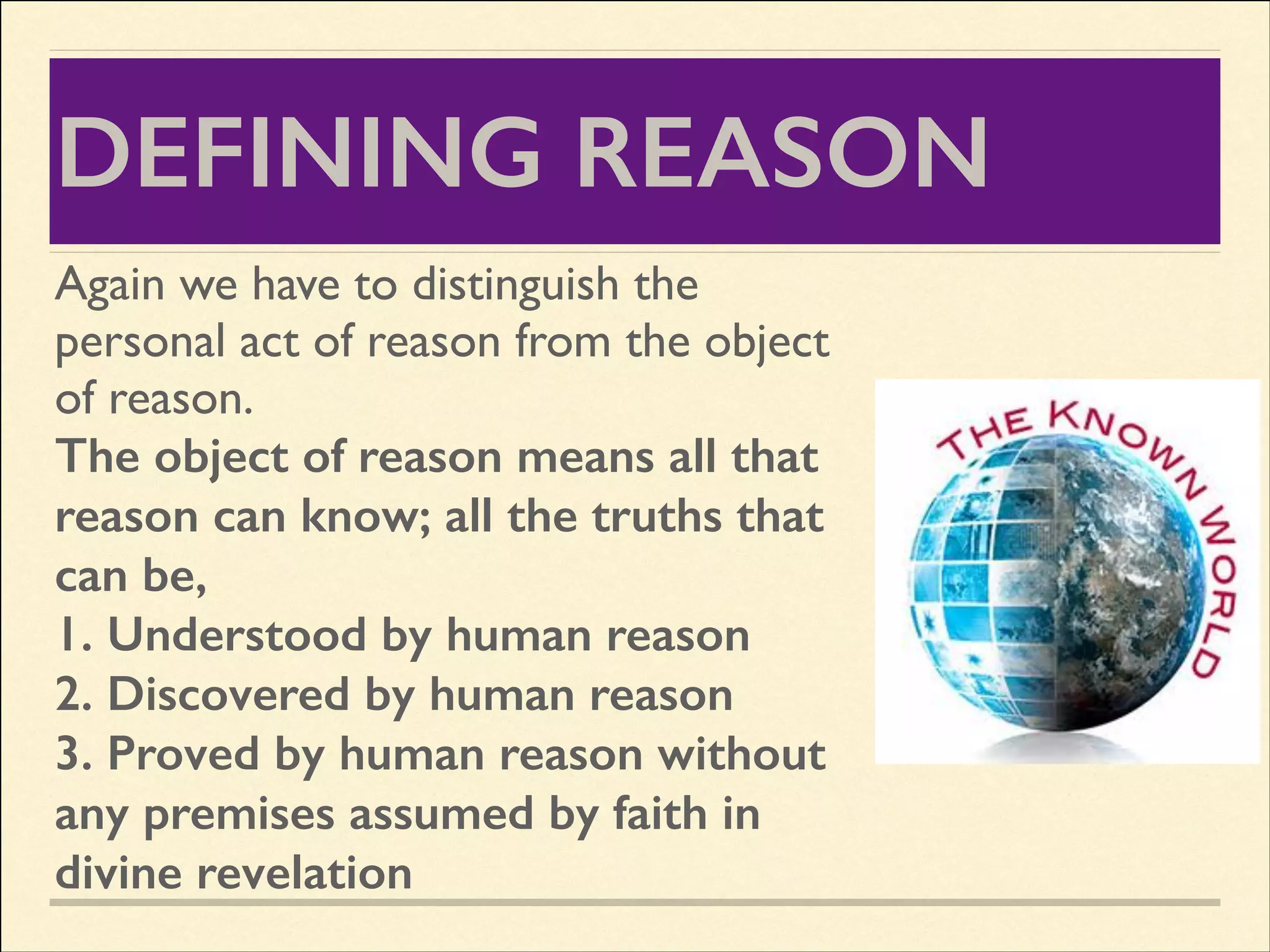
DEFINING REASON
Again we have to distinguish the
personal act of reason from the object
of reason.	

The object of reason means all that
reason can know; all the truths that
can be,
1. Understood by human reason
2. Discovered by human reason
3. Proved by human reason without
any premises assumed by faith in
divine revelation
DEFINING REASON
Again we have to distinguish the
reason |ˈriːz(ə)n|	

personal act of reason from the object
- a reason.	

cause, explanation, or justification for
of
an action or event	

The object of reason means all that
- in Logic a premise of an argument in
reason can know; all the truths that
support of a belief	

can be,
- the power of the mind to think,
1. Understood form judgements logically	

understand, and by human reason
2.to find an answer human reason
- Discovered by to a problem by
3. Proved by human reason without
considering possible options	

- persuade (someone) with rational
any premises assumed by faith in
argument
divine revelation
DEFINING REASON
Again we have to distinguish the
personal act of reason from the object
of reason.	

The object of reason means all that
reason can know; all the truths that
can be,
1. Understood by human reason
2. Discovered by human reason
3. Proved by human reason without
any premises assumed by faith in
divine revelation
Reason is relative to truth - a
way of knowing truth understanding, discovering or
proving it.	

Faith is also relative to truth - it
is a way of discovering it.	

Every human being has exercised
faith in some way - much of what
we know comes by faith, what
parents tell us, as well as friends,
writers, society etc.	

Outside of, and inside of religion,
faith and reason are roads to
truth.
Reason is relative to truth - a
way of knowing truth understanding, discovering or
proving it.	

Faith is also relative to truth - it
is a way of discovering it.	

Every human being has exercised
faith in some way - much of what
we know comes by faith, what
parents tell us, as well as friends,
writers, society etc.	

Outside of, and inside of religion,
faith and reason are roads to
truth.
THE RELATION BETWEEN
OBJECTS OF FAITH AND REASON
What is the logical relation
between the object of faith
and the object of reason?
How are these two truths those known by unaided
human reason, and those
knowable by faith in divine
revelation - related?
THE RELATION BETWEEN
OBJECTS OF FAITH AND REASON
There are 3 kinds of truths:	

1. Truths of faith and not of
reason	

2. Truths of both faith and
reason	

3. Truths of reason and not
of faith
THE RELATION BETWEEN
OBJECTS OF FAITH AND REASON
There are 3 kinds of truths:	

1. Truths of faith and not of
reason	

2. Truths of both faith and
reason	

3. Truths of reason and not
of faith
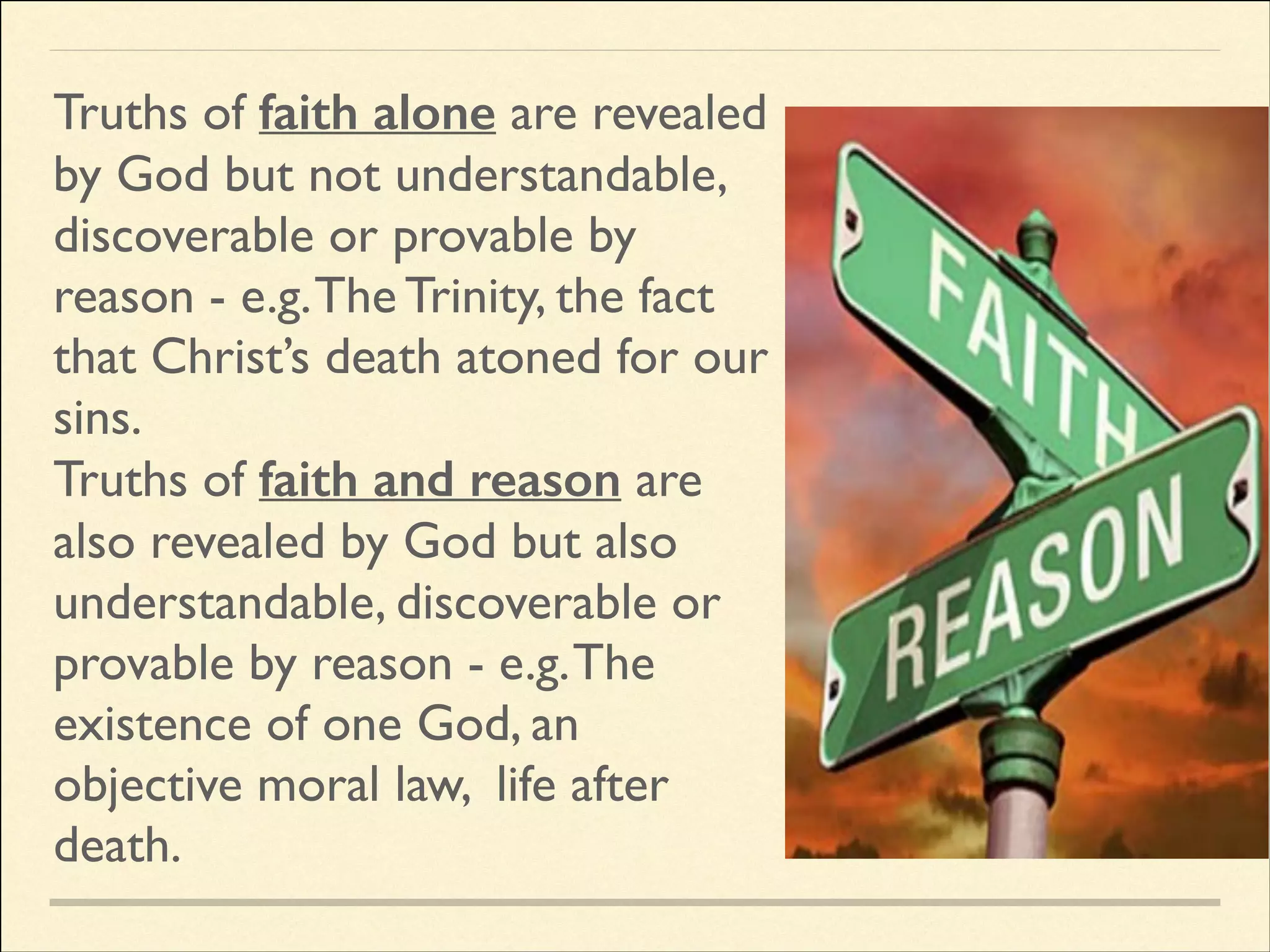
Truths of faith alone are revealed
by God but not understandable,
discoverable or provable by
reason - e.g. The Trinity, the fact
that Christ’s death atoned for our
sins.	

Truths of faith and reason are
also revealed by God but also
understandable, discoverable or
provable by reason - e.g. The
existence of one God, an
objective moral law, life after
death.
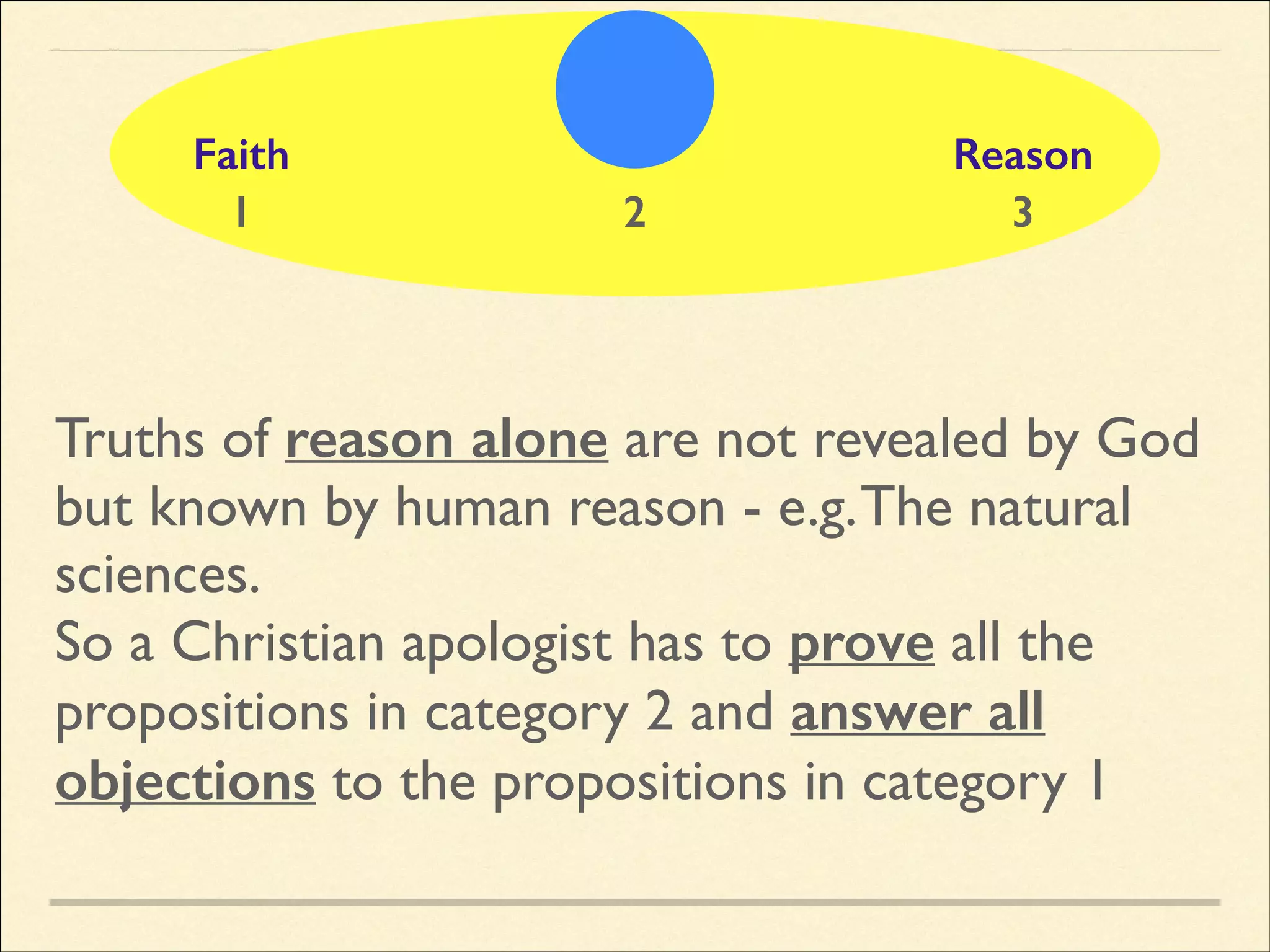
Faith
1

2

Reason
3

Truths of reason alone are not revealed by God
but known by human reason - e.g. The natural
sciences.	

So a Christian apologist has to prove all the
propositions in category 2 and answer all
objections to the propositions in category 1
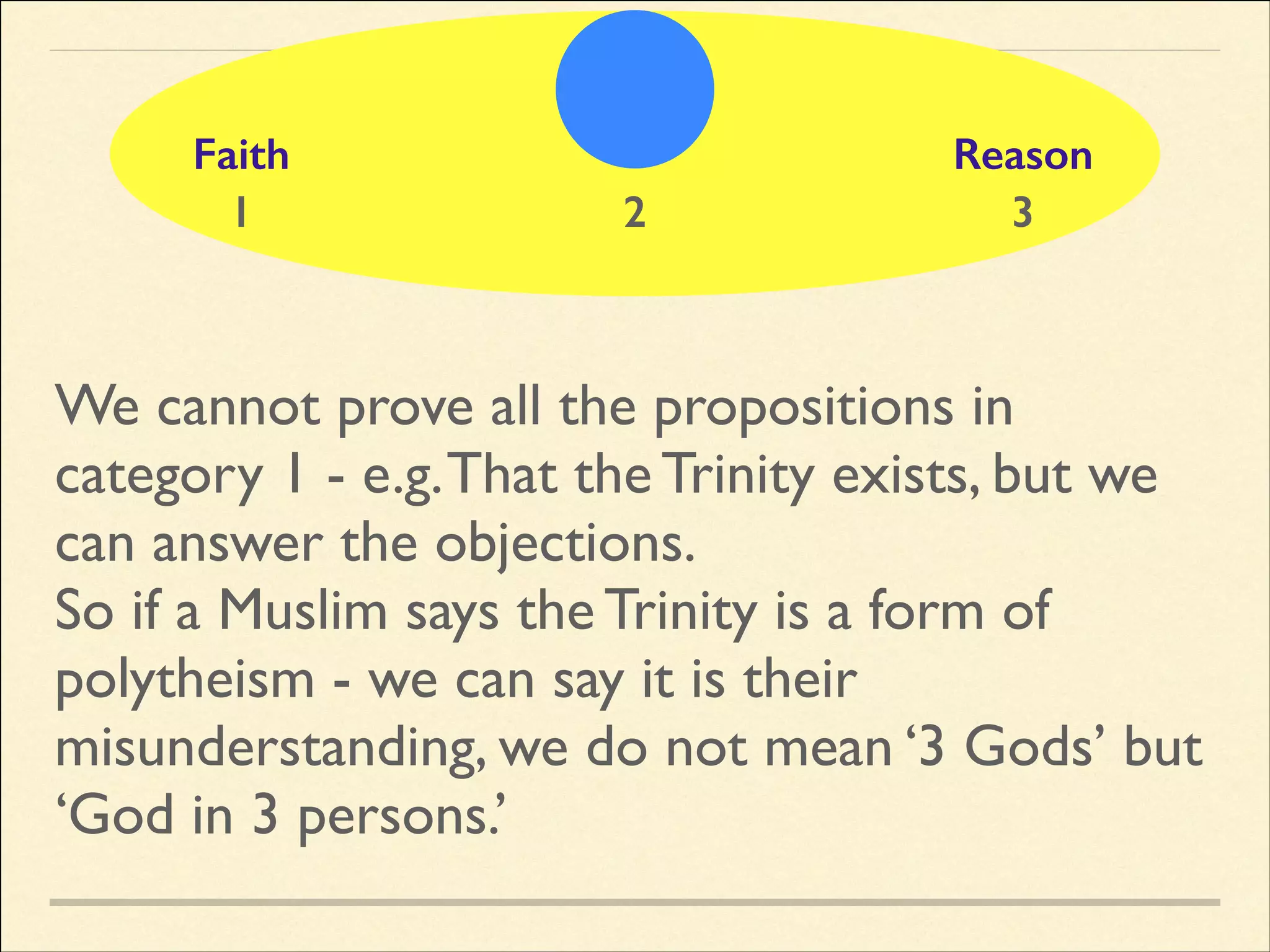
Faith
1

2

Reason
3

We cannot prove all the propositions in
category 1 - e.g. That the Trinity exists, but we
can answer the objections.	

So if a Muslim says the Trinity is a form of
polytheism - we can say it is their
misunderstanding, we do not mean ‘3 Gods’ but
‘God in 3 persons.’
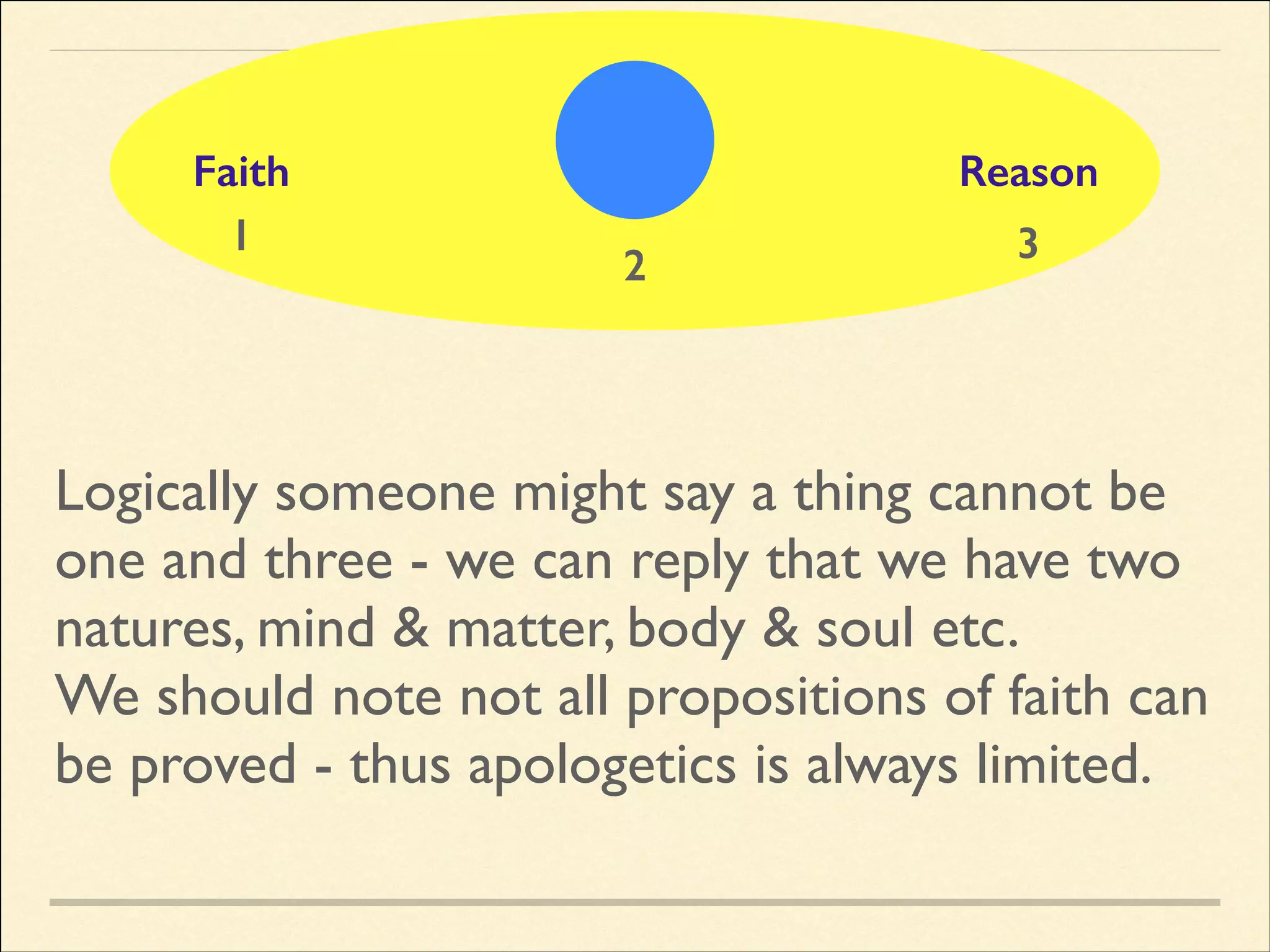
Faith
1

Reason
2

3

Logically someone might say a thing cannot be
one and three - we can reply that we have two
natures, mind & matter, body & soul etc. 	

We should note not all propositions of faith can
be proved - thus apologetics is always limited.
WHY FAITH AND REASON CAN
NEVER CONTRADICT EACH OTHER
Kreeft cites Aquinas’s arguments
in Summa Contra Gentiles in
support of this.	

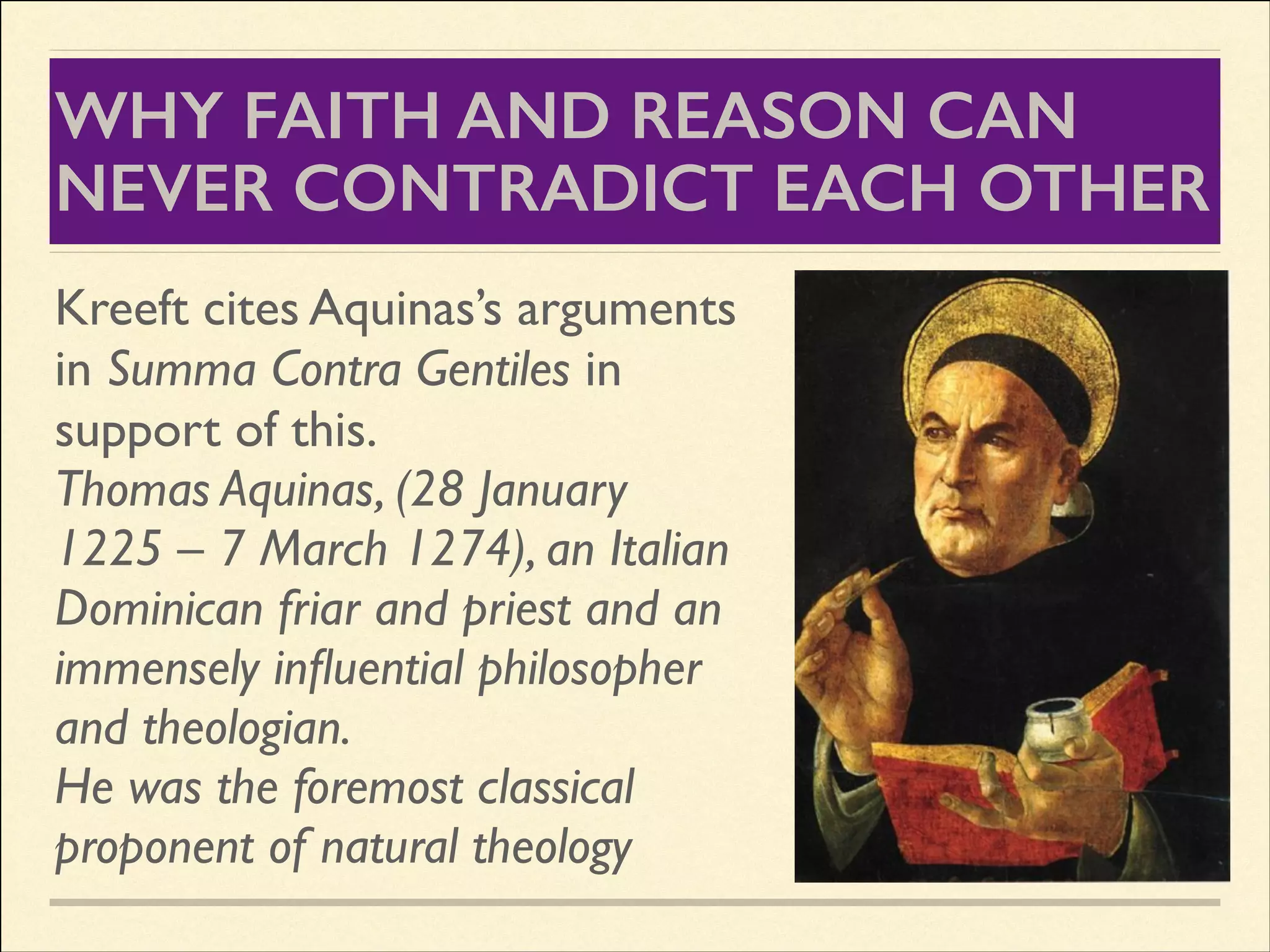
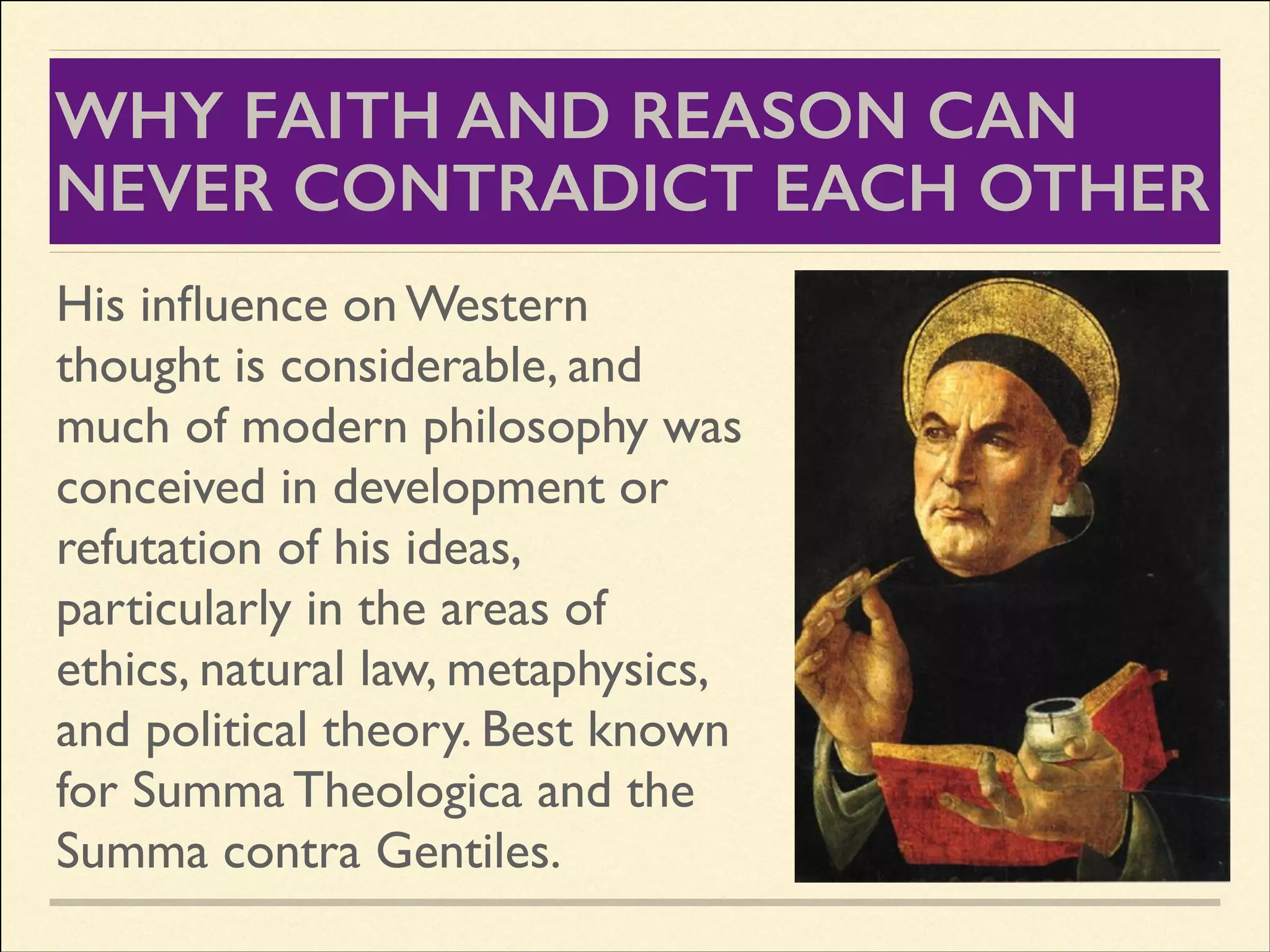
Thomas Aquinas, (28 January
1225 – 7 March 1274), an Italian
Dominican friar and priest and an
immensely influential philosopher
and theologian.	

He was the foremost classical
proponent of natural theology
WHY FAITH AND REASON CAN
NEVER CONTRADICT EACH OTHER
His influence on Western
thought is considerable, and
much of modern philosophy was
conceived in development or
refutation of his ideas,
particularly in the areas of
ethics, natural law, metaphysics,
and political theory. Best known
for Summa Theologica and the
Summa contra Gentiles.
Now, although the truth of the Christian faith which we
have discussed surpasses the capacity of the reason,
nevertheless that truth that the human reason is naturally
endowed to know cannot be opposed to the truth of the
Christian faith. For that with which the human reason is
naturally endowed is clearly most true; so much so, that it is
impossible for us to think of such truths as false. Nor is it
permissible to believe as false that which we hold by faith,
since this is confirmed in a way that is so clearly divine.
Since, therefore, only the false is opposed to the true, as is
clearly evident from an examination of their definitions, it is
impossible that the truth of faith should be opposed to
those principles that the human reason knows naturally.
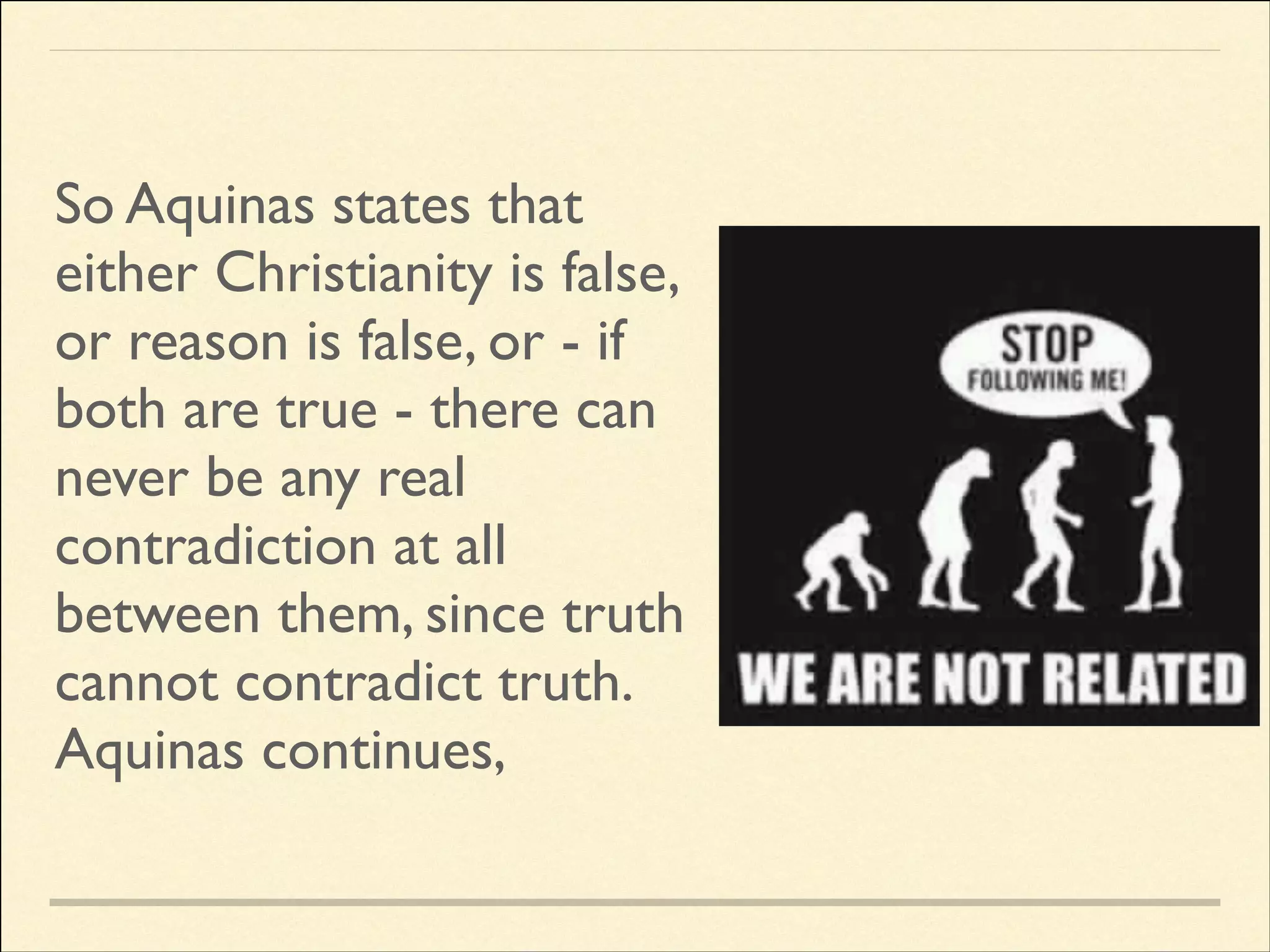
So Aquinas states that
either Christianity is false,
or reason is false, or - if
both are true - there can
never be any real
contradiction at all
between them, since truth
cannot contradict truth.	

Aquinas continues,
Furthermore, that which is introduced into the soul of the
student by the teacher is contained in the knowledge of the
teacher—unless his teaching is fictitious, which it is
improper to say of God. Now, the knowledge of the
principles that are known to us naturally has been
implanted in us by God; for God is the Author of our nature.
These principles, therefore, are also contained by the divine
Wisdom. Hence, whatever is opposed to them is opposed
to the divine Wisdom, and, therefore, cannot come from
God.That which we hold by faith as divinely revealed,
therefore, cannot be contrary to our natural knowledge.
At this point Aquinas uses a line of
argument that many non-believers would
find hard to agree with:
From this we evidently gather the following
conclusion: whatever arguments are brought
forward against the doctrines of faith are
conclusions incorrectly derived from the first and
self-evident principles imbedded in nature. Such
conclusions do not have the force of demonstration;
they are arguments that are either probable or
sophistical. And so, there exists the possibility to
answer them.
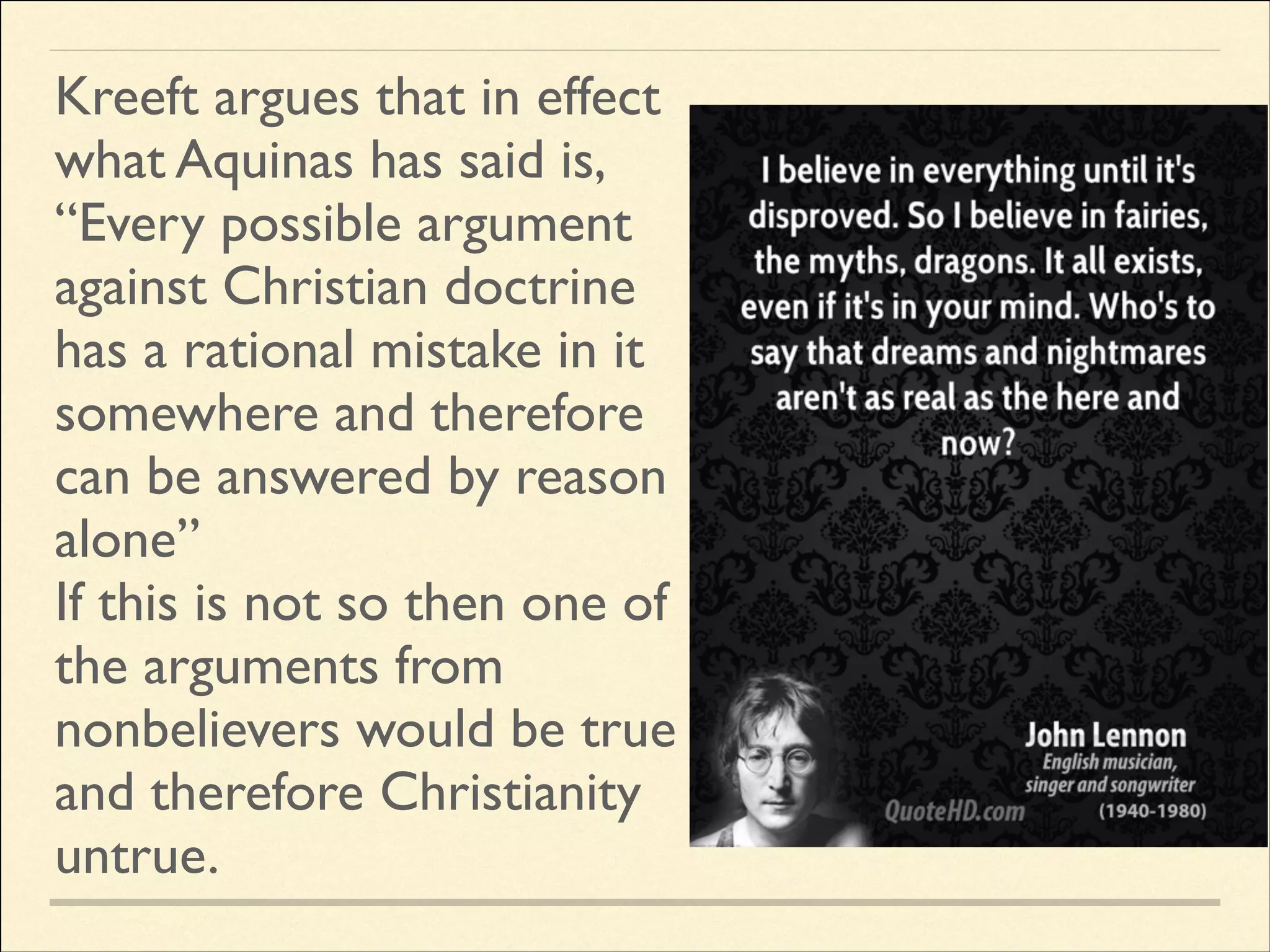
Kreeft argues that in effect
what Aquinas has said is,	

“Every possible argument
against Christian doctrine
has a rational mistake in it
somewhere and therefore
can be answered by reason
alone”	

If this is not so then one of
the arguments from
nonbelievers would be true
and therefore Christianity
untrue.
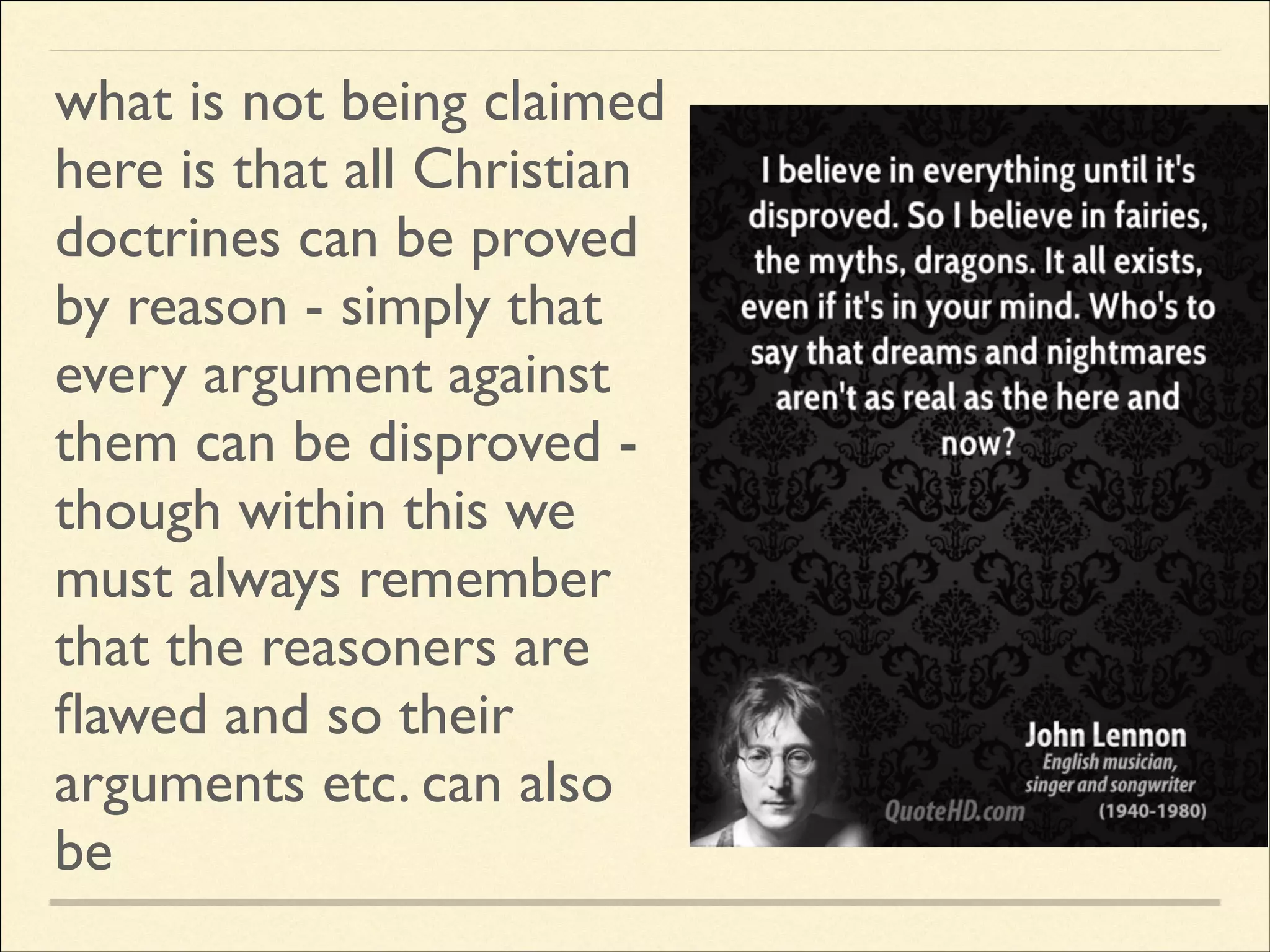
what is not being claimed
here is that all Christian
doctrines can be proved
by reason - simply that
every argument against
them can be disproved though within this we
must always remember
that the reasoners are
flawed and so their
arguments etc. can also
be

Christian Apologetics Session 2

  • 1.
  • 2.
    I READ THISON THEAOTMEAL.COM It is aggressive in nature and although not all aimed specifically at Christians it does attack many basic Christian beliefs. As we examine it consider how you would respond in a gracious, loving way without being condescending or antiintellectual
  • 17.
    What aspects of the Christian faith do youfind people think of as difficult to accept why?
  • 28.
  • 35.
    This section isof vital importance in apologetics: If faith and reason cannot be brought together then apologetics is impossible. apologetics is the attempt to After all we defend faith with reasons weapons.
  • 36.
    DEFINING FAITH We differentiatebetween the act and the object of faith. The object of faith - all the things that are believed - all that God has revealed in the Bible (from a Christian point of view) - all of this is expressed in propositions.
  • 37.
    DEFINING FAITH We differentiatebetween propositionthe object sh the act and |ˌpräpəˈzi of ən| faith. A statement or assertion The object of faith - all the things that are believed - all that expresses a judgment that God hasthe or opinion : revealed in the Bible (from a that all men proposition Christian point of view) - all equal. is are created of this expressed in propositions.
  • 38.
    DEFINING FAITH We differentiatebetween the act and the object of faith. The object of faith - all the things that are believed - all that God has revealed in the Bible (from a Christian point of view) - all of this is expressed in propositions.
  • 39.
    We have manypropositions but only one object of faith, ultimately this is not the Word of God, but God himself. The propositions point beyond themselves to God “A finger is good for pointing at the moon, but woe to him who mistakes the finger for the moon” [Zen saying] The propositions are a way of knowing and telling what we believe about God.
  • 40.
    The act offaith is more than just believing. There are many things we believe in life - but we would not necessarily die for them. Kreeft suggests that Religious faith is something we are prepared to die for and to live every moment for. Faith is more, and stronger, than belief.
  • 41.
    4 aspects ofreligious faith. 1. Emotional faith - trust, assurance, confidence in a person - it includes the biblical ideas of hope and peace. 2. Intellectual faith - is belief, formulated in propositions and creeds.
  • 42.
    4 aspects ofreligious faith. 1. Emotional faith - trust, assurance, confidence in a person - it includes the biblical ideas of hope and peace. 2. Intellectual faith - is belief, formulated in propositions and creeds.
  • 43.
    The Apostles' Creed- dates from very early times in the Church, 50yrs or so from the last writings of the NT. I believe in God, the Father Almighty, the Maker of heaven and earth, and in Jesus Christ, His only Son, our Lord: Who was conceived by the Holy Ghost, born of the virgin Mary, suffered under Pontius Pilate, was crucified, dead, and buried; He descended into hell.
  • 44.
    The third dayHe arose again from the dead; He ascended into heaven, and sitteth on the right hand of God the Father Almighty; from thence he shall come to judge the quick and the dead. I believe in the Holy Ghost; the holy catholic church; the communion of saints; the forgiveness of sins; the resurrection of the body; and the life everlasting. Amen.
  • 45.
    3. Volitional faith- an act of the will choosing to obey God’s will - this is faithfulness which is shown in good works 4. Faith begins in our heart - a term used in scripture - not meaning sentiment, feeling or emotion but the centre of our soul, of our being. Proverbs 4:23
  • 46.
    3. Volitional faith- an act of the will choosing to obey God’s will - this is faithfulness which is shown in good works 4. Faith begins in our heart - a term used in scripture - not meaning sentiment, feeling or emotion but the centre of our soul, of our being. Proverbs 4:23
  • 47.
    DEFINING REASON Again wehave to distinguish the personal act of reason from the object of reason. The object of reason means all that reason can know; all the truths that can be, 1. Understood by human reason 2. Discovered by human reason 3. Proved by human reason without any premises assumed by faith in divine revelation
  • 48.
    DEFINING REASON Again wehave to distinguish the reason |ˈriːz(ə)n| personal act of reason from the object - a reason. cause, explanation, or justification for of an action or event The object of reason means all that - in Logic a premise of an argument in reason can know; all the truths that support of a belief can be, - the power of the mind to think, 1. Understood form judgements logically understand, and by human reason 2.to find an answer human reason - Discovered by to a problem by 3. Proved by human reason without considering possible options - persuade (someone) with rational any premises assumed by faith in argument divine revelation
  • 49.
    DEFINING REASON Again wehave to distinguish the personal act of reason from the object of reason. The object of reason means all that reason can know; all the truths that can be, 1. Understood by human reason 2. Discovered by human reason 3. Proved by human reason without any premises assumed by faith in divine revelation
  • 50.
    Reason is relativeto truth - a way of knowing truth understanding, discovering or proving it. Faith is also relative to truth - it is a way of discovering it. Every human being has exercised faith in some way - much of what we know comes by faith, what parents tell us, as well as friends, writers, society etc. Outside of, and inside of religion, faith and reason are roads to truth.
  • 51.
    Reason is relativeto truth - a way of knowing truth understanding, discovering or proving it. Faith is also relative to truth - it is a way of discovering it. Every human being has exercised faith in some way - much of what we know comes by faith, what parents tell us, as well as friends, writers, society etc. Outside of, and inside of religion, faith and reason are roads to truth.
  • 52.
    THE RELATION BETWEEN OBJECTSOF FAITH AND REASON What is the logical relation between the object of faith and the object of reason? How are these two truths those known by unaided human reason, and those knowable by faith in divine revelation - related?
  • 53.
    THE RELATION BETWEEN OBJECTSOF FAITH AND REASON There are 3 kinds of truths: 1. Truths of faith and not of reason 2. Truths of both faith and reason 3. Truths of reason and not of faith
  • 54.
    THE RELATION BETWEEN OBJECTSOF FAITH AND REASON There are 3 kinds of truths: 1. Truths of faith and not of reason 2. Truths of both faith and reason 3. Truths of reason and not of faith
  • 55.
    Truths of faithalone are revealed by God but not understandable, discoverable or provable by reason - e.g. The Trinity, the fact that Christ’s death atoned for our sins. Truths of faith and reason are also revealed by God but also understandable, discoverable or provable by reason - e.g. The existence of one God, an objective moral law, life after death.
  • 56.
    Faith 1 2 Reason 3 Truths of reasonalone are not revealed by God but known by human reason - e.g. The natural sciences. So a Christian apologist has to prove all the propositions in category 2 and answer all objections to the propositions in category 1
  • 57.
    Faith 1 2 Reason 3 We cannot proveall the propositions in category 1 - e.g. That the Trinity exists, but we can answer the objections. So if a Muslim says the Trinity is a form of polytheism - we can say it is their misunderstanding, we do not mean ‘3 Gods’ but ‘God in 3 persons.’
  • 58.
    Faith 1 Reason 2 3 Logically someone mightsay a thing cannot be one and three - we can reply that we have two natures, mind & matter, body & soul etc. We should note not all propositions of faith can be proved - thus apologetics is always limited.
  • 59.
    WHY FAITH ANDREASON CAN NEVER CONTRADICT EACH OTHER Kreeft cites Aquinas’s arguments in Summa Contra Gentiles in support of this. Thomas Aquinas, (28 January 1225 – 7 March 1274), an Italian Dominican friar and priest and an immensely influential philosopher and theologian. He was the foremost classical proponent of natural theology
  • 60.
    WHY FAITH ANDREASON CAN NEVER CONTRADICT EACH OTHER His influence on Western thought is considerable, and much of modern philosophy was conceived in development or refutation of his ideas, particularly in the areas of ethics, natural law, metaphysics, and political theory. Best known for Summa Theologica and the Summa contra Gentiles.
  • 61.
    Now, although thetruth of the Christian faith which we have discussed surpasses the capacity of the reason, nevertheless that truth that the human reason is naturally endowed to know cannot be opposed to the truth of the Christian faith. For that with which the human reason is naturally endowed is clearly most true; so much so, that it is impossible for us to think of such truths as false. Nor is it permissible to believe as false that which we hold by faith, since this is confirmed in a way that is so clearly divine. Since, therefore, only the false is opposed to the true, as is clearly evident from an examination of their definitions, it is impossible that the truth of faith should be opposed to those principles that the human reason knows naturally.
  • 62.
    So Aquinas statesthat either Christianity is false, or reason is false, or - if both are true - there can never be any real contradiction at all between them, since truth cannot contradict truth. Aquinas continues,
  • 63.
    Furthermore, that whichis introduced into the soul of the student by the teacher is contained in the knowledge of the teacher—unless his teaching is fictitious, which it is improper to say of God. Now, the knowledge of the principles that are known to us naturally has been implanted in us by God; for God is the Author of our nature. These principles, therefore, are also contained by the divine Wisdom. Hence, whatever is opposed to them is opposed to the divine Wisdom, and, therefore, cannot come from God.That which we hold by faith as divinely revealed, therefore, cannot be contrary to our natural knowledge.
  • 64.
    At this pointAquinas uses a line of argument that many non-believers would find hard to agree with: From this we evidently gather the following conclusion: whatever arguments are brought forward against the doctrines of faith are conclusions incorrectly derived from the first and self-evident principles imbedded in nature. Such conclusions do not have the force of demonstration; they are arguments that are either probable or sophistical. And so, there exists the possibility to answer them.
  • 65.
    Kreeft argues thatin effect what Aquinas has said is, “Every possible argument against Christian doctrine has a rational mistake in it somewhere and therefore can be answered by reason alone” If this is not so then one of the arguments from nonbelievers would be true and therefore Christianity untrue.
  • 66.
    what is notbeing claimed here is that all Christian doctrines can be proved by reason - simply that every argument against them can be disproved though within this we must always remember that the reasoners are flawed and so their arguments etc. can also be