Understanding the differences in
Bible Translations
Course 1: Bible Translations
Our goal in this unit is to help you better
understand Bible translations
In the following course, you will learn more about:
1. What is a Bible Translation & Why is it
Needed?
2. English Translations & the Scholarly Debate
3. Translation Philosophies
4. Translation Resources
The definition of a translation is:
 The process of translating words or text from one
language into another
 e.g. ‘the translation of the Bible into English’
 http://www.oxforddictionaries.com/definition/english/translation
What is a translation?
Translation Trivia:
 The Bible is the most translated book
in the world!
 As of Nov 2012 the full Bible has been
translated into 518 languages
 2798 languages have at least some
portion of the Bible
 The Bible was written over thousands of years and by more than
40 different writers.
 Printing didn’t exist back then, so Bible manuscripts were
laboriously hand-copied many times.
 This is why there are no complete Bibles available from the ancient world that
have all of the original languages included.
 Many of the ancient texts must be carefully pieced together to determine full
passages of some books.
 Because original manuscripts were hand-copied many times scholars have
had to compare many thousands of manuscripts and manuscript fragments to
determine as closely as possible what the original text had in it.
 The Bible was originally written in 3 ancient languages:
 Hebrew (Old Testament)
 Greek (New Testament)
 Aramaic (Old/New Testament)
Original Languages & Facts About the Bible
Translation Trivia:
 Many ancient texts were
found on tablets of stone
or clay, sheepskins & brittle
papyrus!
 Yes. It was written in Hebrew, Aramaic and
Greek and most of us cannot read those
languages. (Click here to see sample of Bible in
Greek)
 Yes. The differences are significant enough in
the various languages that Bible texts need to be
translated into, that it makes it necessary to have
multiple translations.
 EXAMPLE: The Hebrew language has a
completely different sentence structure and
punctuation from modern languages; it is also read
from right to left, not left to right as English is.
 Yes. Language evolves over time. So even
the modern-day Hebrew and Greek languages
are quite different from the time when the Bible
was written.
This is why, in order to understand the language
and meaning of the original texts today, we
need biblical scholars to translate the ancient
texts into modern languages.
If the full text of
the Bible were
available from
ancient times,
would we still
need a
translation?
Translation Process
Basic translation is a process of interpreting what the original
language means, and bringing that into a new language.
 Languages can be very different from each other, and even dialects
within the same language can have differences. (example: those
speaking English in England or Australia would have a different dialect
than America.)
 Also, there are many terms and concepts in the original languages that
have no parallels in the languages that the translation is working with.
 Many words don’t have direct one-for-one correspondence.
 Other words can have several possible equivalents in the receptor
language, based upon the intended meaning
 And one word in the receptor language might represent more than
one word in the source language.
 Original texts had no punctuation, it was added later.
 Technical details, such as punctuation and sentence structure, differ
from language to language. Therefore it is important to note that
translation challenges involve more than just finding equivalent words.
 Translating the Bible is extremely technical work that requires a
highly skilled scholarship and begins with an analysis of the original
texts.
 Different translation committees have different philosophies and
those philosophies form the major distinctions between translations.
 There is much (and very technical) scholarly debate on the relation of
accuracy to age.
 This leads to questions such as: is older more accurate? Or is it better to
have a few old manuscripts or to have many that are not as old, but show
agreement among themselves?
 Translation committees debate the exact meanings of some words in
the texts and how best to make them understandable for today’s
audiences. They have have been known to debate at length over
single-word translations that might seem insignificant to the average
person.
 It is important to note that these debates exist because Biblical
scholars and translators care very deeply about the fine details of
linguistics and translation. They believe the Bible is the inspired Word of
God, and that translation should be handled delicately and
reverently.
Translations & Scholarly Debate
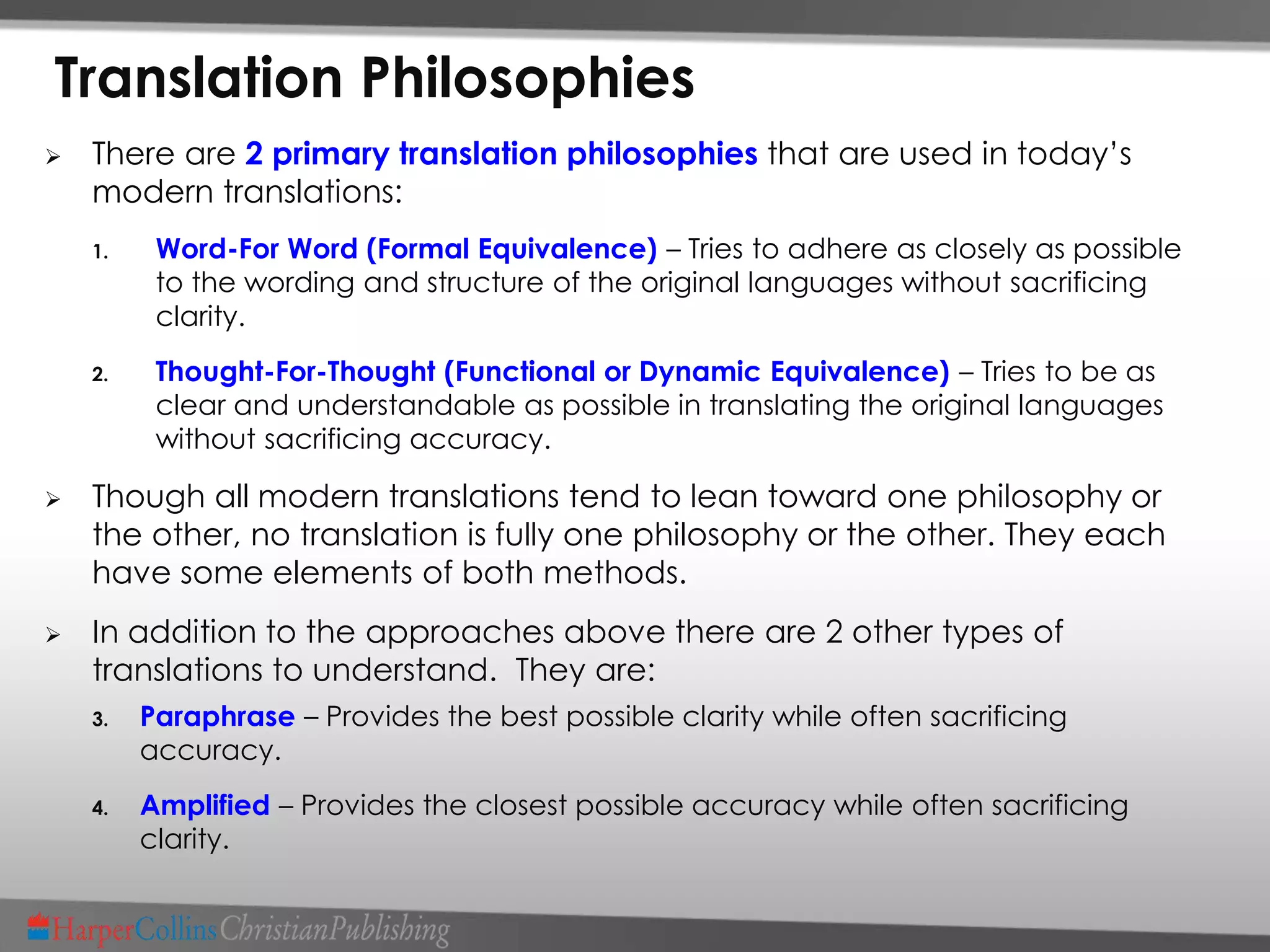
Translation Philosophies
 There are 2 primary translation philosophies that are used in today’s
modern translations:
1. Word-For Word (Formal Equivalence) – Tries to adhere as closely as possible
to the wording and structure of the original languages without sacrificing
clarity.
2. Thought-For-Thought (Functional or Dynamic Equivalence) – Tries to be as
clear and understandable as possible in translating the original languages
without sacrificing accuracy.
 Though all modern translations tend to lean toward one philosophy or
the other, no translation is fully one philosophy or the other. They each
have some elements of both methods.
 In addition to the approaches above there are 2 other types of
translations to understand. They are:
3. Paraphrase – Provides the best possible clarity while often sacrificing
accuracy.
4. Amplified – Provides the closest possible accuracy while often sacrificing
clarity.
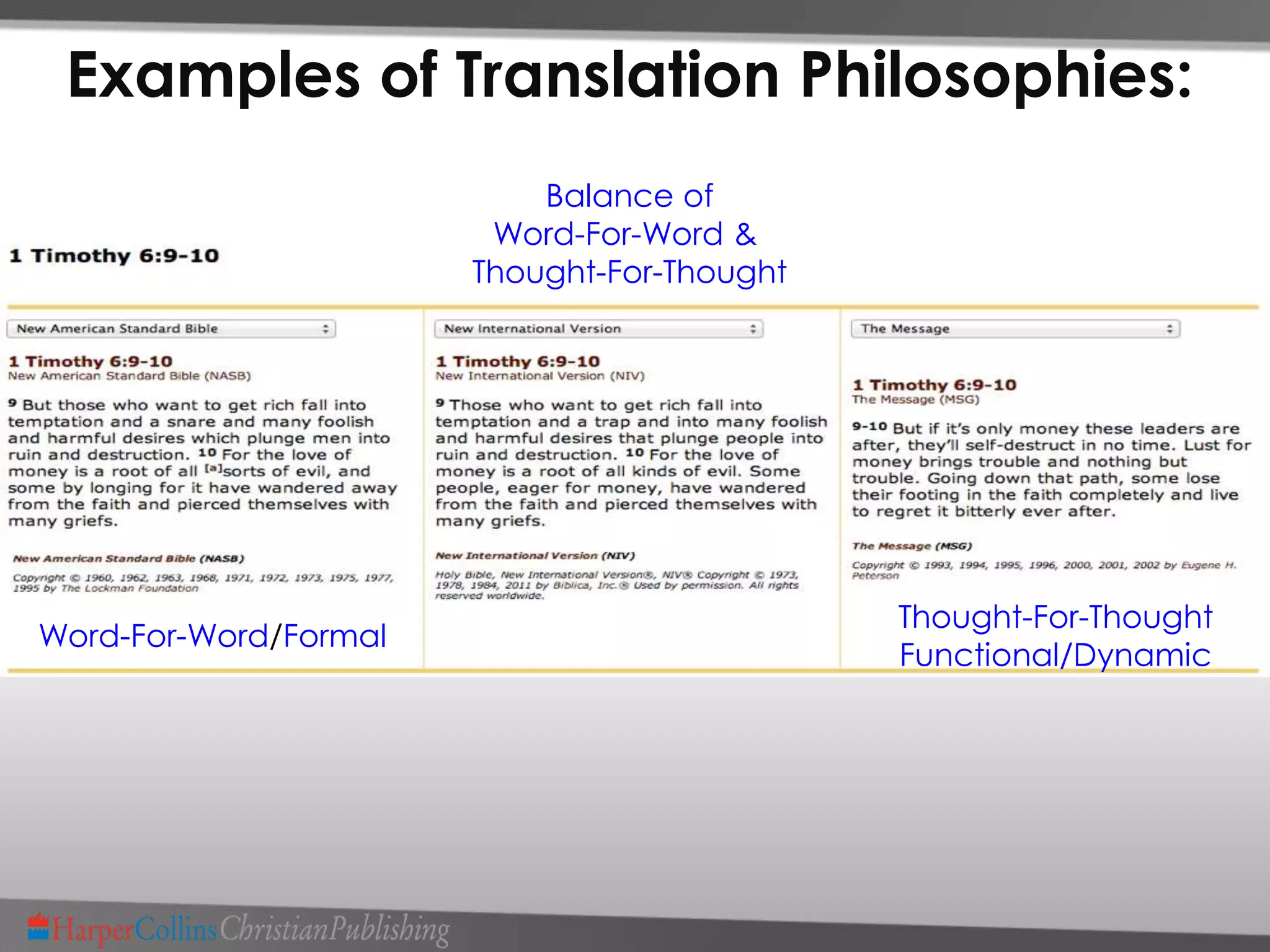
Examples of Translation Philosophies:
Word-For-Word/Formal
Balance of
Word-For-Word &
Thought-For-Thought
Thought-For-Thought
Functional/Dynamic
If every translation is a blend of philosophies, then the question
becomes, is there a “right” one?
 This question opens the door to where the real debate resides
in Biblical translation!
Is There a “Right” Translation?
The real debate is: How much
interpretation is necessary to help the
recipient actually understand what the
original authors were trying to
communicate?
 Those who prefer a word-for-word feel a
literal translation is closer to the original
structure.
 Those who prefer thought-for-thought feel
it more clearly communicates the
intended message.
Wordforword
Thoughtfor
Thought
Here is a listing of the better known English translations,
and where they land within the translation continuum
(the balance between philosophies):
It is extremely important to have a
basic understanding of where
certain translations fall, and what
the differences are, in order to help
a customer choose which
translation is right for them!
Conclusions
 In an effort to do this all justice, there have been many different
attempts at creating the “best” Bible translation.
 That’s one reason why we have so many Bible translations today.
 No translation is perfect. (We don’t even agree on what that
would look like!)
 We recommend that you take the time to compare three or
four translations to get a good feel for the range of possibilities.
 In order for you to helping customers find the right translation, it is
extremely important to have at least a basic understanding of
these differences.
* Key Points to Remember
 A translation is the process of translating words or text from one language to another
 The 3 languages the Bible was originally written in are:
1. Greek
2. Hebrew
3. Aramaic
 There are 2 primary Bible translation types
1. Word-For-Word – Focuses on the words & structure without sacrificing clarity
2. Thought-For-Thought – Focuses on clarity without sacrificing accuracy
 There are 2 additional Bible translation types you may hear of:
1. Amplified – Closest possible accuracy, but sacrifices clarity
2. Paraphrase – Best possible clarity, but sacrifices accuracy
 Use the Bible continuum map to view where a certain translation falls when uncertain
about translation types
 Which translation is “right” depends on the person using the translation and what they
are using it for
• Bible translation guide – Thomas Nelson
• Bible translation chart – Zondervan
• Bible Continuum
• Greek & English NT
• Interlinear Bible Sampler
Resource Downloads:
see files section in upper right corner of training screen
• How to Choose a Translation for All It’s Worth; Fee &
Strauss
• The New King James Version: In the Great Tradition;
Arthur L. Farstad
Reading Suggestions

Course 1: Bible Translations

  • 1.
    Understanding the differencesin Bible Translations Course 1: Bible Translations
  • 2.
    Our goal inthis unit is to help you better understand Bible translations In the following course, you will learn more about: 1. What is a Bible Translation & Why is it Needed? 2. English Translations & the Scholarly Debate 3. Translation Philosophies 4. Translation Resources
  • 3.
    The definition ofa translation is:  The process of translating words or text from one language into another  e.g. ‘the translation of the Bible into English’  http://www.oxforddictionaries.com/definition/english/translation What is a translation? Translation Trivia:  The Bible is the most translated book in the world!  As of Nov 2012 the full Bible has been translated into 518 languages  2798 languages have at least some portion of the Bible
  • 4.
     The Biblewas written over thousands of years and by more than 40 different writers.  Printing didn’t exist back then, so Bible manuscripts were laboriously hand-copied many times.  This is why there are no complete Bibles available from the ancient world that have all of the original languages included.  Many of the ancient texts must be carefully pieced together to determine full passages of some books.  Because original manuscripts were hand-copied many times scholars have had to compare many thousands of manuscripts and manuscript fragments to determine as closely as possible what the original text had in it.  The Bible was originally written in 3 ancient languages:  Hebrew (Old Testament)  Greek (New Testament)  Aramaic (Old/New Testament) Original Languages & Facts About the Bible Translation Trivia:  Many ancient texts were found on tablets of stone or clay, sheepskins & brittle papyrus!
  • 5.
     Yes. Itwas written in Hebrew, Aramaic and Greek and most of us cannot read those languages. (Click here to see sample of Bible in Greek)  Yes. The differences are significant enough in the various languages that Bible texts need to be translated into, that it makes it necessary to have multiple translations.  EXAMPLE: The Hebrew language has a completely different sentence structure and punctuation from modern languages; it is also read from right to left, not left to right as English is.  Yes. Language evolves over time. So even the modern-day Hebrew and Greek languages are quite different from the time when the Bible was written. This is why, in order to understand the language and meaning of the original texts today, we need biblical scholars to translate the ancient texts into modern languages. If the full text of the Bible were available from ancient times, would we still need a translation?
  • 6.
    Translation Process Basic translationis a process of interpreting what the original language means, and bringing that into a new language.  Languages can be very different from each other, and even dialects within the same language can have differences. (example: those speaking English in England or Australia would have a different dialect than America.)  Also, there are many terms and concepts in the original languages that have no parallels in the languages that the translation is working with.  Many words don’t have direct one-for-one correspondence.  Other words can have several possible equivalents in the receptor language, based upon the intended meaning  And one word in the receptor language might represent more than one word in the source language.  Original texts had no punctuation, it was added later.  Technical details, such as punctuation and sentence structure, differ from language to language. Therefore it is important to note that translation challenges involve more than just finding equivalent words.
  • 7.
     Translating theBible is extremely technical work that requires a highly skilled scholarship and begins with an analysis of the original texts.  Different translation committees have different philosophies and those philosophies form the major distinctions between translations.  There is much (and very technical) scholarly debate on the relation of accuracy to age.  This leads to questions such as: is older more accurate? Or is it better to have a few old manuscripts or to have many that are not as old, but show agreement among themselves?  Translation committees debate the exact meanings of some words in the texts and how best to make them understandable for today’s audiences. They have have been known to debate at length over single-word translations that might seem insignificant to the average person.  It is important to note that these debates exist because Biblical scholars and translators care very deeply about the fine details of linguistics and translation. They believe the Bible is the inspired Word of God, and that translation should be handled delicately and reverently. Translations & Scholarly Debate
  • 8.
    Translation Philosophies  Thereare 2 primary translation philosophies that are used in today’s modern translations: 1. Word-For Word (Formal Equivalence) – Tries to adhere as closely as possible to the wording and structure of the original languages without sacrificing clarity. 2. Thought-For-Thought (Functional or Dynamic Equivalence) – Tries to be as clear and understandable as possible in translating the original languages without sacrificing accuracy.  Though all modern translations tend to lean toward one philosophy or the other, no translation is fully one philosophy or the other. They each have some elements of both methods.  In addition to the approaches above there are 2 other types of translations to understand. They are: 3. Paraphrase – Provides the best possible clarity while often sacrificing accuracy. 4. Amplified – Provides the closest possible accuracy while often sacrificing clarity.
  • 9.
    Examples of TranslationPhilosophies: Word-For-Word/Formal Balance of Word-For-Word & Thought-For-Thought Thought-For-Thought Functional/Dynamic
  • 10.
    If every translationis a blend of philosophies, then the question becomes, is there a “right” one?  This question opens the door to where the real debate resides in Biblical translation! Is There a “Right” Translation? The real debate is: How much interpretation is necessary to help the recipient actually understand what the original authors were trying to communicate?  Those who prefer a word-for-word feel a literal translation is closer to the original structure.  Those who prefer thought-for-thought feel it more clearly communicates the intended message. Wordforword Thoughtfor Thought
  • 11.
    Here is alisting of the better known English translations, and where they land within the translation continuum (the balance between philosophies): It is extremely important to have a basic understanding of where certain translations fall, and what the differences are, in order to help a customer choose which translation is right for them!
  • 12.
    Conclusions  In aneffort to do this all justice, there have been many different attempts at creating the “best” Bible translation.  That’s one reason why we have so many Bible translations today.  No translation is perfect. (We don’t even agree on what that would look like!)  We recommend that you take the time to compare three or four translations to get a good feel for the range of possibilities.  In order for you to helping customers find the right translation, it is extremely important to have at least a basic understanding of these differences.
  • 13.
    * Key Pointsto Remember  A translation is the process of translating words or text from one language to another  The 3 languages the Bible was originally written in are: 1. Greek 2. Hebrew 3. Aramaic  There are 2 primary Bible translation types 1. Word-For-Word – Focuses on the words & structure without sacrificing clarity 2. Thought-For-Thought – Focuses on clarity without sacrificing accuracy  There are 2 additional Bible translation types you may hear of: 1. Amplified – Closest possible accuracy, but sacrifices clarity 2. Paraphrase – Best possible clarity, but sacrifices accuracy  Use the Bible continuum map to view where a certain translation falls when uncertain about translation types  Which translation is “right” depends on the person using the translation and what they are using it for
  • 14.
    • Bible translationguide – Thomas Nelson • Bible translation chart – Zondervan • Bible Continuum • Greek & English NT • Interlinear Bible Sampler Resource Downloads: see files section in upper right corner of training screen
  • 15.
    • How toChoose a Translation for All It’s Worth; Fee & Strauss • The New King James Version: In the Great Tradition; Arthur L. Farstad Reading Suggestions