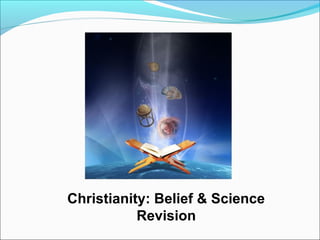
Christianity: Belief & Science
Revision
AREA 1:
METHODS OF ARRIVING AT HUMAN UNDERSTANDING
Revelation of God’s Nature: God showing who he is by what he
does through:
Scripture
General Revelation
Special Revelation
Traditions of the Church
Religious Experience
Order & Design
Revelation of God through Scripture (Bible, Old & New
Testaments)
Divinely inspired or guided
Literal, symbolic or a mixture of both
Can be read by anyone and if taken literally you don’t have
to guess at what God wants
Is a complicated text and has been written by human hands
that may have influenced meanings
General Revelation
Can be seen through:
Creation
Deliverance from suffering e.g. Exodus of Jews
Awareness of his presence, conscience?
Only have to look around at beauty & order and the power
that must have created it
Doesn’t have had to have been ‘God’
There is a lot of violence in existence
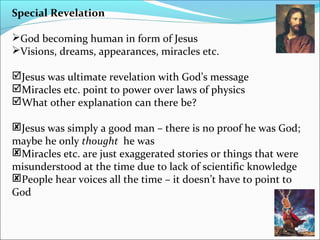
Special Revelation
God becoming human in form of Jesus
Visions, dreams, appearances, miracles etc.
Jesus was ultimate revelation with God’s message
Miracles etc. point to power over laws of physics
What other explanation can there be?
Jesus was simply a good man – there is no proof he was God;
maybe he only thought he was
Miracles etc. are just exaggerated stories or things that were
misunderstood at the time due to lack of scientific knowledge
People hear voices all the time – it doesn’t have to point to
God
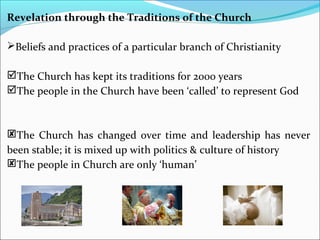
Revelation through the Traditions of the Church
Beliefs and practices of a particular branch of Christianity
The Church has kept its traditions for 2000 years
The people in the Church have been ‘called’ to represent God
The Church has changed over time and leadership has never
been stable; it is mixed up with politics & culture of history
The people in Church are only ‘human’
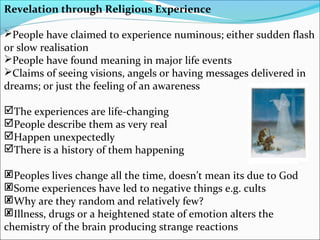
Revelation through Religious Experience
People have claimed to experience numinous; either sudden flash
or slow realisation
People have found meaning in major life events
Claims of seeing visions, angels or having messages delivered in
dreams; or just the feeling of an awareness
The experiences are life-changing
People describe them as very real
Happen unexpectedly
There is a history of them happening
Peoples lives change all the time, doesn’t mean its due to God
Some experiences have led to negative things e.g. cults
Why are they random and relatively few?
Illness, drugs or a heightened state of emotion alters the
chemistry of the brain producing strange reactions
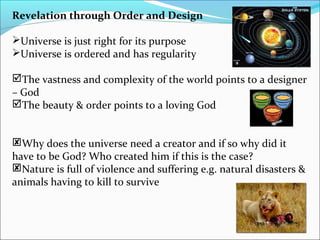
Revelation through Order and Design
Universe is just right for its purpose
Universe is ordered and has regularity
The vastness and complexity of the world points to a designer
– God
The beauty & order points to a loving God
Why does the universe need a creator and if so why did it
have to be God? Who created him if this is the case?
Nature is full of violence and suffering e.g. natural disasters &
animals having to kill to survive
Why is Revelation Important in Christianity?
We cannot understand our purpose in life if we don’t
understand God’s message
This not only affects us now but also in the afterlife
God doesn’t need to reveal himself but we are obviously
important to him
He always has and always will reveal himself
All arguments are open to debate & interpretation
The ‘evidence’ is not very strong – why isn’t he more direct?
How much is true and how much has been edited by human
hands?
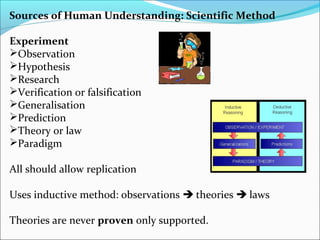
Sources of Human Understanding: Scientific Method
Experiment
Observation
Hypothesis
Research
Verification or falsification
Generalisation
Prediction
Theory or law
Paradigm
All should allow replication
Uses inductive method: observations  theories  laws
Theories are never proven only supported.
Scientific method (cont.)
It does not ‘hold on’ to beliefs but welcomes new evidence
whether it supports or rejects previously held laws or paradigms
It changes theories to fit the evidence – not changing the
evidence to fit the theory.
Takes into account all possibilities
Other people can test and verify or falsify hypotheses
Leads to laws/theories that cover similar occurrences
We can never be sure we have covered all possibilities
Exact replication may not be possible and findings are always
open to interpretation
Every apparently similar occurrence may not be covered
The scientific method is a way to test our ‘common sense’
understanding of things.
This is done using the deductive method i.e. what we see usually
leads to assumptions. E.g.
people believed the world was flat; science showed it wasn’t.
complexity & wonder of nature shows that God designed it;
science gives an alternative theory
The Full Moon Effect (people’s behaviour changes); science has
found no evidence to support this
Common sense based on actual experience
Deductive reasoning can save us ‘reinventing the wheel’
Common sense approaches are often not up to date
People are not always open to common sense being challenged
Deductive reasoning only works if your assumptions are correct
so not as effective as inductive reasoning
 Scientific Method is open to verification & falsification.
 Laws have been changed over time and will continue to do
so as more evidence is uncovered
 Science can only verify or falsify things within its scope
 Verification is based on proper scientific enquiry
 Suitable scientific tests are devised to test hypotheses
 It gives reliable ways to understand the universe
 Evidence is open to interpretation
 Some things are outwith scientific scope
 Some would argue we need mystery in our lives
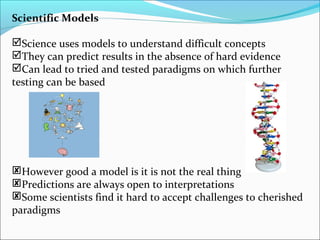
Scientific Models
Science uses models to understand difficult concepts
They can predict results in the absence of hard evidence
Can lead to tried and tested paradigms on which further
testing can be based
However good a model is it is not the real thing
Predictions are always open to interpretations
Some scientists find it hard to accept challenges to cherished
paradigms
Scientific Objectivity
Scientists are objective meaning their views are based on solid
evidence
Objectivity safeguards against scientists ‘twisting’ evidence
Evidence is always open to interpretation
It is extremely difficult to remain 100% objective. Some great
scientists have followed their ‘gut feelings’ with success.
Scientific Method Summarised
It is based on rigorous, methodical approach where the ‘truth’
is based on best evidence available
Evidence always remains open to challenge and change if
necessary
It is the most reliable way of explaining the world around us
It has flaws which could mean unreliable or misinterpreted
theories
Can lead to competing claims and scientists are not as open
to change as they might think
It is limited in what it can explain
Some Christian responses to the Scientific Method
Ordinary people can’t always understand scientific theory
The meaning of life comes from our own actions
Science is anti-religion
Science provides power & knowledge that is too much for
humans to handle
It makes humans think they are God
Scientific method is full of flaws so we should be wary
Scientists’ own beliefs affect their results
A lot of scientific evidence is circumstantial not ‘real’
Science involves interpretations, assumptions and leaps of
logic and this weakens the scientific method.
Some Scientific Materialist Responses to Religious Belief
Religion is a dangerous delusion
It holds humanity back
Religion relies on blind faith
Religion is not open to questions and challenges
The contradictions and illogical things in the Bible point to it
just being a story
Religious belief is extremely subjective especially religious
experiences which cannot be tested
Revelation is confusing, unclear, contradicts itself and is not
consistent, making it unreliable
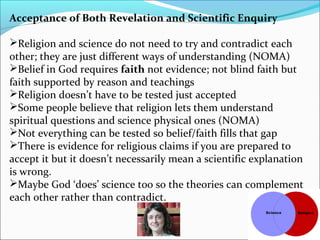
Acceptance of Both Revelation and Scientific Enquiry
Religion and science do not need to try and contradict each
other; they are just different ways of understanding (NOMA)
Belief in God requires faith not evidence; not blind faith but
faith supported by reason and teachings
Religion doesn’t have to be tested just accepted
Some people believe that religion lets them understand
spiritual questions and science physical ones (NOMA)
Not everything can be tested so belief/faith fills that gap
There is evidence for religious claims if you are prepared to
accept it but it doesn’t necessarily mean a scientific explanation
is wrong.
Maybe God ‘does’ science too so the theories can complement
each other rather than contradict.
Area 2: God Created the Universe
Literal Understanding
God is the creator of everything
As in Genesis 1
If its in the Bible it is true
God has special powers
The Bible is a book of faith not science
Requires only faith to understand
Can be accepted as it is with no need of interpretation or
analysing
Doesn’t take into account scientific evidence that contradicts it
It is so simple it rejects the intelligence God gave man
If Genesis is to be taken literally then so should everything else in
the Bible some of which isn’t acceptable today
Symbolic Interpretation
It may be true but in a symbolic way
God’s special powers are portrayed in ways we can understand
By matching the religious claims with that of science it can still
be a book of faith
God is the creator but the ‘story’ is symbolism & myth
Allows explanation of things in a more believable way
Allows the use of God-given intelligence
Accepting some of scientific explanations prevents getting to a
point where faith & science clash
Aquinas’s Cosmological (First Cause) Argument
Thomas Aquinas (1224 – 1274) argued
Everything has a cause
Every cause has a cause
This cannot go back forever
There must have been an uncaused cause to start the chain
That can only be God
Therefore God must have been the First Cause
Everything is contingent (relies on something else)
God isn’t contingent, God is a necessary being
God created everything out of nothing (ex nihilo)
Accepting the First Cause Argument
It is a matter of faith
Does away with the need that everything goes back in time
infinitely
The Argument fits in with what most Christians already believe
God is a special case so he doesn’t need a cause
Rejecting the First Cause Argument
You can’t say everything needs a cause except God. If that is the
case why can’t you say the universe doesn’t need a cause?
Quantum physics has shown some things do appear without a
cause; this would do away with the need for an uncaused cause
i.e. God
By saying God is the cause of all causes means there is an even
bigger creator than him which makes the problem worse
Even if the universe was created why does if have to be the
Christian idea of God?
Maybe it was God but what’s to say he is still around?
Religious Explanations of the Origin of the Universe Summary
It is based on ‘evidence’ from the creator himself
Gives a simple & understandable account of universe’s origins
Gives a meaning & purpose to life
Suggests a creator that cares for us
Its based on belief only, with no scientific support
Uses texts and philosophical arguments that are open to
interpretations
The Big Bang Explains the Origin of the Universe
At this instant, matter, time, energy and space were created
It does not require a creator – it ‘created’ itself
It has evidence to support the theory:
•Expanding Universe which implies an explosive beginning
•Cosmic Background Radiation; the radioactive ‘heat’ is what
scientists would expect to find from this type of ‘explosion’
•Relative Abundance of the Elements: the materials present and
the quantities they are in are also what scientists would expect
to find
The search for the ‘initial conditions’ still continue
There is strong evidence to support the theory from a variety
of scientific fields
It offers a balanced & reasoned explanation for something
that happened when no-one was around to witness it
Much of the evidence is circumstantial (inferred) not
empirical
It is so complex it is difficult for ordinary people to
understand
Gives no explanation of purpose & meaning of life
Some Christian views on the Big Bang
The Big Bang theory is wrong; there is no mention of it in the
Bible
It is based on assumptions & interpretations which might be
wrong
There is contradictory evidence in science
Supporters of Intelligent Design argue there is scientific
support for the belief in creation by God
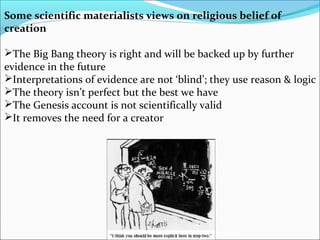
Some scientific materialists views on religious belief of
creation
The Big Bang theory is right and will be backed up by further
evidence in the future
Interpretations of evidence are not ‘blind’; they use reason & logic
The theory isn’t perfect but the best we have
The Genesis account is not scientifically valid
It removes the need for a creator
Both Can Contribute To Understanding Of Origins Of
Universe
The NOMA argument suggests you can believe in both
Science explains the physical, religion the spiritual
Creation by God is outside science’s scope
Christians can accept the Big bang theory if they do not
understand Genesis literally
God may have started the Big Bang and science can explain it
from there
God created Human Life
As described in Genesis 1 & 2: Adam & Eve made in God’
likeness, disobeyed god & banished from Garden of Eden
Literalists believe this word for word
Therefore Earth is only a few thousand years old
Liberalists believe it is a metaphor and allegory and only has
symbolic meaning
Therefore relates to spiritual not physical matters
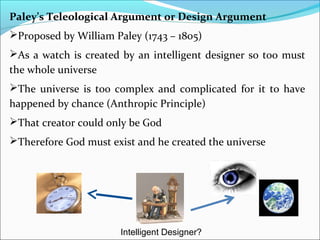
Paley’s Teleological Argument or Design Argument
Proposed by William Paley (1743 – 1805)
As a watch is created by an intelligent designer so too must
the whole universe
The universe is too complex and complicated for it to have
happened by chance (Anthropic Principle)
That creator could only be God
Therefore God must exist and he created the universe
Intelligent Designer?
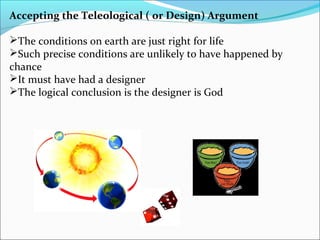
Accepting the Teleological ( or Design) Argument
The conditions on earth are just right for life
Such precise conditions are unlikely to have happened by
chance
It must have had a designer
The logical conclusion is the designer is God
Rejecting the TeIeoIogical Argument
Maybe it was designed but maybe it wasn’t the Christian God
Maybe it was a team of ‘Gods’
It begs the question ‘Who designed God?’
Why did the universe need a cause if God didn’t?
Maybe the laws of physics are ‘God’?
The universe & earth are by no means perfect; sustainment of
life requires the death of other plants and/or animals. How does
this point to an intelligent designer?
Luck rather than order seems to reign; there is no order in
natural disasters. They are random acts causing suffering to
innocent people.
The anthropic principle says the conditions have been made
perfect for life. It is the other way around - life is here because of
the conditions.
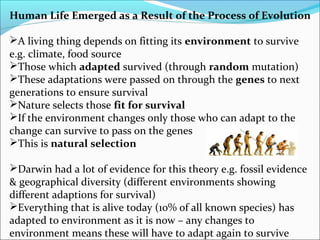
Human Life Emerged as a Result of the Process of Evolution
A living thing depends on fitting its environment to survive
e.g. climate, food source
Those which adapted survived (through random mutation)
These adaptations were passed on through the genes to next
generations to ensure survival
Nature selects those fit for survival
If the environment changes only those who can adapt to the
change can survive to pass on the genes
This is natural selection
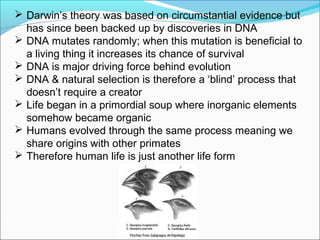
Darwin had a lot of evidence for this theory e.g. fossil evidence
& geographical diversity (different environments showing
different adaptions for survival)
Everything that is alive today (10% of all known species) has
adapted to environment as it is now – any changes to
environment means these will have to adapt again to survive
 Darwin’s theory was based on circumstantial evidence but
has since been backed up by discoveries in DNA
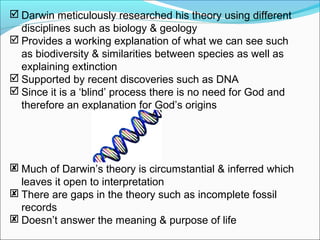
 DNA mutates randomly; when this mutation is beneficial to
a living thing it increases its chance of survival
 DNA is major driving force behind evolution
 DNA & natural selection is therefore a ‘blind’ process that
doesn’t require a creator
 Life began in a primordial soup where inorganic elements
somehow became organic
 Humans evolved through the same process meaning we
share origins with other primates
 Therefore human life is just another life form
 Darwin meticulously researched his theory using different
disciplines such as biology & geology
 Provides a working explanation of what we can see such
as biodiversity & similarities between species as well as
explaining extinction
 Supported by recent discoveries such as DNA
 Since it is a ‘blind’ process there is no need for God and
therefore an explanation for God’s origins
 Much of Darwin’s theory is circumstantial & inferred which
leaves it open to interpretation
 There are gaps in the theory such as incomplete fossil
records
 Doesn’t answer the meaning & purpose of life
Interpretation 1: The Bible’s Creation Story is Right
The Bible creation story is true therefore humans didn’t evolve
It is based on belief & faith and rejects science
Some Christians accept Genesis as symbolic. It is not a scientific
explanation but as a way to explain what human life is for
It is clear – if the Bible says its true then it is true
It gives answers to the meaning & purpose of life
Uses the truth in the bible to back up the truth in the Bible – a
circular argument open to debate
Does not take any scientific evidence into account
Intelligent Design
Supporters of Intelligent Design argue that there
is scientific evidence supporting creation of
human life by God, e.g. irreducible complexity.
There is a strong scientific basis for Intelligent Design
Does away with the need to use only the Bible to support God as
the creator
Suggests credible alternatives to the flaws in Darwinism
Scientific argument is complex and could be beyond ordinary
people including Christians
Implies the Bible story is not enough
Still doesn’t prove the Christian idea of God created life. Leads
back to ‘who designed God?’ Schoolboy Objection
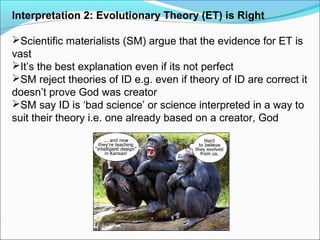
Interpretation 2: Evolutionary Theory (ET) is Right
Scientific materialists (SM) argue that the evidence for ET is
vast
It’s the best explanation even if its not perfect
SM reject theories of ID e.g. even if theory of ID are correct it
doesn’t prove God was creator
SM say ID is ‘bad science’ or science interpreted in a way to
suit their theory i.e. one already based on a creator, God
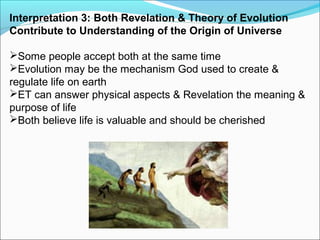
Interpretation 3: Both Revelation & Theory of Evolution
Contribute to Understanding of the Origin of Universe
Some people accept both at the same time
Evolution may be the mechanism God used to create &
regulate life on earth
ET can answer physical aspects & Revelation the meaning &
purpose of life
Both believe life is valuable and should be cherished

RELIGIOUS BELIEFS & SCIENCE

  • 1.
    Christianity: Belief &Science Revision
  • 2.
    AREA 1: METHODS OFARRIVING AT HUMAN UNDERSTANDING Revelation of God’s Nature: God showing who he is by what he does through: Scripture General Revelation Special Revelation Traditions of the Church Religious Experience Order & Design
  • 3.
    Revelation of Godthrough Scripture (Bible, Old & New Testaments) Divinely inspired or guided Literal, symbolic or a mixture of both Can be read by anyone and if taken literally you don’t have to guess at what God wants Is a complicated text and has been written by human hands that may have influenced meanings
  • 4.
    General Revelation Can beseen through: Creation Deliverance from suffering e.g. Exodus of Jews Awareness of his presence, conscience? Only have to look around at beauty & order and the power that must have created it Doesn’t have had to have been ‘God’ There is a lot of violence in existence
  • 5.
    Special Revelation God becominghuman in form of Jesus Visions, dreams, appearances, miracles etc. Jesus was ultimate revelation with God’s message Miracles etc. point to power over laws of physics What other explanation can there be? Jesus was simply a good man – there is no proof he was God; maybe he only thought he was Miracles etc. are just exaggerated stories or things that were misunderstood at the time due to lack of scientific knowledge People hear voices all the time – it doesn’t have to point to God
  • 6.
    Revelation through theTraditions of the Church Beliefs and practices of a particular branch of Christianity The Church has kept its traditions for 2000 years The people in the Church have been ‘called’ to represent God The Church has changed over time and leadership has never been stable; it is mixed up with politics & culture of history The people in Church are only ‘human’
  • 7.
    Revelation through ReligiousExperience People have claimed to experience numinous; either sudden flash or slow realisation People have found meaning in major life events Claims of seeing visions, angels or having messages delivered in dreams; or just the feeling of an awareness The experiences are life-changing People describe them as very real Happen unexpectedly There is a history of them happening Peoples lives change all the time, doesn’t mean its due to God Some experiences have led to negative things e.g. cults Why are they random and relatively few? Illness, drugs or a heightened state of emotion alters the chemistry of the brain producing strange reactions
  • 8.
    Revelation through Orderand Design Universe is just right for its purpose Universe is ordered and has regularity The vastness and complexity of the world points to a designer – God The beauty & order points to a loving God Why does the universe need a creator and if so why did it have to be God? Who created him if this is the case? Nature is full of violence and suffering e.g. natural disasters & animals having to kill to survive
  • 9.
    Why is RevelationImportant in Christianity? We cannot understand our purpose in life if we don’t understand God’s message This not only affects us now but also in the afterlife God doesn’t need to reveal himself but we are obviously important to him He always has and always will reveal himself All arguments are open to debate & interpretation The ‘evidence’ is not very strong – why isn’t he more direct? How much is true and how much has been edited by human hands?
  • 10.
    Sources of HumanUnderstanding: Scientific Method Experiment Observation Hypothesis Research Verification or falsification Generalisation Prediction Theory or law Paradigm All should allow replication Uses inductive method: observations  theories  laws Theories are never proven only supported.
  • 11.
    Scientific method (cont.) Itdoes not ‘hold on’ to beliefs but welcomes new evidence whether it supports or rejects previously held laws or paradigms It changes theories to fit the evidence – not changing the evidence to fit the theory. Takes into account all possibilities Other people can test and verify or falsify hypotheses Leads to laws/theories that cover similar occurrences We can never be sure we have covered all possibilities Exact replication may not be possible and findings are always open to interpretation Every apparently similar occurrence may not be covered
  • 12.
    The scientific methodis a way to test our ‘common sense’ understanding of things. This is done using the deductive method i.e. what we see usually leads to assumptions. E.g. people believed the world was flat; science showed it wasn’t. complexity & wonder of nature shows that God designed it; science gives an alternative theory The Full Moon Effect (people’s behaviour changes); science has found no evidence to support this Common sense based on actual experience Deductive reasoning can save us ‘reinventing the wheel’ Common sense approaches are often not up to date People are not always open to common sense being challenged Deductive reasoning only works if your assumptions are correct so not as effective as inductive reasoning
  • 13.
     Scientific Methodis open to verification & falsification.  Laws have been changed over time and will continue to do so as more evidence is uncovered  Science can only verify or falsify things within its scope  Verification is based on proper scientific enquiry  Suitable scientific tests are devised to test hypotheses  It gives reliable ways to understand the universe  Evidence is open to interpretation  Some things are outwith scientific scope  Some would argue we need mystery in our lives
  • 14.
    Scientific Models Science usesmodels to understand difficult concepts They can predict results in the absence of hard evidence Can lead to tried and tested paradigms on which further testing can be based However good a model is it is not the real thing Predictions are always open to interpretations Some scientists find it hard to accept challenges to cherished paradigms
  • 15.
    Scientific Objectivity Scientists areobjective meaning their views are based on solid evidence Objectivity safeguards against scientists ‘twisting’ evidence Evidence is always open to interpretation It is extremely difficult to remain 100% objective. Some great scientists have followed their ‘gut feelings’ with success.
  • 16.
    Scientific Method Summarised Itis based on rigorous, methodical approach where the ‘truth’ is based on best evidence available Evidence always remains open to challenge and change if necessary It is the most reliable way of explaining the world around us It has flaws which could mean unreliable or misinterpreted theories Can lead to competing claims and scientists are not as open to change as they might think It is limited in what it can explain
  • 17.
    Some Christian responsesto the Scientific Method Ordinary people can’t always understand scientific theory The meaning of life comes from our own actions Science is anti-religion Science provides power & knowledge that is too much for humans to handle It makes humans think they are God Scientific method is full of flaws so we should be wary Scientists’ own beliefs affect their results A lot of scientific evidence is circumstantial not ‘real’ Science involves interpretations, assumptions and leaps of logic and this weakens the scientific method.
  • 18.
    Some Scientific MaterialistResponses to Religious Belief Religion is a dangerous delusion It holds humanity back Religion relies on blind faith Religion is not open to questions and challenges The contradictions and illogical things in the Bible point to it just being a story Religious belief is extremely subjective especially religious experiences which cannot be tested Revelation is confusing, unclear, contradicts itself and is not consistent, making it unreliable
  • 19.
    Acceptance of BothRevelation and Scientific Enquiry Religion and science do not need to try and contradict each other; they are just different ways of understanding (NOMA) Belief in God requires faith not evidence; not blind faith but faith supported by reason and teachings Religion doesn’t have to be tested just accepted Some people believe that religion lets them understand spiritual questions and science physical ones (NOMA) Not everything can be tested so belief/faith fills that gap There is evidence for religious claims if you are prepared to accept it but it doesn’t necessarily mean a scientific explanation is wrong. Maybe God ‘does’ science too so the theories can complement each other rather than contradict.
  • 20.
    Area 2: GodCreated the Universe Literal Understanding God is the creator of everything As in Genesis 1 If its in the Bible it is true God has special powers The Bible is a book of faith not science Requires only faith to understand Can be accepted as it is with no need of interpretation or analysing Doesn’t take into account scientific evidence that contradicts it It is so simple it rejects the intelligence God gave man If Genesis is to be taken literally then so should everything else in the Bible some of which isn’t acceptable today
  • 21.
    Symbolic Interpretation It maybe true but in a symbolic way God’s special powers are portrayed in ways we can understand By matching the religious claims with that of science it can still be a book of faith God is the creator but the ‘story’ is symbolism & myth Allows explanation of things in a more believable way Allows the use of God-given intelligence Accepting some of scientific explanations prevents getting to a point where faith & science clash
  • 22.
    Aquinas’s Cosmological (FirstCause) Argument Thomas Aquinas (1224 – 1274) argued Everything has a cause Every cause has a cause This cannot go back forever There must have been an uncaused cause to start the chain That can only be God Therefore God must have been the First Cause Everything is contingent (relies on something else) God isn’t contingent, God is a necessary being God created everything out of nothing (ex nihilo)
  • 23.
    Accepting the FirstCause Argument It is a matter of faith Does away with the need that everything goes back in time infinitely The Argument fits in with what most Christians already believe God is a special case so he doesn’t need a cause
  • 24.
    Rejecting the FirstCause Argument You can’t say everything needs a cause except God. If that is the case why can’t you say the universe doesn’t need a cause? Quantum physics has shown some things do appear without a cause; this would do away with the need for an uncaused cause i.e. God By saying God is the cause of all causes means there is an even bigger creator than him which makes the problem worse Even if the universe was created why does if have to be the Christian idea of God? Maybe it was God but what’s to say he is still around?
  • 25.
    Religious Explanations ofthe Origin of the Universe Summary It is based on ‘evidence’ from the creator himself Gives a simple & understandable account of universe’s origins Gives a meaning & purpose to life Suggests a creator that cares for us Its based on belief only, with no scientific support Uses texts and philosophical arguments that are open to interpretations
  • 26.
    The Big BangExplains the Origin of the Universe At this instant, matter, time, energy and space were created It does not require a creator – it ‘created’ itself It has evidence to support the theory: •Expanding Universe which implies an explosive beginning •Cosmic Background Radiation; the radioactive ‘heat’ is what scientists would expect to find from this type of ‘explosion’ •Relative Abundance of the Elements: the materials present and the quantities they are in are also what scientists would expect to find The search for the ‘initial conditions’ still continue
  • 27.
    There is strongevidence to support the theory from a variety of scientific fields It offers a balanced & reasoned explanation for something that happened when no-one was around to witness it Much of the evidence is circumstantial (inferred) not empirical It is so complex it is difficult for ordinary people to understand Gives no explanation of purpose & meaning of life
  • 28.
    Some Christian viewson the Big Bang The Big Bang theory is wrong; there is no mention of it in the Bible It is based on assumptions & interpretations which might be wrong There is contradictory evidence in science Supporters of Intelligent Design argue there is scientific support for the belief in creation by God
  • 29.
    Some scientific materialistsviews on religious belief of creation The Big Bang theory is right and will be backed up by further evidence in the future Interpretations of evidence are not ‘blind’; they use reason & logic The theory isn’t perfect but the best we have The Genesis account is not scientifically valid It removes the need for a creator
  • 30.
    Both Can ContributeTo Understanding Of Origins Of Universe The NOMA argument suggests you can believe in both Science explains the physical, religion the spiritual Creation by God is outside science’s scope Christians can accept the Big bang theory if they do not understand Genesis literally God may have started the Big Bang and science can explain it from there
  • 31.
    God created HumanLife As described in Genesis 1 & 2: Adam & Eve made in God’ likeness, disobeyed god & banished from Garden of Eden Literalists believe this word for word Therefore Earth is only a few thousand years old Liberalists believe it is a metaphor and allegory and only has symbolic meaning Therefore relates to spiritual not physical matters
  • 32.
    Paley’s Teleological Argumentor Design Argument Proposed by William Paley (1743 – 1805) As a watch is created by an intelligent designer so too must the whole universe The universe is too complex and complicated for it to have happened by chance (Anthropic Principle) That creator could only be God Therefore God must exist and he created the universe Intelligent Designer?
  • 33.
    Accepting the Teleological( or Design) Argument The conditions on earth are just right for life Such precise conditions are unlikely to have happened by chance It must have had a designer The logical conclusion is the designer is God
  • 34.
    Rejecting the TeIeoIogicalArgument Maybe it was designed but maybe it wasn’t the Christian God Maybe it was a team of ‘Gods’ It begs the question ‘Who designed God?’ Why did the universe need a cause if God didn’t? Maybe the laws of physics are ‘God’? The universe & earth are by no means perfect; sustainment of life requires the death of other plants and/or animals. How does this point to an intelligent designer? Luck rather than order seems to reign; there is no order in natural disasters. They are random acts causing suffering to innocent people. The anthropic principle says the conditions have been made perfect for life. It is the other way around - life is here because of the conditions.
  • 35.
    Human Life Emergedas a Result of the Process of Evolution A living thing depends on fitting its environment to survive e.g. climate, food source Those which adapted survived (through random mutation) These adaptations were passed on through the genes to next generations to ensure survival Nature selects those fit for survival If the environment changes only those who can adapt to the change can survive to pass on the genes This is natural selection Darwin had a lot of evidence for this theory e.g. fossil evidence & geographical diversity (different environments showing different adaptions for survival) Everything that is alive today (10% of all known species) has adapted to environment as it is now – any changes to environment means these will have to adapt again to survive
  • 36.
     Darwin’s theorywas based on circumstantial evidence but has since been backed up by discoveries in DNA  DNA mutates randomly; when this mutation is beneficial to a living thing it increases its chance of survival  DNA is major driving force behind evolution  DNA & natural selection is therefore a ‘blind’ process that doesn’t require a creator  Life began in a primordial soup where inorganic elements somehow became organic  Humans evolved through the same process meaning we share origins with other primates  Therefore human life is just another life form
  • 37.
     Darwin meticulouslyresearched his theory using different disciplines such as biology & geology  Provides a working explanation of what we can see such as biodiversity & similarities between species as well as explaining extinction  Supported by recent discoveries such as DNA  Since it is a ‘blind’ process there is no need for God and therefore an explanation for God’s origins  Much of Darwin’s theory is circumstantial & inferred which leaves it open to interpretation  There are gaps in the theory such as incomplete fossil records  Doesn’t answer the meaning & purpose of life
  • 38.
    Interpretation 1: TheBible’s Creation Story is Right The Bible creation story is true therefore humans didn’t evolve It is based on belief & faith and rejects science Some Christians accept Genesis as symbolic. It is not a scientific explanation but as a way to explain what human life is for It is clear – if the Bible says its true then it is true It gives answers to the meaning & purpose of life Uses the truth in the bible to back up the truth in the Bible – a circular argument open to debate Does not take any scientific evidence into account
  • 39.
    Intelligent Design Supporters ofIntelligent Design argue that there is scientific evidence supporting creation of human life by God, e.g. irreducible complexity. There is a strong scientific basis for Intelligent Design Does away with the need to use only the Bible to support God as the creator Suggests credible alternatives to the flaws in Darwinism Scientific argument is complex and could be beyond ordinary people including Christians Implies the Bible story is not enough Still doesn’t prove the Christian idea of God created life. Leads back to ‘who designed God?’ Schoolboy Objection
  • 40.
    Interpretation 2: EvolutionaryTheory (ET) is Right Scientific materialists (SM) argue that the evidence for ET is vast It’s the best explanation even if its not perfect SM reject theories of ID e.g. even if theory of ID are correct it doesn’t prove God was creator SM say ID is ‘bad science’ or science interpreted in a way to suit their theory i.e. one already based on a creator, God
  • 41.
    Interpretation 3: BothRevelation & Theory of Evolution Contribute to Understanding of the Origin of Universe Some people accept both at the same time Evolution may be the mechanism God used to create & regulate life on earth ET can answer physical aspects & Revelation the meaning & purpose of life Both believe life is valuable and should be cherished