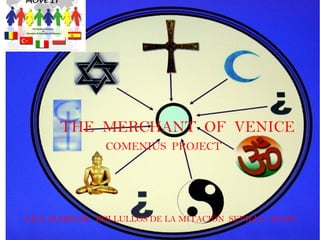
THE  MERCHANT  OF  VENICE COMENIUS  PROJECT I.E.S. ALMINAR  BOLLULLOS DE LA MITACIÓN  SEVILLA  SPAIN
 
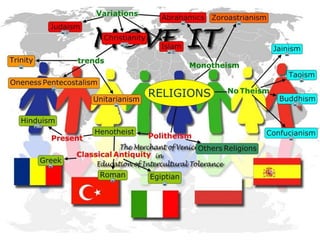
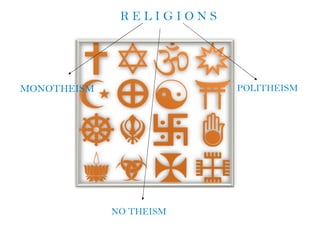
R E L I G I O N S MONOTHEISM POLITHEISM NO THEISM
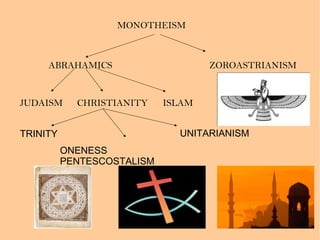
MONOTHEISM ZOROASTRIANISM ABRAHAMICS JUDAISM CHRISTIANITY ISLAM TRINITY ONENESS PENTESCOSTALISM UNITARIANISM
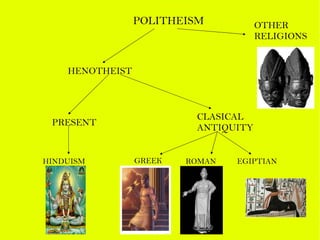
POLITHEISM OTHER RELIGIONS HENOTHEIST CLASICAL ANTIQUITY PRESENT HINDUISM GREEK ROMAN EGIPTIAN
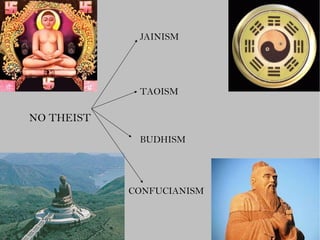
NO THEIST JAINISM TAOISM BUDHISM CONFUCIANISM
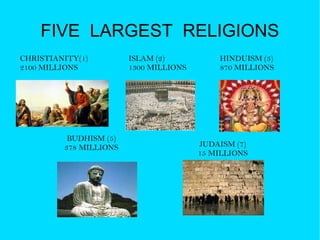
FIVE  LARGEST  RELIGIONS CHRISTIANITY(1) 2100 MILLIONS ISLAM (2) 1300 MILLIONS HINDUISM (3) 870 MILLIONS BUDHISM (5) 378 MILLIONS JUDAISM (7) 15 MILLIONS
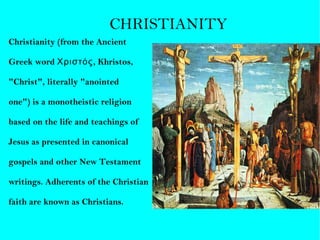
Christianity (from the Ancient Greek word Χριστός, Khristos, "Christ", literally "anointed one") is a monotheistic religion based on the life and teachings of  Jesus as presented in canonical  gospels and other New Testament  writings. Adherents of the Christian  faith are known as Christians. CHRISTIANITY
Islam (Arabic:  الإسلام ‎  al-’islām, pronounced [ʔɪsˈlæːm] )  is the  monotheistic  religion  articulated by the Qur’an, a text considered  by its adherents to be the verbatim word oF God (Arabic:  الله ‎ , Allah), and by the teachings and normative example (called the Sunnah and composed of Hadith) of Muhammad, often considered by them to be the last prophet of God. In addition to referring to the religion itself, the word Islam means 'submission to God', 'peace', and 'way to peace'. An adherent of Islam is called a Muslim. I S L A M
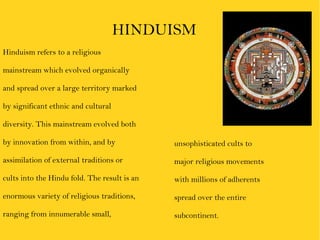
Hinduism refers to a religious  mainstream which evolved organically  and spread over a large territory marked  by significant ethnic and cultural  diversity. This mainstream evolved both  by innovation from within, and by  assimilation of external traditions or  cults into the Hindu fold. The result is an  enormous variety of religious traditions,  ranging from innumerable small,  HINDUISM unsophisticated cults to  major religious movements  with millions of adherents  spread over the entire  subcontinent.
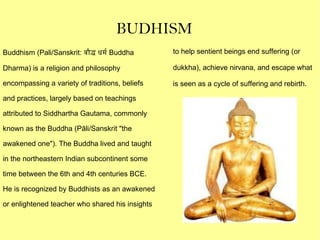
BUDHISM Buddhism (Pali/Sanskrit:  बौद्ध धर्म  Buddha  Dharma) is a religion and philosophy  encompassing a variety of traditions, beliefs  and practices, largely based on teachings  attributed to Siddhartha Gautama, commonly  known as the Buddha (Pāli/Sanskrit "the  awakened one"). The Buddha lived and taught  in the northeastern Indian subcontinent some  time between the 6th and 4th centuries BCE.  He is recognized by Buddhists as an awakened  or enlightened teacher who shared his insights  to help sentient beings end suffering (or  dukkha), achieve nirvana, and escape what  is seen as a cycle of suffering and rebirth.
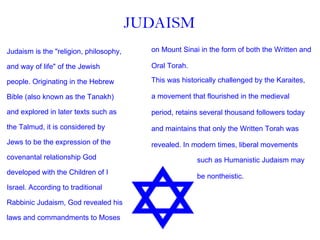
Judaism is the "religion, philosophy,  and way of life" of the Jewish  people. Originating in the Hebrew  Bible (also known as the Tanakh)  and explored in later texts such as  the Talmud, it is considered by  Jews to be the expression of the  covenantal relationship God  developed with the Children of I Israel. According to traditional  Rabbinic Judaism, God revealed his  laws and commandments to Moses  This was historically challenged by the Karaites,  a movement that flourished in the medieval  period, retains several thousand followers today  and maintains that only the Written Torah was  revealed. In modern times, liberal movements  JUDAISM on Mount Sinai in the form of both the Written and  Oral Torah.  such as Humanistic Judaism may  be nontheistic.

Religions

  • 1.
    THE MERCHANT OF VENICE COMENIUS PROJECT I.E.S. ALMINAR BOLLULLOS DE LA MITACIÓN SEVILLA SPAIN
  • 2.
  • 3.
    R E LI G I O N S MONOTHEISM POLITHEISM NO THEISM
  • 4.
    MONOTHEISM ZOROASTRIANISM ABRAHAMICSJUDAISM CHRISTIANITY ISLAM TRINITY ONENESS PENTESCOSTALISM UNITARIANISM
  • 5.
    POLITHEISM OTHER RELIGIONSHENOTHEIST CLASICAL ANTIQUITY PRESENT HINDUISM GREEK ROMAN EGIPTIAN
  • 6.
    NO THEIST JAINISMTAOISM BUDHISM CONFUCIANISM
  • 7.
    FIVE LARGEST RELIGIONS CHRISTIANITY(1) 2100 MILLIONS ISLAM (2) 1300 MILLIONS HINDUISM (3) 870 MILLIONS BUDHISM (5) 378 MILLIONS JUDAISM (7) 15 MILLIONS
  • 8.
    Christianity (from theAncient Greek word Χριστός, Khristos, "Christ", literally "anointed one") is a monotheistic religion based on the life and teachings of Jesus as presented in canonical gospels and other New Testament writings. Adherents of the Christian faith are known as Christians. CHRISTIANITY
  • 9.
    Islam (Arabic: الإسلام ‎ al-’islām, pronounced [ʔɪsˈlæːm] ) is the monotheistic religion articulated by the Qur’an, a text considered by its adherents to be the verbatim word oF God (Arabic: الله ‎ , Allah), and by the teachings and normative example (called the Sunnah and composed of Hadith) of Muhammad, often considered by them to be the last prophet of God. In addition to referring to the religion itself, the word Islam means 'submission to God', 'peace', and 'way to peace'. An adherent of Islam is called a Muslim. I S L A M
  • 10.
    Hinduism refers toa religious mainstream which evolved organically and spread over a large territory marked by significant ethnic and cultural diversity. This mainstream evolved both by innovation from within, and by assimilation of external traditions or cults into the Hindu fold. The result is an enormous variety of religious traditions, ranging from innumerable small, HINDUISM unsophisticated cults to major religious movements with millions of adherents spread over the entire subcontinent.
  • 11.
    BUDHISM Buddhism (Pali/Sanskrit: बौद्ध धर्म Buddha Dharma) is a religion and philosophy encompassing a variety of traditions, beliefs and practices, largely based on teachings attributed to Siddhartha Gautama, commonly known as the Buddha (Pāli/Sanskrit "the awakened one"). The Buddha lived and taught in the northeastern Indian subcontinent some time between the 6th and 4th centuries BCE. He is recognized by Buddhists as an awakened or enlightened teacher who shared his insights to help sentient beings end suffering (or dukkha), achieve nirvana, and escape what is seen as a cycle of suffering and rebirth.
  • 12.
    Judaism is the"religion, philosophy, and way of life" of the Jewish people. Originating in the Hebrew Bible (also known as the Tanakh) and explored in later texts such as the Talmud, it is considered by Jews to be the expression of the covenantal relationship God developed with the Children of I Israel. According to traditional Rabbinic Judaism, God revealed his laws and commandments to Moses This was historically challenged by the Karaites, a movement that flourished in the medieval period, retains several thousand followers today and maintains that only the Written Torah was revealed. In modern times, liberal movements JUDAISM on Mount Sinai in the form of both the Written and Oral Torah. such as Humanistic Judaism may be nontheistic.