Dr. Arun Draviam’s
Devendra Mishra; Prabhakar Pandey; Saman Rizvi; Aditya Arya;
Arnab Bhattacharya; Shreeharsha TV; Ankit Karmakar;
AIM, New Delhi
3rd Mar, 2014
 A Real Estate Investment
Trust or REIT is a company
that owns and operates
income-producing real estate
 REITs are also known as Real
Estate Stocks
 Some REITs not only operate,
but also finance real estate
 REITs provide an alternative
way of holding Real Estate
properties without physically
possessing them.
 REITs were first created in the US in 1960’s to give anyone
and everyone the ability to invest in large-scale
commercial properties.
 Legalized in 2001 in the USA and 2007 in UK
 REIT Law Passed in India in 2013.
 The shares of most REITs are publicly traded on
major stock exchanges
 The US Congress created the legislative framework
for REITs in 1960 to enable the investing public to
benefit from investments in large scale real-estate
enterprises
 REITs provide ongoing dividend income along with
the potential for long-term capital gains through
share price appreciation
 It is also a powerful tool for long-term portfolio
diversification
 Equity REITs own and operate income-
producing real estate
 Mortgage REITs lend money directly to real
estate owners and their operators, or indirectly
through acquisition of loans or mortgage backed
securities
 Hybrid REITs are companies that both own
properties and make loans to owners and
operators
REIT offers investors alternatives across a broad range
of real-estate properties:-
 Ownership of REIT increases investors’ total return
and / or lowers the overall risk in both equity and
fixed income portfolios due to diversification.
 Dividend growth rates for REIT shares can outpace
inflation.
 REIT business enterprise is based in large part; on
the value of tangible and quantifiable assets,
namely large scale commercial real state.
 Liquidity – REITs are traded on all major stock
exchanges like any other publicly traded company.
 Shareholder Value – REIT shareholders receive value in
form of both dividends and price appreciation
 Active Management – REITs are professionally
managed and adhere to corporate governance
principles
 Disclosure Obligations – REITs are required to provide
regular financial disclosures and audited financial
statements
 Limited Liability – Shareholders have no personal
liability for debts incurred by REITs
Individual investors can participate broadly in
opportunities available in the REIT industry
through REIT mutual funds.
These REIT mutual funds are managed by
portfolio managers with a high degree of
expertise in the real estate industry.
REIT mutual funds provide investors with a
cost-effective opportunity to add to a balanced
investment portfolio .
REIT mutual funds offer diversified exposure
to the real estate asset class
 NAV calculation – The REITs’ total assets
minus all liabilities, divided by all outstanding
equity shares of the REIT yields the NAV
 Value of a REITs’ property assets can be
enhanced through capital expenditures. This
is significant because these expenditures,
either for development or maintenance of
property, can maintain or increase NAVs
 REIT was introduced in Singapore in the year 2002.
 REITs distribute at least 90% of their income to
unit holders in return for tax concessions from the
Singapore Government.
 The majority of REITs listed on the SGX invest in
property assets pertaining to hotels & lodging,
industrial & office, residential, retail and
healthcare.
 SGX provides retail investors with a compendium of
different REITs specializing in different sectors, hereby
providing inherent diversification of portfolio.
 Subject to strict regulations imposed by the Monetary
Authority of Singapore, S-REITs offer better transparency
and corporate governance that many other corporate
sectors.
 dividends, derived in part from rental income are strongly
correlated with the high occupancy rates of assets, renewal
of leases and better valuations of property in land-scarce
Singapore
 The type and quality of a REIT’s assets is an important
factor affecting generated income.
 Categorizing of REITs by the type of property assets is
done because REITs are pro-cyclical investments.
 Many of the S-REITs rely substantially on debt to
finance property acquisitions.
 Rising interest rates adversely affect REITs laden with
high debt to equity ratios However, with expansionary
monetary policy and strong repository of foreign
reserves, Singapore is well fortified against such
radical changes in the economy.
 The biggest challenge in Singapore is the shortage of
land.
 The high gearing REIT of Singapore may find difficulty
in debt refinancing and may therefore be forced to
take measures to depress its price.
 In October, 2012 the government introduced further
belt-tightening measures in Singapore to curb the
speculative residential property market by imposing
caps causing a slow down in real estate.
 Industry has been seeking a REIT vehicle for many
years.
 Pressure on Government and Treasury for change:
 External – SIICs etc.
 Capital Flow Offshore
 Pensions issues – poor performance of equities etc.
 Clear appetite for real estate: buy-to-let
 Urban Task Force / Barker Report
 Company and Listing Rules
 Must be a closed ended company
 Must be listed on main stock exchange (LSE not AIM)
 Must have one class of (voting) shares
 Must be resident in UK for tax purposes
 Restrictions on large share-holdings (10% rule)
 Activity Rules
 Define a Tax Exempt Business (ring-fenced)
 75% of firm’s profit from real estate (rents)
 75% of firm’s assets = real estate
 Must have three properties (not owner occupied)
 Development activity OK for portfolio building (3 year
rule)
 Other Constraints and Rules
 Gearing rule: Profit/Finance Costs  1.25
 Conversion charge 2% of GAV – may be phased
 Tax and Distribution
 TEB not subject to corporation tax
 90% of profit must be distributed as Property
Investment Dividend (PID)
 PID subject to withholding tax and treated as property
income for shareholders
 Capital allowances set against income in profits
calculation
 Cannot offset losses inside/outside TEB
 Establishing a Critical Mass
 Conversions of Property Companies
 New entrants and listing requirements
 The offshore industry and REITs
 Specialist or Diversified Vehicles?
 Professional versus retail investors
 Investor interests versus management interests
 Returns and Market Expectations
 REITs as an income vehicle
 Property values, yields and distributions
 Growth, retained earnings and distributions
 The state of the market and investor confidence
 The REIT shall be set up as a Trust under the
provisions of the Indian Trusts Act, 1882. REITs shall
not launch any schemes.
 The REIT shall have parties such as trustee (registered
with SEBI), sponsor, manager and principal valuer.
 The Trust shall initially apply for registration with SEBI as
a REIT in the specified format. It shall fulfil eligibility
criteria as specified in the draft Regulations.
 SEBI, on being satisfied that the eligibility conditions are
satisfied, shall grant the REIT certificate of registration.
 After registration, the REIT shall raise funds initially through an initial offer
and once listed, may subsequently raise funds through follow-on offers.
 Listing of units shall be mandatory for all REITs. The units of the REIT shall
continue to be listed on the exchange unless delisted under the Regulations.
Provisions for delisting have also been specified in the Regulations.
 For coming out with initial offer, it has been specified that the size of the
assets under the REIT shall not be less than Rs. 1000 crore which is expected
to ensure that initially only large assets and established players enter the
market.
 Further, minimum initial offer size of Rs. 250 crore and minimum public
float of 25% is specified to ensure adequate public participation and float in
the units.
 The REIT may raise funds from any investors, resident or foreign. However,
initially, till the market develops, it is proposed that the units of the REITs
may be offered only to HNIs/institutions and therefore, it is proposed that
the minimum subscription size shall be Rs. 2 lakhs and the unit size shall be
Rs. 1 lakh.
• Reits will provide an avenue to real estate developers to
commercialise developed property, providing an exit avenue.
• It will also provide overleveraged companies an opportunity to
deleverage. It will increase the depth of the Indian real estate
market and provide additional liquidity.
• Reits would also enable people to channelise their investments into
India's realty sector through a regulated mechanism. Since the
investment in Reits is asset-backed, it is ideal for investors wanting
to invest in real estate without the hassle of checks on property titles
and the plethora of regulatory approvals.
• Considering the current economic slowdown and paucity of funds,
Reits are expected to infuse a fresh lease of life into an otherwise
choppy market.
Details
 The obvious road blocks are taxation of Reits, foreign
investments in Reits and stamping of agreements relating to
transfer of property to the Reits. In addition to these stumbling
blocks, there is a need to fix the following issues to make the Reit
regulations workable.
 One of the basic premises of the draft Reit regulations is the
need to provide an exit avenue and liquidity. However, the
definition of "real estate" seems rather constricted. The
definition of "real estate" or "property" should be broadened to
include all commercial and residential property and completed
infrastructure assets such as roads and highways that have a
regular income flow.
 The investors shall have right to remove the manager, auditor, principal
valuer, seek delisting of units, apply to SEBI for change in trustee, etc.
 An annual meeting of all investors is mandatory to be convened by the
Trustee wherein matters such as latest annual accounts, valuation
reports, performance of the REIT, approval of auditors & their fees,
appointment of principal valuer, etc. shall be discussed.
 Approval of investors has been made mandatory in special cases such
as certain related party transactions, any transaction with value
exceeding 15% of the REIT assets, borrowing exceeding 25%, change in
manager/ sponsor, change in investment strategy, delisting of units,
etc.
 In order to ensure that a related party does not influence the decision,
it has been specified that any person who is a party to any transaction
as well as associates of such person(s) shall not participate in voting on
the specific issue.
 Keeping in mind that transparency has been a cornerstone of the
REIT industry globally, detailed disclosure requirements have
been specified in the proposed Regulations.
 Minimum disclosure requirements in the offer
document/follow-on offer document have been specified in the
proposed Regulations. Further, minimum disclosures have also
been specified for the annual and half-yearly reports to be sent to
the investors.
 Certain event-based disclosures have also been specified.
Further, the REIT shall additionally be bound by periodical
disclosure requirements required under the listing agreement
with the exchanges
 90% of the REIT value should be invested in revenue
generating properties and 10% in other assets as specified in
the proposed Regulations.
 To ensure regular income to the investors, it has been
mandated to distribute at least 90% of the net distributable
income after tax of the REIT to the investors.
 The REIT shall not invest in vacant land or agricultural land or
mortgages other than mortgage backed securities. Further, the
REIT shall only invest in assets based in India.
 Investment up to 100% of the corpus of the REIT has been
permitted in one project subject to the condition that
minimum size of such asset is not less than Rs. 1000 crore.
 To ensure that the underlying assets of REIT are valued
accurately, requirement of a full valuation including a physical
inspection of the properties has been specified at least once a
year.
 A six monthly updating in the valuation capturing key changes
in the last six months has also been specified.
 The NAV shall be declared at least twice in a year. Provisions
have also been specified for valuation in case of any material
development.
 Any purchase of a new property or sale of an existing property, it
has been required that a full valuation be undertaken and the
value of the transaction shall be not less than 90% and not more
than 110% of the assessed value of the property for sale/purchase
of assets respectively.
Real Estate Holding
House
Land
Commercial
Buildings
Other
6.5
7
7.5
8
8.5
Yes No
Do you hold RE
investments?
Do you
hold RE
investm
ents?
37%
17%
17%
29%
0%
Why Invest in RE?
Security
Security
Social Status
diversify
portfolio
Normal
Course of
Life
Other
57%19%
19%
5%
Why Not Invest in RE?
Cost
Upkeep
NonCurrent
Other
86%
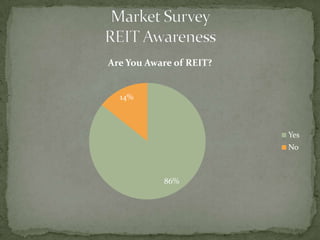
14%
Are You Aware of REIT?
No
Yes
46%
27%
27%
Would You Invest in
Demateialised
RealEstate?
Yes
No
Skeptic
20%
7%
73%
Do You Think
Dematerialised RE is a
Good Idea?
Yes
No
I Don’t
Know
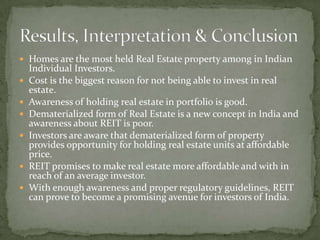
 Homes are the most held Real Estate property among in Indian
Individual Investors.
 Cost is the biggest reason for not being able to invest in real
estate.
 Awareness of holding real estate in portfolio is good.
 Dematerialized form of Real Estate is a new concept in India and
awareness about REIT is poor.
 Investors are aware that dematerialized form of property
provides opportunity for holding real estate units at affordable
price.
 REIT promises to make real estate more affordable and with in
reach of an average investor.
 With enough awareness and proper regulatory guidelines, REIT
can prove to become a promising avenue for investors of India.
References
www.investopedia.com
www.reita.org
IntroTo Singapore REITS – NUS Students’ Investment Society
Consultation paper on draft SEBI (Real Estate Investment Trusts) Regulations, 2013

REIT in india

  • 1.
    Dr. Arun Draviam’s DevendraMishra; Prabhakar Pandey; Saman Rizvi; Aditya Arya; Arnab Bhattacharya; Shreeharsha TV; Ankit Karmakar; AIM, New Delhi 3rd Mar, 2014
  • 2.
     A RealEstate Investment Trust or REIT is a company that owns and operates income-producing real estate  REITs are also known as Real Estate Stocks  Some REITs not only operate, but also finance real estate  REITs provide an alternative way of holding Real Estate properties without physically possessing them.
  • 3.
     REITs werefirst created in the US in 1960’s to give anyone and everyone the ability to invest in large-scale commercial properties.  Legalized in 2001 in the USA and 2007 in UK  REIT Law Passed in India in 2013.
  • 4.
     The sharesof most REITs are publicly traded on major stock exchanges  The US Congress created the legislative framework for REITs in 1960 to enable the investing public to benefit from investments in large scale real-estate enterprises  REITs provide ongoing dividend income along with the potential for long-term capital gains through share price appreciation  It is also a powerful tool for long-term portfolio diversification
  • 5.
     Equity REITsown and operate income- producing real estate  Mortgage REITs lend money directly to real estate owners and their operators, or indirectly through acquisition of loans or mortgage backed securities  Hybrid REITs are companies that both own properties and make loans to owners and operators
  • 6.
    REIT offers investorsalternatives across a broad range of real-estate properties:-
  • 7.
     Ownership ofREIT increases investors’ total return and / or lowers the overall risk in both equity and fixed income portfolios due to diversification.  Dividend growth rates for REIT shares can outpace inflation.  REIT business enterprise is based in large part; on the value of tangible and quantifiable assets, namely large scale commercial real state.
  • 8.
     Liquidity –REITs are traded on all major stock exchanges like any other publicly traded company.  Shareholder Value – REIT shareholders receive value in form of both dividends and price appreciation  Active Management – REITs are professionally managed and adhere to corporate governance principles  Disclosure Obligations – REITs are required to provide regular financial disclosures and audited financial statements  Limited Liability – Shareholders have no personal liability for debts incurred by REITs
  • 9.
    Individual investors canparticipate broadly in opportunities available in the REIT industry through REIT mutual funds. These REIT mutual funds are managed by portfolio managers with a high degree of expertise in the real estate industry. REIT mutual funds provide investors with a cost-effective opportunity to add to a balanced investment portfolio . REIT mutual funds offer diversified exposure to the real estate asset class
  • 10.
     NAV calculation– The REITs’ total assets minus all liabilities, divided by all outstanding equity shares of the REIT yields the NAV  Value of a REITs’ property assets can be enhanced through capital expenditures. This is significant because these expenditures, either for development or maintenance of property, can maintain or increase NAVs
  • 11.
     REIT wasintroduced in Singapore in the year 2002.  REITs distribute at least 90% of their income to unit holders in return for tax concessions from the Singapore Government.  The majority of REITs listed on the SGX invest in property assets pertaining to hotels & lodging, industrial & office, residential, retail and healthcare.
  • 12.
     SGX providesretail investors with a compendium of different REITs specializing in different sectors, hereby providing inherent diversification of portfolio.  Subject to strict regulations imposed by the Monetary Authority of Singapore, S-REITs offer better transparency and corporate governance that many other corporate sectors.  dividends, derived in part from rental income are strongly correlated with the high occupancy rates of assets, renewal of leases and better valuations of property in land-scarce Singapore
  • 13.
     The typeand quality of a REIT’s assets is an important factor affecting generated income.  Categorizing of REITs by the type of property assets is done because REITs are pro-cyclical investments.  Many of the S-REITs rely substantially on debt to finance property acquisitions.  Rising interest rates adversely affect REITs laden with high debt to equity ratios However, with expansionary monetary policy and strong repository of foreign reserves, Singapore is well fortified against such radical changes in the economy.
  • 14.
     The biggestchallenge in Singapore is the shortage of land.  The high gearing REIT of Singapore may find difficulty in debt refinancing and may therefore be forced to take measures to depress its price.  In October, 2012 the government introduced further belt-tightening measures in Singapore to curb the speculative residential property market by imposing caps causing a slow down in real estate.
  • 15.
     Industry hasbeen seeking a REIT vehicle for many years.  Pressure on Government and Treasury for change:  External – SIICs etc.  Capital Flow Offshore  Pensions issues – poor performance of equities etc.  Clear appetite for real estate: buy-to-let  Urban Task Force / Barker Report
  • 16.
     Company andListing Rules  Must be a closed ended company  Must be listed on main stock exchange (LSE not AIM)  Must have one class of (voting) shares  Must be resident in UK for tax purposes  Restrictions on large share-holdings (10% rule)  Activity Rules  Define a Tax Exempt Business (ring-fenced)  75% of firm’s profit from real estate (rents)  75% of firm’s assets = real estate  Must have three properties (not owner occupied)  Development activity OK for portfolio building (3 year rule)
  • 17.
     Other Constraintsand Rules  Gearing rule: Profit/Finance Costs  1.25  Conversion charge 2% of GAV – may be phased  Tax and Distribution  TEB not subject to corporation tax  90% of profit must be distributed as Property Investment Dividend (PID)  PID subject to withholding tax and treated as property income for shareholders  Capital allowances set against income in profits calculation  Cannot offset losses inside/outside TEB
  • 18.
     Establishing aCritical Mass  Conversions of Property Companies  New entrants and listing requirements  The offshore industry and REITs  Specialist or Diversified Vehicles?  Professional versus retail investors  Investor interests versus management interests  Returns and Market Expectations  REITs as an income vehicle  Property values, yields and distributions  Growth, retained earnings and distributions  The state of the market and investor confidence
  • 19.
     The REITshall be set up as a Trust under the provisions of the Indian Trusts Act, 1882. REITs shall not launch any schemes.  The REIT shall have parties such as trustee (registered with SEBI), sponsor, manager and principal valuer.  The Trust shall initially apply for registration with SEBI as a REIT in the specified format. It shall fulfil eligibility criteria as specified in the draft Regulations.  SEBI, on being satisfied that the eligibility conditions are satisfied, shall grant the REIT certificate of registration.
  • 20.
     After registration,the REIT shall raise funds initially through an initial offer and once listed, may subsequently raise funds through follow-on offers.  Listing of units shall be mandatory for all REITs. The units of the REIT shall continue to be listed on the exchange unless delisted under the Regulations. Provisions for delisting have also been specified in the Regulations.  For coming out with initial offer, it has been specified that the size of the assets under the REIT shall not be less than Rs. 1000 crore which is expected to ensure that initially only large assets and established players enter the market.  Further, minimum initial offer size of Rs. 250 crore and minimum public float of 25% is specified to ensure adequate public participation and float in the units.  The REIT may raise funds from any investors, resident or foreign. However, initially, till the market develops, it is proposed that the units of the REITs may be offered only to HNIs/institutions and therefore, it is proposed that the minimum subscription size shall be Rs. 2 lakhs and the unit size shall be Rs. 1 lakh.
  • 21.
    • Reits willprovide an avenue to real estate developers to commercialise developed property, providing an exit avenue. • It will also provide overleveraged companies an opportunity to deleverage. It will increase the depth of the Indian real estate market and provide additional liquidity. • Reits would also enable people to channelise their investments into India's realty sector through a regulated mechanism. Since the investment in Reits is asset-backed, it is ideal for investors wanting to invest in real estate without the hassle of checks on property titles and the plethora of regulatory approvals. • Considering the current economic slowdown and paucity of funds, Reits are expected to infuse a fresh lease of life into an otherwise choppy market. Details
  • 22.
     The obviousroad blocks are taxation of Reits, foreign investments in Reits and stamping of agreements relating to transfer of property to the Reits. In addition to these stumbling blocks, there is a need to fix the following issues to make the Reit regulations workable.  One of the basic premises of the draft Reit regulations is the need to provide an exit avenue and liquidity. However, the definition of "real estate" seems rather constricted. The definition of "real estate" or "property" should be broadened to include all commercial and residential property and completed infrastructure assets such as roads and highways that have a regular income flow.
  • 23.
     The investorsshall have right to remove the manager, auditor, principal valuer, seek delisting of units, apply to SEBI for change in trustee, etc.  An annual meeting of all investors is mandatory to be convened by the Trustee wherein matters such as latest annual accounts, valuation reports, performance of the REIT, approval of auditors & their fees, appointment of principal valuer, etc. shall be discussed.  Approval of investors has been made mandatory in special cases such as certain related party transactions, any transaction with value exceeding 15% of the REIT assets, borrowing exceeding 25%, change in manager/ sponsor, change in investment strategy, delisting of units, etc.  In order to ensure that a related party does not influence the decision, it has been specified that any person who is a party to any transaction as well as associates of such person(s) shall not participate in voting on the specific issue.
  • 24.
     Keeping inmind that transparency has been a cornerstone of the REIT industry globally, detailed disclosure requirements have been specified in the proposed Regulations.  Minimum disclosure requirements in the offer document/follow-on offer document have been specified in the proposed Regulations. Further, minimum disclosures have also been specified for the annual and half-yearly reports to be sent to the investors.  Certain event-based disclosures have also been specified. Further, the REIT shall additionally be bound by periodical disclosure requirements required under the listing agreement with the exchanges
  • 25.
     90% ofthe REIT value should be invested in revenue generating properties and 10% in other assets as specified in the proposed Regulations.  To ensure regular income to the investors, it has been mandated to distribute at least 90% of the net distributable income after tax of the REIT to the investors.  The REIT shall not invest in vacant land or agricultural land or mortgages other than mortgage backed securities. Further, the REIT shall only invest in assets based in India.  Investment up to 100% of the corpus of the REIT has been permitted in one project subject to the condition that minimum size of such asset is not less than Rs. 1000 crore.
  • 26.
     To ensurethat the underlying assets of REIT are valued accurately, requirement of a full valuation including a physical inspection of the properties has been specified at least once a year.  A six monthly updating in the valuation capturing key changes in the last six months has also been specified.  The NAV shall be declared at least twice in a year. Provisions have also been specified for valuation in case of any material development.  Any purchase of a new property or sale of an existing property, it has been required that a full valuation be undertaken and the value of the transaction shall be not less than 90% and not more than 110% of the assessed value of the property for sale/purchase of assets respectively.
  • 27.
    Real Estate Holding House Land Commercial Buildings Other 6.5 7 7.5 8 8.5 YesNo Do you hold RE investments? Do you hold RE investm ents?
  • 28.
    37% 17% 17% 29% 0% Why Invest inRE? Security Security Social Status diversify portfolio Normal Course of Life Other 57%19% 19% 5% Why Not Invest in RE? Cost Upkeep NonCurrent Other
  • 29.
    86% 14% Are You Awareof REIT? No Yes
  • 30.
    46% 27% 27% Would You Investin Demateialised RealEstate? Yes No Skeptic 20% 7% 73% Do You Think Dematerialised RE is a Good Idea? Yes No I Don’t Know
  • 31.
     Homes arethe most held Real Estate property among in Indian Individual Investors.  Cost is the biggest reason for not being able to invest in real estate.  Awareness of holding real estate in portfolio is good.  Dematerialized form of Real Estate is a new concept in India and awareness about REIT is poor.  Investors are aware that dematerialized form of property provides opportunity for holding real estate units at affordable price.  REIT promises to make real estate more affordable and with in reach of an average investor.  With enough awareness and proper regulatory guidelines, REIT can prove to become a promising avenue for investors of India.
  • 32.
    References www.investopedia.com www.reita.org IntroTo Singapore REITS– NUS Students’ Investment Society Consultation paper on draft SEBI (Real Estate Investment Trusts) Regulations, 2013