
1
Exploring The REIT Industry
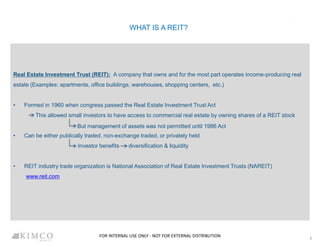
WHAT IS A REIT?
Real Estate Investment Trust (REIT): A company that owns and for the most part operates income-producing real
estate (Examples: apartments, office buildings, warehouses, shopping centers, etc.)
• Formed in 1960 when congress passed the Real Estate Investment Trust Act
This allowed small investors to have access to commercial real estate by owning shares of a REIT stock
• Can be either publically traded, non-exchange traded, or privately held
Investor benefits diversification & liquidity
• REIT industry trade organization is National Association of Real Estate Investment Trusts (NAREIT)
www.reit.com
2
But management of assets was not permitted until 1986 Act
FOR INTERNAL USE ONLY - NOT FOR EXTERNAL DISTRIBUTION
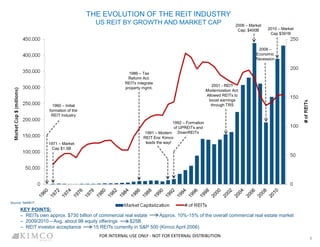
THE EVOLUTION OF THE REIT INDUSTRY
US REIT BY GROWTH AND MARKET CAP
3
Source: NAREIT
KEY POINTS:
– REITs own approx. $730 billion of commercial real estate Approx. 10%-15% of the overall commercial real estate market
– 2009/2010 – Avg. about 98 equity offerings $25B
– REIT investor acceptance 15 REITs currently in S&P 500 (Kimco April 2006)
1960 – Initial
formation of the
REIT Industry
1971 – Market
Cap $1.5B
1986 – Tax
Reform Act:
REITs integrate
property mgmt.
2001 - REIT
Modernization Act:
Allowed REITs to
boost earnings
through TRS
2006 – Market
Cap: $400B 2010 – Market
Cap $391B
1991 – Modern
REIT Era: Kimco
leads the way!
1992 – Formation
of UPREITs and
DownREITs
2008 –
Economic
Recession
FOR INTERNAL USE ONLY - NOT FOR EXTERNAL DISTRIBUTION
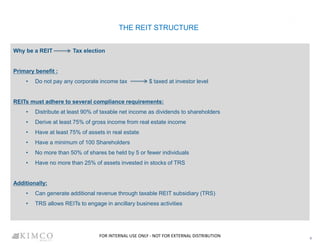
THE REIT STRUCTURE
Why be a REIT Tax election
Primary benefit :
• Do not pay any corporate income tax $ taxed at investor level
REITs must adhere to several compliance requirements:
• Distribute at least 90% of taxable net income as dividends to shareholders
• Derive at least 75% of gross income from real estate income
• Have at least 75% of assets in real estate
• Have a minimum of 100 Shareholders
• No more than 50% of shares be held by 5 or fewer individuals
• Have no more than 25% of assets invested in stocks of TRS
Additionally:
• Can generate additional revenue through taxable REIT subsidiary (TRS)
• TRS allows REITs to engage in ancillary business activities
4
FOR INTERNAL USE ONLY - NOT FOR EXTERNAL DISTRIBUTION
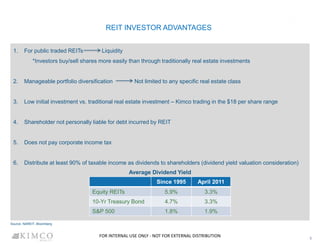
REIT INVESTOR ADVANTAGES
1. For public traded REITs Liquidity
*Investors buy/sell shares more easily than through traditionally real estate investments
2. Manageable portfolio diversification Not limited to any specific real estate class
3. Low initial investment vs. traditional real estate investment – Kimco trading in the $18 per share range
4. Shareholder not personally liable for debt incurred by REIT
5. Does not pay corporate income tax
6. Distribute at least 90% of taxable income as dividends to shareholders (dividend yield valuation consideration)
5
Since 1995 April 2011
Equity REITs 5.9% 3.3%
10-Yr Treasury Bond 4.7% 3.3%
S&P 500 1.8% 1.9%
Average Dividend Yield
Source: NAREIT, Bloomberg
FOR INTERNAL USE ONLY - NOT FOR EXTERNAL DISTRIBUTION
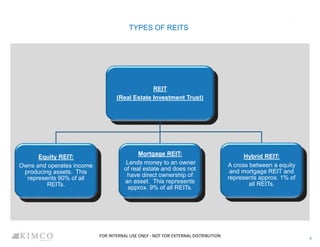
TYPES OF REITS
REIT
(Real Estate Investment Trust)
Equity REIT:
Owns and operates income
producing assets. This
represents 90% of all
REITs.
Mortgage REIT:
Lends money to an owner
of real estate and does not
have direct ownership of
an asset. This represents
approx. 9% of all REITs.
Hybrid REIT:
A cross between a equity
and mortgage REIT and
represents approx. 1% of
all REITs.
6
FOR INTERNAL USE ONLY - NOT FOR EXTERNAL DISTRIBUTION
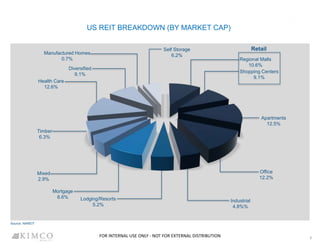
US REIT BREAKDOWN (BY MARKET CAP)
7
Source: NAREIT
Retail
Regional Malls
10.6%
Shopping Centers
9.1%
Apartments
12.5%
Office
12.2%
Industrial
4.8%%
Lodging/Resorts
5.2%
Mortgage
8.6%
Mixed
2.9%
Timber
6.3%
Health Care
12.6%
Diversified
9.1%
Manufactured Homes
0.7%
Self Storage
6.2%
FOR INTERNAL USE ONLY - NOT FOR EXTERNAL DISTRIBUTION
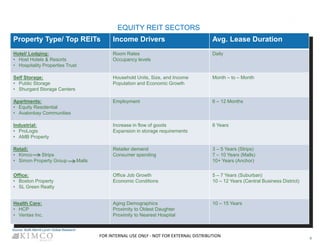
EQUITY REIT SECTORS
Property Type/ Top REITs Income Drivers Avg. Lease Duration
Hotel/ Lodging:
• Host Hotels & Resorts
• Hospitality Properties Trust
Room Rates
Occupancy levels
Daily
Self Storage:
• Public Storage
• Shurgard Storage Centers
Household Units, Size, and Income
Population and Economic Growth
Month – to – Month
Apartments:
• Equity Residential
• Avalonbay Communities
Employment 6 – 12 Months
Industrial:
• ProLogis
• AMB Property
Increase in flow of goods
Expansion in storage requirements
6 Years
Retail:
• Kimco Strips
• Simon Property Group Malls
Retailer demand
Consumer spending
3 – 5 Years (Strips)
7 – 10 Years (Malls)
10+ Years (Anchor)
Office:
• Boston Property
• SL Green Realty
Office Job Growth
Economic Conditions
5 – 7 Years (Suburban)
10 – 12 Years (Central Business District)
Health Care:
• HCP
• Ventas Inc.
Aging Demographics
Proximity to Oldest Daughter
Proximity to Nearest Hospital
10 – 15 Years
8
Source: BofA Merrill Lynch Global Research
FOR INTERNAL USE ONLY - NOT FOR EXTERNAL DISTRIBUTION
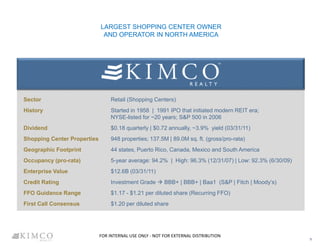
Sector Retail (Shopping Centers)
History Started in 1958 | 1991 IPO that initiated modern REIT era;
NYSE-listed for ~20 years; S&P 500 in 2006
Dividend $0.18 quarterly | $0.72 annually, ~3.9% yield (03/31/11)
Shopping Center Properties 948 properties; 137.5M | 89.0M sq. ft. (gross/pro-rata)
Geographic Footprint 44 states, Puerto Rico, Canada, Mexico and South America
Occupancy (pro-rata) 5-year average: 94.2% | High: 96.3% (12/31/07) | Low: 92.3% (6/30/09)
Enterprise Value $12.6B (03/31/11)
Credit Rating Investment Grade  BBB+ | BBB+ | Baa1 (S&P | Fitch | Moody’s)
FFO Guidance Range $1.17 - $1.21 per diluted share (Recurring FFO)
First Call Consensus $1.20 per diluted share
LARGEST SHOPPING CENTER OWNER
AND OPERATOR IN NORTH AMERICA
9
FOR INTERNAL USE ONLY - NOT FOR EXTERNAL DISTRIBUTION
REIT RETURNS
1. Total return profile of a REIT stock includes stock price appreciation as well as dividend yield
2. REITs outperformed the bigger market over longer periods of time (10, 15, 20 year spans)
10
39.5%
5.2%
3.0%
11.8% 11.0% 12.0%
22.6%
2.2% 2.9% 2.6%
6.9%
8.8%
0.0%
5.0%
10.0%
15.0%
20.0%
25.0%
30.0%
35.0%
40.0%
45.0%
1-Year 3-Year 5-Year 10-Year 15-Year 20-Year
Historical Compound Annual Total Returns: REITs vs. S&P 500
NAREIT Equity S&P 500
Source: NAREIT
REIT Return Profile
Equity
Growth through
acquisitions,
developments,
redevelopments
Bond
Receive steady
stream of income
through lease
structures
FOR INTERNAL USE ONLY - NOT FOR EXTERNAL DISTRIBUTION
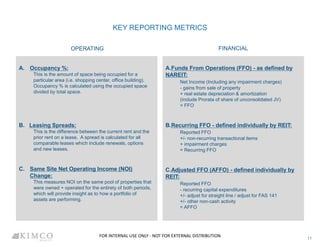
KEY REPORTING METRICS
OPERATING
A. Occupancy %:
This is the amount of space being occupied for a
particular area (i.e. shopping center, office building).
Occupancy % is calculated using the occupied space
divided by total space.
B. Leasing Spreads:
This is the difference between the current rent and the
prior rent on a lease. A spread is calculated for all
comparable leases which include renewals, options
and new leases.
C. Same Site Net Operating Income (NOI)
Change:
This measures NOI on the same pool of properties that
were owned + operated for the entirety of both periods,
which will provide insight as to how a portfolio of
assets are performing.
FINANCIAL
A.Funds From Operations (FFO) - as defined by
NAREIT:
Net Income (Including any impairment charges)
- gains from sale of property
+ real estate depreciation & amortization
(include Prorata of share of unconsolidated JV)
= FFO
B.Recurring FFO - defined individually by REIT:
Reported FFO
+/- non-recurring transactional items
+ impairment charges
= Recurring FFO
C.Adjusted FFO (AFFO) - defined individually by
REIT:
Reported FFO
- recurring capital expenditures
+/- adjust for straight line / adjust for FAS 141
+/- other non-cash activity
= AFFO
11
FOR INTERNAL USE ONLY - NOT FOR EXTERNAL DISTRIBUTION
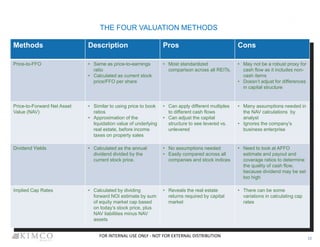
THE FOUR VALUATION METHODS
Methods Description Pros Cons
Price-to-FFO • Same as price-to-earnings
ratio
• Calculated as current stock
price/FFO per share
• Most standardized
comparison across all REITs.
• May not be a robust proxy for
cash flow as it includes non-
cash items
• Doesn’t adjust for differences
in capital structure
Price-to-Forward Net Asset
Value (NAV)
• Similar to using price to book
ratios
• Approximation of the
liquidation value of underlying
real estate, before income
taxes on property sales
• Can apply different multiples
to different cash flows
• Can adjust the capital
structure to see levered vs.
unlevered
• Many assumptions needed in
the NAV calculations by
analyst
• Ignores the company’s
business enterprise
Dividend Yields • Calculated as the annual
dividend divided by the
current stock price.
• No assumptions needed
• Easily compared across all
companies and stock indices
• Need to look at AFFO
estimate and payout and
coverage ratios to determine
the quality of cash flow,
because dividend may be set
too high
Implied Cap Rates • Calculated by dividing
forward NOI estimate by sum
of equity market cap based
on today’s stock price, plus
NAV liabilities minus NAV
assets
• Reveals the real estate
returns required by capital
market
• There can be some
variations in calculating cap
rates
12
FOR INTERNAL USE ONLY - NOT FOR EXTERNAL DISTRIBUTION
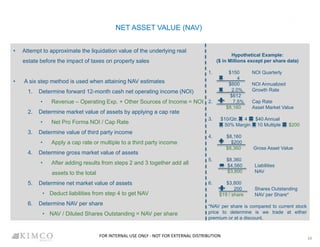
NET ASSET VALUE (NAV)
• Attempt to approximate the liquidation value of the underlying real
estate before the impact of taxes on property sales
• A six step method is used when attaining NAV estimates
1. Determine forward 12-month cash net operating income (NOI)
• Revenue – Operating Exp. + Other Sources of Income = NOI
2. Determine market value of assets by applying a cap rate
• Net Pro Forma NOI / Cap Rate
3. Determine value of third party income
• Apply a cap rate or multiple to a third party income
4. Determine gross market value of assets
• After adding results from steps 2 and 3 together add all
assets to the total
5. Determine net market value of assets
• Deduct liabilities from step 4 to get NAV
6. Determine NAV per share
• NAV / Diluted Shares Outstanding = NAV per share
13
Hypothetical Example:
($ in Millions except per share data)
1. $150 NOI Quarterly
4
$600 NOI Annualized
2.0% Growth Rate
$612
2. 7.5% Cap Rate
$8,160 Asset Market Value
3. $10/Qtr. 4 $40 Annual
50% Margin 10 Multiple $200
4. $8,160
$200
$8,360 Gross Asset Value
5. $8,360
$4,560 Liabilities
$3,800 NAV
6. $3,800
200 Shares Outstanding
$19 / share NAV per Share*
*NAV per share is compared to current stock
price to determine is we trade at either
premium or at a discount.
FOR INTERNAL USE ONLY - NOT FOR EXTERNAL DISTRIBUTION
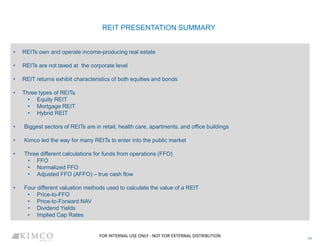
REIT PRESENTATION SUMMARY
• REITs own and operate income-producing real estate
• REITs are not taxed at the corporate level
• REIT returns exhibit characteristics of both equities and bonds
• Three types of REITs
• Equity REIT
• Mortgage REIT
• Hybrid REIT
• Biggest sectors of REITs are in retail, health care, apartments, and office buildings
• Kimco led the way for many REITs to enter into the public market
• Three different calculations for funds from operations (FFO)
• FFO
• Normalized FFO
• Adjusted FFO (AFFO) – true cash flow
• Four different valuation methods used to calculate the value of a REIT
• Price-to-FFO
• Price-to-Forward NAV
• Dividend Yields
• Implied Cap Rates
14
FOR INTERNAL USE ONLY - NOT FOR EXTERNAL DISTRIBUTION
QUESTIONS?
15
FOR INTERNAL USE ONLY - NOT FOR EXTERNAL DISTRIBUTION

REIT Overview

  • 1.
  • 2.
    WHAT IS AREIT? Real Estate Investment Trust (REIT): A company that owns and for the most part operates income-producing real estate (Examples: apartments, office buildings, warehouses, shopping centers, etc.) • Formed in 1960 when congress passed the Real Estate Investment Trust Act This allowed small investors to have access to commercial real estate by owning shares of a REIT stock • Can be either publically traded, non-exchange traded, or privately held Investor benefits diversification & liquidity • REIT industry trade organization is National Association of Real Estate Investment Trusts (NAREIT) www.reit.com 2 But management of assets was not permitted until 1986 Act FOR INTERNAL USE ONLY - NOT FOR EXTERNAL DISTRIBUTION
  • 3.
    THE EVOLUTION OFTHE REIT INDUSTRY US REIT BY GROWTH AND MARKET CAP 3 Source: NAREIT KEY POINTS: – REITs own approx. $730 billion of commercial real estate Approx. 10%-15% of the overall commercial real estate market – 2009/2010 – Avg. about 98 equity offerings $25B – REIT investor acceptance 15 REITs currently in S&P 500 (Kimco April 2006) 1960 – Initial formation of the REIT Industry 1971 – Market Cap $1.5B 1986 – Tax Reform Act: REITs integrate property mgmt. 2001 - REIT Modernization Act: Allowed REITs to boost earnings through TRS 2006 – Market Cap: $400B 2010 – Market Cap $391B 1991 – Modern REIT Era: Kimco leads the way! 1992 – Formation of UPREITs and DownREITs 2008 – Economic Recession FOR INTERNAL USE ONLY - NOT FOR EXTERNAL DISTRIBUTION
  • 4.
    THE REIT STRUCTURE Whybe a REIT Tax election Primary benefit : • Do not pay any corporate income tax $ taxed at investor level REITs must adhere to several compliance requirements: • Distribute at least 90% of taxable net income as dividends to shareholders • Derive at least 75% of gross income from real estate income • Have at least 75% of assets in real estate • Have a minimum of 100 Shareholders • No more than 50% of shares be held by 5 or fewer individuals • Have no more than 25% of assets invested in stocks of TRS Additionally: • Can generate additional revenue through taxable REIT subsidiary (TRS) • TRS allows REITs to engage in ancillary business activities 4 FOR INTERNAL USE ONLY - NOT FOR EXTERNAL DISTRIBUTION
  • 5.
    REIT INVESTOR ADVANTAGES 1.For public traded REITs Liquidity *Investors buy/sell shares more easily than through traditionally real estate investments 2. Manageable portfolio diversification Not limited to any specific real estate class 3. Low initial investment vs. traditional real estate investment – Kimco trading in the $18 per share range 4. Shareholder not personally liable for debt incurred by REIT 5. Does not pay corporate income tax 6. Distribute at least 90% of taxable income as dividends to shareholders (dividend yield valuation consideration) 5 Since 1995 April 2011 Equity REITs 5.9% 3.3% 10-Yr Treasury Bond 4.7% 3.3% S&P 500 1.8% 1.9% Average Dividend Yield Source: NAREIT, Bloomberg FOR INTERNAL USE ONLY - NOT FOR EXTERNAL DISTRIBUTION
  • 6.
    TYPES OF REITS REIT (RealEstate Investment Trust) Equity REIT: Owns and operates income producing assets. This represents 90% of all REITs. Mortgage REIT: Lends money to an owner of real estate and does not have direct ownership of an asset. This represents approx. 9% of all REITs. Hybrid REIT: A cross between a equity and mortgage REIT and represents approx. 1% of all REITs. 6 FOR INTERNAL USE ONLY - NOT FOR EXTERNAL DISTRIBUTION
  • 7.
    US REIT BREAKDOWN(BY MARKET CAP) 7 Source: NAREIT Retail Regional Malls 10.6% Shopping Centers 9.1% Apartments 12.5% Office 12.2% Industrial 4.8%% Lodging/Resorts 5.2% Mortgage 8.6% Mixed 2.9% Timber 6.3% Health Care 12.6% Diversified 9.1% Manufactured Homes 0.7% Self Storage 6.2% FOR INTERNAL USE ONLY - NOT FOR EXTERNAL DISTRIBUTION
  • 8.
    EQUITY REIT SECTORS PropertyType/ Top REITs Income Drivers Avg. Lease Duration Hotel/ Lodging: • Host Hotels & Resorts • Hospitality Properties Trust Room Rates Occupancy levels Daily Self Storage: • Public Storage • Shurgard Storage Centers Household Units, Size, and Income Population and Economic Growth Month – to – Month Apartments: • Equity Residential • Avalonbay Communities Employment 6 – 12 Months Industrial: • ProLogis • AMB Property Increase in flow of goods Expansion in storage requirements 6 Years Retail: • Kimco Strips • Simon Property Group Malls Retailer demand Consumer spending 3 – 5 Years (Strips) 7 – 10 Years (Malls) 10+ Years (Anchor) Office: • Boston Property • SL Green Realty Office Job Growth Economic Conditions 5 – 7 Years (Suburban) 10 – 12 Years (Central Business District) Health Care: • HCP • Ventas Inc. Aging Demographics Proximity to Oldest Daughter Proximity to Nearest Hospital 10 – 15 Years 8 Source: BofA Merrill Lynch Global Research FOR INTERNAL USE ONLY - NOT FOR EXTERNAL DISTRIBUTION
  • 9.
    Sector Retail (ShoppingCenters) History Started in 1958 | 1991 IPO that initiated modern REIT era; NYSE-listed for ~20 years; S&P 500 in 2006 Dividend $0.18 quarterly | $0.72 annually, ~3.9% yield (03/31/11) Shopping Center Properties 948 properties; 137.5M | 89.0M sq. ft. (gross/pro-rata) Geographic Footprint 44 states, Puerto Rico, Canada, Mexico and South America Occupancy (pro-rata) 5-year average: 94.2% | High: 96.3% (12/31/07) | Low: 92.3% (6/30/09) Enterprise Value $12.6B (03/31/11) Credit Rating Investment Grade  BBB+ | BBB+ | Baa1 (S&P | Fitch | Moody’s) FFO Guidance Range $1.17 - $1.21 per diluted share (Recurring FFO) First Call Consensus $1.20 per diluted share LARGEST SHOPPING CENTER OWNER AND OPERATOR IN NORTH AMERICA 9 FOR INTERNAL USE ONLY - NOT FOR EXTERNAL DISTRIBUTION
  • 10.
    REIT RETURNS 1. Totalreturn profile of a REIT stock includes stock price appreciation as well as dividend yield 2. REITs outperformed the bigger market over longer periods of time (10, 15, 20 year spans) 10 39.5% 5.2% 3.0% 11.8% 11.0% 12.0% 22.6% 2.2% 2.9% 2.6% 6.9% 8.8% 0.0% 5.0% 10.0% 15.0% 20.0% 25.0% 30.0% 35.0% 40.0% 45.0% 1-Year 3-Year 5-Year 10-Year 15-Year 20-Year Historical Compound Annual Total Returns: REITs vs. S&P 500 NAREIT Equity S&P 500 Source: NAREIT REIT Return Profile Equity Growth through acquisitions, developments, redevelopments Bond Receive steady stream of income through lease structures FOR INTERNAL USE ONLY - NOT FOR EXTERNAL DISTRIBUTION
  • 11.
    KEY REPORTING METRICS OPERATING A.Occupancy %: This is the amount of space being occupied for a particular area (i.e. shopping center, office building). Occupancy % is calculated using the occupied space divided by total space. B. Leasing Spreads: This is the difference between the current rent and the prior rent on a lease. A spread is calculated for all comparable leases which include renewals, options and new leases. C. Same Site Net Operating Income (NOI) Change: This measures NOI on the same pool of properties that were owned + operated for the entirety of both periods, which will provide insight as to how a portfolio of assets are performing. FINANCIAL A.Funds From Operations (FFO) - as defined by NAREIT: Net Income (Including any impairment charges) - gains from sale of property + real estate depreciation & amortization (include Prorata of share of unconsolidated JV) = FFO B.Recurring FFO - defined individually by REIT: Reported FFO +/- non-recurring transactional items + impairment charges = Recurring FFO C.Adjusted FFO (AFFO) - defined individually by REIT: Reported FFO - recurring capital expenditures +/- adjust for straight line / adjust for FAS 141 +/- other non-cash activity = AFFO 11 FOR INTERNAL USE ONLY - NOT FOR EXTERNAL DISTRIBUTION
  • 12.
    THE FOUR VALUATIONMETHODS Methods Description Pros Cons Price-to-FFO • Same as price-to-earnings ratio • Calculated as current stock price/FFO per share • Most standardized comparison across all REITs. • May not be a robust proxy for cash flow as it includes non- cash items • Doesn’t adjust for differences in capital structure Price-to-Forward Net Asset Value (NAV) • Similar to using price to book ratios • Approximation of the liquidation value of underlying real estate, before income taxes on property sales • Can apply different multiples to different cash flows • Can adjust the capital structure to see levered vs. unlevered • Many assumptions needed in the NAV calculations by analyst • Ignores the company’s business enterprise Dividend Yields • Calculated as the annual dividend divided by the current stock price. • No assumptions needed • Easily compared across all companies and stock indices • Need to look at AFFO estimate and payout and coverage ratios to determine the quality of cash flow, because dividend may be set too high Implied Cap Rates • Calculated by dividing forward NOI estimate by sum of equity market cap based on today’s stock price, plus NAV liabilities minus NAV assets • Reveals the real estate returns required by capital market • There can be some variations in calculating cap rates 12 FOR INTERNAL USE ONLY - NOT FOR EXTERNAL DISTRIBUTION
  • 13.
    NET ASSET VALUE(NAV) • Attempt to approximate the liquidation value of the underlying real estate before the impact of taxes on property sales • A six step method is used when attaining NAV estimates 1. Determine forward 12-month cash net operating income (NOI) • Revenue – Operating Exp. + Other Sources of Income = NOI 2. Determine market value of assets by applying a cap rate • Net Pro Forma NOI / Cap Rate 3. Determine value of third party income • Apply a cap rate or multiple to a third party income 4. Determine gross market value of assets • After adding results from steps 2 and 3 together add all assets to the total 5. Determine net market value of assets • Deduct liabilities from step 4 to get NAV 6. Determine NAV per share • NAV / Diluted Shares Outstanding = NAV per share 13 Hypothetical Example: ($ in Millions except per share data) 1. $150 NOI Quarterly 4 $600 NOI Annualized 2.0% Growth Rate $612 2. 7.5% Cap Rate $8,160 Asset Market Value 3. $10/Qtr. 4 $40 Annual 50% Margin 10 Multiple $200 4. $8,160 $200 $8,360 Gross Asset Value 5. $8,360 $4,560 Liabilities $3,800 NAV 6. $3,800 200 Shares Outstanding $19 / share NAV per Share* *NAV per share is compared to current stock price to determine is we trade at either premium or at a discount. FOR INTERNAL USE ONLY - NOT FOR EXTERNAL DISTRIBUTION
  • 14.
    REIT PRESENTATION SUMMARY •REITs own and operate income-producing real estate • REITs are not taxed at the corporate level • REIT returns exhibit characteristics of both equities and bonds • Three types of REITs • Equity REIT • Mortgage REIT • Hybrid REIT • Biggest sectors of REITs are in retail, health care, apartments, and office buildings • Kimco led the way for many REITs to enter into the public market • Three different calculations for funds from operations (FFO) • FFO • Normalized FFO • Adjusted FFO (AFFO) – true cash flow • Four different valuation methods used to calculate the value of a REIT • Price-to-FFO • Price-to-Forward NAV • Dividend Yields • Implied Cap Rates 14 FOR INTERNAL USE ONLY - NOT FOR EXTERNAL DISTRIBUTION
  • 15.
    QUESTIONS? 15 FOR INTERNAL USEONLY - NOT FOR EXTERNAL DISTRIBUTION

Editor's Notes