ANALYSIS OF REIT
REGULATIONS
MARCH 2015
MARCH 2015
ANALYSIS OF REIT REGULATIONS
Contents
India REIT
Regulations -
A Holistic
Perspective
Importance of a Real
Estate Investment
Trust (REIT) in the
Indian Context
India REIT
Regulations
01 04 08
India REIT Regulations-
A Holistic Perspective
The Real Estate Investment Trust
(REIT) - an investment vehicle that
invests in rent-yielding completed real
estate properties has the potential
to transform the Indian real estate
sector. Currently, developers incur
huge capital expenditure especially in
Commercial Real Estate (CRE), on land,
construction, interior fit-outs, etc. which
remain locked for years until the asset
generates returns to break-even. REIT
will help attracting long-term financing
from domestic as well as foreign
sources. This could improve fund
availability to real estate developers and
reduce some burden on completed
assets by allowing owners of such
assets to raise capital from investors
against issue of units. Further, for the
investors, the REIT can provide a new
investment vehicle with ongoing returns,
elevated transparency and governance
standards.
Tax
Implications
Structure of
REITs in India
History and
Regulatory Reforms
of REIT Markets
Making REITs
Successful in India
12 16 20 24
MARCH 2015
ANALYSIS OF REIT REGULATIONS
Importance of a Real Estate
Investment Trust (REIT) in
the Indian context
A REIT could provide an attractive alternative investment
instrument in the Indian financial markets. Introduction of
REIT can be a boon for developers and more so to the real
estate investors as it helps in negating the shortcomings of
investing in physical real estate. This new investment vehicle
offers an exit opportunity to developers thereby enabling
them to monetise their real estate. While on the other
hand, mandatory listing of the REITs on recognised stock
exchanges will offer an easy entry and exit mechanism
for investors. With respect to providing liquidity to the
investors, REIT may be at par with equity shares trading on
the exchange.
A REIT could have a large opportunity
in the Indian real estate market with a
growing economy, existing portfolio of
commercial real estate and conducive
investment climate.
Alternative investment
opportunity:
4
Being a new investment instrument for an Indian investor it is imperative to study the
performance of REITs, globally. Over the past decade, returns on equity of traded REITs
has comparatively over performed the returns on leading stock markets indexes, across
the world. REITs across the globe have provided five year returns in the range of 12 to
24 per cent. With Japanese and Malaysian markets providing returns in the range of 7
to 12 per cent,1
expectations from Asian economies are on the rise.
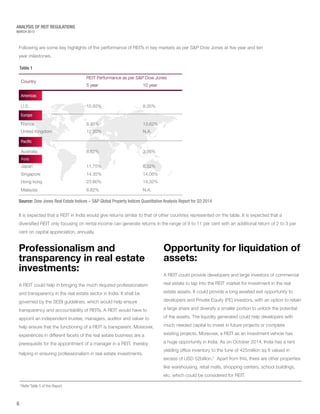
Following are some key highlights of the performance of REITs in key markets as per
S&P Dow Jones at five year and ten year milestones.
5
1
Refer Table 1
MARCH 2015
ANALYSIS OF REIT REGULATIONS
It is expected that a REIT in India would give returns similar to that of other countries represented on the table. It is expected that a
diversified REIT only focusing on rental income can generate returns in the range of 9 to 11 per cent with an additional return of 2 to 3 per
cent on capital appreciation, annually.
Professionalism and
transparency in real estate
investments:
A REIT could help in bringing the much required professionalism
and transparency in the real estate sector in India. It shall be
governed by the SEBI guidelines, which would help ensure
transparency and accountability of REITs. A REIT would have to
appoint an independent trustee, managers, auditor and valuer to
help ensure that the functioning of a REIT is transparent. Moreover,
experiences in different facets of the real estate business are a
prerequisite for the appointment of a manager in a REIT, thereby
helping in ensuring professionalism in real estate investments.	
Opportunity for liquidation of
assets:
A REIT could provide developers and large investors of commercial
real estate to tap into the REIT market for investment in the real
estate assets. It could provide a long awaited exit opportunity to
developers and Private Equity (PE) investors, with an option to retain
a large share and diversify a smaller portion to unlock the potential
of the assets. The liquidity generated could help developers with
much needed capital to invest in future projects or complete
existing projects. Moreover, a REIT as an investment vehicle has
a huge opportunity in India. As on October 2014, India has a rent
yielding office inventory to the tune of 425million sq ft valued in
excess of USD 52billion.2
Apart from this, there are other properties
like warehousing, retail malls, shopping centers, school buildings,
etc. which could be considered for REIT.
Source: Dow Jones Real Estate Indices – S&P Global Property Indices Quantitative Analysis Report for Q3 2014
Country
REIT Performance as per S&P Dow Jones
5 year 10 year
Americas
U.S. 15.93% 8.35%
Europe
France 8.95% 13.62%
United Kingdom 12.20% N.A.
Pacific
Australia 8.62% 3.56%
Asia
Japan 11.75% 6.32%
Singapore 14.35% 14.06%
Hong kong 23.80% 14.32%
Malaysia 6.82% N.A.
6
Following are some key highlights of the performance of REITs in key markets as per S&P Dow Jones at five year and ten
year milestones.
2
Refer Table 5 of this Report
Table 1
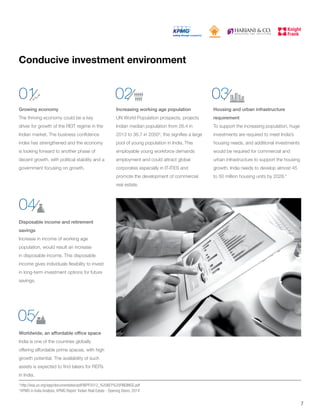
Conducive investment environment
Growing economy
The thriving economy could be a key
driver for growth of the REIT regime in the
Indian market. The business confidence
index has strengthened and the economy
is looking forward to another phase of
decent growth, with political stability and a
government focusing on growth.
Housing and urban infrastructure
requirement
To support the increasing population, huge
investments are required to meet India’s
housing needs, and additional investments
would be required for commercial and
urban infrastructure to support the housing
growth. India needs to develop almost 45
to 50 million housing units by 2028.4
Disposable income and retirement
savings
Increase in income of working age
population, would result an increase
in disposable income. This disposable
income gives individuals flexibility to invest
in long-term investment options for future
savings.
Worldwide, an affordable office space
India is one of the countries globally
offering affordable prime spaces, with high
growth potential. The availability of such
assets is expected to find takers for REITs
in India.
Increasing working age population
UN World Population prospects, projects
Indian median population from 26.4 in
2013 to 36.7 in 20503
, this signifies a large
pool of young population in India. This
employable young workforce demands
employment and could attract global
corporates especially in IT-ITES and
promote the development of commercial
real estate.
01
04
05
02 03
7
3
http://esa.un.org/wpp/documentation/pdf/WPP2012_%20KEY%20FINDINGS.pdf
4
KPMG in India Analysis; KPMG Report ‘Indian Real Estate - Opening Doors, 2014’
MARCH 2015
ANALYSIS OF REIT REGULATIONS
8
Initially proposed in December 2008 by the Securities and Exchange
Board of India (SEBI), the SEBI (Real Estate Investment Trusts)
Regulations, 2014 (‘REIT Regulations’) have been notified.
Several developers, financial institutions and private equity players
that have been preparing their real estate portfolio for the new
investment environment will be ready to offer their investment
propositions to investors, beginning 2015.
India REIT regulations
MARCH 2015
ANALYSIS OF REIT REGULATIONS
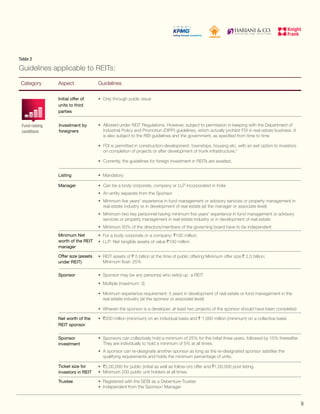
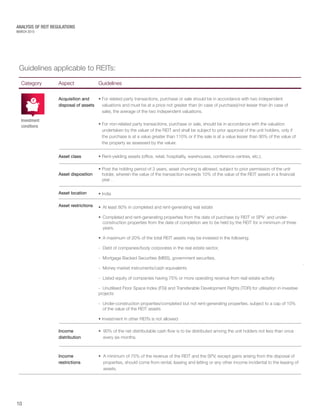
Guidelines applicable to REITs:
Category Aspect Guidelines
Initial offer of
units to third
parties
• Only through public issue
•	Allowed under REIT Regulations. However, subject to permission in keeping with the Department of
Industrial Policy and Promotion (DIPP) guidelines, which actually prohibit FDI in real estate business .It
is also subject to the RBI guidelines and the government, as specified from time to time
•	FDI is permitted in construction-development: townships, housing etc. with an exit option to investors
on completion of projects or after development of trunk infrastructure.5
•	 Currently, the guidelines for foreign investment in REITs are awaited.
Listing • Mandatory
Manager •	 Can be a body corporate, company or LLP incorporated in India
•	 An entity separate from the Sponsor
•	Minimum five years’ experience in fund management or advisory services or property management in
real estate industry or in development of real estate (at the manager or associate level)
•	Minimum two key personnel having minimum five years’ experience in fund management or advisory
services or property management in real estate industry or in development of real estate
•	 Minimum 50% of the directors/members of the governing board have to be independent
Minimum Net
worth of the REIT
manager
• For a body corporate or a company: `100 million;
• LLP: Net tangible assets of value `100 million
Offer size (assets
under REIT)
• REIT assets of ` 5 billion at the time of public offering Minimum offer size:` 2.5 billion;
Minimum float: 25%
Sponsor • Sponsor may be any person(s) who set(s) up a REIT
• Multiple (maximum: 3)
• Minimum experience requirement: 5 years in development of real estate or fund management in the
real estate industry (at the sponsor or associate level)
• Wherein the sponsor is a developer, at least two projects of the sponsor should have been completed
Net worth of the
REIT sponsor
• `200 million (minimum) on an individual basis and ` 1,000 million (minimum) on a collective basis
Sponsor
investment
• Sponsors can collectively hold a minimum of 25% for the initial three years, followed by 15% thereafter.
They are individually to hold a minimum of 5% at all times.
• A sponsor can re-designate another sponsor as long as the re-designated sponsor satisfies the
qualifying requirements and holds the minimum percentage of units.
Ticket size for
investors in REIT
• `2,00,000 for public (initial as well as follow-on) offer and `1,00,000 post listing.
• Minimum 200 public unit holders at all times
Trustee • Registered with the SEBI as a Debenture Trustee
• Independent from the Sponsor/ Manager
Investment by
foreigners
Fund-raising
conditions
9
Table 2
MARCH 2015
ANALYSIS OF REIT REGULATIONS
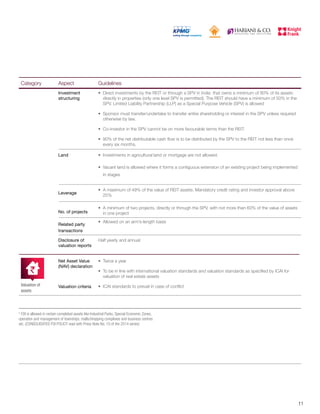
Guidelines applicable to REITs:
Category Aspect Guidelines
Acquisition and
disposal of assets
• For related party transactions, purchase or sale should be in accordance with two independent
valuations and must be at a price not greater than (in case of purchase)/not lesser than (in case of
sale), the average of the two independent valuations.
• For non-related party transactions, purchase or sale, should be in accordance with the valuation
undertaken by the valuer of the REIT and shall be subject to prior approval of the unit holders, only if
the purchase is at a value greater than 110% or if the sale is at a value lesser than 90% of the value of
the property as assessed by the valuer.
Asset class • Rent-yielding assets (office, retail, hospitality, warehouses, conference centres, etc.).
Asset disposition
• Post the holding period of 3 years, asset churning is allowed, subject to prior permission of the unit
holder, wherein the value of the transaction exceeds 10% of the value of the REIT assets in a financial
year .
Asset location • India
Asset restrictions •	 At least 80% in completed and rent-generating real estate
•	 Completed and rent-generating properties from the date of purchase by REIT or SPV and under-
construction properties from the date of completion are to be held by the REIT for a minimum of three
years.
•	 A maximum of 20% of the total REIT assets may be invested in the following:
-	 Debt of companies/body corporates in the real estate sector,
-	 Mortgage Backed Securities (MBS), government securities,
-	 Money market instruments/cash equivalents
-	 Listed equity of companies having 75% or more operating revenue from real estate activity
-	 Unutilised Floor Space Index (FSI) and Transferable Development Rights (TDR) for utilisation in investee
projects
-	Under-construction properties/completed but not rent-generating properties, subject to a cap of 10%
of the value of the REIT assets
• Investment in other REITs is not allowed.
.
Income
distribution
• 90% of the net distributable cash flow is to be distributed among the unit holders not less than once
every six months.
Income
restrictions
• A minimum of 75% of the revenue of the REIT and the SPV, except gains arising from the disposal of
properties, should come from rental, leasing and letting or any other income incidental to the leasing of
assets.
Investment
conditions
10
ANALYSIS OF REIT REGULATIONS
Category Aspect Guidelines
Investment
structuring
• Direct investments by the REIT or through a SPV in India that owns a minimum of 80% of its assets
directly in properties (only one level SPV is permitted). The REIT should have a minimum of 50% in the
SPV. Limited Liability Partnership (LLP) as a Special Purpose Vehicle (SPV) is allowed
• Sponsor must transfer/undertake to transfer entire shareholding or interest in the SPV unless required
otherwise by law.
• Co-investor in the SPV cannot be on more favourable terms than the REIT.
• 90% of the net distributable cash flow is to be distributed by the SPV to the REIT not less than once
every six months.
Land • Investments in agricultural land or mortgage are not allowed.
• Vacant land is allowed where it forms a contiguous extension of an existing project being implemented
in stages
Leverage
• A maximum of 49% of the value of REIT assets. Mandatory credit rating and investor approval above
25%
No. of projects
• A minimum of two projects, directly or through the SPV, with not more than 60% of the value of assets
in one project
Related party
transactions
• Allowed on an arm’s-length basis
Disclosure of
valuation reports
Half yearly and annual
Net Asset Value
(NAV) declaration
• Twice a year
• To be in line with international valuation standards and valuation standards as specified by ICAI for
valuation of real estate assets
• ICAI standards to prevail in case of conflictValuation criteriaValuation of
assets
11
5
FDI is allowed in certain completed assets like Industrial Parks, Special Economic Zones,
operation and management of townships, malls/shopping complexes and business centres
etc. (CONSOLIDATED FDI POLICY read with Press Note No. 10 of the 2014 series)
MARCH 2015
ANALYSIS OF REIT REGULATIONS
The REIT regulations have sought to create an ecosystem
by detailing the role and responsibilities of each stakeholder
and laying down the conditions for operating and managing
a REIT in India. The guidelines pertaining to fund raising
and investments outline the fundamentals of REITs in the
country, and have been listed in Table 2. Channelising a
portion of public savings into real estate was one of the
objectives of these guidelines. In the absence of the REIT
Regulations, the nearest alternative to property investment
was private equity funds that operate within the SEBI
(Alternative Investment Fund) Regulations, 2012 (SAFR).
However, besides characteristic differences, the ticket size of the
investments under the SAFR was high, at `10 million. This caused
small investors who showed interest in investing in property to
invest in physical assets directly, which are fraught with their own
share of complexities. In contrast, the REIT investment vehicle
will allow investments as low as `0.2 million in the case of public
offers, and `0.1million in subsequent trading on recognised stock
exchanges. This provides liquidity, easy entry-exit for unit holders
comparable to shares and allows developers to monetise their real
estate assets with an option to retain a large share and diversify a
smaller portion to unlock the potential of the assets.
12
Structure of REITs in India
The REIT Regulations also allow foreigners to buy units of a REIT,
thereby channelising overseas investments of sovereign wealth
funds, retirement funds and High Net-worth Individuals, among
others. This can infuse equity in the cash-strapped real estate
assets and help attract long-term financing from domestic/foreign
sources, thereby reducing the burden on the banking sector.
Currently, the FDI regulations by DIPP allow investments in under-
construction real estate and completed projects for operation
and management of townships, malls/ shopping complexes
and business centers. However, the guidelines for direct foreign
investment in REITs are awaited.
13
In the draft REIT Regulations, 2013 for the initial offer, a REIT was
required to have assets of ` 10 billion. This condition has been
halved since the draft guidelines were introduced in October 2013,
thereby making it easier for several smaller players to enter the REIT
market. In addition, the regulations also allow multiple sponsors
(a maximum of three) for a REIT. The draft guidelines allowed only
a single sponsor to promote a REIT. Hence, coupled with a lower
asset size to begin with, the provision for multiple sponsors can be
encouraging for several small and regional players.
MARCH 2015
ANALYSIS OF REIT REGULATIONS
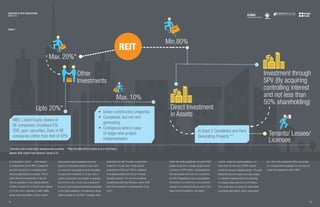
As indicated in chart 1 , with respect
to investments by the REIT, at least 80
per cent should be in completed and
revenue-generating real estate. This is
lower than the requirement of 90 per
cent as specified in the draft guidelines.
Further, a maximum of 20 per cent instead
of 10 per cent, is allowed in debt, MBS,
government securities, money market
instruments/cash equivalents and the
equity of companies having 75 per cent
or more from real estate activity (including
a maximum investment of 10 per cent in
under-construction real estate). Increasing
the limit from the 10 per cent overall limit
for such instruments/investments specified
in the draft guidelines, the relaxation allows
higher liquidity for the REIT manager while
restricting the risk of under-construction
projects to 10 per cent. It also allows
investment in FSI and TDR for utilisation
in investee projects but not for trading/
liquidity purpose. The move is practical,
considering cities like Mumbai, where TDR
and FSI involvement in development is the
norm.
Under the draft guidelines, the entire REIT
assets could be in a single project worth
a minimum of `10 billion. Addressing the
risk associated with such an investment,
the REIT Regulations have necessitated
investment in a minimum of two projects,
wherein not more than 60 per cent of the
value can be invested in one asset.
Further, under the draft guidelines, not
more than 20 per cent of REIT assets
would be rented to related parties. The said
threshold has now been removed subject
to valuation requirements and obtaining
of required approvals from unit holders.
This could open up doors for large listed
companies like banks, stock exchanges,
Max. 20%*
Upto 20%*
Max. 10%
Min.80%
Other
Investments
MBS, Listed Equity shares of
RE companies Unutilised FSI,
TDR, govt. securities, Debt of RE
companies (other than that of SPV)
At least 2 Completed and Rent
Generating Projects **
•	 Under-construction properties
•	 Completed, but not rent
generating
•	 Contiguous land in case
of stage-wise project
implementation
Direct Investment
in Assets
Investment through
SPV (By acquiring
controlling interest
and not less than
50% shareholding)
Tenants/ Lessee/
Licensee
*Including under-construction/ developmental properties **Not more than 60% of assets to be in one Project
Source: SEBI, Knight Frank Research, Hariani  Co
MARCH 2014
ANALYSIS OF REIT REGULATIONS
14 15
REIT
etc. who hold substantial office properties
to monetise their properties by carrying out
a sale and leaseback with a REIT.
Chart 1
MARCH 2015
ANALYSIS OF REIT REGULATIONS
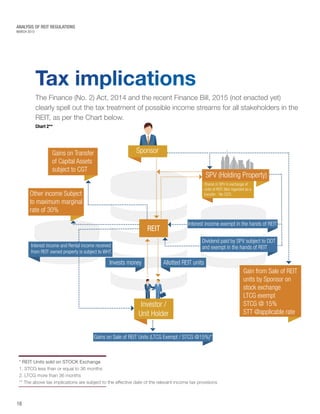
Tax implications
The Finance (No. 2) Act, 2014 and the recent Finance Bill, 2015 (not enacted yet)
clearly spell out the tax treatment of possible income streams for all stakeholders in the
REIT, as per the Chart below.
* REIT Units sold on STOCK Exchange
1. STCG less than or equal to 36 months
2. LTCG more than 36 months
** The above tax implications are subject to the effective date of the relevant income tax provisions
16
Invests money Allotted REIT units
Interest income and Rental income received
from REIT owned property is subject to WHT.
Shares in SPV in exchange of
units of REIT (Not regarded as a
transfer - No CGT)
Interest income exempt in the hands of REIT
Gains on Sale of REIT Units (LTCG Exempt / STCG @15%)*
Dividend paid by SPV subject to DDT
and exempt in the hands of REIT
REIT
Investor /
Unit Holder
SPV (Holding Property)
Gain from Sale of REIT
units by Sponsor on
stock exchange
LTCG exempt
STCG @ 15%
STT @applicable rate
SponsorGains on Transfer
of Capital Assets
subject to CGT
Other income Subject
to maximum marginal
rate of 30%
Chart 2**
Accordingly, the tax implications which will arise on account of capital gains, rental income, dividend income and interest
income are listed below:
Capital gains
Rental income
a. Sponsors’ tax liability on the transfer
of shares in SPV
No capital gains tax arises on the initial
transfer of shares of the SPV to a REIT
in exchange of units of the REIT by the
sponsor.
Further, it has been proposed in the
Finance Bill, 2015, that at the time of
disposal of the above REIT units (under
an IPO listing or sale on stock exchange
thereafter), the sponsor of REITs would
be eligible for concessional capital gains
tax regime on par with other investors.
Accordingly, long term capital gains (LTCG)
on transfer of units would be exempt and
short term capital gains (STCG) would be
taxable at the rate of 15 per cent provided
applicable Securities Transaction Tax
(‘STT’) is paid on the sale of such units..
This is similar to an IPO of a company
where LTCG arising to the promoter on
sale of shares through an offer for sale
or on the stock exchange post listing
is exempt from tax. Given that both are
similar in terms of public listing, parity may
make it lucrative for sponsors to opt for a
REIT. In doing so, the Revenue authorities
have tried to address the sponsors’
apprehension regarding high costs of
setting-up a REIT.
The Income-tax Act, 1961 (‘the Act’) states
that acquisition cost of the shares of the
SPV as well as the date on which the
shares were originally purchased should
be considered while computing the capital
gains tax on sale of REIT units held by a
sponsor.
b. Business trust’s tax liability on the
disposal of assets
Any gains/income arising out of disposal
of assets by the REIT (typically real estate
assets or shares in SPV) would attract
capital gains tax, depending on whether
the gains are short-term or long-term in
nature.
c. Unit holders’ tax liability on the sale
of REIT units on the stock exchange
If the unit holders sell the units of the REIT
on the stock exchange after holding it for
more than 36 months, the capital gain
arising on sale of such units of REIT will be
exempt from tax. However, transfers within
the 36 month period will attract short-term
capital gains tax at a concessional tax rate
of 15 per cent. Such sale of units on the
stock exchange shall be subject to STT on
transaction value.
a Rental income received by the REIT
The Finance Bill, 2015 has proposed that
the rental income arising to REIT from the
real estate assets directly held by the REIT
would be eligible for pass through status.
Accordingly, such income will be exempt in
the hands of REIT.
Further, the tenant or lessee is not required
to withhold tax on payment of rent to the
REIT.
b. REIT distributing rental income to unit
holders
Distribution of rental income by REIT to
the REIT unit holders is chargeable to tax
in the hands of the REIT unit holders on
distribution.
The REIT is required to withhold tax at 10
per cent on distribution of such income
to the resident unit holders and at the
applicable rates on distribution to the non-
resident (not being a company) or foreign
company unit holders.
17
MARCH 2015
ANALYSIS OF REIT REGULATIONS
Dividend income
Interest
Other income distributed by REIT to unit-holders
A lower withholding tax rate of 5 per cent on interest
income in case of ECBs availed by a REIT.
a. Distribution of dividend by SPV
If the SPV is a company, it has to adhere
to the regulations of the Companies Act.
According to the Act, any company paying
dividend would attract Dividend Distribution
Tax (DDT) at 17.65 per cent excluding
surcharge and education cess. Hence,
the dividend paid by the SPV to the REIT
would attract DDT.
a. REIT receiving interest
If the SPV is funded through interest-
bearing debt by the REIT, any interest
paid by the SPV to the REIT would not be
taxable. Additionally, the SPV’s tax liability
will decrease, as interest is a tax
deductible
Distributed income received by the unit holder from the REIT, except the proportionate interest and rental income (as discussed above) will
be exempt under the provisions of the Income Tax Act, 1961.
The beneficial provision of lower rate of withholding tax is now available also to REIT, subject to the conditions as mentioned in the Act.
b. REIT receiving dividend from SPV
The dividend received by the REIT from the
SPV would be subject to DDT at the level
of SPV and therefore it will be exempt in the
hands of a REIT.
c. REIT distributing dividend received
from SPV to unit holders
By the logic of REIT receiving dividends, the
REIT unit holders receiving dividends are
b. REIT distributing interest received
from SPV to unit holders
The interest income earned by the REIT
from the SPV would not be taxable in
itself (as mentioned above), but would be
taxable in the hands of the unit holders.
The unit holder(s) will be subject to
also exempted. This is because REITs are
intended to be pass through entities.
withholding tax on the interest component
of the distributed income at 5 per cent for
a non-resident and 10 per cent for resident
unit holders. It is worthwhile to note that for
the non-residents, 5 percent is the final tax
incidence on such interest income.
18
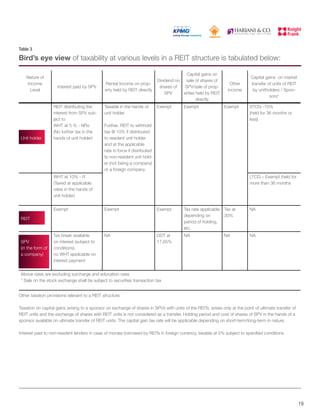
Bird’s eye view of taxability at various levels in a REIT structure is tabulated below:
19
Table 3
Nature of
Income
Level
Interest paid by SPV
Rental Income on prop-
erty held by REIT directly
Dividend on
shares of
SPV
Capital gains on
sale of shares of
SPV/sale of prop-
erties held by REIT
directly
Other
income
Capital gains on market
transfer of units of REIT
by unitholders / Spon-
sors*
Unit holder
REIT distributing the
interest from SPV sub-
ject to
WHT at 5 % - NRs
(No further tax in the
hands of unit holder)
Taxable in the hands of
unit holder
Further, REIT to withhold
tax @ 10% if distributed
to resident unit holder
and at the applicable
rate in force if distributed
to non-resident unit hold-
er (not being a company)
or a foreign company
Exempt Exempt Exempt STCG -15%
(held for 36 months or
less)
WHT at 10% - R
(Taxed at applicable
rates in the hands of
unit holder)
LTCG – Exempt (held for
more than 36 months
REIT
Exempt Exempt Exempt Tax rate applicable
depending on
period of holding,
etc.
Tax at
30%
NA
SPV
(in the form of
a company)
Tax break available
on interest (subject to
conditions),
no WHT applicable on
interest payment
NA DDT at
17.65%
NA NA NA
Above rates are excluding surcharge and education cess
* Sale on the stock exchange shall be subject to securities transaction tax
Other taxation provisions relevant to a REIT structure:
Taxation on capital gains arising to a sponsor on exchange of shares in SPVs with units of the REITs, arises only at the point of ultimate transfer of
REIT units and the exchange of shares with REIT units is not considered as a transfer. Holding period and cost of shares of SPV in the hands of a
sponsor available on ultimate transfer of REIT units. The capital gain tax rate will be applicable depending on short-term/long-term in nature.
Interest paid to non-resident lenders in case of monies borrowed by REITs in foreign currency, taxable at 5% subject to specified conditions
MARCH 2015
ANALYSIS OF REIT REGULATIONS
History and Regulatory
reforms of REIT markets
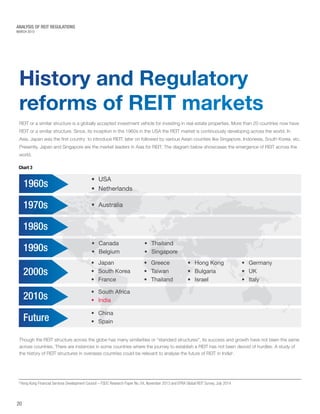
REIT or a similar structure is a globally accepted investment vehicle for investing in real estate properties. More than 20 countries now have
REIT or a similar structure. Since, its inception in the 1960s in the USA the REIT market is continuously developing across the world. In
Asia, Japan was the first country to introduce REIT, later on followed by various Asian counties like Singapore, Indonesia, South Korea, etc.
Presently, Japan and Singapore are the market leaders in Asia for REIT. The diagram below showcases the emergence of REIT across the
world.
Though the REIT structure across the globe has many similarities or “standard structures”, its success and growth have not been the same
across countries. There are instances in some countries where the journey to establish a REIT has not been devoid of hurdles. A study of
the history of REIT structures in overseas countries could be relevant to analyse the future of REIT in India6
.
1960s
1970s
1980s
1990s
2000s
2010s
Future
•	 USA
•	 Netherlands
•	 Canada	
•	 Belgium
•	 South Africa	
•	 India
•	 China	
•	 Spain
•	 Japan	
•	 South Korea
•	 France
•	 Thailand
•	 Singapore
•	 Greece
•	 Taiwan
•	 Thailand
•	 Hong Kong
•	 Bulgaria
•	 Israel
•	 Germany
•	 UK
•	 Italy
•	 Australia
20
6
Hong Kong Financial Services Development Council – FSDC Research Paper No. 04, November 2013 and EPRA Global REIT Survey, July 2014
Chart 3
Evolution of the Australian REIT (‘A-REIT’) Market
Australia is one of the leaders in establishing a REIT regime and
the first Australian REIT was established in 1971. Australian REITs
(erstwhile famous as the Listed Property Trust or ‘LPT’) are relatively
simpler tax effective corporate structures enabling pooled property
investment. Following the first Australian REIT, the market for listed
Australian REITs developed progressively until the 1980s. However,
the Australian REIT market received a boost from the lessons
learned from the failure of the commercial property market in the
early 1990s an essential lesson being the importance of holding
some liquid assets along with holding direct properties.
REITs offered a convenient mechanism effectively blending
investment in property along with a good liquidity position. This led
to a huge roar in the Australian REIT market during the late 1990s,
reinforced by both private players as well as institutions, around 60
REITs were listed on the ASX during this time. Further, increase in the
popularity of stapled securities and internationalisation of Australian
REITs further pushed the growth of the Australian REIT market.
Evolution of the U.S. REIT Market
The U.S. REIT market journey began in the 1960s. In the 1970s
and 1980s it was at a developing phase. It was in the 1990s, where
the sector had achieved a substantial growth due to increase in
acceptance of REIT among the investors as an alternative mode
of investment in real estate properties. The reason behind such
growth was majorly because of positive changes in the U.S. tax and
regulatory laws.
The U.S. REITs are classified on the basis of their investment form
such as equity REITs, investing directly in properties and mortgage
REITs, investing in housing loans and other real estate finance, which
can be managed either internally or externally.
The two important tax and regulatory breakthroughs for the U.S.
REITs have been the Tax Reform Act, 1986 (‘TRA’) and the REIT
Modernisation Act (‘RMA’) effective from 2001. The TRA pushed
for real estate investments to become more tax-transparent and
for integration of REITs with ancillary real estate business, like
property management, leasing or development, thereby facilitating
more effective management of REITs. While the RMA made
way for creation of taxable REIT subsidiaries (‘TRS’), which can
independently engage in such ancillary business activities.
During the 55 years of REIT history, the U.S. REIT market has gone
through a roller coaster ride of success, failure, development and
change which has transformed today’s REIT as an important vehicle
for investment into real estate properties across the world.
21
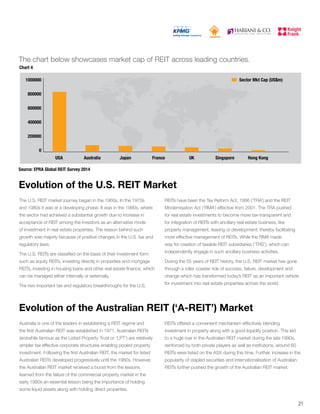
The chart below showcases market cap of REIT across leading countries.
USA Australia Japan France UK Singapore Hong Kong
200000
400000
600000
800000
1000000
0
Sector Mkt Cap (US$m)
Source: EPRA Global REIT Survey 2014
Chart 4
MARCH 2015
ANALYSIS OF REIT REGULATIONS
Evolution of the Japanese REIT (‘J-REIT’) Market
Evolution of the Hong Kong REIT (‘H-REIT’) Market
Japan is a leading REIT market in Asia. The first two J-REITs were
listed in 2001 and thereafter the J-REIT market grew rapidly with
around 41 J-REITs listed by early 2007.
The swiftness of this growth mechanism can be credited to efficient
tax and regulatory reforms. Reforms such as lowered tax rate on
H-REIT was introduced through the Hong Kong REIT Code in 2003.
However, since its emergence, the H-REIT market growth has
been sluggish. Its development story significantly lags behind the
other REIT markets in the Asia-Pacific region mainly due to relative
restrictiveness and want of some tangible incentives.
Recognising the need of the current REIT market, the Securities
and Futures Commission (SFC) has revised Hong Kong’s Code
on Real Estate Investment Trusts (REITs) on August 29, 2014,
taking immediate effect. Under the new regime, Hong Kong’s
REIT portfolios have been expanded to allow investment in retail
properties, commercial and hotel properties, as well as properties in
Mainland China. Further permission has now been granted for REITs
capital gains and dividends, allowing funds-of-funds to invest in
REITs further enhanced the growth and appeal of REITs. Other
factors such as large gap (“spread”) between dividend yields of
J-REITs and interest yields of 10 year government bonds, track
record of stable dividends among listed names greatly contributed in
promoting J-REITs as a lucrative investment alternative.
to invest in developing properties, as also engage in development
activities and to purchase financial instruments (including local and
foreign property funds), subject to the criteria of minimum investment
in rent-generating property. In addition, appropriate provisions have
been introduced to ensure transparency in a REIT’s activities.
Going by the fact that regulatory changes play an important role in
evolution of the REITs, it could be interesting to see how markets
react to the recent changes to the Hong Kong REIT regime.
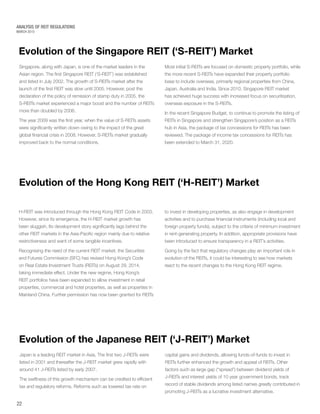
Evolution of the Singapore REIT (‘S-REIT’) Market
22
Singapore, along with Japan, is one of the market leaders in the
Asian region. The first Singapore REIT (‘S-REIT’) was established
and listed in July 2002. The growth of S-REITs market after the
launch of the first REIT was slow until 2005. However, post the
declaration of the policy of remission of stamp duty in 2005, the
S-REITs market experienced a major boost and the number of REITs
more than doubled by 2006.
The year 2009 was the first year, when the value of S-REITs assets
were significantly written down owing to the impact of the great
global financial crisis in 2008. However, S-REITs market gradually
improved back to the normal conditions.
Most initial S-REITs are focused on domestic property portfolio, while
the more recent S-REITs have expanded their property portfolio
base to include overseas, primarily regional properties from China,
Japan, Australia and India. Since 2010, Singapore REIT market
has achieved huge success with increased focus on securitisation,
overseas exposure in the S-REITs.
In the recent Singapore Budget, to continue to promote the listing of
REITs in Singapore and strengthen Singapore’s position as a REITs
hub in Asia, the package of tax concessions for REITs has been
reviewed. The package of income tax concessions for REITs has
been extended to March 31, 2020.
Conclusion: REIT markets evolve with market conditions
and regulatory changes
The REIT market over the years has showcased a similar growth
phase in various countries like the U.S., Australia and Singapore.
Initially, there was slow growth, which gradually moved to substantial
growth with changes in the REIT tax and regulatory regime to make
it commercially acceptable among the investors, this was followed
by sector consolidation. Internationalisation of REIT has deepened
the global real estate sector and boosted market liquidity.
Key takeaways from international REITs which currently do not form
part of the REIT regime in India are the concepts of stamp duty
remission, overseas property portfolio and clarity on tax issues.
Additionally, it is worth noting that, mere legalising REITs does not
guarantee that it will take off. REIT regulators have to ensure that
the REIT regime is continuously reviewed in accordance with the
changing requirement of the real estate market.
Evolution of the United Kingdom REIT
(‘U.K.-REIT’) Market
The U.K. REIT vehicle was launched with effect from 1 January 2007
by the Finance Act 2006. Within the first year of the regime itself,
the number of registered REITs grew significantly, but since then the
growth has been sluggish.
The U.K. REIT regime operates through a combination of legislation
(primary and secondary) plus guidance. The primary legislation
has been reworked as part of a project to simplify the U.K.’s tax
legislation which forms part of the Corporation Tax Act 2010. The
legislation now separates the property rental business from the
other business activities termed as the residual business for taxation
purposes.
Over the seven years from its launch, the U.K. REIT regime has
evolved with a number of changes that have resulted in a more
attractive REIT regime which are worthwhile to note. Key changes
brought about in the regime were, relaxation of listing requirement
to allow listing on secondary markets, abolition of flat 2 per cent tax
charged on value of properties of groups entering the REIT market,
allowing cash to be a good asset for the business test of 75:25 as
also modification of stamp duty on bulk purchases of residential
property, which were especially aimed at encouraging smaller real
estate players seeking to start-up REITs and boosting the residential
property markets.
The J-REIT market demonstrated a reverse trend since mid 2007.
Several steps such as raising funds from Japanese banks through
various mechanisms as well as tax reforms such as allowing
retention of negative goodwill brought about at the right time which
have facilitated the effective functioning of J-REITs market.
23
MARCH 2015
ANALYSIS OF REIT REGULATIONS
Making REITs
successful in India
Tax related
Tax efficiency can be critical to the success of REITs. While the
basic framework for one-level taxation has been laid down by the
Finance (No. 2) Act, 2014 and supplemented by the Finance Bill,
2015 certain challenges persist in structuring a REIT. It is critical
that the government considers further amendments to the Income
tax Act to provide a tax efficient and stable regime for REITs in
India. Some of the key challenges in the current taxation regime at
various levels of the REIT structure are elaborated below:
24
•	 Provisions are made to exempt the transfer of shares of the
SPV by the sponsor in exchange of REIT units and not direct
transfer of the property to the REIT. Holding property can be
beneficial as it saves on SPV level distribution taxes, however
the lack of exemption to sponsors is likely to deter direct
holding of properties by REITs.
•	 The exchange of shares of the SPV for units of REIT would
happen at the market value and could result in profit in the
hands of the Sponsor, which could entail tax liability in the
hands of the Sponsor under the provisions of Minimum
Alternate Tax (‘MAT’). Since exchange of shares for REIT units
is merely to set-up the REIT and is not per se a commercial
transaction, the Government may consider exempting the
same from MAT.
•	 In a case where the SPV is primarily funded by share capital,
normal corporate taxes would be applicable at the SPV
level and any distribution of profits by the SPV would entail
distribution taxes. Exemption from distribution taxes should be
provided to the SPV to the extent it distributes dividends to the
REIT.
25
MARCH 2015
ANALYSIS OF REIT REGULATIONS
•	 Requirement of holding the REIT units for more than 36
months to qualify as long-term capital asset may act as a
disincentive for investors to invest in the REIT vis-à-vis listed
equity shares where the period of holding to qualify as long-
term capital asset is more than 12 months. Parity is required to
make it lucrative for investors to invest in units of a REIT.
•	 The REIT should be made a complete pass-through vehicle as
against the current provisions which allows pass-through only
with respect to interest income from SPV and rental income
which is taxed in the hands of the investors directly while
capital gains and other income is taxed at a REIT level and
exempt in the hands of the investors.
Exchange control related
Allowing foreign investment in REITs can be critical to create the
necessary liquidity and depth in the market post listing of the REIT.
Further, many foreign private equity players are currently invested
in commercial stabilised assets and should be allowed to sponsor/
manage the REIT. Amendment to the foreign exchange control
regulations on the following lines would be critical in this respect:
-	Foreign portfolio investors and non-resident Indians should
be permitted to invest in units of a REIT without any cap or
restriction on the units that can be acquired.
26
-	Foreign sponsors should be allowed to acquire units of REITs
under automatic route. In such a case, swap of existing
shares of SPV held by a non-resident sponsor with the units
of a REIT should be permitted under automatic route.
-	It should be clarified that a REIT with majority foreign
ownership would not be subject to downstream
conditionalities related to FDI.
-	Managers of a REIT having FDI should be treated as a
non fund based activity and should not be subject to the
capitalisation norms applicable to fund based activities.
Source: Knight Frank Research
Property type Potential REIT-able space
(million sq ft)
Potential Value
(USD billion)
Office 425 52
Retail 64 16
Warehouse 919 28
Total 1,408 96
Concluding remarks
In the near future, we expect the REIT vehicle to increase the depth
of the Indian property market through enhanced transparency
and governance standards along with monitoring of the REIT’s
performance on a regular basis by the financial media. The REIT
Regulations fix the roles and responsibilities of stakeholders with
respect to the underlying property in terms of valuation, structural
audit, safety audit and insurance of the property at regular time
periods. Besides adequate and timely disclosure on important
developments relating to the REIT, it also prescribes the quantum
and timelines for income distribution. In case of violations on aspects
ranging from delay in allotment of units to distribution of income to
unit holders, it has listed the consequences as well.
Select eligible REIT property segments
Rates for stamp duties and registration
costs in some key cities are provided
below:
Cities Stamp duties Registration charges
Mumbai, Pune
(Maharashtra)
5% 1%
Delhi 4-6% 1%
Gurgaon 6-8% INR 100- 15000
Chennai 7% 1%
Hyderabad 5% 0.50%
Bengaluru 5% 1%
Kolkata 6-6% 1.10%
Source: Government websites
27
Stamp duty related
Given that there are no corporate tax related concessions at the
SPV level, it would seem attractive for REITs to hold the properties
directly. However, this may not be feasible for REITs in India given
the high state stamp duties and registration costs applicable in
various states on acquisition of properties.
The transfer of assets at the initial stage of setting-up a REIT could
be regarded as a transfer, which may attract stamp duty thereon,
which, ranges from approximately 5 per cent to 10 per cent
depending upon the state in which the property is located.
In this regard, the government ought to consider making the stamp
duty uniform across the states or consider waiving the stamp duty
where a REIT holds property over a specified period of years, in line
with Singapore REITs or alternatively, the state governments could
consider a one-time waiver of stamp duty on transfer of assets to
REITs or SPVs owned by REITs.
Other regulations
Further, changes in some other regulations can help to enhance
the REIT regime in India. Some of the potential changes are stated
below:
•	 Inclusion of units of REITs set-up as a trust in the definition of
‘security’ as per the Securities Contract (Regulation) Act, 1956
•	 Changes in the SEBI Foreign Portfolio Investors (FPI) regulations
and Foreign Exchange Management Act (FEMA) to allow foreign
investment in units of REITs at the time of an IPO or listing on
the stock exchange
•	 Insurance Regulatory and Development Authority’s (IRDA)
investment regulations to be tweaked to allow insurance
companies to invest in REITs, thereby enabling REITs to have a
wider investor base. Similarly, changes should be brought about
in the provident fund regime, by notifying REITs as an eligible
investment in the prescribed pattern of investment.
Table 4
Table 5
MARCH 2015
ANALYSIS OF REIT REGULATIONS
3%
19%
23%
23%
23%
Mumbai Pune
Chennai
Hyderabad
Kolkata
NCR
Bengaluru
10% 3%
11%
11%
Distribution of occupied office space
Total 425 Mn. Sqft.
19%
23%
10%
11%
11%
28
Chart 4
The REIT-able arena may cover completed and rent-generating
real estate assets. It is estimated approximately USD 96billion or
1.41 billion sqft occupied CRE across office, retail and warehouse
segments that could potentially benefit from the REIT opportunity.
In the case of office and retail, the top seven cities, namely Mumbai,
NCR, Bengaluru, Chennai, Hyderabad, Kolkata and Pune, have
been considered. The all-India estimate for warehouse market sizing
has been considered from our recently-launched India Logistics
and Warehousing Report 2014. The ambit of the REIT-able universe
extends to almost all rent-generating real estate. As a result, rented
residential property can also be considered for the purpose of
REITs. However, on account of the absence of an institutional rental
market in the residential segment, it has not been considered in our
REIT-able space estimates.
Learning from lessons of other countries, it is evident that the
success of REITs in any country depends on that country’s
capability to customise the rules and regulations governing REITs
in such a way that they fit into their own markets. The support of
governing authorities to help ensure a less restrictive REIT regime
and favourable tax transparency status can be a critical factor
in the development of a vibrant REIT sector in a new market.
While there is huge potential, how much and how soon this is
harnessed will depend on the overall economic momentum and the
acceptance of REIT as an investment vehicle.
29
This report has been prepared by Knight Frank India Pvt. Ltd. (“Knight Frank”), KPMG (Registered) (“KPMG”) and Hariani  Co.(“Hariani”) to provide inputs from tax and regulatory
perspective. Inputs of the parties are based on information from various sources. This report is published to provide a detailed, informative report along with strategic evaluation and insight
to the law and market implications in the real estate sector on the research topic covered herein. This report is a combination of a critical analysis of law and analyzing existing trends and
predicting future trends in the real estate sector from the data collected through market surveys and interactions with real estate agents, developers, funds and other stakeholders. It is
published for general information only and is subject to changes in market conditions, legal and regulatory framework and other environmental dynamics. Although, high standards have
been used in the preparation of the information, analysis, views and projections presented in this report, Knight Frank, KPMG and Hariani disclaim any and all responsibility for any errors
or omission/s in this report. Knight Frank, KPMG and Hariani accept no liability, legal or otherwise for consequences of any person acting or refraining from acting on the basis of any
information contained herein. Knight Frank, KPMG and Hariani further disclaim all responsibility for any loss or damage, if any, resultant from the contents of this report. This report is not
intended to be an advertisement or solicitation on behalf of Hariani and is not a substitute to professional legal advice. Transmission, receipt or use of this report does not constitute or
create a lawyer-client relationship. Reproduction of this report in whole or in part is allowed with proper reference to Knight Frank, Hariani and KPMG.
KPMG International’s Trademarks are the sole property of KPMG International and their use here does not imply auditing by or endorsement of KPMG International or any of its member firms.
HARIANI  CO.
Ameet Hariani
Managing Partner
knowledge@hariani.co.in
+91 22 2278 0600
Aziza Khatri
Partner
knowledge@hariani.co.in
+91 22 2278 0600
Trupti Daphtary
Head, Knowledge Management
knowledge@hariani.co.in
+91 22 2278 0600
NAREDCO
Sunil Mantri
President, NAREDCO
sunil@mantrirealty.com
+91 22 6156 0500
REPORT AUTHORS
KPMG
Punit Shah
Partner, Co-Head Tax
KPMG in India
punitshah@kpmg.com
+91 22 3090 2681
Neeraj Bansal
Partner and Head, Real
Estate and Construction
KPMG in India
nbansal@kpmg.com
+91 124 307 5035
Samip Barlota
Director, Tax
KPMG in India
samip@kpmg.com
+91 22 3090 1573
KNIGHT FRANK INDIA
Rajeev Bairathi
Executive Director  Head,
Capital Markets
rajeev.bairathi@in.knightfrank.com
+91 124 4075030
Ankit Aggarwal
Associate Director, Capital Markets
ankit.aggarwal@in.knightfrank.com
+91 124 4075030
Vivek Rathi
Assistant Vice President, Research
vivek.rathi@in.knightfrank.com
+91 22 6745 0102
Hitendra Gupta
Consultant, Research
hitendra.gupta@in.knightfrank.com
+91 22 6745 0102

REIT Regulations - KF-Mar15

  • 1.
  • 2.
    MARCH 2015 ANALYSIS OFREIT REGULATIONS Contents India REIT Regulations - A Holistic Perspective Importance of a Real Estate Investment Trust (REIT) in the Indian Context India REIT Regulations 01 04 08 India REIT Regulations- A Holistic Perspective
  • 3.
    The Real EstateInvestment Trust (REIT) - an investment vehicle that invests in rent-yielding completed real estate properties has the potential to transform the Indian real estate sector. Currently, developers incur huge capital expenditure especially in Commercial Real Estate (CRE), on land, construction, interior fit-outs, etc. which remain locked for years until the asset generates returns to break-even. REIT will help attracting long-term financing from domestic as well as foreign sources. This could improve fund availability to real estate developers and reduce some burden on completed assets by allowing owners of such assets to raise capital from investors against issue of units. Further, for the investors, the REIT can provide a new investment vehicle with ongoing returns, elevated transparency and governance standards. Tax Implications Structure of REITs in India History and Regulatory Reforms of REIT Markets Making REITs Successful in India 12 16 20 24
  • 4.
    MARCH 2015 ANALYSIS OFREIT REGULATIONS Importance of a Real Estate Investment Trust (REIT) in the Indian context A REIT could provide an attractive alternative investment instrument in the Indian financial markets. Introduction of REIT can be a boon for developers and more so to the real estate investors as it helps in negating the shortcomings of investing in physical real estate. This new investment vehicle offers an exit opportunity to developers thereby enabling them to monetise their real estate. While on the other hand, mandatory listing of the REITs on recognised stock exchanges will offer an easy entry and exit mechanism for investors. With respect to providing liquidity to the investors, REIT may be at par with equity shares trading on the exchange. A REIT could have a large opportunity in the Indian real estate market with a growing economy, existing portfolio of commercial real estate and conducive investment climate. Alternative investment opportunity: 4
  • 5.
    Being a newinvestment instrument for an Indian investor it is imperative to study the performance of REITs, globally. Over the past decade, returns on equity of traded REITs has comparatively over performed the returns on leading stock markets indexes, across the world. REITs across the globe have provided five year returns in the range of 12 to 24 per cent. With Japanese and Malaysian markets providing returns in the range of 7 to 12 per cent,1 expectations from Asian economies are on the rise. Following are some key highlights of the performance of REITs in key markets as per S&P Dow Jones at five year and ten year milestones. 5 1 Refer Table 1
  • 6.
    MARCH 2015 ANALYSIS OFREIT REGULATIONS It is expected that a REIT in India would give returns similar to that of other countries represented on the table. It is expected that a diversified REIT only focusing on rental income can generate returns in the range of 9 to 11 per cent with an additional return of 2 to 3 per cent on capital appreciation, annually. Professionalism and transparency in real estate investments: A REIT could help in bringing the much required professionalism and transparency in the real estate sector in India. It shall be governed by the SEBI guidelines, which would help ensure transparency and accountability of REITs. A REIT would have to appoint an independent trustee, managers, auditor and valuer to help ensure that the functioning of a REIT is transparent. Moreover, experiences in different facets of the real estate business are a prerequisite for the appointment of a manager in a REIT, thereby helping in ensuring professionalism in real estate investments. Opportunity for liquidation of assets: A REIT could provide developers and large investors of commercial real estate to tap into the REIT market for investment in the real estate assets. It could provide a long awaited exit opportunity to developers and Private Equity (PE) investors, with an option to retain a large share and diversify a smaller portion to unlock the potential of the assets. The liquidity generated could help developers with much needed capital to invest in future projects or complete existing projects. Moreover, a REIT as an investment vehicle has a huge opportunity in India. As on October 2014, India has a rent yielding office inventory to the tune of 425million sq ft valued in excess of USD 52billion.2 Apart from this, there are other properties like warehousing, retail malls, shopping centers, school buildings, etc. which could be considered for REIT. Source: Dow Jones Real Estate Indices – S&P Global Property Indices Quantitative Analysis Report for Q3 2014 Country REIT Performance as per S&P Dow Jones 5 year 10 year Americas U.S. 15.93% 8.35% Europe France 8.95% 13.62% United Kingdom 12.20% N.A. Pacific Australia 8.62% 3.56% Asia Japan 11.75% 6.32% Singapore 14.35% 14.06% Hong kong 23.80% 14.32% Malaysia 6.82% N.A. 6 Following are some key highlights of the performance of REITs in key markets as per S&P Dow Jones at five year and ten year milestones. 2 Refer Table 5 of this Report Table 1
  • 7.
    Conducive investment environment Growingeconomy The thriving economy could be a key driver for growth of the REIT regime in the Indian market. The business confidence index has strengthened and the economy is looking forward to another phase of decent growth, with political stability and a government focusing on growth. Housing and urban infrastructure requirement To support the increasing population, huge investments are required to meet India’s housing needs, and additional investments would be required for commercial and urban infrastructure to support the housing growth. India needs to develop almost 45 to 50 million housing units by 2028.4 Disposable income and retirement savings Increase in income of working age population, would result an increase in disposable income. This disposable income gives individuals flexibility to invest in long-term investment options for future savings. Worldwide, an affordable office space India is one of the countries globally offering affordable prime spaces, with high growth potential. The availability of such assets is expected to find takers for REITs in India. Increasing working age population UN World Population prospects, projects Indian median population from 26.4 in 2013 to 36.7 in 20503 , this signifies a large pool of young population in India. This employable young workforce demands employment and could attract global corporates especially in IT-ITES and promote the development of commercial real estate. 01 04 05 02 03 7 3 http://esa.un.org/wpp/documentation/pdf/WPP2012_%20KEY%20FINDINGS.pdf 4 KPMG in India Analysis; KPMG Report ‘Indian Real Estate - Opening Doors, 2014’
  • 8.
    MARCH 2015 ANALYSIS OFREIT REGULATIONS 8 Initially proposed in December 2008 by the Securities and Exchange Board of India (SEBI), the SEBI (Real Estate Investment Trusts) Regulations, 2014 (‘REIT Regulations’) have been notified. Several developers, financial institutions and private equity players that have been preparing their real estate portfolio for the new investment environment will be ready to offer their investment propositions to investors, beginning 2015. India REIT regulations MARCH 2015 ANALYSIS OF REIT REGULATIONS
  • 9.
    Guidelines applicable toREITs: Category Aspect Guidelines Initial offer of units to third parties • Only through public issue • Allowed under REIT Regulations. However, subject to permission in keeping with the Department of Industrial Policy and Promotion (DIPP) guidelines, which actually prohibit FDI in real estate business .It is also subject to the RBI guidelines and the government, as specified from time to time • FDI is permitted in construction-development: townships, housing etc. with an exit option to investors on completion of projects or after development of trunk infrastructure.5 • Currently, the guidelines for foreign investment in REITs are awaited. Listing • Mandatory Manager • Can be a body corporate, company or LLP incorporated in India • An entity separate from the Sponsor • Minimum five years’ experience in fund management or advisory services or property management in real estate industry or in development of real estate (at the manager or associate level) • Minimum two key personnel having minimum five years’ experience in fund management or advisory services or property management in real estate industry or in development of real estate • Minimum 50% of the directors/members of the governing board have to be independent Minimum Net worth of the REIT manager • For a body corporate or a company: `100 million; • LLP: Net tangible assets of value `100 million Offer size (assets under REIT) • REIT assets of ` 5 billion at the time of public offering Minimum offer size:` 2.5 billion; Minimum float: 25% Sponsor • Sponsor may be any person(s) who set(s) up a REIT • Multiple (maximum: 3) • Minimum experience requirement: 5 years in development of real estate or fund management in the real estate industry (at the sponsor or associate level) • Wherein the sponsor is a developer, at least two projects of the sponsor should have been completed Net worth of the REIT sponsor • `200 million (minimum) on an individual basis and ` 1,000 million (minimum) on a collective basis Sponsor investment • Sponsors can collectively hold a minimum of 25% for the initial three years, followed by 15% thereafter. They are individually to hold a minimum of 5% at all times. • A sponsor can re-designate another sponsor as long as the re-designated sponsor satisfies the qualifying requirements and holds the minimum percentage of units. Ticket size for investors in REIT • `2,00,000 for public (initial as well as follow-on) offer and `1,00,000 post listing. • Minimum 200 public unit holders at all times Trustee • Registered with the SEBI as a Debenture Trustee • Independent from the Sponsor/ Manager Investment by foreigners Fund-raising conditions 9 Table 2
  • 10.
    MARCH 2015 ANALYSIS OFREIT REGULATIONS Guidelines applicable to REITs: Category Aspect Guidelines Acquisition and disposal of assets • For related party transactions, purchase or sale should be in accordance with two independent valuations and must be at a price not greater than (in case of purchase)/not lesser than (in case of sale), the average of the two independent valuations. • For non-related party transactions, purchase or sale, should be in accordance with the valuation undertaken by the valuer of the REIT and shall be subject to prior approval of the unit holders, only if the purchase is at a value greater than 110% or if the sale is at a value lesser than 90% of the value of the property as assessed by the valuer. Asset class • Rent-yielding assets (office, retail, hospitality, warehouses, conference centres, etc.). Asset disposition • Post the holding period of 3 years, asset churning is allowed, subject to prior permission of the unit holder, wherein the value of the transaction exceeds 10% of the value of the REIT assets in a financial year . Asset location • India Asset restrictions • At least 80% in completed and rent-generating real estate • Completed and rent-generating properties from the date of purchase by REIT or SPV and under- construction properties from the date of completion are to be held by the REIT for a minimum of three years. • A maximum of 20% of the total REIT assets may be invested in the following: - Debt of companies/body corporates in the real estate sector, - Mortgage Backed Securities (MBS), government securities, - Money market instruments/cash equivalents - Listed equity of companies having 75% or more operating revenue from real estate activity - Unutilised Floor Space Index (FSI) and Transferable Development Rights (TDR) for utilisation in investee projects - Under-construction properties/completed but not rent-generating properties, subject to a cap of 10% of the value of the REIT assets • Investment in other REITs is not allowed. . Income distribution • 90% of the net distributable cash flow is to be distributed among the unit holders not less than once every six months. Income restrictions • A minimum of 75% of the revenue of the REIT and the SPV, except gains arising from the disposal of properties, should come from rental, leasing and letting or any other income incidental to the leasing of assets. Investment conditions 10 ANALYSIS OF REIT REGULATIONS
  • 11.
    Category Aspect Guidelines Investment structuring •Direct investments by the REIT or through a SPV in India that owns a minimum of 80% of its assets directly in properties (only one level SPV is permitted). The REIT should have a minimum of 50% in the SPV. Limited Liability Partnership (LLP) as a Special Purpose Vehicle (SPV) is allowed • Sponsor must transfer/undertake to transfer entire shareholding or interest in the SPV unless required otherwise by law. • Co-investor in the SPV cannot be on more favourable terms than the REIT. • 90% of the net distributable cash flow is to be distributed by the SPV to the REIT not less than once every six months. Land • Investments in agricultural land or mortgage are not allowed. • Vacant land is allowed where it forms a contiguous extension of an existing project being implemented in stages Leverage • A maximum of 49% of the value of REIT assets. Mandatory credit rating and investor approval above 25% No. of projects • A minimum of two projects, directly or through the SPV, with not more than 60% of the value of assets in one project Related party transactions • Allowed on an arm’s-length basis Disclosure of valuation reports Half yearly and annual Net Asset Value (NAV) declaration • Twice a year • To be in line with international valuation standards and valuation standards as specified by ICAI for valuation of real estate assets • ICAI standards to prevail in case of conflictValuation criteriaValuation of assets 11 5 FDI is allowed in certain completed assets like Industrial Parks, Special Economic Zones, operation and management of townships, malls/shopping complexes and business centres etc. (CONSOLIDATED FDI POLICY read with Press Note No. 10 of the 2014 series)
  • 12.
    MARCH 2015 ANALYSIS OFREIT REGULATIONS The REIT regulations have sought to create an ecosystem by detailing the role and responsibilities of each stakeholder and laying down the conditions for operating and managing a REIT in India. The guidelines pertaining to fund raising and investments outline the fundamentals of REITs in the country, and have been listed in Table 2. Channelising a portion of public savings into real estate was one of the objectives of these guidelines. In the absence of the REIT Regulations, the nearest alternative to property investment was private equity funds that operate within the SEBI (Alternative Investment Fund) Regulations, 2012 (SAFR). However, besides characteristic differences, the ticket size of the investments under the SAFR was high, at `10 million. This caused small investors who showed interest in investing in property to invest in physical assets directly, which are fraught with their own share of complexities. In contrast, the REIT investment vehicle will allow investments as low as `0.2 million in the case of public offers, and `0.1million in subsequent trading on recognised stock exchanges. This provides liquidity, easy entry-exit for unit holders comparable to shares and allows developers to monetise their real estate assets with an option to retain a large share and diversify a smaller portion to unlock the potential of the assets. 12 Structure of REITs in India
  • 13.
    The REIT Regulationsalso allow foreigners to buy units of a REIT, thereby channelising overseas investments of sovereign wealth funds, retirement funds and High Net-worth Individuals, among others. This can infuse equity in the cash-strapped real estate assets and help attract long-term financing from domestic/foreign sources, thereby reducing the burden on the banking sector. Currently, the FDI regulations by DIPP allow investments in under- construction real estate and completed projects for operation and management of townships, malls/ shopping complexes and business centers. However, the guidelines for direct foreign investment in REITs are awaited. 13 In the draft REIT Regulations, 2013 for the initial offer, a REIT was required to have assets of ` 10 billion. This condition has been halved since the draft guidelines were introduced in October 2013, thereby making it easier for several smaller players to enter the REIT market. In addition, the regulations also allow multiple sponsors (a maximum of three) for a REIT. The draft guidelines allowed only a single sponsor to promote a REIT. Hence, coupled with a lower asset size to begin with, the provision for multiple sponsors can be encouraging for several small and regional players.
  • 14.
    MARCH 2015 ANALYSIS OFREIT REGULATIONS As indicated in chart 1 , with respect to investments by the REIT, at least 80 per cent should be in completed and revenue-generating real estate. This is lower than the requirement of 90 per cent as specified in the draft guidelines. Further, a maximum of 20 per cent instead of 10 per cent, is allowed in debt, MBS, government securities, money market instruments/cash equivalents and the equity of companies having 75 per cent or more from real estate activity (including a maximum investment of 10 per cent in under-construction real estate). Increasing the limit from the 10 per cent overall limit for such instruments/investments specified in the draft guidelines, the relaxation allows higher liquidity for the REIT manager while restricting the risk of under-construction projects to 10 per cent. It also allows investment in FSI and TDR for utilisation in investee projects but not for trading/ liquidity purpose. The move is practical, considering cities like Mumbai, where TDR and FSI involvement in development is the norm. Under the draft guidelines, the entire REIT assets could be in a single project worth a minimum of `10 billion. Addressing the risk associated with such an investment, the REIT Regulations have necessitated investment in a minimum of two projects, wherein not more than 60 per cent of the value can be invested in one asset. Further, under the draft guidelines, not more than 20 per cent of REIT assets would be rented to related parties. The said threshold has now been removed subject to valuation requirements and obtaining of required approvals from unit holders. This could open up doors for large listed companies like banks, stock exchanges, Max. 20%* Upto 20%* Max. 10% Min.80% Other Investments MBS, Listed Equity shares of RE companies Unutilised FSI, TDR, govt. securities, Debt of RE companies (other than that of SPV) At least 2 Completed and Rent Generating Projects ** • Under-construction properties • Completed, but not rent generating • Contiguous land in case of stage-wise project implementation Direct Investment in Assets Investment through SPV (By acquiring controlling interest and not less than 50% shareholding) Tenants/ Lessee/ Licensee *Including under-construction/ developmental properties **Not more than 60% of assets to be in one Project Source: SEBI, Knight Frank Research, Hariani Co MARCH 2014 ANALYSIS OF REIT REGULATIONS 14 15 REIT etc. who hold substantial office properties to monetise their properties by carrying out a sale and leaseback with a REIT. Chart 1
  • 15.
    MARCH 2015 ANALYSIS OFREIT REGULATIONS Tax implications The Finance (No. 2) Act, 2014 and the recent Finance Bill, 2015 (not enacted yet) clearly spell out the tax treatment of possible income streams for all stakeholders in the REIT, as per the Chart below. * REIT Units sold on STOCK Exchange 1. STCG less than or equal to 36 months 2. LTCG more than 36 months ** The above tax implications are subject to the effective date of the relevant income tax provisions 16 Invests money Allotted REIT units Interest income and Rental income received from REIT owned property is subject to WHT. Shares in SPV in exchange of units of REIT (Not regarded as a transfer - No CGT) Interest income exempt in the hands of REIT Gains on Sale of REIT Units (LTCG Exempt / STCG @15%)* Dividend paid by SPV subject to DDT and exempt in the hands of REIT REIT Investor / Unit Holder SPV (Holding Property) Gain from Sale of REIT units by Sponsor on stock exchange LTCG exempt STCG @ 15% STT @applicable rate SponsorGains on Transfer of Capital Assets subject to CGT Other income Subject to maximum marginal rate of 30% Chart 2**
  • 16.
    Accordingly, the taximplications which will arise on account of capital gains, rental income, dividend income and interest income are listed below: Capital gains Rental income a. Sponsors’ tax liability on the transfer of shares in SPV No capital gains tax arises on the initial transfer of shares of the SPV to a REIT in exchange of units of the REIT by the sponsor. Further, it has been proposed in the Finance Bill, 2015, that at the time of disposal of the above REIT units (under an IPO listing or sale on stock exchange thereafter), the sponsor of REITs would be eligible for concessional capital gains tax regime on par with other investors. Accordingly, long term capital gains (LTCG) on transfer of units would be exempt and short term capital gains (STCG) would be taxable at the rate of 15 per cent provided applicable Securities Transaction Tax (‘STT’) is paid on the sale of such units.. This is similar to an IPO of a company where LTCG arising to the promoter on sale of shares through an offer for sale or on the stock exchange post listing is exempt from tax. Given that both are similar in terms of public listing, parity may make it lucrative for sponsors to opt for a REIT. In doing so, the Revenue authorities have tried to address the sponsors’ apprehension regarding high costs of setting-up a REIT. The Income-tax Act, 1961 (‘the Act’) states that acquisition cost of the shares of the SPV as well as the date on which the shares were originally purchased should be considered while computing the capital gains tax on sale of REIT units held by a sponsor. b. Business trust’s tax liability on the disposal of assets Any gains/income arising out of disposal of assets by the REIT (typically real estate assets or shares in SPV) would attract capital gains tax, depending on whether the gains are short-term or long-term in nature. c. Unit holders’ tax liability on the sale of REIT units on the stock exchange If the unit holders sell the units of the REIT on the stock exchange after holding it for more than 36 months, the capital gain arising on sale of such units of REIT will be exempt from tax. However, transfers within the 36 month period will attract short-term capital gains tax at a concessional tax rate of 15 per cent. Such sale of units on the stock exchange shall be subject to STT on transaction value. a Rental income received by the REIT The Finance Bill, 2015 has proposed that the rental income arising to REIT from the real estate assets directly held by the REIT would be eligible for pass through status. Accordingly, such income will be exempt in the hands of REIT. Further, the tenant or lessee is not required to withhold tax on payment of rent to the REIT. b. REIT distributing rental income to unit holders Distribution of rental income by REIT to the REIT unit holders is chargeable to tax in the hands of the REIT unit holders on distribution. The REIT is required to withhold tax at 10 per cent on distribution of such income to the resident unit holders and at the applicable rates on distribution to the non- resident (not being a company) or foreign company unit holders. 17
  • 17.
    MARCH 2015 ANALYSIS OFREIT REGULATIONS Dividend income Interest Other income distributed by REIT to unit-holders A lower withholding tax rate of 5 per cent on interest income in case of ECBs availed by a REIT. a. Distribution of dividend by SPV If the SPV is a company, it has to adhere to the regulations of the Companies Act. According to the Act, any company paying dividend would attract Dividend Distribution Tax (DDT) at 17.65 per cent excluding surcharge and education cess. Hence, the dividend paid by the SPV to the REIT would attract DDT. a. REIT receiving interest If the SPV is funded through interest- bearing debt by the REIT, any interest paid by the SPV to the REIT would not be taxable. Additionally, the SPV’s tax liability will decrease, as interest is a tax deductible Distributed income received by the unit holder from the REIT, except the proportionate interest and rental income (as discussed above) will be exempt under the provisions of the Income Tax Act, 1961. The beneficial provision of lower rate of withholding tax is now available also to REIT, subject to the conditions as mentioned in the Act. b. REIT receiving dividend from SPV The dividend received by the REIT from the SPV would be subject to DDT at the level of SPV and therefore it will be exempt in the hands of a REIT. c. REIT distributing dividend received from SPV to unit holders By the logic of REIT receiving dividends, the REIT unit holders receiving dividends are b. REIT distributing interest received from SPV to unit holders The interest income earned by the REIT from the SPV would not be taxable in itself (as mentioned above), but would be taxable in the hands of the unit holders. The unit holder(s) will be subject to also exempted. This is because REITs are intended to be pass through entities. withholding tax on the interest component of the distributed income at 5 per cent for a non-resident and 10 per cent for resident unit holders. It is worthwhile to note that for the non-residents, 5 percent is the final tax incidence on such interest income. 18
  • 18.
    Bird’s eye viewof taxability at various levels in a REIT structure is tabulated below: 19 Table 3 Nature of Income Level Interest paid by SPV Rental Income on prop- erty held by REIT directly Dividend on shares of SPV Capital gains on sale of shares of SPV/sale of prop- erties held by REIT directly Other income Capital gains on market transfer of units of REIT by unitholders / Spon- sors* Unit holder REIT distributing the interest from SPV sub- ject to WHT at 5 % - NRs (No further tax in the hands of unit holder) Taxable in the hands of unit holder Further, REIT to withhold tax @ 10% if distributed to resident unit holder and at the applicable rate in force if distributed to non-resident unit hold- er (not being a company) or a foreign company Exempt Exempt Exempt STCG -15% (held for 36 months or less) WHT at 10% - R (Taxed at applicable rates in the hands of unit holder) LTCG – Exempt (held for more than 36 months REIT Exempt Exempt Exempt Tax rate applicable depending on period of holding, etc. Tax at 30% NA SPV (in the form of a company) Tax break available on interest (subject to conditions), no WHT applicable on interest payment NA DDT at 17.65% NA NA NA Above rates are excluding surcharge and education cess * Sale on the stock exchange shall be subject to securities transaction tax Other taxation provisions relevant to a REIT structure: Taxation on capital gains arising to a sponsor on exchange of shares in SPVs with units of the REITs, arises only at the point of ultimate transfer of REIT units and the exchange of shares with REIT units is not considered as a transfer. Holding period and cost of shares of SPV in the hands of a sponsor available on ultimate transfer of REIT units. The capital gain tax rate will be applicable depending on short-term/long-term in nature. Interest paid to non-resident lenders in case of monies borrowed by REITs in foreign currency, taxable at 5% subject to specified conditions
  • 19.
    MARCH 2015 ANALYSIS OFREIT REGULATIONS History and Regulatory reforms of REIT markets REIT or a similar structure is a globally accepted investment vehicle for investing in real estate properties. More than 20 countries now have REIT or a similar structure. Since, its inception in the 1960s in the USA the REIT market is continuously developing across the world. In Asia, Japan was the first country to introduce REIT, later on followed by various Asian counties like Singapore, Indonesia, South Korea, etc. Presently, Japan and Singapore are the market leaders in Asia for REIT. The diagram below showcases the emergence of REIT across the world. Though the REIT structure across the globe has many similarities or “standard structures”, its success and growth have not been the same across countries. There are instances in some countries where the journey to establish a REIT has not been devoid of hurdles. A study of the history of REIT structures in overseas countries could be relevant to analyse the future of REIT in India6 . 1960s 1970s 1980s 1990s 2000s 2010s Future • USA • Netherlands • Canada • Belgium • South Africa • India • China • Spain • Japan • South Korea • France • Thailand • Singapore • Greece • Taiwan • Thailand • Hong Kong • Bulgaria • Israel • Germany • UK • Italy • Australia 20 6 Hong Kong Financial Services Development Council – FSDC Research Paper No. 04, November 2013 and EPRA Global REIT Survey, July 2014 Chart 3
  • 20.
    Evolution of theAustralian REIT (‘A-REIT’) Market Australia is one of the leaders in establishing a REIT regime and the first Australian REIT was established in 1971. Australian REITs (erstwhile famous as the Listed Property Trust or ‘LPT’) are relatively simpler tax effective corporate structures enabling pooled property investment. Following the first Australian REIT, the market for listed Australian REITs developed progressively until the 1980s. However, the Australian REIT market received a boost from the lessons learned from the failure of the commercial property market in the early 1990s an essential lesson being the importance of holding some liquid assets along with holding direct properties. REITs offered a convenient mechanism effectively blending investment in property along with a good liquidity position. This led to a huge roar in the Australian REIT market during the late 1990s, reinforced by both private players as well as institutions, around 60 REITs were listed on the ASX during this time. Further, increase in the popularity of stapled securities and internationalisation of Australian REITs further pushed the growth of the Australian REIT market. Evolution of the U.S. REIT Market The U.S. REIT market journey began in the 1960s. In the 1970s and 1980s it was at a developing phase. It was in the 1990s, where the sector had achieved a substantial growth due to increase in acceptance of REIT among the investors as an alternative mode of investment in real estate properties. The reason behind such growth was majorly because of positive changes in the U.S. tax and regulatory laws. The U.S. REITs are classified on the basis of their investment form such as equity REITs, investing directly in properties and mortgage REITs, investing in housing loans and other real estate finance, which can be managed either internally or externally. The two important tax and regulatory breakthroughs for the U.S. REITs have been the Tax Reform Act, 1986 (‘TRA’) and the REIT Modernisation Act (‘RMA’) effective from 2001. The TRA pushed for real estate investments to become more tax-transparent and for integration of REITs with ancillary real estate business, like property management, leasing or development, thereby facilitating more effective management of REITs. While the RMA made way for creation of taxable REIT subsidiaries (‘TRS’), which can independently engage in such ancillary business activities. During the 55 years of REIT history, the U.S. REIT market has gone through a roller coaster ride of success, failure, development and change which has transformed today’s REIT as an important vehicle for investment into real estate properties across the world. 21 The chart below showcases market cap of REIT across leading countries. USA Australia Japan France UK Singapore Hong Kong 200000 400000 600000 800000 1000000 0 Sector Mkt Cap (US$m) Source: EPRA Global REIT Survey 2014 Chart 4
  • 21.
    MARCH 2015 ANALYSIS OFREIT REGULATIONS Evolution of the Japanese REIT (‘J-REIT’) Market Evolution of the Hong Kong REIT (‘H-REIT’) Market Japan is a leading REIT market in Asia. The first two J-REITs were listed in 2001 and thereafter the J-REIT market grew rapidly with around 41 J-REITs listed by early 2007. The swiftness of this growth mechanism can be credited to efficient tax and regulatory reforms. Reforms such as lowered tax rate on H-REIT was introduced through the Hong Kong REIT Code in 2003. However, since its emergence, the H-REIT market growth has been sluggish. Its development story significantly lags behind the other REIT markets in the Asia-Pacific region mainly due to relative restrictiveness and want of some tangible incentives. Recognising the need of the current REIT market, the Securities and Futures Commission (SFC) has revised Hong Kong’s Code on Real Estate Investment Trusts (REITs) on August 29, 2014, taking immediate effect. Under the new regime, Hong Kong’s REIT portfolios have been expanded to allow investment in retail properties, commercial and hotel properties, as well as properties in Mainland China. Further permission has now been granted for REITs capital gains and dividends, allowing funds-of-funds to invest in REITs further enhanced the growth and appeal of REITs. Other factors such as large gap (“spread”) between dividend yields of J-REITs and interest yields of 10 year government bonds, track record of stable dividends among listed names greatly contributed in promoting J-REITs as a lucrative investment alternative. to invest in developing properties, as also engage in development activities and to purchase financial instruments (including local and foreign property funds), subject to the criteria of minimum investment in rent-generating property. In addition, appropriate provisions have been introduced to ensure transparency in a REIT’s activities. Going by the fact that regulatory changes play an important role in evolution of the REITs, it could be interesting to see how markets react to the recent changes to the Hong Kong REIT regime. Evolution of the Singapore REIT (‘S-REIT’) Market 22 Singapore, along with Japan, is one of the market leaders in the Asian region. The first Singapore REIT (‘S-REIT’) was established and listed in July 2002. The growth of S-REITs market after the launch of the first REIT was slow until 2005. However, post the declaration of the policy of remission of stamp duty in 2005, the S-REITs market experienced a major boost and the number of REITs more than doubled by 2006. The year 2009 was the first year, when the value of S-REITs assets were significantly written down owing to the impact of the great global financial crisis in 2008. However, S-REITs market gradually improved back to the normal conditions. Most initial S-REITs are focused on domestic property portfolio, while the more recent S-REITs have expanded their property portfolio base to include overseas, primarily regional properties from China, Japan, Australia and India. Since 2010, Singapore REIT market has achieved huge success with increased focus on securitisation, overseas exposure in the S-REITs. In the recent Singapore Budget, to continue to promote the listing of REITs in Singapore and strengthen Singapore’s position as a REITs hub in Asia, the package of tax concessions for REITs has been reviewed. The package of income tax concessions for REITs has been extended to March 31, 2020.
  • 22.
    Conclusion: REIT marketsevolve with market conditions and regulatory changes The REIT market over the years has showcased a similar growth phase in various countries like the U.S., Australia and Singapore. Initially, there was slow growth, which gradually moved to substantial growth with changes in the REIT tax and regulatory regime to make it commercially acceptable among the investors, this was followed by sector consolidation. Internationalisation of REIT has deepened the global real estate sector and boosted market liquidity. Key takeaways from international REITs which currently do not form part of the REIT regime in India are the concepts of stamp duty remission, overseas property portfolio and clarity on tax issues. Additionally, it is worth noting that, mere legalising REITs does not guarantee that it will take off. REIT regulators have to ensure that the REIT regime is continuously reviewed in accordance with the changing requirement of the real estate market. Evolution of the United Kingdom REIT (‘U.K.-REIT’) Market The U.K. REIT vehicle was launched with effect from 1 January 2007 by the Finance Act 2006. Within the first year of the regime itself, the number of registered REITs grew significantly, but since then the growth has been sluggish. The U.K. REIT regime operates through a combination of legislation (primary and secondary) plus guidance. The primary legislation has been reworked as part of a project to simplify the U.K.’s tax legislation which forms part of the Corporation Tax Act 2010. The legislation now separates the property rental business from the other business activities termed as the residual business for taxation purposes. Over the seven years from its launch, the U.K. REIT regime has evolved with a number of changes that have resulted in a more attractive REIT regime which are worthwhile to note. Key changes brought about in the regime were, relaxation of listing requirement to allow listing on secondary markets, abolition of flat 2 per cent tax charged on value of properties of groups entering the REIT market, allowing cash to be a good asset for the business test of 75:25 as also modification of stamp duty on bulk purchases of residential property, which were especially aimed at encouraging smaller real estate players seeking to start-up REITs and boosting the residential property markets. The J-REIT market demonstrated a reverse trend since mid 2007. Several steps such as raising funds from Japanese banks through various mechanisms as well as tax reforms such as allowing retention of negative goodwill brought about at the right time which have facilitated the effective functioning of J-REITs market. 23
  • 23.
    MARCH 2015 ANALYSIS OFREIT REGULATIONS Making REITs successful in India Tax related Tax efficiency can be critical to the success of REITs. While the basic framework for one-level taxation has been laid down by the Finance (No. 2) Act, 2014 and supplemented by the Finance Bill, 2015 certain challenges persist in structuring a REIT. It is critical that the government considers further amendments to the Income tax Act to provide a tax efficient and stable regime for REITs in India. Some of the key challenges in the current taxation regime at various levels of the REIT structure are elaborated below: 24 • Provisions are made to exempt the transfer of shares of the SPV by the sponsor in exchange of REIT units and not direct transfer of the property to the REIT. Holding property can be beneficial as it saves on SPV level distribution taxes, however the lack of exemption to sponsors is likely to deter direct holding of properties by REITs.
  • 24.
    • The exchangeof shares of the SPV for units of REIT would happen at the market value and could result in profit in the hands of the Sponsor, which could entail tax liability in the hands of the Sponsor under the provisions of Minimum Alternate Tax (‘MAT’). Since exchange of shares for REIT units is merely to set-up the REIT and is not per se a commercial transaction, the Government may consider exempting the same from MAT. • In a case where the SPV is primarily funded by share capital, normal corporate taxes would be applicable at the SPV level and any distribution of profits by the SPV would entail distribution taxes. Exemption from distribution taxes should be provided to the SPV to the extent it distributes dividends to the REIT. 25
  • 25.
    MARCH 2015 ANALYSIS OFREIT REGULATIONS • Requirement of holding the REIT units for more than 36 months to qualify as long-term capital asset may act as a disincentive for investors to invest in the REIT vis-à-vis listed equity shares where the period of holding to qualify as long- term capital asset is more than 12 months. Parity is required to make it lucrative for investors to invest in units of a REIT. • The REIT should be made a complete pass-through vehicle as against the current provisions which allows pass-through only with respect to interest income from SPV and rental income which is taxed in the hands of the investors directly while capital gains and other income is taxed at a REIT level and exempt in the hands of the investors. Exchange control related Allowing foreign investment in REITs can be critical to create the necessary liquidity and depth in the market post listing of the REIT. Further, many foreign private equity players are currently invested in commercial stabilised assets and should be allowed to sponsor/ manage the REIT. Amendment to the foreign exchange control regulations on the following lines would be critical in this respect: - Foreign portfolio investors and non-resident Indians should be permitted to invest in units of a REIT without any cap or restriction on the units that can be acquired. 26 - Foreign sponsors should be allowed to acquire units of REITs under automatic route. In such a case, swap of existing shares of SPV held by a non-resident sponsor with the units of a REIT should be permitted under automatic route. - It should be clarified that a REIT with majority foreign ownership would not be subject to downstream conditionalities related to FDI. - Managers of a REIT having FDI should be treated as a non fund based activity and should not be subject to the capitalisation norms applicable to fund based activities.
  • 26.
    Source: Knight FrankResearch Property type Potential REIT-able space (million sq ft) Potential Value (USD billion) Office 425 52 Retail 64 16 Warehouse 919 28 Total 1,408 96 Concluding remarks In the near future, we expect the REIT vehicle to increase the depth of the Indian property market through enhanced transparency and governance standards along with monitoring of the REIT’s performance on a regular basis by the financial media. The REIT Regulations fix the roles and responsibilities of stakeholders with respect to the underlying property in terms of valuation, structural audit, safety audit and insurance of the property at regular time periods. Besides adequate and timely disclosure on important developments relating to the REIT, it also prescribes the quantum and timelines for income distribution. In case of violations on aspects ranging from delay in allotment of units to distribution of income to unit holders, it has listed the consequences as well. Select eligible REIT property segments Rates for stamp duties and registration costs in some key cities are provided below: Cities Stamp duties Registration charges Mumbai, Pune (Maharashtra) 5% 1% Delhi 4-6% 1% Gurgaon 6-8% INR 100- 15000 Chennai 7% 1% Hyderabad 5% 0.50% Bengaluru 5% 1% Kolkata 6-6% 1.10% Source: Government websites 27 Stamp duty related Given that there are no corporate tax related concessions at the SPV level, it would seem attractive for REITs to hold the properties directly. However, this may not be feasible for REITs in India given the high state stamp duties and registration costs applicable in various states on acquisition of properties. The transfer of assets at the initial stage of setting-up a REIT could be regarded as a transfer, which may attract stamp duty thereon, which, ranges from approximately 5 per cent to 10 per cent depending upon the state in which the property is located. In this regard, the government ought to consider making the stamp duty uniform across the states or consider waiving the stamp duty where a REIT holds property over a specified period of years, in line with Singapore REITs or alternatively, the state governments could consider a one-time waiver of stamp duty on transfer of assets to REITs or SPVs owned by REITs. Other regulations Further, changes in some other regulations can help to enhance the REIT regime in India. Some of the potential changes are stated below: • Inclusion of units of REITs set-up as a trust in the definition of ‘security’ as per the Securities Contract (Regulation) Act, 1956 • Changes in the SEBI Foreign Portfolio Investors (FPI) regulations and Foreign Exchange Management Act (FEMA) to allow foreign investment in units of REITs at the time of an IPO or listing on the stock exchange • Insurance Regulatory and Development Authority’s (IRDA) investment regulations to be tweaked to allow insurance companies to invest in REITs, thereby enabling REITs to have a wider investor base. Similarly, changes should be brought about in the provident fund regime, by notifying REITs as an eligible investment in the prescribed pattern of investment. Table 4 Table 5
  • 27.
    MARCH 2015 ANALYSIS OFREIT REGULATIONS 3% 19% 23% 23% 23% Mumbai Pune Chennai Hyderabad Kolkata NCR Bengaluru 10% 3% 11% 11% Distribution of occupied office space Total 425 Mn. Sqft. 19% 23% 10% 11% 11% 28 Chart 4
  • 28.
    The REIT-able arenamay cover completed and rent-generating real estate assets. It is estimated approximately USD 96billion or 1.41 billion sqft occupied CRE across office, retail and warehouse segments that could potentially benefit from the REIT opportunity. In the case of office and retail, the top seven cities, namely Mumbai, NCR, Bengaluru, Chennai, Hyderabad, Kolkata and Pune, have been considered. The all-India estimate for warehouse market sizing has been considered from our recently-launched India Logistics and Warehousing Report 2014. The ambit of the REIT-able universe extends to almost all rent-generating real estate. As a result, rented residential property can also be considered for the purpose of REITs. However, on account of the absence of an institutional rental market in the residential segment, it has not been considered in our REIT-able space estimates. Learning from lessons of other countries, it is evident that the success of REITs in any country depends on that country’s capability to customise the rules and regulations governing REITs in such a way that they fit into their own markets. The support of governing authorities to help ensure a less restrictive REIT regime and favourable tax transparency status can be a critical factor in the development of a vibrant REIT sector in a new market. While there is huge potential, how much and how soon this is harnessed will depend on the overall economic momentum and the acceptance of REIT as an investment vehicle. 29
  • 29.
    This report hasbeen prepared by Knight Frank India Pvt. Ltd. (“Knight Frank”), KPMG (Registered) (“KPMG”) and Hariani Co.(“Hariani”) to provide inputs from tax and regulatory perspective. Inputs of the parties are based on information from various sources. This report is published to provide a detailed, informative report along with strategic evaluation and insight to the law and market implications in the real estate sector on the research topic covered herein. This report is a combination of a critical analysis of law and analyzing existing trends and predicting future trends in the real estate sector from the data collected through market surveys and interactions with real estate agents, developers, funds and other stakeholders. It is published for general information only and is subject to changes in market conditions, legal and regulatory framework and other environmental dynamics. Although, high standards have been used in the preparation of the information, analysis, views and projections presented in this report, Knight Frank, KPMG and Hariani disclaim any and all responsibility for any errors or omission/s in this report. Knight Frank, KPMG and Hariani accept no liability, legal or otherwise for consequences of any person acting or refraining from acting on the basis of any information contained herein. Knight Frank, KPMG and Hariani further disclaim all responsibility for any loss or damage, if any, resultant from the contents of this report. This report is not intended to be an advertisement or solicitation on behalf of Hariani and is not a substitute to professional legal advice. Transmission, receipt or use of this report does not constitute or create a lawyer-client relationship. Reproduction of this report in whole or in part is allowed with proper reference to Knight Frank, Hariani and KPMG. KPMG International’s Trademarks are the sole property of KPMG International and their use here does not imply auditing by or endorsement of KPMG International or any of its member firms. HARIANI CO. Ameet Hariani Managing Partner knowledge@hariani.co.in +91 22 2278 0600 Aziza Khatri Partner knowledge@hariani.co.in +91 22 2278 0600 Trupti Daphtary Head, Knowledge Management knowledge@hariani.co.in +91 22 2278 0600 NAREDCO Sunil Mantri President, NAREDCO sunil@mantrirealty.com +91 22 6156 0500 REPORT AUTHORS KPMG Punit Shah Partner, Co-Head Tax KPMG in India punitshah@kpmg.com +91 22 3090 2681 Neeraj Bansal Partner and Head, Real Estate and Construction KPMG in India nbansal@kpmg.com +91 124 307 5035 Samip Barlota Director, Tax KPMG in India samip@kpmg.com +91 22 3090 1573 KNIGHT FRANK INDIA Rajeev Bairathi Executive Director Head, Capital Markets rajeev.bairathi@in.knightfrank.com +91 124 4075030 Ankit Aggarwal Associate Director, Capital Markets ankit.aggarwal@in.knightfrank.com +91 124 4075030 Vivek Rathi Assistant Vice President, Research vivek.rathi@in.knightfrank.com +91 22 6745 0102 Hitendra Gupta Consultant, Research hitendra.gupta@in.knightfrank.com +91 22 6745 0102