Registers
• Computer registers are memory storing units that operate
at high speed. It's a component of a computer's processor.
It can hold any type of data, including a bit sequence or a
single piece of data. Eight registers, a memory unit, and a
control unit make up a basic computer. These devices must
be connected on a regular basis.
• Registers are a type of computer memory used to accept,
store, and transfer data and instructions used by the CPU
right away. Processor registers refer to the registers used by
the CPU. During the execution of a program, registers are
used to store data temporarily. In most cases, the number
of bits that a register can hold is used to determine its size.
How is Register made
• Register is made with help of flip flop.
• Since flip flop has capacity to store one bit of
data using this concept we merge multiple flip
to form a Register
• If the Register is of 4 bits than the total
number of flip will be 4 (4 Flip Flop=1(4 bit
Register)
• Similarly for 8 bit Register(8 Flip Flops=1(8 bit
Register) and so on.
We can make Registers in the following
ways
• SISO(Serial Input Serial Output)
• SIPO(Serial Input Parallel Output)
• PISO(Parallel Input Serial Output)
• PIPO(Parallel Input Parallel Output)
SISO
• We can make it with the help of D Flip Flop for making Register. It will take Input Serial wise and produce output
Serial wise also.
• 4 bit Register(4 Flip Flop)
Clk 1:- 1 X X X
Clk 2:- 0 1 X X
Clk 3:- 0 0 1 X
Clk 4:- 1 0 0 1 (1
Clk 5:- X 1 0 0 (01
Clk 6:- X X 1 0 (001
Clk 7:- X X X 1 (1001)
D3 D1 Q1 Q0
D0
Q3 D2 Q2
Din 1001
clk
1001
SIPO
• We can make it with the help of D Flip Flop for making Register. It will take Input Serial wise and produce parallel
wise output.
• 4 bit Register(4 Flip Flop)
Clk 1:- 1 0 0 0
Clk 2:- 0 1 0 0
Clk 3:- 0 0 1 0
Clk 4:- 1 0 0 1 (1001)
D3 D1 Q1 Q0
D0
Q3 D2 Q2
Din 1001
clk
1 0 0 1
PISO
• We can make it with the help of D Flip Flop for making Register. It will take parallel wise and produce serial wise
output also.
• 4 bit Register(4 Flip Flop)
Clk 1(parallel inout):- 1 0 0 1
Clk 2:- X 1 0 0(1
Clk 3:- X X 1 0(10
Clk 4:- X X X 1 (1001)
D3 D1 Q1 Q0
D0
Q3 D2 Q2
Din 1001
clk
1001
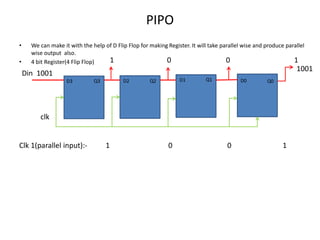
PIPO
• We can make it with the help of D Flip Flop for making Register. It will take parallel wise and produce parallel
wise output also.
• 4 bit Register(4 Flip Flop)
Clk 1(parallel input):- 1 0 0 1
D3 D1 Q1 Q0
D0
Q3 D2 Q2
Din 1001
clk
1001
1 0 0 1

Registers.pptx

  • 1.
    Registers • Computer registersare memory storing units that operate at high speed. It's a component of a computer's processor. It can hold any type of data, including a bit sequence or a single piece of data. Eight registers, a memory unit, and a control unit make up a basic computer. These devices must be connected on a regular basis. • Registers are a type of computer memory used to accept, store, and transfer data and instructions used by the CPU right away. Processor registers refer to the registers used by the CPU. During the execution of a program, registers are used to store data temporarily. In most cases, the number of bits that a register can hold is used to determine its size.
  • 2.
    How is Registermade • Register is made with help of flip flop. • Since flip flop has capacity to store one bit of data using this concept we merge multiple flip to form a Register • If the Register is of 4 bits than the total number of flip will be 4 (4 Flip Flop=1(4 bit Register) • Similarly for 8 bit Register(8 Flip Flops=1(8 bit Register) and so on.
  • 3.
    We can makeRegisters in the following ways • SISO(Serial Input Serial Output) • SIPO(Serial Input Parallel Output) • PISO(Parallel Input Serial Output) • PIPO(Parallel Input Parallel Output)
  • 4.
    SISO • We canmake it with the help of D Flip Flop for making Register. It will take Input Serial wise and produce output Serial wise also. • 4 bit Register(4 Flip Flop) Clk 1:- 1 X X X Clk 2:- 0 1 X X Clk 3:- 0 0 1 X Clk 4:- 1 0 0 1 (1 Clk 5:- X 1 0 0 (01 Clk 6:- X X 1 0 (001 Clk 7:- X X X 1 (1001) D3 D1 Q1 Q0 D0 Q3 D2 Q2 Din 1001 clk 1001
  • 5.
    SIPO • We canmake it with the help of D Flip Flop for making Register. It will take Input Serial wise and produce parallel wise output. • 4 bit Register(4 Flip Flop) Clk 1:- 1 0 0 0 Clk 2:- 0 1 0 0 Clk 3:- 0 0 1 0 Clk 4:- 1 0 0 1 (1001) D3 D1 Q1 Q0 D0 Q3 D2 Q2 Din 1001 clk 1 0 0 1
  • 6.
    PISO • We canmake it with the help of D Flip Flop for making Register. It will take parallel wise and produce serial wise output also. • 4 bit Register(4 Flip Flop) Clk 1(parallel inout):- 1 0 0 1 Clk 2:- X 1 0 0(1 Clk 3:- X X 1 0(10 Clk 4:- X X X 1 (1001) D3 D1 Q1 Q0 D0 Q3 D2 Q2 Din 1001 clk 1001
  • 7.
    PIPO • We canmake it with the help of D Flip Flop for making Register. It will take parallel wise and produce parallel wise output also. • 4 bit Register(4 Flip Flop) Clk 1(parallel input):- 1 0 0 1 D3 D1 Q1 Q0 D0 Q3 D2 Q2 Din 1001 clk 1001 1 0 0 1