
REDI Stakeholder Meeting
What is the Regional Economic Development
Initiative (REDI)?
• REDI is a private-public partnership engaging
stakeholders in a collaborative effort to create jobs
by focusing on Silicon Valley's most promising
economic opportunities.
• Regional economic competitiveness requires a
coordinated strategy and action.
Why is REDI Important?
• Silicon Valley is a hotspot for innovation and startups,
but faces increasing challenges to growth:
– Increasing competition from regions around the nation
and globe developing innovation economies.
• E.g. Tel Aviv, Munich/Stuttgart, New York City, Austin and
Seattle
– High cost of housing and the relative cost of doing
business in Silicon Valley make it increasingly difficult
for firms to locate and grow and attract talent.
• A collaborative regional approach is needed to remain on
top.
What is REDI?
REDI strives to build on regional activities and create
one regional voice to:
• Promote the region
• Recruit New Businesses
• Retain Existing Businesses
• Attract Public Investment
• Support Local Entrepreneurs
Funders of REDI
South Bay Construction | Cosmopolitan Catering | Robinson Oil | Adobe
Silicon Valley Community Foundation | Joseph J. Albanese, Inc.
Barry Swenson Builder | Bozzuto Insurance Services | Hensel Phelps | GivePoint Partners LLC
Alliance Roofing Co | Blach Construction
Early Findings: Silicon Valley’s Opportunity
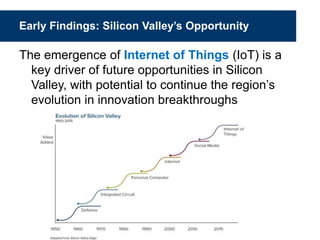
The emergence of Internet of Things (IoT) is a
key driver of future opportunities in Silicon
Valley, with potential to continue the region’s
evolution in innovation breakthroughs
Early Findings: Silicon Valley’s Opportunity
IoT is creating a number of new opportunities for companies
to connect with each other and with public sector partners
to leverage exciting innovations in:
• Agile Development and Manufacturing
• Smart Buildings
• Transportation R&D
• Health Technology
REDI is mobilizing private sector business leaders in each
of these four areas to create and implement an action plan to
grow the sector.
Where is the value potential of the
Internet of Things?
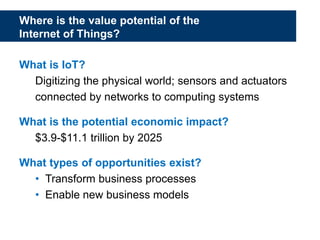
What is IoT?
Digitizing the physical world; sensors and actuators
connected by networks to computing systems
What is the potential economic impact?
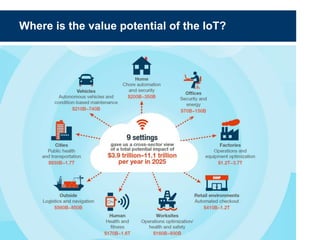
$3.9-$11.1 trillion by 2025
What types of opportunities exist?
• Transform business processes
• Enable new business models
Where is the value potential of the IoT?
Role of REDI
• Regional convener of business, local government
and community partners to accelerate job creation,
innovation and business opportunities.
• REDI forums will define community challenges that
business can help address in each of these
opportunity areas while marketing the region as a
center of innovation.
• Convene, Collaborate & Champion
Action Team Updates
Agile Development & Manufacturing
Opportunities to Grow the Industry
• Growing End Markets and New Products
• New Processes
• Unique Regional Advantages
• Economic Trends
Goals for the Agile Development & Manufacturing Action Team
• Expand jobs and economic impact of the industry
• Expand the manufacturing talent pool in Silicon Valley
• Build awareness of the value of manufacturing in the region
• Improve connections among regional businesses, and
education systems
Agile Development & Manufacturing
Enhancing Business to Business Connections and
Building the Talent Pool are priority action areas,
including the following strategies:
• Centralize information and resources about Silicon
Valley manufacturers and resources for B2B
connections and talent development;
• Articulate the competitive advantages of manufacturing
in Silicon Valley;
• Promote Silicon Valley’s manufacturing “brand”;
• Develop a platform to actively broker connections
among manufacturing customers, suppliers and
potential business partners; and,
• Support additional alignment and industry engagement
with education and workforce systems.
Agile Development & Manufacturing
Action Team Commitments
• Develop an ongoing forum to promote business to
business connections in Silicon Valley.
• Advising creation of an online resource directory and
connection hub to generate stronger local buyer-
supplier relationships, including a map of local
manufacturers.
• Develop a compelling rationale and “brand” for
manufacturing in the region. The team is developing a
series of case studies of clients choosing Silicon Valley
manufacturers/suppliers in the region for products,
especially within high opportunity industries (including
Health Technology and transportation).
Early Actions
• Drafted first company case study as a model for the
case study series
Smart Buildings
Opportunities to Grow the Industry
• Growing Market Demand
• Changing Technology
• Shifting Policies
• Changing Social and Environmental Issues
Goals for the Smart Buildings Action Team
• Expand jobs and economic impact of the industry
• Raise awareness of smart building technologies
and benefits
• Increase coordination and collaboration of
organizations
Smart Buildings
Market Development is a priority action area,
including the following strategies:
• Obtain smart buildings industry data to identify
areas of improvement, particularly related to
building energy usage data and technology
adoption.
• Build awareness of smart buildings technologies
and benefits to increase the deployment of products
and services.
• Accelerate development of the market and
technology adoption.
Smart Buildings
Action Team Commitments
• Partnering with PG&E to work on opportunities with
small and medium businesses to improve building
efficiency.
• Working with City of San Jose to identify potential
demonstration/pilot projects for innovative smart
building technologies.
• Creating a marketing/outreach strategy to reach
target audiences and build awareness of smart building
technologies and improve efficiencies.
Early Actions
• Developed a white paper that synthesizes the data
available to identify priority areas for action and
measure ongoing progress in growing the regional smart
buildings industry
Transportation R&D
Opportunities to Grow the Industry
• Growing End Markets
• New Products and Technologies
• Unique Regional Assets
Goals for the Transportation R&D Action Team
• Expand jobs and economic impact of the industry
• Raise Silicon Valley’s profile as a “test bed” for
transportation technologies
• Work to address the region’s traffic and related
safety issues
Transportation R&D
Collaboration around demonstration and adoption is
a priority action area, including the following
strategies:
• Define the problem as congestion and safety to
motivate action and collaboration around
multifaceted transportation solutions;
• Articulate a call to action;
• Develop a central forum to encourage collaboration
and information exchange; and,
• Engage senior public and industry leaders in the
forum design and implementation.
Transportation R&D
Action Team Commitments
• Showcase event with senior public and local
elected leaders to raise awareness of
transportation technologies being developed in the
region, and the opportunity for these technologies
to address key regional challenges: congestion
and safety.
Early actions
• Developed a white paper articulating the
economic opportunity of transportation
technologies in Silicon Valley, and a call to action
to public and private leaders to collaborate on
solutions
Health Technology
Opportunities to Grow the Industry
– Growing Market Demand
– Health Technology Convergence
– New Products and Services
– Cost Drivers
Goals
• Long-term: Make Silicon Valley a known center of health
care technology innovation
• Short-term: Strengthen connections between health
system end users and local entrepreneurs and tech
companies
Health Technology
Opportunity: Create an Industry Catalyst that
could:
– Expand collaboration between entrepreneurs and
health systems;
– Accelerate innovation through access to data;
– Promote Silicon Valley as a center for Health
Technology innovation, and
– Develop technical talent.
Health Technology
Action Team Commitments
• Convene an initial forum in Fall 2015 provide a
venue for startups to understand customers and
real-world barriers to execution, as well as for
institutions/health systems to find solutions to
health care problems.
Early Actions
– Hospital Council met to identify top health care
challenges in need of a tech solution.
– Developed White Paper on Health Technology
initiatives in the region and similar collaborations
nationwide.
Role of REDI Moving Forward
• Convener of business, local government, and
community partners to advance regional economic
competitiveness and accelerate job creation.
• The SJSV Chamber can be the backbone
organization for REDI forums.
– Identifying funding for ongoing support
– Convening stakeholders around opportunity areas
and mobilizing around action strategies
– Marketing the region as center of innovation
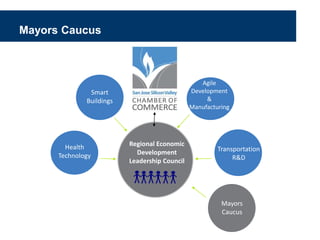
Mayors Caucus
Regional Economic
Development
Leadership Council
Health
Technology
Smart
Buildings
Agile
Development
&
Manufacturing
Transportation
R&D
Mayors
Caucus
Next Steps
August - September
– REDI action teams will finalize action plans
– REDI stakeholder group review action plans
October
– REDI public launch event with the Silicon Valley
Business Journal – Oct 13th
September-December
– REDI action teams work on identified action steps
and achieve early wins

Regional Economic Development Initiative 2015

  • 1.
  • 2.
    What is theRegional Economic Development Initiative (REDI)? • REDI is a private-public partnership engaging stakeholders in a collaborative effort to create jobs by focusing on Silicon Valley's most promising economic opportunities. • Regional economic competitiveness requires a coordinated strategy and action.
  • 3.
    Why is REDIImportant? • Silicon Valley is a hotspot for innovation and startups, but faces increasing challenges to growth: – Increasing competition from regions around the nation and globe developing innovation economies. • E.g. Tel Aviv, Munich/Stuttgart, New York City, Austin and Seattle – High cost of housing and the relative cost of doing business in Silicon Valley make it increasingly difficult for firms to locate and grow and attract talent. • A collaborative regional approach is needed to remain on top.
  • 4.
    What is REDI? REDIstrives to build on regional activities and create one regional voice to: • Promote the region • Recruit New Businesses • Retain Existing Businesses • Attract Public Investment • Support Local Entrepreneurs
  • 5.
    Funders of REDI SouthBay Construction | Cosmopolitan Catering | Robinson Oil | Adobe Silicon Valley Community Foundation | Joseph J. Albanese, Inc. Barry Swenson Builder | Bozzuto Insurance Services | Hensel Phelps | GivePoint Partners LLC Alliance Roofing Co | Blach Construction
  • 7.
    Early Findings: SiliconValley’s Opportunity The emergence of Internet of Things (IoT) is a key driver of future opportunities in Silicon Valley, with potential to continue the region’s evolution in innovation breakthroughs
  • 8.
    Early Findings: SiliconValley’s Opportunity IoT is creating a number of new opportunities for companies to connect with each other and with public sector partners to leverage exciting innovations in: • Agile Development and Manufacturing • Smart Buildings • Transportation R&D • Health Technology REDI is mobilizing private sector business leaders in each of these four areas to create and implement an action plan to grow the sector.
  • 9.
    Where is thevalue potential of the Internet of Things? What is IoT? Digitizing the physical world; sensors and actuators connected by networks to computing systems What is the potential economic impact? $3.9-$11.1 trillion by 2025 What types of opportunities exist? • Transform business processes • Enable new business models
  • 10.
    Where is thevalue potential of the IoT?
  • 11.
    Role of REDI •Regional convener of business, local government and community partners to accelerate job creation, innovation and business opportunities. • REDI forums will define community challenges that business can help address in each of these opportunity areas while marketing the region as a center of innovation. • Convene, Collaborate & Champion
  • 12.
  • 13.
    Agile Development &Manufacturing Opportunities to Grow the Industry • Growing End Markets and New Products • New Processes • Unique Regional Advantages • Economic Trends Goals for the Agile Development & Manufacturing Action Team • Expand jobs and economic impact of the industry • Expand the manufacturing talent pool in Silicon Valley • Build awareness of the value of manufacturing in the region • Improve connections among regional businesses, and education systems
  • 14.
    Agile Development &Manufacturing Enhancing Business to Business Connections and Building the Talent Pool are priority action areas, including the following strategies: • Centralize information and resources about Silicon Valley manufacturers and resources for B2B connections and talent development; • Articulate the competitive advantages of manufacturing in Silicon Valley; • Promote Silicon Valley’s manufacturing “brand”; • Develop a platform to actively broker connections among manufacturing customers, suppliers and potential business partners; and, • Support additional alignment and industry engagement with education and workforce systems.
  • 15.
    Agile Development &Manufacturing Action Team Commitments • Develop an ongoing forum to promote business to business connections in Silicon Valley. • Advising creation of an online resource directory and connection hub to generate stronger local buyer- supplier relationships, including a map of local manufacturers. • Develop a compelling rationale and “brand” for manufacturing in the region. The team is developing a series of case studies of clients choosing Silicon Valley manufacturers/suppliers in the region for products, especially within high opportunity industries (including Health Technology and transportation). Early Actions • Drafted first company case study as a model for the case study series
  • 16.
    Smart Buildings Opportunities toGrow the Industry • Growing Market Demand • Changing Technology • Shifting Policies • Changing Social and Environmental Issues Goals for the Smart Buildings Action Team • Expand jobs and economic impact of the industry • Raise awareness of smart building technologies and benefits • Increase coordination and collaboration of organizations
  • 17.
    Smart Buildings Market Developmentis a priority action area, including the following strategies: • Obtain smart buildings industry data to identify areas of improvement, particularly related to building energy usage data and technology adoption. • Build awareness of smart buildings technologies and benefits to increase the deployment of products and services. • Accelerate development of the market and technology adoption.
  • 18.
    Smart Buildings Action TeamCommitments • Partnering with PG&E to work on opportunities with small and medium businesses to improve building efficiency. • Working with City of San Jose to identify potential demonstration/pilot projects for innovative smart building technologies. • Creating a marketing/outreach strategy to reach target audiences and build awareness of smart building technologies and improve efficiencies. Early Actions • Developed a white paper that synthesizes the data available to identify priority areas for action and measure ongoing progress in growing the regional smart buildings industry
  • 19.
    Transportation R&D Opportunities toGrow the Industry • Growing End Markets • New Products and Technologies • Unique Regional Assets Goals for the Transportation R&D Action Team • Expand jobs and economic impact of the industry • Raise Silicon Valley’s profile as a “test bed” for transportation technologies • Work to address the region’s traffic and related safety issues
  • 20.
    Transportation R&D Collaboration arounddemonstration and adoption is a priority action area, including the following strategies: • Define the problem as congestion and safety to motivate action and collaboration around multifaceted transportation solutions; • Articulate a call to action; • Develop a central forum to encourage collaboration and information exchange; and, • Engage senior public and industry leaders in the forum design and implementation.
  • 21.
    Transportation R&D Action TeamCommitments • Showcase event with senior public and local elected leaders to raise awareness of transportation technologies being developed in the region, and the opportunity for these technologies to address key regional challenges: congestion and safety. Early actions • Developed a white paper articulating the economic opportunity of transportation technologies in Silicon Valley, and a call to action to public and private leaders to collaborate on solutions
  • 22.
    Health Technology Opportunities toGrow the Industry – Growing Market Demand – Health Technology Convergence – New Products and Services – Cost Drivers Goals • Long-term: Make Silicon Valley a known center of health care technology innovation • Short-term: Strengthen connections between health system end users and local entrepreneurs and tech companies
  • 23.
    Health Technology Opportunity: Createan Industry Catalyst that could: – Expand collaboration between entrepreneurs and health systems; – Accelerate innovation through access to data; – Promote Silicon Valley as a center for Health Technology innovation, and – Develop technical talent.
  • 24.
    Health Technology Action TeamCommitments • Convene an initial forum in Fall 2015 provide a venue for startups to understand customers and real-world barriers to execution, as well as for institutions/health systems to find solutions to health care problems. Early Actions – Hospital Council met to identify top health care challenges in need of a tech solution. – Developed White Paper on Health Technology initiatives in the region and similar collaborations nationwide.
  • 25.
    Role of REDIMoving Forward • Convener of business, local government, and community partners to advance regional economic competitiveness and accelerate job creation. • The SJSV Chamber can be the backbone organization for REDI forums. – Identifying funding for ongoing support – Convening stakeholders around opportunity areas and mobilizing around action strategies – Marketing the region as center of innovation
  • 26.
    Mayors Caucus Regional Economic Development LeadershipCouncil Health Technology Smart Buildings Agile Development & Manufacturing Transportation R&D Mayors Caucus
  • 27.
    Next Steps August -September – REDI action teams will finalize action plans – REDI stakeholder group review action plans October – REDI public launch event with the Silicon Valley Business Journal – Oct 13th September-December – REDI action teams work on identified action steps and achieve early wins

Editor's Notes

  • #10 - The Internet of Things has the potential of unlocking savings,  generating employment and profits while improving quality of life in health care, manufacturing, transportation and buildings -  Silicon Valley can be the global leader in applying IT to business and the community solutions http://www.mckinsey.com/insights/business_technology/the_internet_of_things_the_value_of_digitizing_the_physical_world
  • #11 - The Internet of Things has the potential of unlocking savings,  generating employment and profits while improving quality of life in health care, manufacturing, transportation and buildings -  Silicon Valley can be the global leader in applying IT to business and the community solutions http://www.mckinsey.com/insights/business_technology/the_internet_of_things_the_value_of_digitizing_the_physical_world
  • #12  -  REDI is the regional convener of business, local government and community partners that is creating forums to accelerate job creation , innovation and business opportunities in health IT, agile development and manufacturing, transportation R&D and smart buildings the chamber wants to position itself as the regional convener of business and community partners in these four opportunity areas -  REDI forums will define community challenges that business can help address in each of these opportunity areas while marketing the region as a center of innovation ---  how health IT can help connect patients to quality medical care and reduce costs ---  how contract manufacturers can connect to local business while reducing time to market ---  how transportation R&D can reduce congestion and promote safety  ---  how smart technology can help buildings increase energy efficiency and reduce emission
  • #17 Goals -- (expanded) *Expand jobs and economic impact of the smart buildings industry in Silicon Valley by increasing deployment of smart building technologies into new and existing buildings in the region. *Raise awareness of smart building technologies and benefits in the building industry and among the public to accelerate development of the market and technology adoption. *Increase coordination and collaboration of organizations related to the smart buildings industry (e.g. trade associations, private companies, utilities, advocacy organizations, universities) to align and amplify impact, and reduce duplication of efforts.
  • #23 Goals Long-term goal: Make Silicon Valley a worldwide destination for Healthcare technology innovation. Short-term goals: Develop a forum to help entrepreneurs break into the healthcare market, including informing entrepreneurs of the healthcare problems that need to be solved and connecting them to hospitals. Leveraging resources, such as data, to strengthen the Health Technology industry in Silicon Valley. Helping hospitals gain access to the latest Health Technology ideas.
  • #24 Action strategies to develop the catalyst include: Do a scan of similar collaborative models in the area and elsewhere to gather design ideas and determine opportunities to leverage. Draft a design model and review. Sign on official members. Launch prototype “forum(s)”. Assess results, adapt forums and scale. Action strategies to expand collaboration between entrepreneurs and health systems include: Develop a forum, possibly through the Chamber, where entrepreneurs can meet with hospital representatives to understand what problems need to be solved. Action strategies to accelerate innovation through access to data: Identify examples of data agreements from other places and determine data that is available. Identify team members and create a joint agreement among data source organizations and outline barriers. Develop a shared platform and determine how to best use the data to aid the growth of the Health IT industry. Action strategies market Silicon Valley as a center for Health IT innovation: Define our current South Bay excellences (and commitment to innovation) and define our differentiators. Market the catalyst. Market Silicon Valley as a place for medical tourism. The team determined that the purpose of the forum will be to provide a venue for startups to understand customers (e.g. institutions, systems, patients), and real-world barriers to execution, as well as for institutions/health systems to find solutions to healthcare problems. Currently, entrepreneurs develop products without knowing the needs of the industry, and also need support navigating the healthcare space, as well as validating their innovations. These industry needs became the basis for developing the pilot forum where entrepreneurs and hospital leads come together. Hospital leaders and the Silicon Valley chapter of Health 2.0, a group that brings together entrepreneurs, organizations and investors to provide mentorship, are partnering to launch this pilot forum.
  • #25 forum will be to provide a venue for startups to understand customers (e.g. institutions, systems, patients), and real-world barriers to execution, as well as for institutions/health systems to find solutions to healthcare problems.
  • #26 -  REDI is the regional convener of business, local government and community partners that is creating forums to accelerate job creation , innovation and business opportunities in health IT, agile development and manufacturing, transportation R&D and smart buildings the chamber wants to position itself as the regional convener of business and community partners in these four opportunity areas -  REDI forums will define community challenges that business can help address in each of these opportunity areas while marketing the region as a center of innovation ---  how health IT can help connect patients to quality medical care and reduce costs ---  how contract manufacturers can connect to local business while reducing time to market ---  how transportation R&D can reduce congestion and promote safety  ---  how smart technology can help buildings increase energy efficiency and reduce emission