Christina Boyd, LSCSW, LCAC
Co-Occurring Disorders EPL
Week #6
Cultural Intelligence
and Wrap Up
• Welcome and Check in
• Review Learning Activity around Cultural
Competence
Welcome
• Need for Culturally Sensitive Services
• Overview of Cultural SensitivityPresentation
• Review and Wrap up of series!
• Final QuestionsSummary
Agenda
NAMI-
MENTAL HEALTH
FACTS-
MULTICULTURAL
• https://www.nami.org/NAMI/media/NAMI-
Media/Infographics/MulticulturalMHFacts10-
23-15.pdf
Understanding
Culture in
Treatment
(Sufrin, ACOG, 2018)
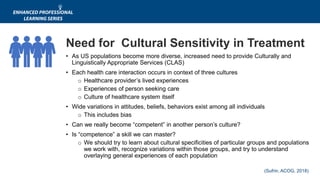
Need for Cultural Sensitivity in Treatment
• As US populations become more diverse, increased need to provide Culturally and
Linguistically Appropriate Services (CLAS)
• Each health care interaction occurs in context of three cultures
o Healthcare provider’s lived experiences
o Experiences of person seeking care
o Culture of healthcare system itself
• Wide variations in attitudes, beliefs, behaviors exist among all individuals
o This includes bias
• Can we really become “competent” in another person’s culture?
• Is “competence” a skill we can master?
o We should try to learn about cultural specificities of particular groups and populations
we work with, recognize variations within those groups, and try to understand
overlaying general experiences of each population
Addiction Counseling Competencies, https://store.samhsa.gov/product/TAP-21-
Addiction-Counseling-Competencies/SMA15-4171
Used With Permission From: Diana Padilla
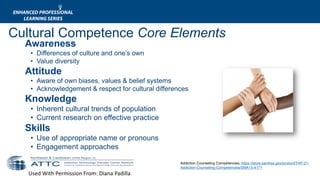
Awareness
• Differences of culture and one’s own
• Value diversity
Attitude
• Aware of own biases, values & belief systems
• Acknowledgement & respect for cultural differences
Knowledge
• Inherent cultural trends of population
• Current research on effective practice
Skills
• Use of appropriate name or pronouns
• Engagement approaches
Cultural Competence Core Elements
Used With Permission From: Diana Padilla
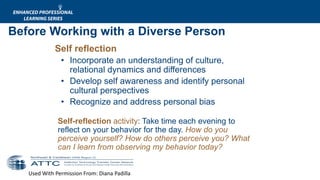
Self reflection
• Incorporate an understanding of culture,
relational dynamics and differences
• Develop self awareness and identify personal
cultural perspectives
• Recognize and address personal bias
Self-reflection activity: Take time each evening to
reflect on your behavior for the day. How do you
perceive yourself? How do others perceive you? What
can I learn from observing my behavior today?
Before Working with a Diverse Person
Used With Permission From: Diana Padilla
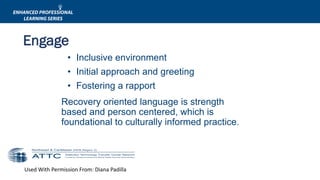
• Inclusive environment
• Initial approach and greeting
• Fostering a rapport
Recovery oriented language is strength
based and person centered, which is
foundational to culturally informed practice.
Engage
Used With Permission From: Diana Padilla Botticelli-Koh-Changing-the-Language-Addiction, JAMA 2016
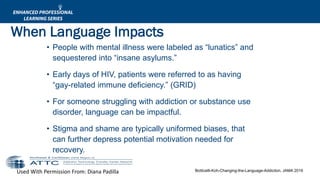
• People with mental illness were labeled as “lunatics” and
sequestered into “insane asylums.”
• Early days of HIV, patients were referred to as having
“gay-related immune deficiency.” (GRID)
• For someone struggling with addiction or substance use
disorder, language can be impactful.
• Stigma and shame are typically uniformed biases, that
can further depress potential motivation needed for
recovery.
When Language Impacts
Used With Permission From: Diana Padilla
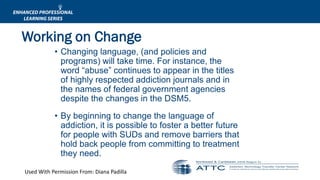
• Changing language, (and policies and
programs) will take time. For instance, the
word “abuse” continues to appear in the titles
of highly respected addiction journals and in
the names of federal government agencies
despite the changes in the DSM5.
• By beginning to change the language of
addiction, it is possible to foster a better future
for people with SUDs and remove barriers that
hold back people from committing to treatment
they need.
Working on Change
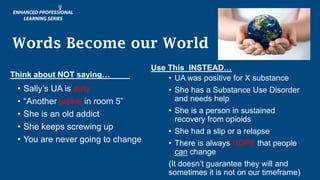
• UA was positive for X substance
• She has a Substance Use Disorder
and needs help
• She is a person in sustained
recovery from opioids
• She had a slip or a relapse
• There is always HOPE that people
can change
(It doesn’t guarantee they will and
sometimes it is not on our timeframe)
Use This INSTEAD…
• Sally’s UA is dirty
• “Another junkie in room 5”
• She is an old addict
• She keeps screwing up
• You are never going to change
Think about NOT saying…
Words Become our World
Used With Permission From: Diana Padilla
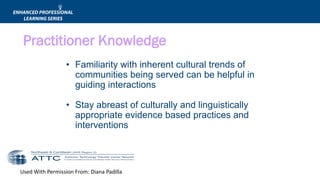
• Familiarity with inherent cultural trends of
communities being served can be helpful in
guiding interactions
• Stay abreast of culturally and linguistically
appropriate evidence based practices and
interventions
Practitioner Knowledge
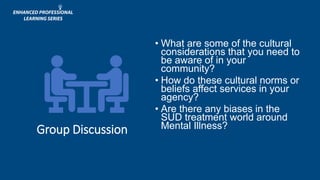
• What are some of the cultural
considerations that you need to
be aware of in your
community?
• How do these cultural norms or
beliefs affect services in your
agency?
• Are there any biases in the
SUD treatment world around
Mental Illness?Group Discussion
What are some things that you see in your practice setting that have
to do with culture that get in the way of people getting better?
-Please use your chat function to write in your thoughts or
unmute your microphone and talk about it!
What are some positive things your agency or community is
doing in the area of cultural sensitivity?
Hurdles to effective treatment
Used With Permission From: Diana Padilla NDRI, Cultural Proficiency in Drug Court Programs curricula,
Contrasting Values, Attitudes and Behaviors, 2002
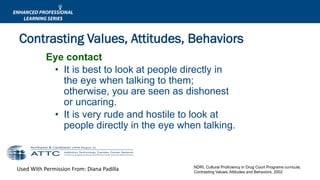
Eye contact
• It is best to look at people directly in
the eye when talking to them;
otherwise, you are seen as dishonest
or uncaring.
• It is very rude and hostile to look at
people directly in the eye when talking.
Contrasting Values, Attitudes, Behaviors
Used With Permission From: Diana Padilla
NDRI, Cultural Proficiency in Drug Court Programs curricula,
Contrasting Values, Attitudes and Behaviors, 2002
Control over illness
• We all have the power to help
ourselves get better.
• There is nothing we can do about
being sick, because our fate is in the
hands of a higher power.
Contrasting Values, Attitudes, Behaviors
Used With Permission From: Diana Padilla
Source: C. Storti, (1994). “Cross-cultural Dialogues.”
1. Don’t assume sameness
2. What you think of as normal human behavior may only be cultural
3. Familiar behaviors may have different meanings. Same behaviors may
not mean the same thing
4. Don’t assume that what you meant is what was understood
5. Don’t assume that what you understood is what was meant
6. You don’t have to like or accept “different” behavior, but you can try to
understand where it comes from
7. Most people do behave rationally, you just have to discover the rationale
7 Lessons in Cross Cultural Dialogue
Used With Permission From: Diana Padilla
1. Tell me about your racial /ethnic /religious background and share
something about the commonly held values and beliefs of people in your
community.
2. How are you the same as others in your community?
3. How are you different from others in your community?
4. What two things would help the program deliver effective services to you?
Culturally Informed Questions
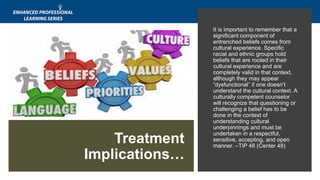
It is important to remember that a
significant component of
entrenched beliefs comes from
cultural experience. Specific
racial and ethnic groups hold
beliefs that are rooted in their
cultural experience and are
completely valid in that context,
although they may appear
“dysfunctional” if one doesn’t
understand the cultural context. A
culturally competent counselor
will recognize that questioning or
challenging a belief has to be
done in the context of
understanding cultural
underpinnings and must be
undertaken in a respectful,
sensitive, accepting, and open
manner. –TIP 48 (Center 48)
Treatment
Implications…
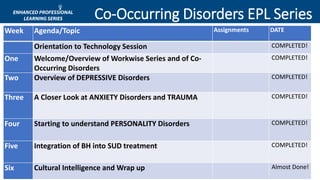
Week Agenda/Topic Assignments DATE
Orientation to Technology Session COMPLETED!
One Welcome/Overview of Workwise Series and of Co-
Occurring Disorders
COMPLETED!
Two Overview of DEPRESSIVE Disorders COMPLETED!
Three A Closer Look at ANXIETY Disorders and TRAUMA COMPLETED!
Four Starting to understand PERSONALITY Disorders COMPLETED!
Five Integration of BH into SUD treatment COMPLETED!
Six Cultural Intelligence and Wrap up Almost Done!
Co-Occurring Disorders EPL Series
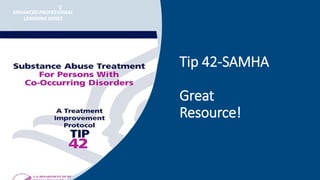
Tip 42-SAMHA
Great
Resource!
What?
So what?
Now what?
What is one thing that stands out from this
series for you?
PLEASE TYPE IT IN THE
CHAT BOX!
What did
you
learn?
Questions
Do something
to further your
practice to
help those
with a
co-occurring
disorder!
As this series ends…
For your Valuable Time and Attention
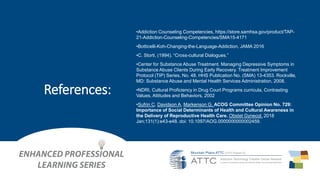
•Addiction Counseling Competencies, https://store.samhsa.gov/product/TAP-
21-Addiction-Counseling-Competencies/SMA15-4171
•Botticelli-Koh-Changing-the-Language-Addiction, JAMA 2016
•C. Storti, (1994). “Cross-cultural Dialogues.”
•Center for Substance Abuse Treatment. Managing Depressive Symptoms in
Substance Abuse Clients During Early Recovery. Treatment Improvement
Protocol (TIP) Series, No. 48. HHS Publication No. (SMA) 13-4353. Rockville,
MD: Substance Abuse and Mental Health Services Administration, 2008.
•NDRI, Cultural Proficiency in Drug Court Programs curricula, Contrasting
Values, Attitudes and Behaviors, 2002
•Sufrin C, Davidson A, Markenson G, ACOG Committee Opinion No. 729:
Importance of Social Determinants of Health and Cultural Awareness in
the Delivery of Reproductive Health Care. Obstet Gynecol. 2018
Jan;131(1):e43-e48. doi: 10.1097/AOG.0000000000002459.
References:

Region 8 Co-Occurring Disorders (Wk 6)

  • 1.
    Christina Boyd, LSCSW,LCAC Co-Occurring Disorders EPL
  • 2.
  • 3.
    • Welcome andCheck in • Review Learning Activity around Cultural Competence Welcome • Need for Culturally Sensitive Services • Overview of Cultural SensitivityPresentation • Review and Wrap up of series! • Final QuestionsSummary Agenda
  • 4.
  • 5.
    (Sufrin, ACOG, 2018) Needfor Cultural Sensitivity in Treatment • As US populations become more diverse, increased need to provide Culturally and Linguistically Appropriate Services (CLAS) • Each health care interaction occurs in context of three cultures o Healthcare provider’s lived experiences o Experiences of person seeking care o Culture of healthcare system itself • Wide variations in attitudes, beliefs, behaviors exist among all individuals o This includes bias • Can we really become “competent” in another person’s culture? • Is “competence” a skill we can master? o We should try to learn about cultural specificities of particular groups and populations we work with, recognize variations within those groups, and try to understand overlaying general experiences of each population
  • 6.
    Addiction Counseling Competencies,https://store.samhsa.gov/product/TAP-21- Addiction-Counseling-Competencies/SMA15-4171 Used With Permission From: Diana Padilla Awareness • Differences of culture and one’s own • Value diversity Attitude • Aware of own biases, values & belief systems • Acknowledgement & respect for cultural differences Knowledge • Inherent cultural trends of population • Current research on effective practice Skills • Use of appropriate name or pronouns • Engagement approaches Cultural Competence Core Elements
  • 7.
    Used With PermissionFrom: Diana Padilla Self reflection • Incorporate an understanding of culture, relational dynamics and differences • Develop self awareness and identify personal cultural perspectives • Recognize and address personal bias Self-reflection activity: Take time each evening to reflect on your behavior for the day. How do you perceive yourself? How do others perceive you? What can I learn from observing my behavior today? Before Working with a Diverse Person
  • 8.
    Used With PermissionFrom: Diana Padilla • Inclusive environment • Initial approach and greeting • Fostering a rapport Recovery oriented language is strength based and person centered, which is foundational to culturally informed practice. Engage
  • 9.
    Used With PermissionFrom: Diana Padilla Botticelli-Koh-Changing-the-Language-Addiction, JAMA 2016 • People with mental illness were labeled as “lunatics” and sequestered into “insane asylums.” • Early days of HIV, patients were referred to as having “gay-related immune deficiency.” (GRID) • For someone struggling with addiction or substance use disorder, language can be impactful. • Stigma and shame are typically uniformed biases, that can further depress potential motivation needed for recovery. When Language Impacts
  • 10.
    Used With PermissionFrom: Diana Padilla • Changing language, (and policies and programs) will take time. For instance, the word “abuse” continues to appear in the titles of highly respected addiction journals and in the names of federal government agencies despite the changes in the DSM5. • By beginning to change the language of addiction, it is possible to foster a better future for people with SUDs and remove barriers that hold back people from committing to treatment they need. Working on Change
  • 11.
    • UA waspositive for X substance • She has a Substance Use Disorder and needs help • She is a person in sustained recovery from opioids • She had a slip or a relapse • There is always HOPE that people can change (It doesn’t guarantee they will and sometimes it is not on our timeframe) Use This INSTEAD… • Sally’s UA is dirty • “Another junkie in room 5” • She is an old addict • She keeps screwing up • You are never going to change Think about NOT saying… Words Become our World
  • 12.
    Used With PermissionFrom: Diana Padilla • Familiarity with inherent cultural trends of communities being served can be helpful in guiding interactions • Stay abreast of culturally and linguistically appropriate evidence based practices and interventions Practitioner Knowledge
  • 13.
    • What aresome of the cultural considerations that you need to be aware of in your community? • How do these cultural norms or beliefs affect services in your agency? • Are there any biases in the SUD treatment world around Mental Illness?Group Discussion
  • 14.
    What are somethings that you see in your practice setting that have to do with culture that get in the way of people getting better? -Please use your chat function to write in your thoughts or unmute your microphone and talk about it! What are some positive things your agency or community is doing in the area of cultural sensitivity? Hurdles to effective treatment
  • 15.
    Used With PermissionFrom: Diana Padilla NDRI, Cultural Proficiency in Drug Court Programs curricula, Contrasting Values, Attitudes and Behaviors, 2002 Eye contact • It is best to look at people directly in the eye when talking to them; otherwise, you are seen as dishonest or uncaring. • It is very rude and hostile to look at people directly in the eye when talking. Contrasting Values, Attitudes, Behaviors
  • 16.
    Used With PermissionFrom: Diana Padilla NDRI, Cultural Proficiency in Drug Court Programs curricula, Contrasting Values, Attitudes and Behaviors, 2002 Control over illness • We all have the power to help ourselves get better. • There is nothing we can do about being sick, because our fate is in the hands of a higher power. Contrasting Values, Attitudes, Behaviors
  • 17.
    Used With PermissionFrom: Diana Padilla Source: C. Storti, (1994). “Cross-cultural Dialogues.” 1. Don’t assume sameness 2. What you think of as normal human behavior may only be cultural 3. Familiar behaviors may have different meanings. Same behaviors may not mean the same thing 4. Don’t assume that what you meant is what was understood 5. Don’t assume that what you understood is what was meant 6. You don’t have to like or accept “different” behavior, but you can try to understand where it comes from 7. Most people do behave rationally, you just have to discover the rationale 7 Lessons in Cross Cultural Dialogue
  • 18.
    Used With PermissionFrom: Diana Padilla 1. Tell me about your racial /ethnic /religious background and share something about the commonly held values and beliefs of people in your community. 2. How are you the same as others in your community? 3. How are you different from others in your community? 4. What two things would help the program deliver effective services to you? Culturally Informed Questions
  • 19.
    It is importantto remember that a significant component of entrenched beliefs comes from cultural experience. Specific racial and ethnic groups hold beliefs that are rooted in their cultural experience and are completely valid in that context, although they may appear “dysfunctional” if one doesn’t understand the cultural context. A culturally competent counselor will recognize that questioning or challenging a belief has to be done in the context of understanding cultural underpinnings and must be undertaken in a respectful, sensitive, accepting, and open manner. –TIP 48 (Center 48) Treatment Implications…
  • 20.
    Week Agenda/Topic AssignmentsDATE Orientation to Technology Session COMPLETED! One Welcome/Overview of Workwise Series and of Co- Occurring Disorders COMPLETED! Two Overview of DEPRESSIVE Disorders COMPLETED! Three A Closer Look at ANXIETY Disorders and TRAUMA COMPLETED! Four Starting to understand PERSONALITY Disorders COMPLETED! Five Integration of BH into SUD treatment COMPLETED! Six Cultural Intelligence and Wrap up Almost Done! Co-Occurring Disorders EPL Series
  • 21.
  • 22.
  • 23.
    What is onething that stands out from this series for you? PLEASE TYPE IT IN THE CHAT BOX! What did you learn?
  • 24.
  • 25.
    Do something to furtheryour practice to help those with a co-occurring disorder! As this series ends…
  • 26.
    For your ValuableTime and Attention
  • 27.
    •Addiction Counseling Competencies,https://store.samhsa.gov/product/TAP- 21-Addiction-Counseling-Competencies/SMA15-4171 •Botticelli-Koh-Changing-the-Language-Addiction, JAMA 2016 •C. Storti, (1994). “Cross-cultural Dialogues.” •Center for Substance Abuse Treatment. Managing Depressive Symptoms in Substance Abuse Clients During Early Recovery. Treatment Improvement Protocol (TIP) Series, No. 48. HHS Publication No. (SMA) 13-4353. Rockville, MD: Substance Abuse and Mental Health Services Administration, 2008. •NDRI, Cultural Proficiency in Drug Court Programs curricula, Contrasting Values, Attitudes and Behaviors, 2002 •Sufrin C, Davidson A, Markenson G, ACOG Committee Opinion No. 729: Importance of Social Determinants of Health and Cultural Awareness in the Delivery of Reproductive Health Care. Obstet Gynecol. 2018 Jan;131(1):e43-e48. doi: 10.1097/AOG.0000000000002459. References: