Cultural Competency at
Schwab Rehabilitation Hospital
Kemi Olarinde, OTS
What is Cultural Competency and why is
it important?
 Culture: integrated patterns of human behavior that
include the language, thoughts, communications, actions,
customs, beliefs, values, and institutions of racial, ethnic,
religious, or social groups
 Cultural Competency in Health Care: ability of systems to
provide care to patients with diverse values, beliefs and
behaviors, including tailoring delivery to meet patients’
social, cultural, and linguistic needs.
 Knowledge, Attitude, Skill
 The US Census Bureau predicts that within the next 50
years, half of the US population will be from cultures
other than Caucasian
Health Disparities and Why They Exist
 Minorities suffer disproportionately from preventable and treatable
conditions such as cardiovascular disease, asthma, cancer, diabetes
HIV/AIDS, stroke, Alzheimer's, and others
 Minorities are more likely to…
 Be more socio-economically disadvantaged
 Have lower levels of education
 Access to health care
 Uninsured, receive referrals, utilize therapeutic procedures
and services
 Live in neighborhoods with greater environmental hazards
 Air pollution, unsafe due to violence, food desserts
 Have jobs with higher occupational hazards
 Less benefits, factory workers
Here at Schwab Rehabilitation Hospital
Diversity and Inclusion Statement
At Sinai Health System, our human
diversity is a key component that
drives the purpose and uniqueness of
the organization. We are privileged
to have a culturally rich workforce
and we are honored to serve,
support, and provide services to an
exceptionally diverse community. We
respect and value the cultural
differences among one another and
we use that to leverage our
effectiveness and organizational
success.
Our Definition of Diversity
At Sinai Health System, diversity is an all-
inclusive concept. It includes differences
among race, gender, age, national origin,
ethnicity, disability, religion, culture,
socio-economic status, sexual orientation
and any other attributes that truly
represent an individual or group. We
understand that diversity is not only the
obvious differences, but the less apparent
as well. Individual lifestyles, work/life
balance, interpersonal styles, life
experiences, talents, and creative passions
are all factors that contribute to a person’s
culture or identity.
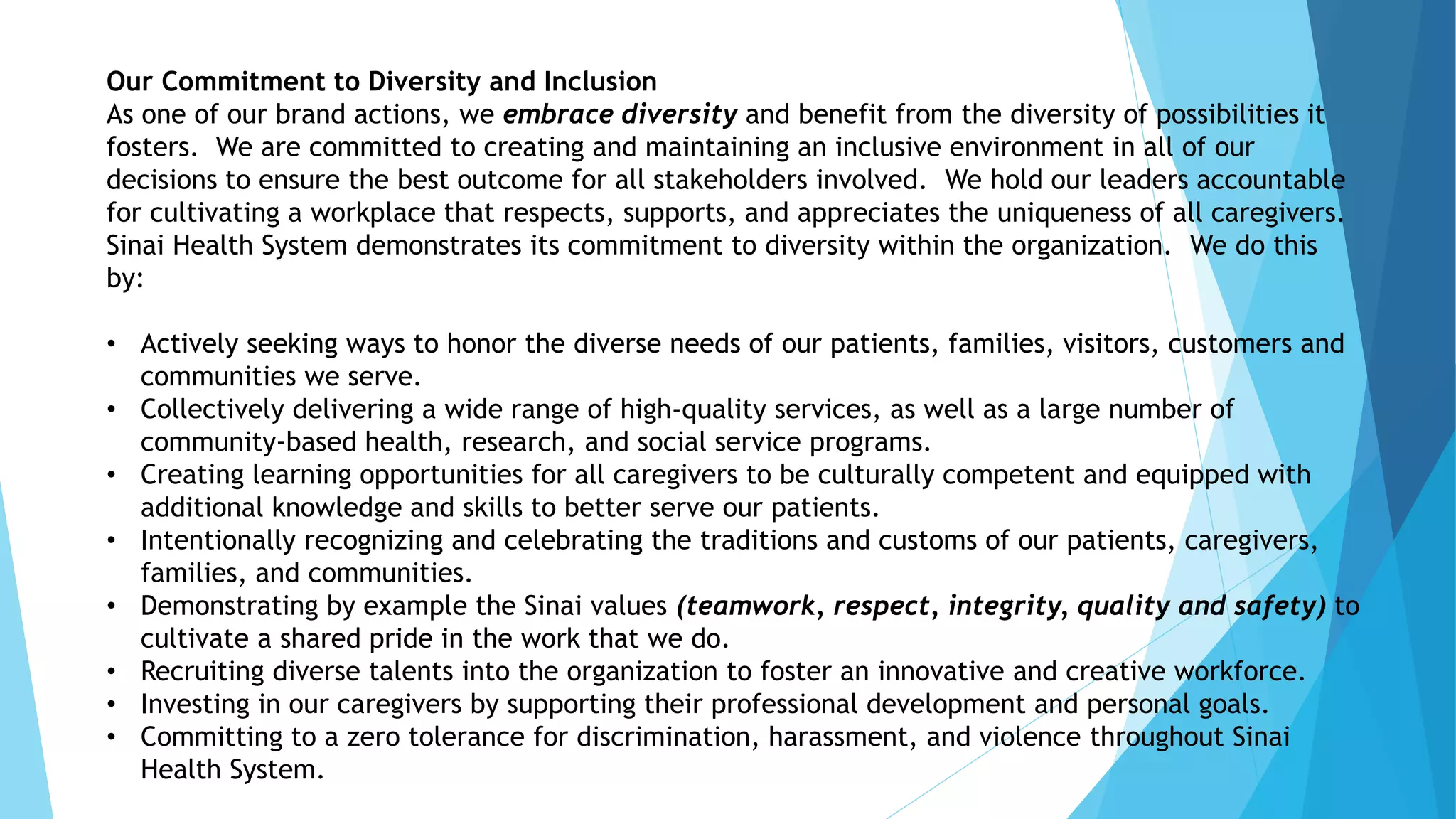
Our Commitment to Diversity and Inclusion
As one of our brand actions, we embrace diversity and benefit from the diversity of possibilities it
fosters. We are committed to creating and maintaining an inclusive environment in all of our
decisions to ensure the best outcome for all stakeholders involved. We hold our leaders accountable
for cultivating a workplace that respects, supports, and appreciates the uniqueness of all caregivers.
Sinai Health System demonstrates its commitment to diversity within the organization. We do this
by:
• Actively seeking ways to honor the diverse needs of our patients, families, visitors, customers and
communities we serve.
• Collectively delivering a wide range of high-quality services, as well as a large number of
community-based health, research, and social service programs.
• Creating learning opportunities for all caregivers to be culturally competent and equipped with
additional knowledge and skills to better serve our patients.
• Intentionally recognizing and celebrating the traditions and customs of our patients, caregivers,
families, and communities.
• Demonstrating by example the Sinai values (teamwork, respect, integrity, quality and safety) to
cultivate a shared pride in the work that we do.
• Recruiting diverse talents into the organization to foster an innovative and creative workforce.
• Investing in our caregivers by supporting their professional development and personal goals.
• Committing to a zero tolerance for discrimination, harassment, and violence throughout Sinai
Health System.
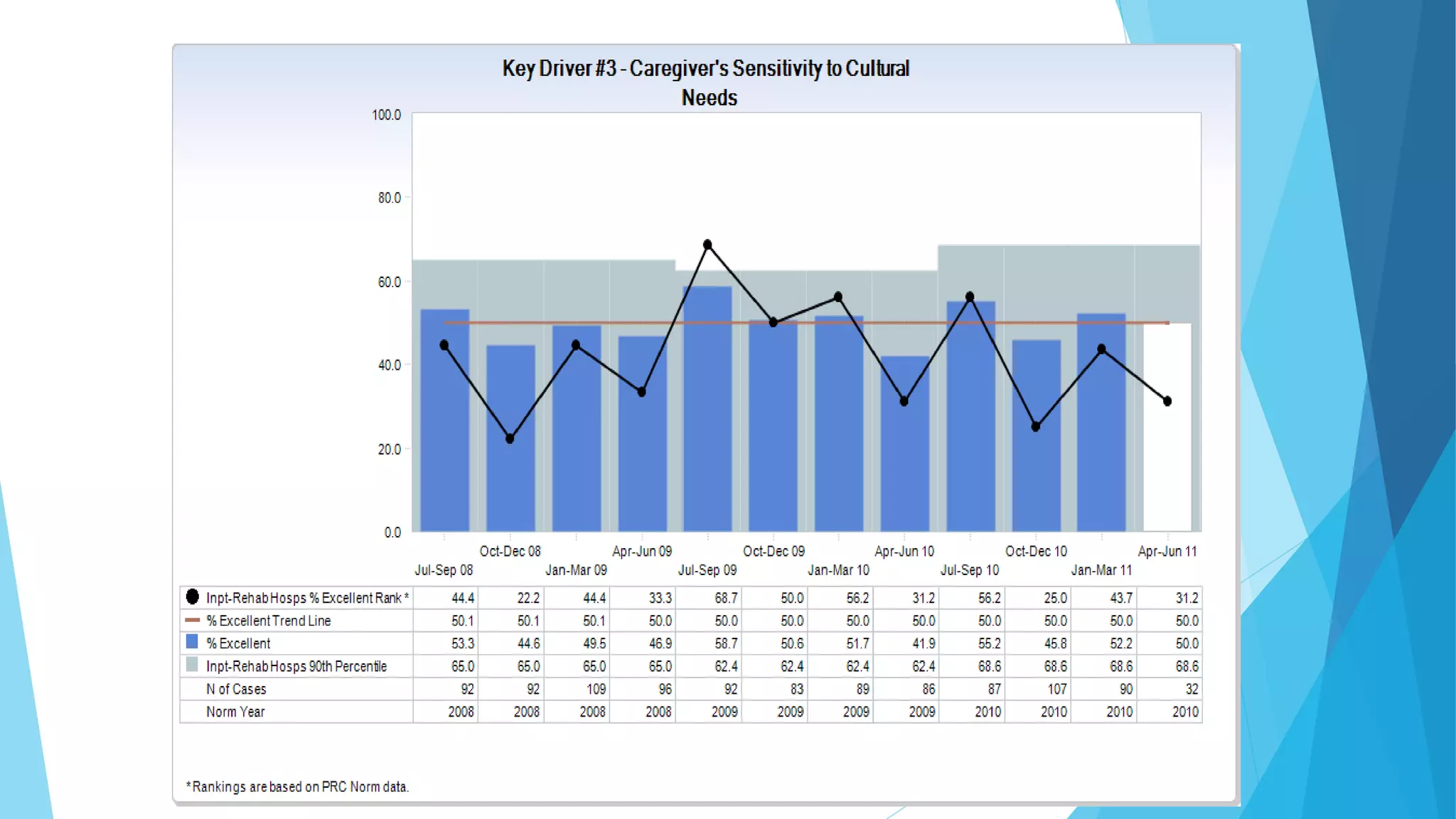
How are we doing?
 Caregiver’s Sensitivity to Cultural Needs
“Now I would like to ask you some questions
about the CAREGIVERS OVERALL at Schwab
Rehabilitation Hospital. How would you rate
the caregivers on: Their Respect for (Your/Your
Family Member's) Cultural Beliefs and Values?
Would you say:”
Why?
 Lack of diversity in health care’s leadership and
workforce.
 Systems of care poorly designed to meet the
needs of diverse patient populations
 Poor communication between providers and
patients of different backgrounds.
How can we fix it….
Language and Communication
 Effective communication can improve outcome measures such as patient satisfaction, adherence to
treatment, and disease treatment outcomes
 Approximately 20% of US residents speak a language other than English at home
 Use of interpreters
 Speak to patient and family
 Be simple clear and concise
 Patients prefer interpreter vs family member
 Red Phone
 Located in small gym
 Step by step instructions
 Speaker phone
 40% of adults in the US have literacy skills at or below basic levels; furthermore low health literacy was
26% and the prevalence of marginal health literacy was another 20%
 Avoid too much medical jargon
 Continue to use handouts with pictures
 Continue psychology groups for patient education
Personal Attitudes
 Distrust among racial minorities
 Taking extra time to ask patients about their lives
 Displaying materials that acknowledge the diversity of the patient pool
 Assumptions/Stereotyping
 In group vs out group
 Avoid generalizations
 Think about real or fictional examples of people who do not conform to stereotypes
and exposure to more positive ideas
 Self-fulling prophecies
 Therapist’s beliefs and behaviors about a patient’s expectations can affect and/or
influence the patient’s outcomes in therapy
 “Non compliant” vs “missed a follow up appointment”
 Fear of being prejudiced
 see interracial interactions as an opportunity to learn and grow to reduce anxiety
Microaggressions
“brief and commonplace daily verbal, behavioral, or environmental indignities,
whether intentional or unintentional, that communicate hostile, derogatory, or
negative racial slights and insults toward people of color”
 Alien in own land: “Where are you from?” “You speak good English”
 Ascription of intelligence: “You are a credit to your race” “You are so
articulate”
 Color blindness: “When I look at you, I don’t see color” “There is only one
race, the human race.”
 Criminality: Checking/clutching your wallet or purse when a minority
approaches
 Denial of individual racism: “I’m not a racist. I have several Black friends.”
 Myth of meritocracy: “Everyone can succeed in this society, if they work hard
enough”
Knowledge
 Awareness of cultural practices
 Individualism vs Collectivism
 Personal space
 Body Language
 Sense of Time
 Eye contact
Training and Continuing Education
 Have been shown to improve
 Patient Satisfaction
 Providers’ knowledge, attitudes, and skills.
 Focus on
 Avoidance of bias
 General concepts of culture
 Patient centeredness
 In conclusion,
 See diversity as an opportunity to learn and don’t be so nervous!
 Educate yourself on stereotypes and avoid generalizations.
 Be conscious and aware of microaggressions.
 Think about how you are communicating and use interpreters!
 Seek out ways to educate yourself on cultural competency!
References
 Beach, M. C., Price, E. G., Gary, T. L., Robinson, K. A., Gozu, A., Palacio, A., Cooper, L. A. (2005).
Cultural Competency: A Systematic Review of Health Care Provider Educational Interventions. Medical
Care, 43(4), 356–373.
 Betancourt, J.R, Green, A. R., Carrillo, J. E., Ananeh-Firempong, O., 2003. Defining Cultural
Competence: A Practical Framework for Addressing Racial/Ethnic Disparities in Health and Health Care.
Public Health Reports. (118) 293 - 302.
 Betancourt, J. R., Corbett, J., Bondaryk, M. R., (2014). Addressing Disparities and Achieving Equity:
Cultural Competence, Ethics, and Health-care Transformation. Chest, 145 (1), 143 - 148
 Burgess, D. J., PhD., Fu, Steven S,M.D., M.S.C.E., & van Ryn, Michelle, PhD, MPH. (2004). Journal of
General Internal Medicine, 19(11), 1154-9. Why do providers contribute to disparities and what can be
done about it?
 Markova, T., & Broome, B. (2007). Effective communication and delivery of culturally competent
health care. Urologic Nursing, 27(3), 239-242.
 Perloff, R. M., Bonder, B., Ray, G. B., Eileen, B. R., & Siminoff, L. A. (2006). Doctor-patient
communication, cultural competence, and minority health: Theoretical and empirical
perspectives. The American Behavioral Scientist, 49(6), 835-852.
 Saha, S., Beach, M. C., & Cooper, L. A. (2008). Patient Centeredness, Cultural Competence and
Healthcare Quality. Journal of the National Medical Association, 100(11), 1275–1285.
 Sue, D. W., Capodilupo, C. M., Torino, G. C., Bucceri, J. M., Holder, A. B., Nadal, K. L., & Esquilin, M.
(2007). Racial microaggressions in everyday life: Implications for clinical practice. American
Psychologist, 62(4), 271-286.
Thank you!

FW_Inservice

  • 1.
    Cultural Competency at SchwabRehabilitation Hospital Kemi Olarinde, OTS
  • 2.
    What is CulturalCompetency and why is it important?  Culture: integrated patterns of human behavior that include the language, thoughts, communications, actions, customs, beliefs, values, and institutions of racial, ethnic, religious, or social groups  Cultural Competency in Health Care: ability of systems to provide care to patients with diverse values, beliefs and behaviors, including tailoring delivery to meet patients’ social, cultural, and linguistic needs.  Knowledge, Attitude, Skill  The US Census Bureau predicts that within the next 50 years, half of the US population will be from cultures other than Caucasian
  • 3.
    Health Disparities andWhy They Exist  Minorities suffer disproportionately from preventable and treatable conditions such as cardiovascular disease, asthma, cancer, diabetes HIV/AIDS, stroke, Alzheimer's, and others  Minorities are more likely to…  Be more socio-economically disadvantaged  Have lower levels of education  Access to health care  Uninsured, receive referrals, utilize therapeutic procedures and services  Live in neighborhoods with greater environmental hazards  Air pollution, unsafe due to violence, food desserts  Have jobs with higher occupational hazards  Less benefits, factory workers
  • 4.
    Here at SchwabRehabilitation Hospital Diversity and Inclusion Statement At Sinai Health System, our human diversity is a key component that drives the purpose and uniqueness of the organization. We are privileged to have a culturally rich workforce and we are honored to serve, support, and provide services to an exceptionally diverse community. We respect and value the cultural differences among one another and we use that to leverage our effectiveness and organizational success. Our Definition of Diversity At Sinai Health System, diversity is an all- inclusive concept. It includes differences among race, gender, age, national origin, ethnicity, disability, religion, culture, socio-economic status, sexual orientation and any other attributes that truly represent an individual or group. We understand that diversity is not only the obvious differences, but the less apparent as well. Individual lifestyles, work/life balance, interpersonal styles, life experiences, talents, and creative passions are all factors that contribute to a person’s culture or identity.
  • 5.
    Our Commitment toDiversity and Inclusion As one of our brand actions, we embrace diversity and benefit from the diversity of possibilities it fosters. We are committed to creating and maintaining an inclusive environment in all of our decisions to ensure the best outcome for all stakeholders involved. We hold our leaders accountable for cultivating a workplace that respects, supports, and appreciates the uniqueness of all caregivers. Sinai Health System demonstrates its commitment to diversity within the organization. We do this by: • Actively seeking ways to honor the diverse needs of our patients, families, visitors, customers and communities we serve. • Collectively delivering a wide range of high-quality services, as well as a large number of community-based health, research, and social service programs. • Creating learning opportunities for all caregivers to be culturally competent and equipped with additional knowledge and skills to better serve our patients. • Intentionally recognizing and celebrating the traditions and customs of our patients, caregivers, families, and communities. • Demonstrating by example the Sinai values (teamwork, respect, integrity, quality and safety) to cultivate a shared pride in the work that we do. • Recruiting diverse talents into the organization to foster an innovative and creative workforce. • Investing in our caregivers by supporting their professional development and personal goals. • Committing to a zero tolerance for discrimination, harassment, and violence throughout Sinai Health System.
  • 6.
    How are wedoing?  Caregiver’s Sensitivity to Cultural Needs “Now I would like to ask you some questions about the CAREGIVERS OVERALL at Schwab Rehabilitation Hospital. How would you rate the caregivers on: Their Respect for (Your/Your Family Member's) Cultural Beliefs and Values? Would you say:”
  • 8.
    Why?  Lack ofdiversity in health care’s leadership and workforce.  Systems of care poorly designed to meet the needs of diverse patient populations  Poor communication between providers and patients of different backgrounds. How can we fix it….
  • 9.
    Language and Communication Effective communication can improve outcome measures such as patient satisfaction, adherence to treatment, and disease treatment outcomes  Approximately 20% of US residents speak a language other than English at home  Use of interpreters  Speak to patient and family  Be simple clear and concise  Patients prefer interpreter vs family member  Red Phone  Located in small gym  Step by step instructions  Speaker phone  40% of adults in the US have literacy skills at or below basic levels; furthermore low health literacy was 26% and the prevalence of marginal health literacy was another 20%  Avoid too much medical jargon  Continue to use handouts with pictures  Continue psychology groups for patient education
  • 10.
    Personal Attitudes  Distrustamong racial minorities  Taking extra time to ask patients about their lives  Displaying materials that acknowledge the diversity of the patient pool  Assumptions/Stereotyping  In group vs out group  Avoid generalizations  Think about real or fictional examples of people who do not conform to stereotypes and exposure to more positive ideas  Self-fulling prophecies  Therapist’s beliefs and behaviors about a patient’s expectations can affect and/or influence the patient’s outcomes in therapy  “Non compliant” vs “missed a follow up appointment”  Fear of being prejudiced  see interracial interactions as an opportunity to learn and grow to reduce anxiety
  • 11.
    Microaggressions “brief and commonplacedaily verbal, behavioral, or environmental indignities, whether intentional or unintentional, that communicate hostile, derogatory, or negative racial slights and insults toward people of color”  Alien in own land: “Where are you from?” “You speak good English”  Ascription of intelligence: “You are a credit to your race” “You are so articulate”  Color blindness: “When I look at you, I don’t see color” “There is only one race, the human race.”  Criminality: Checking/clutching your wallet or purse when a minority approaches  Denial of individual racism: “I’m not a racist. I have several Black friends.”  Myth of meritocracy: “Everyone can succeed in this society, if they work hard enough”
  • 12.
    Knowledge  Awareness ofcultural practices  Individualism vs Collectivism  Personal space  Body Language  Sense of Time  Eye contact
  • 13.
    Training and ContinuingEducation  Have been shown to improve  Patient Satisfaction  Providers’ knowledge, attitudes, and skills.  Focus on  Avoidance of bias  General concepts of culture  Patient centeredness  In conclusion,  See diversity as an opportunity to learn and don’t be so nervous!  Educate yourself on stereotypes and avoid generalizations.  Be conscious and aware of microaggressions.  Think about how you are communicating and use interpreters!  Seek out ways to educate yourself on cultural competency!
  • 14.
    References  Beach, M.C., Price, E. G., Gary, T. L., Robinson, K. A., Gozu, A., Palacio, A., Cooper, L. A. (2005). Cultural Competency: A Systematic Review of Health Care Provider Educational Interventions. Medical Care, 43(4), 356–373.  Betancourt, J.R, Green, A. R., Carrillo, J. E., Ananeh-Firempong, O., 2003. Defining Cultural Competence: A Practical Framework for Addressing Racial/Ethnic Disparities in Health and Health Care. Public Health Reports. (118) 293 - 302.  Betancourt, J. R., Corbett, J., Bondaryk, M. R., (2014). Addressing Disparities and Achieving Equity: Cultural Competence, Ethics, and Health-care Transformation. Chest, 145 (1), 143 - 148  Burgess, D. J., PhD., Fu, Steven S,M.D., M.S.C.E., & van Ryn, Michelle, PhD, MPH. (2004). Journal of General Internal Medicine, 19(11), 1154-9. Why do providers contribute to disparities and what can be done about it?  Markova, T., & Broome, B. (2007). Effective communication and delivery of culturally competent health care. Urologic Nursing, 27(3), 239-242.  Perloff, R. M., Bonder, B., Ray, G. B., Eileen, B. R., & Siminoff, L. A. (2006). Doctor-patient communication, cultural competence, and minority health: Theoretical and empirical perspectives. The American Behavioral Scientist, 49(6), 835-852.  Saha, S., Beach, M. C., & Cooper, L. A. (2008). Patient Centeredness, Cultural Competence and Healthcare Quality. Journal of the National Medical Association, 100(11), 1275–1285.  Sue, D. W., Capodilupo, C. M., Torino, G. C., Bucceri, J. M., Holder, A. B., Nadal, K. L., & Esquilin, M. (2007). Racial microaggressions in everyday life: Implications for clinical practice. American Psychologist, 62(4), 271-286.
  • 15.