Reflexive
Verbs
Reflexive Verbs
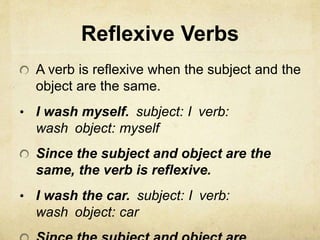
A verb is reflexive when the subject and the
object are the same.
• I wash myself. subject: I verb:
wash object: myself
Since the subject and object are the
same, the verb is reflexive.
• I wash the car. subject: I verb:
wash object: car
Reflexive Verbs
Here's another example of how a verb can be either
reflexive or non-reflexive.
• I scratch myself. subject: I verb: scratch object:
myself
Since the subject and object are the same, the
verb is reflexive.
• I scratch the dog. subject: I verb: scratch object:
dog
Since the subject and object are different, the
verb is not reflexive.
Reflexive Verbs
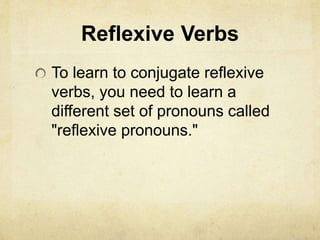
To learn to conjugate reflexive
verbs, you need to learn a
different set of pronouns called
"reflexive pronouns."
Reflexive Verbs
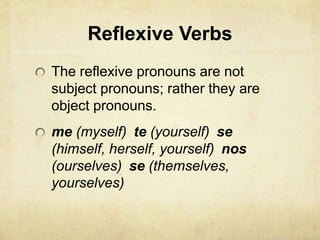
The reflexive pronouns are not
subject pronouns; rather they are
object pronouns.
me (myself) te (yourself) se
(himself, herself, yourself) nos
(ourselves) se (themselves,
yourselves)
Reflexive Verbs
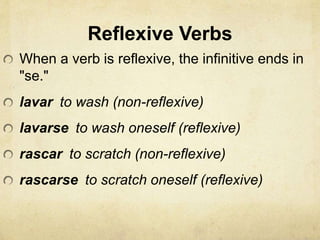
When a verb is reflexive, the infinitive ends in
"se."
lavar to wash (non-reflexive)
lavarse to wash oneself (reflexive)
rascar to scratch (non-reflexive)
rascarse to scratch oneself (reflexive)
Reflexive Verbs
There is one reflexive verb you have
been using since you began
studying Spanish.
llamarse - to call oneself
¿Cómo se llama usted? What do
you call yourself?
Me llamo Juan. I call myself Juan.
Reflexive Verbs
When you learned to conjugate
regular verbs, you needed to learn a
set of pronouns called "subject
pronouns.”
lavar
yo lavo tú lavas él, ella, usted
lava nosotros/as
lavamos vosotros/as laváis ellos,
ellas, ustedes lavan
Reflexive Verbs
The purpose of the reflexive object
pronouns is to show that the action
of the verb remains with the subject.
Juan se lava la cara. Juan washes
his face. (reflexive)
Juan lava su carro. (non-
reflexive) Juan washes his car.
Note: When referring to body parts,
use the definite article, thus "la cara"
Reflexive Verbs
wash the dog x wash your face
raise the book x raise your arm
put the baby to bed x go to bed
wake up your son x wake up
yourself
...and so on

Reflexive verbs

  • 1.
  • 2.
    Reflexive Verbs A verbis reflexive when the subject and the object are the same. • I wash myself. subject: I verb: wash object: myself Since the subject and object are the same, the verb is reflexive. • I wash the car. subject: I verb: wash object: car
  • 3.
    Reflexive Verbs Here's anotherexample of how a verb can be either reflexive or non-reflexive. • I scratch myself. subject: I verb: scratch object: myself Since the subject and object are the same, the verb is reflexive. • I scratch the dog. subject: I verb: scratch object: dog Since the subject and object are different, the verb is not reflexive.
  • 4.
    Reflexive Verbs To learnto conjugate reflexive verbs, you need to learn a different set of pronouns called "reflexive pronouns."
  • 5.
    Reflexive Verbs The reflexivepronouns are not subject pronouns; rather they are object pronouns. me (myself) te (yourself) se (himself, herself, yourself) nos (ourselves) se (themselves, yourselves)
  • 6.
    Reflexive Verbs When averb is reflexive, the infinitive ends in "se." lavar to wash (non-reflexive) lavarse to wash oneself (reflexive) rascar to scratch (non-reflexive) rascarse to scratch oneself (reflexive)
  • 7.
    Reflexive Verbs There isone reflexive verb you have been using since you began studying Spanish. llamarse - to call oneself ¿Cómo se llama usted? What do you call yourself? Me llamo Juan. I call myself Juan.
  • 8.
    Reflexive Verbs When youlearned to conjugate regular verbs, you needed to learn a set of pronouns called "subject pronouns.” lavar yo lavo tú lavas él, ella, usted lava nosotros/as lavamos vosotros/as laváis ellos, ellas, ustedes lavan
  • 9.
    Reflexive Verbs The purposeof the reflexive object pronouns is to show that the action of the verb remains with the subject. Juan se lava la cara. Juan washes his face. (reflexive) Juan lava su carro. (non- reflexive) Juan washes his car. Note: When referring to body parts, use the definite article, thus "la cara"
  • 10.
    Reflexive Verbs wash thedog x wash your face raise the book x raise your arm put the baby to bed x go to bed wake up your son x wake up yourself ...and so on