SEMANTICS AND
PRAGMATICS
PROFESSOR: Monserrat Angulo
Spring 2021
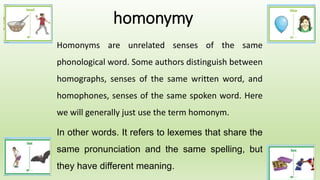
homonymy
Homonyms are unrelated senses of the same
phonological word. Some authors distinguish between
homographs, senses of the same written word, and
homophones, senses of the same spoken word. Here
we will generally just use the term homonym.
In other words. It refers to lexemes that share the
same pronunciation and the same spelling, but
they have different meaning.
We can distinguish different types depending on their syntactic behavior, and
spelling, for example:
1. lexemes of the same syntactic category, and with the same spelling: e.g.
lap “circuit of a course” and lap “part of body when sitting down”;
2. of the same category, but with different spelling: e.g. the verbs ring and
wring;
3. of different categories, but with the same spelling: e.g. the verb bear and
the noun bear;
4. of different categories, and with different spelling: e.g. not, knot.
Of course variations in pronunciation mean that not all speakers have the
same set of homonyms. Some English speakers for example pronounce the
pairs click and clique, or talk and torque, in the same way, making these
homonyms, which are spelled differently.
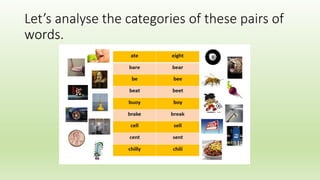
Let’s analyse the categories of these pairs of
words.
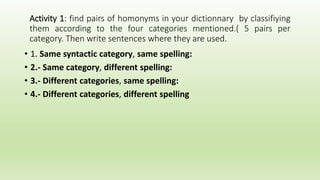
Activity 1: find pairs of homonyms in your dictionnary by classifiying
them according to the four categories mentioned.( 5 pairs per
category. Then write sentences where they are used.
• 1. Same syntactic category, same spelling:
• 2.- Same category, different spelling:
• 3.- Different categories, same spelling:
• 4.- Different categories, different spelling
Polysemy
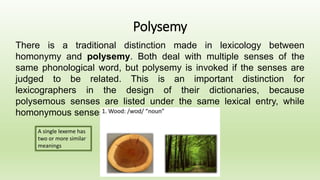
There is a traditional distinction made in lexicology between
homonymy and polysemy. Both deal with multiple senses of the
same phonological word, but polysemy is invoked if the senses are
judged to be related. This is an important distinction for
lexicographers in the design of their dictionaries, because
polysemous senses are listed under the same lexical entry, while
homonymous senses are given separate entries.
A single lexeme has
two or more similar
meanings
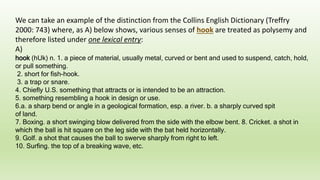
We can take an example of the distinction from the Collins English Dictionary (Treffry
2000: 743) where, as A) below shows, various senses of hook are treated as polysemy and
therefore listed under one lexical entry:
A)
hook (hUk) n. 1. a piece of material, usually metal, curved or bent and used to suspend, catch, hold,
or pull something.
2. short for fish-hook.
3. a trap or snare.
4. Chiefly U.S. something that attracts or is intended to be an attraction.
5. something resembling a hook in design or use.
6.a. a sharp bend or angle in a geological formation, esp. a river. b. a sharply curved spit
of land.
7. Boxing. a short swinging blow delivered from the side with the elbow bent. 8. Cricket. a shot in
which the ball is hit square on the leg side with the bat held horizontally.
9. Golf. a shot that causes the ball to swerve sharply from right to left.
10. Surfing. the top of a breaking wave, etc.
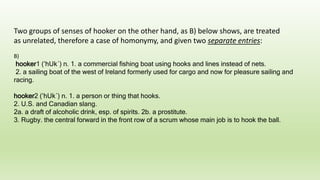
Two groups of senses of hooker on the other hand, as B) below shows, are treated
as unrelated, therefore a case of homonymy, and given two separate entries:
B)
hooker1 (’hUk´) n. 1. a commercial fishing boat using hooks and lines instead of nets.
2. a sailing boat of the west of Ireland formerly used for cargo and now for pleasure sailing and
racing.
hooker2 (’hUk´) n. 1. a person or thing that hooks.
2. U.S. and Canadian slang.
2a. a draft of alcoholic drink, esp. of spirits. 2b. a prostitute.
3. Rugby. the central forward in the front row of a scrum whose main job is to hook the ball.
ACTIVITY 2: Find a word in the dictionary that have many meanings but
they are all related in a way and one more word which represents
meanings totally disconnected one from the other.

Homonymys polisemys

  • 1.
  • 2.
    homonymy Homonyms are unrelatedsenses of the same phonological word. Some authors distinguish between homographs, senses of the same written word, and homophones, senses of the same spoken word. Here we will generally just use the term homonym. In other words. It refers to lexemes that share the same pronunciation and the same spelling, but they have different meaning.
  • 3.
    We can distinguishdifferent types depending on their syntactic behavior, and spelling, for example: 1. lexemes of the same syntactic category, and with the same spelling: e.g. lap “circuit of a course” and lap “part of body when sitting down”; 2. of the same category, but with different spelling: e.g. the verbs ring and wring; 3. of different categories, but with the same spelling: e.g. the verb bear and the noun bear; 4. of different categories, and with different spelling: e.g. not, knot. Of course variations in pronunciation mean that not all speakers have the same set of homonyms. Some English speakers for example pronounce the pairs click and clique, or talk and torque, in the same way, making these homonyms, which are spelled differently.
  • 4.
    Let’s analyse thecategories of these pairs of words.
  • 5.
    Activity 1: findpairs of homonyms in your dictionnary by classifiying them according to the four categories mentioned.( 5 pairs per category. Then write sentences where they are used. • 1. Same syntactic category, same spelling: • 2.- Same category, different spelling: • 3.- Different categories, same spelling: • 4.- Different categories, different spelling
  • 6.
    Polysemy There is atraditional distinction made in lexicology between homonymy and polysemy. Both deal with multiple senses of the same phonological word, but polysemy is invoked if the senses are judged to be related. This is an important distinction for lexicographers in the design of their dictionaries, because polysemous senses are listed under the same lexical entry, while homonymous senses are given separate entries. A single lexeme has two or more similar meanings
  • 7.
    We can takean example of the distinction from the Collins English Dictionary (Treffry 2000: 743) where, as A) below shows, various senses of hook are treated as polysemy and therefore listed under one lexical entry: A) hook (hUk) n. 1. a piece of material, usually metal, curved or bent and used to suspend, catch, hold, or pull something. 2. short for fish-hook. 3. a trap or snare. 4. Chiefly U.S. something that attracts or is intended to be an attraction. 5. something resembling a hook in design or use. 6.a. a sharp bend or angle in a geological formation, esp. a river. b. a sharply curved spit of land. 7. Boxing. a short swinging blow delivered from the side with the elbow bent. 8. Cricket. a shot in which the ball is hit square on the leg side with the bat held horizontally. 9. Golf. a shot that causes the ball to swerve sharply from right to left. 10. Surfing. the top of a breaking wave, etc.
  • 8.
    Two groups ofsenses of hooker on the other hand, as B) below shows, are treated as unrelated, therefore a case of homonymy, and given two separate entries: B) hooker1 (’hUk´) n. 1. a commercial fishing boat using hooks and lines instead of nets. 2. a sailing boat of the west of Ireland formerly used for cargo and now for pleasure sailing and racing. hooker2 (’hUk´) n. 1. a person or thing that hooks. 2. U.S. and Canadian slang. 2a. a draft of alcoholic drink, esp. of spirits. 2b. a prostitute. 3. Rugby. the central forward in the front row of a scrum whose main job is to hook the ball.
  • 9.
    ACTIVITY 2: Finda word in the dictionary that have many meanings but they are all related in a way and one more word which represents meanings totally disconnected one from the other.