Download as PDF, PPTX





![Functor
THE LEGEND
OF FUNCTOR
trait Functor[F[_]] {
def map[A, B](fa: F[A])(f: A => B): F[B]
}](https://image.slidesharecdn.com/refactoringfunctionaltypeclasses-200731140953/85/Refactoring-Functional-Type-Classes-5-320.jpg)
![Functor -> Apply
THE LEGEND
OF FUNCTOR
trait Apply[F[_]] extends Functor[F] {
def map[A, B](fa: F[A])(f: A => B): F[B]
def ap[A, B](ff: F[A => B])(f: F[A]): F[B]
}](https://image.slidesharecdn.com/refactoringfunctionaltypeclasses-200731140953/85/Refactoring-Functional-Type-Classes-6-320.jpg)
![Functor -> Apply -> Applicative
THE LEGEND
OF FUNCTOR
trait Applicative[F[_]] extends Apply[F] {
def map[A, B](fa: F[A])(f: A => B): F[B]
def ap[A, B](ff: F[A => B])(f: F[A]): F[B]
def pure[A](a: A): F[A]
}](https://image.slidesharecdn.com/refactoringfunctionaltypeclasses-200731140953/85/Refactoring-Functional-Type-Classes-7-320.jpg)
![Functor -> Apply -> Applicative -> Monad
THE LEGEND
OF FUNCTOR
trait Monad[F[_]] extends Applicative[F] {
def map[A, B](fa: F[A])(f: A => B): F[B]
def ap[A, B](ff: F[A => B])(f: F[A]): F[B]
def pure[A](a: A): F[A]
def flatMap[A, B](fa: F[A])(f: A => F[B]): F[B]
}
*Bind is skipped.](https://image.slidesharecdn.com/refactoringfunctionaltypeclasses-200731140953/85/Refactoring-Functional-Type-Classes-8-320.jpg)


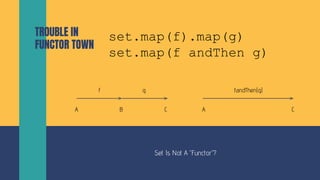
: F[B]
f :: Int -> Int -> Int -> Int
f <$> arg1 <*> arg2 <*> arg3](https://image.slidesharecdn.com/refactoringfunctionaltypeclasses-200731140953/85/Refactoring-Functional-Type-Classes-12-320.jpg)


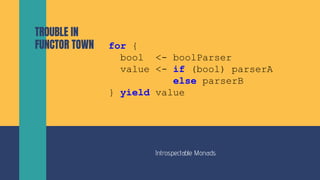
![ZIO Codec
TROUBLE IN
FUNCTOR TOWN
lazy val js: Codec[Val] =
((spacing, ()) ~>
(obj | arr | str | `true` |
`false` | `null` | num)
<~ ((), spacing))](https://image.slidesharecdn.com/refactoringfunctionaltypeclasses-200731140953/85/Refactoring-Functional-Type-Classes-16-320.jpg)
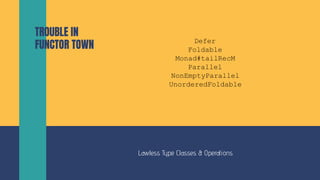
(f: A => B): F[B]
val fa: F[A] = …
val f : A => B = …
fa.map(a => f(a))
Type B is unconstrainable!](https://image.slidesharecdn.com/refactoringfunctionaltypeclasses-200731140953/85/Refactoring-Functional-Type-Classes-18-320.jpg)
![Invariance Pain
TROUBLE IN
FUNCTOR TOWN
val functorDog: F[Dog] = …
val functorAnimal: F[Animal] =
functorDog
ERROR!!!](https://image.slidesharecdn.com/refactoringfunctionaltypeclasses-200731140953/85/Refactoring-Functional-Type-Classes-19-320.jpg)
![Invariance Pain
TROUBLE IN
FUNCTOR TOWN
val functorDog: F[Dog] = …
val functorAnimal: F[Animal] =
functorDog.widen[Animal]](https://image.slidesharecdn.com/refactoringfunctionaltypeclasses-200731140953/85/Refactoring-Functional-Type-Classes-20-320.jpg)
: F[A] =
fa *> forever(fa)](https://image.slidesharecdn.com/refactoringfunctionaltypeclasses-200731140953/85/Refactoring-Functional-Type-Classes-21-320.jpg)


![Maddening Monad Transformers
TROUBLE IN
FUNCTOR TOWN
type MyApp[E, W, S, R, A] =
OptionT[
EitherT[
WriterT[
StateT[
Kleisli[Task, R, *],
S, *],
W, *],
E, *],
*]](https://image.slidesharecdn.com/refactoringfunctionaltypeclasses-200731140953/85/Refactoring-Functional-Type-Classes-25-320.jpg)


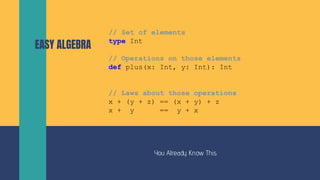
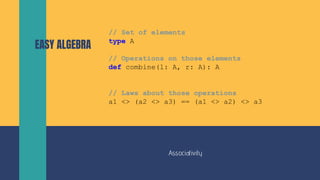
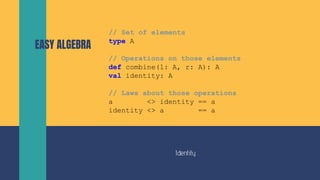
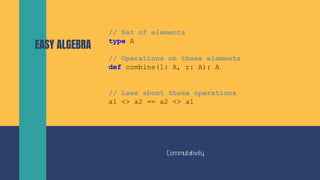

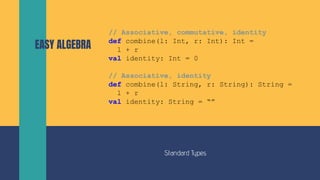
![EASY ALGEBRA
Business Domain Specific Types
final case class Csv(
rows: Vector[Vector[String]],
headers: Map[String, Int]
)
// Associative, identity
def combine(l: Csv, r: Csv): Csv =
???](https://image.slidesharecdn.com/refactoringfunctionaltypeclasses-200731140953/85/Refactoring-Functional-Type-Classes-34-320.jpg)



![TOUR OF ZIO
PRELUDE Data Structures &
Patterns for
Traversing
List[A], Option[A], ...
Patterns of
Composition for
Types
(A, A) => A
Patterns of
Composition for
Type Constructors
(F[A], F[A]) => F[A]
Three Areas of Focus](https://image.slidesharecdn.com/refactoringfunctionaltypeclasses-200731140953/85/Refactoring-Functional-Type-Classes-38-320.jpg)

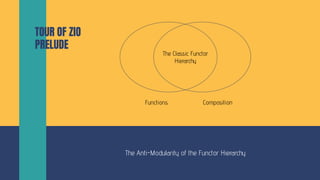
![TOUR OF ZIO
PRELUDE
The Anti-Modularity of the Functor Hierarchy
trait Monad[F[_]] extends Applicative[F] {
def map[A, B](fa: F[A])(f: A => B): F[B]
def ap[A, B](ff: F[A => B])(f: F[A]): F[B]
def pure[A](a: A): F[A]
def flatMap[A, B](fa: F[A])(f: A => F[B]): F[B]
}](https://image.slidesharecdn.com/refactoringfunctionaltypeclasses-200731140953/85/Refactoring-Functional-Type-Classes-41-320.jpg)
![TOUR OF ZIO
PRELUDE
Detangling Functions from Composition
trait Monad[F[_]] {
def map[A, B](fa: F[A])(f: A => B): F[B]
def zip[A, B](fa: F[A], fb: F[B]): F[(A, B)]
def any: F[Any]
def flatten[A](fa: F[F[A]]): F[A]
}](https://image.slidesharecdn.com/refactoringfunctionaltypeclasses-200731140953/85/Refactoring-Functional-Type-Classes-42-320.jpg)

![TOUR OF ZIO
PRELUDE
The Modularity of the ZIO Prelude Hierarchy
type Semigroup[A] = Associative[A]
type CommutativeSemigroup[A] = Associative[A] with Commutative[A]
type Monoid[A] = Identity[A]
type CommutativeMonoid[A] = Commutative[A] with Identity[A]
type Group[A] = Identity[A] with Inverse[A]
type AbelianGroup[A] = Commutative[A] with Identity[A] with Inverse[A]](https://image.slidesharecdn.com/refactoringfunctionaltypeclasses-200731140953/85/Refactoring-Functional-Type-Classes-44-320.jpg)
![TOUR OF ZIO
PRELUDE
The Modularity of the ZIO Prelude Hierarchy
type Functor[F[+_]] = Covariant[F]
type Contravariant[F[-_]] = zio.prelude.Contravariant[F]
type Invariant[F[_]] = zio.prelude.Invariant[F]
type Alternative[F[+_]] = Covariant[F] with IdentityBoth[F] with IdentityEither[F]
type InvariantAlt[F[_]] = Invariant[F] with IdentityBoth[F] with IdentityEither[F]](https://image.slidesharecdn.com/refactoringfunctionaltypeclasses-200731140953/85/Refactoring-Functional-Type-Classes-45-320.jpg)
![TOUR OF ZIO
PRELUDE
The Modularity of the ZIO Prelude Hierarchy
type InvariantSemigroupal[F[_]] = Invariant[F] with AssociativeBoth[F]
type Semigroupal[F[+_]] = Covariant[F] with AssociativeBoth[F]
type ContravariantSemigroupal[F[-_]] = Contravariant[F] with AssociativeBoth[F]
type SemigroupK[F[_]] = AssociativeEither[F]
type MonoidK[F[_]] = IdentityEither[F]
type ContravariantMonoidal[F[-_]] = Contravariant[F] with IdentityBoth[F]
type InvariantMonoidal[F[_]] = Invariant[F] with IdentityBoth[F]](https://image.slidesharecdn.com/refactoringfunctionaltypeclasses-200731140953/85/Refactoring-Functional-Type-Classes-46-320.jpg)
![TOUR OF ZIO
PRELUDE
The Modularity of the ZIO Prelude Hierarchy
type FlatMap[F[+_]] = Covariant[F] with AssociativeFlatten[F]
type Monad[F[+_]] = Covariant[F] with IdentityFlatten[F]
type Divide[F[-_]] = Contravariant[F] with AssociativeBoth[F]
type Divisible[F[-_]] = Contravariant[F] with IdentityBoth[F]
type Decidable[F[-_]] = Contravariant[F] with IdentityBoth[F] with IdentityEither[F]
type Apply[F[+_]] = Covariant[F] with AssociativeBoth[F]
type Applicative[F[+_]] = Covariant[F] with IdentityBoth[F]
type InvariantApplicative[F[_]] = Invariant[F] with IdentityBoth[F]](https://image.slidesharecdn.com/refactoringfunctionaltypeclasses-200731140953/85/Refactoring-Functional-Type-Classes-47-320.jpg)
![TOUR OF ZIO
PRELUDE
trait Associative[A] {
def combine(l: A, r: A): A
}
// a1 <> (a2 <> a3) == (a1 <> a2) <> a3](https://image.slidesharecdn.com/refactoringfunctionaltypeclasses-200731140953/85/Refactoring-Functional-Type-Classes-48-320.jpg)
![TOUR OF ZIO
PRELUDE
trait Identity[A] extends Associative[A] {
def combine(l: A, r: A): A
def identity: A
}
// a <> identity == a
// identity <> a == a](https://image.slidesharecdn.com/refactoringfunctionaltypeclasses-200731140953/85/Refactoring-Functional-Type-Classes-49-320.jpg)
![TOUR OF ZIO
PRELUDE
trait Commutative[A] extends Associative[A] {
def combine(l: A, r: A): A
}
// a1 <> a2 == a2 <> a1](https://image.slidesharecdn.com/refactoringfunctionaltypeclasses-200731140953/85/Refactoring-Functional-Type-Classes-50-320.jpg)
![TOUR OF ZIO
PRELUDE
trait Covariant[F[+_]] {
def map[A, B](f: A => B):
F[A] => F[B]
}
Variance Guarantees Automatic Widening](https://image.slidesharecdn.com/refactoringfunctionaltypeclasses-200731140953/85/Refactoring-Functional-Type-Classes-51-320.jpg)
![TOUR OF ZIO
PRELUDE
trait Contravariant[F[-_]] {
def contramap[A, B](f: B => A):
F[A] => F[B]
}
Variance Guarantees Automatic Narrowing](https://image.slidesharecdn.com/refactoringfunctionaltypeclasses-200731140953/85/Refactoring-Functional-Type-Classes-52-320.jpg)

trait Invariant[F[_]] {
def invmap[A, B](f: A <=> B):
F[A] <=> F[B]
}](https://image.slidesharecdn.com/refactoringfunctionaltypeclasses-200731140953/85/Refactoring-Functional-Type-Classes-53-320.jpg)
![TOUR OF ZIO
PRELUDE
trait AssociativeBoth[F[_]] {
def combine[A, B](
left : F[A],
right: F[B]): F[(A, B)]
}
// zio1 zip zio2](https://image.slidesharecdn.com/refactoringfunctionaltypeclasses-200731140953/85/Refactoring-Functional-Type-Classes-54-320.jpg)
![TOUR OF ZIO
PRELUDE
trait AssociativeEither[F[_]] {
def combine[A, B](
left : F[A],
right: F[B]): F[Either[A, B]]
}
// zio1 orElseEither zio2](https://image.slidesharecdn.com/refactoringfunctionaltypeclasses-200731140953/85/Refactoring-Functional-Type-Classes-55-320.jpg)
![TOUR OF ZIO
PRELUDE
trait AssociativeFlatten[F[+_]] {
def flatten[A](nested: F[F[A]]): F[A]
}
// zio.flatten](https://image.slidesharecdn.com/refactoringfunctionaltypeclasses-200731140953/85/Refactoring-Functional-Type-Classes-56-320.jpg)
![TOUR OF ZIO
PRELUDE
trait IdentityBoth[F[_]] extends
AssociativeBoth[F] {
def combine[A, B](
left : F[A],
right: F[B]): F[(A, B)]
def any: F[Any]
}
// zio1 zip zio2
// ZIO.unit](https://image.slidesharecdn.com/refactoringfunctionaltypeclasses-200731140953/85/Refactoring-Functional-Type-Classes-57-320.jpg)
![TOUR OF ZIO
PRELUDE
trait IdentityEither[F[_]] extends
AssociativeBoth[F] {
def combine[A, B](
left : F[A],
right: F[B]): F[Either[A, B]]
def none: F[Nothing]
}
// zio1 orElseEither zio2
// ZIO.halt(Cause.empty)](https://image.slidesharecdn.com/refactoringfunctionaltypeclasses-200731140953/85/Refactoring-Functional-Type-Classes-58-320.jpg)
![TOUR OF ZIO
PRELUDE
trait IdentityFlatten[F[+_]] extends
AssociativeFlatten[F] {
def flatten[A](nested: F[F[A]]): F[A]
def any: F[Any]
}
// zio.flatten
// ZIO.unit](https://image.slidesharecdn.com/refactoringfunctionaltypeclasses-200731140953/85/Refactoring-Functional-Type-Classes-59-320.jpg)
![TOUR OF ZIO
PRELUDE
trait CommutativeBoth[F[_]] extends
AssociativeBoth[F] {
def combine[A, B](
left : F[A],
right: F[B]): F[(A, B)]
}
// zio1 zipPar zio2](https://image.slidesharecdn.com/refactoringfunctionaltypeclasses-200731140953/85/Refactoring-Functional-Type-Classes-60-320.jpg)
![TOUR OF ZIO
PRELUDE
trait CommutativeEither[F[_]] extends
AssociativeEither[F] {
def combine[A, B](
left : F[A],
right: F[B]): F[Either[A, B]]
}
// zio1 raceEither zio2](https://image.slidesharecdn.com/refactoringfunctionaltypeclasses-200731140953/85/Refactoring-Functional-Type-Classes-61-320.jpg)
![TOUR OF ZIO
PRELUDE
trait Traversable[Data[+_]] {
def foreach[Effect[_]: …, A, B](as: Data[A])(
f: A => Effect[B]): Effect[Data[B]]
}
// requests.foreach { request =>
// handleRequest(request)
// }](https://image.slidesharecdn.com/refactoringfunctionaltypeclasses-200731140953/85/Refactoring-Functional-Type-Classes-62-320.jpg)
![TOUR OF ZIO
PRELUDE
trait NonEmptyTraversable[Data[+_]] extends
Traversable[Data] {
def foreach1[Effect[_]: …, A, B](as: Data[A])(
f: A => Effect[B]): Effect[Data[B]]
}](https://image.slidesharecdn.com/refactoringfunctionaltypeclasses-200731140953/85/Refactoring-Functional-Type-Classes-63-320.jpg)
![TOUR OF ZIO
PRELUDE
Debug[-A]
Equal[-A]
Hash[-A]
Ord[-A]
Embracing Declaration-Site Variance
implicit val ordAnimal:
Ord[Animal] = …
if (dog1 <= dog2) {
// WORKS!!!
}](https://image.slidesharecdn.com/refactoringfunctionaltypeclasses-200731140953/85/Refactoring-Functional-Type-Classes-64-320.jpg)
![TOUR OF ZIO
PRELUDE
NonEmptyList[A]
Validation[E, A]
ZSet[M, A]
Embrace & Extend Scala Collections](https://image.slidesharecdn.com/refactoringfunctionaltypeclasses-200731140953/85/Refactoring-Functional-Type-Classes-65-320.jpg)
![TOUR OF ZIO
PRELUDE
trait ZPure[-StateIn, +StateOut, -Env, +Err, +Success]
type State[S, +A] = ZPure[S, S, Any, Nothing, A]
type EState[S, +E, +A] = ZPure[S, S, Any, E , A]
No More Monad Transformers
For when you think ZIO is great but just doesn’t have enough type parameters](https://image.slidesharecdn.com/refactoringfunctionaltypeclasses-200731140953/85/Refactoring-Functional-Type-Classes-66-320.jpg)
![TOUR OF ZIO
PRELUDE
type MyStack[S1, S2, R, E, A] =
Kleisli[
({ type lambda[a] =
EitherT[
({ type lambda[a] =
IndexedStateT[Eval, S1, S2, a]
})#lambda,
E,
a]
})#lambda,
R,
A]
The Alternative](https://image.slidesharecdn.com/refactoringfunctionaltypeclasses-200731140953/85/Refactoring-Functional-Type-Classes-67-320.jpg)
![TOUR OF ZIO
PRELUDE
// Monad Transformers
def get[S, R, E]: MyStack[S, S, R, E, S] = {
type SState[A] = State[S, A]
type EitherESState[A] = EitherT[SState, E, A]
val eitherT = EitherT.liftF[SState, E, S](State.get)
Kleisli.liftF[EitherESState, R, S](eitherT)
}
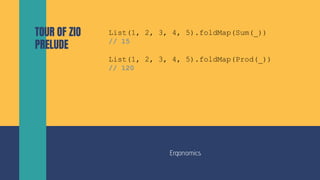
// ZPure
def get[S]: State[S, S] =
State.get[S]
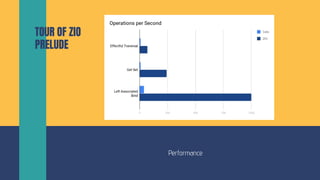
Ergonomics](https://image.slidesharecdn.com/refactoringfunctionaltypeclasses-200731140953/85/Refactoring-Functional-Type-Classes-68-320.jpg)
![TOUR OF ZIO
PRELUDE
Newtypes
object Meter extends Subtype[Int]
type Meter = Meter.Type
object Sum extends SubtypeF
type Sum[A] = Sum.Type[A]
object Natural extends
NewtypeSmart[Int](isGreaterThanEqualTo(0))
type Natural = Natural.Type](https://image.slidesharecdn.com/refactoringfunctionaltypeclasses-200731140953/85/Refactoring-Functional-Type-Classes-70-320.jpg)




The document discusses the complexities and modularity of functors and type classes in functional programming, particularly within the context of Scala. It critiques the Haskell functor hierarchy, presenting alternatives provided by the ZIO Prelude library that aim to offer better compositional patterns. The document also highlights design principles and various type classes that facilitate easier and more ergonomic programming practices.


![Getting Started with Apache Spark: Big Data Made Simple [Free Meetup]](https://cdn.slidesharecdn.com/ss_thumbnails/apachesparkgettingstarted-260203175547-8361bcc3-thumbnail.jpg?width=640&height=640&fit=bounds)


