
Applicative	Functor
learn how to use an Applicative Functor to handle multiple independent effectful values
through	the	work	of
slides	by @philip_schwarz
Paul	ChiusanoSergei	Winitzki Runar	Bjarnason Debasish	Ghosh Adelbert	Chang
@adelbertchang@debasishg@pchiusano@runaroramasergei-winitzki-11a6431
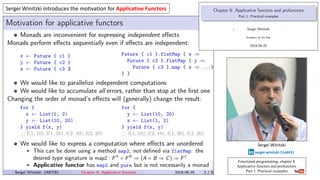
Sergei	Winitzki	introduces	the	motivation	for	Applicative Functors
Functional programming, chapter 8.
Applicative functors and profunctors.
Part 1: Practical examples
Sergei	Winitzki
sergei-winitzki-11a6431
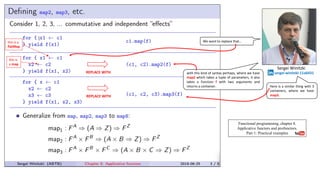
with this kind of syntax perhaps, where we have
map2 which takes a tuple of parameters, it also
takes a function f with two arguments and
returns a container.
this	is	a	
flatMap
this	is	
a	map
We want to replace that…
REPLACE	WITH
REPLACE	WITH
Here is a similar thing with 3
containers, where we have
map3.
Functional programming, chapter 8.
Applicative functors and profunctors.
Part 1: Practical examples
Sergei	Winitzki
sergei-winitzki-11a6431
Sergei	Winitzki	defines	map2 for	Either[String,	A]
In the case where we have
two errors, we want to
accumulate the two errors.
In the case where we have two results,
we can actually perform the computation
that is requested, which is this function f.
only	the	first	error	is	returned
both	errors	are	returned
In these two cases there is not
enough data to call f so we
return an error.
Notice that map2 does
more than a monadic for,
which stops after the first
error: it can accumulate all
the errors.
Functional programming, chapter 8.
Applicative functors and profunctors.
Part 1: Practical examples
Sergei	Winitzki
sergei-winitzki-11a6431
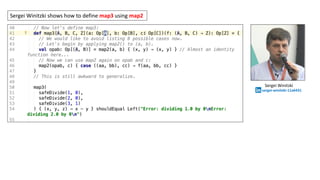
Sergei	Winitzki	shows	how	to	define	map3 using	map2
Sergei	Winitzki
sergei-winitzki-11a6431
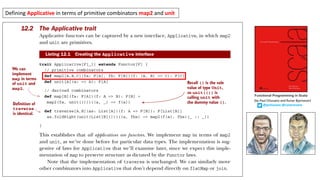
Defining	Applicative in	terms	of	primitive	combinators	map2 and	unit
Functional Programming in Scala
(by	Paul	Chiusano	and	Runar	Bjarnason)
@pchiusano @runarorama
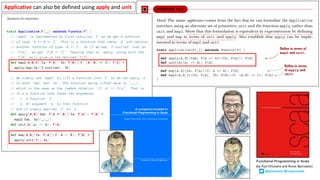
Applicative can	also	be	defined	using	apply and	unit
Functional Programming in Scala
(by	Paul	Chiusano	and	Runar	Bjarnason)
@pchiusano @runarorama
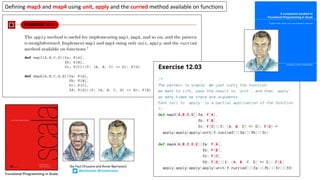
Defining	map3 and	map4 using	unit,	apply and	the	curried method	available	on	functions
Functional Programming in Scala
(by	Paul	Chiusano	and	Runar	Bjarnason)
@pchiusano @runarorama
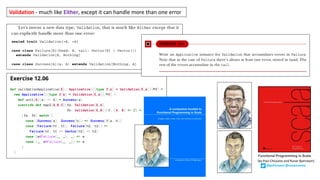
Validation - much	like	Either,	except	it	can	handle	more	than	one	error
Functional Programming in Scala
(by	Paul	Chiusano	and	Runar	Bjarnason)
@pchiusano @runarorama
Validation of	independent	values	using	map3
Functional Programming in Scala
(by	Paul	Chiusano	and	Runar	Bjarnason)
@pchiusano @runarorama
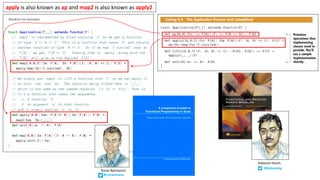
apply is	also	known	as	ap and	map2 is	also	known	as	apply2
@debasishg
Debasish	Ghosh
Runar	Bjarnason)
@runarorama
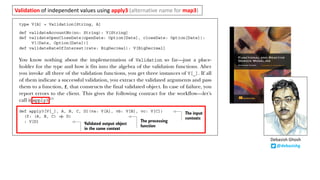
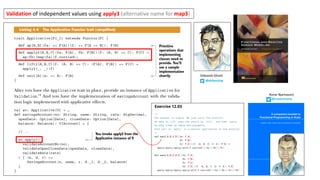
Validation of	independent	values	using	apply3 (alternative	name	for map3)
@debasishg
Debasish	Ghosh
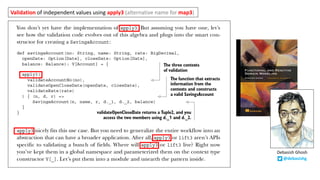
Validation of	independent	values	using	apply3 (alternative	name	for	map3)
@debasishg
Debasish	Ghosh
Validation of	independent	values	using	apply3 (alternative	name	for	map3)
@debasishg
Debasish	Ghosh
Runar	Bjarnason)
@runarorama
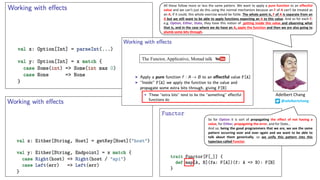
All these follow more or less the same pattern. We want to apply a pure function to an effectful
value and we can’t just do this using the normal mechanism because an F of A can’t be treated as
an A, if it could, this whole exercise would be futile. The whole point is, F of A is separate from an
A but we still want to be able to apply functions expecting an A to this value. And so for each F,
e.g. Option, Either, State, they have this notion of getting inside this value and observing what
that is, and in the case where we do have an A, apply the function and then we are also going to
plumb some bits through.
So for Option it is sort of propagating the effect of not having a
value, for Either, propagating the error, and for State…
And so, being the good programmers that we are, we see the same
pattern occurring over and over again and we want to be able to
talk about them generically, so we unify this pattern into this
typeclass called Functor.
Adelbert	Chang
@adelbertchang
The Functor, Applicative, Monad talk
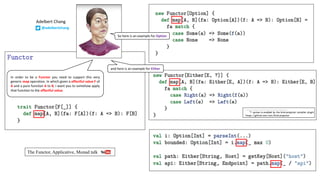
In order to be a Functor you need to support this very
generic map operation. In which given a effectful value F of
A and a pure function A to B, I want you to somehow apply
that function to the effectful value.
So here is an example for Option
and here is an example for Either
Adelbert	Chang
@adelbertchang
The Functor, Applicative, Monad talk
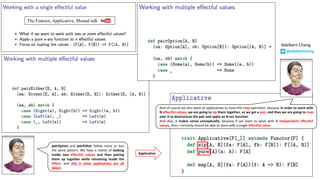
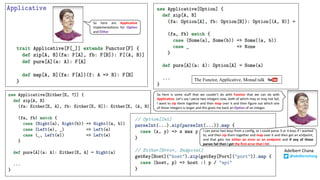
pairOption and pairEither follow more or less
the same pattern. We have a notion of looking
inside two effectful values and then pairing
them up together while remaining inside the
effect, and this is what applicatives are all
about.
And of course we also want all applicatives to have this map operation, because in order to work with
N effectful values, we are going to zip them together, so we get a pair, and then we are going to map
over it to destructure the pair and apply an N-ary function.
And also, it makes sense conceptually, because if we claim to work with N independent effectful
values, then I certainly should be able to work with a single effectful value.
Applicative
Adelbert	Chang
@adelbertchang
The Functor, Applicative, Monad talk
So here are Applicative
implementations for Option
and Either
So here is some stuff that we couldn’t do with Functor that we can do with
Applicative. Let’s say I parse two integers now, both of which may or may not fail,
I want to zip them together and then map over it and then figure out which one
of those integers is larger and this gives me back an Option of an integer.
I can parse two keys from a config, or I could parse 3 or 4 keys if I wanted
to, and then zip them together and map over it and then get an endpoint,
and that gets me either an error or an endpoint and if any of those
parses fail then I get the first error that I hit.
Adelbert	Chang
@adelbertchang
The Functor, Applicative, Monad talk
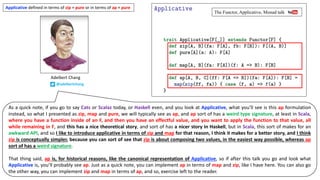
As a quick note, if you go to say Cats or Scalaz today, or Haskell even, and you look at Applicative, what you’ll see is this ap formulation
instead, so what I presented as zip, map and pure, we will typically see as ap, and ap sort of has a weird type signature, at least in Scala,
where you have a function inside of an F, and then you have an effectful value, and you want to apply the function to that value, all
while remaining in F, and this has a nice theoretical story, and sort of has a nicer story in Haskell, but in Scala, this sort of makes for an
awkward API, and so I like to introduce applicative in terms of zip and map for that reason, I think it makes for a better story, and I think
zip is conceptually simpler, because you can sort of see that zip is about composing two values, in the easiest way possible, whereas ap
sort of has a weird signature.
That thing said, ap is, for historical reasons, like the canonical representation of Applicative, so if after this talk you go and look what
Applicative is, you’ll probably see ap. Just as a quick note, you can implement ap in terms of map and zip, like I have here. You can also go
the other way, you can implement zip and map in terms of ap, and so, exercise left to the reader.
Applicative defined	in	terms	of	zip	+	pure	or	in	terms	of	ap	+	pure
Adelbert	Chang
@adelbertchang
The Functor, Applicative, Monad talk

Applicative Functor

  • 1.
    Applicative Functor learn how touse an Applicative Functor to handle multiple independent effectful values through the work of slides by @philip_schwarz Paul ChiusanoSergei Winitzki Runar Bjarnason Debasish Ghosh Adelbert Chang @adelbertchang@debasishg@pchiusano@runaroramasergei-winitzki-11a6431
  • 2.
    Sergei Winitzki introduces the motivation for Applicative Functors Functional programming,chapter 8. Applicative functors and profunctors. Part 1: Practical examples Sergei Winitzki sergei-winitzki-11a6431
  • 3.
    with this kindof syntax perhaps, where we have map2 which takes a tuple of parameters, it also takes a function f with two arguments and returns a container. this is a flatMap this is a map We want to replace that… REPLACE WITH REPLACE WITH Here is a similar thing with 3 containers, where we have map3. Functional programming, chapter 8. Applicative functors and profunctors. Part 1: Practical examples Sergei Winitzki sergei-winitzki-11a6431
  • 4.
    Sergei Winitzki defines map2 for Either[String, A] In thecase where we have two errors, we want to accumulate the two errors. In the case where we have two results, we can actually perform the computation that is requested, which is this function f. only the first error is returned both errors are returned In these two cases there is not enough data to call f so we return an error. Notice that map2 does more than a monadic for, which stops after the first error: it can accumulate all the errors. Functional programming, chapter 8. Applicative functors and profunctors. Part 1: Practical examples Sergei Winitzki sergei-winitzki-11a6431
  • 5.
  • 6.
    Defining Applicative in terms of primitive combinators map2 and unit FunctionalProgramming in Scala (by Paul Chiusano and Runar Bjarnason) @pchiusano @runarorama
  • 7.
    Applicative can also be defined using apply and unit FunctionalProgramming in Scala (by Paul Chiusano and Runar Bjarnason) @pchiusano @runarorama
  • 8.
    Defining map3 and map4 using unit, applyand the curried method available on functions Functional Programming in Scala (by Paul Chiusano and Runar Bjarnason) @pchiusano @runarorama
  • 9.
    Validation - much like Either, except it can handle more than one error FunctionalProgramming in Scala (by Paul Chiusano and Runar Bjarnason) @pchiusano @runarorama
  • 10.
    Validation of independent values using map3 Functional Programmingin Scala (by Paul Chiusano and Runar Bjarnason) @pchiusano @runarorama
  • 11.
    apply is also known as ap and map2is also known as apply2 @debasishg Debasish Ghosh Runar Bjarnason) @runarorama
  • 12.
  • 13.
  • 14.
  • 15.
    All these followmore or less the same pattern. We want to apply a pure function to an effectful value and we can’t just do this using the normal mechanism because an F of A can’t be treated as an A, if it could, this whole exercise would be futile. The whole point is, F of A is separate from an A but we still want to be able to apply functions expecting an A to this value. And so for each F, e.g. Option, Either, State, they have this notion of getting inside this value and observing what that is, and in the case where we do have an A, apply the function and then we are also going to plumb some bits through. So for Option it is sort of propagating the effect of not having a value, for Either, propagating the error, and for State… And so, being the good programmers that we are, we see the same pattern occurring over and over again and we want to be able to talk about them generically, so we unify this pattern into this typeclass called Functor. Adelbert Chang @adelbertchang The Functor, Applicative, Monad talk
  • 16.
    In order tobe a Functor you need to support this very generic map operation. In which given a effectful value F of A and a pure function A to B, I want you to somehow apply that function to the effectful value. So here is an example for Option and here is an example for Either Adelbert Chang @adelbertchang The Functor, Applicative, Monad talk
  • 17.
    pairOption and pairEitherfollow more or less the same pattern. We have a notion of looking inside two effectful values and then pairing them up together while remaining inside the effect, and this is what applicatives are all about. And of course we also want all applicatives to have this map operation, because in order to work with N effectful values, we are going to zip them together, so we get a pair, and then we are going to map over it to destructure the pair and apply an N-ary function. And also, it makes sense conceptually, because if we claim to work with N independent effectful values, then I certainly should be able to work with a single effectful value. Applicative Adelbert Chang @adelbertchang The Functor, Applicative, Monad talk
  • 18.
    So here areApplicative implementations for Option and Either So here is some stuff that we couldn’t do with Functor that we can do with Applicative. Let’s say I parse two integers now, both of which may or may not fail, I want to zip them together and then map over it and then figure out which one of those integers is larger and this gives me back an Option of an integer. I can parse two keys from a config, or I could parse 3 or 4 keys if I wanted to, and then zip them together and map over it and then get an endpoint, and that gets me either an error or an endpoint and if any of those parses fail then I get the first error that I hit. Adelbert Chang @adelbertchang The Functor, Applicative, Monad talk
  • 19.
    As a quicknote, if you go to say Cats or Scalaz today, or Haskell even, and you look at Applicative, what you’ll see is this ap formulation instead, so what I presented as zip, map and pure, we will typically see as ap, and ap sort of has a weird type signature, at least in Scala, where you have a function inside of an F, and then you have an effectful value, and you want to apply the function to that value, all while remaining in F, and this has a nice theoretical story, and sort of has a nicer story in Haskell, but in Scala, this sort of makes for an awkward API, and so I like to introduce applicative in terms of zip and map for that reason, I think it makes for a better story, and I think zip is conceptually simpler, because you can sort of see that zip is about composing two values, in the easiest way possible, whereas ap sort of has a weird signature. That thing said, ap is, for historical reasons, like the canonical representation of Applicative, so if after this talk you go and look what Applicative is, you’ll probably see ap. Just as a quick note, you can implement ap in terms of map and zip, like I have here. You can also go the other way, you can implement zip and map in terms of ap, and so, exercise left to the reader. Applicative defined in terms of zip + pure or in terms of ap + pure Adelbert Chang @adelbertchang The Functor, Applicative, Monad talk