©2021 VMware, Inc.
Going Serverless
using the Spring Framework ecosystem
Timo Salm
Senior Specialist Solution Engineer VMware Tanzu
September 2021
©2021 VMware, Inc.
Agenda
2
▪ About me
▪ What is Serverless?
▪ Going Serverless with your Spring Boot applications
©2021 VMware, Inc. 3
About me
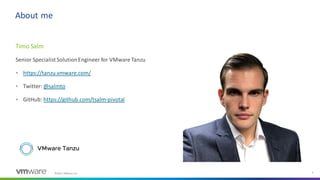
Timo Salm
Senior SpecialistSolutionEngineer for VMware Tanzu
▪ https://tanzu.vmware.com/
▪ Twitter: @salmto
▪ GitHub: https://github.com/tsalm-pivotal
4
©2021 VMware, Inc.
What Is Serverless?
©2021 VMware, Inc. 5
Serverless doesn’t mean there are no servers, it means you don’t care about them.
Serverless can be group into two areas:
▪ Backend as a Service (BaaS) Replacing server-side, self-managed components with off-the-shelf
services
▪ Functions as a Service (FaaS) A new way of building and deploying server-side software, oriented
around deploying individual functions
The key is that with both, you don't have to manageyour own server hosts or server processes and can
focus on business value!
What is Serverless?
©2021 VMware, Inc. 6
A Serverless service …
▪ … does not require managing a long-lived host or application instance
▪ … self auto-scales and auto-provisions, dependent on load
▪ … has implicit high availability
▪ … has performance capabilities defined in terms other than host size/count
▪ … has costs that are based on precise usage, up from and down to zero usage
Key characteristics
What is Serverless?
©2021 VMware, Inc. 7
▪ Shorter lead time
▪ Reduced packaging and deploymentcomplexity
▪ Increased flexibility of scaling
▪ Reduced resource cost
▪ Reduced labor cost
▪ Reduced risk
Why Serverless?
©2021 VMware, Inc. 8
▪ Unpredictable costs
▪ Spinning up machines takes time - from a few seconds to minutes
▪ Most Serverless applications are stateless and the managementof state can be somewhat tricky
▪ Higher latency due to inter-component communication over HTTP APIs and “cold starts”
▪ Problematic with downstream systems that cannot increase their capacity quickly enough
▪ Typically limited in how long each invocation is allowed to run
▪ Multitenancy problems
Part 1/2
Drawbacks / Limitations of Serverless
©2021 VMware, Inc. 9
▪ Debugging is more complicated (a single request can travel between several machines and some of
those machines disappear at times)
▪ Added work is needed to provide tracing and monitoring solutions, which can add complexity and cost
to the project
▪ Security can be more demanding in a serverless environment
▪ Loss of control over
▪ absoluteconfiguration
▪ the performance of Serverless components
▪ issue resolution
▪ security
▪ The difficulty of local testing
▪ Vendor lock-in unless you are using OSS projects like e.g. Knative
Part 2/2
Drawbacks / Limitations of Serverless
©2021 VMware, Inc. 10
An open-source community project which adds components for
deploying, running, and managing applicationson any Kubernetes
in a Serverless way.
What is Knative?
To primary components:
▪ Serving:Supports deploying and serving of serverless applications and functions
▪ Eventing: Enables developers to use an event-driven architecture with serverless
applications
©2021 VMware, Inc. 11
Summary
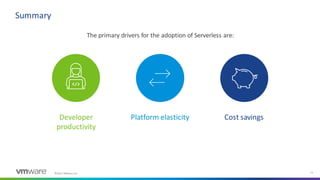
The primary drivers for the adoption of Serverless are:
Developer
productivity
Platform elasticity Cost savings
12
©2021 VMware, Inc.
Going Serverless
with your Spring Boot applications
13
©2021 VMware, Inc.
Demo
Running a Spring Boot application on Knative
©2021 VMware, Inc. 16
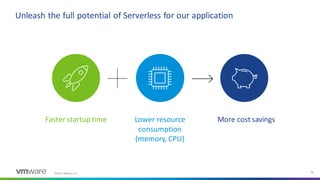
Unleash the full potential of Serverless for our application
Faster startup time Lower resource
consumption
(memory, CPU)
More cost savings
©2021 VMware, Inc. 17
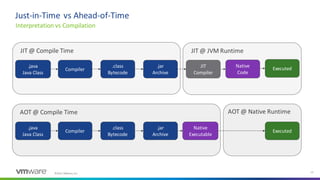
Interpretation vs Compilation
Just-in-Time vs Ahead-of-Time
.java
Java Class
JIT @ Compile Time
Compiler
.class
Bytecode
JIT @ JVM Runtime
JIT
Compiler
Native
Code
.java
Java Class
AOT @ Compile Time
Compiler
.class
Bytecode
AOT @ Native Runtime
.jar
Archive
Executed
Native
Executable
Executed
.jar
Archive
©2021 VMware, Inc. 18
What are Native Images?
Smaller, faster and lower resource consumption
▪ Standaloneexecutableof ahead-of-time compiled Javacode
▪ Includes the applicationclasses, classes from its dependencies, runtime library classes, and statically linked
native code from JDK
▪ Runs without the need of a JVM, necessary componentsare includedin a runtime system, called“Substrate VM”
▪ Specific to the OS and machine architecture for which it was compiled
▪ Requires fewer resources than regular Javaapplicationsrunning on a JVM
©2021 VMware, Inc. 19
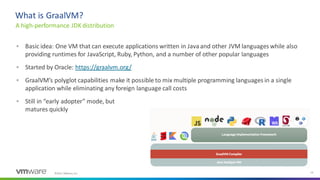
▪ Basic idea: One VM that can execute applications written in Java and other JVM languages while also
providing runtimes for JavaScript, Ruby, Python, and a number of other popular languages
▪ Started by Oracle: https://graalvm.org/
▪ GraalVM’s polyglot capabilities make it possible to mix multiple programming languages in a single
application while eliminating any foreign language call costs
▪ Still in “early adopter” mode, but
matures quickly
A high-performance JDKdistribution
What is GraalVM?
©2021 VMware, Inc. 20
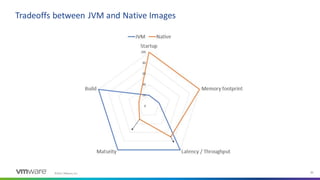
Tradeoffs between JVM and Native Images
©2021 VMware, Inc. 21
▪ A static analysis of your application from the main entry point is performed at build time
▪ The unused parts are removed at build time
▪ Configuration is required for reflection, resources, and dynamic proxies
▪ Classpath is fixed at build time
▪ No class lazy loading: everything shipped in the executables will be loaded in memory on startup
▪ Some code will run at build time
▪ There are some limitations around some aspects of Java applications that are not fully supported
Key differences between JVM and GraalVM native image platform
©2021 VMware, Inc. 23
Spring Native provides incubating support
for compiling Spring applications to lightweight native executables using the
GraalVM native-image compiler.
The goal is to support compilation of existing or new Spring Boot
applications to native executables.
Unchanged.
©2021 VMware, Inc. 24
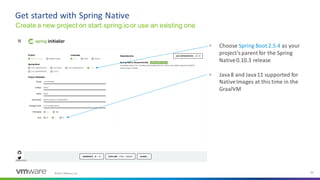
▪ Choose Spring Boot 2.5.4 as your
project’sparent for the Spring
Native0.10.3 release
▪ Java8 and Java11 supported for
NativeImages at this time in the
GraalVM
Get started with Spring Native
Create a new project on start.spring.io or use an existing one
©2021 VMware, Inc. 25
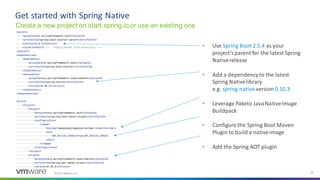
▪ Use Spring Boot 2.5.4 as your
project’sparent for the latest Spring
Nativerelease
▪ Add a dependencyto the latest
Spring Nativelibrary
e.g. spring-native version 0.10.3
▪ Leverage Paketo JavaNativeImage
Buildpack
▪ Configure the Spring Boot Maven
Plugin to build a nativeimage
▪ Add the Spring AOT plugin
Get started with Spring Native
Create a new project on start.spring.io or use an existing one
©2021 VMware, Inc. 26
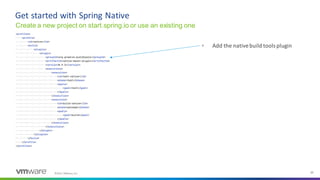
▪ Add the nativebuild tools plugin
Get started with Spring Native
Create a new project on start.spring.io or use an existing one
©2021 VMware, Inc. 27
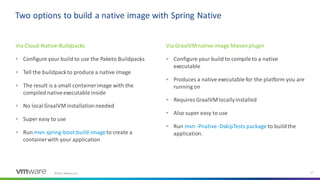
Two options to build a native image with Spring Native
Via Cloud-Native-Buildpacks
▪ Configure your build to use the Paketo Buildpacks
▪ Tell the buildpackto produce a native image
▪ The result is a small containerimage with the
compiled nativeexecutable inside
▪ No local GraalVM installationneeded
▪ Super easy to use
▪ Run mvn spring-boot:build-imageto create a
containerwith your application
Via GraalVM native image Mavenplugin
▪ Configure your build to compileto a native
executable
▪ Produces a native executable for the platform you are
running on
▪ Requires GraalVM locallyinstalled
▪ Also super easy to use
▪ Run mvn -Pnative -DskipTests package to buildthe
application.
28
©2021 VMware, Inc.
Demo
Running a Spring Boot application as Native Image
on Knative
©2021 VMware, Inc. 30
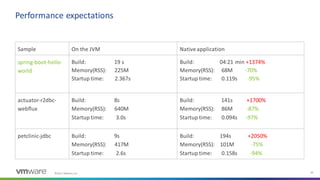
Performance expectations
Sample On the JVM Nativeapplication
spring-boot-hello-
world
Build: 19 s
Memory(RSS): 225M
Startup time: 2.367s
Build: 04:21 min +1374%
Memory(RSS): 68M -70%
Startup time: 0.119s -95%
actuator-r2dbc-
webflux
Build: 8s
Memory(RSS): 640M
Startup time: 3.0s
Build: 141s +1700%
Memory(RSS): 86M -87%
Startup time: 0.094s -97%
petclinic-jdbc Build: 9s
Memory(RSS): 417M
Startup time: 2.6s
Build: 194s +2050%
Memory(RSS): 101M -75%
Startup time: 0.158s -94%
©2021 VMware, Inc. 31
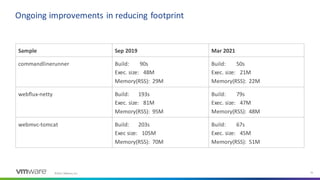
Ongoing improvements in reducing footprint
Sample Sep 2019 Mar 2021
commandlinerunner Build: 90s
Exec. size: 48M
Memory(RSS): 29M
Build: 50s
Exec. size: 21M
Memory(RSS): 22M
webflux-netty Build: 193s
Exec. size: 81M
Memory(RSS): 95M
Build: 79s
Exec. size: 47M
Memory(RSS): 48M
webmvc-tomcat Build: 203s
Exec size: 105M
Memory(RSS): 70M
Build: 67s
Exec. size: 45M
Memory(RSS): 51M
©2021 VMware, Inc. 32
▪ Delegate Native Imagebuilding to the CI/CD pipeline, leveraging Spring Native and Paketo
Buildpacks
▪ Unchanged Developer UX in your IDE, with the same JVM
Use JVM locally, delegate Native Builds to CI/CD…
Can I keep the great Spring UX when going Native?
©2021 VMware, Inc. 33
Spring Boot 3, based on Spring Framework 6, is expected to provide first-
class support for native application deployment, as well as an optimized
footprint on the JVM.
The road ahead
©2021 VMware, Inc. 34
▪ Documentation: https://docs.spring.io/spring-native/docs/current/reference/htmlsingle/
▪ Spring Native project on Github: https://github.com/spring-projects-experimental/spring-native
▪ Workshop by my awesome colleague Dan Dobrin: https://github.com/ddobrin/native-spring-on-k8s-
with-graalvm-workshop
Resources
©2021 VMware, Inc.
Thank You

Going Serverless Using the Spring Framework Ecosystem

  • 1.
    ©2021 VMware, Inc. GoingServerless using the Spring Framework ecosystem Timo Salm Senior Specialist Solution Engineer VMware Tanzu September 2021
  • 2.
    ©2021 VMware, Inc. Agenda 2 ▪About me ▪ What is Serverless? ▪ Going Serverless with your Spring Boot applications
  • 3.
    ©2021 VMware, Inc.3 About me Timo Salm Senior SpecialistSolutionEngineer for VMware Tanzu ▪ https://tanzu.vmware.com/ ▪ Twitter: @salmto ▪ GitHub: https://github.com/tsalm-pivotal
  • 4.
  • 5.
    ©2021 VMware, Inc.5 Serverless doesn’t mean there are no servers, it means you don’t care about them. Serverless can be group into two areas: ▪ Backend as a Service (BaaS) Replacing server-side, self-managed components with off-the-shelf services ▪ Functions as a Service (FaaS) A new way of building and deploying server-side software, oriented around deploying individual functions The key is that with both, you don't have to manageyour own server hosts or server processes and can focus on business value! What is Serverless?
  • 6.
    ©2021 VMware, Inc.6 A Serverless service … ▪ … does not require managing a long-lived host or application instance ▪ … self auto-scales and auto-provisions, dependent on load ▪ … has implicit high availability ▪ … has performance capabilities defined in terms other than host size/count ▪ … has costs that are based on precise usage, up from and down to zero usage Key characteristics What is Serverless?
  • 7.
    ©2021 VMware, Inc.7 ▪ Shorter lead time ▪ Reduced packaging and deploymentcomplexity ▪ Increased flexibility of scaling ▪ Reduced resource cost ▪ Reduced labor cost ▪ Reduced risk Why Serverless?
  • 8.
    ©2021 VMware, Inc.8 ▪ Unpredictable costs ▪ Spinning up machines takes time - from a few seconds to minutes ▪ Most Serverless applications are stateless and the managementof state can be somewhat tricky ▪ Higher latency due to inter-component communication over HTTP APIs and “cold starts” ▪ Problematic with downstream systems that cannot increase their capacity quickly enough ▪ Typically limited in how long each invocation is allowed to run ▪ Multitenancy problems Part 1/2 Drawbacks / Limitations of Serverless
  • 9.
    ©2021 VMware, Inc.9 ▪ Debugging is more complicated (a single request can travel between several machines and some of those machines disappear at times) ▪ Added work is needed to provide tracing and monitoring solutions, which can add complexity and cost to the project ▪ Security can be more demanding in a serverless environment ▪ Loss of control over ▪ absoluteconfiguration ▪ the performance of Serverless components ▪ issue resolution ▪ security ▪ The difficulty of local testing ▪ Vendor lock-in unless you are using OSS projects like e.g. Knative Part 2/2 Drawbacks / Limitations of Serverless
  • 10.
    ©2021 VMware, Inc.10 An open-source community project which adds components for deploying, running, and managing applicationson any Kubernetes in a Serverless way. What is Knative? To primary components: ▪ Serving:Supports deploying and serving of serverless applications and functions ▪ Eventing: Enables developers to use an event-driven architecture with serverless applications
  • 11.
    ©2021 VMware, Inc.11 Summary The primary drivers for the adoption of Serverless are: Developer productivity Platform elasticity Cost savings
  • 12.
    12 ©2021 VMware, Inc. GoingServerless with your Spring Boot applications
  • 13.
    13 ©2021 VMware, Inc. Demo Runninga Spring Boot application on Knative
  • 14.
    ©2021 VMware, Inc.16 Unleash the full potential of Serverless for our application Faster startup time Lower resource consumption (memory, CPU) More cost savings
  • 15.
    ©2021 VMware, Inc.17 Interpretation vs Compilation Just-in-Time vs Ahead-of-Time .java Java Class JIT @ Compile Time Compiler .class Bytecode JIT @ JVM Runtime JIT Compiler Native Code .java Java Class AOT @ Compile Time Compiler .class Bytecode AOT @ Native Runtime .jar Archive Executed Native Executable Executed .jar Archive
  • 16.
    ©2021 VMware, Inc.18 What are Native Images? Smaller, faster and lower resource consumption ▪ Standaloneexecutableof ahead-of-time compiled Javacode ▪ Includes the applicationclasses, classes from its dependencies, runtime library classes, and statically linked native code from JDK ▪ Runs without the need of a JVM, necessary componentsare includedin a runtime system, called“Substrate VM” ▪ Specific to the OS and machine architecture for which it was compiled ▪ Requires fewer resources than regular Javaapplicationsrunning on a JVM
  • 17.
    ©2021 VMware, Inc.19 ▪ Basic idea: One VM that can execute applications written in Java and other JVM languages while also providing runtimes for JavaScript, Ruby, Python, and a number of other popular languages ▪ Started by Oracle: https://graalvm.org/ ▪ GraalVM’s polyglot capabilities make it possible to mix multiple programming languages in a single application while eliminating any foreign language call costs ▪ Still in “early adopter” mode, but matures quickly A high-performance JDKdistribution What is GraalVM?
  • 18.
    ©2021 VMware, Inc.20 Tradeoffs between JVM and Native Images
  • 19.
    ©2021 VMware, Inc.21 ▪ A static analysis of your application from the main entry point is performed at build time ▪ The unused parts are removed at build time ▪ Configuration is required for reflection, resources, and dynamic proxies ▪ Classpath is fixed at build time ▪ No class lazy loading: everything shipped in the executables will be loaded in memory on startup ▪ Some code will run at build time ▪ There are some limitations around some aspects of Java applications that are not fully supported Key differences between JVM and GraalVM native image platform
  • 20.
    ©2021 VMware, Inc.23 Spring Native provides incubating support for compiling Spring applications to lightweight native executables using the GraalVM native-image compiler. The goal is to support compilation of existing or new Spring Boot applications to native executables. Unchanged.
  • 21.
    ©2021 VMware, Inc.24 ▪ Choose Spring Boot 2.5.4 as your project’sparent for the Spring Native0.10.3 release ▪ Java8 and Java11 supported for NativeImages at this time in the GraalVM Get started with Spring Native Create a new project on start.spring.io or use an existing one
  • 22.
    ©2021 VMware, Inc.25 ▪ Use Spring Boot 2.5.4 as your project’sparent for the latest Spring Nativerelease ▪ Add a dependencyto the latest Spring Nativelibrary e.g. spring-native version 0.10.3 ▪ Leverage Paketo JavaNativeImage Buildpack ▪ Configure the Spring Boot Maven Plugin to build a nativeimage ▪ Add the Spring AOT plugin Get started with Spring Native Create a new project on start.spring.io or use an existing one
  • 23.
    ©2021 VMware, Inc.26 ▪ Add the nativebuild tools plugin Get started with Spring Native Create a new project on start.spring.io or use an existing one
  • 24.
    ©2021 VMware, Inc.27 Two options to build a native image with Spring Native Via Cloud-Native-Buildpacks ▪ Configure your build to use the Paketo Buildpacks ▪ Tell the buildpackto produce a native image ▪ The result is a small containerimage with the compiled nativeexecutable inside ▪ No local GraalVM installationneeded ▪ Super easy to use ▪ Run mvn spring-boot:build-imageto create a containerwith your application Via GraalVM native image Mavenplugin ▪ Configure your build to compileto a native executable ▪ Produces a native executable for the platform you are running on ▪ Requires GraalVM locallyinstalled ▪ Also super easy to use ▪ Run mvn -Pnative -DskipTests package to buildthe application.
  • 25.
    28 ©2021 VMware, Inc. Demo Runninga Spring Boot application as Native Image on Knative
  • 26.
    ©2021 VMware, Inc.30 Performance expectations Sample On the JVM Nativeapplication spring-boot-hello- world Build: 19 s Memory(RSS): 225M Startup time: 2.367s Build: 04:21 min +1374% Memory(RSS): 68M -70% Startup time: 0.119s -95% actuator-r2dbc- webflux Build: 8s Memory(RSS): 640M Startup time: 3.0s Build: 141s +1700% Memory(RSS): 86M -87% Startup time: 0.094s -97% petclinic-jdbc Build: 9s Memory(RSS): 417M Startup time: 2.6s Build: 194s +2050% Memory(RSS): 101M -75% Startup time: 0.158s -94%
  • 27.
    ©2021 VMware, Inc.31 Ongoing improvements in reducing footprint Sample Sep 2019 Mar 2021 commandlinerunner Build: 90s Exec. size: 48M Memory(RSS): 29M Build: 50s Exec. size: 21M Memory(RSS): 22M webflux-netty Build: 193s Exec. size: 81M Memory(RSS): 95M Build: 79s Exec. size: 47M Memory(RSS): 48M webmvc-tomcat Build: 203s Exec size: 105M Memory(RSS): 70M Build: 67s Exec. size: 45M Memory(RSS): 51M
  • 28.
    ©2021 VMware, Inc.32 ▪ Delegate Native Imagebuilding to the CI/CD pipeline, leveraging Spring Native and Paketo Buildpacks ▪ Unchanged Developer UX in your IDE, with the same JVM Use JVM locally, delegate Native Builds to CI/CD… Can I keep the great Spring UX when going Native?
  • 29.
    ©2021 VMware, Inc.33 Spring Boot 3, based on Spring Framework 6, is expected to provide first- class support for native application deployment, as well as an optimized footprint on the JVM. The road ahead
  • 30.
    ©2021 VMware, Inc.34 ▪ Documentation: https://docs.spring.io/spring-native/docs/current/reference/htmlsingle/ ▪ Spring Native project on Github: https://github.com/spring-projects-experimental/spring-native ▪ Workshop by my awesome colleague Dan Dobrin: https://github.com/ddobrin/native-spring-on-k8s- with-graalvm-workshop Resources
  • 31.