Re-discovering Hunger 
Hunger and satiety manipulations as a 
tool for the treatment of obesity 
Fabio Piccini MD PhD 
f.piccini@univpm.it 
© Fabio Piccini 2012 1
Declaration of Interest 
The author reports no conflict of interest with 
respect to the content of this workshop 
© Fabio Piccini 2012 2
About me 
• Doctor in Medicine 
• Licensed Junghian 
analyst (IAAP) 
• Eating Disorders 
specialist 
• Master in Sport and 
Exercise Nutrition 
• PhD in Food Nutrition 
and Health 
© Fabio Piccini 2012 3
What mental health professionals 
need to know about obesity 
In the 21st century, obesity is a health problem affecting rich and poor, 
educated and uneducated, Westernized and non-Westernized societies. 
The contribution of genes to obesity risk is small, while the 
contribution of our toxic food and activity environment is huge 
© Fabio Piccini 2012 4
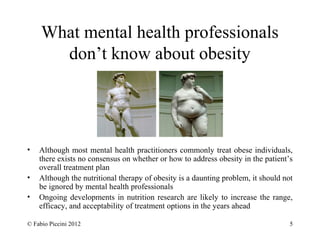
What mental health professionals 
don’t know about obesity 
• Although most mental health practitioners commonly treat obese individuals, 
there exists no consensus on whether or how to address obesity in the patient’s 
overall treatment plan 
• Although the nutritional therapy of obesity is a daunting problem, it should not 
be ignored by mental health professionals 
• Ongoing developments in nutrition research are likely to increase the range, 
efficacy, and acceptability of treatment options in the years ahead 
© Fabio Piccini 2012 5
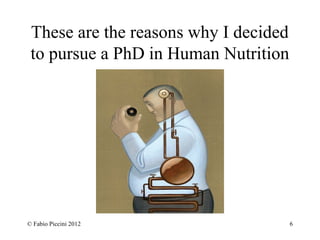
These are the reasons why I decided 
to pursue a PhD in Human Nutrition 
© Fabio Piccini 2012 6
Is obesity an eating disorder? 
Many papers has argued both for 
and against the possibility that 
obesity may be considered to be an 
eating disorder. In practice these 
two lines of evidence are not 
mutually exclusive. There is 
without doubt a shift in the 
population distribution towards 
increased body weights which is 
unlikely to be due to an “inter-national” 
eating disorder, but is the 
end-result of numerous 
environmental and behavioural 
changes within the population 
© Fabio Piccini 2012 7
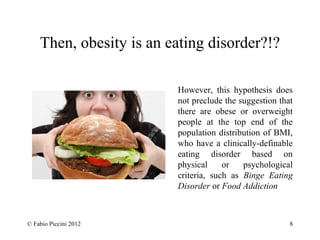
Then, obesity is an eating disorder?!? 
However, this hypothesis does 
not preclude the suggestion that 
there are obese or overweight 
people at the top end of the 
population distribution of BMI, 
who have a clinically-definable 
eating disorder based on 
physical or psychological 
criteria, such as Binge Eating 
Disorder or Food Addiction 
© Fabio Piccini 2012 8
The Obesity-Eating Paradox 
• There is a fundamental problem within western culture that has injured 
the way people think about food, exercise, and their own bodies 
• Meals are being super-sized, food items heavily processed, and 
inactive forms of recreation, such as watching TV and playing video 
games, have become the norm 
• While the nations of plenty struggles to reduce their intake of cheap 
and fatty foods, unhealthy obsessions with weight and body image 
persist 
• Twenty-five percent of college-aged women report using binging and 
purging for weight management. Even amongst those who don’t suffer 
from eating disorders, pressures to be thin complicate relationships 
with food 
© Fabio Piccini 2012 9
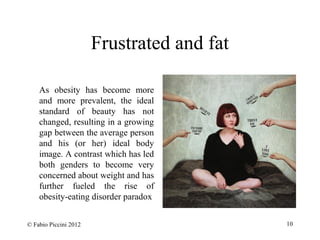
Frustrated and fat 
As obesity has become more 
and more prevalent, the ideal 
standard of beauty has not 
changed, resulting in a growing 
gap between the average person 
and his (or her) ideal body 
image. A contrast which has led 
both genders to become very 
concerned about weight and has 
further fueled the rise of 
obesity-eating disorder paradox 
© Fabio Piccini 2012 10
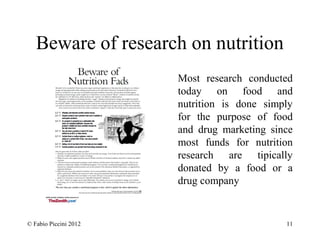
Beware of research on nutrition 
Most research conducted 
today on food and 
nutrition is done simply 
for the purpose of food 
and drug marketing since 
most funds for nutrition 
research are tipically 
donated by a food or a 
drug company 
© Fabio Piccini 2012 11
Beware of research on weight-loss 
While trying to dissect 
current nutritional beliefs 
to find track of their 
evolution and to evaluate 
the research behind them I 
began to realize that the 
research on weight loss 
has become so skewed 
with food politics that it 
has turned to an oxymoron 
© Fabio Piccini 2012 12
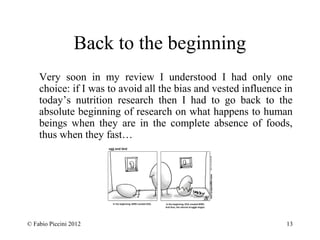
Back to the beginning 
Very soon in my review I understood I had only one 
choice: if I was to avoid all the bias and vested influence in 
today’s nutrition research then I had to go back to the 
absolute beginning of research on what happens to human 
beings when they are in the complete absence of foods, 
thus when they fast… 
© Fabio Piccini 2012 13
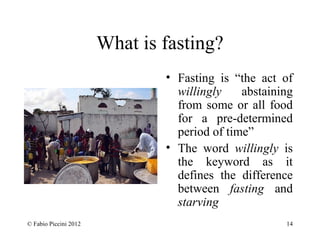
What is fasting? 
• Fasting is “the act of 
willingly abstaining 
from some or all food 
for a pre-determined 
period of time” 
• The word willingly is 
the keyword as it 
defines the difference 
between fasting and 
starving 
© Fabio Piccini 2012 14
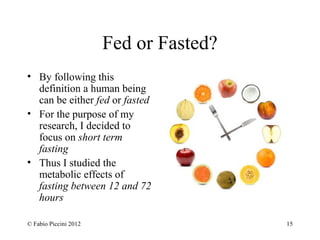
Fed or Fasted? 
• By following this 
definition a human being 
can be either fed or fasted 
• For the purpose of my 
research, I decided to 
focus on short term 
fasting 
• Thus I studied the 
metabolic effects of 
fasting between 12 and 72 
hours 
© Fabio Piccini 2012 15
Benefits of studying short-term-fasting 
• People with vested 
interests in selling 
consumable products have 
no interest in fasting (you 
cannot put fasting into a 
pill and sell it) 
• There is a large volume of 
research that has been 
conducted on fasting 
© Fabio Piccini 2012 16
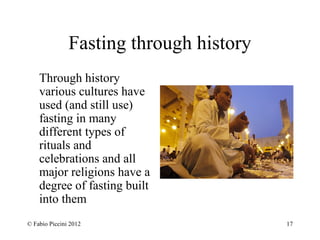
Fasting through history 
Through history 
various cultures have 
used (and still use) 
fasting in many 
different types of 
rituals and 
celebrations and all 
major religions have a 
degree of fasting built 
into them 
© Fabio Piccini 2012 17
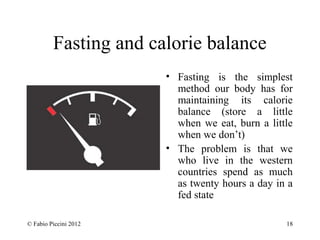
Fasting and calorie balance 
• Fasting is the simplest 
method our body has for 
maintaining its calorie 
balance (store a little 
when we eat, burn a little 
when we don’t) 
• The problem is that we 
who live in the western 
countries spend as much 
as twenty hours a day in a 
fed state 
© Fabio Piccini 2012 18
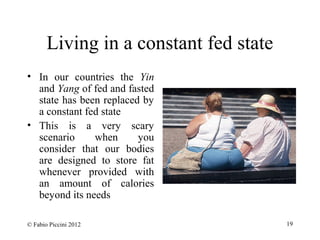
Living in a constant fed state 
• In our countries the Yin 
and Yang of fed and fasted 
state has been replaced by 
a constant fed state 
• This is a very scary 
scenario when you 
consider that our bodies 
are designed to store fat 
whenever provided with 
an amount of calories 
beyond its needs 
© Fabio Piccini 2012 19
If our bodies are designed to fast 
why doesn’t anyone fast anymore? 
• Most likeky it is because 
the concept of fasting for 
weight loss and health has 
been villanized in western 
countries as it goes against 
business 
• To the food and drug 
industry the idea of people 
eating less is bad for 
business 
© Fabio Piccini 2012 20
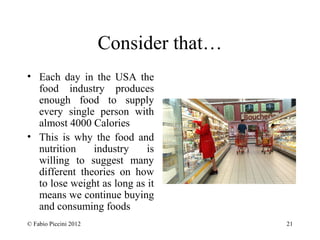
Consider that… 
• Each day in the USA the 
food industry produces 
enough food to supply 
every single person with 
almost 4000 Calories 
• This is why the food and 
nutrition industry is 
willing to suggest many 
different theories on how 
to lose weight as long as it 
means we continue buying 
and consuming foods 
© Fabio Piccini 2012 21
Fasting in Textbooks 
• Why the conventional 
texbooks on human 
nutrition has so little 
to say about fasting? 
• If you go check 
current standard 
nutrition textbooks 
you’ll discover they 
devote as little as 4-5 
pages to fasting 
© Fabio Piccini 2012 22
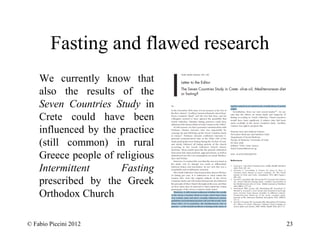
Fasting and flawed research 
We currently know that 
also the results of the 
Seven Countries Study in 
Crete could have been 
influenced by the practice 
(still common) in rural 
Greece people of religious 
Intermittent Fasting 
prescribed by the Greek 
Orthodox Church 
© Fabio Piccini 2012 23
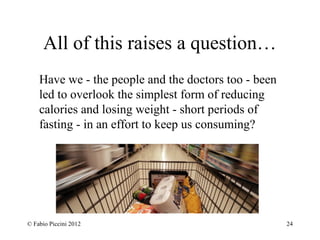
All of this raises a question… 
Have we - the people and the doctors too - been 
led to overlook the simplest form of reducing 
calories and losing weight - short periods of 
fasting - in an effort to keep us consuming? 
© Fabio Piccini 2012 24
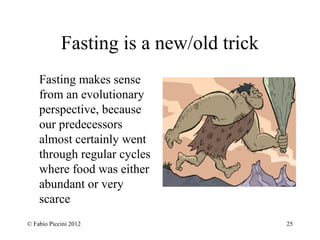
Fasting is a new/old trick 
Fasting makes sense 
from an evolutionary 
perspective, because 
our predecessors 
almost certainly went 
through regular cycles 
where food was either 
abundant or very 
scarce 
© Fabio Piccini 2012 25
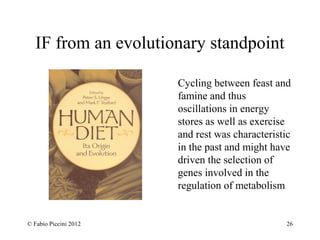
IF from an evolutionary standpoint 
Cycling between feast and 
famine and thus 
oscillations in energy 
stores as well as exercise 
and rest was characteristic 
in the past and might have 
driven the selection of 
genes involved in the 
regulation of metabolism 
© Fabio Piccini 2012 26
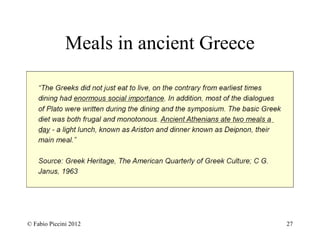
Meals in ancient Greece 
© Fabio Piccini 2012 27
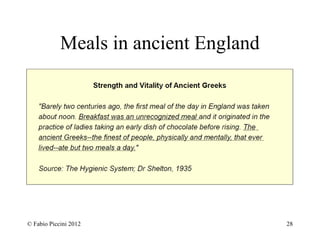
Meals in ancient England 
© Fabio Piccini 2012 28
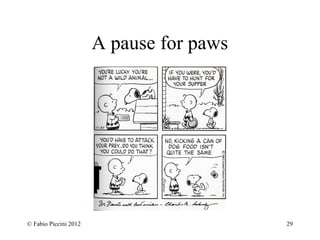
A pause for paws 
© Fabio Piccini 2012 29
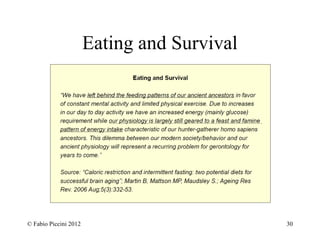
Eating and Survival 
© Fabio Piccini 2012 30
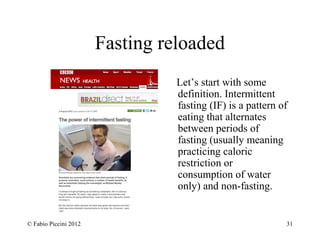
Fasting reloaded 
Let’s start with some 
definition. Intermittent 
fasting (IF) is a pattern of 
eating that alternates 
between periods of 
fasting (usually meaning 
practicing caloric 
restriction or 
consumption of water 
only) and non-fasting. 
© Fabio Piccini 2012 31
What are the practical applications of IF? 
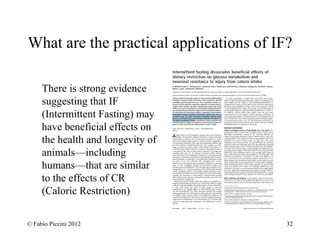
There is strong evidence 
suggesting that IF 
(Intermittent Fasting) may 
have beneficial effects on 
the health and longevity of 
animals—including 
humans—that are similar 
to the effects of CR 
(Caloric Restriction) 
© Fabio Piccini 2012 32
IF and insulin sensitivity 
During the course of human 
evolution, the body may have 
established protective 
mechanisms to adapt to cycling 
eating conditions by sensitizing 
insulin receptors when it was 
critical that every bit of food be 
efficiently used or stored (as in 
famine), or by desensitizing 
them when there was a surplus, 
so the body wouldn’t be overly-burdened 
by grossly excessive 
calorie intake 
© Fabio Piccini 2012 33
Is IF effective for weight loss? 
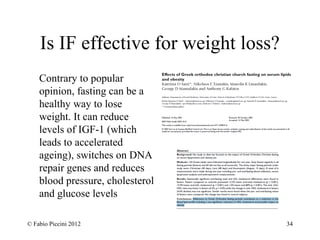
Contrary to popular 
opinion, fasting can be a 
healthy way to lose 
weight. It can reduce 
levels of IGF-1 (which 
leads to accelerated 
ageing), switches on DNA 
repair genes and reduces 
blood pressure, cholesterol 
and glucose levels 
© Fabio Piccini 2012 34
Is Intermittent Fasting healthy? 
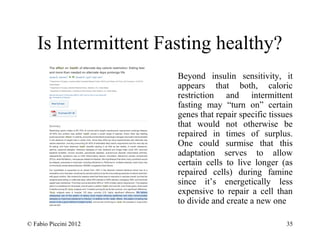
Beyond insulin sensitivity, it 
appears that both, caloric 
restriction and intermittent 
fasting may “turn on” certain 
genes that repair specific tissues 
that would not otherwise be 
repaired in times of surplus. 
One could surmise that this 
adaptation serves to allow 
certain cells to live longer (as 
repaired cells) during famine 
since it’s energetically less 
expensive to repair a cell than 
to divide and create a new one 
© Fabio Piccini 2012 35
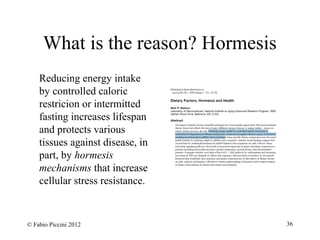
What is the reason? Hormesis 
Reducing energy intake 
by controlled caloric 
restricion or intermitted 
fasting increases lifespan 
and protects various 
tissues against disease, in 
part, by hormesis 
mechanisms that increase 
cellular stress resistance. 
© Fabio Piccini 2012 36
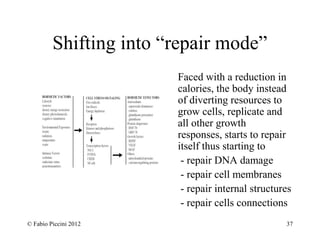
Shifting into “repair mode” 
Faced with a reduction in 
calories, the body instead 
of diverting resources to 
grow cells, replicate and 
all other growth 
responses, starts to repair 
itself thus starting to 
- repair DNA damage 
- repair cell membranes 
- repair internal structures 
- repair cells connections 
© Fabio Piccini 2012 37
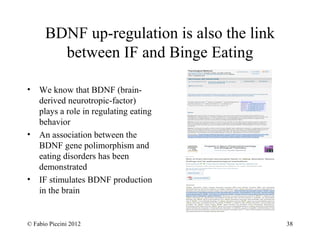
BDNF up-regulation is also the link 
between IF and Binge Eating 
• We know that BDNF (brain-derived 
neurotropic-factor) 
plays a role in regulating eating 
behavior 
• An association between the 
BDNF gene polimorphism and 
eating disorders has been 
demonstrated 
• IF stimulates BDNF production 
in the brain 
© Fabio Piccini 2012 38
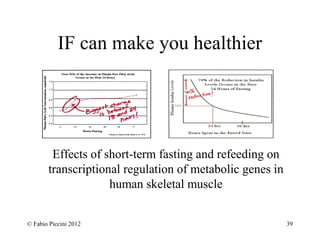
IF can make you healthier 
Effects of short-term fasting and refeeding on 
transcriptional regulation of metabolic genes in 
human skeletal muscle 
© Fabio Piccini 2012 39
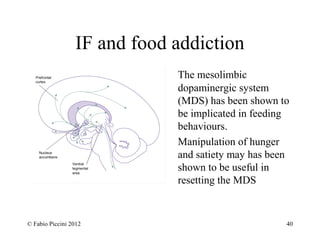
IF and food addiction 
The mesolimbic 
dopaminergic system 
(MDS) has been shown to 
be implicated in feeding 
behaviours. 
Manipulation of hunger 
and satiety may has been 
shown to be useful in 
resetting the MDS 
© Fabio Piccini 2012 40
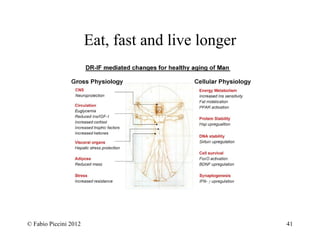
Eat, fast and live longer 
© Fabio Piccini 2012 41
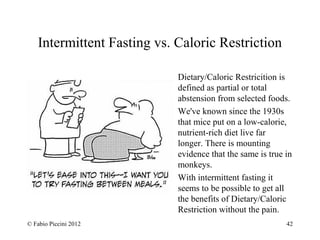
Intermittent Fasting vs. Caloric Restriction 
Dietary/Caloric Restricition is 
defined as partial or total 
abstension from selected foods. 
We've known since the 1930s 
that mice put on a low-calorie, 
nutrient-rich diet live far 
longer. There is mounting 
evidence that the same is true in 
monkeys. 
With intermittent fasting it 
seems to be possible to get all 
the benefits of Dietary/Caloric 
Restriction without the pain. 
© Fabio Piccini 2012 42
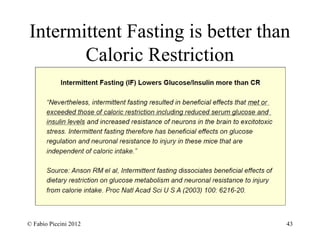
Intermittent Fasting is better than 
Caloric Restriction 
© Fabio Piccini 2012 43
What does IF looks like? 
There are a few ways 
to do IF 
• Skipping meals 
• Condensing eating 
window 
• Alternating day fasts 
• Single 24 hours fast 
• Mix and match any of 
the above 
© Fabio Piccini 2012 44
1. Skipping meals 
The simplest way 
to start with 
Intermittent 
Fasting is 
skipping one 
random meal on 
some days 
© Fabio Piccini 2012 45
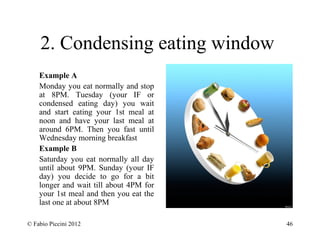
2. Condensing eating window 
Example A 
Monday you eat normally and stop 
at 8PM. Tuesday (your IF or 
condensed eating day) you wait 
and start eating your 1st meal at 
noon and have your last meal at 
around 6PM. Then you fast until 
Wednesday morning breakfast 
Example B 
Saturday you eat normally all day 
until about 9PM. Sunday (your IF 
day) you decide to go for a bit 
longer and wait till about 4PM for 
your 1st meal and then you eat the 
last one at about 8PM 
© Fabio Piccini 2012 46
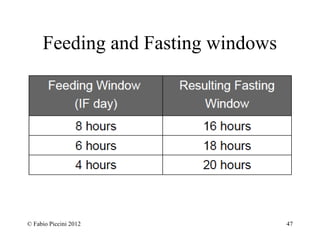
Feeding and Fasting windows 
© Fabio Piccini 2012 47
3. Alternating day fasts 
It means eating what 
you want one day, 
then follow a very 
restricted diet (fewer 
than 600 calories) the 
next (it does not seem 
to matter that much 
what you eat on non-fast 
days) and so on 
© Fabio Piccini 2012 48
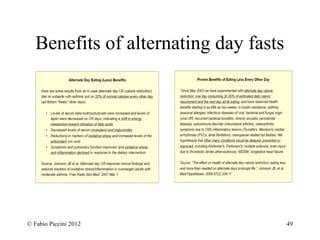
Benefits of alternating day fasts 
© Fabio Piccini 2012 49
4. Twentyfour hours fast 
It’s when you eat 
your breakfast (or 
lunch, or dinner) 
then you fast for 
twentyfour hours 
till the same meal 
of the next day 
© Fabio Piccini 2012 50
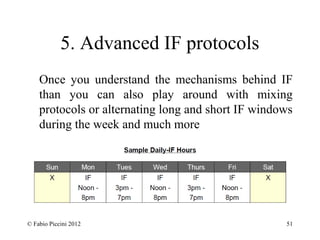
5. Advanced IF protocols 
Once you understand the mechanisms behind IF 
than you can also play around with mixing 
protocols or alternating long and short IF windows 
during the week and much more 
© Fabio Piccini 2012 51
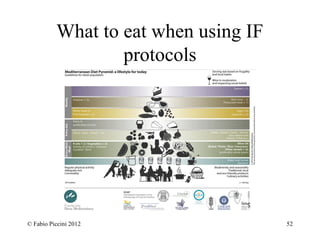
What to eat when using IF 
protocols 
© Fabio Piccini 2012 52
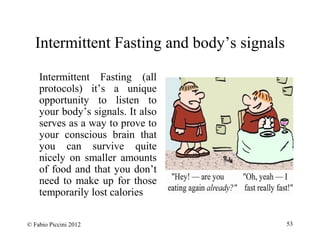
Intermittent Fasting and body’s signals 
Intermittent Fasting (all 
protocols) it’s a unique 
opportunity to listen to 
your body’s signals. It also 
serves as a way to prove to 
your conscious brain that 
you can survive quite 
nicely on smaller amounts 
of food and that you don’t 
need to make up for those 
temporarily lost calories 
© Fabio Piccini 2012 53
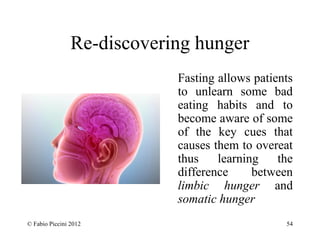
Re-discovering hunger 
Fasting allows patients 
to unlearn some bad 
eating habits and to 
become aware of some 
of the key cues that 
causes them to overeat 
thus learning the 
difference between 
limbic hunger and 
somatic hunger 
© Fabio Piccini 2012 54
An ounce of prevention is worth 
a pound of cure 
Teaching people to 
experiment, to control 
and to manipulate 
hunger should become 
a routine preventive 
health-care strategy 
for all the people who 
live in the Western 
countries 
© Fabio Piccini 2012 55
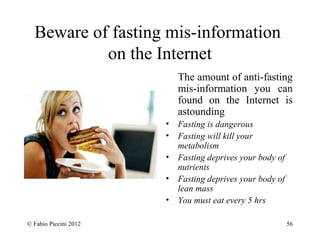
Beware of fasting mis-information 
on the Internet 
The amount of anti-fasting 
mis-information you can 
found on the Internet is 
astounding 
• Fasting is dangerous 
• Fasting will kill your 
metabolism 
• Fasting deprives your body of 
nutrients 
• Fasting deprives your body of 
lean mass 
• You must eat every 5 hrs 
© Fabio Piccini 2012 56
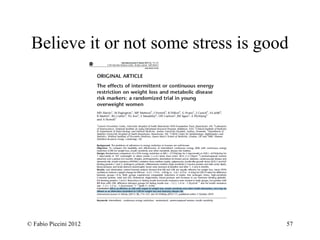
Believe it or not some stress is good 
© Fabio Piccini 2012 57
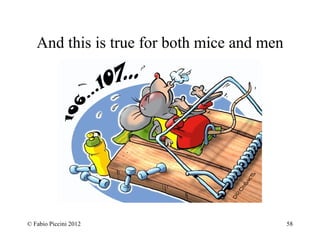
And this is true for both mice and men 
© Fabio Piccini 2012 58
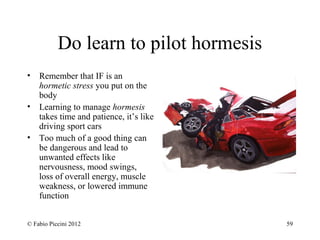
Do learn to pilot hormesis 
• Remember that IF is an 
hormetic stress you put on the 
body 
• Learning to manage hormesis 
takes time and patience, it’s like 
driving sport cars 
• Too much of a good thing can 
be dangerous and lead to 
unwanted effects like 
nervousness, mood swings, 
loss of overall energy, muscle 
weakness, or lowered immune 
function 
© Fabio Piccini 2012 59
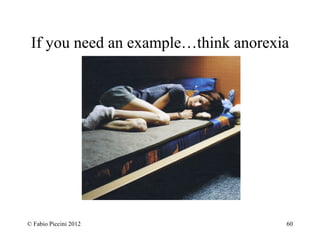
If you need an example…think anorexia 
© Fabio Piccini 2012 60
Do not use Intermittent Fasting… 
Without strict 
supervision in case of: 
• Children 
• Adolescents 
• Pregnant women 
• People with ED 
history 
© Fabio Piccini 2012 61
Why do doctors use obesity 
treatments that don’t work? 
Currently in Europe only a 
few doctors know how to 
properly implement and 
manage Intermittent 
Fasting protocols. This 
prevent many people who 
suffer from binge eating, 
obesity and related 
disorders from accessing 
these powerful therapeutic 
strategies 
© Fabio Piccini 2012 62
“Don't be afraid if things seem difficult in the beginning. 
That's only the initial impression. The important thing is not 
to retreat; you have to master yourself…” 
© Fabio Piccini 2012 63
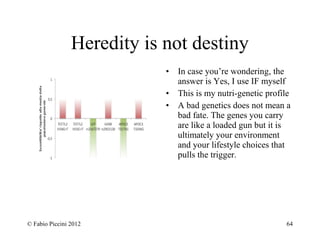
Heredity is not destiny 
• In case you’re wondering, the 
answer is Yes, I use IF myself 
• This is my nutri-genetic profile 
• A bad genetics does not mean a 
bad fate. The genes you carry 
are like a loaded gun but it is 
ultimately your environment 
and your lifestyle choices that 
pulls the trigger. 
© Fabio Piccini 2012 64
Thank you for your attention 
If you’re interested in hosting IF training for 
students or residents in your institution just drop 
me an Email: 
f.piccini@univpm.it 
© Fabio Piccini 2012 65

Re-discovering hunger

  • 1.
    Re-discovering Hunger Hungerand satiety manipulations as a tool for the treatment of obesity Fabio Piccini MD PhD f.piccini@univpm.it © Fabio Piccini 2012 1
  • 2.
    Declaration of Interest The author reports no conflict of interest with respect to the content of this workshop © Fabio Piccini 2012 2
  • 3.
    About me •Doctor in Medicine • Licensed Junghian analyst (IAAP) • Eating Disorders specialist • Master in Sport and Exercise Nutrition • PhD in Food Nutrition and Health © Fabio Piccini 2012 3
  • 4.
    What mental healthprofessionals need to know about obesity In the 21st century, obesity is a health problem affecting rich and poor, educated and uneducated, Westernized and non-Westernized societies. The contribution of genes to obesity risk is small, while the contribution of our toxic food and activity environment is huge © Fabio Piccini 2012 4
  • 5.
    What mental healthprofessionals don’t know about obesity • Although most mental health practitioners commonly treat obese individuals, there exists no consensus on whether or how to address obesity in the patient’s overall treatment plan • Although the nutritional therapy of obesity is a daunting problem, it should not be ignored by mental health professionals • Ongoing developments in nutrition research are likely to increase the range, efficacy, and acceptability of treatment options in the years ahead © Fabio Piccini 2012 5
  • 6.
    These are thereasons why I decided to pursue a PhD in Human Nutrition © Fabio Piccini 2012 6
  • 7.
    Is obesity aneating disorder? Many papers has argued both for and against the possibility that obesity may be considered to be an eating disorder. In practice these two lines of evidence are not mutually exclusive. There is without doubt a shift in the population distribution towards increased body weights which is unlikely to be due to an “inter-national” eating disorder, but is the end-result of numerous environmental and behavioural changes within the population © Fabio Piccini 2012 7
  • 8.
    Then, obesity isan eating disorder?!? However, this hypothesis does not preclude the suggestion that there are obese or overweight people at the top end of the population distribution of BMI, who have a clinically-definable eating disorder based on physical or psychological criteria, such as Binge Eating Disorder or Food Addiction © Fabio Piccini 2012 8
  • 9.
    The Obesity-Eating Paradox • There is a fundamental problem within western culture that has injured the way people think about food, exercise, and their own bodies • Meals are being super-sized, food items heavily processed, and inactive forms of recreation, such as watching TV and playing video games, have become the norm • While the nations of plenty struggles to reduce their intake of cheap and fatty foods, unhealthy obsessions with weight and body image persist • Twenty-five percent of college-aged women report using binging and purging for weight management. Even amongst those who don’t suffer from eating disorders, pressures to be thin complicate relationships with food © Fabio Piccini 2012 9
  • 10.
    Frustrated and fat As obesity has become more and more prevalent, the ideal standard of beauty has not changed, resulting in a growing gap between the average person and his (or her) ideal body image. A contrast which has led both genders to become very concerned about weight and has further fueled the rise of obesity-eating disorder paradox © Fabio Piccini 2012 10
  • 11.
    Beware of researchon nutrition Most research conducted today on food and nutrition is done simply for the purpose of food and drug marketing since most funds for nutrition research are tipically donated by a food or a drug company © Fabio Piccini 2012 11
  • 12.
    Beware of researchon weight-loss While trying to dissect current nutritional beliefs to find track of their evolution and to evaluate the research behind them I began to realize that the research on weight loss has become so skewed with food politics that it has turned to an oxymoron © Fabio Piccini 2012 12
  • 13.
    Back to thebeginning Very soon in my review I understood I had only one choice: if I was to avoid all the bias and vested influence in today’s nutrition research then I had to go back to the absolute beginning of research on what happens to human beings when they are in the complete absence of foods, thus when they fast… © Fabio Piccini 2012 13
  • 14.
    What is fasting? • Fasting is “the act of willingly abstaining from some or all food for a pre-determined period of time” • The word willingly is the keyword as it defines the difference between fasting and starving © Fabio Piccini 2012 14
  • 15.
    Fed or Fasted? • By following this definition a human being can be either fed or fasted • For the purpose of my research, I decided to focus on short term fasting • Thus I studied the metabolic effects of fasting between 12 and 72 hours © Fabio Piccini 2012 15
  • 16.
    Benefits of studyingshort-term-fasting • People with vested interests in selling consumable products have no interest in fasting (you cannot put fasting into a pill and sell it) • There is a large volume of research that has been conducted on fasting © Fabio Piccini 2012 16
  • 17.
    Fasting through history Through history various cultures have used (and still use) fasting in many different types of rituals and celebrations and all major religions have a degree of fasting built into them © Fabio Piccini 2012 17
  • 18.
    Fasting and caloriebalance • Fasting is the simplest method our body has for maintaining its calorie balance (store a little when we eat, burn a little when we don’t) • The problem is that we who live in the western countries spend as much as twenty hours a day in a fed state © Fabio Piccini 2012 18
  • 19.
    Living in aconstant fed state • In our countries the Yin and Yang of fed and fasted state has been replaced by a constant fed state • This is a very scary scenario when you consider that our bodies are designed to store fat whenever provided with an amount of calories beyond its needs © Fabio Piccini 2012 19
  • 20.
    If our bodiesare designed to fast why doesn’t anyone fast anymore? • Most likeky it is because the concept of fasting for weight loss and health has been villanized in western countries as it goes against business • To the food and drug industry the idea of people eating less is bad for business © Fabio Piccini 2012 20
  • 21.
    Consider that… •Each day in the USA the food industry produces enough food to supply every single person with almost 4000 Calories • This is why the food and nutrition industry is willing to suggest many different theories on how to lose weight as long as it means we continue buying and consuming foods © Fabio Piccini 2012 21
  • 22.
    Fasting in Textbooks • Why the conventional texbooks on human nutrition has so little to say about fasting? • If you go check current standard nutrition textbooks you’ll discover they devote as little as 4-5 pages to fasting © Fabio Piccini 2012 22
  • 23.
    Fasting and flawedresearch We currently know that also the results of the Seven Countries Study in Crete could have been influenced by the practice (still common) in rural Greece people of religious Intermittent Fasting prescribed by the Greek Orthodox Church © Fabio Piccini 2012 23
  • 24.
    All of thisraises a question… Have we - the people and the doctors too - been led to overlook the simplest form of reducing calories and losing weight - short periods of fasting - in an effort to keep us consuming? © Fabio Piccini 2012 24
  • 25.
    Fasting is anew/old trick Fasting makes sense from an evolutionary perspective, because our predecessors almost certainly went through regular cycles where food was either abundant or very scarce © Fabio Piccini 2012 25
  • 26.
    IF from anevolutionary standpoint Cycling between feast and famine and thus oscillations in energy stores as well as exercise and rest was characteristic in the past and might have driven the selection of genes involved in the regulation of metabolism © Fabio Piccini 2012 26
  • 27.
    Meals in ancientGreece © Fabio Piccini 2012 27
  • 28.
    Meals in ancientEngland © Fabio Piccini 2012 28
  • 29.
    A pause forpaws © Fabio Piccini 2012 29
  • 30.
    Eating and Survival © Fabio Piccini 2012 30
  • 31.
    Fasting reloaded Let’sstart with some definition. Intermittent fasting (IF) is a pattern of eating that alternates between periods of fasting (usually meaning practicing caloric restriction or consumption of water only) and non-fasting. © Fabio Piccini 2012 31
  • 32.
    What are thepractical applications of IF? There is strong evidence suggesting that IF (Intermittent Fasting) may have beneficial effects on the health and longevity of animals—including humans—that are similar to the effects of CR (Caloric Restriction) © Fabio Piccini 2012 32
  • 33.
    IF and insulinsensitivity During the course of human evolution, the body may have established protective mechanisms to adapt to cycling eating conditions by sensitizing insulin receptors when it was critical that every bit of food be efficiently used or stored (as in famine), or by desensitizing them when there was a surplus, so the body wouldn’t be overly-burdened by grossly excessive calorie intake © Fabio Piccini 2012 33
  • 34.
    Is IF effectivefor weight loss? Contrary to popular opinion, fasting can be a healthy way to lose weight. It can reduce levels of IGF-1 (which leads to accelerated ageing), switches on DNA repair genes and reduces blood pressure, cholesterol and glucose levels © Fabio Piccini 2012 34
  • 35.
    Is Intermittent Fastinghealthy? Beyond insulin sensitivity, it appears that both, caloric restriction and intermittent fasting may “turn on” certain genes that repair specific tissues that would not otherwise be repaired in times of surplus. One could surmise that this adaptation serves to allow certain cells to live longer (as repaired cells) during famine since it’s energetically less expensive to repair a cell than to divide and create a new one © Fabio Piccini 2012 35
  • 36.
    What is thereason? Hormesis Reducing energy intake by controlled caloric restricion or intermitted fasting increases lifespan and protects various tissues against disease, in part, by hormesis mechanisms that increase cellular stress resistance. © Fabio Piccini 2012 36
  • 37.
    Shifting into “repairmode” Faced with a reduction in calories, the body instead of diverting resources to grow cells, replicate and all other growth responses, starts to repair itself thus starting to - repair DNA damage - repair cell membranes - repair internal structures - repair cells connections © Fabio Piccini 2012 37
  • 38.
    BDNF up-regulation isalso the link between IF and Binge Eating • We know that BDNF (brain-derived neurotropic-factor) plays a role in regulating eating behavior • An association between the BDNF gene polimorphism and eating disorders has been demonstrated • IF stimulates BDNF production in the brain © Fabio Piccini 2012 38
  • 39.
    IF can makeyou healthier Effects of short-term fasting and refeeding on transcriptional regulation of metabolic genes in human skeletal muscle © Fabio Piccini 2012 39
  • 40.
    IF and foodaddiction The mesolimbic dopaminergic system (MDS) has been shown to be implicated in feeding behaviours. Manipulation of hunger and satiety may has been shown to be useful in resetting the MDS © Fabio Piccini 2012 40
  • 41.
    Eat, fast andlive longer © Fabio Piccini 2012 41
  • 42.
    Intermittent Fasting vs.Caloric Restriction Dietary/Caloric Restricition is defined as partial or total abstension from selected foods. We've known since the 1930s that mice put on a low-calorie, nutrient-rich diet live far longer. There is mounting evidence that the same is true in monkeys. With intermittent fasting it seems to be possible to get all the benefits of Dietary/Caloric Restriction without the pain. © Fabio Piccini 2012 42
  • 43.
    Intermittent Fasting isbetter than Caloric Restriction © Fabio Piccini 2012 43
  • 44.
    What does IFlooks like? There are a few ways to do IF • Skipping meals • Condensing eating window • Alternating day fasts • Single 24 hours fast • Mix and match any of the above © Fabio Piccini 2012 44
  • 45.
    1. Skipping meals The simplest way to start with Intermittent Fasting is skipping one random meal on some days © Fabio Piccini 2012 45
  • 46.
    2. Condensing eatingwindow Example A Monday you eat normally and stop at 8PM. Tuesday (your IF or condensed eating day) you wait and start eating your 1st meal at noon and have your last meal at around 6PM. Then you fast until Wednesday morning breakfast Example B Saturday you eat normally all day until about 9PM. Sunday (your IF day) you decide to go for a bit longer and wait till about 4PM for your 1st meal and then you eat the last one at about 8PM © Fabio Piccini 2012 46
  • 47.
    Feeding and Fastingwindows © Fabio Piccini 2012 47
  • 48.
    3. Alternating dayfasts It means eating what you want one day, then follow a very restricted diet (fewer than 600 calories) the next (it does not seem to matter that much what you eat on non-fast days) and so on © Fabio Piccini 2012 48
  • 49.
    Benefits of alternatingday fasts © Fabio Piccini 2012 49
  • 50.
    4. Twentyfour hoursfast It’s when you eat your breakfast (or lunch, or dinner) then you fast for twentyfour hours till the same meal of the next day © Fabio Piccini 2012 50
  • 51.
    5. Advanced IFprotocols Once you understand the mechanisms behind IF than you can also play around with mixing protocols or alternating long and short IF windows during the week and much more © Fabio Piccini 2012 51
  • 52.
    What to eatwhen using IF protocols © Fabio Piccini 2012 52
  • 53.
    Intermittent Fasting andbody’s signals Intermittent Fasting (all protocols) it’s a unique opportunity to listen to your body’s signals. It also serves as a way to prove to your conscious brain that you can survive quite nicely on smaller amounts of food and that you don’t need to make up for those temporarily lost calories © Fabio Piccini 2012 53
  • 54.
    Re-discovering hunger Fastingallows patients to unlearn some bad eating habits and to become aware of some of the key cues that causes them to overeat thus learning the difference between limbic hunger and somatic hunger © Fabio Piccini 2012 54
  • 55.
    An ounce ofprevention is worth a pound of cure Teaching people to experiment, to control and to manipulate hunger should become a routine preventive health-care strategy for all the people who live in the Western countries © Fabio Piccini 2012 55
  • 56.
    Beware of fastingmis-information on the Internet The amount of anti-fasting mis-information you can found on the Internet is astounding • Fasting is dangerous • Fasting will kill your metabolism • Fasting deprives your body of nutrients • Fasting deprives your body of lean mass • You must eat every 5 hrs © Fabio Piccini 2012 56
  • 57.
    Believe it ornot some stress is good © Fabio Piccini 2012 57
  • 58.
    And this istrue for both mice and men © Fabio Piccini 2012 58
  • 59.
    Do learn topilot hormesis • Remember that IF is an hormetic stress you put on the body • Learning to manage hormesis takes time and patience, it’s like driving sport cars • Too much of a good thing can be dangerous and lead to unwanted effects like nervousness, mood swings, loss of overall energy, muscle weakness, or lowered immune function © Fabio Piccini 2012 59
  • 60.
    If you needan example…think anorexia © Fabio Piccini 2012 60
  • 61.
    Do not useIntermittent Fasting… Without strict supervision in case of: • Children • Adolescents • Pregnant women • People with ED history © Fabio Piccini 2012 61
  • 62.
    Why do doctorsuse obesity treatments that don’t work? Currently in Europe only a few doctors know how to properly implement and manage Intermittent Fasting protocols. This prevent many people who suffer from binge eating, obesity and related disorders from accessing these powerful therapeutic strategies © Fabio Piccini 2012 62
  • 63.
    “Don't be afraidif things seem difficult in the beginning. That's only the initial impression. The important thing is not to retreat; you have to master yourself…” © Fabio Piccini 2012 63
  • 64.
    Heredity is notdestiny • In case you’re wondering, the answer is Yes, I use IF myself • This is my nutri-genetic profile • A bad genetics does not mean a bad fate. The genes you carry are like a loaded gun but it is ultimately your environment and your lifestyle choices that pulls the trigger. © Fabio Piccini 2012 64
  • 65.
    Thank you foryour attention If you’re interested in hosting IF training for students or residents in your institution just drop me an Email: f.piccini@univpm.it © Fabio Piccini 2012 65