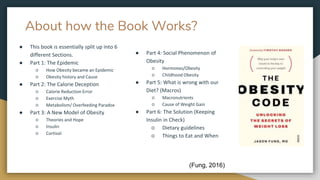
The Obesity Code:Unlocking the
Secrets of Weight Loss
By: Dr. Jason Fung
Group: Brotein
By: Danniela Nieto, Dharan Harikrishnan, John Porter, Ricardo Montejano
Author’s education, background and credentials
● Dr. Jason Fung is a Canadian Nephrologist
● Graduated from University of Toronto
● Completed residency at University of California, Los Angeles (UCLA)
● World leading expert on intermittent fasting, low carb and type 2
diabetes.
● Has written 3 best-selling health books
○ The Obesity Code: Unlocking the secrets of weight loss
○ The Complete Guide to Fasting
○ The Diabetes Code: Prevent and reverse type 2 diabetes
naturally
● Co-founded the Intensive Dietary Management program
● Owns his own website and performs multiple workshops and seminars
for colleagues
(Diet Doctor, 2018)
About how the Book Works?
● This book is essentially split up into 6
different Sections.
● Part 1: The Epidemic
○ How Obesity became an Epidemic
○ Obesity history and Cause
● Part 2: The Calorie Deception
○ Calorie Reduction Error
○ Exercise Myth
○ Metabolism/ Overfeeding Paradox
● Part 3: A New Model of Obesity
○ Theories and Hope
○ Insulin
○ Cortisol
● Part 4: Social Phenomenon of
Obesity
○ Hormones/Obesity
○ Childhood Obesity
● Part 5: What is wrong with our
Diet? (Macros)
○ Macronutrients
○ Cause of Weight Gain
● Part 6: The Solution (Keeping
Insulin in Check)
○ Dietary guidelines
○ Things to Eat and When
(Fung, 2016)
Scientific Claims & Author Reasoning.
In the 1970’s obesity became increasingly prevalent in the US population as the standard diet and mealtime
patterns changed. Countless attempts at reducing obesity have failed- calorie restriction, Keto, Atkins, Paleo,
etc. because they failed to consider the underlying factors behind what keeps obese people obese.
Dr. Fung believes that people become and remain obese because of an underlying factor not addressing in
modern dieting: insulin resistance as a result of high concentrations of insulin in the system over long
period of time which doesn’t go away with short-term diet changes or increased exercise. He alleges (and
provides studies to support) that all of the following contribute to heightened insulin levels:
● Refined carbohydrates (grains & sugars cause glucose/insulin spike)
● Artificial sweeteners (have low glycemic but high insulin response)
● High concentrations of fructose (contribute directly to fatty liver)
● Snacking (keeps elevated blood glucose/insulin during day)
● Any medication that raises insulin (many diabetes medications)
● Genetics (seen in adoption & twin studies)
● Poor sleep (poorly regulates hormones)
● Increased stress (cortisol increases blood glucose)
● Lack of fiber (which slow glucose/insulin response)
(Fung, 2016)
Claims continued: Diet debunking.
● The “Calories-In Calories-Out” model fails to consider:
○ Most deadly: all calories are not equal. E.g., body responds to 1 calorie sugar differently
than 1 calorie fat or protein.
○ Calories in directly affects calories out- BMR will go down.
○ Exercise doesn’t play a large role in caloric expenditure- BMR will go down.
○ Hormones regulate hunger/satiety, so we can’t always control cal-in.
● Low carb, high protein &/or high fat diets still raise insulin levels, same with low fat diets.
○ Have short-term weight loss but will eventually return, especially if you don’t stick with it.
○ While proteins & fats don’t have a glycemic response, all food causes insulin response.
○ Appetite remains for refined carbs (always room for cake).
○ Low fat: added calories, particularly damaging ones like fructose (large dose w/o fiber).
● Finally, fixing insulin resistance is complicated, requires long-term
changes to diet & behavior.
(Wilks et. al., 2007)
MYTH!
(Fung, 2016)
TL;DR: Author’s concept
● This book is the “Adam Ruins
Everything” of diets.
● Combines what works in each of the
diet plans & combines them into a
‘grand unified theory’ that explains the
underlying factor that’s eluded people:
Concepts of Diet Reviewed
- 5 Basic Steps are Stated in his 6th part of his book.
- What should you be eating and when should you be
eating?
- This is also based around the big idea of intermittent
fasting to actually obtain results.
- Part 1: Reduce refined grains
- Part 2: Reduce added sugars
- Part 3: Keep protein In proportion
- Part 4: Consume more fiber & vinegar
- Part 5: Consume more natural fats
(Fung, 2016)
Compared to D.A.S.H Diet
D.A.S.H. Diet
● Primarily focused on lowering
cholesterol and blood pressure
● Emphasizes portion size, eating
a variety of food groups and
getting the right amount of
nutrients
● Emphasizes vegetables, fruit,
low-fat dairy products and
moderate amounts of fish, poultry
and nuts.
● Recommends sugary foods to be
limited to 5 times a week or
fewer.
● The DASH Diet is not a weight
loss program.
Obesity Code
● Reduce refined grains and sugar intake.
● Doesn’t set specific Macronutrient ranges
or a max limit for net carbs.
● Encourages intermittent fasting.
● Chooses whole, unprocessed foods
(Vegetables, fruits, animal protein and
unprocessed fats such as olive oil and
butter).
● These foods provide a lower
carbohydrate diet, high in natural fats
and moderate protein.
● Processed whole grains and root
vegetables can be consumed, but not as
often since they elicit a greater insulin
effect.
● Has fasting/meal timing component.
Peer Reviewed Journal Articles
ARTICLE NUMBER 1: Breaking the fast: Meal patterns and
beliefs about healthy eating style are associated with
adherence to intermittent fasting diets
Method: Volunteers were gathered via social media
announcement and were asked to fill out a survey indicating
if they had ever followed an Intermittent fasting, IF, diet
Study: Groups of participants were divided up into current
and former IF dieters
Survey: Based off of the participants categorization questions
were asked regarding demographic information, previous diet
habits, meal and snack patterns, beliefs about healthy meal
and snack patterns, prioritisation of satiation over palatability
Results: Former IF dieters were more likely to believe that
eating three different meals throughout the day is healthy
ann that several snack throughout the day is healthy. A
higher proportion of Former-IF Dieters always prioritised
fullness.
Article Number 2: Is Fasting Good for you?
Author: David Stipp is a Boston based science writer who
focuses on aging research
Findings:
- Article mentions fasting and the results yielded in a
variety of different animals.
- Author tends to compare calorie restricting to fasting
and is in clear favor of fasting
- One of the effects found in IF is the body’s
responsiveness to insulin.
- A human study conducted on 60 elderly men and
women, results varied between two groups that did
and did not fast
Conclusion: The author is indeed in favor of fasting. He
preaches the benefits and also shows the negatives.
“Debunking the ‘Obesity Code’ Diet”
- Article posted in Healthline by Jessica Peralta
- The article was not in favor of the Obesity Code diet
and gave arguments as to why the diet is not for
everyone
- Controlling hormone imbalance is indeed important,
but specifically in regards as to the way the book
says to do it is debatable
- Dr. Peter LePort, and registered dietician Heidi j.
SIlver were used in the interview and gave reasoning
as to why certain elements of the Obesity code diet
do not work
“Forget calorie counting — this is the real
secret to weight loss”
- Article posted in the New York post by
Reed Tucker
- The article is in support of the diet by
explaining how ideals of the diet can be
done and how celebrities do it too
- Myths are expelled such as that during
fasting muscle is depleted as well as
energy balance
- The article then finishes by mentioning
other diets that utilize fasting methods
Weakness of Diet
● Makes the claim that the number of calories
should not be heavily considered when one is
considering weight loss.
-A Calorie is still a calorie (Howell, 2017)
● There weren’t any clear blueprints to
recommended serving sizes.
- The larger the food portion, the more calories
one is usually intaking (Herman Et al, 2016).
● Uses lots of scientific words that an average
reader may not fully comprehend.
● Not a large number of handy guides to know
the insulin effect of various foods.
● Requires severe dilligence, it seems.
● A variety of whole foods can be quite
expensive, not available in food deserts.
● Seemingly conflicting information, going to
need a re-read.
Strengths of Diet
● States in the beginning of the book that he only
uses peer reviewed scientific articles to back up
his claims and ONLY ones that were done on
humans.
● States that obesity requires a multifactorial
approach, addresses sleeping patterns, stress
levels, etc..
● Though it may not explain how much should be
consumed, it does explain what should be eaten
on a daily basis.
● Has podcast for updated information & recipes
● Debunks common ideas that very low fat diets
are “healthy”.
-Reduces White Matter Microglia activation during
aging.
Marketing and Power Words
● Firm commitment to only using peer-reviewed studies on humans from reputable
sources, with a preference for longer-term studies.
○ Quite compelling. Even the weird bit about vinegar which does lower the
glycemic/insulin response of food.
● Persuasive phrases that denote certainty and authority (quite cocky):
○ “All diets fail.”
○ “I can make you fat.”
○ “I can make you lose weight.”
○ “But the researchers were drinking the Kool Aid”
○ “The emperor had no clothes.”
● Appeals to the diet cynics who are frustrated with conflicting data or have been
burned by diets (including the “eat less move more” dogma) in the past.
(Johnston, Kim, & Buller, 2004)
References
Diet Doctor. (2018). Dr. Jason Fung, MD. Retrieved from https://www.dietdoctor.com/authors/dr-jason-fung-m-d
Fung, J. (2016). The obesity code: Unlocking the secrets of weight loss. Vancouver: Greystone Books.
Herman, P. Polivy, J. Vartanian, L.R. and Pliner, P. (2016). Are Large Portions responsible for the obesity epidemic? Obtained
From Physiology & Behavior. Volume 156, pages 177-181. Published March 15, 2016.
Howell, S. (2017). A Calorie is Still a Calorie, According to Rigorous New Evidence. Obtained from
https://www.ommegaonline.org/article-details/A-Calorie-is-Still-a-Calorie-According-to-Rigorous-
New-Evidence/1509
Johnston, C.S., Kim, C. M., Buller, & A. J., (2004, Jan). Vinegar Improves Insulin Sensitivity to a High-Carbohydrate Meal in
Subjects With Insulin Resistance or Type 2 Diabetes. American Diabetes Association, 27(1). https://doi.org/10.2337/diacare.27.1.281
Mayo Clinic (2018). DASH Diet: Healthy eating to lower your Blood Pressure. Obtained from
https://www.mayoclinic.org/healthy-lifestyle/nutrition-and-healthy-eating/in-depth/dash-diet/art-20048456
Peralta, J. (2018). 'Obesity Code' Diet. Retrieved from
https://www.healthline.com/health-news/debunking-the-obesity-code-diet
Tucker, R. (2018). Forget calorie counting — this is the real secret to weight loss. Retrieved from
https://nypost.com/2016/03/23/forget-calorie-counting-this-is-the-real-secret-to-weight-loss/
Potter, C., Griggs, R., Brunstrom, J., & Rogers, P. (2018). Breaking the fast: Meal patterns and beliefs about healthy eating style
are associated with adherence to intermittent fasting diets. Appetite, 133, 32-39. doi: 10.1016/j.appet.2018.10.020
Stipp, D. Scientific American , Vol. 308, No. 1 (JANUARY 2013), pp. 23-24 Published by: Scientific American, a division of Nature
America, Inc. Stable URL: https://www.jstor.org/stable/10.2307/26017881
Wilks, D. C., Sharp, S. J., Ekelund, U., Thompson, S. G., Mander, A. P., Turner, R. M., Jebb, S. A., … Lindroos, A.
K. (2011). Objectively measured physical activity and fat mass in children: a bias-adjusted meta-
analysis of prospective studies. PloS one, 6(2), e17205. doi:10.1371/journal.pone.0017205

Obesity Code Evaluation

  • 1.
    The Obesity Code:Unlockingthe Secrets of Weight Loss By: Dr. Jason Fung Group: Brotein By: Danniela Nieto, Dharan Harikrishnan, John Porter, Ricardo Montejano
  • 2.
    Author’s education, backgroundand credentials ● Dr. Jason Fung is a Canadian Nephrologist ● Graduated from University of Toronto ● Completed residency at University of California, Los Angeles (UCLA) ● World leading expert on intermittent fasting, low carb and type 2 diabetes. ● Has written 3 best-selling health books ○ The Obesity Code: Unlocking the secrets of weight loss ○ The Complete Guide to Fasting ○ The Diabetes Code: Prevent and reverse type 2 diabetes naturally ● Co-founded the Intensive Dietary Management program ● Owns his own website and performs multiple workshops and seminars for colleagues (Diet Doctor, 2018)
  • 3.
    About how theBook Works? ● This book is essentially split up into 6 different Sections. ● Part 1: The Epidemic ○ How Obesity became an Epidemic ○ Obesity history and Cause ● Part 2: The Calorie Deception ○ Calorie Reduction Error ○ Exercise Myth ○ Metabolism/ Overfeeding Paradox ● Part 3: A New Model of Obesity ○ Theories and Hope ○ Insulin ○ Cortisol ● Part 4: Social Phenomenon of Obesity ○ Hormones/Obesity ○ Childhood Obesity ● Part 5: What is wrong with our Diet? (Macros) ○ Macronutrients ○ Cause of Weight Gain ● Part 6: The Solution (Keeping Insulin in Check) ○ Dietary guidelines ○ Things to Eat and When (Fung, 2016)
  • 4.
    Scientific Claims &Author Reasoning. In the 1970’s obesity became increasingly prevalent in the US population as the standard diet and mealtime patterns changed. Countless attempts at reducing obesity have failed- calorie restriction, Keto, Atkins, Paleo, etc. because they failed to consider the underlying factors behind what keeps obese people obese. Dr. Fung believes that people become and remain obese because of an underlying factor not addressing in modern dieting: insulin resistance as a result of high concentrations of insulin in the system over long period of time which doesn’t go away with short-term diet changes or increased exercise. He alleges (and provides studies to support) that all of the following contribute to heightened insulin levels: ● Refined carbohydrates (grains & sugars cause glucose/insulin spike) ● Artificial sweeteners (have low glycemic but high insulin response) ● High concentrations of fructose (contribute directly to fatty liver) ● Snacking (keeps elevated blood glucose/insulin during day) ● Any medication that raises insulin (many diabetes medications) ● Genetics (seen in adoption & twin studies) ● Poor sleep (poorly regulates hormones) ● Increased stress (cortisol increases blood glucose) ● Lack of fiber (which slow glucose/insulin response) (Fung, 2016)
  • 5.
    Claims continued: Dietdebunking. ● The “Calories-In Calories-Out” model fails to consider: ○ Most deadly: all calories are not equal. E.g., body responds to 1 calorie sugar differently than 1 calorie fat or protein. ○ Calories in directly affects calories out- BMR will go down. ○ Exercise doesn’t play a large role in caloric expenditure- BMR will go down. ○ Hormones regulate hunger/satiety, so we can’t always control cal-in. ● Low carb, high protein &/or high fat diets still raise insulin levels, same with low fat diets. ○ Have short-term weight loss but will eventually return, especially if you don’t stick with it. ○ While proteins & fats don’t have a glycemic response, all food causes insulin response. ○ Appetite remains for refined carbs (always room for cake). ○ Low fat: added calories, particularly damaging ones like fructose (large dose w/o fiber). ● Finally, fixing insulin resistance is complicated, requires long-term changes to diet & behavior. (Wilks et. al., 2007) MYTH! (Fung, 2016)
  • 6.
    TL;DR: Author’s concept ●This book is the “Adam Ruins Everything” of diets. ● Combines what works in each of the diet plans & combines them into a ‘grand unified theory’ that explains the underlying factor that’s eluded people:
  • 7.
    Concepts of DietReviewed - 5 Basic Steps are Stated in his 6th part of his book. - What should you be eating and when should you be eating? - This is also based around the big idea of intermittent fasting to actually obtain results. - Part 1: Reduce refined grains - Part 2: Reduce added sugars - Part 3: Keep protein In proportion - Part 4: Consume more fiber & vinegar - Part 5: Consume more natural fats (Fung, 2016)
  • 8.
    Compared to D.A.S.HDiet D.A.S.H. Diet ● Primarily focused on lowering cholesterol and blood pressure ● Emphasizes portion size, eating a variety of food groups and getting the right amount of nutrients ● Emphasizes vegetables, fruit, low-fat dairy products and moderate amounts of fish, poultry and nuts. ● Recommends sugary foods to be limited to 5 times a week or fewer. ● The DASH Diet is not a weight loss program. Obesity Code ● Reduce refined grains and sugar intake. ● Doesn’t set specific Macronutrient ranges or a max limit for net carbs. ● Encourages intermittent fasting. ● Chooses whole, unprocessed foods (Vegetables, fruits, animal protein and unprocessed fats such as olive oil and butter). ● These foods provide a lower carbohydrate diet, high in natural fats and moderate protein. ● Processed whole grains and root vegetables can be consumed, but not as often since they elicit a greater insulin effect. ● Has fasting/meal timing component.
  • 9.
    Peer Reviewed JournalArticles ARTICLE NUMBER 1: Breaking the fast: Meal patterns and beliefs about healthy eating style are associated with adherence to intermittent fasting diets Method: Volunteers were gathered via social media announcement and were asked to fill out a survey indicating if they had ever followed an Intermittent fasting, IF, diet Study: Groups of participants were divided up into current and former IF dieters Survey: Based off of the participants categorization questions were asked regarding demographic information, previous diet habits, meal and snack patterns, beliefs about healthy meal and snack patterns, prioritisation of satiation over palatability Results: Former IF dieters were more likely to believe that eating three different meals throughout the day is healthy ann that several snack throughout the day is healthy. A higher proportion of Former-IF Dieters always prioritised fullness. Article Number 2: Is Fasting Good for you? Author: David Stipp is a Boston based science writer who focuses on aging research Findings: - Article mentions fasting and the results yielded in a variety of different animals. - Author tends to compare calorie restricting to fasting and is in clear favor of fasting - One of the effects found in IF is the body’s responsiveness to insulin. - A human study conducted on 60 elderly men and women, results varied between two groups that did and did not fast Conclusion: The author is indeed in favor of fasting. He preaches the benefits and also shows the negatives.
  • 10.
    “Debunking the ‘ObesityCode’ Diet” - Article posted in Healthline by Jessica Peralta - The article was not in favor of the Obesity Code diet and gave arguments as to why the diet is not for everyone - Controlling hormone imbalance is indeed important, but specifically in regards as to the way the book says to do it is debatable - Dr. Peter LePort, and registered dietician Heidi j. SIlver were used in the interview and gave reasoning as to why certain elements of the Obesity code diet do not work “Forget calorie counting — this is the real secret to weight loss” - Article posted in the New York post by Reed Tucker - The article is in support of the diet by explaining how ideals of the diet can be done and how celebrities do it too - Myths are expelled such as that during fasting muscle is depleted as well as energy balance - The article then finishes by mentioning other diets that utilize fasting methods
  • 11.
    Weakness of Diet ●Makes the claim that the number of calories should not be heavily considered when one is considering weight loss. -A Calorie is still a calorie (Howell, 2017) ● There weren’t any clear blueprints to recommended serving sizes. - The larger the food portion, the more calories one is usually intaking (Herman Et al, 2016). ● Uses lots of scientific words that an average reader may not fully comprehend. ● Not a large number of handy guides to know the insulin effect of various foods. ● Requires severe dilligence, it seems. ● A variety of whole foods can be quite expensive, not available in food deserts. ● Seemingly conflicting information, going to need a re-read. Strengths of Diet ● States in the beginning of the book that he only uses peer reviewed scientific articles to back up his claims and ONLY ones that were done on humans. ● States that obesity requires a multifactorial approach, addresses sleeping patterns, stress levels, etc.. ● Though it may not explain how much should be consumed, it does explain what should be eaten on a daily basis. ● Has podcast for updated information & recipes ● Debunks common ideas that very low fat diets are “healthy”. -Reduces White Matter Microglia activation during aging.
  • 12.
    Marketing and PowerWords ● Firm commitment to only using peer-reviewed studies on humans from reputable sources, with a preference for longer-term studies. ○ Quite compelling. Even the weird bit about vinegar which does lower the glycemic/insulin response of food. ● Persuasive phrases that denote certainty and authority (quite cocky): ○ “All diets fail.” ○ “I can make you fat.” ○ “I can make you lose weight.” ○ “But the researchers were drinking the Kool Aid” ○ “The emperor had no clothes.” ● Appeals to the diet cynics who are frustrated with conflicting data or have been burned by diets (including the “eat less move more” dogma) in the past. (Johnston, Kim, & Buller, 2004)
  • 13.
    References Diet Doctor. (2018).Dr. Jason Fung, MD. Retrieved from https://www.dietdoctor.com/authors/dr-jason-fung-m-d Fung, J. (2016). The obesity code: Unlocking the secrets of weight loss. Vancouver: Greystone Books. Herman, P. Polivy, J. Vartanian, L.R. and Pliner, P. (2016). Are Large Portions responsible for the obesity epidemic? Obtained From Physiology & Behavior. Volume 156, pages 177-181. Published March 15, 2016. Howell, S. (2017). A Calorie is Still a Calorie, According to Rigorous New Evidence. Obtained from https://www.ommegaonline.org/article-details/A-Calorie-is-Still-a-Calorie-According-to-Rigorous- New-Evidence/1509 Johnston, C.S., Kim, C. M., Buller, & A. J., (2004, Jan). Vinegar Improves Insulin Sensitivity to a High-Carbohydrate Meal in Subjects With Insulin Resistance or Type 2 Diabetes. American Diabetes Association, 27(1). https://doi.org/10.2337/diacare.27.1.281 Mayo Clinic (2018). DASH Diet: Healthy eating to lower your Blood Pressure. Obtained from https://www.mayoclinic.org/healthy-lifestyle/nutrition-and-healthy-eating/in-depth/dash-diet/art-20048456
  • 14.
    Peralta, J. (2018).'Obesity Code' Diet. Retrieved from https://www.healthline.com/health-news/debunking-the-obesity-code-diet Tucker, R. (2018). Forget calorie counting — this is the real secret to weight loss. Retrieved from https://nypost.com/2016/03/23/forget-calorie-counting-this-is-the-real-secret-to-weight-loss/ Potter, C., Griggs, R., Brunstrom, J., & Rogers, P. (2018). Breaking the fast: Meal patterns and beliefs about healthy eating style are associated with adherence to intermittent fasting diets. Appetite, 133, 32-39. doi: 10.1016/j.appet.2018.10.020 Stipp, D. Scientific American , Vol. 308, No. 1 (JANUARY 2013), pp. 23-24 Published by: Scientific American, a division of Nature America, Inc. Stable URL: https://www.jstor.org/stable/10.2307/26017881 Wilks, D. C., Sharp, S. J., Ekelund, U., Thompson, S. G., Mander, A. P., Turner, R. M., Jebb, S. A., … Lindroos, A. K. (2011). Objectively measured physical activity and fat mass in children: a bias-adjusted meta- analysis of prospective studies. PloS one, 6(2), e17205. doi:10.1371/journal.pone.0017205

Editor's Notes

  • #3 dharan
  • #4 Dharan
  • #5 John
  • #6 John
  • #7 John
  • #8 Dharan
  • #9 Ricky
  • #10 Article 1 : The participants included in this study were divided into two groups, former IF dieters and current IF dieters. Respondents voluntarily participated in the survey and were gathered from volunteer database and a social media posting on the 5:2 IF diet facebook page A variety of questions were asked and those ranged from… Results showed that Former-IF Dieters were more likely to report eating a mid-morning snack and a mid-afternoon snack compared with Current-IF Dieters, Former IF dieters were more likely to believe that eating three different meals throughout the day is healthy ann that several snack throughout the day is healthy. Discussion Current IF dieters were more likely to reserve their eating for later on in the day, this might show a positive correlation to adhereing to an IF diet by reducing calorie counting and simply continuing on with your day. For many, IF diets seem to require less effort than daily calorie restriction diets, are cost-effective, and are a useful tool in promoting weight loss and maintenance. However, this study highlights that IF diets may not be effective for everyone, particularly those with strongly held beliefs about the potential negative consequences of missing regular meal and snack times Article 2 The author describes how fasting studies have shown reduction in overall calorie consumotion by 30-40 percent and that it expands life span by a third or more in animals in a mouse study conducted in 2003 mice fasted regualrly were healthier by some measures than mice subjected to calorie restriction (lower levels of insulin and glucose in their blood He includes that IF may promote some of the same benifits of clorie restriction, but the idea of fasting sounds better to most people as it is more palatable, so one does not have to renounce the pleaseures of a feast During fasting there is decreased sensitivit to insulin which often accompanies obesity and has been inked to diabetes and heart failure He links this finding to a reasearch study conducted in mice where they eat high fatty foods for 8 hours and then fast for the rest of the day and how they did not get obese or have high insulin levels The 60 participants who fasted spent 123 days in the infirmary, and six died. Meanwhile 60 seniors who did not fast racked up 219 infirmary days, and 13 died. He ends the article whith admitting that there are still some red flags associated with fasting, he then says that there must be continued research and human variables need to come intoplay with these studies
  • #11 The article initially address the concept of intermittent fasting. In an interview with Dr. Fung he tells the post that it is all the more common to see people fast. Dr. Fung says Hugh Jackman, Miranda Kerr, and Jimmy Kimmel do it, and it is a normal behavior The NY Post mentions a study in which subjects fasted alternate days for 70 days and found a 6 % decrease in mass but an 11.4 percent drop in body fat while muscle did not change The Post then reiterates some of the diet ideals such as fasting twice a week, how to fast, and what drinks to drink during the fast to make it more bearable (like drinking broth, green tea, sparkling water) They even give tips on how to stick to it like not mentioning it in social settings and treating yourself to a meal after the fasting is over The article starts by addressing how diets are always a new social media fb and how there are endless hashtags to keep up with the latest trend “the obesity code” is labeled as the latest diet trend Dr Peter points out how the book recoemdends eating when hungry, and how estblishing eating at times is a more practicle way of setting meal time especially for the mdoern lifestyle His point is that it is more common and practical to set meal times rather than wait to eat when hungry which may not be practical He also mentions that “eating when hungry” is a caveman ideal and they only lived to 25 years old while we who eat processed foods and fixed meal times live to 70 Heidi points out that intermitent fasting has only been studied on animals and not humans and how it maynot be sustaibable over the long term Lastly she says that in regards short term fasting weight loss is mostly made up of water and glycogen rather than fat
  • #12 Ricky
  • #13 John