RED DE NODOS DE IGUALDAD DE GÉNERO
This project has received funding from the European Union's Horizon 2020 research and innovation programme under
grant agreement No. 787829.
Red de Nodos de Igualdad de Género - UCM
Context
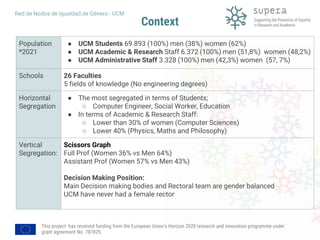
Population
*2021
● UCM Students 69.893 (100%) men (38%) women (62%)
● UCM Academic & Research Staff 6.372 (100%) men (51,8%) women (48,2%)
● UCM Administrative Staff 3.328 (100%) men (42,3%) women (57, 7%)
Schools 26 Faculties
5 fields of knowledge (No engineering degrees)
Horizontal
Segregation
● The most segregated in terms of Students;
○ Computer Engineer, Social Worker, Education
● In terms of Academic & Research Staff:
○ Lower than 30% of women (Computer Sciences)
○ Lower 40% (Physics, Maths and Philosophy)
Vertical
Segregation:
Scissors Graph
Full Prof (Women 36% vs Men 64%)
Assistant Prof (Women 57% vs Men 43%)
Decision Making Position:
Main Decision making bodies and Rectoral team are gender balanced
UCM have never had a female rector
This project has received funding from the European Union's Horizon 2020 research and innovation programme under
grant agreement No. 787829.
Red de Nodos de Igualdad de Género - UCM
Description: Gender Equality Nodes Network
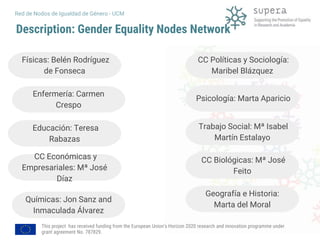
Físicas: Belén Rodríguez
de Fonseca
Enfermería: Carmen
Crespo
Educación: Teresa
Rabazas
CC Económicas y
Empresariales: Mª José
Díaz
CC Políticas y Sociología:
Maribel Blázquez
Psicología: Marta Aparicio
Trabajo Social: Mª Isabel
Martín Estalayo
CC Biológicas: Mª José
Feito
Químicas: Jon Sanz and
Inmaculada Álvarez
Geografía e Historia:
Marta del Moral
This project has received funding from the European Union's Horizon 2020 research and innovation programme under
grant agreement No. 787829.
Red de Nodos de Igualdad de Género - UCM
Description: Gender Equality Nodes Network
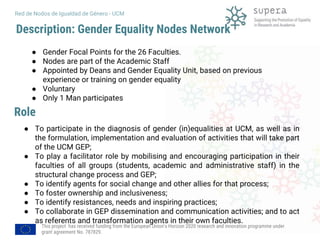
● Gender Focal Points for the 26 Faculties.
● Nodes are part of the Academic Staff
● Appointed by Deans and Gender Equality Unit, based on previous
experience or training on gender equality
● Voluntary
● Only 1 Man participates
● To participate in the diagnosis of gender (in)equalities at UCM, as well as in
the formulation, implementation and evaluation of activities that will take part
of the UCM GEP;
● To play a facilitator role by mobilising and encouraging participation in their
faculties of all groups (students, academic and administrative staff) in the
structural change process and GEP;
● To identify agents for social change and other allies for that process;
● To foster ownership and inclusiveness;
● To identify resistances, needs and inspiring practices;
● To collaborate in GEP dissemination and communication activities; and to act
as referents and transformation agents in their own faculties.
Role
This project has received funding from the European Union's Horizon 2020 research and innovation programme under
grant agreement No. 787829.
Red de Nodos de Igualdad de Género - UCM
Description: Gender Equality Nodes Network
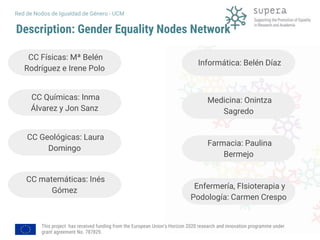
CC Geológicas: Laura
Domingo
CC matemáticas: Inés
Gómez
Informática: Belén Díaz
Medicina: Onintza
Sagredo
Farmacia: Paulina
Bermejo
Enfermería, FIsioterapia y
Podología: Carmen Crespo
CC Físicas: Mª Belén
Rodríguez e Irene Polo
CC Químicas: Inma
Álvarez y Jon Sanz
This project has received funding from the European Union's Horizon 2020 research and innovation programme under
grant agreement No. 787829.
Red de Nodos de Igualdad de Género - UCM
Description: Gender Equality Nodes Network
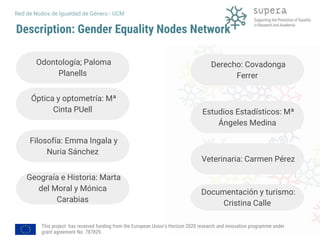
Derecho: Covadonga
Ferrer
Estudios Estadísticos: Mª
Ángeles Medina
Veterinaria: Carmen Pérez
Documentación y turismo:
Cristina Calle
Odontología; Paloma
Planells
Óptica y optometría: Mª
Cinta PUell
Filosofía: Emma Ingala y
Nuria Sánchez
Geograía e Historia: Marta
del Moral y Mónica
Carabias
This project has received funding from the European Union's Horizon 2020 research and innovation programme under
grant agreement No. 787829.
Red de Nodos de Igualdad de Género - UCM
Why is your practice an example of institutionalisation?
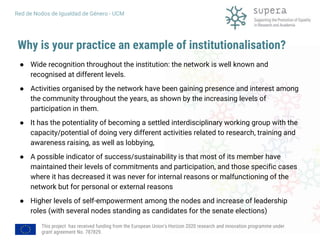
● Wide recognition throughout the institution: the network is well known and
recognised at different levels.
● Activities organised by the network have been gaining presence and interest among
the community throughout the years, as shown by the increasing levels of
participation in them.
● It has the potentiality of becoming a settled interdisciplinary working group with the
capacity/potential of doing very different activities related to research, training and
awareness raising, as well as lobbying,
● A possible indicator of success/sustainability is that most of its member have
maintained their levels of commitments and participation, and those specific cases
where it has decreased it was never for internal reasons or malfunctioning of the
network but for personal or external reasons
● Higher levels of self-empowerment among the nodes and increase of leadership
roles (with several nodes standing as candidates for the senate elections)
This project has received funding from the European Union's Horizon 2020 research and innovation programme under
grant agreement No. 787829.
Red de Nodos de Igualdad de Género - UCM
Activities organised by the Network
By the SUPERA - UCM Team for the network
● Training and capacity building
● Network meetings organized
● Technical assistance
By the network for the UCM Community
● Presentations of UCM Needs Assessment results
● Workshops for defining GEP actions
● Participatory diagnosis activities
○ Procedures for the distribution of time schedules and modules, which are
different for each of the 26 Faculties of the UCM;
○ Diagnosis on Resistances to Gender Equality Policies;
○ Diagnosis about enviromental sexist and sexual harassment and informal
strategies to address those situations.
● Gender in Teaching: Identification and collection of good practices within the
UCM and dissemination of guidelines and recommendations throughout the
UCM community
This project has received funding from the European Union's Horizon 2020 research and innovation programme under
grant agreement No. 787829.
Red de Nodos de Igualdad de Género - UCM
Co-creation techniques used
Participatory techniques:
○ Lotus Blossom
○ Role Playing
○ Map of Actors
○ Collaborative design of actions
Questionnaire about each Faculty procedure for
schedule assignation
Focus groups
This project has received funding from the European Union's Horizon 2020 research and innovation programme under
grant agreement No. 787829.
Red de Nodos de Igualdad de Género - UCM
Impact drivers: Facilitating and/or success factors
- Core team and SUPERA team on permanent coordination and facilitation roles
- Working on the basis of motivation and continuous learning
- Voluntary participation
- Participatory approach based on active listening and exchange between
disciplines (which foster appropriation)
- Ownership and involvement of key stakeholders
- Openness to different understanding and levels of expertise: Each node brought
in a different and complementary set of skills and attitudes
- Good relations and communication with most of the Dean’s teams, which
derives in the network being highly recognised at faculty level
- Decentralising GE issues and the structural change process
- Feminist practise based on recognition, mutual support and visibility of all types
of knowleges
- Bottom-up approach
- Unique network with all faculties involved
This project has received funding from the European Union's Horizon 2020 research and innovation programme under
grant agreement No. 787829.
Red de Nodos de Igualdad de Género - UCM
Problems or difficulties encountered
- Lack of resources (mainly human resources) for a permanent
support and promotion of the network
- GE issues and activities were very much centralised in the GE Unit
- Lack of understanding of the network by certain levels of the
institution, involving lack of formal/official recognition by the top
leadership positions. This poses a challenge to the sustainability of
the network as it is based mainly on a bottom-up approach
- Lack of time from the nodes
- Difficulties to engage students
This project has received funding from the European Union's Horizon 2020 research and innovation programme under
grant agreement No. 787829.
Red de Nodos de Igualdad de Género - UCM
Has the SUPERA Consortium or a H2020 project been a
facilitator factor? How & Why?
● SUPERA Team has been responsible of the set up and
the coordination of the network so far
● Training and capacity building activities has been
promoted and funded by the SUPERA
● International exchange among the consortium has
enriched UCM discussions on GE
● SUPERA has been a link with the EU updates and
discussion on GE in Research and Academia
This project has received funding from the European Union's Horizon 2020 research and innovation programme under
grant agreement No. 787829.
Red de Nodos de Igualdad de Género - UCM
SUPERA principles
(Cumulative, Inclusive, Innovative, Sustainable)
Knowledge and experiences of all the nodes
Different categories, different groups (students, admin
and faculty) and different fields of knowledge working
together
Participatory techniques and co-creation workshops have
been used to propose solutions and measures to
promote gender equality
This project has received funding from the European Union's Horizon 2020 research and
innovation programme under grant agreement No. 787829.
¡Muchas Gracias!
superaprojectoffice@ucm.es

Red De Nodos De Igualdad De Genero

  • 1.
    RED DE NODOSDE IGUALDAD DE GÉNERO
  • 2.
    This project hasreceived funding from the European Union's Horizon 2020 research and innovation programme under grant agreement No. 787829. Red de Nodos de Igualdad de Género - UCM Context Population *2021 ● UCM Students 69.893 (100%) men (38%) women (62%) ● UCM Academic & Research Staff 6.372 (100%) men (51,8%) women (48,2%) ● UCM Administrative Staff 3.328 (100%) men (42,3%) women (57, 7%) Schools 26 Faculties 5 fields of knowledge (No engineering degrees) Horizontal Segregation ● The most segregated in terms of Students; ○ Computer Engineer, Social Worker, Education ● In terms of Academic & Research Staff: ○ Lower than 30% of women (Computer Sciences) ○ Lower 40% (Physics, Maths and Philosophy) Vertical Segregation: Scissors Graph Full Prof (Women 36% vs Men 64%) Assistant Prof (Women 57% vs Men 43%) Decision Making Position: Main Decision making bodies and Rectoral team are gender balanced UCM have never had a female rector
  • 3.
    This project hasreceived funding from the European Union's Horizon 2020 research and innovation programme under grant agreement No. 787829. Red de Nodos de Igualdad de Género - UCM Description: Gender Equality Nodes Network Físicas: Belén Rodríguez de Fonseca Enfermería: Carmen Crespo Educación: Teresa Rabazas CC Económicas y Empresariales: Mª José Díaz CC Políticas y Sociología: Maribel Blázquez Psicología: Marta Aparicio Trabajo Social: Mª Isabel Martín Estalayo CC Biológicas: Mª José Feito Químicas: Jon Sanz and Inmaculada Álvarez Geografía e Historia: Marta del Moral
  • 4.
    This project hasreceived funding from the European Union's Horizon 2020 research and innovation programme under grant agreement No. 787829. Red de Nodos de Igualdad de Género - UCM Description: Gender Equality Nodes Network ● Gender Focal Points for the 26 Faculties. ● Nodes are part of the Academic Staff ● Appointed by Deans and Gender Equality Unit, based on previous experience or training on gender equality ● Voluntary ● Only 1 Man participates ● To participate in the diagnosis of gender (in)equalities at UCM, as well as in the formulation, implementation and evaluation of activities that will take part of the UCM GEP; ● To play a facilitator role by mobilising and encouraging participation in their faculties of all groups (students, academic and administrative staff) in the structural change process and GEP; ● To identify agents for social change and other allies for that process; ● To foster ownership and inclusiveness; ● To identify resistances, needs and inspiring practices; ● To collaborate in GEP dissemination and communication activities; and to act as referents and transformation agents in their own faculties. Role
  • 5.
    This project hasreceived funding from the European Union's Horizon 2020 research and innovation programme under grant agreement No. 787829. Red de Nodos de Igualdad de Género - UCM Description: Gender Equality Nodes Network CC Geológicas: Laura Domingo CC matemáticas: Inés Gómez Informática: Belén Díaz Medicina: Onintza Sagredo Farmacia: Paulina Bermejo Enfermería, FIsioterapia y Podología: Carmen Crespo CC Físicas: Mª Belén Rodríguez e Irene Polo CC Químicas: Inma Álvarez y Jon Sanz
  • 6.
    This project hasreceived funding from the European Union's Horizon 2020 research and innovation programme under grant agreement No. 787829. Red de Nodos de Igualdad de Género - UCM Description: Gender Equality Nodes Network Derecho: Covadonga Ferrer Estudios Estadísticos: Mª Ángeles Medina Veterinaria: Carmen Pérez Documentación y turismo: Cristina Calle Odontología; Paloma Planells Óptica y optometría: Mª Cinta PUell Filosofía: Emma Ingala y Nuria Sánchez Geograía e Historia: Marta del Moral y Mónica Carabias
  • 7.
    This project hasreceived funding from the European Union's Horizon 2020 research and innovation programme under grant agreement No. 787829. Red de Nodos de Igualdad de Género - UCM Why is your practice an example of institutionalisation? ● Wide recognition throughout the institution: the network is well known and recognised at different levels. ● Activities organised by the network have been gaining presence and interest among the community throughout the years, as shown by the increasing levels of participation in them. ● It has the potentiality of becoming a settled interdisciplinary working group with the capacity/potential of doing very different activities related to research, training and awareness raising, as well as lobbying, ● A possible indicator of success/sustainability is that most of its member have maintained their levels of commitments and participation, and those specific cases where it has decreased it was never for internal reasons or malfunctioning of the network but for personal or external reasons ● Higher levels of self-empowerment among the nodes and increase of leadership roles (with several nodes standing as candidates for the senate elections)
  • 8.
    This project hasreceived funding from the European Union's Horizon 2020 research and innovation programme under grant agreement No. 787829. Red de Nodos de Igualdad de Género - UCM Activities organised by the Network By the SUPERA - UCM Team for the network ● Training and capacity building ● Network meetings organized ● Technical assistance By the network for the UCM Community ● Presentations of UCM Needs Assessment results ● Workshops for defining GEP actions ● Participatory diagnosis activities ○ Procedures for the distribution of time schedules and modules, which are different for each of the 26 Faculties of the UCM; ○ Diagnosis on Resistances to Gender Equality Policies; ○ Diagnosis about enviromental sexist and sexual harassment and informal strategies to address those situations. ● Gender in Teaching: Identification and collection of good practices within the UCM and dissemination of guidelines and recommendations throughout the UCM community
  • 9.
    This project hasreceived funding from the European Union's Horizon 2020 research and innovation programme under grant agreement No. 787829. Red de Nodos de Igualdad de Género - UCM Co-creation techniques used Participatory techniques: ○ Lotus Blossom ○ Role Playing ○ Map of Actors ○ Collaborative design of actions Questionnaire about each Faculty procedure for schedule assignation Focus groups
  • 10.
    This project hasreceived funding from the European Union's Horizon 2020 research and innovation programme under grant agreement No. 787829. Red de Nodos de Igualdad de Género - UCM Impact drivers: Facilitating and/or success factors - Core team and SUPERA team on permanent coordination and facilitation roles - Working on the basis of motivation and continuous learning - Voluntary participation - Participatory approach based on active listening and exchange between disciplines (which foster appropriation) - Ownership and involvement of key stakeholders - Openness to different understanding and levels of expertise: Each node brought in a different and complementary set of skills and attitudes - Good relations and communication with most of the Dean’s teams, which derives in the network being highly recognised at faculty level - Decentralising GE issues and the structural change process - Feminist practise based on recognition, mutual support and visibility of all types of knowleges - Bottom-up approach - Unique network with all faculties involved
  • 11.
    This project hasreceived funding from the European Union's Horizon 2020 research and innovation programme under grant agreement No. 787829. Red de Nodos de Igualdad de Género - UCM Problems or difficulties encountered - Lack of resources (mainly human resources) for a permanent support and promotion of the network - GE issues and activities were very much centralised in the GE Unit - Lack of understanding of the network by certain levels of the institution, involving lack of formal/official recognition by the top leadership positions. This poses a challenge to the sustainability of the network as it is based mainly on a bottom-up approach - Lack of time from the nodes - Difficulties to engage students
  • 12.
    This project hasreceived funding from the European Union's Horizon 2020 research and innovation programme under grant agreement No. 787829. Red de Nodos de Igualdad de Género - UCM Has the SUPERA Consortium or a H2020 project been a facilitator factor? How & Why? ● SUPERA Team has been responsible of the set up and the coordination of the network so far ● Training and capacity building activities has been promoted and funded by the SUPERA ● International exchange among the consortium has enriched UCM discussions on GE ● SUPERA has been a link with the EU updates and discussion on GE in Research and Academia
  • 13.
    This project hasreceived funding from the European Union's Horizon 2020 research and innovation programme under grant agreement No. 787829. Red de Nodos de Igualdad de Género - UCM SUPERA principles (Cumulative, Inclusive, Innovative, Sustainable) Knowledge and experiences of all the nodes Different categories, different groups (students, admin and faculty) and different fields of knowledge working together Participatory techniques and co-creation workshops have been used to propose solutions and measures to promote gender equality
  • 14.
    This project hasreceived funding from the European Union's Horizon 2020 research and innovation programme under grant agreement No. 787829. ¡Muchas Gracias! superaprojectoffice@ucm.es