Rita Bencivenga
Researcher & Lecturer in inclusive science
Tracing Italian GEPs: positive action
plans and other pathways
Gender Equality Plan
License / Licence / Licenza: creativecommons.org/licenses/by/4.0/
English
This material is licensed under a Creative Commons Attribution 4.0
International License (CC BY 4.0).
You are free to share and adapt it, provided that clear attribution is given
to Rita Bencivenga and a link to the source is included.
Français
Ce matériel est mis à disposition sous Licence Creative Commons
Attribution 4.0 International (CC BY 4.0).
Vous êtes autorisé·et à le partager et l’adapter, à condition d’attribuer
clairement la paternité à Rita Bencivenga et d’inclure un lien vers la
source.
Italiano
Questo materiale è rilasciato con Licenza Creative Commons
Attribuzione 4.0 (CC BY 4.0).
È consentito condividerlo e adattarlo, a condizione di attribuirne
chiaramente la paternità a Rita Bencivenga e inserire un link alla fonte.
creativecommons.org/licenses/by/4.0/
Tracing Italian gender
equality plans: positive
action plans and other
pathways
Rita Bencivenga, University of Genoa, Italy
March 2022
Italian specificities: GEPs and National
Recovery and Resilience Plan (PNRR) funding
• Access to PNRR funding is granted only to universities, research institutions, and
other public or private entities that have adopted, or commit to adopting within the
first year of the project, both a “Gender Budget” and a “Gender Equality Plan” (GEP),
in line with the prerequisite already required for all Horizon Europe projects.
• (Linee Guida MUR per le iniziative di Sistema della Missione 4 Componente 2. p. 13)
Rita Bencivenga 4
UniGE: the GEP starts from the Positive Action Plan
(PAP): a three years document existing since 2011 in all
Italian public bodies
Why? By Law, Public Administrations – including all
Public research organisations and Universities – must
have a Positive Action Plan.
UniGE starting point
PAP GEP
Rita Bencivenga 5
Gender equality, inclusion and respect of
diversity in UniGE before the GEP
• Work-life balance: subsidised agreements with infant schools, kindergartens,
summer centres since 2008.
• Since 2015, agreements have been in place with institutions to support
members of staff taking care of individuals who are not self-sufficient.
• All admin staff are offered subsidised access to summer camps and holiday
clubs;
• A parents’ fund has also been set up for specific categories of non-tenured
teaching staff (research scholarship holders, PhD students and ESRs).
• Since 2015, a double student university ID allows students transitioning
gender, upon their request, to obtain a temporary bureaucratic profile and a
student university ID bearing the student’s preferred name.
Rita Bencivenga 6
Gender equality, inclusion and respect of
diversity in UniGE before the GEP
• Since 2017, regulations in matters of Remote working for administrative staff
• The Consigliere/a di fiducia (Trusted advisor): since 2017, 3-year mandate. A professional
practitioner: specific support to anyone in the academic community seeking assistance
about harassment and/or mobbing.
• Since 2018, the code of conduct for the prevention of any form of
discrimination, harassment, mobbing in the workplace.
• Two statutory bodies (CUG and CPO) devoted to protecting gender equality
and contrasting discrimination and the periodic plans they provide: the
Positive Action Plan (PAP) 2021-2023 and the Gender Budget (Bilancio di
Genere) 2020.
• The Rector’s Delegate for equal opportunities and inclusion, since 2021.
• Since 2021: the procedure aiming at protecting whistle-blowers.
Rita Bencivenga 7
Crossroad between gender mainstreaming and
positive actions.
A key question is: who are GEPs actually addressing? The coexistence of Gender
Mainstreaming (GM) and Positive Action (PA) measures may reinforce the perception
that GEPs concern only part of the academic community.
In some cases there is no will to open decision-making and programmatic spaces to
new visions and to actors who are rarely or never included:
- Gender mainstreaming requires a preparatory phase phase which can ALSO be
constituted by Positive Actions
- But positive actions, alone, do not have the strength to restructure the dominant
ideas, values, practices.
Rita Bencivenga 8
Challenges
Analyses of institutional tools for promoting gender equality in academia—such as the Athena Swan Charter
and PAPs—have pointed out some recurring issues:
• the tendency to generate heavy workloads, particularly for female members of GEP working groups (1,2);
• an emphasis on work–life balance (3), which is important but, on its own, insufficient to bring about the
structural change required for effective gender mainstreaming.
1. Caffrey, L., Wyatt, D., Fudge, N., Mattingley, H., Williamson, C., & McKevitt, C. (2016), Gender equity
programmes in academic medicine: A realist evaluation approach to Athena SWAN processes, in BMJ Open,
vol. 6, n. 9, pp. 1-9. https://doi.org/10.1136/bmjopen-2016-012090
2. Bencivenga, R. (2019), "Gender Equality in Academia: Comparative Perspectives From Feminist
Institutionalism", in P. Paoloni, M. Paoloni, & S. Arduini (eds. by), Proceedings of the 2nd International
Conference on Gender Research ICGR 2019, Roma, Università RomaTre, pp. 66-72.
3. Galizzi, G., & Siboni, B. (2016), Positive action plans in Italian universities: Does gender really matter?, in
Meditari Accountancy Research, vol. 24, n. 2, pp. 246-268. https://doi.org/10.1108/MEDAR-09-2015-0062
Rita Bencivenga 9
Italian Specificities and Strengths
• Integrated approach: CUG (Single guarantee committee) and CPO (Equal opportunities
committee) address gender equality, anti-discrimination, well-being, and prevention of
harassment/violence → alignment with Horizon Europe focus on diversity and intersectionality.
• Proactive practices: Some universities already broaden equality to inclusion (e.g., double
student card for transgender students).
• Mandatory CUGs in all public institutions (not only universities) → stronger territorial/sectoral
networking.
• Collaborative networks:
• National Forum of CUGs (Public Administrations).
• Local CUG networks (e.g., Turin, Genoa).
• Sectoral networks (e.g., environmental protection system SNPA).
• Benefits: sharing good practices, coordinated actions on PAPs, work–life balance, training →
greater consistency and stronger impact.
Rita Bencivenga 10
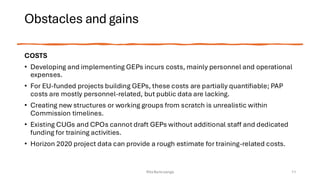
Obstacles and gains
COSTS
• Developing and implementing GEPs incurs costs, mainly personnel and operational
expenses.
• For EU-funded projects building GEPs, these costs are partially quantifiable; PAP
costs are mostly personnel-related, but public data are lacking.
• Creating new structures or working groups from scratch is unrealistic within
Commission timelines.
• Existing CUGs and CPOs cannot draft GEPs without additional staff and dedicated
funding for training activities.
• Horizon 2020 project data can provide a rough estimate for training-related costs.
Rita Bencivenga 11
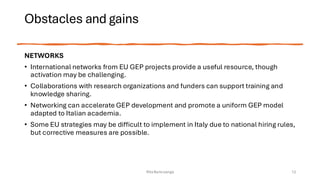
Obstacles and gains
NETWORKS
• International networks from EU GEP projects provide a useful resource, though
activation may be challenging.
• Collaborations with research organizations and funders can support training and
knowledge sharing.
• Networking can accelerate GEP development and promote a uniform GEP model
adapted to Italian academia.
• Some EU strategies may be difficult to implement in Italy due to national hiring rules,
but corrective measures are possible.
Rita Bencivenga 12
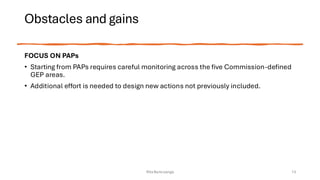
Obstacles and gains
FOCUS ON PAPs
• Starting from PAPs requires careful monitoring across the five Commission-defined
GEP areas.
• Additional effort is needed to design new actions not previously included.
Rita Bencivenga 13
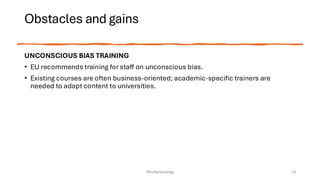
Obstacles and gains
UNCONSCIOUS BIAS TRAINING
• EU recommends training for staff on unconscious bias.
• Existing courses are often business-oriented; academic-specific trainers are
needed to adapt content to universities.
Rita Bencivenga 14
Obstacles and gains
UNEQUAL WORKLOAD
• Extra work for transforming PAPs into GEPs may fall disproportionately on women.
• Studies (Athena Swan) show practical GEP work often handled by women, risking
gender segregation.
• Italian experience confirms this imbalance, with limited career benefit for women
doing the work.
• Current mechanisms (Athena Swan, CUGs) do not ensure equal distribution of work
or positive career impact.
Rita Bencivenga 15
Learn more at:
www.ritabencivenga.it
Follow me on LinkedIn
https://www.linkedin.com/in/rita-bencivenga-147a1915/
QR Code
"Diversity drives innovation – in research, in tech, in society."

Tracing_Italian_GEP_PAP_and_other_pathways.pdf

  • 1.
    Rita Bencivenga Researcher &Lecturer in inclusive science Tracing Italian GEPs: positive action plans and other pathways Gender Equality Plan
  • 2.
    License / Licence/ Licenza: creativecommons.org/licenses/by/4.0/ English This material is licensed under a Creative Commons Attribution 4.0 International License (CC BY 4.0). You are free to share and adapt it, provided that clear attribution is given to Rita Bencivenga and a link to the source is included. Français Ce matériel est mis à disposition sous Licence Creative Commons Attribution 4.0 International (CC BY 4.0). Vous êtes autorisé·et à le partager et l’adapter, à condition d’attribuer clairement la paternité à Rita Bencivenga et d’inclure un lien vers la source. Italiano Questo materiale è rilasciato con Licenza Creative Commons Attribuzione 4.0 (CC BY 4.0). È consentito condividerlo e adattarlo, a condizione di attribuirne chiaramente la paternità a Rita Bencivenga e inserire un link alla fonte. creativecommons.org/licenses/by/4.0/
  • 3.
    Tracing Italian gender equalityplans: positive action plans and other pathways Rita Bencivenga, University of Genoa, Italy March 2022
  • 4.
    Italian specificities: GEPsand National Recovery and Resilience Plan (PNRR) funding • Access to PNRR funding is granted only to universities, research institutions, and other public or private entities that have adopted, or commit to adopting within the first year of the project, both a “Gender Budget” and a “Gender Equality Plan” (GEP), in line with the prerequisite already required for all Horizon Europe projects. • (Linee Guida MUR per le iniziative di Sistema della Missione 4 Componente 2. p. 13) Rita Bencivenga 4
  • 5.
    UniGE: the GEPstarts from the Positive Action Plan (PAP): a three years document existing since 2011 in all Italian public bodies Why? By Law, Public Administrations – including all Public research organisations and Universities – must have a Positive Action Plan. UniGE starting point PAP GEP Rita Bencivenga 5
  • 6.
    Gender equality, inclusionand respect of diversity in UniGE before the GEP • Work-life balance: subsidised agreements with infant schools, kindergartens, summer centres since 2008. • Since 2015, agreements have been in place with institutions to support members of staff taking care of individuals who are not self-sufficient. • All admin staff are offered subsidised access to summer camps and holiday clubs; • A parents’ fund has also been set up for specific categories of non-tenured teaching staff (research scholarship holders, PhD students and ESRs). • Since 2015, a double student university ID allows students transitioning gender, upon their request, to obtain a temporary bureaucratic profile and a student university ID bearing the student’s preferred name. Rita Bencivenga 6
  • 7.
    Gender equality, inclusionand respect of diversity in UniGE before the GEP • Since 2017, regulations in matters of Remote working for administrative staff • The Consigliere/a di fiducia (Trusted advisor): since 2017, 3-year mandate. A professional practitioner: specific support to anyone in the academic community seeking assistance about harassment and/or mobbing. • Since 2018, the code of conduct for the prevention of any form of discrimination, harassment, mobbing in the workplace. • Two statutory bodies (CUG and CPO) devoted to protecting gender equality and contrasting discrimination and the periodic plans they provide: the Positive Action Plan (PAP) 2021-2023 and the Gender Budget (Bilancio di Genere) 2020. • The Rector’s Delegate for equal opportunities and inclusion, since 2021. • Since 2021: the procedure aiming at protecting whistle-blowers. Rita Bencivenga 7
  • 8.
    Crossroad between gendermainstreaming and positive actions. A key question is: who are GEPs actually addressing? The coexistence of Gender Mainstreaming (GM) and Positive Action (PA) measures may reinforce the perception that GEPs concern only part of the academic community. In some cases there is no will to open decision-making and programmatic spaces to new visions and to actors who are rarely or never included: - Gender mainstreaming requires a preparatory phase phase which can ALSO be constituted by Positive Actions - But positive actions, alone, do not have the strength to restructure the dominant ideas, values, practices. Rita Bencivenga 8
  • 9.
    Challenges Analyses of institutionaltools for promoting gender equality in academia—such as the Athena Swan Charter and PAPs—have pointed out some recurring issues: • the tendency to generate heavy workloads, particularly for female members of GEP working groups (1,2); • an emphasis on work–life balance (3), which is important but, on its own, insufficient to bring about the structural change required for effective gender mainstreaming. 1. Caffrey, L., Wyatt, D., Fudge, N., Mattingley, H., Williamson, C., & McKevitt, C. (2016), Gender equity programmes in academic medicine: A realist evaluation approach to Athena SWAN processes, in BMJ Open, vol. 6, n. 9, pp. 1-9. https://doi.org/10.1136/bmjopen-2016-012090 2. Bencivenga, R. (2019), "Gender Equality in Academia: Comparative Perspectives From Feminist Institutionalism", in P. Paoloni, M. Paoloni, & S. Arduini (eds. by), Proceedings of the 2nd International Conference on Gender Research ICGR 2019, Roma, Università RomaTre, pp. 66-72. 3. Galizzi, G., & Siboni, B. (2016), Positive action plans in Italian universities: Does gender really matter?, in Meditari Accountancy Research, vol. 24, n. 2, pp. 246-268. https://doi.org/10.1108/MEDAR-09-2015-0062 Rita Bencivenga 9
  • 10.
    Italian Specificities andStrengths • Integrated approach: CUG (Single guarantee committee) and CPO (Equal opportunities committee) address gender equality, anti-discrimination, well-being, and prevention of harassment/violence → alignment with Horizon Europe focus on diversity and intersectionality. • Proactive practices: Some universities already broaden equality to inclusion (e.g., double student card for transgender students). • Mandatory CUGs in all public institutions (not only universities) → stronger territorial/sectoral networking. • Collaborative networks: • National Forum of CUGs (Public Administrations). • Local CUG networks (e.g., Turin, Genoa). • Sectoral networks (e.g., environmental protection system SNPA). • Benefits: sharing good practices, coordinated actions on PAPs, work–life balance, training → greater consistency and stronger impact. Rita Bencivenga 10
  • 11.
    Obstacles and gains COSTS •Developing and implementing GEPs incurs costs, mainly personnel and operational expenses. • For EU-funded projects building GEPs, these costs are partially quantifiable; PAP costs are mostly personnel-related, but public data are lacking. • Creating new structures or working groups from scratch is unrealistic within Commission timelines. • Existing CUGs and CPOs cannot draft GEPs without additional staff and dedicated funding for training activities. • Horizon 2020 project data can provide a rough estimate for training-related costs. Rita Bencivenga 11
  • 12.
    Obstacles and gains NETWORKS •International networks from EU GEP projects provide a useful resource, though activation may be challenging. • Collaborations with research organizations and funders can support training and knowledge sharing. • Networking can accelerate GEP development and promote a uniform GEP model adapted to Italian academia. • Some EU strategies may be difficult to implement in Italy due to national hiring rules, but corrective measures are possible. Rita Bencivenga 12
  • 13.
    Obstacles and gains FOCUSON PAPs • Starting from PAPs requires careful monitoring across the five Commission-defined GEP areas. • Additional effort is needed to design new actions not previously included. Rita Bencivenga 13
  • 14.
    Obstacles and gains UNCONSCIOUSBIAS TRAINING • EU recommends training for staff on unconscious bias. • Existing courses are often business-oriented; academic-specific trainers are needed to adapt content to universities. Rita Bencivenga 14
  • 15.
    Obstacles and gains UNEQUALWORKLOAD • Extra work for transforming PAPs into GEPs may fall disproportionately on women. • Studies (Athena Swan) show practical GEP work often handled by women, risking gender segregation. • Italian experience confirms this imbalance, with limited career benefit for women doing the work. • Current mechanisms (Athena Swan, CUGs) do not ensure equal distribution of work or positive career impact. Rita Bencivenga 15
  • 16.
    Learn more at: www.ritabencivenga.it Followme on LinkedIn https://www.linkedin.com/in/rita-bencivenga-147a1915/ QR Code "Diversity drives innovation – in research, in tech, in society."