
Recruitment methods In
Fashion Industry


 Submitted By,
         Karthika U
Recruitment
•Recruitment refers to the process of
attracting, screening, and selecting a qualified person for
a job.

•All companies in any industry can benefit from contingency
or retain professional recruiters or outsourcing the process
to recruitment agencies.
By Industry
   •Apparel/Clothing
   •Dyes/Chemicals
   •Fashion
   •Jewellery
   •Retail/Stores
   •Import-Export
   •Textile
   •Home Textiles
   •Logistic/Warehouse
By Functional Area
   •Designer
   •Coordinator
   •Business Assistant
   •Top Management
   •HRD/HR
   •Research/Development
   •Marketing
   •Merchandise
   •Quality Control
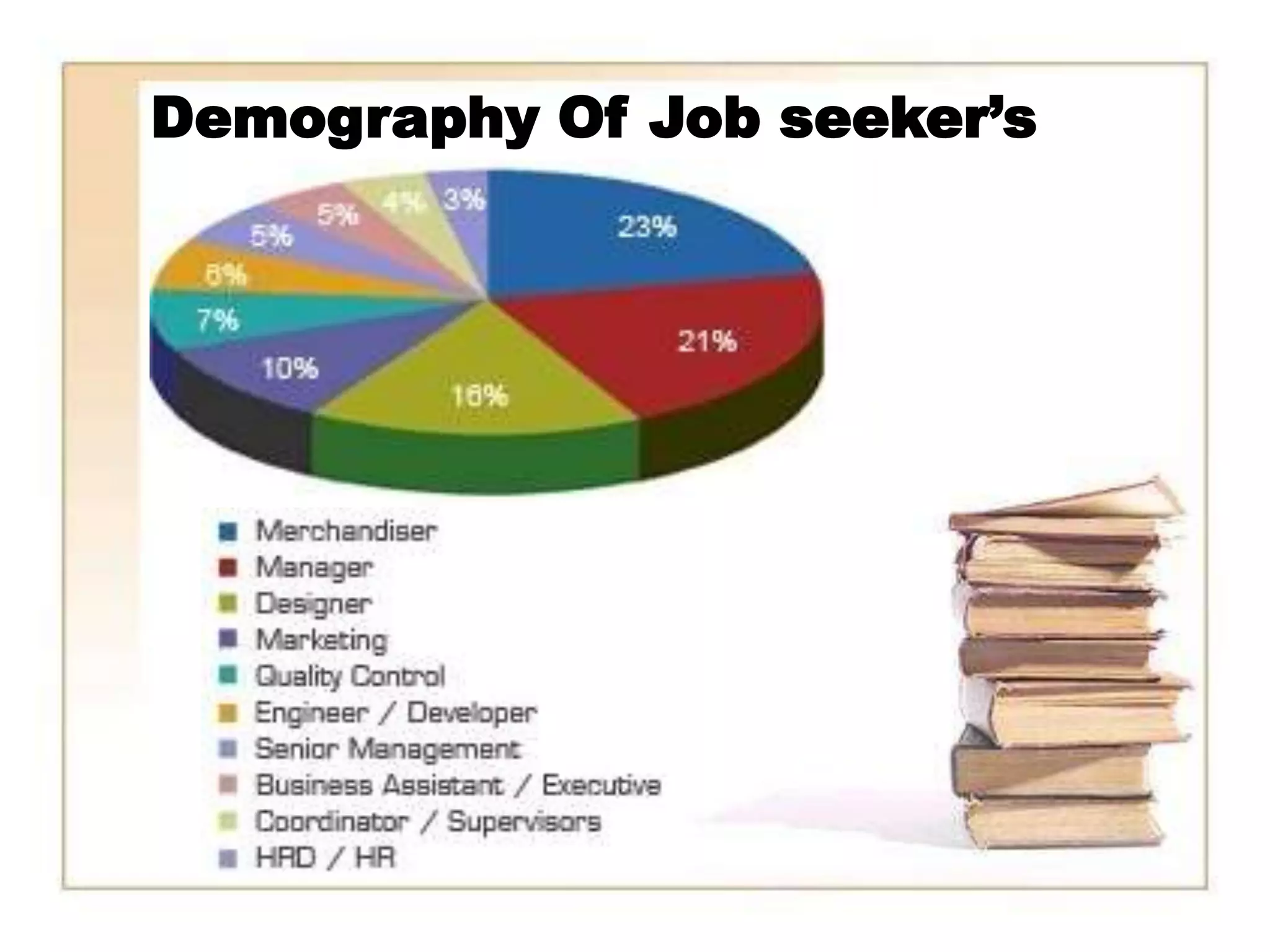
Demography Of Job seeker’s
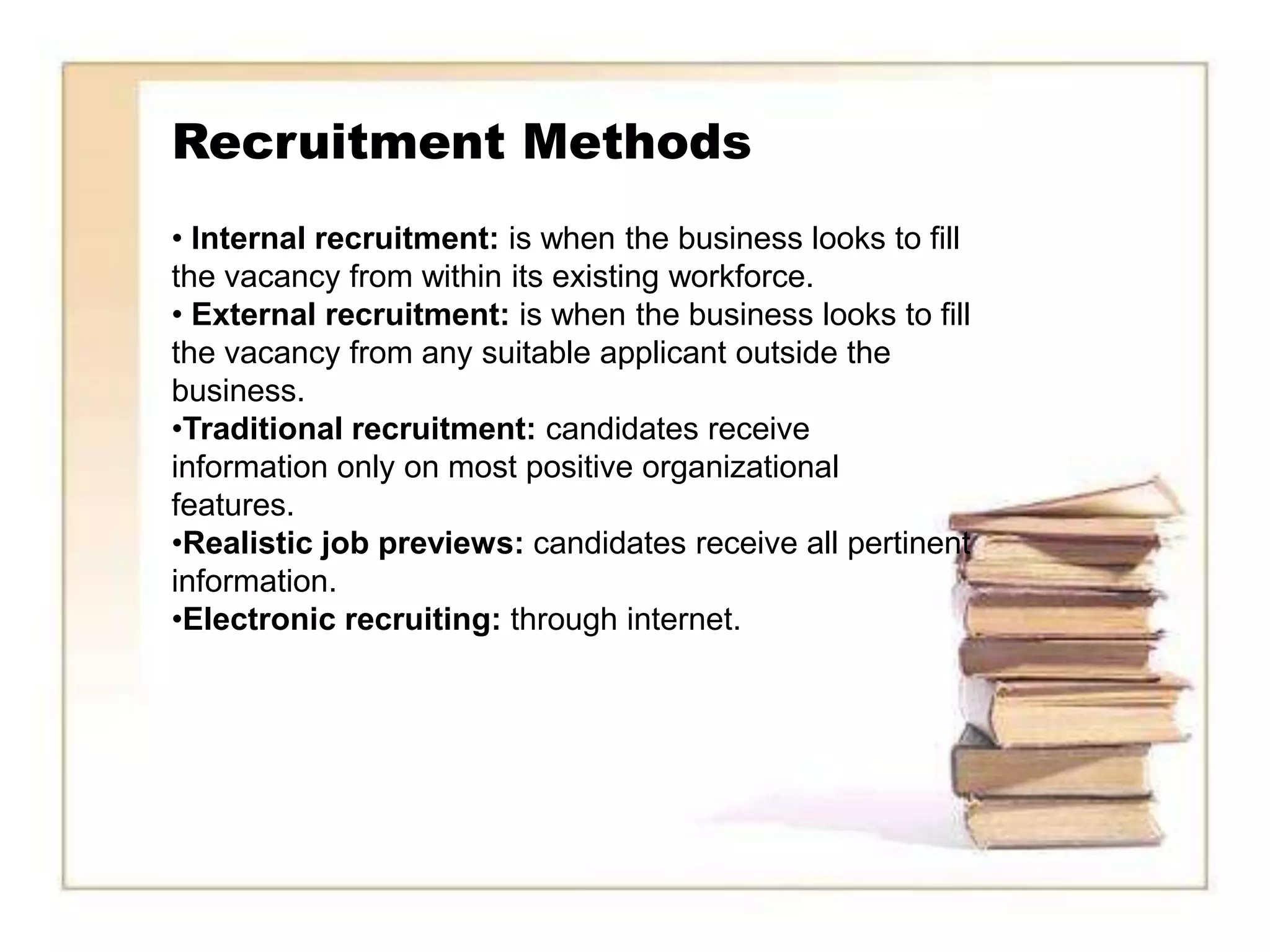
Recruitment Methods
• Internal recruitment: is when the business looks to fill
the vacancy from within its existing workforce.
• External recruitment: is when the business looks to fill
the vacancy from any suitable applicant outside the
business.
•Traditional recruitment: candidates receive
information only on most positive organizational
features.
•Realistic job previews: candidates receive all pertinent
information.
•Electronic recruiting: through internet.
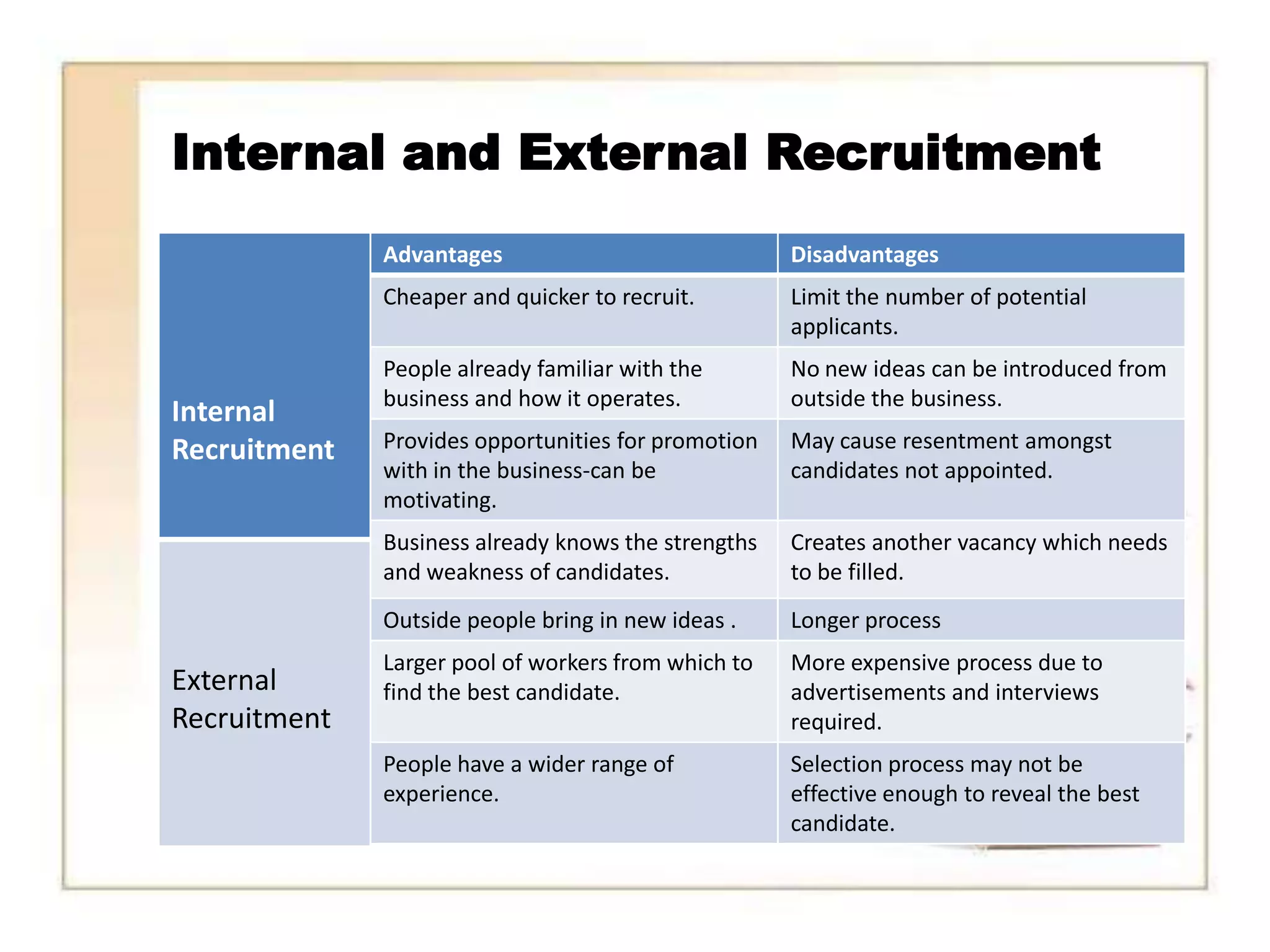
Internal and External Recruitment
              Advantages                             Disadvantages
              Cheaper and quicker to recruit.        Limit the number of potential
                                                     applicants.
              People already familiar with the       No new ideas can be introduced from
              business and how it operates.          outside the business.
Internal
Recruitment   Provides opportunities for promotion   May cause resentment amongst
              with in the business-can be            candidates not appointed.
              motivating.
              Business already knows the strengths   Creates another vacancy which needs
              and weakness of candidates.            to be filled.
              Outside people bring in new ideas .    Longer process
              Larger pool of workers from which to   More expensive process due to
External      find the best candidate.               advertisements and interviews
Recruitment                                          required.
              People have a wider range of           Selection process may not be
              experience.                            effective enough to reveal the best
                                                     candidate.
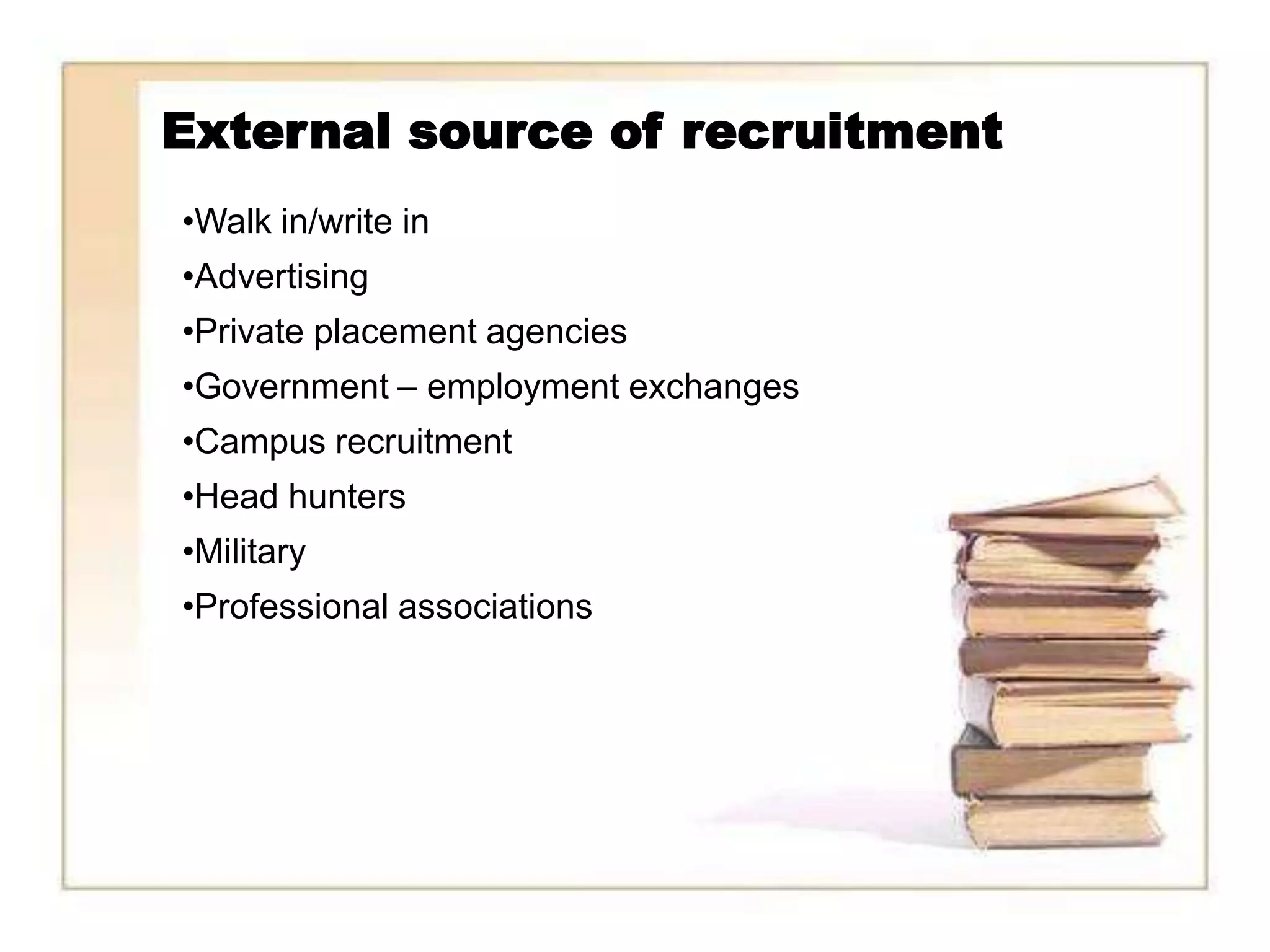
External source of recruitment
•Walk in/write in
•Advertising
•Private placement agencies
•Government – employment exchanges
•Campus recruitment
•Head hunters
•Military
•Professional associations
Electronic recruiting
•Recruitment thru internet
•Advantage is wide publicity and a chance for a large
number of applicants to choose
•Best method to be assessed depends upon:
- Cost per hire
- Number of resumes
- Time-lapse between recruitment and placement ratio
- Applicant performance and turnover
Retention of employees
•Planning ahead
•Clarity in job requirements
•Identify a good source of recruitment
•Screening and interviewing
•Providing challenging work
•Focus on compensation and working conditions
SELECTION
 Selection
   – Choosing from a pool of applicants the person or persons
     who offer the greatest performance potential.

 Selection Steps
   – Completion of a formal application form.
   – Interviewing.
   – Testing.
   – Reference checks.
   – Physical examination.
   – Final analysis and decision to hire or reject.
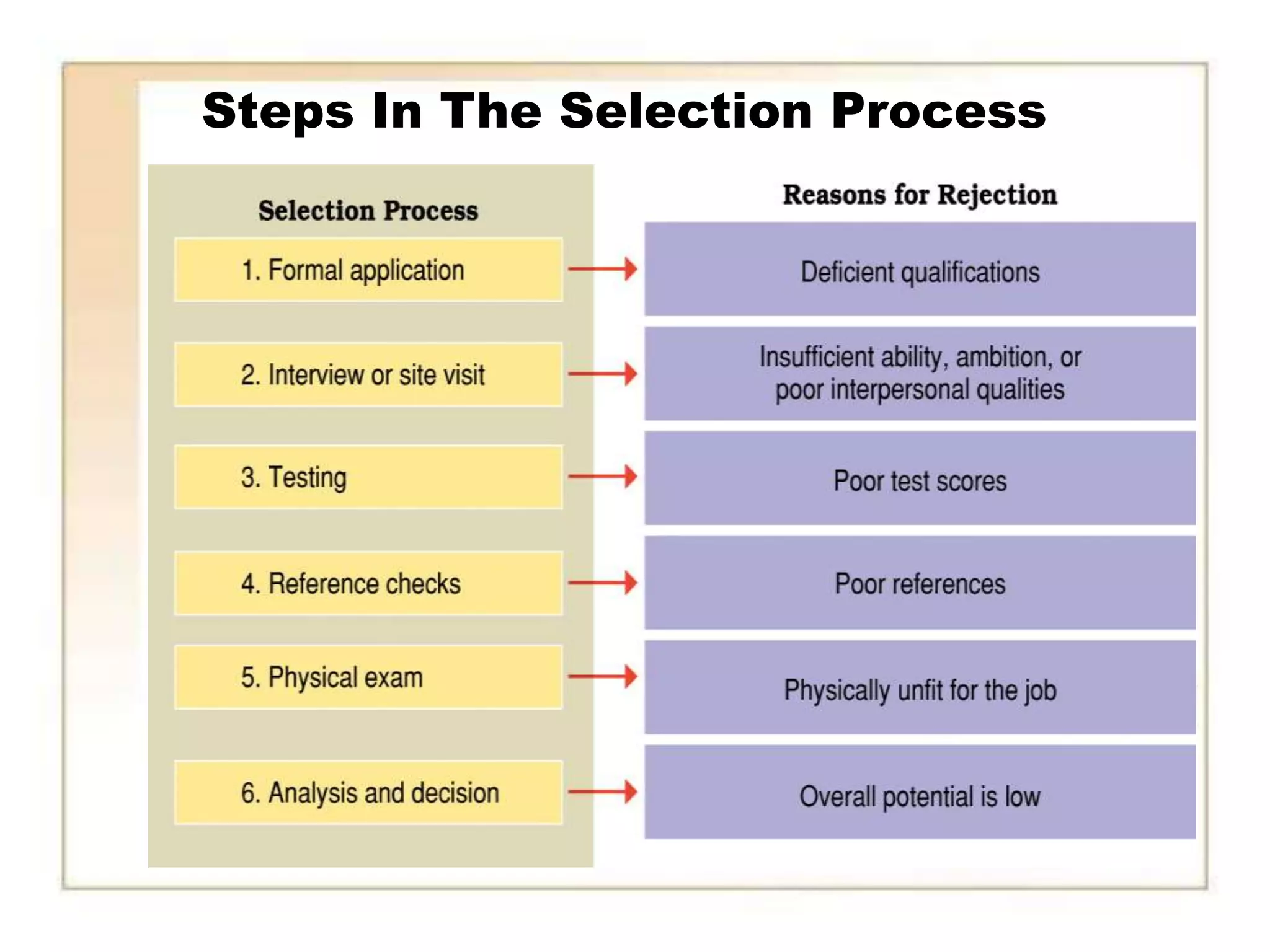
Steps In The Selection Process

 Step 1—application forms
   – Declares individual to be a job candidate.
   – Documents applicant’s personal history and
     qualifications.
   – Personal résumés may be included.
   – Applicants lacking appropriate credentials
     are rejected at this step.
Steps In The Selection Process


 Step 2—interviews
   – Exchange of information between job candidate and key
     members of the organization.
   – Opportunity for job candidate and organizational
     members to learn more about each other.
Steps In The Selection Process

 Step 3 — employment tests
   – Used to further screen applicants by gathering
     additional job-relevant information.
   – Common types of employment tests:
       •   Intelligence
       •   Aptitude
       •   Personality
       •   Interests
Steps In The Selection Process
 Criteria for selection devices:
   – Reliability
       • The selection device is consistent in
         measurement.
   – Validity
       • There is a demonstrable relationship between a
         person’s score or rating on a selection device
         and his/her eventual job performance.
Steps In The Selection Process
 Behaviorally-oriented employment tests:
   – Assessment center
      • Evaluates a person’s performance in simulated
        work situations.
   – Work sampling
      • Evaluates a person’s performance on actual job
        tasks.
Steps In The Selection Process
 Behaviorally-oriented employment tests:
   – Assessment center
      • Evaluates a person’s performance in simulated work situations.
   – Work sampling
      • Evaluates a person’s performance on actual job tasks.
Steps In The Selection Process

 Step 5 — physical examinations
   – Ensure applicant’s physical capability to fulfill job
      requirements.
   – Basis for enrolling applicant in life, health, and disability
      insurance programs.
   – Drug testing is done at this step.
Steps In The Selection Process

 Step 6 — final decision to hire or reject
    – Best selection decisions will involve extensive consultation
      among multiple parties.
    – Selection decision should focus on all aspects of the
      candidate’s capacity to perform the designated job.
Steps In The Selection Process

 Step 6 — final decision to hire or reject
    – Best selection decisions will involve extensive
      consultation among multiple parties.
    – Selection decision should focus on all aspects of the
      candidate’s capacity to perform the designated job.
Introduction of employee to the
organization
 •Welcomes the newcomer
 •Explains the overall objectives of the company and his role
 •Shows the location or place of work
 •Hands over the rule book or job descriptions
 •Provides details about training and promotional advancements
 •Discusses working conditions
 •History of that company
 •Layout and physical facilities
 •Products/services offered
 •Overview of the company procedures
 •Disciplinary procedures
 •Probationary period
Employee benefits
•Pay scales

•Vacations, holidays

•Schedules

•Counselling

•Other benefits

•Training opportunities
THANK YOU

Hr karthika u

  • 1.
    Recruitment methods In FashionIndustry Submitted By, Karthika U
  • 2.
    Recruitment •Recruitment refers tothe process of attracting, screening, and selecting a qualified person for a job. •All companies in any industry can benefit from contingency or retain professional recruiters or outsourcing the process to recruitment agencies.
  • 3.
    By Industry •Apparel/Clothing •Dyes/Chemicals •Fashion •Jewellery •Retail/Stores •Import-Export •Textile •Home Textiles •Logistic/Warehouse
  • 4.
    By Functional Area •Designer •Coordinator •Business Assistant •Top Management •HRD/HR •Research/Development •Marketing •Merchandise •Quality Control
  • 5.
    Demography Of Jobseeker’s
  • 6.
    Recruitment Methods • Internalrecruitment: is when the business looks to fill the vacancy from within its existing workforce. • External recruitment: is when the business looks to fill the vacancy from any suitable applicant outside the business. •Traditional recruitment: candidates receive information only on most positive organizational features. •Realistic job previews: candidates receive all pertinent information. •Electronic recruiting: through internet.
  • 7.
    Internal and ExternalRecruitment Advantages Disadvantages Cheaper and quicker to recruit. Limit the number of potential applicants. People already familiar with the No new ideas can be introduced from business and how it operates. outside the business. Internal Recruitment Provides opportunities for promotion May cause resentment amongst with in the business-can be candidates not appointed. motivating. Business already knows the strengths Creates another vacancy which needs and weakness of candidates. to be filled. Outside people bring in new ideas . Longer process Larger pool of workers from which to More expensive process due to External find the best candidate. advertisements and interviews Recruitment required. People have a wider range of Selection process may not be experience. effective enough to reveal the best candidate.
  • 8.
    External source ofrecruitment •Walk in/write in •Advertising •Private placement agencies •Government – employment exchanges •Campus recruitment •Head hunters •Military •Professional associations
  • 9.
    Electronic recruiting •Recruitment thruinternet •Advantage is wide publicity and a chance for a large number of applicants to choose •Best method to be assessed depends upon: - Cost per hire - Number of resumes - Time-lapse between recruitment and placement ratio - Applicant performance and turnover
  • 10.
    Retention of employees •Planningahead •Clarity in job requirements •Identify a good source of recruitment •Screening and interviewing •Providing challenging work •Focus on compensation and working conditions
  • 11.
    SELECTION  Selection – Choosing from a pool of applicants the person or persons who offer the greatest performance potential.  Selection Steps – Completion of a formal application form. – Interviewing. – Testing. – Reference checks. – Physical examination. – Final analysis and decision to hire or reject.
  • 12.
    Steps In TheSelection Process
  • 13.
    Steps In TheSelection Process  Step 1—application forms – Declares individual to be a job candidate. – Documents applicant’s personal history and qualifications. – Personal résumés may be included. – Applicants lacking appropriate credentials are rejected at this step.
  • 14.
    Steps In TheSelection Process  Step 2—interviews – Exchange of information between job candidate and key members of the organization. – Opportunity for job candidate and organizational members to learn more about each other.
  • 15.
    Steps In TheSelection Process  Step 3 — employment tests – Used to further screen applicants by gathering additional job-relevant information. – Common types of employment tests: • Intelligence • Aptitude • Personality • Interests
  • 16.
    Steps In TheSelection Process  Criteria for selection devices: – Reliability • The selection device is consistent in measurement. – Validity • There is a demonstrable relationship between a person’s score or rating on a selection device and his/her eventual job performance.
  • 17.
    Steps In TheSelection Process  Behaviorally-oriented employment tests: – Assessment center • Evaluates a person’s performance in simulated work situations. – Work sampling • Evaluates a person’s performance on actual job tasks.
  • 18.
    Steps In TheSelection Process  Behaviorally-oriented employment tests: – Assessment center • Evaluates a person’s performance in simulated work situations. – Work sampling • Evaluates a person’s performance on actual job tasks.
  • 19.
    Steps In TheSelection Process  Step 5 — physical examinations – Ensure applicant’s physical capability to fulfill job requirements. – Basis for enrolling applicant in life, health, and disability insurance programs. – Drug testing is done at this step.
  • 20.
    Steps In TheSelection Process  Step 6 — final decision to hire or reject – Best selection decisions will involve extensive consultation among multiple parties. – Selection decision should focus on all aspects of the candidate’s capacity to perform the designated job.
  • 21.
    Steps In TheSelection Process  Step 6 — final decision to hire or reject – Best selection decisions will involve extensive consultation among multiple parties. – Selection decision should focus on all aspects of the candidate’s capacity to perform the designated job.
  • 22.
    Introduction of employeeto the organization •Welcomes the newcomer •Explains the overall objectives of the company and his role •Shows the location or place of work •Hands over the rule book or job descriptions •Provides details about training and promotional advancements •Discusses working conditions •History of that company •Layout and physical facilities •Products/services offered •Overview of the company procedures •Disciplinary procedures •Probationary period
  • 23.
    Employee benefits •Pay scales •Vacations,holidays •Schedules •Counselling •Other benefits •Training opportunities
  • 24.