

RECOMMENDATION
ENGINES
AN ARCHITECTURAL GUIDE
by Timothy Vogel; Sr. Data Architect; Sony Network Entertainment Inc
(SNEI)
tim.vogel@am.sony.com
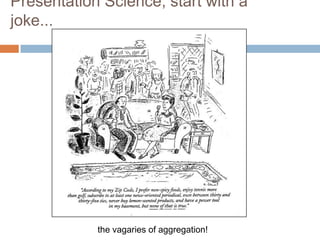
the vagaries of aggregation!
Presentation Science; start with a
joke...
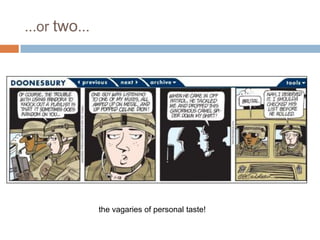
...or two...
the vagaries of personal taste!
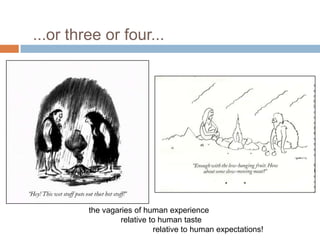
...or three or four...
the vagaries of human experience
relative to human taste
relative to human expectations!
Semantic Transport
 Collaborative Filtering - tenets of "semantic transport"
 "Automated Collaborative Filtering and Semantic Transports"
 http://www.lucifer.com/~sasha/articles/ACF.html
 "Social Trust Bonds"
 all recommendations depend upon "trust" between the recommender
and target audience.
 behavioral similarity is the "online proxy" for social familiarity between
human beings.
 trust is promoted and diminished by the efficacy of the recommendation
itself via...
 the recommender's actual motivation
 the recommendee's perception of that motivation
 the recomendee's final judgment of the recommendation's "quality"
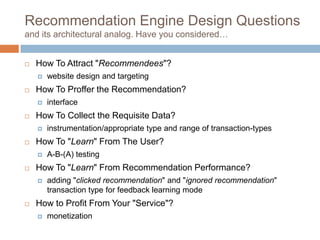
Recommendation Engine Design Questions
and its architectural analog. Have you considered…
 How To Attract "Recommendees"?
 website design and targeting
 How To Proffer the Recommendation?
 interface
 How To Collect the Requisite Data?
 instrumentation/appropriate type and range of transaction-types
 How To "Learn" From The User?
 A-B-(A) testing
 How To "Learn" From Recommendation Performance?
 adding "clicked recommendation" and "ignored recommendation"
transaction type for feedback learning mode
 How to Profit From Your "Service"?
 monetization
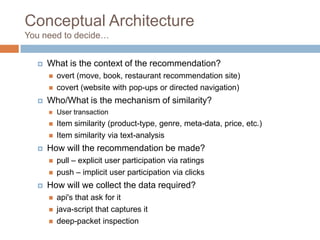
Conceptual Architecture
You need to decide…
 What is the context of the recommendation?
 overt (move, book, restaurant recommendation site)
 covert (website with pop-ups or directed navigation)
 Who/What is the mechanism of similarity?
 User transaction
 Item similarity (product-type, genre, meta-data, price, etc.)
 Item similarity via text-analysis
 How will the recommendation be made?
 pull – explicit user participation via ratings
 push – implicit user participation via clicks
 How will we collect the data required?
 api's that ask for it
 java-script that captures it
 deep-packet inspection
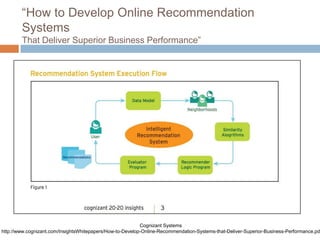
“How to Develop Online Recommendation
Systems
That Deliver Superior Business Performance”
Cognizant Systems
http://www.cognizant.com/InsightsWhitepapers/How-to-Develop-Online-Recommendation-Systems-that-Deliver-Superior-Business-Performance.pdf
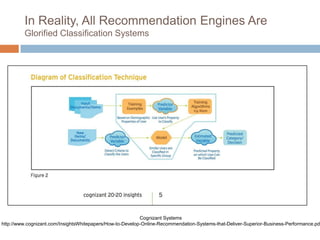
In Reality, All Recommendation Engines Are
Glorified Classification Systems
Cognizant Systems
http://www.cognizant.com/InsightsWhitepapers/How-to-Develop-Online-Recommendation-Systems-that-Deliver-Superior-Business-Performance.pdf
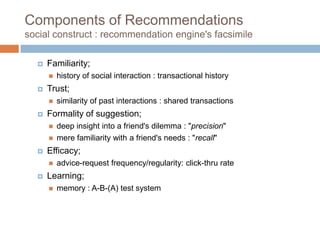
Components of Recommendations
social construct : recommendation engine's facsimile
 Familiarity;
 history of social interaction : transactional history
 Trust;
 similarity of past interactions : shared transactions
 Formality of suggestion;
 deep insight into a friend's dilemma : "precision"
 mere familiarity with a friend's needs : "recall"
 Efficacy;
 advice-request frequency/regularity: click-thru rate
 Learning;
 memory : A-B-(A) test system
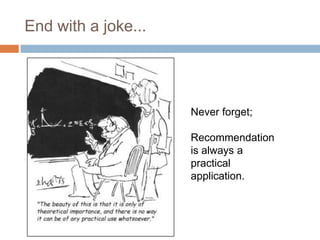
End with a joke...
Never forget;
Recommendation
is always a
practical
application.
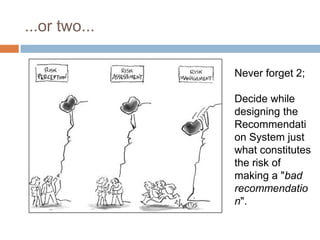
...or two...
Never forget 2;
Decide while
designing the
Recommendati
on System just
what constitutes
the risk of
making a "bad
recommendatio
n".

Recommendation Engines - An Architectural Guide

  • 1.
    RECOMMENDATION ENGINES AN ARCHITECTURAL GUIDE byTimothy Vogel; Sr. Data Architect; Sony Network Entertainment Inc (SNEI) tim.vogel@am.sony.com
  • 2.
    the vagaries ofaggregation! Presentation Science; start with a joke...
  • 3.
    ...or two... the vagariesof personal taste!
  • 4.
    ...or three orfour... the vagaries of human experience relative to human taste relative to human expectations!
  • 5.
    Semantic Transport  CollaborativeFiltering - tenets of "semantic transport"  "Automated Collaborative Filtering and Semantic Transports"  http://www.lucifer.com/~sasha/articles/ACF.html  "Social Trust Bonds"  all recommendations depend upon "trust" between the recommender and target audience.  behavioral similarity is the "online proxy" for social familiarity between human beings.  trust is promoted and diminished by the efficacy of the recommendation itself via...  the recommender's actual motivation  the recommendee's perception of that motivation  the recomendee's final judgment of the recommendation's "quality"
  • 6.
    Recommendation Engine DesignQuestions and its architectural analog. Have you considered…  How To Attract "Recommendees"?  website design and targeting  How To Proffer the Recommendation?  interface  How To Collect the Requisite Data?  instrumentation/appropriate type and range of transaction-types  How To "Learn" From The User?  A-B-(A) testing  How To "Learn" From Recommendation Performance?  adding "clicked recommendation" and "ignored recommendation" transaction type for feedback learning mode  How to Profit From Your "Service"?  monetization
  • 7.
    Conceptual Architecture You needto decide…  What is the context of the recommendation?  overt (move, book, restaurant recommendation site)  covert (website with pop-ups or directed navigation)  Who/What is the mechanism of similarity?  User transaction  Item similarity (product-type, genre, meta-data, price, etc.)  Item similarity via text-analysis  How will the recommendation be made?  pull – explicit user participation via ratings  push – implicit user participation via clicks  How will we collect the data required?  api's that ask for it  java-script that captures it  deep-packet inspection
  • 8.
    “How to DevelopOnline Recommendation Systems That Deliver Superior Business Performance” Cognizant Systems http://www.cognizant.com/InsightsWhitepapers/How-to-Develop-Online-Recommendation-Systems-that-Deliver-Superior-Business-Performance.pdf
  • 9.
    In Reality, AllRecommendation Engines Are Glorified Classification Systems Cognizant Systems http://www.cognizant.com/InsightsWhitepapers/How-to-Develop-Online-Recommendation-Systems-that-Deliver-Superior-Business-Performance.pdf
  • 10.
    Components of Recommendations socialconstruct : recommendation engine's facsimile  Familiarity;  history of social interaction : transactional history  Trust;  similarity of past interactions : shared transactions  Formality of suggestion;  deep insight into a friend's dilemma : "precision"  mere familiarity with a friend's needs : "recall"  Efficacy;  advice-request frequency/regularity: click-thru rate  Learning;  memory : A-B-(A) test system
  • 11.
    End with ajoke... Never forget; Recommendation is always a practical application.
  • 12.
    ...or two... Never forget2; Decide while designing the Recommendati on System just what constitutes the risk of making a "bad recommendatio n".