Course Title:
Introduction to Biotechnology
Course Instructor:
SALMAN SAEED
Botany department
UNIVERSITY college of management & Sciences, Khanewal,
PAKSITAN
2
 Introduction
 Definition
 Steps
 Applications
3 Salman Saeed Lecturer (Botany)
INTRODUCTION
 Recombinant DNA (rDNA): DNA molecules
formed by laboratory methods of genetic
recombination (such as molecular cloning) to
bring together genetic material from multiple
sources, creating sequences that would not
otherwise be found in the genome.
 rDNA is possible because DNA molecules from all
organisms share the same chemical structure.
They differ only in the nucleotide sequence within
that identical overall structure.
4 Salman Saeed Lecturer (Botany)
Recombinant DNA
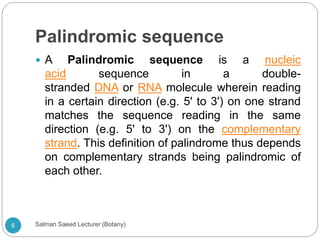
 rDNA is the general name for a piece of DNA that
has been created by the combination of at least
two strands. rDNA molecules are sometimes
called chimeric DNA, because they can be made
of material from two different species. R-DNA
technology uses palindromic sequences and
leads to the production of sticky and blunt ends.
5 Salman Saeed Lecturer (Botany)
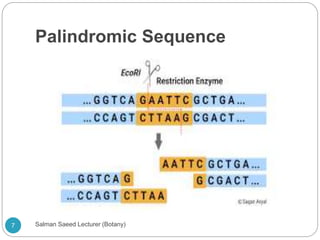
Palindromic sequence
 A Palindromic sequence is a nucleic
acid sequence in a double-
stranded DNA or RNA molecule wherein reading
in a certain direction (e.g. 5' to 3') on one strand
matches the sequence reading in the same
direction (e.g. 5' to 3') on the complementary
strand. This definition of palindrome thus depends
on complementary strands being palindromic of
each other.
6 Salman Saeed Lecturer (Botany)
Palindromic Sequence
7 Salman Saeed Lecturer (Botany)
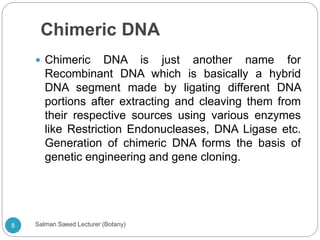
Chimeric DNA
 Chimeric DNA is just another name for
Recombinant DNA which is basically a hybrid
DNA segment made by ligating different DNA
portions after extracting and cleaving them from
their respective sources using various enzymes
like Restriction Endonucleases, DNA Ligase etc.
Generation of chimeric DNA forms the basis of
genetic engineering and gene cloning.
8 Salman Saeed Lecturer (Botany)
What is Recombinant DNA
 This is DNA that has been formed artificially by
combining constituents from different organisms.
9 Salman Saeed Lecturer (Botany)
Recombinant DNA Technology
 Using Recombinant DNA technology, we can
isolate and clone single copy of a gene or a DNA
segment into an indefinite number of copies, all
identical. These new combinations of genetic
material or Recombinant DNA (rDNA) molecules
are introduced into the host cells, where they
propagate and multiply. The technique or
methodology is called Recombinant DNA
technology.
10 Salman Saeed Lecturer (Botany)
Obtaining rDNA
 Step 1: The DNA fragment containing the gene
sequence to be cloned (also known as insert) is
isolated.
 Step 2: Cutting DNA.
 Step 3: Joining DNA
 Step 4: Insertion of these DNA fragments into host
cell using a “vector” (carries DNA molecule).
11 Salman Saeed Lecturer (Botany)
Conti…
 Step 5: The rDNA molecules are generated when
the vector self replicates in the host cell.
 Step 6: Transfer of the rDNA molecules into an
appropriate host cell.
 Step 7: Selection of the host cells carring the
rDNA molecule using a marker.
 Step 8: Replication of the cells carrying rDNA
molecules to get a genetically identical cells or
clone.
12 Salman Saeed Lecturer (Botany)
TERMS USED IN CLONING
 DNA recombination.
The DNA fragment to be cloned is inserted
into a vector.
 Transformation.
The recombinant DNA enters into the host
cell and proliferates.
 Selective amplification.
A specific antibiotic is added to kill E. coli
without any protection. The transformed E.
coli is protected by the antibiotic-resistance
gene
 Isolation of desired DNA clones
13 Salman Saeed Lecturer (Botany)
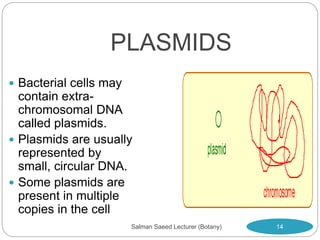
PLASMIDS
 Bacterial cells may
contain extra-
chromosomal DNA
called plasmids.
 Plasmids are usually
represented by
small, circular DNA.
 Some plasmids are
present in multiple
copies in the cell
14
Salman Saeed Lecturer (Botany)
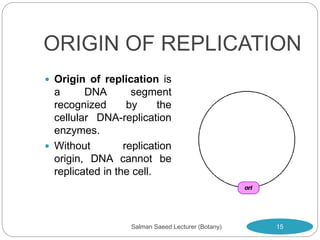
ORIGIN OF REPLICATION
 Origin of replication is
a DNA segment
recognized by the
cellular DNA-replication
enzymes.
 Without replication
origin, DNA cannot be
replicated in the cell.
15
Salman Saeed Lecturer (Botany)
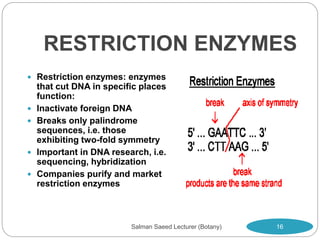
RESTRICTION ENZYMES
 Restriction enzymes: enzymes
that cut DNA in specific places
function:
 Inactivate foreign DNA
 Breaks only palindrome
sequences, i.e. those
exhibiting two-fold symmetry
 Important in DNA research, i.e.
sequencing, hybridization
 Companies purify and market
restriction enzymes
16
Salman Saeed Lecturer (Botany)
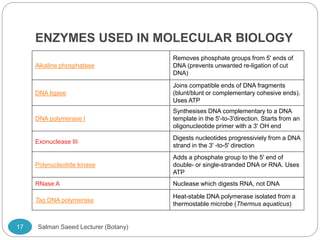
ENZYMES USED IN MOLECULAR BIOLOGY
Alkaline phosphatase

Removes phosphate groups from 5' ends of
DNA (prevents unwanted re-ligation of cut
DNA)
DNA ligase
Joins compatible ends of DNA fragments
(blunt/blunt or complementary cohesive ends).
Uses ATP
DNA polymerase I
Synthesises DNA complementary to a DNA
template in the 5'-to-3'direction. Starts from an
oligonucleotide primer with a 3' OH end
Exonuclease III
Digests nucleotides progressiviely from a DNA
strand in the 3' -to-5' direction
Polynucleotide kinase
Adds a phosphate group to the 5' end of
double- or single-stranded DNA or RNA. Uses
ATP
RNase A Nuclease which digests RNA, not DNA
Taq DNA polymerase
Heat-stable DNA polymerase isolated from a
thermostable microbe (Thermus aquaticus)
17 Salman Saeed Lecturer (Botany)
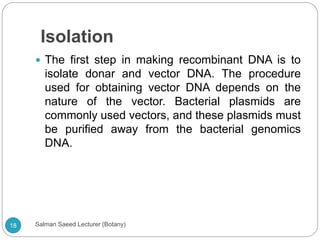
Isolation
 The first step in making recombinant DNA is to
isolate donar and vector DNA. The procedure
used for obtaining vector DNA depends on the
nature of the vector. Bacterial plasmids are
commonly used vectors, and these plasmids must
be purified away from the bacterial genomics
DNA.
18 Salman Saeed Lecturer (Botany)
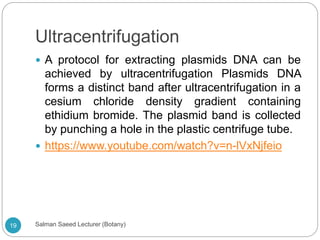
Ultracentrifugation
 A protocol for extracting plasmids DNA can be
achieved by ultracentrifugation Plasmids DNA
forms a distinct band after ultracentrifugation in a
cesium chloride density gradient containing
ethidium bromide. The plasmid band is collected
by punching a hole in the plastic centrifuge tube.
 https://www.youtube.com/watch?v=n-lVxNjfeio
19 Salman Saeed Lecturer (Botany)
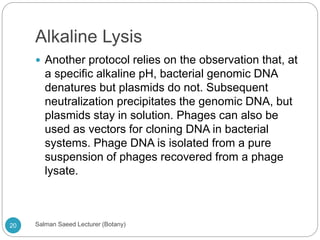
Alkaline Lysis
 Another protocol relies on the observation that, at
a specific alkaline pH, bacterial genomic DNA
denatures but plasmids do not. Subsequent
neutralization precipitates the genomic DNA, but
plasmids stay in solution. Phages can also be
used as vectors for cloning DNA in bacterial
systems. Phage DNA is isolated from a pure
suspension of phages recovered from a phage
lysate.
20 Salman Saeed Lecturer (Botany)
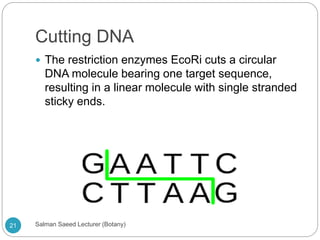
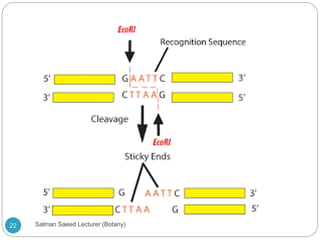
Cutting DNA
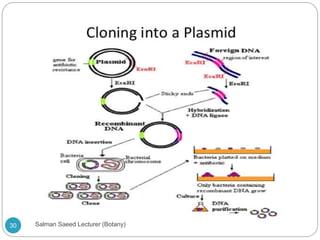
 The restriction enzymes EcoRi cuts a circular
DNA molecule bearing one target sequence,
resulting in a linear molecule with single stranded
sticky ends.
21 Salman Saeed Lecturer (Botany)
22 Salman Saeed Lecturer (Botany)
Insertion
 Choosing a gene Cloning Vector
 A vector is any DNA molecule which is capable of
multiplying inside the host to which our gene of
interest is integrated for cloning. In this process
restriction enzyme function as scissors for cutting
the DNA molecule. Ligase enzyme is the joining
enzyme that join the vector DNA with the gene of
interest this will produce the recombinant DNA.
23 Salman Saeed Lecturer (Botany)
Introducing Vector DNA into Host
Cell
 Plasmid Vector
 The vector is added to a flask containing a culture
of E.coli.
 Calcium ions usually in the form of calcium
chloride are added to the flask followed by a brief
heat shock.
 This allows holes to briefly appear in the cell
surface membrane of the E.coli making it
permeable to DNA and allowing the plasmids to
enter.
24 Salman Saeed Lecturer (Botany)
Phage Vectors
 Introduced by infection of bacterial lawn growing
on an agar plate.
 The culture or growth of viruses is made more
difficult than the culture of bacteria or fungi by the
fact that viruses will only grow.
25 Salman Saeed Lecturer (Botany)
Placing the Gene in the vector.
 Plasmid DNA
 DNA molecule are small and can be easily
separated based on the size.
 Bacterial cells are broken open and chromosomal
DNA is centrifuged down.
 This leaves the plasmid DNA in the liquid above
the pellet.
 The plasmid are purified before cutting with a
restriction enzyme.
26 Salman Saeed Lecturer (Botany)
Conti…
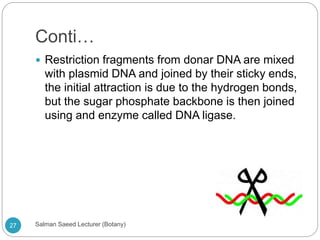
 Restriction fragments from donar DNA are mixed
with plasmid DNA and joined by their sticky ends,
the initial attraction is due to the hydrogen bonds,
but the sugar phosphate backbone is then joined
using and enzyme called DNA ligase.
27 Salman Saeed Lecturer (Botany)
Example of use of Recombinant DNA
Technology
 Insulin Production
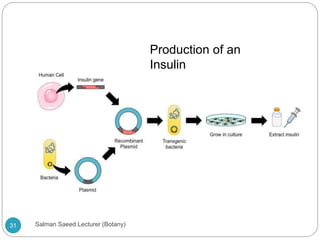
 The DNA for insulin is first isolated
 A plasmid made of DNA is removed from a
bacterial cell
 A restriction enzyme cuts the plasmid DNA open,
leaving sticky ends.
 The insulin gene, with complementary sticky ends
is added.
28 Salman Saeed Lecturer (Botany)
Examples of Use of Recombinant
DNA Technology
 DNA ligase enzyme splices (joins) together the
plasmid DNA and the insulin DNA.
 The plasmid (now genetically modified) is inserted
back into the bacterium.
 The bacterium host cell, divides and produces
copies of the plasmid.
 The Bacterium makes human insulin using the
gene in the plasmid.
 The insulin is extracted from the bacterial culture.
29 Salman Saeed Lecturer (Botany)
30 Salman Saeed Lecturer (Botany)
Production of an
Insulin
31 Salman Saeed Lecturer (Botany)
Applications
 Preparation of gene maps.
 In revealing details of various infections, diseases such as
"inborn errors of metabolism."
 Finding out the complete nucleotide sequence of genome of an
organism and identification of genes.
 Detecting cytogenetic abnormalities e.g. Down's syndrome,
multifactorial disorders, atherosclerosis, coronary artery
disease etc.
 Preventing various genetic disorders e.g. inherited
haemoglobin disorders, phenylketonuria, retinoblastoma etc.
 Understand a molecular event is biological processes like
growth, differentiation, ageing etc.
32 Salman Saeed Lecturer (Botany)
Conti…
 Replacement or correction of deleterious mutation by transfer
of clone gene in a patient.
 Production of genetically modified organisms (GMOs) or
transgenic organisms for providing particular product and
nutrient.
 Gene Therapy: Removal and replacement of defective genes
with normal healthy functional genes is known as gene therapy
e.g. Sickle cell anaemia, Severe Combined Immuno-Deficiency
(SCID). SCID is due to a defect in the gene for the enzyme
adenosine deaminase (ADA) in 25 per cent of the cases.
33 Salman Saeed Lecturer (Botany)
 It has several negative features as well: extensive
erosion and genetic destruction of plant
Germplasm; ecological imbalance; production of
dangerous toxic chemicals, production of highly
lethal microbes and their use in microbiological
warfare to kill humans, animals and plants.
34 Salman Saeed Lecturer (Botany)
35

Recombinant-DNA Technology

  • 1.
    Course Title: Introduction toBiotechnology Course Instructor: SALMAN SAEED Botany department UNIVERSITY college of management & Sciences, Khanewal, PAKSITAN
  • 2.
  • 3.
     Introduction  Definition Steps  Applications 3 Salman Saeed Lecturer (Botany)
  • 4.
    INTRODUCTION  Recombinant DNA(rDNA): DNA molecules formed by laboratory methods of genetic recombination (such as molecular cloning) to bring together genetic material from multiple sources, creating sequences that would not otherwise be found in the genome.  rDNA is possible because DNA molecules from all organisms share the same chemical structure. They differ only in the nucleotide sequence within that identical overall structure. 4 Salman Saeed Lecturer (Botany)
  • 5.
    Recombinant DNA  rDNAis the general name for a piece of DNA that has been created by the combination of at least two strands. rDNA molecules are sometimes called chimeric DNA, because they can be made of material from two different species. R-DNA technology uses palindromic sequences and leads to the production of sticky and blunt ends. 5 Salman Saeed Lecturer (Botany)
  • 6.
    Palindromic sequence  APalindromic sequence is a nucleic acid sequence in a double- stranded DNA or RNA molecule wherein reading in a certain direction (e.g. 5' to 3') on one strand matches the sequence reading in the same direction (e.g. 5' to 3') on the complementary strand. This definition of palindrome thus depends on complementary strands being palindromic of each other. 6 Salman Saeed Lecturer (Botany)
  • 7.
    Palindromic Sequence 7 SalmanSaeed Lecturer (Botany)
  • 8.
    Chimeric DNA  ChimericDNA is just another name for Recombinant DNA which is basically a hybrid DNA segment made by ligating different DNA portions after extracting and cleaving them from their respective sources using various enzymes like Restriction Endonucleases, DNA Ligase etc. Generation of chimeric DNA forms the basis of genetic engineering and gene cloning. 8 Salman Saeed Lecturer (Botany)
  • 9.
    What is RecombinantDNA  This is DNA that has been formed artificially by combining constituents from different organisms. 9 Salman Saeed Lecturer (Botany)
  • 10.
    Recombinant DNA Technology Using Recombinant DNA technology, we can isolate and clone single copy of a gene or a DNA segment into an indefinite number of copies, all identical. These new combinations of genetic material or Recombinant DNA (rDNA) molecules are introduced into the host cells, where they propagate and multiply. The technique or methodology is called Recombinant DNA technology. 10 Salman Saeed Lecturer (Botany)
  • 11.
    Obtaining rDNA  Step1: The DNA fragment containing the gene sequence to be cloned (also known as insert) is isolated.  Step 2: Cutting DNA.  Step 3: Joining DNA  Step 4: Insertion of these DNA fragments into host cell using a “vector” (carries DNA molecule). 11 Salman Saeed Lecturer (Botany)
  • 12.
    Conti…  Step 5:The rDNA molecules are generated when the vector self replicates in the host cell.  Step 6: Transfer of the rDNA molecules into an appropriate host cell.  Step 7: Selection of the host cells carring the rDNA molecule using a marker.  Step 8: Replication of the cells carrying rDNA molecules to get a genetically identical cells or clone. 12 Salman Saeed Lecturer (Botany)
  • 13.
    TERMS USED INCLONING  DNA recombination. The DNA fragment to be cloned is inserted into a vector.  Transformation. The recombinant DNA enters into the host cell and proliferates.  Selective amplification. A specific antibiotic is added to kill E. coli without any protection. The transformed E. coli is protected by the antibiotic-resistance gene  Isolation of desired DNA clones 13 Salman Saeed Lecturer (Botany)
  • 14.
    PLASMIDS  Bacterial cellsmay contain extra- chromosomal DNA called plasmids.  Plasmids are usually represented by small, circular DNA.  Some plasmids are present in multiple copies in the cell 14 Salman Saeed Lecturer (Botany)
  • 15.
    ORIGIN OF REPLICATION Origin of replication is a DNA segment recognized by the cellular DNA-replication enzymes.  Without replication origin, DNA cannot be replicated in the cell. 15 Salman Saeed Lecturer (Botany)
  • 16.
    RESTRICTION ENZYMES  Restrictionenzymes: enzymes that cut DNA in specific places function:  Inactivate foreign DNA  Breaks only palindrome sequences, i.e. those exhibiting two-fold symmetry  Important in DNA research, i.e. sequencing, hybridization  Companies purify and market restriction enzymes 16 Salman Saeed Lecturer (Botany)
  • 17.
    ENZYMES USED INMOLECULAR BIOLOGY Alkaline phosphatase Removes phosphate groups from 5' ends of DNA (prevents unwanted re-ligation of cut DNA) DNA ligase Joins compatible ends of DNA fragments (blunt/blunt or complementary cohesive ends). Uses ATP DNA polymerase I Synthesises DNA complementary to a DNA template in the 5'-to-3'direction. Starts from an oligonucleotide primer with a 3' OH end Exonuclease III Digests nucleotides progressiviely from a DNA strand in the 3' -to-5' direction Polynucleotide kinase Adds a phosphate group to the 5' end of double- or single-stranded DNA or RNA. Uses ATP RNase A Nuclease which digests RNA, not DNA Taq DNA polymerase Heat-stable DNA polymerase isolated from a thermostable microbe (Thermus aquaticus) 17 Salman Saeed Lecturer (Botany)
  • 18.
    Isolation  The firststep in making recombinant DNA is to isolate donar and vector DNA. The procedure used for obtaining vector DNA depends on the nature of the vector. Bacterial plasmids are commonly used vectors, and these plasmids must be purified away from the bacterial genomics DNA. 18 Salman Saeed Lecturer (Botany)
  • 19.
    Ultracentrifugation  A protocolfor extracting plasmids DNA can be achieved by ultracentrifugation Plasmids DNA forms a distinct band after ultracentrifugation in a cesium chloride density gradient containing ethidium bromide. The plasmid band is collected by punching a hole in the plastic centrifuge tube.  https://www.youtube.com/watch?v=n-lVxNjfeio 19 Salman Saeed Lecturer (Botany)
  • 20.
    Alkaline Lysis  Anotherprotocol relies on the observation that, at a specific alkaline pH, bacterial genomic DNA denatures but plasmids do not. Subsequent neutralization precipitates the genomic DNA, but plasmids stay in solution. Phages can also be used as vectors for cloning DNA in bacterial systems. Phage DNA is isolated from a pure suspension of phages recovered from a phage lysate. 20 Salman Saeed Lecturer (Botany)
  • 21.
    Cutting DNA  Therestriction enzymes EcoRi cuts a circular DNA molecule bearing one target sequence, resulting in a linear molecule with single stranded sticky ends. 21 Salman Saeed Lecturer (Botany)
  • 22.
    22 Salman SaeedLecturer (Botany)
  • 23.
    Insertion  Choosing agene Cloning Vector  A vector is any DNA molecule which is capable of multiplying inside the host to which our gene of interest is integrated for cloning. In this process restriction enzyme function as scissors for cutting the DNA molecule. Ligase enzyme is the joining enzyme that join the vector DNA with the gene of interest this will produce the recombinant DNA. 23 Salman Saeed Lecturer (Botany)
  • 24.
    Introducing Vector DNAinto Host Cell  Plasmid Vector  The vector is added to a flask containing a culture of E.coli.  Calcium ions usually in the form of calcium chloride are added to the flask followed by a brief heat shock.  This allows holes to briefly appear in the cell surface membrane of the E.coli making it permeable to DNA and allowing the plasmids to enter. 24 Salman Saeed Lecturer (Botany)
  • 25.
    Phage Vectors  Introducedby infection of bacterial lawn growing on an agar plate.  The culture or growth of viruses is made more difficult than the culture of bacteria or fungi by the fact that viruses will only grow. 25 Salman Saeed Lecturer (Botany)
  • 26.
    Placing the Genein the vector.  Plasmid DNA  DNA molecule are small and can be easily separated based on the size.  Bacterial cells are broken open and chromosomal DNA is centrifuged down.  This leaves the plasmid DNA in the liquid above the pellet.  The plasmid are purified before cutting with a restriction enzyme. 26 Salman Saeed Lecturer (Botany)
  • 27.
    Conti…  Restriction fragmentsfrom donar DNA are mixed with plasmid DNA and joined by their sticky ends, the initial attraction is due to the hydrogen bonds, but the sugar phosphate backbone is then joined using and enzyme called DNA ligase. 27 Salman Saeed Lecturer (Botany)
  • 28.
    Example of useof Recombinant DNA Technology  Insulin Production  The DNA for insulin is first isolated  A plasmid made of DNA is removed from a bacterial cell  A restriction enzyme cuts the plasmid DNA open, leaving sticky ends.  The insulin gene, with complementary sticky ends is added. 28 Salman Saeed Lecturer (Botany)
  • 29.
    Examples of Useof Recombinant DNA Technology  DNA ligase enzyme splices (joins) together the plasmid DNA and the insulin DNA.  The plasmid (now genetically modified) is inserted back into the bacterium.  The bacterium host cell, divides and produces copies of the plasmid.  The Bacterium makes human insulin using the gene in the plasmid.  The insulin is extracted from the bacterial culture. 29 Salman Saeed Lecturer (Botany)
  • 30.
    30 Salman SaeedLecturer (Botany)
  • 31.
    Production of an Insulin 31Salman Saeed Lecturer (Botany)
  • 32.
    Applications  Preparation ofgene maps.  In revealing details of various infections, diseases such as "inborn errors of metabolism."  Finding out the complete nucleotide sequence of genome of an organism and identification of genes.  Detecting cytogenetic abnormalities e.g. Down's syndrome, multifactorial disorders, atherosclerosis, coronary artery disease etc.  Preventing various genetic disorders e.g. inherited haemoglobin disorders, phenylketonuria, retinoblastoma etc.  Understand a molecular event is biological processes like growth, differentiation, ageing etc. 32 Salman Saeed Lecturer (Botany)
  • 33.
    Conti…  Replacement orcorrection of deleterious mutation by transfer of clone gene in a patient.  Production of genetically modified organisms (GMOs) or transgenic organisms for providing particular product and nutrient.  Gene Therapy: Removal and replacement of defective genes with normal healthy functional genes is known as gene therapy e.g. Sickle cell anaemia, Severe Combined Immuno-Deficiency (SCID). SCID is due to a defect in the gene for the enzyme adenosine deaminase (ADA) in 25 per cent of the cases. 33 Salman Saeed Lecturer (Botany)
  • 34.
     It hasseveral negative features as well: extensive erosion and genetic destruction of plant Germplasm; ecological imbalance; production of dangerous toxic chemicals, production of highly lethal microbes and their use in microbiological warfare to kill humans, animals and plants. 34 Salman Saeed Lecturer (Botany)
  • 35.