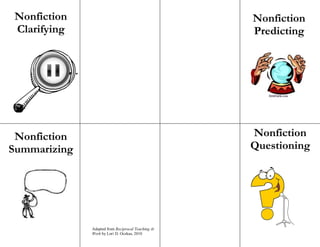
Nonfiction
Clarifying
Nonfiction
Predicting
Nonfiction
Questioning
Nonfiction
Summarizing
Adapted from Reciprocal Teaching At
Work by Lori D. Oczkus, 2010
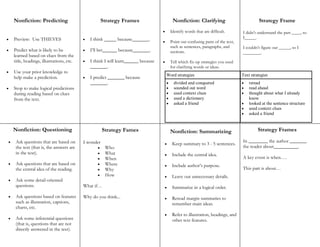
Strategy Frame
I didn’t understand the part ____, so
I_____.
I couldn’t figure out _____, so I
________.
Strategy Frames
 I think _____ because_______.
 I’ll bet______ because_______.
 I think I will learn______ because
_______.
 I predict _______ because
_______.
Nonfiction: Predicting
 Preview: Use THIEVES
 Predict what is likely to be
learned based on clues from the
title, headings, illustrations, etc.
 Use your prior knowledge to
help make a prediction.
 Stop to make logical predictions
during reading based on clues
from the text.
Nonfiction: Questioning
 Ask questions that are based on
the text (that is, the answers are
in the text).
 Ask questions that are based on
the central idea of the reading.
 Ask some detail-oriented
questions.
 Ask questions based on features
such as illustration, captions,
charts, etc.
 Ask some inferential questions
(that is, questions that are not
directly answered in the text).
Nonfiction: Clarifying
 Identify words that are difficult.
 Point out confusing parts of the text,
such as sentences, paragraphs, and
sections.
 Tell which fix-up strategies you used
for clarifying words or ideas.
Strategy Frames
In ________ the author _______
the reader about__________.
A key event is when….
This part is about…
Strategy Fames
I wonder
 Who
 What
 When
 Where
 Why
 How
What if…
Why do you think...
Nonfiction: Summarizing
 Keep summary to 3 - 5 sentences.
 Include the central idea.
 Include author’s purpose.
 Leave out unnecessary details.
 Summarize in a logical order.
 Reread margin summaries to
remember main ideas.
 Refer to illustration, headings, and
other text features.
Word strategies Text strategies
 divided and conquered
 sounded out word
 used context clues
 used a dictionary
 asked a friend
 reread
 read ahead
 thought about what I already
know
 looked at the sentence structure
 used context clues
 asked a friend

Reciprocal Teaching Nonfiction Foldable

  • 1.
  • 2.
    Strategy Frame I didn’tunderstand the part ____, so I_____. I couldn’t figure out _____, so I ________. Strategy Frames  I think _____ because_______.  I’ll bet______ because_______.  I think I will learn______ because _______.  I predict _______ because _______. Nonfiction: Predicting  Preview: Use THIEVES  Predict what is likely to be learned based on clues from the title, headings, illustrations, etc.  Use your prior knowledge to help make a prediction.  Stop to make logical predictions during reading based on clues from the text. Nonfiction: Questioning  Ask questions that are based on the text (that is, the answers are in the text).  Ask questions that are based on the central idea of the reading.  Ask some detail-oriented questions.  Ask questions based on features such as illustration, captions, charts, etc.  Ask some inferential questions (that is, questions that are not directly answered in the text). Nonfiction: Clarifying  Identify words that are difficult.  Point out confusing parts of the text, such as sentences, paragraphs, and sections.  Tell which fix-up strategies you used for clarifying words or ideas. Strategy Frames In ________ the author _______ the reader about__________. A key event is when…. This part is about… Strategy Fames I wonder  Who  What  When  Where  Why  How What if… Why do you think... Nonfiction: Summarizing  Keep summary to 3 - 5 sentences.  Include the central idea.  Include author’s purpose.  Leave out unnecessary details.  Summarize in a logical order.  Reread margin summaries to remember main ideas.  Refer to illustration, headings, and other text features. Word strategies Text strategies  divided and conquered  sounded out word  used context clues  used a dictionary  asked a friend  reread  read ahead  thought about what I already know  looked at the sentence structure  used context clues  asked a friend