By
Prof. Rakesh D. Amrutkar
Head of Department, Pharmaceutical Chemistry
Mahatma Gandhi Vidyamandir’s
Samajshri Prashantdada Hiray College of Pharmacy,
Malegaon.
Drug Receptor
1
2
 First postulated by John Langley (1878)
◦ Established after his experiments using nicotine and
curare analogues on muscle contraction.
 Furthered by Paul Ehrlich (1845-1945)
◦ Demonstrated that stereoselectivity was essential in
drug-receptor signaling.
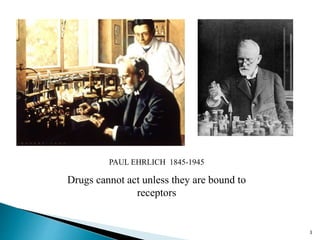
PAUL EHRLICH 1845-1945
Drugs cannot act unless they are bound to
receptors
3
RECEPTOR:
A receptor is the specific chemical constituent of the cell with
which a drug interacts to produce it’s pharmacological effects.
Some receptor sites have been identified with specific parts of
proteins and nucleic acids.
In most cases, the chemical nature of the receptor site remains
doubtful.
Any cellular macromolecule that a drug binds to initiate its effects.
4
◦ Neurotransmitters
◦ Drugs
5
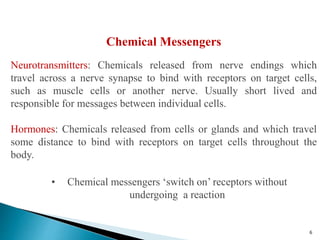
Chemical Messengers
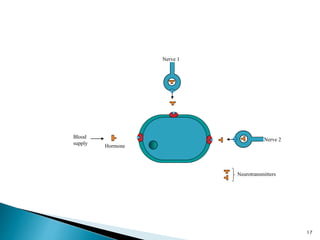
Neurotransmitters: Chemicals released from nerve endings which
travel across a nerve synapse to bind with receptors on target cells,
such as muscle cells or another nerve. Usually short lived and
responsible for messages between individual cells.
Hormones: Chemicals released from cells or glands and which travel
some distance to bind with receptors on target cells throughout the
body.
• Chemical messengers ‘switch on’ receptors without
undergoing a reaction
6
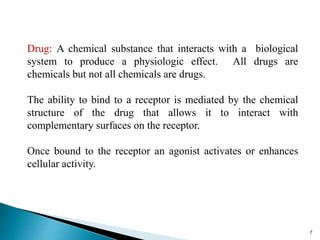
Drug: A chemical substance that interacts with a biological
system to produce a physiologic effect. All drugs are
chemicals but not all chemicals are drugs.
The ability to bind to a receptor is mediated by the chemical
structure of the drug that allows it to interact with
complementary surfaces on the receptor.
Once bound to the receptor an agonist activates or enhances
cellular activity.
7
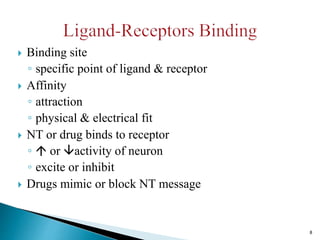
 Binding site
◦ specific point of ligand & receptor
 Affinity
◦ attraction
◦ physical & electrical fit
 NT or drug binds to receptor
◦  or activity of neuron
◦ excite or inhibit
 Drugs mimic or block NT message
8
 Receptor changes shape
 Excitation or Inhibition..
◦ Determined by nature of receptor
◦ receptor subtypes
 NOT NT
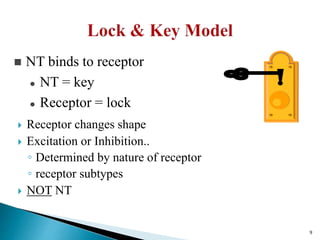
 NT binds to receptor
 NT = key
 Receptor = lock
9
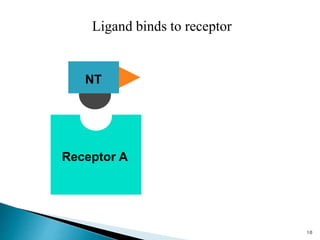
Receptor A
NT
Ligand binds to receptor
10
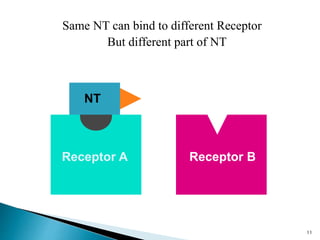
Receptor BReceptor A
Same NT can bind to different Receptor
But different part of NT
NT
11
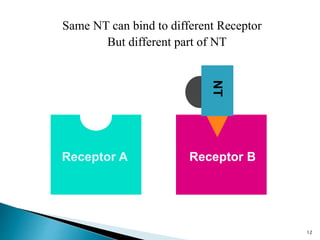
Receptor BReceptor A
Same NT can bind to different Receptor
But different part of NT
NT
12
Receptor BReceptor A
NT
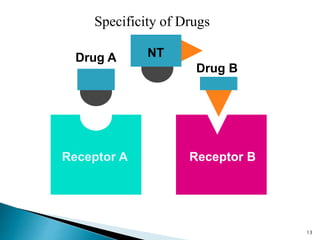
Specificity of Drugs
Drug A
Drug B
13
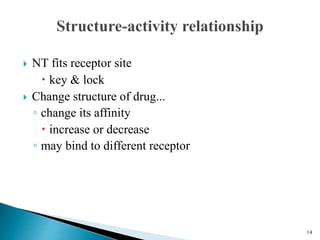
 NT fits receptor site
 key & lock
 Change structure of drug...
◦ change its affinity
 increase or decrease
◦ may bind to different receptor
14
Structure and function of receptors
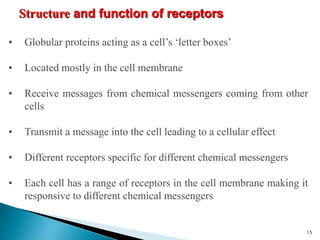
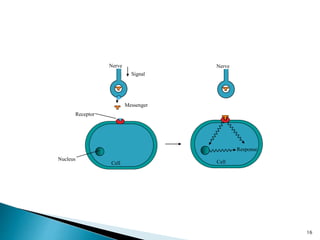
• Globular proteins acting as a cell’s ‘letter boxes’
• Located mostly in the cell membrane
• Receive messages from chemical messengers coming from other
cells
• Transmit a message into the cell leading to a cellular effect
• Different receptors specific for different chemical messengers
• Each cell has a range of receptors in the cell membrane making it
responsive to different chemical messengers
15
Cell
Nerve
Messenger
Signal
Receptor
Nerve
Nucleus
Cell
Response
16
Nerve 1
Nerve 2
Hormone
Blood
supply
Neurotransmitters
17
Mechanism
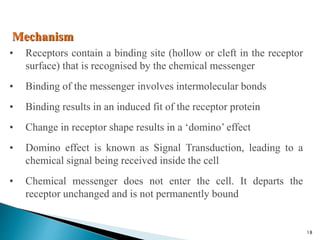
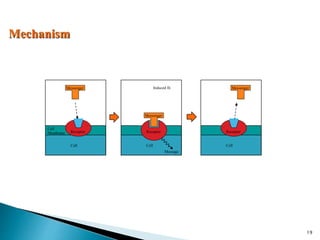
• Receptors contain a binding site (hollow or cleft in the receptor
surface) that is recognised by the chemical messenger
• Binding of the messenger involves intermolecular bonds
• Binding results in an induced fit of the receptor protein
• Change in receptor shape results in a ‘domino’ effect
• Domino effect is known as Signal Transduction, leading to a
chemical signal being received inside the cell
• Chemical messenger does not enter the cell. It departs the
receptor unchanged and is not permanently bound
18
Mechanism
Cell
Membrane
Cell
Receptor
Messenger
message
Induced fit
Cell
Receptor
Messenger
Message
Cell
Messenger
Receptor
19
ENZYME
Binding site of Receptor
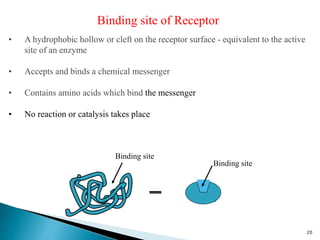
• A hydrophobic hollow or cleft on the receptor surface - equivalent to the active
site of an enzyme
• Accepts and binds a chemical messenger
• Contains amino acids which bind the messenger
• No reaction or catalysis takes place
Binding site
Binding site
20
The Binding Site
21
Messenger Binding
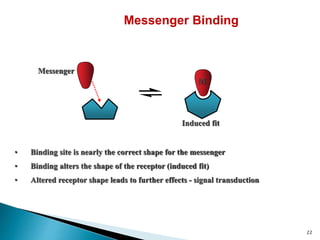
• Binding site is nearly the correct shape for the messenger
• Binding alters the shape of the receptor (induced fit)
• Altered receptor shape leads to further effects - signal transduction
Messenger
Induced fit
M
22
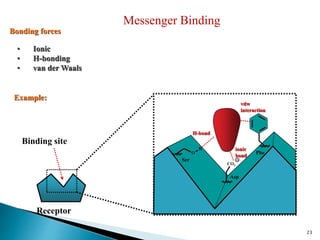
• Ionic
• H-bonding
• van der Waals
Bonding forces
Example:
Receptor
Binding site
vdw
interaction
ionic
bond
H-bond
Phe
Ser
O
H
Asp
CO2
Messenger Binding
23
Substrate Binding
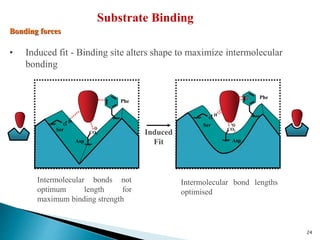
• Induced fit - Binding site alters shape to maximize intermolecular
bonding
Bonding forces
Intermolecular bonds not
optimum length for
maximum binding strength
Intermolecular bond lengths
optimised
Phe
Ser
O
H
Asp
CO2 Induced
Fit
Phe
Ser
O
H
Asp
CO2
24
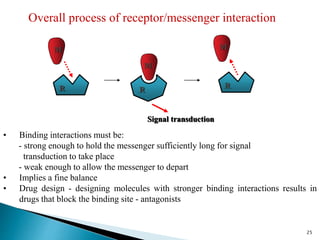
Overall process of receptor/messenger interaction
M
M
ER
• Binding interactions must be:
- strong enough to hold the messenger sufficiently long for signal
transduction to take place
- weak enough to allow the messenger to depart
• Implies a fine balance
• Drug design - designing molecules with stronger binding interactions results in
drugs that block the binding site - antagonists
R
M
ER
Signal transduction
25
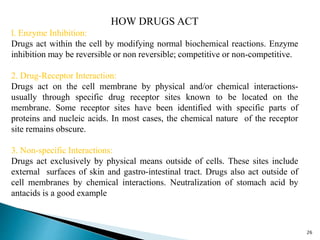
HOW DRUGS ACT
l. Enzyme Inhibition:
Drugs act within the cell by modifying normal biochemical reactions. Enzyme
inhibition may be reversible or non reversible; competitive or non-competitive.
2. Drug-Receptor Interaction:
Drugs act on the cell membrane by physical and/or chemical interactions-
usually through specific drug receptor sites known to be located on the
membrane. Some receptor sites have been identified with specific parts of
proteins and nucleic acids. In most cases, the chemical nature of the receptor
site remains obscure.
3. Non-specific Interactions:
Drugs act exclusively by physical means outside of cells. These sites include
external surfaces of skin and gastro-intestinal tract. Drugs also act outside of
cell membranes by chemical interactions. Neutralization of stomach acid by
antacids is a good example
26
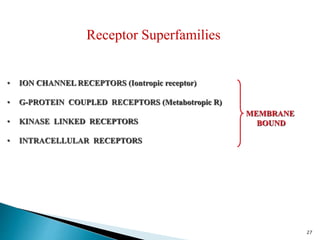
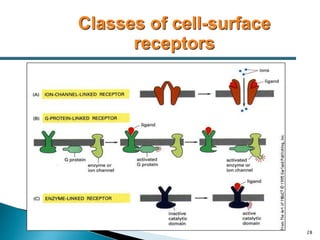
Receptor Superfamilies
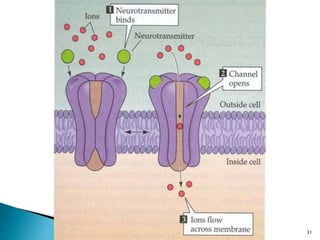
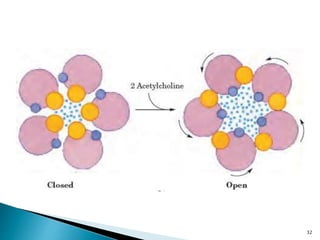
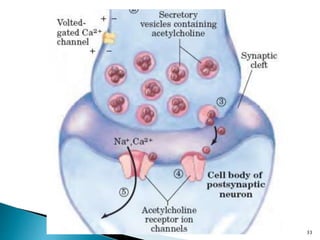
• ION CHANNEL RECEPTORS (Iontropic receptor)
• G-PROTEIN COUPLED RECEPTORS (Metabotropic R)
• KINASE LINKED RECEPTORS
• INTRACELLULAR RECEPTORS
MEMBRANE
BOUND
27
28
Classes of cell-surface
receptors
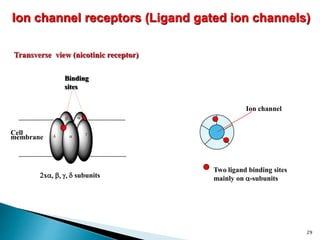
Transverse view (nicotinic receptor)
Two ligand binding sites
mainly on a-subunits
a
a
g
d
b
Ion channel
2xa, b, g, d subunits
Cell
membrane
a
ad
b
g
Binding
sites
Ion channel receptors (Ligand gated ion channels)
29
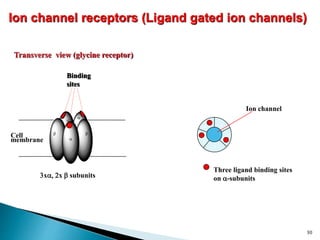
Transverse view (glycine receptor)
Three ligand binding sites
on a-subunits
a
a
b
b
a
Ion channel
3xa, 2x b subunits
Cell
membrane
a
a
a
bb
Binding
sites
Ion channel receptors (Ligand gated ion channels)
30
31
32
33
34
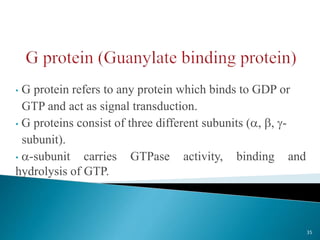
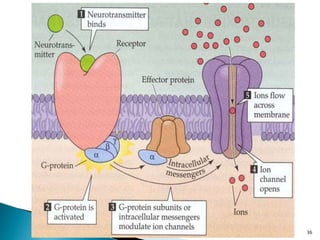
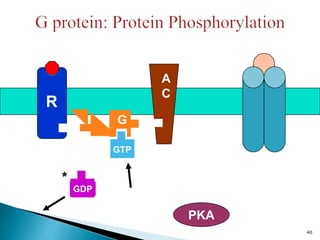
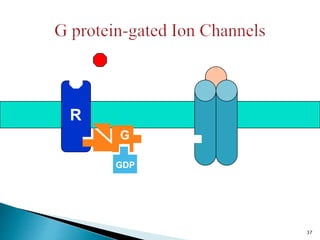
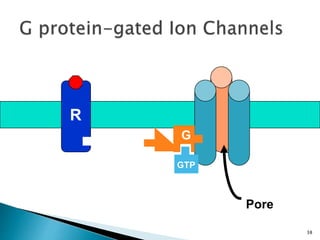
• G protein refers to any protein which binds to GDP or
GTP and act as signal transduction.
• G proteins consist of three different subunits (a, b, g-
subunit).
• a-subunit carries GTPase activity, binding and
hydrolysis of GTP.
35
36
R
G
GDP
37
R
G
GTP
Pore
38
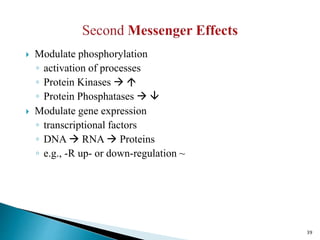
 Modulate phosphorylation
◦ activation of processes
◦ Protein Kinases  
◦ Protein Phosphatases  
 Modulate gene expression
◦ transcriptional factors
◦ DNA  RNA  Proteins
◦ e.g., -R up- or down-regulation ~
39
R
G
GTP
A
C
GDP
*
PKA
40
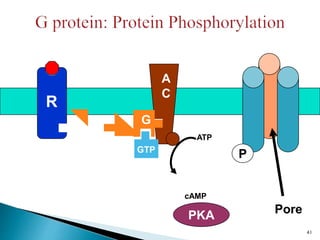
R
A
C
PKA
G
GTP
ATP
cAMP
P
Pore
41
THANK YOU…!!
Contact:
rakesh_2504@yahoo.co.in
Mob:+91-9890870610
10/15/2019 42

Receptor ppt

  • 1.
    By Prof. Rakesh D.Amrutkar Head of Department, Pharmaceutical Chemistry Mahatma Gandhi Vidyamandir’s Samajshri Prashantdada Hiray College of Pharmacy, Malegaon. Drug Receptor 1
  • 2.
    2  First postulatedby John Langley (1878) ◦ Established after his experiments using nicotine and curare analogues on muscle contraction.  Furthered by Paul Ehrlich (1845-1945) ◦ Demonstrated that stereoselectivity was essential in drug-receptor signaling.
  • 3.
    PAUL EHRLICH 1845-1945 Drugscannot act unless they are bound to receptors 3
  • 4.
    RECEPTOR: A receptor isthe specific chemical constituent of the cell with which a drug interacts to produce it’s pharmacological effects. Some receptor sites have been identified with specific parts of proteins and nucleic acids. In most cases, the chemical nature of the receptor site remains doubtful. Any cellular macromolecule that a drug binds to initiate its effects. 4
  • 5.
  • 6.
    Chemical Messengers Neurotransmitters: Chemicalsreleased from nerve endings which travel across a nerve synapse to bind with receptors on target cells, such as muscle cells or another nerve. Usually short lived and responsible for messages between individual cells. Hormones: Chemicals released from cells or glands and which travel some distance to bind with receptors on target cells throughout the body. • Chemical messengers ‘switch on’ receptors without undergoing a reaction 6
  • 7.
    Drug: A chemicalsubstance that interacts with a biological system to produce a physiologic effect. All drugs are chemicals but not all chemicals are drugs. The ability to bind to a receptor is mediated by the chemical structure of the drug that allows it to interact with complementary surfaces on the receptor. Once bound to the receptor an agonist activates or enhances cellular activity. 7
  • 8.
     Binding site ◦specific point of ligand & receptor  Affinity ◦ attraction ◦ physical & electrical fit  NT or drug binds to receptor ◦  or activity of neuron ◦ excite or inhibit  Drugs mimic or block NT message 8
  • 9.
     Receptor changesshape  Excitation or Inhibition.. ◦ Determined by nature of receptor ◦ receptor subtypes  NOT NT  NT binds to receptor  NT = key  Receptor = lock 9
  • 10.
  • 11.
    Receptor BReceptor A SameNT can bind to different Receptor But different part of NT NT 11
  • 12.
    Receptor BReceptor A SameNT can bind to different Receptor But different part of NT NT 12
  • 13.
    Receptor BReceptor A NT Specificityof Drugs Drug A Drug B 13
  • 14.
     NT fitsreceptor site  key & lock  Change structure of drug... ◦ change its affinity  increase or decrease ◦ may bind to different receptor 14
  • 15.
    Structure and functionof receptors • Globular proteins acting as a cell’s ‘letter boxes’ • Located mostly in the cell membrane • Receive messages from chemical messengers coming from other cells • Transmit a message into the cell leading to a cellular effect • Different receptors specific for different chemical messengers • Each cell has a range of receptors in the cell membrane making it responsive to different chemical messengers 15
  • 16.
  • 17.
  • 18.
    Mechanism • Receptors containa binding site (hollow or cleft in the receptor surface) that is recognised by the chemical messenger • Binding of the messenger involves intermolecular bonds • Binding results in an induced fit of the receptor protein • Change in receptor shape results in a ‘domino’ effect • Domino effect is known as Signal Transduction, leading to a chemical signal being received inside the cell • Chemical messenger does not enter the cell. It departs the receptor unchanged and is not permanently bound 18
  • 19.
  • 20.
    ENZYME Binding site ofReceptor • A hydrophobic hollow or cleft on the receptor surface - equivalent to the active site of an enzyme • Accepts and binds a chemical messenger • Contains amino acids which bind the messenger • No reaction or catalysis takes place Binding site Binding site 20
  • 21.
  • 22.
    Messenger Binding • Bindingsite is nearly the correct shape for the messenger • Binding alters the shape of the receptor (induced fit) • Altered receptor shape leads to further effects - signal transduction Messenger Induced fit M 22
  • 23.
    • Ionic • H-bonding •van der Waals Bonding forces Example: Receptor Binding site vdw interaction ionic bond H-bond Phe Ser O H Asp CO2 Messenger Binding 23
  • 24.
    Substrate Binding • Inducedfit - Binding site alters shape to maximize intermolecular bonding Bonding forces Intermolecular bonds not optimum length for maximum binding strength Intermolecular bond lengths optimised Phe Ser O H Asp CO2 Induced Fit Phe Ser O H Asp CO2 24
  • 25.
    Overall process ofreceptor/messenger interaction M M ER • Binding interactions must be: - strong enough to hold the messenger sufficiently long for signal transduction to take place - weak enough to allow the messenger to depart • Implies a fine balance • Drug design - designing molecules with stronger binding interactions results in drugs that block the binding site - antagonists R M ER Signal transduction 25
  • 26.
    HOW DRUGS ACT l.Enzyme Inhibition: Drugs act within the cell by modifying normal biochemical reactions. Enzyme inhibition may be reversible or non reversible; competitive or non-competitive. 2. Drug-Receptor Interaction: Drugs act on the cell membrane by physical and/or chemical interactions- usually through specific drug receptor sites known to be located on the membrane. Some receptor sites have been identified with specific parts of proteins and nucleic acids. In most cases, the chemical nature of the receptor site remains obscure. 3. Non-specific Interactions: Drugs act exclusively by physical means outside of cells. These sites include external surfaces of skin and gastro-intestinal tract. Drugs also act outside of cell membranes by chemical interactions. Neutralization of stomach acid by antacids is a good example 26
  • 27.
    Receptor Superfamilies • IONCHANNEL RECEPTORS (Iontropic receptor) • G-PROTEIN COUPLED RECEPTORS (Metabotropic R) • KINASE LINKED RECEPTORS • INTRACELLULAR RECEPTORS MEMBRANE BOUND 27
  • 28.
  • 29.
    Transverse view (nicotinicreceptor) Two ligand binding sites mainly on a-subunits a a g d b Ion channel 2xa, b, g, d subunits Cell membrane a ad b g Binding sites Ion channel receptors (Ligand gated ion channels) 29
  • 30.
    Transverse view (glycinereceptor) Three ligand binding sites on a-subunits a a b b a Ion channel 3xa, 2x b subunits Cell membrane a a a bb Binding sites Ion channel receptors (Ligand gated ion channels) 30
  • 31.
  • 32.
  • 33.
  • 34.
  • 35.
    • G proteinrefers to any protein which binds to GDP or GTP and act as signal transduction. • G proteins consist of three different subunits (a, b, g- subunit). • a-subunit carries GTPase activity, binding and hydrolysis of GTP. 35
  • 36.
  • 37.
  • 38.
  • 39.
     Modulate phosphorylation ◦activation of processes ◦ Protein Kinases   ◦ Protein Phosphatases    Modulate gene expression ◦ transcriptional factors ◦ DNA  RNA  Proteins ◦ e.g., -R up- or down-regulation ~ 39
  • 40.
  • 41.
  • 42.