Electricity and
the Environment
November 2020
Legislative advertising paid for by: Association of Electric Companies of Texas
1005 Congress, Suite 1000, Austin, TX 78701 • 512-474-6725 • www.aect.net
512-474-6725
www.aect.net
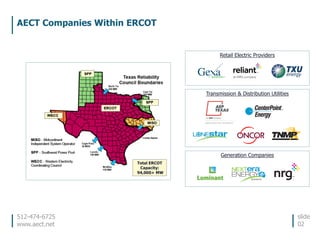
AECT Companies Within ERCOT
slide
02
Transmission & Distribution Utilities
Total ERCOT
Capacity:
94,000+ MW
Retail Electric Providers
Generation Companies
512-474-6725
www.aect.net
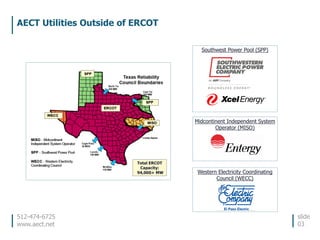
AECT Utilities Outside of ERCOT
slide
03
Western Electricity Coordinating
Council (WECC)
Midcontinent Independent System
Operator (MISO)
Southwest Power Pool (SPP)
Total ERCOT
Capacity:
94,000+ MW
512-474-6725
www.aect.net
Strong Environmental Performance by Electric Generators in Texas
slide
04
Electric Generators in Texas Use Fuel Efficiently and
Effectively Capture Emissions
– Texas is one of a minority of states with NOx, SO2 and CO2 emissions rates below the
national average for electric generation
– Texas electric generators have the lowest rate of NOx emissions when compared with
neighboring states
– New power plants include modern environmental emissions controls.
Maintaining Access to Cooling Water is Important to
Continued Generation Reliability
– Dependable water supplies are essential to the reliable generation of electricity because most
electric generation units require the use of water for system cooling.
– AECT member companies represent the largest private owners, builders, and operators of
private reservoirs in Texas.
512-474-6725
www.aect.net
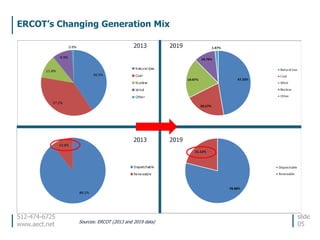
ERCOT’s Changing Generation Mix
slide
05
slide
05Sources: ERCOT (2013 and 2019 data)
20192013
20192013
512-474-6725
www.aect.net
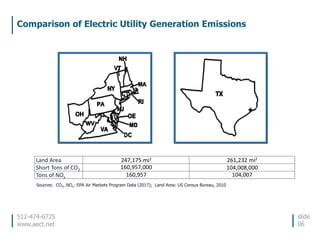
Comparison of Electric Utility Generation Emissions
slide
06
Sources: CO2, NOx: EPA Air Markets Program Data (2017); Land Area: US Census Bureau, 2010
Land Area 247,175 mi2 261,232 mi2
Short Tons of CO2 160,957,000 104,008,000
Tons of NOx 160,957 104,007
512-474-6725
www.aect.net
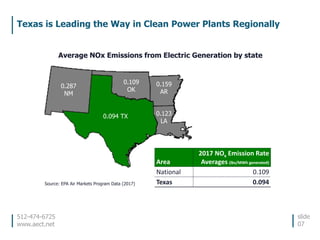
0.287
NM
0.094 TX
0.109
OK
0.159
AR
0.123
LA
Texas is Leading the Way in Clean Power Plants Regionally
slide
07
Area
2017 NOx Emission Rate
Averages (lbs/MWh generated)
National 0.109
Texas 0.094
Average NOx Emissions from Electric Generation by state
Source: EPA Air Markets Program Data (2017)
512-474-6725
www.aect.net
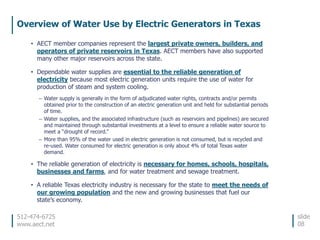
Overview of Water Use by Electric Generators in Texas
slide
08
• AECT member companies represent the largest private owners, builders, and
operators of private reservoirs in Texas. AECT members have also supported
many other major reservoirs across the state.
• Dependable water supplies are essential to the reliable generation of
electricity because most electric generation units require the use of water for
production of steam and system cooling.
– Water supply is generally in the form of adjudicated water rights, contracts and/or permits
obtained prior to the construction of an electric generation unit and held for substantial periods
of time.
– Water supplies, and the associated infrastructure (such as reservoirs and pipelines) are secured
and maintained through substantial investments at a level to ensure a reliable water source to
meet a “drought of record.”
– More than 95% of the water used in electric generation is not consumed, but is recycled and
re-used. Water consumed for electric generation is only about 4% of total Texas water
demand.
• The reliable generation of electricity is necessary for homes, schools, hospitals,
businesses and farms, and for water treatment and sewage treatment.
• A reliable Texas electricity industry is necessary for the state to meet the needs of
our growing population and the new and growing businesses that fuel our
state’s economy.
512-474-6725
www.aect.net
How Texas’ Steam Power Plants Use Water
slide
09
• The graphic above is a simplified example of a power plant’s use of water for steam generation.
• Most power plants heat water in a closed system until it becomes steam, then pressurize that
steam to turn a generating turbine.
• The steam is then routed to a condenser, where the water is condensed and reused in the steam
cycle.
Turbine Generator TransformerPump
Combustion
Water
Steam
Cooling Water
Condenser
Fuel
Controls
Stack
Electricity
Flow of Power
Flow of H2O
Flow of H2O
512-474-6725
www.aect.net
Management and Use of Water
slide
10
• Electric generating facilities in Texas are required to obtain TCEQ permits
for their wastewater discharge, including cooling water.
– AECT member companies have an outstanding record of compliance with state
and federal water quality standards and requirements, which includes rigorous
monitoring of the wastewater discharge
• In addition to complying with state and federal water quality regulations,
AECT member companies are committed to practicing sound water
conservation. Companies:
– Reuse and/or recycle water whenever possible
– Capture and use of storm water runoff
– Restore, enhance and create aquatic habitats
– Preserve ecosystems
– Enhance and create valuable wetlands
• Many reservoirs created by electric generating companies are used for
recreational purposes, including camping, boating, fishing and swimming.
512-474-6725
www.aect.net
Water Usage in the Average Household
slide
11
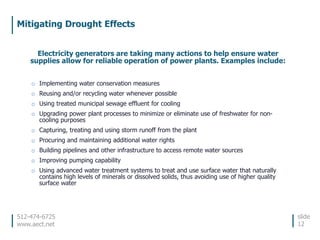
Only about 3% of an
average household’s total
daily consumption of
water is needed to
generate the electricity
that is used by the
household each day.
Source: Viability and Impacts of Implementing Various Power Plant
Cooling Technologies in Texas, prepared for EPRI by Texas A&M
University, July 2012
512-474-6725
www.aect.net
Mitigating Drought Effects
slide
12
Electricity generators are taking many actions to help ensure water
supplies allow for reliable operation of power plants. Examples include:
o Implementing water conservation measures
o Reusing and/or recycling water whenever possible
o Using treated municipal sewage effluent for cooling
o Upgrading power plant processes to minimize or eliminate use of freshwater for non-
cooling purposes
o Capturing, treating and using storm runoff from the plant
o Procuring and maintaining additional water rights
o Building pipelines and other infrastructure to access remote water sources
o Improving pumping capability
o Using advanced water treatment systems to treat and use surface water that naturally
contains high levels of minerals or dissolved solids, thus avoiding use of higher quality
surface water
512-474-6725
www.aect.net
Selected Environmental Programs and Fees
slide
13
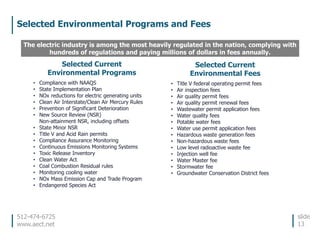
The electric industry is among the most heavily regulated in the nation, complying with
hundreds of regulations and paying millions of dollars in fees annually.
Selected Current
Environmental Programs
• Compliance with NAAQS
• State Implementation Plan
• NOx reductions for electric generating units
• Clean Air Interstate/Clean Air Mercury Rules
• Prevention of Significant Deterioration
• New Source Review (NSR)
Non-attainment NSR, including offsets
• State Minor NSR
• Title V and Acid Rain permits
• Compliance Assurance Monitoring
• Continuous Emissions Monitoring Systems
• Toxic Release Inventory
• Clean Water Act
• Coal Combustion Residual rules
• Monitoring cooling water
• NOx Mass Emission Cap and Trade Program
• Endangered Species Act
Selected Current
Environmental Fees
• Title V federal operating permit fees
• Air inspection fees
• Air quality permit fees
• Air quality permit renewal fees
• Wastewater permit application fees
• Water quality fees
• Potable water fees
• Water use permit application fees
• Hazardous waste generation fees
• Non-hazardous waste fees
• Low level radioactive waste fee
• Injection well fee
• Water Master fee
• Stormwater fee
• Groundwater Conservation District fees
512-474-6725
www.aect.net
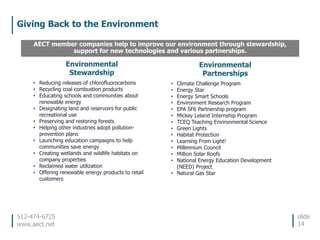
Giving Back to the Environment
slide
14
AECT member companies help to improve our environment through stewardship,
support for new technologies and various partnerships.
Environmental
Stewardship
• Reducing releases of chlorofluorocarbons
• Recycling coal combustion products
• Educating schools and communities about
renewable energy
• Designating land and reservoirs for public
recreational use
• Preserving and restoring forests
• Helping other industries adopt pollution-
prevention plans
• Launching education campaigns to help
communities save energy
• Creating wetlands and wildlife habitats on
company properties
• Reclaimed water utilization
• Offering renewable energy products to retail
customers
Environmental
Partnerships
• Climate Challenge Program
• Energy Star
• Energy Smart Schools
• Environment Research Program
• EPA SF6 Partnership program
• Mickey Leland Internship Program
• TCEQ Teaching Environmental Science
• Green Lights
• Habitat Protection
• Learning From Light!
• Millennium Council
• Million Solar Roofs
• National Energy Education Development
(NEED) Project
• Natural Gas Star
512-474-6725
www.aect.net
How to Reach Us
slide
15
AECT.net
@aectnet
AECT Advocacy
The AECT App

Electricity and the Environment

  • 1.
    Electricity and the Environment November2020 Legislative advertising paid for by: Association of Electric Companies of Texas 1005 Congress, Suite 1000, Austin, TX 78701 • 512-474-6725 • www.aect.net
  • 2.
    512-474-6725 www.aect.net AECT Companies WithinERCOT slide 02 Transmission & Distribution Utilities Total ERCOT Capacity: 94,000+ MW Retail Electric Providers Generation Companies
  • 3.
    512-474-6725 www.aect.net AECT Utilities Outsideof ERCOT slide 03 Western Electricity Coordinating Council (WECC) Midcontinent Independent System Operator (MISO) Southwest Power Pool (SPP) Total ERCOT Capacity: 94,000+ MW
  • 4.
    512-474-6725 www.aect.net Strong Environmental Performanceby Electric Generators in Texas slide 04 Electric Generators in Texas Use Fuel Efficiently and Effectively Capture Emissions – Texas is one of a minority of states with NOx, SO2 and CO2 emissions rates below the national average for electric generation – Texas electric generators have the lowest rate of NOx emissions when compared with neighboring states – New power plants include modern environmental emissions controls. Maintaining Access to Cooling Water is Important to Continued Generation Reliability – Dependable water supplies are essential to the reliable generation of electricity because most electric generation units require the use of water for system cooling. – AECT member companies represent the largest private owners, builders, and operators of private reservoirs in Texas.
  • 5.
    512-474-6725 www.aect.net ERCOT’s Changing GenerationMix slide 05 slide 05Sources: ERCOT (2013 and 2019 data) 20192013 20192013
  • 6.
    512-474-6725 www.aect.net Comparison of ElectricUtility Generation Emissions slide 06 Sources: CO2, NOx: EPA Air Markets Program Data (2017); Land Area: US Census Bureau, 2010 Land Area 247,175 mi2 261,232 mi2 Short Tons of CO2 160,957,000 104,008,000 Tons of NOx 160,957 104,007
  • 7.
    512-474-6725 www.aect.net 0.287 NM 0.094 TX 0.109 OK 0.159 AR 0.123 LA Texas isLeading the Way in Clean Power Plants Regionally slide 07 Area 2017 NOx Emission Rate Averages (lbs/MWh generated) National 0.109 Texas 0.094 Average NOx Emissions from Electric Generation by state Source: EPA Air Markets Program Data (2017)
  • 8.
    512-474-6725 www.aect.net Overview of WaterUse by Electric Generators in Texas slide 08 • AECT member companies represent the largest private owners, builders, and operators of private reservoirs in Texas. AECT members have also supported many other major reservoirs across the state. • Dependable water supplies are essential to the reliable generation of electricity because most electric generation units require the use of water for production of steam and system cooling. – Water supply is generally in the form of adjudicated water rights, contracts and/or permits obtained prior to the construction of an electric generation unit and held for substantial periods of time. – Water supplies, and the associated infrastructure (such as reservoirs and pipelines) are secured and maintained through substantial investments at a level to ensure a reliable water source to meet a “drought of record.” – More than 95% of the water used in electric generation is not consumed, but is recycled and re-used. Water consumed for electric generation is only about 4% of total Texas water demand. • The reliable generation of electricity is necessary for homes, schools, hospitals, businesses and farms, and for water treatment and sewage treatment. • A reliable Texas electricity industry is necessary for the state to meet the needs of our growing population and the new and growing businesses that fuel our state’s economy.
  • 9.
    512-474-6725 www.aect.net How Texas’ SteamPower Plants Use Water slide 09 • The graphic above is a simplified example of a power plant’s use of water for steam generation. • Most power plants heat water in a closed system until it becomes steam, then pressurize that steam to turn a generating turbine. • The steam is then routed to a condenser, where the water is condensed and reused in the steam cycle. Turbine Generator TransformerPump Combustion Water Steam Cooling Water Condenser Fuel Controls Stack Electricity Flow of Power Flow of H2O Flow of H2O
  • 10.
    512-474-6725 www.aect.net Management and Useof Water slide 10 • Electric generating facilities in Texas are required to obtain TCEQ permits for their wastewater discharge, including cooling water. – AECT member companies have an outstanding record of compliance with state and federal water quality standards and requirements, which includes rigorous monitoring of the wastewater discharge • In addition to complying with state and federal water quality regulations, AECT member companies are committed to practicing sound water conservation. Companies: – Reuse and/or recycle water whenever possible – Capture and use of storm water runoff – Restore, enhance and create aquatic habitats – Preserve ecosystems – Enhance and create valuable wetlands • Many reservoirs created by electric generating companies are used for recreational purposes, including camping, boating, fishing and swimming.
  • 11.
    512-474-6725 www.aect.net Water Usage inthe Average Household slide 11 Only about 3% of an average household’s total daily consumption of water is needed to generate the electricity that is used by the household each day. Source: Viability and Impacts of Implementing Various Power Plant Cooling Technologies in Texas, prepared for EPRI by Texas A&M University, July 2012
  • 12.
    512-474-6725 www.aect.net Mitigating Drought Effects slide 12 Electricitygenerators are taking many actions to help ensure water supplies allow for reliable operation of power plants. Examples include: o Implementing water conservation measures o Reusing and/or recycling water whenever possible o Using treated municipal sewage effluent for cooling o Upgrading power plant processes to minimize or eliminate use of freshwater for non- cooling purposes o Capturing, treating and using storm runoff from the plant o Procuring and maintaining additional water rights o Building pipelines and other infrastructure to access remote water sources o Improving pumping capability o Using advanced water treatment systems to treat and use surface water that naturally contains high levels of minerals or dissolved solids, thus avoiding use of higher quality surface water
  • 13.
    512-474-6725 www.aect.net Selected Environmental Programsand Fees slide 13 The electric industry is among the most heavily regulated in the nation, complying with hundreds of regulations and paying millions of dollars in fees annually. Selected Current Environmental Programs • Compliance with NAAQS • State Implementation Plan • NOx reductions for electric generating units • Clean Air Interstate/Clean Air Mercury Rules • Prevention of Significant Deterioration • New Source Review (NSR) Non-attainment NSR, including offsets • State Minor NSR • Title V and Acid Rain permits • Compliance Assurance Monitoring • Continuous Emissions Monitoring Systems • Toxic Release Inventory • Clean Water Act • Coal Combustion Residual rules • Monitoring cooling water • NOx Mass Emission Cap and Trade Program • Endangered Species Act Selected Current Environmental Fees • Title V federal operating permit fees • Air inspection fees • Air quality permit fees • Air quality permit renewal fees • Wastewater permit application fees • Water quality fees • Potable water fees • Water use permit application fees • Hazardous waste generation fees • Non-hazardous waste fees • Low level radioactive waste fee • Injection well fee • Water Master fee • Stormwater fee • Groundwater Conservation District fees
  • 14.
    512-474-6725 www.aect.net Giving Back tothe Environment slide 14 AECT member companies help to improve our environment through stewardship, support for new technologies and various partnerships. Environmental Stewardship • Reducing releases of chlorofluorocarbons • Recycling coal combustion products • Educating schools and communities about renewable energy • Designating land and reservoirs for public recreational use • Preserving and restoring forests • Helping other industries adopt pollution- prevention plans • Launching education campaigns to help communities save energy • Creating wetlands and wildlife habitats on company properties • Reclaimed water utilization • Offering renewable energy products to retail customers Environmental Partnerships • Climate Challenge Program • Energy Star • Energy Smart Schools • Environment Research Program • EPA SF6 Partnership program • Mickey Leland Internship Program • TCEQ Teaching Environmental Science • Green Lights • Habitat Protection • Learning From Light! • Millennium Council • Million Solar Roofs • National Energy Education Development (NEED) Project • Natural Gas Star
  • 15.
    512-474-6725 www.aect.net How to ReachUs slide 15 AECT.net @aectnet AECT Advocacy The AECT App