1-2-3 Literacy Class
February 9, 2014
Hang out with us for an hour and you will
learn about....
 Developing Literacy Skills for Babies
 Developmental Milestones for birth to age 3
 The importance of oral language development
 Finger-plays, Rhythm, and Song
 Enhancing thinking skills during a read aloud
 Concept of Story and Story Grammar
 Book Handling Skills and Concepts of Print
 Promoting Literacy without a Book…… WHAT?
 Writing and the A-B-C’s
 What to expect in Kindergarten – the look of the books
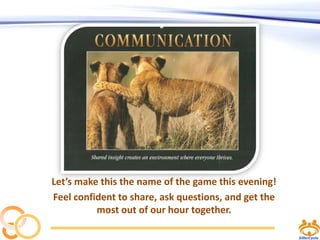
Let’s make this the name of the game this evening!
Feel confident to share, ask questions, and get the
most out of our hour together.
Developing Literacy Skills for Babies

Babies may begin to view book experiences as
pleasurable.
Books are considered toys at this stage.
Read aloud to children ~ make it expressive and
fun!
Fabric, plastic, or board books are easiest for
babies to hold.
Develop routines.
Developmental Milestones

The link below has an easy to read chart of
developmental milestones to include Motor
Development, Cognitive Development, and What
Parents Can Do.... beginning at birth...
http://teacher.scholastic.com/products/face-new/pdf/board-books/developmental-milestones-chart.pdf
Oral Language Development
o Everyday activities provide wonderful
opportunities to engage in conversation and
develop language skills.
o TALK ~ TALK ~ TALK – be sure to get beyond pure
“business talk”.
http://www.youtube.com/watch?v=IzvintTlBNs

o A reliable indicator of reading comprehension
success in grade 3 is actually a child’s verbal
abilities at age 3!
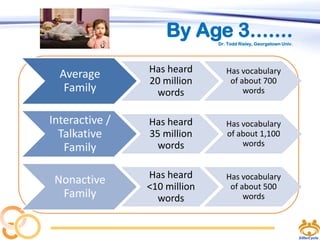
By Age 3.......
Dr. Todd Risley, Georgetown Univ.

Average
Family

Has heard
20 million
words

Has vocabulary
of about 700
words

Interactive /
Talkative
Family

Has heard
35 million
words

Has vocabulary
of about 1,100
words

Nonactive
Family

Has heard
<10 million
words

Has vocabulary
of about 500
words
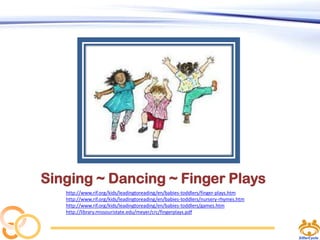
Singing ~ Dancing ~ Finger Plays
http://www.rif.org/kids/leadingtoreading/en/babies-toddlers/finger-plays.htm
http://www.rif.org/kids/leadingtoreading/en/babies-toddlers/nursery-rhymes.htm
http://www.rif.org/kids/leadingtoreading/en/babies-toddlers/games.htm
http://library.missouristate.edu/meyer/crc/fingerplays.pdf
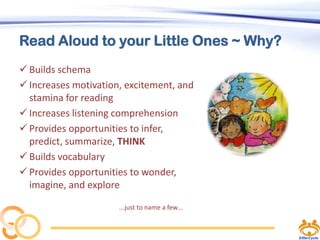
Read Aloud to your Little Ones ~ Why?
 Builds schema
 Increases motivation, excitement, and
stamina for reading
 Increases listening comprehension
 Provides opportunities to infer,
predict, summarize, THINK
 Builds vocabulary
 Provides opportunities to wonder,
imagine, and explore
...just to name a few...
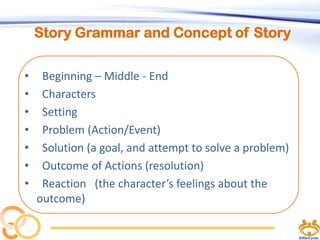
Story Grammar and Concept of Story
•
•
•
•
•
•
•

Beginning – Middle - End
Characters
Setting
Problem (Action/Event)
Solution (a goal, and attempt to solve a problem)
Outcome of Actions (resolution)
Reaction (the character’s feelings about the
outcome)
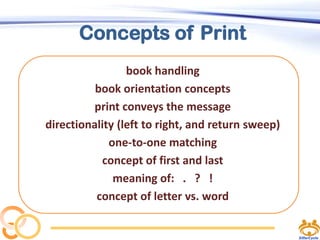
Concepts of Print
book handling
book orientation concepts
print conveys the message
directionality (left to right, and return sweep)
one-to-one matching
concept of first and last
meaning of: . ? !
concept of letter vs. word
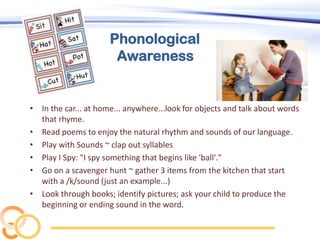
Phonological
Awareness

• In the car... at home... anywhere...look for objects and talk about words
that rhyme.
• Read poems to enjoy the natural rhythm and sounds of our language.
• Play with Sounds ~ clap out syllables
• Play I Spy: "I spy something that begins like 'ball'."
• Go on a scavenger hunt ~ gather 3 items from the kitchen that start
with a /k/sound (just an example...)
• Look through books; identify pictures; ask your child to produce the
beginning or ending sound in the word.
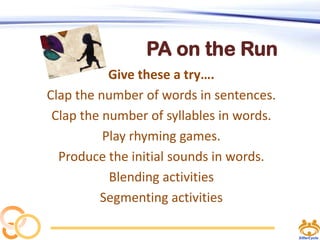
PA on the Run
Give these a try….
Clap the number of words in sentences.
Clap the number of syllables in words.
Play rhyming games.
Produce the initial sounds in words.
Blending activities
Segmenting activities
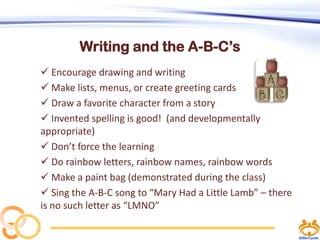
Writing and the A-B-C’s
 Encourage drawing and writing
 Make lists, menus, or create greeting cards
 Draw a favorite character from a story
 Invented spelling is good! (and developmentally
appropriate)
 Don’t force the learning
 Do rainbow letters, rainbow names, rainbow words
 Make a paint bag (demonstrated during the class)
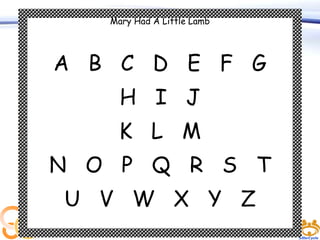
 Sing the A-B-C song to “Mary Had a Little Lamb” – there
is no such letter as “LMNO”
Mary Had A Little Lamb

A B C D E F G
H I J

K L M
N O P Q R S T

U V W X Y Z
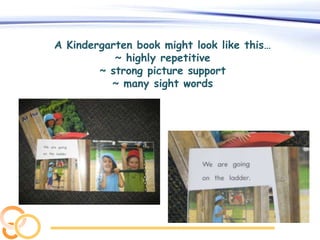
A Kindergarten book might look like this…
~ highly repetitive
~ strong picture support
~ many sight words
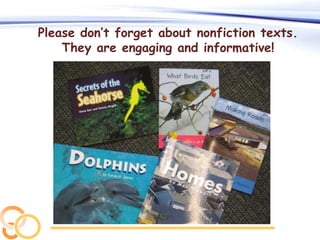
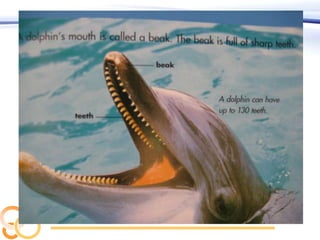
Please don’t forget about nonfiction texts.
They are engaging and informative!
1-2-3 Literacy Class
February 9, 2014

Thank you for
joining us!

SitterCycle 1-2-3 Literacy Class

  • 1.
  • 2.
    Hang out withus for an hour and you will learn about....  Developing Literacy Skills for Babies  Developmental Milestones for birth to age 3  The importance of oral language development  Finger-plays, Rhythm, and Song  Enhancing thinking skills during a read aloud  Concept of Story and Story Grammar  Book Handling Skills and Concepts of Print  Promoting Literacy without a Book…… WHAT?  Writing and the A-B-C’s  What to expect in Kindergarten – the look of the books
  • 4.
    Let’s make thisthe name of the game this evening! Feel confident to share, ask questions, and get the most out of our hour together.
  • 5.
    Developing Literacy Skillsfor Babies Babies may begin to view book experiences as pleasurable. Books are considered toys at this stage. Read aloud to children ~ make it expressive and fun! Fabric, plastic, or board books are easiest for babies to hold. Develop routines.
  • 6.
    Developmental Milestones The linkbelow has an easy to read chart of developmental milestones to include Motor Development, Cognitive Development, and What Parents Can Do.... beginning at birth... http://teacher.scholastic.com/products/face-new/pdf/board-books/developmental-milestones-chart.pdf
  • 7.
    Oral Language Development oEveryday activities provide wonderful opportunities to engage in conversation and develop language skills. o TALK ~ TALK ~ TALK – be sure to get beyond pure “business talk”. http://www.youtube.com/watch?v=IzvintTlBNs o A reliable indicator of reading comprehension success in grade 3 is actually a child’s verbal abilities at age 3!
  • 8.
    By Age 3....... Dr.Todd Risley, Georgetown Univ. Average Family Has heard 20 million words Has vocabulary of about 700 words Interactive / Talkative Family Has heard 35 million words Has vocabulary of about 1,100 words Nonactive Family Has heard <10 million words Has vocabulary of about 500 words
  • 9.
    Singing ~ Dancing~ Finger Plays http://www.rif.org/kids/leadingtoreading/en/babies-toddlers/finger-plays.htm http://www.rif.org/kids/leadingtoreading/en/babies-toddlers/nursery-rhymes.htm http://www.rif.org/kids/leadingtoreading/en/babies-toddlers/games.htm http://library.missouristate.edu/meyer/crc/fingerplays.pdf
  • 10.
    Read Aloud toyour Little Ones ~ Why?  Builds schema  Increases motivation, excitement, and stamina for reading  Increases listening comprehension  Provides opportunities to infer, predict, summarize, THINK  Builds vocabulary  Provides opportunities to wonder, imagine, and explore ...just to name a few...
  • 11.
    Story Grammar andConcept of Story • • • • • • • Beginning – Middle - End Characters Setting Problem (Action/Event) Solution (a goal, and attempt to solve a problem) Outcome of Actions (resolution) Reaction (the character’s feelings about the outcome)
  • 13.
    Concepts of Print bookhandling book orientation concepts print conveys the message directionality (left to right, and return sweep) one-to-one matching concept of first and last meaning of: . ? ! concept of letter vs. word
  • 14.
    Phonological Awareness • In thecar... at home... anywhere...look for objects and talk about words that rhyme. • Read poems to enjoy the natural rhythm and sounds of our language. • Play with Sounds ~ clap out syllables • Play I Spy: "I spy something that begins like 'ball'." • Go on a scavenger hunt ~ gather 3 items from the kitchen that start with a /k/sound (just an example...) • Look through books; identify pictures; ask your child to produce the beginning or ending sound in the word.
  • 15.
    PA on theRun Give these a try…. Clap the number of words in sentences. Clap the number of syllables in words. Play rhyming games. Produce the initial sounds in words. Blending activities Segmenting activities
  • 16.
    Writing and theA-B-C’s  Encourage drawing and writing  Make lists, menus, or create greeting cards  Draw a favorite character from a story  Invented spelling is good! (and developmentally appropriate)  Don’t force the learning  Do rainbow letters, rainbow names, rainbow words  Make a paint bag (demonstrated during the class)  Sing the A-B-C song to “Mary Had a Little Lamb” – there is no such letter as “LMNO”
  • 17.
    Mary Had ALittle Lamb A B C D E F G H I J K L M N O P Q R S T U V W X Y Z
  • 18.
    A Kindergarten bookmight look like this… ~ highly repetitive ~ strong picture support ~ many sight words
  • 19.
    Please don’t forgetabout nonfiction texts. They are engaging and informative!
  • 21.
    1-2-3 Literacy Class February9, 2014 Thank you for joining us!