READING
WRITING
AND
Dear Lord,
As we gather for our reading and writing class today,
we seek your guidance and wisdom. Bless us with
open minds and hearts, that we may absorb the
knowledge and insights shared. Inspire us to express
ourselves eloquently through words and comprehend
the stories that unfold before us. May our time
together be filled with understanding, creativity, and a
shared love for learning. In your name, we pray.
Amen.
In our last session, we
learned.........
In our previous session, we
tackled........
From our recent session, we
shed light on.....
REVIEW
Reading and Writing
Players guess the humorous
phrases displayed on the
screen. One phrase is shown at
a time, and everyone takes a
guess.
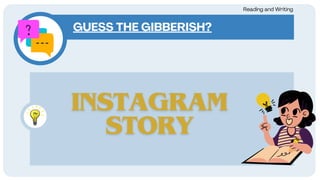
GUESS THE GIBBERISH?
MECHANICS
Reading Comprehension Strategies
GUESS THE GIBBERISH?
Reading and Writing
GUESS THE GIBBERISH?
Reading and Writing
GUESS THE GIBBERISH?
Reading and Writing
GUESS THE GIBBERISH?
Reading and Writing
GUESS THE GIBBERISH?
Reading and Writing
GUESS THE GIBBERISH?
Reading and Writing
GUESS THE GIBBERISH?
Reading and Writing
GUESS THE GIBBERISH?
Reading and Writing
GUESS THE GIBBERISH?
Reading and Writing
GUESS THE GIBBERISH?
Reading and Writing
GUESS THE GIBBERISH?
Reading and Writing
GUESS THE GIBBERISH?
Reading and Writing
GUESS THE GIBBERISH?
Reading and Writing
GUESS THE GIBBERISH?
Reading and Writing
TEXT
CONNECTED
DISCOURSE
AS
WHAT IS A TEXT?
a text is generally considered as written material
a group of ideas put together to make a point or
one central idea
text also made up of sentences
it deals with cohesion
Reading and Writing
WHAT IS A DISCOURSE?
originally the word ‘discourse '
comes from the Latin discursus
which denoted conversation,
argument, or speech.
Reading and Writing
WHAT IS A DISCOURSE?
Text with distinct features and purpose.
A formal and often lengthy discussion of a topic
where concepts and insights are arranged in an
organized and logical manner.
An extended expression of thoughts or ideas.
Reading and Writing
EXAMPLE OF DISCOURSE?
Reading and Writing
A conversation: Two
friends chatting
about their day,
exchanging
thoughts and
feelings.
EXAMPLE OF DISCOURSE?
Reading and Writing
A speech: A politician
delivering a
passionate address
to a crowd, trying to
persuade them of a
certain viewpoint.
EXAMPLE OF DISCOURSE?
Reading and Writing
A news article: A
journalist reporting
on current events,
providing information
and analysis to the
public.
EXAMPLE OF DISCOURSE?
Reading and Writing
A poem: A writer
expressing their
emotions and ideas
through creative
language and
imagery.
EXAMPLE OF DISCOURSE?
Reading and Writing
A song: A musician
using lyrics and
melody to tell a story
or evoke emotion in
the listener.
1. To Inform: This is the most basic
purpose of discourse, where the aim is to
convey knowledge or facts to an audience.
Examples include news articles, scientific
reports, instructional manuals, and
lectures.
PURPOSE OF DISCOURSE
Reading and Writing
2. To Persuade: The goal here is to convince the
audience to adopt a particular point of view, belief, or
course of action. This can be seen in political
speeches, advertisements, sales pitches, and
argumentative essays.
PURPOSE OF DISCOURSE
Reading and Writing
3. To Entertain: This purpose focuses on
engaging and enjoyable experiences for the
audience. Jokes, poems, songs, stories, and
plays all fall under this category.
PURPOSE OF DISCOURSE
Reading and Writing
4. To Express Emotion: Discourse can be used to
share personal feelings, thoughts, and experiences.
This can include diaries, letters, poetry, and even
informal conversations.
PURPOSE OF DISCOURSE
Reading and Writing
5. To Build Relationships: Through discourse, we can
connect with others, establish rapport, and build
relationships. This can involve casual conversations,
negotiations, apologies, and expressions of gratitude.
PURPOSE OF DISCOURSE
Reading and Writing
6. To Create Shared Understanding: Discourse
allows us to discuss and explore different ideas,
perspectives, and experiences, leading to a shared
understanding of the world around us. This can be
seen in group discussions, brainstorming sessions, and
collaborative writing projects.
PURPOSE OF DISCOURSE
Reading and Writing
7. To Perform Rituals or Ceremonies: Discourse
plays a role in various rituals and ceremonies, serving
to mark important events, express cultural values, and
transmit traditions. This can include prayers,
speeches, and chants during weddings, funerals, or
religious services.
PURPOSE OF DISCOURSE
Reading and Writing
8. To Innovate and Discover: Through discourse, we
can exchange ideas, challenge existing views, and
generate new knowledge. This can be seen in
academic debates, scientific collaborations, and
brainstorming sessions within businesses.
PURPOSE OF DISCOURSE
Reading and Writing
9. To Reflect and Analyze: Discourse allows us to
critically examine our thoughts, experiences, and
the world around us. This can involve journaling,
introspection, and discussions about complex
issues.
PURPOSE OF DISCOURSE
Reading and Writing
Checking of Understanding
Reading and Writing
What is a text?
1.
a. A written message
b. Any piece of written or spoken
communication
c. A conversation between two people
d. A form of poetry
Checking of Understanding
Reading and Writing
2. What does discourse refer to?
a. Individual words
b. The study of language structure
c. A broader analysis of language use in
context
d. A specific style of writing
Checking of Understanding
Reading and Writing
3. In simple terms, a text is:
a. A written message
b. Any form of communication
c. A long piece of writing
d. A speech delivered in public
Checking of Understanding
Reading and Writing
4. Discourse extends its study beyond
individual pieces to focus on:
a. The structure of sentences
b. The broader use of language in society
c. The phonetics of speech
d. The grammar rules in writing
Checking of Understanding
Reading and Writing
Which statement best defines discourse?
a. A specific literary genre
b. The analysis of spoken or written
communication
c. A type of linguistic ambiguity
d. The rhythm in a piece of writing
GENERALIZATION
How does reading a story
or a paragraph help us
understand the whole
message?
1.
Reading Comprehension Strategies
GENERALIZATION
2. Why is it important to
understand what the
author is saying when we
read a story or text?
Reading Comprehension Strategies
Thank
you!
Add a short description

Reading-and-Writing-week-1-module-1 (1).pdf

  • 1.
  • 2.
    Dear Lord, As wegather for our reading and writing class today, we seek your guidance and wisdom. Bless us with open minds and hearts, that we may absorb the knowledge and insights shared. Inspire us to express ourselves eloquently through words and comprehend the stories that unfold before us. May our time together be filled with understanding, creativity, and a shared love for learning. In your name, we pray. Amen.
  • 3.
    In our lastsession, we learned......... In our previous session, we tackled........ From our recent session, we shed light on..... REVIEW Reading and Writing
  • 4.
    Players guess thehumorous phrases displayed on the screen. One phrase is shown at a time, and everyone takes a guess. GUESS THE GIBBERISH? MECHANICS Reading Comprehension Strategies
  • 5.
  • 6.
  • 7.
  • 8.
  • 9.
  • 10.
  • 11.
  • 12.
  • 13.
  • 14.
  • 15.
  • 16.
  • 17.
  • 18.
  • 19.
  • 20.
    WHAT IS ATEXT? a text is generally considered as written material a group of ideas put together to make a point or one central idea text also made up of sentences it deals with cohesion Reading and Writing
  • 21.
    WHAT IS ADISCOURSE? originally the word ‘discourse ' comes from the Latin discursus which denoted conversation, argument, or speech. Reading and Writing
  • 22.
    WHAT IS ADISCOURSE? Text with distinct features and purpose. A formal and often lengthy discussion of a topic where concepts and insights are arranged in an organized and logical manner. An extended expression of thoughts or ideas. Reading and Writing
  • 23.
    EXAMPLE OF DISCOURSE? Readingand Writing A conversation: Two friends chatting about their day, exchanging thoughts and feelings.
  • 24.
    EXAMPLE OF DISCOURSE? Readingand Writing A speech: A politician delivering a passionate address to a crowd, trying to persuade them of a certain viewpoint.
  • 25.
    EXAMPLE OF DISCOURSE? Readingand Writing A news article: A journalist reporting on current events, providing information and analysis to the public.
  • 26.
    EXAMPLE OF DISCOURSE? Readingand Writing A poem: A writer expressing their emotions and ideas through creative language and imagery.
  • 27.
    EXAMPLE OF DISCOURSE? Readingand Writing A song: A musician using lyrics and melody to tell a story or evoke emotion in the listener.
  • 28.
    1. To Inform:This is the most basic purpose of discourse, where the aim is to convey knowledge or facts to an audience. Examples include news articles, scientific reports, instructional manuals, and lectures. PURPOSE OF DISCOURSE Reading and Writing
  • 29.
    2. To Persuade:The goal here is to convince the audience to adopt a particular point of view, belief, or course of action. This can be seen in political speeches, advertisements, sales pitches, and argumentative essays. PURPOSE OF DISCOURSE Reading and Writing
  • 30.
    3. To Entertain:This purpose focuses on engaging and enjoyable experiences for the audience. Jokes, poems, songs, stories, and plays all fall under this category. PURPOSE OF DISCOURSE Reading and Writing
  • 31.
    4. To ExpressEmotion: Discourse can be used to share personal feelings, thoughts, and experiences. This can include diaries, letters, poetry, and even informal conversations. PURPOSE OF DISCOURSE Reading and Writing
  • 32.
    5. To BuildRelationships: Through discourse, we can connect with others, establish rapport, and build relationships. This can involve casual conversations, negotiations, apologies, and expressions of gratitude. PURPOSE OF DISCOURSE Reading and Writing
  • 33.
    6. To CreateShared Understanding: Discourse allows us to discuss and explore different ideas, perspectives, and experiences, leading to a shared understanding of the world around us. This can be seen in group discussions, brainstorming sessions, and collaborative writing projects. PURPOSE OF DISCOURSE Reading and Writing
  • 34.
    7. To PerformRituals or Ceremonies: Discourse plays a role in various rituals and ceremonies, serving to mark important events, express cultural values, and transmit traditions. This can include prayers, speeches, and chants during weddings, funerals, or religious services. PURPOSE OF DISCOURSE Reading and Writing
  • 35.
    8. To Innovateand Discover: Through discourse, we can exchange ideas, challenge existing views, and generate new knowledge. This can be seen in academic debates, scientific collaborations, and brainstorming sessions within businesses. PURPOSE OF DISCOURSE Reading and Writing
  • 36.
    9. To Reflectand Analyze: Discourse allows us to critically examine our thoughts, experiences, and the world around us. This can involve journaling, introspection, and discussions about complex issues. PURPOSE OF DISCOURSE Reading and Writing
  • 37.
    Checking of Understanding Readingand Writing What is a text? 1. a. A written message b. Any piece of written or spoken communication c. A conversation between two people d. A form of poetry
  • 38.
    Checking of Understanding Readingand Writing 2. What does discourse refer to? a. Individual words b. The study of language structure c. A broader analysis of language use in context d. A specific style of writing
  • 39.
    Checking of Understanding Readingand Writing 3. In simple terms, a text is: a. A written message b. Any form of communication c. A long piece of writing d. A speech delivered in public
  • 40.
    Checking of Understanding Readingand Writing 4. Discourse extends its study beyond individual pieces to focus on: a. The structure of sentences b. The broader use of language in society c. The phonetics of speech d. The grammar rules in writing
  • 41.
    Checking of Understanding Readingand Writing Which statement best defines discourse? a. A specific literary genre b. The analysis of spoken or written communication c. A type of linguistic ambiguity d. The rhythm in a piece of writing
  • 42.
    GENERALIZATION How does readinga story or a paragraph help us understand the whole message? 1. Reading Comprehension Strategies
  • 43.
    GENERALIZATION 2. Why isit important to understand what the author is saying when we read a story or text? Reading Comprehension Strategies
  • 44.