1. จุดประสงค์
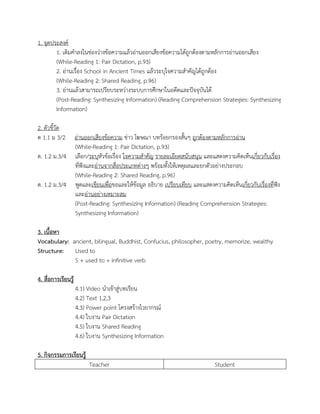
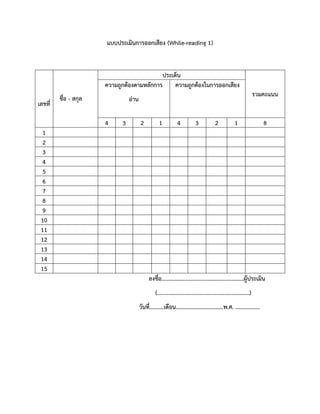
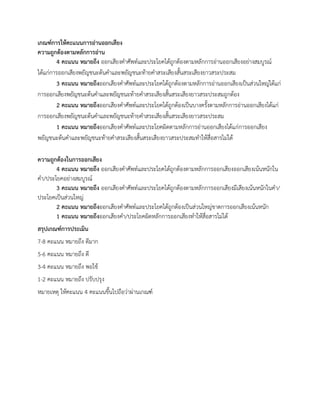
1. เติมคำลงในช่องว่ำงข้อควำมแล้วอ่ำนออกเสียงข้อควำมได้ถูกต้องตำมหลักกำรอ่ำนออกเสียง
(While-Reading1: Pair Dictation, p.93)
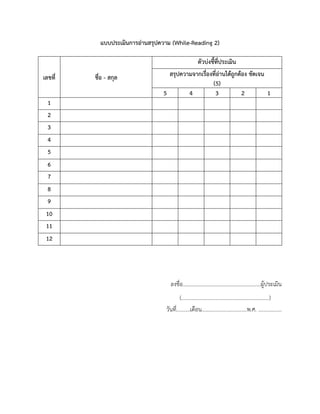
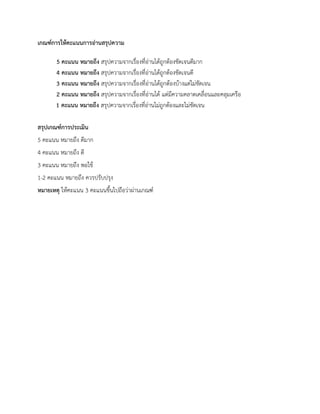
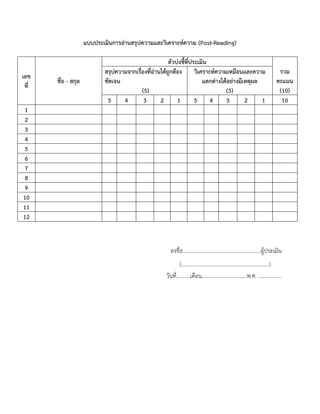
2. อ่ำนเรื่อง School in Ancient Times แล้วระบุใจควำมสำคัญได้ถูกต้อง
(While-Reading 2: Shared Reading, p.96)
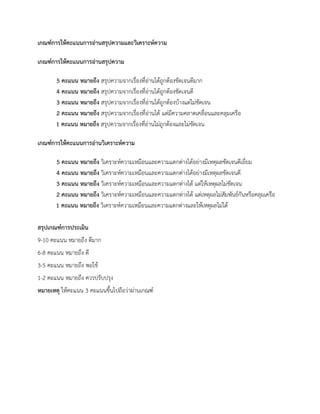
3. อ่ำนแล้วสำมำรถเปรียบระหว่ำงระบบกำรศึกษำในอดีตและปัจจุบันได้
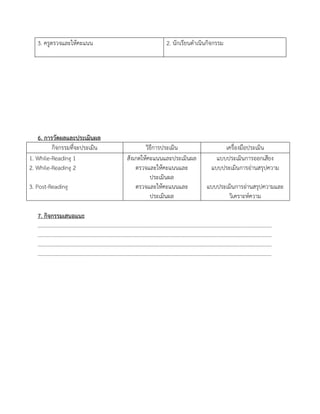
(Post-Reading: Synthesizing Information) (Reading Comprehension Strategies: Synthesizing
Information)
2. ตัวชี้วัด
ต 1.1 ม 3/2 อ่ำนออกเสียงข้อควำม ข่ำว โฆษณำ บทร้อยกรองสั้นๆ ถูกต้องตำมหลักกำรอ่ำน
(While-Reading 1: Pair Dictation, p.93)
ต. 1.2 ม.3/4 เลือก/ระบุหัวข้อเรื่อง ใจควำมสำคัญ รำยละเอียดสนับสนุน และแสดงควำมคิดเห็นเกี่ยวกับเรื่อง
ที่ฟังและอ่ำนจำกสื่อประเภทต่ำงๆ พร้อมทั้งให้เหตุผลและยกตัวอย่ำงประกอบ
(While-Reading 2: Shared Reading, p.96)
ต. 1.2 ม.3/4 พูดและเขียนเพื่อขอและให้ข้อมูล อธิบำย เปรียบเทียบ และแสดงควำมคิดเห็นเกี่ยวกับเรื่องที่ฟัง
และอ่ำนอย่ำงเหมำะสม
(Post-Reading: Synthesizing Information) (Reading Comprehension Strategies:
Synthesizing Information)
3. เนื้อหา
Vocabulary: ancient, bilingual, Buddhist, Confucius, philosopher, poetry, memorize, wealthy
Structure: Used to
S + used to + infinitive verb
4. สื่อการเรียนรู้
4.1) Video นำเข้ำสู่บทเรียน
4.2) Text 1,2,3
4.3) Power point โครงสร้ำงไวยำกรณ์
4.4) ใบงำน Pair Dictation
4.5) ใบงำน Shared Reading
4.6) ใบงำน Synthesizing Information
5. กิจกรรมการเรียนรู้
Teacher Student
3.
Pre-Reading
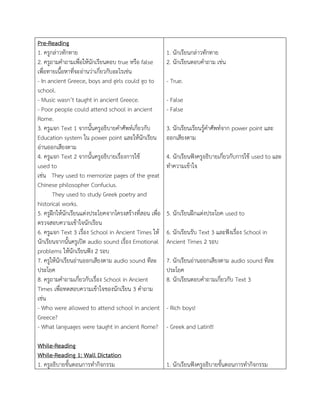
1. ครูกล่ำวทักทำย
2. ครูถำมคำถำมเพื่อให้นักเรียนตอบtrue หรือ false
เพื่อทำยเนื้อหำที่จะอ่ำนว่ำเกี่ยวกับอะไรเช่น
- In ancient Greece, boys and girls could go to
school.
- Music wasn’t taught in ancient Greece.
- Poor people could attend school in ancient
Rome.
3. ครูแจก Text 1 จำกนั้นครูอธิบำยคำศัพท์เกี่ยวกับ
Education system ใน power point และให้นักเรียน
อ่ำนออกเสียงตำม
4. ครูแจก Text 2 จำกนั้นครูอธิบำยเรื่องกำรใช้
used to
เช่น They used to memorize pages of the great
Chinese philosopher Confucius.
They used to study Greek poetry and
historical works.
5. ครูฝึกให้นักเรียนแต่งประโยคจำกโครงสร้ำงที่สอน เพื่อ
ตรวจสอบควำมเข้ำใจนักเรียน
6. ครูแจก Text 3 เรื่อง School in Ancient Times ให้
นักเรียนจำกนั้นครูเปิด audio sound เรื่อง Emotional
problems ให้นักเรียนฟัง 2 รอบ
7. ครูให้นักเรียนอ่ำนออกเสียงตำม audio sound ทีละ
ประโยค
8. ครูถำมคำถำมเกี่ยวกับเรื่อง School in Ancient
Times เพื่อทดสอบควำมเข้ำใจของนักเรียน 3 คำถำม
เช่น
- Who were allowed to attend school in ancient
Greece?
- What languages were taught in ancient Rome?
While-Reading
While-Reading 1: Wall Dictation
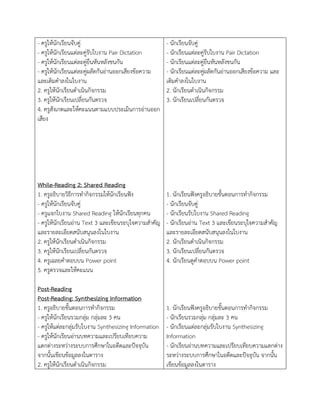
1. ครูอธิบำยขั้นตอนกำรทำกิจกรรม
1. นักเรียนกล่ำวทักทำย
2. นักเรียนตอบคำถำม เช่น
- True.
- False
- False
3. นักเรียนเรียนรู้คำศัพท์จำก power point และ
ออกเสียงตำม
4. นักเรียนฟังครูอธิบำยเกี่ยวกับกำรใช้ used to และ
ทำควำมเข้ำใจ
5. นักเรียนฝึกแต่งประโยค used to
6. นักเรียนรับ Text 3 และฟังเรื่อง School in
Ancient Times 2 รอบ
7. นักเรียนอ่ำนออกเสียงตำม audio sound ทีละ
ประโยค
8. นักเรียนตอบคำถำมเกี่ยวกับ Text 3
- Rich boys!
- Greek and Latin!!!
1. นักเรียนฟังครูอธิบำยขั้นตอนกำรทำกิจกรรม
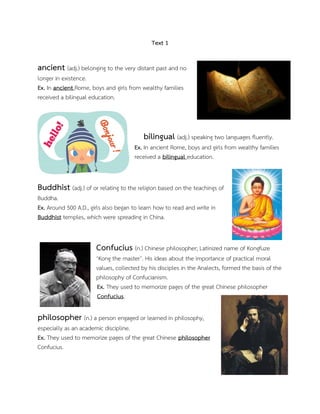
Text 1
ancient (adj.)belonging to the very distant past and no
longer in existence.
Ex. In ancient Rome, boys and girls from wealthy families
received a bilingual education.
bilingual (adj.) speaking two languages fluently.
Ex. In ancient Rome, boys and girls from wealthy families
received a bilingual education.
Buddhist (adj.) of or relating to the religion based on the teachings of
Buddha.
Ex. Around 500 A.D., girls also began to learn how to read and write in
Buddhist temples, which were spreading in China.
Confucius (n.) Chinese philosopher; Latinized name of Kongfuze
‘Kong the master’. His ideas about the importance of practical moral
values, collected by his disciples in the Analects, formed the basis of the
philosophy of Confucianism.
Ex. They used to memorize pages of the great Chinese philosopher
Confucius.
philosopher (n.) a person engaged or learned in philosophy,
especially as an academic discipline.
Ex. They used to memorize pages of the great Chinese philosopher
Confucius.
7.
poetry (n.) literarywork in which the expression of feelings and ideas
is given intensity by the use of distinctive style and rhythm; poems
collectively or as a genre of literature.
Ex. They used to study Greek poetry
memorize (v.) commit to memory; learn by heart.
Ex. They used to memorize pages of the great Chinese
philosopher Confucius.
wealthy (adj.) having a great deal of money, resources, or
assets; rich.
Ex. In ancient Rome, boys and girls from wealthy families
received a bilingual education.
8.
Text 2
Used to
Example:
They used to study Greek poetry and historical works.
It is better not to use "used to" in questions or negative forms; however, this is sometimes done
in informal spoken English. It is better to ask questions and create negative sentences
using Simple Past.
USE 1 Habit in the Past
"Used to" expresses the idea that something was an old habit that stopped in the past. It
indicates that something was often repeated in the past, but it is not usually done now.
Examples:
Teachers used to beat students who didn’t pay attention or who were lazy.
They typically used to start school when they were about six years old.
They used to memorize pages of the great Chinese philosopher Confucius.
Form: used to + verb
9.
Text 3
School inAncient Times
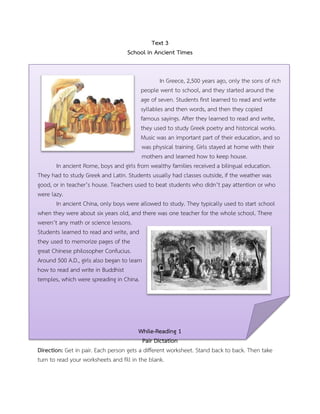
In Greece, 2,500 years ago, only the sons of rich
people went to school, and they started around the
age of seven. Students first learned to read and write
syllables and then words, and then they copied
famous sayings. After they learned to read and write,
they used to study Greek poetry and historical works.
Music was an important part of their education, and so
was physical training. Girls stayed at home with their
mothers and learned how to keep house.
In ancient Rome, boys and girls from wealthy families received a bilingual education.
They had to study Greek and Latin. Students usually had classes outside, if the weather was
good, or in teacher’s house. Teachers used to beat students who didn’t pay attention or who
were lazy.
In ancient China, only boys were allowed to study. They typically used to start school
when they were about six years old, and there was one teacher for the whole school. There
weren’t any math or science lessons.
Students learned to read and write, and
they used to memorize pages of the
great Chinese philosopher Confucius.
Around 500 A.D., girls also began to learn
how to read and write in Buddhist
temples, which were spreading in China.
While-Reading 1
Pair Dictation
Direction: Get in pair. Each person gets a different worksheet. Stand back to back. Then take
turn to read your worksheets and fill in the blank.
10.
Worksheet A
In Greece,2,500 years ago, only the sons of 1.________________ went to
school, and they started around the age of seven. Students first learned to read
and write 2.______________ and then words, and then they copied famous
sayings. After they learned to read and write, they 3._______________ study
Greek poetry and 4._______________ works. Music was an important part of
their education, and so was physical training. Girls 5.________________ at home
with their mothers and learned how to keep house.
In ancient Rome, boys and girls from 6._____________ families received
a bilingual education. They had to study 7._____________ and Latin. Students
usually had classes outside, if the 8._______________ was good, or in teacher’s
house. Teachers used to beat students who didn’t pay 9.___________ or who
were lazy.
In ancient China, only boys were 10.____________ to study. They
typically 11._______________ start school when they were about six years old,
and there was one teacher for the whole school. There weren’t any math or
12._______________ lessons. Students learned to read and write, and they used
to 13.________________ pages of the great Chinese philosopher Confucius.
Around 500 A.D., girls also began to learn how to read and write in Buddhist
temples, which were 14.___________________ in China.
Worksheet B
In Greece, 1._____________________ ago, only the sons of rich people
went to school, and they started around the age of seven. Students first
learned to read and write syllables and then words, and then they
2.______________ famous sayings. After they learned to read and write, they
used to study Greek 3._______________ and historical works. Music was an
4._______________ part of their education, and so was physical
5._____________. Girls stayed at home with their mothers and learned how to
keep house.
In 6.____________ Rome, boys and girls from wealthy families received a
7.____________ education. They had to study Greek and 8._________. Students
usually had classes outside, if the weather was good, or in teacher’s house.
Teachers 9.____________ beat students who didn’t pay attention or who were
11.
While–Reading 2
Shared Reading
Direction:Get in pair. Read and discuss Text 3. Write the main idea and supporting details in
each paragraph.
Paragraph 1
1. Main idea of the paragraph.
Only rich boys went to school in Ancient Greece.
2. Supporting details of the main idea.
2.1 They started going to school at the age of 7.
2.2 ……………………………………………………………………………………………………………………………………………
2.3 ……………………………………………………………………………………………………………………………………………
Paragraph 2
1. Main idea of the paragraph.
………………………………………………………………………………………………………………………………………………………….
2. Supporting details of the main idea.
2.1 ……………………………………………………………………………………………………………………………………………
2.2 ……………………………………………………………………………………………………………………………………………
2.3 ……………………………………………………………………………………………………………………………………………
Paragraph 3
1. Main idea of the paragraph.
………………………………………………………………………………………………………………………………………………………….
2. Supporting details of the main idea.
2.1 ……………………………………………………………………………………………………………………………………………
2.2 ……………………………………………………………………………………………………………………………………………
2.3 ……………………………………………………………………………………………………………………………………………
12.
Post-Reading
Synthesizing Information
Direction: Getin group of three. Discuss and compare between ancient educational systems
and nowadays. Write down differences and similarities in the table.
Countries Differences and similarities
Ancient Greece
Ex. In ancient Greece, only rich boys could attend school but today
everybody can go to school.
Ancient Rome
Ancient China