Department of Education
Region III
Division of Pampanga
Arayat East District
SAN MATEO ELEMENTARY SCHOOL
SCHOOL READING INTERVENTION PROGRAM
School Year 2014-2015
GRADE V-1
RATIONALE
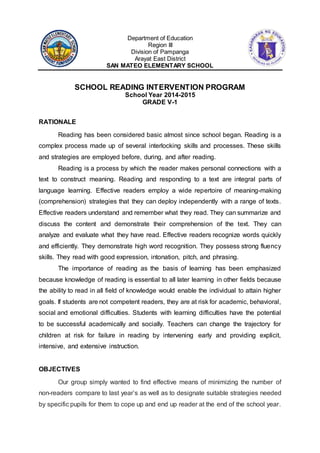
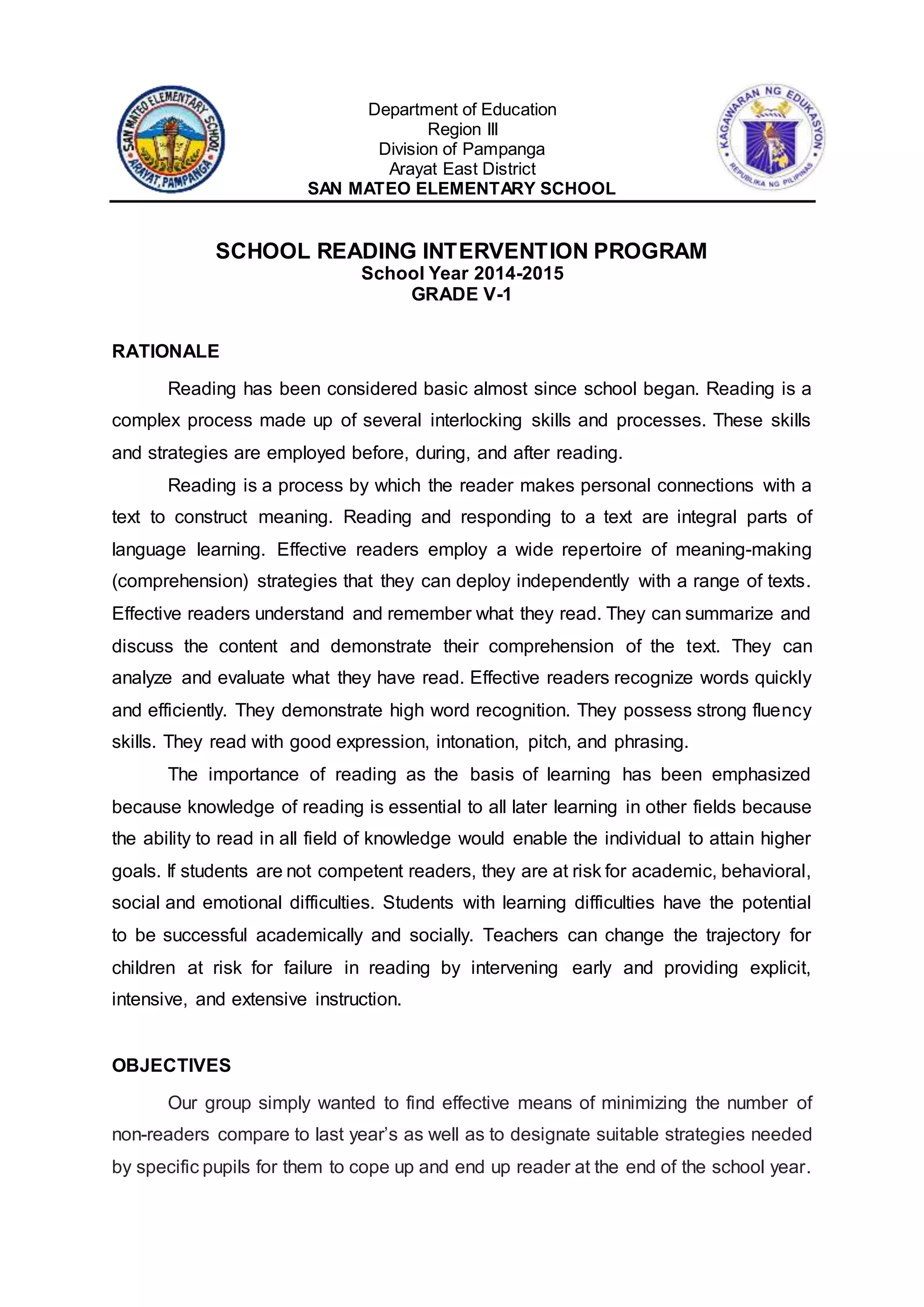
Reading has been considered basic almost since school began. Reading is a
complex process made up of several interlocking skills and processes. These skills
and strategies are employed before, during, and after reading.
Reading is a process by which the reader makes personal connections with a
text to construct meaning. Reading and responding to a text are integral parts of
language learning. Effective readers employ a wide repertoire of meaning-making
(comprehension) strategies that they can deploy independently with a range of texts.
Effective readers understand and remember what they read. They can summarize and
discuss the content and demonstrate their comprehension of the text. They can
analyze and evaluate what they have read. Effective readers recognize words quickly
and efficiently. They demonstrate high word recognition. They possess strong fluency
skills. They read with good expression, intonation, pitch, and phrasing.
The importance of reading as the basis of learning has been emphasized
because knowledge of reading is essential to all later learning in other fields because
the ability to read in all field of knowledge would enable the individual to attain higher
goals. If students are not competent readers, they are at risk for academic, behavioral,
social and emotional difficulties. Students with learning difficulties have the potential
to be successful academically and socially. Teachers can change the trajectory for
children at risk for failure in reading by intervening early and providing explicit,
intensive, and extensive instruction.
OBJECTIVES
Our group simply wanted to find effective means of minimizing the number of
non-readers compare to last year’s as well as to designate suitable strategies needed
by specific pupils for them to cope up and end up reader at the end of the school year.
Department of Education
Region III
Division of Pampanga
Arayat East District
SAN MATEO ELEMENTARY SCHOOL
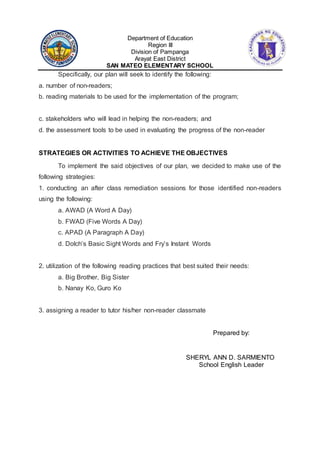
Specifically, our plan will seek to identify the following:
a. number of non-readers;
b. reading materials to be used for the implementation of the program;
c. stakeholders who will lead in helping the non-readers; and
d. the assessment tools to be used in evaluating the progress of the non-reader
STRATEGIES OR ACTIVITIES TO ACHIEVE THE OBJECTIVES
To implement the said objectives of our plan, we decided to make use of the
following strategies:
1. conducting an after class remediation sessions for those identified non-readers
using the following:
a. AWAD (A Word A Day)
b. FWAD (Five Words A Day)
c. APAD (A Paragraph A Day)
d. Dolch’s Basic Sight Words and Fry’s Instant Words
2. utilization of the following reading practices that best suited their needs:
a. Big Brother, Big Sister
b. Nanay Ko, Guro Ko
3. assigning a reader to tutor his/her non-reader classmate
Prepared by:
SHERYL ANN D. SARMIENTO
School English Leader

READING INTERVENTION.docx

  • 1.
    Department of Education RegionIII Division of Pampanga Arayat East District SAN MATEO ELEMENTARY SCHOOL SCHOOL READING INTERVENTION PROGRAM School Year 2014-2015 GRADE V-1 RATIONALE Reading has been considered basic almost since school began. Reading is a complex process made up of several interlocking skills and processes. These skills and strategies are employed before, during, and after reading. Reading is a process by which the reader makes personal connections with a text to construct meaning. Reading and responding to a text are integral parts of language learning. Effective readers employ a wide repertoire of meaning-making (comprehension) strategies that they can deploy independently with a range of texts. Effective readers understand and remember what they read. They can summarize and discuss the content and demonstrate their comprehension of the text. They can analyze and evaluate what they have read. Effective readers recognize words quickly and efficiently. They demonstrate high word recognition. They possess strong fluency skills. They read with good expression, intonation, pitch, and phrasing. The importance of reading as the basis of learning has been emphasized because knowledge of reading is essential to all later learning in other fields because the ability to read in all field of knowledge would enable the individual to attain higher goals. If students are not competent readers, they are at risk for academic, behavioral, social and emotional difficulties. Students with learning difficulties have the potential to be successful academically and socially. Teachers can change the trajectory for children at risk for failure in reading by intervening early and providing explicit, intensive, and extensive instruction. OBJECTIVES Our group simply wanted to find effective means of minimizing the number of non-readers compare to last year’s as well as to designate suitable strategies needed by specific pupils for them to cope up and end up reader at the end of the school year.
  • 2.
    Department of Education RegionIII Division of Pampanga Arayat East District SAN MATEO ELEMENTARY SCHOOL Specifically, our plan will seek to identify the following: a. number of non-readers; b. reading materials to be used for the implementation of the program; c. stakeholders who will lead in helping the non-readers; and d. the assessment tools to be used in evaluating the progress of the non-reader STRATEGIES OR ACTIVITIES TO ACHIEVE THE OBJECTIVES To implement the said objectives of our plan, we decided to make use of the following strategies: 1. conducting an after class remediation sessions for those identified non-readers using the following: a. AWAD (A Word A Day) b. FWAD (Five Words A Day) c. APAD (A Paragraph A Day) d. Dolch’s Basic Sight Words and Fry’s Instant Words 2. utilization of the following reading practices that best suited their needs: a. Big Brother, Big Sister b. Nanay Ko, Guro Ko 3. assigning a reader to tutor his/her non-reader classmate Prepared by: SHERYL ANN D. SARMIENTO School English Leader