Discuss the salient features of
reading
Enumerate the benefits of
reading
 "Reading" is the process of looking at a series of written
symbols and getting meaning from them. When we read, we use
our eyes to receive written symbols (letters, punctuation marks
and spaces) and we use our brain to convert them into words,
sentences and paragraphs that communicate something to us.
 Reading can be silent (in our head) or aloud (so that other
people can hear).
 Reading is a receptive skill - through it we receive information.
But the complex process of reading also requires the skill of
speaking, so that we can pronounce the words that we read. In
this sense, reading is also a productive skill in that we are both
receiving information and transmitting it (even if only to
ourselves).
 That reading is the third of the four language
skills, which are:
1. Listening
2. Speaking
3. Reading
4. Writing
 In our own language, reading is usually the
third language skill that we learn.
10
BENEFITS
OF
READING
 Mental Stimulation
› Studies have shown that staying mentally
stimulated can slow the progress of (or
possibly even prevent) Alzheimer’s and
Dementia, since keeping your brain active
and engaged prevents it from losing power.
 Stress deduction
› No matter how much stress you have at work,
in your personal relationships, or countless
other issues faced in daily life, it all just slips
away when you lose yourself in a great story.
A well-written novel can transport you to other
realms, while an engaging article will distract
you and keep you in the present moment,
letting tensions drain away and allowing you
to relax.
 Knowledge
› Everything you read fills your head with
new bits of information, and you never
know when it might come in handy. The
more knowledge you have, the better-
equipped you are to tackle any challenge
you’ll ever face.
 Vocabulary Expansion
› Reading books is also vital for
learning new languages, as non-native
speakers gain exposure to words used in
context, which will ameliorate their own
speaking and writing fluency.
 Memory Improvement
› every new memory you create forges new
synapses (brain pathways)and strengthens
existing ones, which assists in short-
term memory recall as well as stabilizing
moods.
 Stronger Analytical Thinking Skills
› Have you ever read an amazing mystery
novel, and solved the mystery yourself before
finishing the book? If so, you were able to put
critical and analytical thinking to work by
taking note of all the details provided and
sorting them out to determine “whodunnit”.
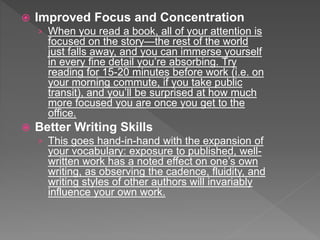
 Improved Focus and Concentration
› When you read a book, all of your attention is
focused on the story—the rest of the world
just falls away, and you can immerse yourself
in every fine detail you’re absorbing. Try
reading for 15-20 minutes before work (i.e. on
your morning commute, if you take public
transit), and you’ll be surprised at how much
more focused you are once you get to the
office.
 Better Writing Skills
› This goes hand-in-hand with the expansion of
your vocabulary: exposure to published, well-
written work has a noted effect on one’s own
writing, as observing the cadence, fluidity, and
writing styles of other authors will invariably
influence your own work.
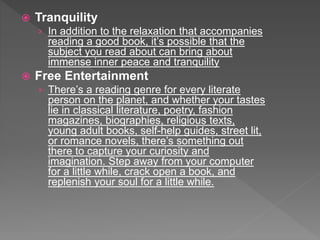
 Tranquility
› In addition to the relaxation that accompanies
reading a good book, it’s possible that the
subject you read about can bring about
immense inner peace and tranquility
 Free Entertainment
› There’s a reading genre for every literate
person on the planet, and whether your tastes
lie in classical literature, poetry, fashion
magazines, biographies, religious texts,
young adult books, self-help guides, street lit,
or romance novels, there’s something out
there to capture your curiosity and
imagination. Step away from your computer
for a little while, crack open a book, and
replenish your soul for a little while.

Reading

  • 2.
    Discuss the salientfeatures of reading Enumerate the benefits of reading
  • 3.
     "Reading" isthe process of looking at a series of written symbols and getting meaning from them. When we read, we use our eyes to receive written symbols (letters, punctuation marks and spaces) and we use our brain to convert them into words, sentences and paragraphs that communicate something to us.  Reading can be silent (in our head) or aloud (so that other people can hear).  Reading is a receptive skill - through it we receive information. But the complex process of reading also requires the skill of speaking, so that we can pronounce the words that we read. In this sense, reading is also a productive skill in that we are both receiving information and transmitting it (even if only to ourselves).
  • 4.
     That readingis the third of the four language skills, which are: 1. Listening 2. Speaking 3. Reading 4. Writing  In our own language, reading is usually the third language skill that we learn.
  • 5.
  • 6.
     Mental Stimulation ›Studies have shown that staying mentally stimulated can slow the progress of (or possibly even prevent) Alzheimer’s and Dementia, since keeping your brain active and engaged prevents it from losing power.  Stress deduction › No matter how much stress you have at work, in your personal relationships, or countless other issues faced in daily life, it all just slips away when you lose yourself in a great story. A well-written novel can transport you to other realms, while an engaging article will distract you and keep you in the present moment, letting tensions drain away and allowing you to relax.
  • 7.
     Knowledge › Everythingyou read fills your head with new bits of information, and you never know when it might come in handy. The more knowledge you have, the better- equipped you are to tackle any challenge you’ll ever face.  Vocabulary Expansion › Reading books is also vital for learning new languages, as non-native speakers gain exposure to words used in context, which will ameliorate their own speaking and writing fluency.
  • 8.
     Memory Improvement ›every new memory you create forges new synapses (brain pathways)and strengthens existing ones, which assists in short- term memory recall as well as stabilizing moods.  Stronger Analytical Thinking Skills › Have you ever read an amazing mystery novel, and solved the mystery yourself before finishing the book? If so, you were able to put critical and analytical thinking to work by taking note of all the details provided and sorting them out to determine “whodunnit”.
  • 9.
     Improved Focusand Concentration › When you read a book, all of your attention is focused on the story—the rest of the world just falls away, and you can immerse yourself in every fine detail you’re absorbing. Try reading for 15-20 minutes before work (i.e. on your morning commute, if you take public transit), and you’ll be surprised at how much more focused you are once you get to the office.  Better Writing Skills › This goes hand-in-hand with the expansion of your vocabulary: exposure to published, well- written work has a noted effect on one’s own writing, as observing the cadence, fluidity, and writing styles of other authors will invariably influence your own work.
  • 10.
     Tranquility › Inaddition to the relaxation that accompanies reading a good book, it’s possible that the subject you read about can bring about immense inner peace and tranquility  Free Entertainment › There’s a reading genre for every literate person on the planet, and whether your tastes lie in classical literature, poetry, fashion magazines, biographies, religious texts, young adult books, self-help guides, street lit, or romance novels, there’s something out there to capture your curiosity and imagination. Step away from your computer for a little while, crack open a book, and replenish your soul for a little while.