+
DIGITAL TRANSLATORS:
Part of the problem or part
of the solution?
Session #7163
Gillian Lord
glord@ufl.edu
Amy Rossomondo
arossomo@ku.edu
11/19/2017
+
Session Objectives
Consider attitudes toward and examine patterns
of use of Digital Translators (DTs)
Understand and be able to articulate the
strengths and weaknesses of digital translation
with respect to FL teaching and learning
Discover different techniques for using DTs in
language teaching and learning
Collaborate to develop contours of activities for
use with our language students
+
AUDIENCE INPUT
Do you use DTs for your own purposes?
If so, for what? How?
Do you prohibit their use in your language
classes?
Do your students use them (anyway)?
+
Student use
Almost 98% of students admit to having used
Google Translate at some point
 … to check vocabulary, for prewriting, or to
understand instructions
Of these, 97% of students detect errors of
some kind.
-Hagele-Strombergsson 2016
+
Student use
Most previous work considers translators
negatively, focusing on how to detect and
prevent their use:
 Need to “minimize inappropriate use” (Fountain & Fountain,
2009)
 “Instructors find themselves playing “forensic linguist” in order to
gather evidence of cheating” (Correa, 2014)
 “Anecdotal classroom evidence points to beginners availing
themselves of MT help, even against the advice of
teachers”(Garcia & Pena 2011)
 “Inexperienced students of foreign languages often equate
learning a language with translation” (Alley, 2005)
+
Student use
Student and faculty attitudes
 (Jolley & Maimone, 2015)
Survey-based study on the use of and
attitudes, perceptions, and beliefs about DTs
by students and instructors in university
Spanish programs
+
Jolley & Maimone 2015
+
Jolley & Maimone 2015
+
Jolley & Maimone 2015
+
Reactions?
Take 2 minutes to discuss the results of the
Jolley & Maimone study with the people
around you:
 Do the results reflect your own attitudes and use
of DTs as an instructor?
 Do the results resonate with your impressions of
your students’ attitudes and patterns of usage?
 What does this lead you to conclude?
+
Jolley & Maimone’s
Primary recommendation:
That students receive training regarding
potential pedagogical applications of
digital translators as tools in language
teaching and learning.
+
Student use
To a 2nd year Spanish student, I would encourage them to use
online 21st century language resources but I would also advise them to
use these resources with caution. These online resources can actually
be very effective at improving your Spanish comprehension. First, if you
come across a phrase that you do not understand, you should first
try to make sense of the context. If that does not help, you could try
typing the phrase on Google translate. Be sure to set the translator
from Spanish to English in this case. Oftentimes, the translation is not
entirely accurate. Whenever I stumble upon a phrase I do not
comprehend and type it into the online translator, I type the keywords of
the translation into WordReference to ensure that the appropriate words
have been incorporated. Let’s say, for example, that I come across the
phrase “la historia me perturbaba.” If I did not know a single word in
this sentence, I would type this into Google translate…
+
Student use
Initially, in the first sentence, the words distinto and seres were
not immediately familiar to me, but using cognates I could assume that
distinto means distinct. I could also predict using context that seres has
something to do with characters, because Marco is a character, so it
follows that his distinctiveness would be compared to that of other
characters. Google Translate translated seres as beings, which makes
fantastic sense when paired with humanos. I always confuse verbs that
start with ll, so in the second sentence I had to use context clues of
“(blank) the exaggeration to the extreme” to remember that llevó
probably means carried. Knowing now that ser humano means
human being, the last sentence is more logical than the first read-
through, when I thought it was saying “the to be human”. It is
possible that eventually I would have made the connection between
to be and being, but Google Translate helped to expedite the mental
leap.
+
Student use
Upon initially reading the phrase, I knew the author was
describing Marco using a comparison to the rest of humanity. However,
there were words and phrases I did not know, which hindered my
understanding. I first copy and pasted the phrase into Google
Translate which translated the first sentence correctly, but did not
put together the last part correctly. Through context clues and
translating a couple of key words, I was able to decipher the meaning of
the phrase to be loosely “This story disturbed me because Marco is not
so different than other human beings. He exaggerated to an extreme.
He is a human incapable of accepting reality and needs fiction to live.” I
think Google Translate can definitely be a good starting point when
a student is having trouble understanding a reading, but the
content should be taken lightly and supported by further
confirmation with resources like WordReference or SpanishDict.
+
ACTFL & MLA recommendations
ACTFL
Partnership for 21st Century Skills (P21) = intersection of
disciplinary learning and 21st Century Skills:
IN THE PAST TODAY
Using technology as a “cool tool’”  Integrating technology
into instruction to
enhance learning
No mention of DTs
+
ACTFL & MLA recommendations
MLA (2007)
Reflect on language use itself so that students understand:
 “Expressions such as "the pursuit of happiness," "liberté, égalité,
fraternité," and "la Raza" connote cultural dimensions that extend well
beyond their immediate translation.”
 Achieve enough proficiency … that allows both linguistic exchanges and
metalinguistic exchanges (that is, discussion about the language itself).
 Have a solid command as well as an analytic knowledge of specific
metaphors and key terms that inform culture.
 Differences in meaning, mentality, and worldview as expressed in
American English and in the target language.
No mention of DTs
+
How accurate are DTs?
 In September, Google announced that its Neural
Machine Translation (GNMT) system can now “in some
cases” produce translations that are “nearly
indistinguishable” from those of humans.
BUT…
 “GNMT can still make significant errors that a human
translator would never make, like dropping words and
mistranslating proper names or rare terms, and
translating sentences in isolation rather than considering
the context of the paragraph or page.”
Google Research Blog, 9/27/2016
+
ACTIVITY
Pick some of the following examples of figurative language
use in English to explore the limitations of DTs (i.e., Google
Translate) in the language you teach:
-You are a couch potato.
-Time is money.
-Busy as a bee.
-Clean as a whistle.
-He stood out like a sore thumb.
-It was as easy as shooting fish in a barrel.
-My mouth was as dry as a bone.
-It was as funny as a barrel of monkeys.
-They fought like cats and dogs.
-It was like watching grass grow.
+
Advantages to DTs
DISCUSSION (handout)
“…this technology will have a profound influence on the
teaching of Languages … and with imaginative use, will
allow this influence to be positive for both the students
and their instructors”
-(Groves & Mundt, 2015)
+
Disadvantages to DTs
DISCUSSION (handout)
+
Rethinking DT use in class...
 What are some realistic outcomes of explicit
instruction related to DTs?
-heighten students’ awareness of language use
-facilitate initial engagement with difficult texts to enhance
content learning
-uncover the limitations of DTs and provide guidance for
their productive use
-promote academic integrity and raise metalinguistic
awareness
Instead of assuming they are part of the
problem, make them part of the solution!
“Students need to be taught the skills needed to navigate Google Translate”
(Hagele-Strombergsson 2016)
+
Activity Idea A:
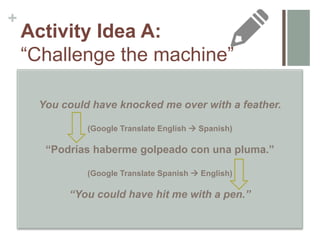
“Challenge the machine”
Think of examples of figurative language that
you could have your students translate from
L1L2 and/or L2L1 that would show them
when and how DTs are inadequate tools.
How can you incorporate these into a
contextualized task?
You could have knocked me over with a feather.
(Google Translate English  Spanish)
“Podrías haberme golpeado con una pluma.”
(Google Translate Spanish  English)
“You could have hit me with a pen.”
+
Activity Idea A:
“Challenge the machine”
Think of examples of figurative language that
you could have your students translate from
L1L2 and/or L2L1 that would show them
when and how DTs are inadequate tools.
How can you incorporate these into a
contextualized task?
+
Activity Idea B:
Dictionary use
See handout
+
Activity Idea C:
Pre- and Post-editing ideas
 Students can use DTs in pre-writing and post-writing
activities to foster better composition skills.
 Discuss some possible ideas for the following:
 PRE-WRITING
 Vocabulary brainstorming?
 Semantic mapping?
 Other?
 POST-WRITING
 Back-translation?
 Other?
+
Brainstorming
Other ideas
 See handout
+
Thank
you.
arossomo
@ku.edu
glord
@ufl.edu
www.slideshare.net/glord/actfl-2016-digital-translators

ACTFL 2016 Digital Translators

  • 1.
    + DIGITAL TRANSLATORS: Part ofthe problem or part of the solution? Session #7163 Gillian Lord glord@ufl.edu Amy Rossomondo arossomo@ku.edu 11/19/2017
  • 2.
    + Session Objectives Consider attitudestoward and examine patterns of use of Digital Translators (DTs) Understand and be able to articulate the strengths and weaknesses of digital translation with respect to FL teaching and learning Discover different techniques for using DTs in language teaching and learning Collaborate to develop contours of activities for use with our language students
  • 3.
    + AUDIENCE INPUT Do youuse DTs for your own purposes? If so, for what? How? Do you prohibit their use in your language classes? Do your students use them (anyway)?
  • 4.
    + Student use Almost 98%of students admit to having used Google Translate at some point  … to check vocabulary, for prewriting, or to understand instructions Of these, 97% of students detect errors of some kind. -Hagele-Strombergsson 2016
  • 5.
    + Student use Most previouswork considers translators negatively, focusing on how to detect and prevent their use:  Need to “minimize inappropriate use” (Fountain & Fountain, 2009)  “Instructors find themselves playing “forensic linguist” in order to gather evidence of cheating” (Correa, 2014)  “Anecdotal classroom evidence points to beginners availing themselves of MT help, even against the advice of teachers”(Garcia & Pena 2011)  “Inexperienced students of foreign languages often equate learning a language with translation” (Alley, 2005)
  • 6.
    + Student use Student andfaculty attitudes  (Jolley & Maimone, 2015) Survey-based study on the use of and attitudes, perceptions, and beliefs about DTs by students and instructors in university Spanish programs
  • 7.
  • 8.
  • 9.
  • 10.
    + Reactions? Take 2 minutesto discuss the results of the Jolley & Maimone study with the people around you:  Do the results reflect your own attitudes and use of DTs as an instructor?  Do the results resonate with your impressions of your students’ attitudes and patterns of usage?  What does this lead you to conclude?
  • 11.
    + Jolley & Maimone’s Primaryrecommendation: That students receive training regarding potential pedagogical applications of digital translators as tools in language teaching and learning.
  • 12.
    + Student use To a2nd year Spanish student, I would encourage them to use online 21st century language resources but I would also advise them to use these resources with caution. These online resources can actually be very effective at improving your Spanish comprehension. First, if you come across a phrase that you do not understand, you should first try to make sense of the context. If that does not help, you could try typing the phrase on Google translate. Be sure to set the translator from Spanish to English in this case. Oftentimes, the translation is not entirely accurate. Whenever I stumble upon a phrase I do not comprehend and type it into the online translator, I type the keywords of the translation into WordReference to ensure that the appropriate words have been incorporated. Let’s say, for example, that I come across the phrase “la historia me perturbaba.” If I did not know a single word in this sentence, I would type this into Google translate…
  • 13.
    + Student use Initially, inthe first sentence, the words distinto and seres were not immediately familiar to me, but using cognates I could assume that distinto means distinct. I could also predict using context that seres has something to do with characters, because Marco is a character, so it follows that his distinctiveness would be compared to that of other characters. Google Translate translated seres as beings, which makes fantastic sense when paired with humanos. I always confuse verbs that start with ll, so in the second sentence I had to use context clues of “(blank) the exaggeration to the extreme” to remember that llevó probably means carried. Knowing now that ser humano means human being, the last sentence is more logical than the first read- through, when I thought it was saying “the to be human”. It is possible that eventually I would have made the connection between to be and being, but Google Translate helped to expedite the mental leap.
  • 14.
    + Student use Upon initiallyreading the phrase, I knew the author was describing Marco using a comparison to the rest of humanity. However, there were words and phrases I did not know, which hindered my understanding. I first copy and pasted the phrase into Google Translate which translated the first sentence correctly, but did not put together the last part correctly. Through context clues and translating a couple of key words, I was able to decipher the meaning of the phrase to be loosely “This story disturbed me because Marco is not so different than other human beings. He exaggerated to an extreme. He is a human incapable of accepting reality and needs fiction to live.” I think Google Translate can definitely be a good starting point when a student is having trouble understanding a reading, but the content should be taken lightly and supported by further confirmation with resources like WordReference or SpanishDict.
  • 15.
    + ACTFL & MLArecommendations ACTFL Partnership for 21st Century Skills (P21) = intersection of disciplinary learning and 21st Century Skills: IN THE PAST TODAY Using technology as a “cool tool’”  Integrating technology into instruction to enhance learning No mention of DTs
  • 16.
    + ACTFL & MLArecommendations MLA (2007) Reflect on language use itself so that students understand:  “Expressions such as "the pursuit of happiness," "liberté, égalité, fraternité," and "la Raza" connote cultural dimensions that extend well beyond their immediate translation.”  Achieve enough proficiency … that allows both linguistic exchanges and metalinguistic exchanges (that is, discussion about the language itself).  Have a solid command as well as an analytic knowledge of specific metaphors and key terms that inform culture.  Differences in meaning, mentality, and worldview as expressed in American English and in the target language. No mention of DTs
  • 17.
    + How accurate areDTs?  In September, Google announced that its Neural Machine Translation (GNMT) system can now “in some cases” produce translations that are “nearly indistinguishable” from those of humans. BUT…  “GNMT can still make significant errors that a human translator would never make, like dropping words and mistranslating proper names or rare terms, and translating sentences in isolation rather than considering the context of the paragraph or page.” Google Research Blog, 9/27/2016
  • 18.
    + ACTIVITY Pick some ofthe following examples of figurative language use in English to explore the limitations of DTs (i.e., Google Translate) in the language you teach: -You are a couch potato. -Time is money. -Busy as a bee. -Clean as a whistle. -He stood out like a sore thumb. -It was as easy as shooting fish in a barrel. -My mouth was as dry as a bone. -It was as funny as a barrel of monkeys. -They fought like cats and dogs. -It was like watching grass grow.
  • 19.
    + Advantages to DTs DISCUSSION(handout) “…this technology will have a profound influence on the teaching of Languages … and with imaginative use, will allow this influence to be positive for both the students and their instructors” -(Groves & Mundt, 2015)
  • 20.
  • 21.
    + Rethinking DT usein class...  What are some realistic outcomes of explicit instruction related to DTs? -heighten students’ awareness of language use -facilitate initial engagement with difficult texts to enhance content learning -uncover the limitations of DTs and provide guidance for their productive use -promote academic integrity and raise metalinguistic awareness Instead of assuming they are part of the problem, make them part of the solution! “Students need to be taught the skills needed to navigate Google Translate” (Hagele-Strombergsson 2016)
  • 22.
    + Activity Idea A: “Challengethe machine” Think of examples of figurative language that you could have your students translate from L1L2 and/or L2L1 that would show them when and how DTs are inadequate tools. How can you incorporate these into a contextualized task? You could have knocked me over with a feather. (Google Translate English  Spanish) “Podrías haberme golpeado con una pluma.” (Google Translate Spanish  English) “You could have hit me with a pen.”
  • 23.
    + Activity Idea A: “Challengethe machine” Think of examples of figurative language that you could have your students translate from L1L2 and/or L2L1 that would show them when and how DTs are inadequate tools. How can you incorporate these into a contextualized task?
  • 24.
  • 25.
    + Activity Idea C: Pre-and Post-editing ideas  Students can use DTs in pre-writing and post-writing activities to foster better composition skills.  Discuss some possible ideas for the following:  PRE-WRITING  Vocabulary brainstorming?  Semantic mapping?  Other?  POST-WRITING  Back-translation?  Other?
  • 26.
  • 27.