Siemens Healthcare Diagnostics Inc.
© 2008 Siemens Healthcare Diagnostics Inc. All rights reserved.
Siemens Healthcare Diagnostics Inc., Tarrytown, NY 10591-5097 USA
10493936_EN Rev. D, 2011-01 1 - English
Instructions for Use
2011-01
Albumin (ALB)
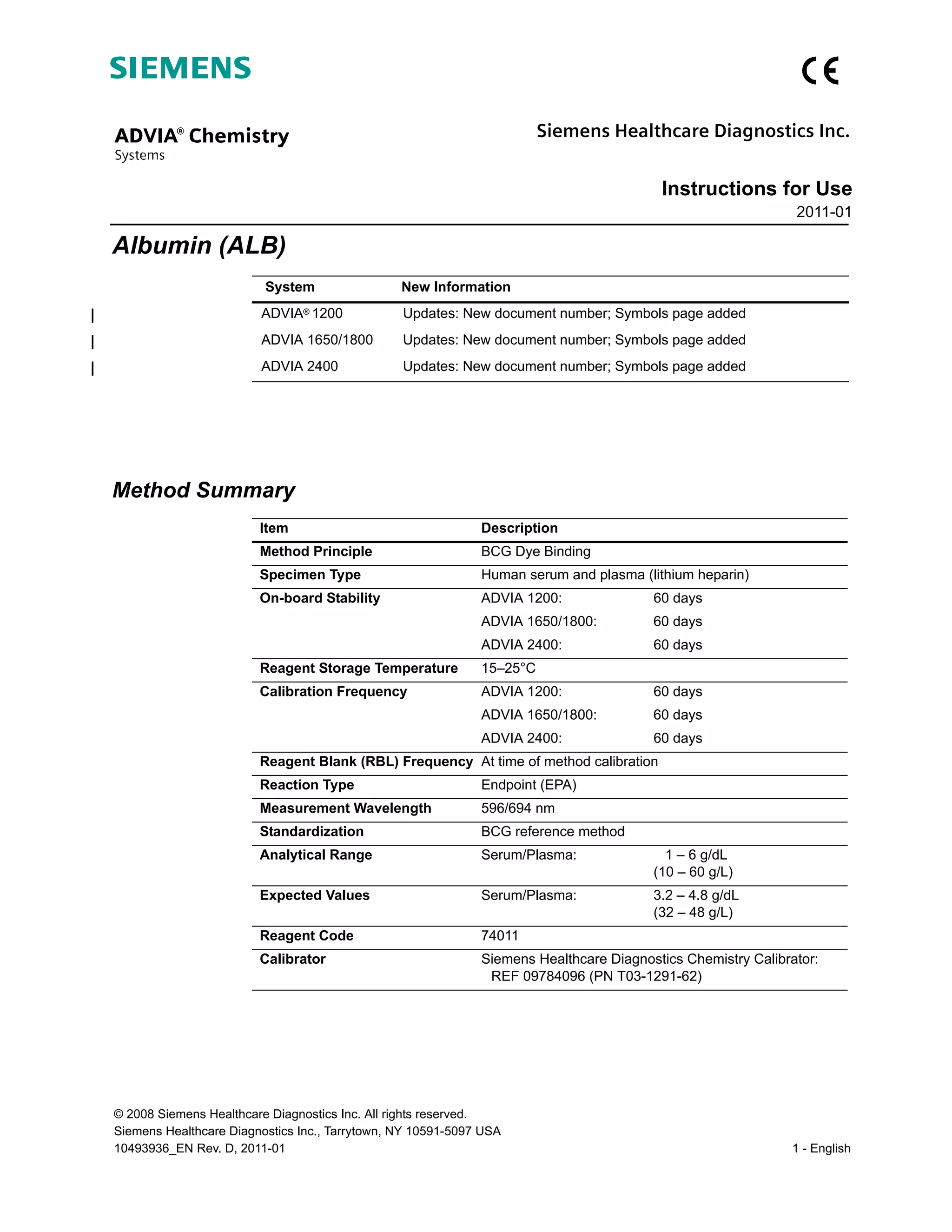
Method Summary
System New Information
ADVIA® 1200 Updates: New document number; Symbols page added
ADVIA 1650/1800 Updates: New document number; Symbols page added
ADVIA 2400 Updates: New document number; Symbols page added
Item Description
Method Principle BCG Dye Binding
Specimen Type Human serum and plasma (lithium heparin)
On-board Stability ADVIA 1200: 60 days
ADVIA 1650/1800: 60 days
ADVIA 2400: 60 days
Reagent Storage Temperature 15–25°C
Calibration Frequency ADVIA 1200: 60 days
ADVIA 1650/1800: 60 days
ADVIA 2400: 60 days
Reagent Blank (RBL) Frequency At time of method calibration
Reaction Type Endpoint (EPA)
Measurement Wavelength 596/694 nm
Standardization BCG reference method
Analytical Range Serum/Plasma: 1 – 6 g/dL
(10 – 60 g/L)
Expected Values Serum/Plasma: 3.2 – 4.8 g/dL
(32 – 48 g/L)
Reagent Code 74011
Calibrator Siemens Healthcare Diagnostics Chemistry Calibrator:
REF 09784096 (PN T03-1291-62)
Albumin (ALB)
2 - English 10493936_EN Rev. D, 2011-01
Intended Use
For in vitro diagnostic use in the quantitative determination of albumin in human serum
and plasma (lithium heparin) on the ADVIA Chemistry systems. Such measurements
are used in the diagnosis and treatment of chronic inflammatory diseases, collagen
diseases, and liver and kidney disorders.
Summary and Explanation 1
The Albumin (ALB) method is based on the method of Doumas, Watson, and Biggs and
uses bromocresol green solution (BCG) as a binding dye.
Principles of the Procedure
Serum or plasma albumin quantitatively binds to BCG to form an albumin-BCG
complex that is measured as an endpoint reaction at 596/694 nm.
Reaction Equation
BCG + Albumin BCG Albumin complex
Reagents
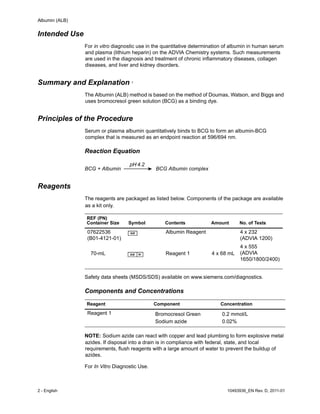
The reagents are packaged as listed below. Components of the package are available
as a kit only.
Safety data sheets (MSDS/SDS) available on www.siemens.com/diagnostics.
Components and Concentrations
NOTE: Sodium azide can react with copper and lead plumbing to form explosive metal
azides. If disposal into a drain is in compliance with federal, state, and local
requirements, flush reagents with a large amount of water to prevent the buildup of
azides.
For In Vitro Diagnostic Use.
REF (PN)
Container Size Symbol Contents Amount No. of Tests
07622536
(B01-4121-01)
Albumin Reagent 4 x 232
(ADVIA 1200)
4 x 555
(ADVIA
1650/1800/2400)
70-mL Reagent 1 4 x 68 mL
Reagent Component Concentration
Reagent 1 Bromocresol Green
Sodium azide
0.2 mmol/L
0.02%
Albumin (ALB)
10493936_EN Rev. D, 2011-01 3 - English
Reagent Preparation and Use
Reagents are ready to use. Before use, gently swirl the reagent to dislodge bubbles
and assure homogeneity.
On-board Reagent Stability (OBS)
For all systems, unopened reagents are stable until the expiration date printed on the
product label when stored at 15° – 25°C. Do not freeze reagents.
For additional details, refer to the Methods Introduction section of the system-specific
Operator’s Guide.
Sample Handling
Siemens recommends using serum or plasma (lithium heparin) for this method. The
use of icteric, hemolyzed, and lipemic samples may cause a significant interference
with this method.
For additional details, refer to Sample Collection and Preparation in the Methods
Introduction section of the system-specific Operator’s Guide.
For instructions on how to load reagents and run samples, refer to the Daily Operations
section of the system-specific Operator’s Guide.
Materials Required but not Provided
The following list contains the materials required, but not provided, to perform this
method:
• sample containers
• system solutions
• calibrator (refer to the Method Summary section for the REFs)
• control materials
For storage and stability information, refer to the package insert.
Calibration
Refer to the package insert supplied with the Siemens Chemistry Calibrator
(REF 09784096; PN T03-1291-62) for handling instructions and values. For setup and
use instructions, refer to the Calibration Overview section of the system-specific
Operator’s Guide.
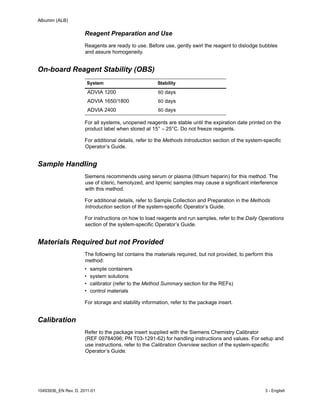
System Stability
ADVIA 1200 60 days
ADVIA 1650/1800 60 days
ADVIA 2400 60 days
Albumin (ALB)
4 - English 10493936_EN Rev. D, 2011-01
Calibration Frequency
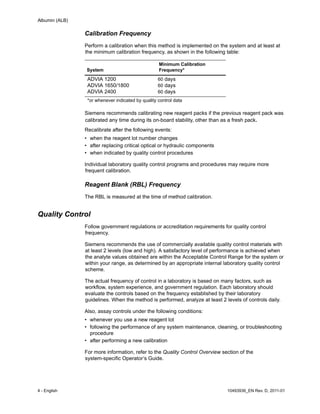
Perform a calibration when this method is implemented on the system and at least at
the minimum calibration frequency, as shown in the following table:
Siemens recommends calibrating new reagent packs if the previous reagent pack was
calibrated any time during its on-board stability, other than as a fresh pack.
Recalibrate after the following events:
• when the reagent lot number changes
• after replacing critical optical or hydraulic components
• when indicated by quality control procedures
Individual laboratory quality control programs and procedures may require more
frequent calibration.
Reagent Blank (RBL) Frequency
The RBL is measured at the time of method calibration.
Quality Control
Follow government regulations or accreditation requirements for quality control
frequency.
Siemens recommends the use of commercially available quality control materials with
at least 2 levels (low and high). A satisfactory level of performance is achieved when
the analyte values obtained are within the Acceptable Control Range for the system or
within your range, as determined by an appropriate internal laboratory quality control
scheme.
The actual frequency of control in a laboratory is based on many factors, such as
workflow, system experience, and government regulation. Each laboratory should
evaluate the controls based on the frequency established by their laboratory
guidelines. When the method is performed, analyze at least 2 levels of controls daily.
Also, assay controls under the following conditions:
• whenever you use a new reagent lot
• following the performance of any system maintenance, cleaning, or troubleshooting
procedure
• after performing a new calibration
For more information, refer to the Quality Control Overview section of the
system-specific Operator’s Guide.
System
Minimum Calibration
Frequency*
ADVIA 1200
ADVIA 1650/1800
ADVIA 2400
60 days
60 days
60 days
*or whenever indicated by quality control data
Albumin (ALB)
10493936_EN Rev. D, 2011-01 5 - English
Limitations of the Procedure 2
A number of substances cause physiological changes in serum or plasma analyte
concentrations. A comprehensive discussion of possible interfering substances, their
serum or plasma concentrations, and their possible physiological involvements is
beyond the scope of this document. Consult listed reference for specific details on
known potential interfering substances.2
As with any chemical reaction, you must be alert to the possible effect on results of
unknown interferences from medications or endogenous substances. The laboratory
and physician must evaluate all patient results in light of the total clinical status of the
patient.
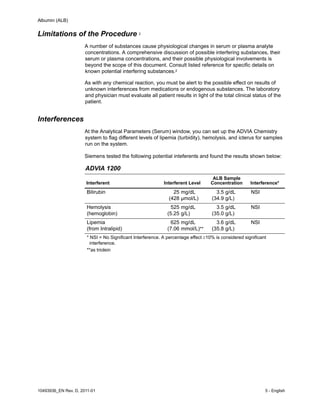
Interferences
At the Analytical Parameters (Serum) window, you can set up the ADVIA Chemistry
system to flag different levels of lipemia (turbidity), hemolysis, and icterus for samples
run on the system.
Siemens tested the following potential inteferents and found the results shown below:
ADVIA 1200
Interferent Interferent Level
ALB Sample
Concentration Interference*
Bilirubin 25
(428
mg/dL
µmol/L)
3.5
(34.9
g/dL
g/L)
NSI
Hemolysis
(hemoglobin)
525
(5.25
mg/dL
g/L)
3.5
(35.0
g/dL
g/L)
NSI
Lipemia
(from Intralipid)
625
(7.06
mg/dL
mmol/L)**
3.6
(35.8
g/dL
g/L)
NSI
* NSI = No Significant Interference. A percentage effect10% is considered significant
interference.
**as triolein
Albumin (ALB)
6 - English 10493936_EN Rev. D, 2011-01
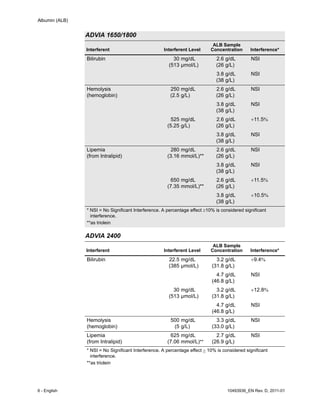
ADVIA 1650/1800
Interferent Interferent Level
ALB Sample
Concentration Interference*
Bilirubin 30
(513
mg/dL
µmol/L)
2.6
(26
g/dL
g/L)
NSI
3.8
(38
g/dL
g/L)
NSI
Hemolysis
(hemoglobin)
250
(2.5
mg/dL
g/L)
2.6
(26
g/dL
g/L)
NSI
3.8
(38
g/dL
g/L)
NSI
525
(5.25
mg/dL
g/L)
2.6
(26
g/dL
g/L)
11.5
3.8
(38
g/dL
g/L)
NSI
Lipemia
(from Intralipid)
280
(3.16
mg/dL
mmol/L)**
2.6
(26
g/dL
g/L)
NSI
3.8
(38
g/dL
g/L)
NSI
650
(7.35
mg/dL
mmol/L)**
2.6
(26
g/dL
g/L)
11.5
3.8
(38
g/dL
g/L)
10.5
* NSI = No Significant Interference. A percentage effect10% is considered significant
interference.
**as triolein
ADVIA 2400
Interferent Interferent Level
ALB Sample
Concentration Interference*
Bilirubin 22.5
(385
mg/dL
µmol/L)
3.2
(31.8
g/dL
g/L)
9.4
4.7
(46.8
g/dL
g/L)
NSI
30
(513
mg/dL
µmol/L)
3.2
(31.8
g/dL
g/L)
12.8
4.7
(46.8
g/dL
g/L)
NSI
Hemolysis
(hemoglobin)
500
(5
mg/dL
g/L)
3.3
(33.0
g/dL
g/L)
NSI
Lipemia
(from Intralipid)
625
(7.06
mg/dL
mmol/L)**
2.7
(26.9
g/dL
g/L)
NSI
* NSI = No Significant Interference. A percentage effect  10% is considered significant
interference.
**as triolein
Albumin (ALB)
10493936_EN Rev. D, 2011-01 7 - English
Performance Characteristics
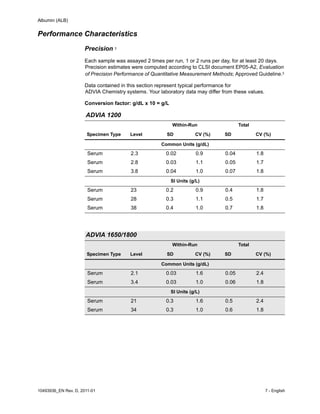
Precision 3
Each sample was assayed 2 times per run, 1 or 2 runs per day, for at least 20 days.
Precision estimates were computed according to CLSI document EP05-A2, Evaluation
of Precision Performance of Quantitative Measurement Methods; Approved Guideline.3
Data contained in this section represent typical performance for
ADVIA Chemistry systems. Your laboratory data may differ from these values.
Conversion factor: g/dL x 10 = g/L
ADVIA 1200
Within-Run Total
Specimen Type Level SD CV (%) SD CV (%)
Common Units (g/dL)
Serum 2.3 0.02 0.9 0.04 1.8
Serum 2.8 0.03 1.1 0.05 1.7
Serum 3.8 0.04 1.0 0.07 1.8
SI Units (g/L)
Serum 23 0.2 0.9 0.4 1.8
Serum 28 0.3 1.1 0.5 1.7
Serum 38 0.4 1.0 0.7 1.8
ADVIA 1650/1800
Within-Run Total
Specimen Type Level SD CV (%) SD CV (%)
Common Units (g/dL)
Serum 2.1 0.03 1.6 0.05 2.4
Serum 3.4 0.03 1.0 0.06 1.8
SI Units (g/L)
Serum 21 0.3 1.6 0.5 2.4
Serum 34 0.3 1.0 0.6 1.8
Albumin (ALB)
8 - English 10493936_EN Rev. D, 2011-01
Analytical Range
This method is linear from 1 – 6 g/dL (10 – 60 g/L) for serum and plasma.
Siemens has validated an automatic rerun condition for this method that extends the
reportable range up to 12 g/dL (120 g/L) for serum and plasma.
Expected Values 4
The expected values for this method are 3.2 – 4.8 g/dL (32 – 48 g/L).
Siemens provides this information for reference. Each laboratory should establish its
own normal range. You can enter normal range values and abnormal range values at
the Analytical Parameters (Chemistry) window.
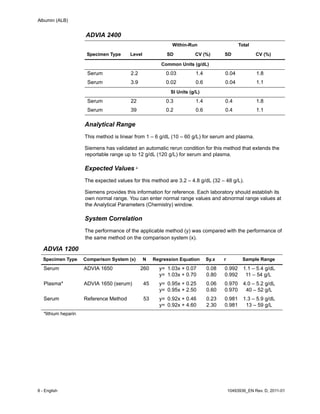
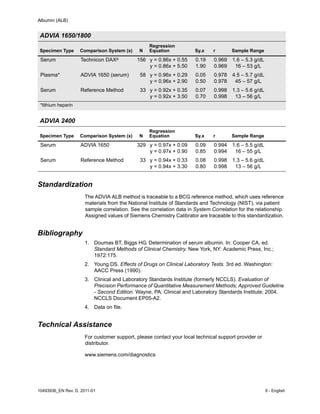
System Correlation
The performance of the applicable method (y) was compared with the performance of
the same method on the comparison system (x).
ADVIA 2400
Within-Run Total
Specimen Type Level SD CV (%) SD CV (%)
Common Units (g/dL)
Serum 2.2 0.03 1.4 0.04 1.8
Serum 3.9 0.02 0.6 0.04 1.1
SI Units (g/L)
Serum 22 0.3 1.4 0.4 1.8
Serum 39 0.2 0.6 0.4 1.1
ADVIA 1200
Specimen Type Comparison System (x) N Regression Equation Sy.x r Sample Range
Serum ADVIA 1650 260 y=
y=
1.03x + 0.07
1.03x + 0.70
0.08
0.80
0.992
0.992
1.1 – 5.4 g/dL
11 – 54 g/L
Plasma* ADVIA 1650 (serum) 45 y=
y=
0.95x + 0.25
0.95x + 2.50
0.06
0.60
0.970
0.970
4.0 – 5.2 g/dL
40 – 52 g/L
Serum Reference Method 53 y=
y=
0.92x + 0.46
0.92x + 4.60
0.23
2.30
0.981
0.981
1.3 – 5.9 g/dL
13 – 59 g/L
*lithium heparin
Albumin (ALB)
10493936_EN Rev. D, 2011-01 9 - English
Standardization
The ADVIA ALB method is traceable to a BCG reference method, which uses reference
materials from the National Institute of Standards and Technology (NIST), via patient
sample correlation. See the correlation data in System Correlation for the relationship.
Assigned values of Siemens Chemistry Calibrator are traceable to this standardization.
Bibliography
1. Doumas BT, Biggs HG. Determination of serum albumin. In: Cooper CA, ed.
Standard Methods of Clinical Chemistry. New York, NY: Academic Press, Inc.;
1972:175.
2. Young DS. Effects of Drugs on Clinical Laboratory Tests. 3rd ed. Washington:
AACC Press (1990).
3. Clinical and Laboratory Standards Institute (formerly NCCLS). Evaluation of
Precision Performance of Quantitative Measurement Methods; Approved Guideline
- Second Edition. Wayne, PA: Clinical and Laboratory Standards Institute; 2004.
NCCLS Document EP05-A2.
4. Data on file.
Technical Assistance
For customer support, please contact your local technical support provider or
distributor.
www.siemens.com/diagnostics
ADVIA 1650/1800
Specimen Type Comparison System (x) N
Regression
Equation Sy.x r Sample Range
Serum Technicon DAX® 156 y = 0.86x + 0.55
y = 0.86x + 5.50
0.19
1.90
0.969
0.969
1.6 – 5.3 g/dL
16 – 53 g/L
Plasma* ADVIA 1650 (serum) 58 y = 0.96x + 0.29
y = 0.96x + 2.90
0.05
0.50
0.978
0.978
4.5 – 5.7 g/dL
45 – 57 g/L
Serum Reference Method 33 y = 0.92x + 0.35
y = 0.92x + 3.50
0.07
0.70
0.998
0.998
1.3 – 5.6 g/dL
13 – 56 g/L
*lithium heparin
ADVIA 2400
Specimen Type Comparison System (x) N
Regression
Equation Sy.x r Sample Range
Serum ADVIA 1650 329 y = 0.97x + 0.09
y = 0.97x + 0.90
0.09
0.85
0.994
0.994
1.6 – 5.5 g/dL
16 – 55 g/L
Serum Reference Method 33 y = 0.94x + 0.33
y = 0.94x + 3.30
0.08
0.80
0.998
0.998
1.3 – 5.6 g/dL
13 – 56 g/L
Albumin (ALB)
10 - English 10493936_EN Rev. D, 2011-01
Trademarks
Technicon DAX and ADVIA are trademarks of Siemens Healthcare Diagnostics.
Intralipid is a trademark of KabiVitrium, Inc.
Albumin (ALB)
10493936_EN Rev. D, 2011-01 11 - English
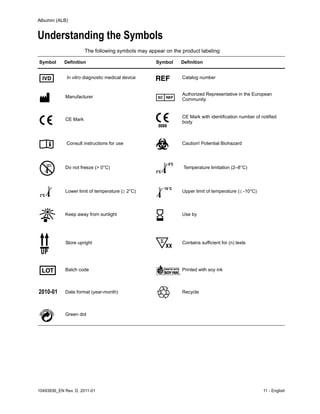
Understanding the Symbols
The following symbols may appear on the product labeling:
Symbol Definition Symbol Definition
In vitro diagnostic medical device Catalog number
Manufacturer
Authorized Representative in the European
Community
CE Mark
CE Mark with identification number of notified
body
Consult instructions for use Caution! Potential Biohazard
Do not freeze (> 0°C) Temperature limitation (2–8°C)
Lower limit of temperature ( 2°C) Upper limit of temperature (-10°C)
Keep away from sunlight Use by
Store upright Contains sufficient for (n) tests
Batch code Printed with soy ink
2010-01 Date format (year-month) Recycle
Green dot

Reactivo de albumina

  • 1.
    Siemens Healthcare DiagnosticsInc. © 2008 Siemens Healthcare Diagnostics Inc. All rights reserved. Siemens Healthcare Diagnostics Inc., Tarrytown, NY 10591-5097 USA 10493936_EN Rev. D, 2011-01 1 - English Instructions for Use 2011-01 Albumin (ALB) Method Summary System New Information ADVIA® 1200 Updates: New document number; Symbols page added ADVIA 1650/1800 Updates: New document number; Symbols page added ADVIA 2400 Updates: New document number; Symbols page added Item Description Method Principle BCG Dye Binding Specimen Type Human serum and plasma (lithium heparin) On-board Stability ADVIA 1200: 60 days ADVIA 1650/1800: 60 days ADVIA 2400: 60 days Reagent Storage Temperature 15–25°C Calibration Frequency ADVIA 1200: 60 days ADVIA 1650/1800: 60 days ADVIA 2400: 60 days Reagent Blank (RBL) Frequency At time of method calibration Reaction Type Endpoint (EPA) Measurement Wavelength 596/694 nm Standardization BCG reference method Analytical Range Serum/Plasma: 1 – 6 g/dL (10 – 60 g/L) Expected Values Serum/Plasma: 3.2 – 4.8 g/dL (32 – 48 g/L) Reagent Code 74011 Calibrator Siemens Healthcare Diagnostics Chemistry Calibrator: REF 09784096 (PN T03-1291-62)
  • 2.
    Albumin (ALB) 2 -English 10493936_EN Rev. D, 2011-01 Intended Use For in vitro diagnostic use in the quantitative determination of albumin in human serum and plasma (lithium heparin) on the ADVIA Chemistry systems. Such measurements are used in the diagnosis and treatment of chronic inflammatory diseases, collagen diseases, and liver and kidney disorders. Summary and Explanation 1 The Albumin (ALB) method is based on the method of Doumas, Watson, and Biggs and uses bromocresol green solution (BCG) as a binding dye. Principles of the Procedure Serum or plasma albumin quantitatively binds to BCG to form an albumin-BCG complex that is measured as an endpoint reaction at 596/694 nm. Reaction Equation BCG + Albumin BCG Albumin complex Reagents The reagents are packaged as listed below. Components of the package are available as a kit only. Safety data sheets (MSDS/SDS) available on www.siemens.com/diagnostics. Components and Concentrations NOTE: Sodium azide can react with copper and lead plumbing to form explosive metal azides. If disposal into a drain is in compliance with federal, state, and local requirements, flush reagents with a large amount of water to prevent the buildup of azides. For In Vitro Diagnostic Use. REF (PN) Container Size Symbol Contents Amount No. of Tests 07622536 (B01-4121-01) Albumin Reagent 4 x 232 (ADVIA 1200) 4 x 555 (ADVIA 1650/1800/2400) 70-mL Reagent 1 4 x 68 mL Reagent Component Concentration Reagent 1 Bromocresol Green Sodium azide 0.2 mmol/L 0.02%
  • 3.
    Albumin (ALB) 10493936_EN Rev.D, 2011-01 3 - English Reagent Preparation and Use Reagents are ready to use. Before use, gently swirl the reagent to dislodge bubbles and assure homogeneity. On-board Reagent Stability (OBS) For all systems, unopened reagents are stable until the expiration date printed on the product label when stored at 15° – 25°C. Do not freeze reagents. For additional details, refer to the Methods Introduction section of the system-specific Operator’s Guide. Sample Handling Siemens recommends using serum or plasma (lithium heparin) for this method. The use of icteric, hemolyzed, and lipemic samples may cause a significant interference with this method. For additional details, refer to Sample Collection and Preparation in the Methods Introduction section of the system-specific Operator’s Guide. For instructions on how to load reagents and run samples, refer to the Daily Operations section of the system-specific Operator’s Guide. Materials Required but not Provided The following list contains the materials required, but not provided, to perform this method: • sample containers • system solutions • calibrator (refer to the Method Summary section for the REFs) • control materials For storage and stability information, refer to the package insert. Calibration Refer to the package insert supplied with the Siemens Chemistry Calibrator (REF 09784096; PN T03-1291-62) for handling instructions and values. For setup and use instructions, refer to the Calibration Overview section of the system-specific Operator’s Guide. System Stability ADVIA 1200 60 days ADVIA 1650/1800 60 days ADVIA 2400 60 days
  • 4.
    Albumin (ALB) 4 -English 10493936_EN Rev. D, 2011-01 Calibration Frequency Perform a calibration when this method is implemented on the system and at least at the minimum calibration frequency, as shown in the following table: Siemens recommends calibrating new reagent packs if the previous reagent pack was calibrated any time during its on-board stability, other than as a fresh pack. Recalibrate after the following events: • when the reagent lot number changes • after replacing critical optical or hydraulic components • when indicated by quality control procedures Individual laboratory quality control programs and procedures may require more frequent calibration. Reagent Blank (RBL) Frequency The RBL is measured at the time of method calibration. Quality Control Follow government regulations or accreditation requirements for quality control frequency. Siemens recommends the use of commercially available quality control materials with at least 2 levels (low and high). A satisfactory level of performance is achieved when the analyte values obtained are within the Acceptable Control Range for the system or within your range, as determined by an appropriate internal laboratory quality control scheme. The actual frequency of control in a laboratory is based on many factors, such as workflow, system experience, and government regulation. Each laboratory should evaluate the controls based on the frequency established by their laboratory guidelines. When the method is performed, analyze at least 2 levels of controls daily. Also, assay controls under the following conditions: • whenever you use a new reagent lot • following the performance of any system maintenance, cleaning, or troubleshooting procedure • after performing a new calibration For more information, refer to the Quality Control Overview section of the system-specific Operator’s Guide. System Minimum Calibration Frequency* ADVIA 1200 ADVIA 1650/1800 ADVIA 2400 60 days 60 days 60 days *or whenever indicated by quality control data
  • 5.
    Albumin (ALB) 10493936_EN Rev.D, 2011-01 5 - English Limitations of the Procedure 2 A number of substances cause physiological changes in serum or plasma analyte concentrations. A comprehensive discussion of possible interfering substances, their serum or plasma concentrations, and their possible physiological involvements is beyond the scope of this document. Consult listed reference for specific details on known potential interfering substances.2 As with any chemical reaction, you must be alert to the possible effect on results of unknown interferences from medications or endogenous substances. The laboratory and physician must evaluate all patient results in light of the total clinical status of the patient. Interferences At the Analytical Parameters (Serum) window, you can set up the ADVIA Chemistry system to flag different levels of lipemia (turbidity), hemolysis, and icterus for samples run on the system. Siemens tested the following potential inteferents and found the results shown below: ADVIA 1200 Interferent Interferent Level ALB Sample Concentration Interference* Bilirubin 25 (428 mg/dL µmol/L) 3.5 (34.9 g/dL g/L) NSI Hemolysis (hemoglobin) 525 (5.25 mg/dL g/L) 3.5 (35.0 g/dL g/L) NSI Lipemia (from Intralipid) 625 (7.06 mg/dL mmol/L)** 3.6 (35.8 g/dL g/L) NSI * NSI = No Significant Interference. A percentage effect10% is considered significant interference. **as triolein
  • 6.
    Albumin (ALB) 6 -English 10493936_EN Rev. D, 2011-01 ADVIA 1650/1800 Interferent Interferent Level ALB Sample Concentration Interference* Bilirubin 30 (513 mg/dL µmol/L) 2.6 (26 g/dL g/L) NSI 3.8 (38 g/dL g/L) NSI Hemolysis (hemoglobin) 250 (2.5 mg/dL g/L) 2.6 (26 g/dL g/L) NSI 3.8 (38 g/dL g/L) NSI 525 (5.25 mg/dL g/L) 2.6 (26 g/dL g/L) 11.5 3.8 (38 g/dL g/L) NSI Lipemia (from Intralipid) 280 (3.16 mg/dL mmol/L)** 2.6 (26 g/dL g/L) NSI 3.8 (38 g/dL g/L) NSI 650 (7.35 mg/dL mmol/L)** 2.6 (26 g/dL g/L) 11.5 3.8 (38 g/dL g/L) 10.5 * NSI = No Significant Interference. A percentage effect10% is considered significant interference. **as triolein ADVIA 2400 Interferent Interferent Level ALB Sample Concentration Interference* Bilirubin 22.5 (385 mg/dL µmol/L) 3.2 (31.8 g/dL g/L) 9.4 4.7 (46.8 g/dL g/L) NSI 30 (513 mg/dL µmol/L) 3.2 (31.8 g/dL g/L) 12.8 4.7 (46.8 g/dL g/L) NSI Hemolysis (hemoglobin) 500 (5 mg/dL g/L) 3.3 (33.0 g/dL g/L) NSI Lipemia (from Intralipid) 625 (7.06 mg/dL mmol/L)** 2.7 (26.9 g/dL g/L) NSI * NSI = No Significant Interference. A percentage effect  10% is considered significant interference. **as triolein
  • 7.
    Albumin (ALB) 10493936_EN Rev.D, 2011-01 7 - English Performance Characteristics Precision 3 Each sample was assayed 2 times per run, 1 or 2 runs per day, for at least 20 days. Precision estimates were computed according to CLSI document EP05-A2, Evaluation of Precision Performance of Quantitative Measurement Methods; Approved Guideline.3 Data contained in this section represent typical performance for ADVIA Chemistry systems. Your laboratory data may differ from these values. Conversion factor: g/dL x 10 = g/L ADVIA 1200 Within-Run Total Specimen Type Level SD CV (%) SD CV (%) Common Units (g/dL) Serum 2.3 0.02 0.9 0.04 1.8 Serum 2.8 0.03 1.1 0.05 1.7 Serum 3.8 0.04 1.0 0.07 1.8 SI Units (g/L) Serum 23 0.2 0.9 0.4 1.8 Serum 28 0.3 1.1 0.5 1.7 Serum 38 0.4 1.0 0.7 1.8 ADVIA 1650/1800 Within-Run Total Specimen Type Level SD CV (%) SD CV (%) Common Units (g/dL) Serum 2.1 0.03 1.6 0.05 2.4 Serum 3.4 0.03 1.0 0.06 1.8 SI Units (g/L) Serum 21 0.3 1.6 0.5 2.4 Serum 34 0.3 1.0 0.6 1.8
  • 8.
    Albumin (ALB) 8 -English 10493936_EN Rev. D, 2011-01 Analytical Range This method is linear from 1 – 6 g/dL (10 – 60 g/L) for serum and plasma. Siemens has validated an automatic rerun condition for this method that extends the reportable range up to 12 g/dL (120 g/L) for serum and plasma. Expected Values 4 The expected values for this method are 3.2 – 4.8 g/dL (32 – 48 g/L). Siemens provides this information for reference. Each laboratory should establish its own normal range. You can enter normal range values and abnormal range values at the Analytical Parameters (Chemistry) window. System Correlation The performance of the applicable method (y) was compared with the performance of the same method on the comparison system (x). ADVIA 2400 Within-Run Total Specimen Type Level SD CV (%) SD CV (%) Common Units (g/dL) Serum 2.2 0.03 1.4 0.04 1.8 Serum 3.9 0.02 0.6 0.04 1.1 SI Units (g/L) Serum 22 0.3 1.4 0.4 1.8 Serum 39 0.2 0.6 0.4 1.1 ADVIA 1200 Specimen Type Comparison System (x) N Regression Equation Sy.x r Sample Range Serum ADVIA 1650 260 y= y= 1.03x + 0.07 1.03x + 0.70 0.08 0.80 0.992 0.992 1.1 – 5.4 g/dL 11 – 54 g/L Plasma* ADVIA 1650 (serum) 45 y= y= 0.95x + 0.25 0.95x + 2.50 0.06 0.60 0.970 0.970 4.0 – 5.2 g/dL 40 – 52 g/L Serum Reference Method 53 y= y= 0.92x + 0.46 0.92x + 4.60 0.23 2.30 0.981 0.981 1.3 – 5.9 g/dL 13 – 59 g/L *lithium heparin
  • 9.
    Albumin (ALB) 10493936_EN Rev.D, 2011-01 9 - English Standardization The ADVIA ALB method is traceable to a BCG reference method, which uses reference materials from the National Institute of Standards and Technology (NIST), via patient sample correlation. See the correlation data in System Correlation for the relationship. Assigned values of Siemens Chemistry Calibrator are traceable to this standardization. Bibliography 1. Doumas BT, Biggs HG. Determination of serum albumin. In: Cooper CA, ed. Standard Methods of Clinical Chemistry. New York, NY: Academic Press, Inc.; 1972:175. 2. Young DS. Effects of Drugs on Clinical Laboratory Tests. 3rd ed. Washington: AACC Press (1990). 3. Clinical and Laboratory Standards Institute (formerly NCCLS). Evaluation of Precision Performance of Quantitative Measurement Methods; Approved Guideline - Second Edition. Wayne, PA: Clinical and Laboratory Standards Institute; 2004. NCCLS Document EP05-A2. 4. Data on file. Technical Assistance For customer support, please contact your local technical support provider or distributor. www.siemens.com/diagnostics ADVIA 1650/1800 Specimen Type Comparison System (x) N Regression Equation Sy.x r Sample Range Serum Technicon DAX® 156 y = 0.86x + 0.55 y = 0.86x + 5.50 0.19 1.90 0.969 0.969 1.6 – 5.3 g/dL 16 – 53 g/L Plasma* ADVIA 1650 (serum) 58 y = 0.96x + 0.29 y = 0.96x + 2.90 0.05 0.50 0.978 0.978 4.5 – 5.7 g/dL 45 – 57 g/L Serum Reference Method 33 y = 0.92x + 0.35 y = 0.92x + 3.50 0.07 0.70 0.998 0.998 1.3 – 5.6 g/dL 13 – 56 g/L *lithium heparin ADVIA 2400 Specimen Type Comparison System (x) N Regression Equation Sy.x r Sample Range Serum ADVIA 1650 329 y = 0.97x + 0.09 y = 0.97x + 0.90 0.09 0.85 0.994 0.994 1.6 – 5.5 g/dL 16 – 55 g/L Serum Reference Method 33 y = 0.94x + 0.33 y = 0.94x + 3.30 0.08 0.80 0.998 0.998 1.3 – 5.6 g/dL 13 – 56 g/L
  • 10.
    Albumin (ALB) 10 -English 10493936_EN Rev. D, 2011-01 Trademarks Technicon DAX and ADVIA are trademarks of Siemens Healthcare Diagnostics. Intralipid is a trademark of KabiVitrium, Inc.
  • 11.
    Albumin (ALB) 10493936_EN Rev.D, 2011-01 11 - English Understanding the Symbols The following symbols may appear on the product labeling: Symbol Definition Symbol Definition In vitro diagnostic medical device Catalog number Manufacturer Authorized Representative in the European Community CE Mark CE Mark with identification number of notified body Consult instructions for use Caution! Potential Biohazard Do not freeze (> 0°C) Temperature limitation (2–8°C) Lower limit of temperature ( 2°C) Upper limit of temperature (-10°C) Keep away from sunlight Use by Store upright Contains sufficient for (n) tests Batch code Printed with soy ink 2010-01 Date format (year-month) Recycle Green dot