Reactive MicroServices
Leveraging Reactive principles
in a technology agnostic way
Lorenzo Nicora
Senior Consultant @ OpenCredo
@nicusX
https://opencredo.com/author/lorenzo
“Reactive” is…
Reactive
Semantically overloaded term
adj. “Readily responsive to stimulus” [Merrian-Webster dictionary]
From Latin “reagere”: act in return
Lorenzo Nicora Reactive μServices
Reactive as…
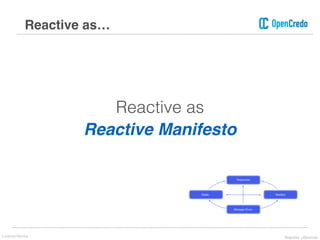
Reactive as
Reactive Manifesto
Lorenzo Nicora Reactive μServices
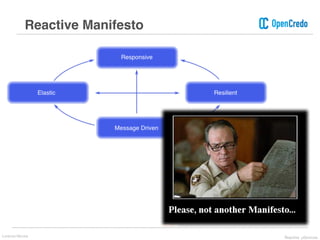
Reactive Manifesto
Lorenzo Nicora Reactive μServices
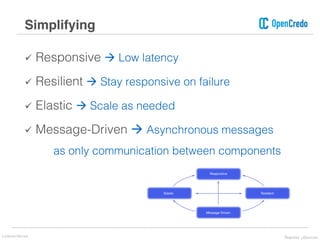
ü Responsive à Low latency
ü Resilient à Stay responsive on failure
ü Elastic à Scale as needed
ü Message-Driven à Asynchronous messages
as only communication between components
Simplifying
Lorenzo Nicora Reactive μServices
✗ No Blocking operation
✗ No Synchronization à No Contention
✗ No Resource hogging
Reactive Manifesto promotes
Decoupling and isolation in…
üTime à Concurrent processing
üSpace à Components location decoupling
Lorenzo Nicora Reactive μServices
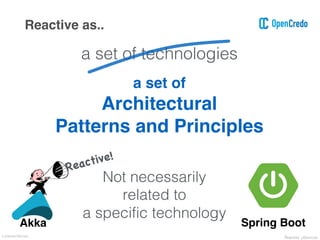
Reactive as..
Akka Spring Boot
a set of
Architectural
Patterns and Principles
Not necessarily
related to
a specific technology
a set of technologies
Lorenzo Nicora Reactive μServices
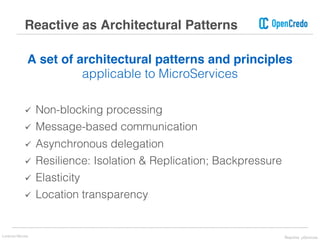
A set of architectural patterns and principles
applicable to MicroServices
ü Non-blocking processing
ü Message-based communication
ü Asynchronous delegation
ü Resilience: Isolation & Replication; Backpressure
ü Elasticity
ü Location transparency
Reactive as Architectural Patterns
Lorenzo Nicora Reactive μServices
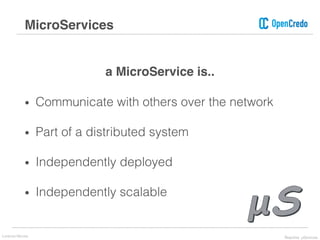
a MicroService is..
• Communicate with others over the network
• Part of a distributed system
• Independently deployed
• Independently scalable
MicroServices
Lorenzo Nicora Reactive μServices
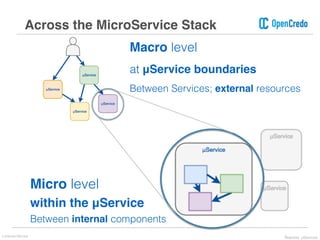
Macro level
at μService boundaries
Between Services; external resources
Across the MicroService Stack
Micro level
within the μService
Between internal components
Lorenzo Nicora Reactive μServices
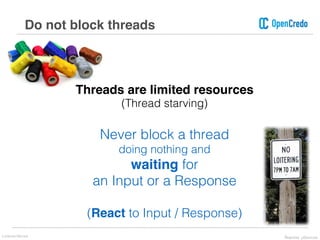
Do not block threads
Never block a thread
doing nothing and
waiting for
an Input or a Response
Threads are limited resources
(Thread starving)
(React to Input / Response)
Lorenzo Nicora Reactive μServices
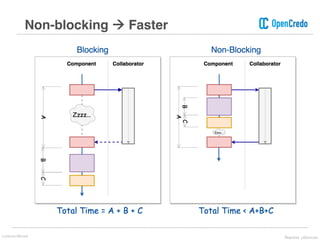
Non-blocking à Faster
Lorenzo Nicora Reactive μServices
Non-blocking Communication
Macro (at service boundaries)
✗ Limit Request/Response pattern
üOne-way messaging (fire and forget)
üPrefer messaging protocols rather than HTTP
Non-blocking
Lorenzo Nicora Reactive μServices
Non-blocking Communication and IO
Micro (within the Service)
✗ Limit blocking/direct method calls
üFutures, Promises, Callbacks
üInternal messaging (e.g. Actor model)
üNon-blocking IO and drivers
Non-blocking
Lorenzo Nicora Reactive μServices
Non-blocking + Blocking = Blocking
✗ Many resources only provide blocking API
• Prefer technologies with non-blocking API
✗ Do not block on a Future…
• To extract the result
• To handle exceptions
❗ Know where your thread come from
• Thread pools
Non-blocking pitfalls
Lorenzo Nicora Reactive μServices
Delegation
* External components
Delegate a task asynchronously
to other components*
Macro (at Service boundaries)
o Delegate tasks to other μServices
o Send Request as a Message
o When required, Response come back as a Message
Lorenzo Nicora Reactive μServices
Delegation
* Internal component
Delegate a task asynchronously
to other components*
Micro (within the Service)
o Execute sub-tasks in separate threads
• Futures/Promises, Callbacks…
o Run multiple tasks in parallel
Lorenzo Nicora Reactive μServices
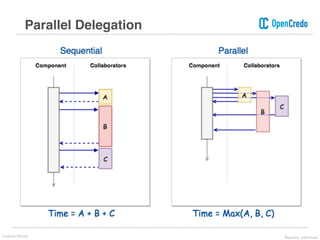
Parallel Delegation
Lorenzo Nicora Reactive μServices
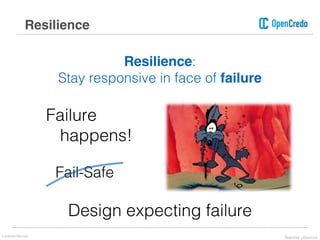
Resilience:
Stay responsive in face of failure
Resilience
Design expecting failure
Failure
happens!
Fail-Safe
Lorenzo Nicora Reactive μServices
• Failure (e.g. connection failure, timeout…)
• Unexpected event
• Not recoverable
• No meaningful response to your client
• Error (e.g. user input error)
• Expected condition
• A specific response to the client (your protocol)
Failure ≠ Error
Lorenzo Nicora Reactive μServices
Resilience: Isolation + Replication
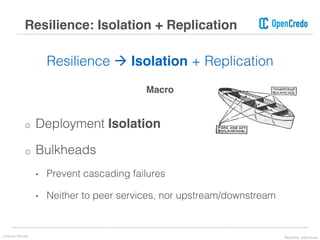
Resilience à Isolation + Replication
Macro
o Deployment Isolation
o Bulkheads
• Prevent cascading failures
• Neither to peer services, nor upstream/downstream
Lorenzo Nicora Reactive μServices
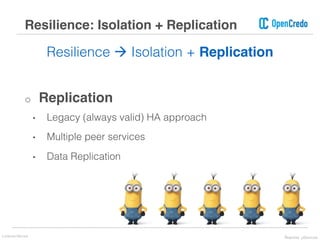
Resilience à Isolation + Replication
o Replication
• Legacy (always valid) HA approach
• Multiple peer services
• Data Replication
Resilience: Isolation + Replication
Lorenzo Nicora Reactive μServices
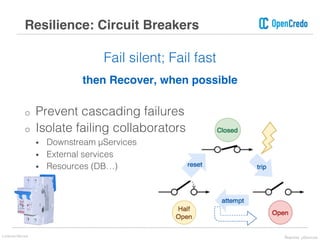
Fail silent; Fail fast
then Recover, when possible
o Prevent cascading failures
o Isolate failing collaborators
• Downstream μServices
• External services
• Resources (DB…)
Resilience: Circuit Breakers
Lorenzo Nicora Reactive μServices
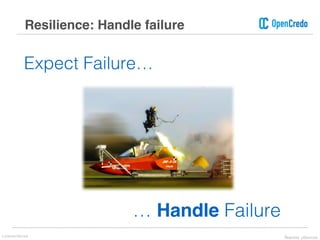
Expect Failure…
Resilience: Handle failure
… Handle Failure
Lorenzo Nicora Reactive μServices
Handle
Errors and Failures
separately
Consistently report Errors to your client
Error is part of your “protocol” (business logic)
Gracefully degrade on Failure
Avoid ”All or nothing” logic
à Partial Responses
Handling Failure
Lorenzo Nicora Reactive μServices
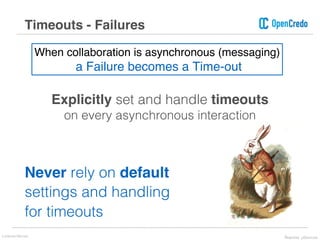
Explicitly set and handle timeouts
on every asynchronous interaction
Never rely on default
settings and handling
for timeouts
Timeouts - Failures
When collaboration is asynchronous (messaging)
a Failure becomes a Time-out
Lorenzo Nicora Reactive μServices
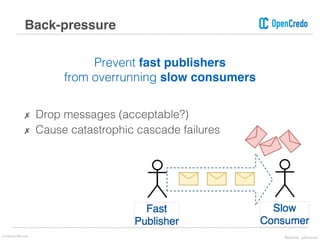
Prevent fast publishers
from overrunning slow consumers
✗ Drop messages (acceptable?)
✗ Cause catastrophic cascade failures
Back-pressure
Lorenzo Nicora Reactive μServices
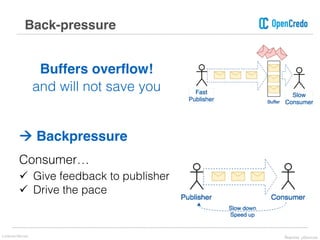
Buffers overflow!
and will not save you
Back-pressure
à Backpressure
Consumer…
ü Give feedback to publisher
ü Drive the pace
Lorenzo Nicora Reactive μServices
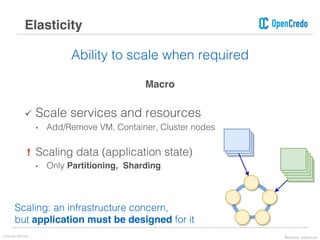
Ability to scale when required
Macro
ü Scale services and resources
• Add/Remove VM, Container, Cluster nodes
❗ Scaling data (application state)
• Only Partitioning, Sharding
Elasticity
Scaling: an infrastructure concern,
but application must be designed for it
Lorenzo Nicora Reactive μServices
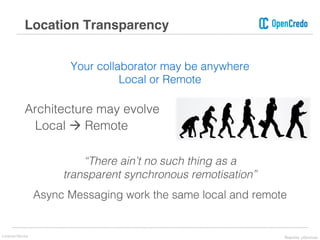
Your collaborator may be anywhere
Local or Remote
Architecture may evolve
Local à Remote
“There ain’t no such thing as a
transparent synchronous remotisation”
Async Messaging work the same local and remote
Location Transparency
Lorenzo Nicora Reactive μServices
You need to find your collaborator
o Service Discovery
• Dynamic service registration
• Heartbeat, Gossip, Health Check (is a service dead?)
• DNS
o Load Balancers
Location Transparency
Lorenzo Nicora Reactive μServices
Conclusions
Lorenzo Nicora Reactive μServices
ü Reactive as a set of
Architectural Patterns and Principles
Ø low latency/high throughput
Ø scale linearly
Ø resiliency
Ø …
ü When not using a ”Reactive” technology
apply discipline,
but still enforce Reactive Principles
ü Keep in mind when designing both…
Macro: μService architecture
Micro: internal software design
Conclusions
Lorenzo Nicora Reactive μServices
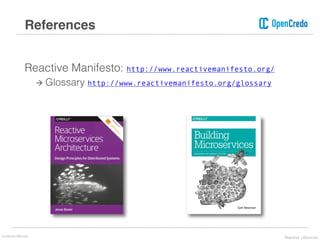
Reactive Manifesto: http://www.reactivemanifesto.org/
à Glossary http://www.reactivemanifesto.org/glossary
References
Lorenzo Nicora Reactive μServices
Q&A
Thanks.
Lorenzo Nicora Reactive μServices

Reactive Microservices By Lorenzo Nicora

  • 1.
    Reactive MicroServices Leveraging Reactiveprinciples in a technology agnostic way Lorenzo Nicora Senior Consultant @ OpenCredo @nicusX https://opencredo.com/author/lorenzo
  • 2.
    “Reactive” is… Reactive Semantically overloadedterm adj. “Readily responsive to stimulus” [Merrian-Webster dictionary] From Latin “reagere”: act in return Lorenzo Nicora Reactive μServices
  • 3.
    Reactive as… Reactive as ReactiveManifesto Lorenzo Nicora Reactive μServices
  • 4.
  • 5.
    ü Responsive àLow latency ü Resilient à Stay responsive on failure ü Elastic à Scale as needed ü Message-Driven à Asynchronous messages as only communication between components Simplifying Lorenzo Nicora Reactive μServices
  • 6.
    ✗ No Blockingoperation ✗ No Synchronization à No Contention ✗ No Resource hogging Reactive Manifesto promotes Decoupling and isolation in… üTime à Concurrent processing üSpace à Components location decoupling Lorenzo Nicora Reactive μServices
  • 7.
    Reactive as.. Akka SpringBoot a set of Architectural Patterns and Principles Not necessarily related to a specific technology a set of technologies Lorenzo Nicora Reactive μServices
  • 8.
    A set ofarchitectural patterns and principles applicable to MicroServices ü Non-blocking processing ü Message-based communication ü Asynchronous delegation ü Resilience: Isolation & Replication; Backpressure ü Elasticity ü Location transparency Reactive as Architectural Patterns Lorenzo Nicora Reactive μServices
  • 9.
    a MicroService is.. •Communicate with others over the network • Part of a distributed system • Independently deployed • Independently scalable MicroServices Lorenzo Nicora Reactive μServices
  • 10.
    Macro level at μServiceboundaries Between Services; external resources Across the MicroService Stack Micro level within the μService Between internal components Lorenzo Nicora Reactive μServices
  • 11.
    Do not blockthreads Never block a thread doing nothing and waiting for an Input or a Response Threads are limited resources (Thread starving) (React to Input / Response) Lorenzo Nicora Reactive μServices
  • 12.
    Non-blocking à Faster LorenzoNicora Reactive μServices
  • 13.
    Non-blocking Communication Macro (atservice boundaries) ✗ Limit Request/Response pattern üOne-way messaging (fire and forget) üPrefer messaging protocols rather than HTTP Non-blocking Lorenzo Nicora Reactive μServices
  • 14.
    Non-blocking Communication andIO Micro (within the Service) ✗ Limit blocking/direct method calls üFutures, Promises, Callbacks üInternal messaging (e.g. Actor model) üNon-blocking IO and drivers Non-blocking Lorenzo Nicora Reactive μServices
  • 15.
    Non-blocking + Blocking= Blocking ✗ Many resources only provide blocking API • Prefer technologies with non-blocking API ✗ Do not block on a Future… • To extract the result • To handle exceptions ❗ Know where your thread come from • Thread pools Non-blocking pitfalls Lorenzo Nicora Reactive μServices
  • 16.
    Delegation * External components Delegatea task asynchronously to other components* Macro (at Service boundaries) o Delegate tasks to other μServices o Send Request as a Message o When required, Response come back as a Message Lorenzo Nicora Reactive μServices
  • 17.
    Delegation * Internal component Delegatea task asynchronously to other components* Micro (within the Service) o Execute sub-tasks in separate threads • Futures/Promises, Callbacks… o Run multiple tasks in parallel Lorenzo Nicora Reactive μServices
  • 18.
  • 19.
    Resilience: Stay responsive inface of failure Resilience Design expecting failure Failure happens! Fail-Safe Lorenzo Nicora Reactive μServices
  • 20.
    • Failure (e.g.connection failure, timeout…) • Unexpected event • Not recoverable • No meaningful response to your client • Error (e.g. user input error) • Expected condition • A specific response to the client (your protocol) Failure ≠ Error Lorenzo Nicora Reactive μServices
  • 21.
    Resilience: Isolation +Replication Resilience à Isolation + Replication Macro o Deployment Isolation o Bulkheads • Prevent cascading failures • Neither to peer services, nor upstream/downstream Lorenzo Nicora Reactive μServices
  • 22.
    Resilience à Isolation+ Replication o Replication • Legacy (always valid) HA approach • Multiple peer services • Data Replication Resilience: Isolation + Replication Lorenzo Nicora Reactive μServices
  • 23.
    Fail silent; Failfast then Recover, when possible o Prevent cascading failures o Isolate failing collaborators • Downstream μServices • External services • Resources (DB…) Resilience: Circuit Breakers Lorenzo Nicora Reactive μServices
  • 24.
    Expect Failure… Resilience: Handlefailure … Handle Failure Lorenzo Nicora Reactive μServices
  • 25.
    Handle Errors and Failures separately Consistentlyreport Errors to your client Error is part of your “protocol” (business logic) Gracefully degrade on Failure Avoid ”All or nothing” logic à Partial Responses Handling Failure Lorenzo Nicora Reactive μServices
  • 26.
    Explicitly set andhandle timeouts on every asynchronous interaction Never rely on default settings and handling for timeouts Timeouts - Failures When collaboration is asynchronous (messaging) a Failure becomes a Time-out Lorenzo Nicora Reactive μServices
  • 27.
    Prevent fast publishers fromoverrunning slow consumers ✗ Drop messages (acceptable?) ✗ Cause catastrophic cascade failures Back-pressure Lorenzo Nicora Reactive μServices
  • 28.
    Buffers overflow! and willnot save you Back-pressure à Backpressure Consumer… ü Give feedback to publisher ü Drive the pace Lorenzo Nicora Reactive μServices
  • 29.
    Ability to scalewhen required Macro ü Scale services and resources • Add/Remove VM, Container, Cluster nodes ❗ Scaling data (application state) • Only Partitioning, Sharding Elasticity Scaling: an infrastructure concern, but application must be designed for it Lorenzo Nicora Reactive μServices
  • 30.
    Your collaborator maybe anywhere Local or Remote Architecture may evolve Local à Remote “There ain’t no such thing as a transparent synchronous remotisation” Async Messaging work the same local and remote Location Transparency Lorenzo Nicora Reactive μServices
  • 31.
    You need tofind your collaborator o Service Discovery • Dynamic service registration • Heartbeat, Gossip, Health Check (is a service dead?) • DNS o Load Balancers Location Transparency Lorenzo Nicora Reactive μServices
  • 32.
  • 33.
    ü Reactive asa set of Architectural Patterns and Principles Ø low latency/high throughput Ø scale linearly Ø resiliency Ø … ü When not using a ”Reactive” technology apply discipline, but still enforce Reactive Principles ü Keep in mind when designing both… Macro: μService architecture Micro: internal software design Conclusions Lorenzo Nicora Reactive μServices
  • 34.
    Reactive Manifesto: http://www.reactivemanifesto.org/ àGlossary http://www.reactivemanifesto.org/glossary References Lorenzo Nicora Reactive μServices
  • 35.