Reactive Applications
di Massimiliano Dessì
Reactive applications

Speaker

Massimiliano Dessì has more than 13 years of
experience in programming.
He’s a proud father of three.

@desmax74

Manager of GDG Sardegna, Founder of S
SpringFramework IT, co-founder of Jug
Sardegna. Author of Spring 2.5 AOP.
He works and lives in Cagliari, Italy.

2
Reactive applications

3
Reactive applications

Software requirements nowadays

Highly Responsive, Real Time
Scalable
Resilient
Petabytes

4
Reactive applications

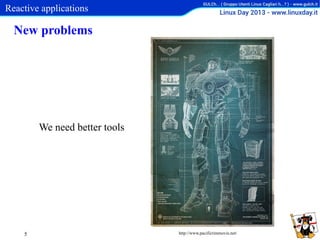
New problems

We need better tools

5

http://www.pacificrimmovie.net/
Reactive applications

Reactive

“readily responsive to a stimulus”
Component active and ready to respond to event
Event Driven

6
Reactive applications

Reactive
React to events → Event Driven
React to failure → Resilient
React through a UI → Interactive
React to load → Scalable

7
Reactive applications

React to event - Event driven

Asyncronous and loosely coupled
+
Non blocking
=
lower latency and higher throughput

8
Reactive applications

React to event - Event driven

Productors push asyncronously data
towards consumers (message passing)
better resource usage
instead of
having consumers continually ask for data

9
Reactive applications

React to event - Event driven

Non blocking operation
mean have all the time
the application responsive
even under failure

10
Reactive applications

Event driven
Actors , No shared mutable state
Promise , Composable
Message passing asyncronous, non Blocking
Lock free concurrency

11
Reactive applications

Scalable

“Capable of being easily expanded or upgraded on
demand”
Event driven and message passing are the foundations

12
Reactive applications

Scalable
“loose coupling and location independence between
components and subsystems make it possible to scale out
the system onto multiple node”
Location transparency
!=
transparent distributed computing

13
Reactive applications

Resilient

“the capacity to recover quickly from difficulties”
In a reactive application, resilience is part of the design from
the beginning

14
Reactive applications

Resilient

Bulkheads and Circuit Breaker patterns
Isolate failure
Manage Failure locally
Avoid cascading failure

15
Reactive applications

Resilient
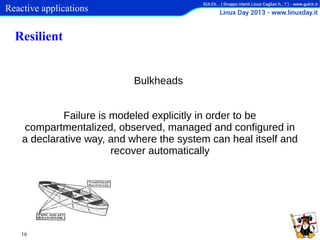
Bulkheads
Failure is modeled explicitly in order to be
compartmentalized, observed, managed and configured in
a declarative way, and where the system can heal itself and
recover automatically

16
Reactive applications

Resilient
Actor lightweight isolated process
(400 bytes of heap space)
Each process has its own supervisor
In case of failure the supervisor receive as async msg
the error
The supervisor can choose the recovery strategy
kill, restart, suspend/resume

17
Reactive applications

Resilient
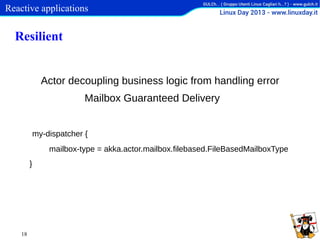
Actor decoupling business logic from handling error
Mailbox Guaranteed Delivery
my-dispatcher {
mailbox-type = akka.actor.mailbox.filebased.FileBasedMailboxType
}

18
Reactive applications

Resilient

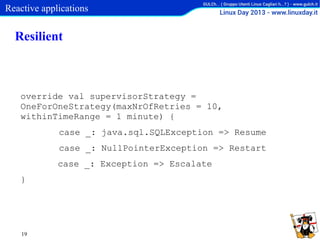
override val supervisorStrategy =
OneForOneStrategy(maxNrOfRetries = 10,
withinTimeRange = 1 minute) {
case _: java.sql.SQLException => Resume
case _: NullPointerException => Restart
case _: Exception => Escalate
}

19
Reactive applications

Resilient
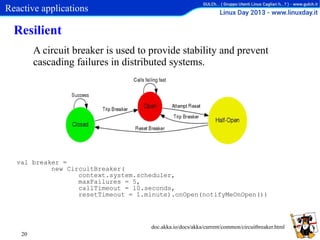
A circuit breaker is used to provide stability and prevent
cascading failures in distributed systems.

val breaker =
new CircuitBreaker(
context.system.scheduler,
maxFailures = 5,
callTimeout = 10.seconds,
resetTimeout = 1.minute).onOpen(notifyMeOnOpen())

doc.akka.io/docs/akka/current/common/circuitbreaker.html
20
Reactive applications

Responsive

quick to respond or react appropriately
Reactive applications use observable models, event
streams and stateful clients.

21
Reactive applications

Tools

Actors
Agent
Future
Functional Reactive Programming

22
Reactive applications

Tools

Actors
Share nothing
Each actor has a Mailbox (message queue)
Comunicates through async and non blocking message
passing
Location transaparent

23
Reactive applications

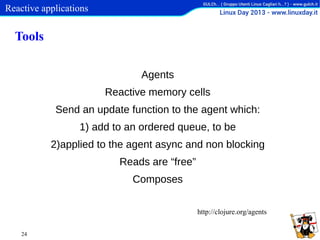
Tools
Agents
Reactive memory cells
Send an update function to the agent which:
1) add to an ordered queue, to be
2)applied to the agent async and non blocking
Reads are “free”
Composes
http://clojure.org/agents
24
Reactive applications

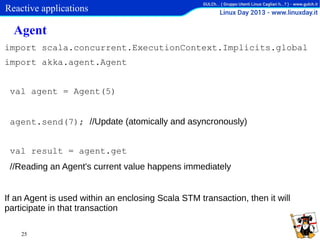
Agent
import scala.concurrent.ExecutionContext.Implicits.global
import akka.agent.Agent

val agent = Agent(5)
agent.send(7); //Update (atomically and asyncronously)
val result = agent.get
//Reading an Agent's current value happens immediately
If an Agent is used within an enclosing Scala STM transaction, then it will
participate in that transaction
25
Reactive applications

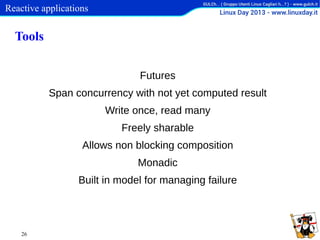
Tools
Futures
Span concurrency with not yet computed result
Write once, read many
Freely sharable
Allows non blocking composition
Monadic
Built in model for managing failure

26
Reactive applications

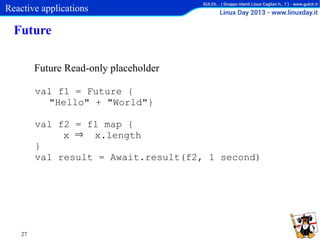
Future
Future Read-only placeholder
val f1 = Future {
"Hello" + "World"}
val f2 = f1 map {
x ⇒ x.length
}
val result = Await.result(f2, 1 second)

27
Reactive applications

Promise
Writeable, single-assignment container, which completes a
Future
import scala.concurrent.{ future, promise }
val p = promise[T]
val f = p.future
val producer = future {
val r = produceSomething()
p success r
ContinueDoingSomethingUnrelated()}
val consumer = future {
startDoingSomething()
f onSuccess {
case r => doSomethingWithResult()
}
28

}
Reactive applications

Tools
Functional reactive programming
Extends futures with concept of stream
Functional variation of the observer pattern
A signal attached to a stream of events
The signal is reevaluated for each event
Model events on a linear timeline deterministic
Compose nicely
Rx, RXJava, Scala.RX, Reactive.js, Knockout.js

29
Reactive applications

References

●

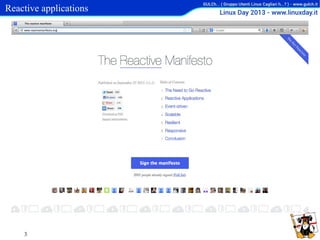
http://www.reactivemanifesto.org/

●

http://akka.io/ (JAVA and SCALA API)

●

Deprecating the observer pattern
http://lampwww.epfl.ch/~imaier/pub/DeprecatingObserversTR
2010.pdf

30
Reactive applications

Q &A

31
Reactive applications

Thanks for your attention

32

Reactive applications Linux Day 2013