Shaping
Exhibitio
n
Develop
ment
Zachary Paul Levine,
Curator at Yeshiva University Museum
Artists, Curators, and
Educators Engaging
Communities
Around
Commu
nity
Perspec
tives
Reaching
Deeper –
Why the Eruv?
(or What the heck is an Eruv and who cares?)
• An eruv is a ritual enclosure for the Sabbath
• Integrate religious and technical creativity
•Eruv history closely tied to Jewish history
• Gaining academic interest
• Artists working around the concept of eruv
Get Your A-Team
Assembled an Advisory Board of
Scholars
• Confounds the most knowledgeable
• Controversial, especially in New York
• Hundreds of thousands of Jews rely on
community eruvs
The Panel’s Conclusions:
• Growing interest popularly
At the Center
These issues are especially important to
Orthodox Jews in particular
• Nobody else uses an eruv (no
kidding!)
• NOT A LOOPHOLE! Illiteracy
around Eruv in Jewish legal
tradition
• Recent data on composition of
Orthodox Jewish community
• Gender dynamics
• Field of Analysis: NYC
On a (Kashered) Silver Platter
• Defined the focus: Eruv and Jewish Community in New
York
In other Words … here’s your audience:
• Defined the Audience: Several Hundred Thousand
Orthodox Jews
Primary Targeted Communities:
• Eruv Enthusiasts (and builders)
• Jewish Schools
• Synagogue Communities
Target: Big Apple
Orthodox Jews
Primary Targeted Communities:
• Eruv Enthusiasts (and builders)
• Jewish Schools
• Synagogue Communities
• Cultivate awareness about the
exhibition
• Enhance the museum’s profile
• Acquire a working database of
community contacts
Early Outreach Goals
Target: Big Apple
Orthodox Jews
Museum Educators
• Know who to call in the schools
• Align exhibition with school needs
• Generate buzz about the exhibition among educators
Putting Out the Call
Education’s Role
Contact Influential Educators and Rabbis
• Consultations
• Program Design and Planning
• Networking
Contact Influential Educators and Rabbis
• Consultations
• Program Design and Planning
• Networking
Interpret Communal Needs
• Identify objects
• Highlight objects
• Identify Essential Lessons
Education’s Role
Putting Out the Call
• Knows people who make eruvs
• Understand the historical and practical dimensions
• Make Connections
Eruv Scholars (Rabbis, Enthusiasts, Others)
• What do people know and not know?
• Life before eruvs
• Impact on women, children, and the infirm
Gathering Information
Getting Communal Voices - Survey
• Stories
• Interviews with eruv creators
• Stories about controversies
• Maintaining eruvs
Leaders – Films
• Finding objects
• What do people know and not know?
• Life before eruvs
• Impact on women, children, and the infirm
Gathering Information
Getting Communal Voices - Survey
• Stories
• Discovered stories about eruv history in
NYC
• Uncovered objects (eruv gates on telephone
poles)
• Made connections with leaders and their
communities
Gathering Information
Effects
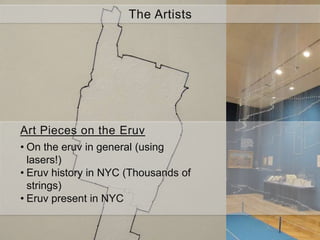
• On the eruv in general (using
lasers!)
• Eruv history in NYC (Thousands of
strings)
• Eruv present in NYC
The Artists
Art Pieces on the Eruv
Meeting Expectations?
• Greater relevance for schools
• Better alignment with programs (youth and adult)
• Education brought into interpretative planning
Education Department’s Role – Success
• Initially, attracted students
• Art pieces enhanced didactic quality
Meeting Expectations?
• Added community voices into the
exhibition
• Tightened the narrative’s argument from the beginning
• Placed the narrative in the NYC area (artifacts and
interactive content)
Community Awareness – Success
Meeting Expectations?
• Community buzz – Did not appear to last
• Community ambassadors (synagogues, experts) – Did not
advocate
• Limited press attention
Unfulfilled Expectations – Limited Press and
Few Visitors
• External factors
Meeting Expectations?
• Hurricane Sandy
• Bus Strike
• Maybe too Jewish?
Caveat – External Factors
And Beyond…
• Benefits of cooperation between curatorial and education
departments
• Value of applying community input to interpretative planning
Lessons Learned
• Challenging to expect participants to act as ambassadors

Shaping Exhibition Development Around Community Perspectives

  • 1.
    Shaping Exhibitio n Develop ment Zachary Paul Levine, Curatorat Yeshiva University Museum Artists, Curators, and Educators Engaging Communities Around Commu nity Perspec tives Reaching Deeper –
  • 2.
    Why the Eruv? (orWhat the heck is an Eruv and who cares?) • An eruv is a ritual enclosure for the Sabbath • Integrate religious and technical creativity •Eruv history closely tied to Jewish history • Gaining academic interest • Artists working around the concept of eruv
  • 3.
    Get Your A-Team Assembledan Advisory Board of Scholars • Confounds the most knowledgeable • Controversial, especially in New York • Hundreds of thousands of Jews rely on community eruvs The Panel’s Conclusions: • Growing interest popularly
  • 4.
    At the Center Theseissues are especially important to Orthodox Jews in particular • Nobody else uses an eruv (no kidding!) • NOT A LOOPHOLE! Illiteracy around Eruv in Jewish legal tradition • Recent data on composition of Orthodox Jewish community • Gender dynamics • Field of Analysis: NYC
  • 5.
    On a (Kashered)Silver Platter • Defined the focus: Eruv and Jewish Community in New York In other Words … here’s your audience: • Defined the Audience: Several Hundred Thousand Orthodox Jews
  • 6.
    Primary Targeted Communities: •Eruv Enthusiasts (and builders) • Jewish Schools • Synagogue Communities Target: Big Apple Orthodox Jews
  • 7.
    Primary Targeted Communities: •Eruv Enthusiasts (and builders) • Jewish Schools • Synagogue Communities • Cultivate awareness about the exhibition • Enhance the museum’s profile • Acquire a working database of community contacts Early Outreach Goals Target: Big Apple Orthodox Jews
  • 8.
    Museum Educators • Knowwho to call in the schools • Align exhibition with school needs • Generate buzz about the exhibition among educators Putting Out the Call
  • 9.
    Education’s Role Contact InfluentialEducators and Rabbis • Consultations • Program Design and Planning • Networking
  • 10.
    Contact Influential Educatorsand Rabbis • Consultations • Program Design and Planning • Networking Interpret Communal Needs • Identify objects • Highlight objects • Identify Essential Lessons Education’s Role
  • 11.
    Putting Out theCall • Knows people who make eruvs • Understand the historical and practical dimensions • Make Connections Eruv Scholars (Rabbis, Enthusiasts, Others)
  • 12.
    • What dopeople know and not know? • Life before eruvs • Impact on women, children, and the infirm Gathering Information Getting Communal Voices - Survey • Stories
  • 13.
    • Interviews witheruv creators • Stories about controversies • Maintaining eruvs Leaders – Films • Finding objects • What do people know and not know? • Life before eruvs • Impact on women, children, and the infirm Gathering Information Getting Communal Voices - Survey • Stories
  • 14.
    • Discovered storiesabout eruv history in NYC • Uncovered objects (eruv gates on telephone poles) • Made connections with leaders and their communities Gathering Information Effects
  • 15.
    • On theeruv in general (using lasers!) • Eruv history in NYC (Thousands of strings) • Eruv present in NYC The Artists Art Pieces on the Eruv
  • 16.
    Meeting Expectations? • Greaterrelevance for schools • Better alignment with programs (youth and adult) • Education brought into interpretative planning Education Department’s Role – Success • Initially, attracted students • Art pieces enhanced didactic quality
  • 17.
    Meeting Expectations? • Addedcommunity voices into the exhibition • Tightened the narrative’s argument from the beginning • Placed the narrative in the NYC area (artifacts and interactive content) Community Awareness – Success
  • 18.
    Meeting Expectations? • Communitybuzz – Did not appear to last • Community ambassadors (synagogues, experts) – Did not advocate • Limited press attention Unfulfilled Expectations – Limited Press and Few Visitors • External factors
  • 19.
    Meeting Expectations? • HurricaneSandy • Bus Strike • Maybe too Jewish? Caveat – External Factors
  • 20.
    And Beyond… • Benefitsof cooperation between curatorial and education departments • Value of applying community input to interpretative planning Lessons Learned • Challenging to expect participants to act as ambassadors

Editor's Notes

  • #2 Introduction: We decided to do an exhibition about the topic of the eruv….
  • #3 Introduction: We decided to do an exhibition about the topic of the eruv….
  • #4 We assembled a panel of scholars and eruv experts to discuss how to approach the topic.The discussion yielded several conclusions / directions
  • #5 The conclusions brought the idea of the community to the center of how we thought about this topic.
  • #6 The conclusions brought the idea of the community to the center of how we thought about this topic.
  • #7 Schools: fit the the interpretative framework, narrative, and programs to schools’ interests Synagogue communities: Spread word about the exhibition and the museum; learn about people involved in eruvs in the areaEruv Builders: Understand the technical and administrative issues around eruvs, and acquire artifacts
  • #8 Schools: fit the the interpretative framework, narrative, and programs to schools’ interests Synagogue communities: Spread word about the exhibition and the museum; learn about people involved in eruvs in the areaEruv Builders: Understand the technical and administrative issues around eruvs, and acquire artifacts