Age Friendly Museums Network Cross Sector Conference:
Thursday 16th
February 2017, British Museum 9.30am-4.30pm
Notesmade by Mary B (Marette) Hickford – marette.hickford@gmail.com
NOTE: I have not captured all information givenby the speakers; Please alsoaccept my sincere
apologiesifthese noteshave misconstruedthe messagesmade through the speechesgivenbythe
speakers.
Creative Ageingby Sadler’sWellsand RoehamptonInstitute
Parkinson’sDiseaseandDance – Why the condition?:
 Capacityto be able to do something
 Contextforpeople tomove
 Structuredwayof trainingandexpandedoffertopeople tojoin
 Demand-led
Sadler’sWellsCompanyof EldersandEnglishNational Ballet’sEldersGroup:
 Bringingage intothe mainstream
 Sadler’sWells15years involvementwith60yearswho are now 75 yearsold
Why Dance?
 Sense of feelinglovelyagain
 Sadler’sWells –to challenge stereotypes
 Feelingsexy
 Expressive
 Empowerment
 Freedom
 Sense of risk – doingsomethingtheydon’tnormallydoandfeel
 Givinga performance,especiallyatthe ENB
Sector:
 2014 – ElixirFestival started
 2017 – itis nowa generational show witha92 year oldchoreographer;journeyfromtrained
dancerto performer
 Parkinsonssuffererssetupowndance group
 Arts → Therapeutic
 Arts projectwithdementia–importantrole of carer for the project’ssuccesswiththe carer
as the dance partner
PartnershipFunding –howandwhere to getit:
 Spreadof classeswithseveral organisations,dance,charities,independentartists
 Thinkregionallyandlocally
 Robustresearchcan leadto NHS CommissioningFunds –GPs interestcanbe high
 Arts Council fundingformuseumswillbeginovernextcouple of years(audience
announcementduringpresentation)
Issuesforinvolvement:
 Gatekeepers
 Access – transport,especiallyinrural areas
 Certainpartnersandsettingsmayhave differentinfluences
 Initial contactto people notinvolvedindance –tastersessionsoffer?
 Beyondthe middle classes(videoshowndepictsdance participantswhowere frommiddle-
classwhite backgroundsandwho’dinitiallyhadsome dance experience fromyouth)
 Projectsneedtobe representative thoughindependentcompaniesalreadyworkingwith
workingclasses –lowprofile
 Ballroomclassestopchoice amongstmanyparticipants
 Hip Hopprojectin SouthLondon(specificclasses?ethnicgroups?)
 GreenwichDance – Olddance hall usedfor bothballroomandcontemporary
How can we use recentresearch exploringpopulationchange to informour practice?By Oxford
Institute of PopulationAgeing and Centre for AgeingWell
Centre for AgeingWell
Routesto bringaboutbetterlaterlife:
 Exercises
 Neighbourhoodsandlivelihoods
 Communitycontributionsthroughvolunteering
VolunteeringActivities:
Neighbourliness
↓ → individual
Informal/Semi-formal
↓ → donations
Formal
↓ → volunteering
Civic→ magistrate,councillor
= Evidence limitedtoformal involvements
Benefits?
 Social interactions
 Isolation
 Loneliness –retirementandbereavement
Associationbetweenhelpingothersandsocial interactionsandrelationships
Formal/informalvolunteeringhealthmeasures:
↑ walkingactivities
↑ strength– grip
↓fewerdepressive symptoms
↓fewerfunctional limitations
↑improvedcognitiveskills –memoryandbrainactivity
↓reductioninmortalityratesfor volunteers
Volunteers:
 Well-beingandsense of purpose
 Dignity
 Independence
 Pleasure
 Happiness
Give and take of interactionimportantforelderlypeople:
 Task satisfaction
 Self-esteem
Feelinglife hasmeaningassociatedwithlowercancerrates,heartdisease andcognitive decline
Project– ‘Men’sSheds’beganinAustralia;Now 350 in the UK:
 Greatermental stimulation
 Meaningful role
Legacy of volunteeringfromyounglifevariesbetweenpeoplenotacrosstime
Those inexcellenthealth –40% volunteering;40% richestincome groupin50+years
Volunteering=white classactivity
Who are the people whobenefit?
 Those whohave most to gain:
o Low-level education
o Mildmental healthproblems
o Unmaterialistic(?) households
Institute of PopulationAgeing
Researchintomuseumvisitors,volunteers,trusteesandmembers:
 Visitors–45-74 yearsoldsmore likelytovisit
 Volunteers –45% over65 yearsand decline over75 years
Demography – compressedfertilityandincreasedlongevity
2014 - medianage = 40 years
2037 – disproportionate populationover65 years(rich,rural areas?)
Noteveryone livinglonger
Healthlife expectancynotinline withlife expectancyrates
Change inoldage:
 Changesto retirement
 Extendingworkinglives
 Carersof grandchildrenand/orparents
 Over75 yearsfastestgrowingage groupbut not all seeingsame increasesinhealth
expectanciesanddisabilities
Seeingelderlypeopleasassets:
 Manchester– ambassadorsforradiostation;2011-12 – 80 reached1,500+ people
Adaptations:
 Outreach – ‘memoryboxes’
 Trainingto carers
 Pop-upexhibitionsforresidential care settings
 Partnerships
Creative digital engagements:
 Apps
 Intergenerational work
Issues:
 Transport
 Expenses
 Fear
 Unvalued
 Personal circumstances
 Bureaucracy
Participationbreedsparticipation:
 Grandparentslookingaftergrand-childrenalso volunteer
Informal volunteering:
 75 years+ stayinvolvedinthistype ratherthanformal volunteering
Whydo age—friendlymuseumsmatter?ByMartin GreenOBE, AgeingWell inWales,Universityof
Leicesterand National MuseumsLiverpool
Martin GreenOBE
Demographicchange – olderpeople reflectiveof Society
Museums:
 Intergenerational space
 Contributors
 Addrichnesse.g.warexperiences/memories
 Projectswithyouth,relationshipscontinue beyondsuchactivities
 Those withdementiacancentre themselves
 Wellbeingpartof the Care Act
National MuseumsLiverpool
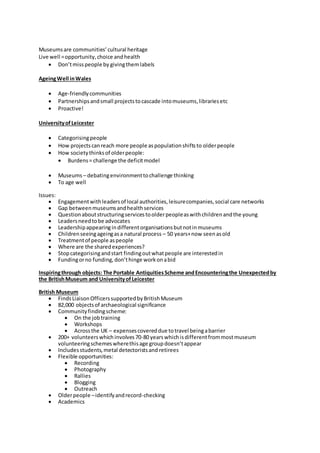
Museumsare communities’cultural heritage
Live well =opportunity,choice andhealth
 Don’tmisspeople by givingthemlabels
AgeingWell inWales
 Age-friendlycommunities
 Partnershipsandsmall projectstocascade intomuseums,librariesetc
 Proactive!
UniversityofLeicester
 Categorisingpeople
 How projectscanreach more people aspopulationshiftsto olderpeople
 How societythinksof olderpeople:
 Burdens= challenge the deficitmodel
 Museums – debatingenvironmenttochallenge thinking
 To age well
Issues:
 Engagementwithleadersof local authorities,leisurecompanies,social care networks
 Gap betweenmuseumsandhealthservices
 Questionaboutstructuringservicestoolderpeopleaswithchildrenandthe young
 Leadersneedtobe advocates
 Leadershipappearingindifferentorganisationsbutnotinmuseums
 Childrenseeingageingasa natural process – 50 years+now seenasold
 Treatmentof people aspeople
 Where are the sharedexperiences?
 Stopcategorisingandstart findingoutwhatpeople are interestedin
 Fundingorno funding,don’thinge workonabid
Inspiringthrough objects: The Portable AntiquitiesScheme andEncounteringthe Unexpectedby
the BritishMuseum and UniversityofLeicester
British Museum
 FindsLiaisonOfficerssupportedbyBritishMuseum
 82,000 objectsof archaeological significance
 Communityfindingscheme:
 On the jobtraining
 Workshops
 Acrossthe UK – expensescovereddue totravel beingabarrier
 200+ volunteerswhichinvolves70-80 yearswhichisdifferentfrommostmuseum
volunteeringschemeswherethisage groupdoesn’tappear
 Includesstudents,metal detectoristsand retirees
 Flexible opportunities:
 Recording
 Photography
 Rallies
 Blogging
 Outreach
 Olderpeople –identifyandrecord-checking
 Academics
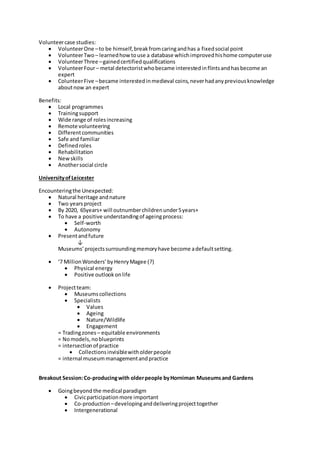
Volunteercase studies:
 VolunteerOne –to be himself,breakfromcaringandhas a fixedsocial point
 VolunteerTwo – learnedhowtouse a database whichimprovedhishome computeruse
 VolunteerThree –gainedcertifiedqualifications
 VolunteerFour– metal detectoristwhobecame interestedinflintsandhasbecome an
expert
 ColunteerFive –became interestedinmedieval coins,neverhadanypreviousknowledge
aboutnow an expert
Benefits:
 Local programmes
 Trainingsupport
 Wide range of rolesincreasing
 Remote volunteering
 Differentcommunities
 Safe and familiar
 Definedroles
 Rehabilitation
 Newskills
 Anothersocial circle
UniversityofLeicester
Encounteringthe Unexpected:
 Natural heritage andnature
 Two yearsproject
 By 2020, 65years+ will outnumberchildrenunder5years+
 To have a positive understandingof ageingprocess:
 Self-worth
 Autonomy
 Presentandfuture
↓
Museums’projectssurroundingmemoryhave become adefaultsetting.
 ‘7 MillionWonders’byHenryMagee (?)
 Physical energy
 Positive outlookonlife
 Projectteam:
 Museumscollections
 Specialists
 Values
 Ageing
 Nature/Wildlife
 Engagement
= Tradingzones – equitable environments
= Nomodels,noblueprints
= intersectionof practice
 Collectionsinvisiblewitholderpeople
= internal museummanagementandpractice
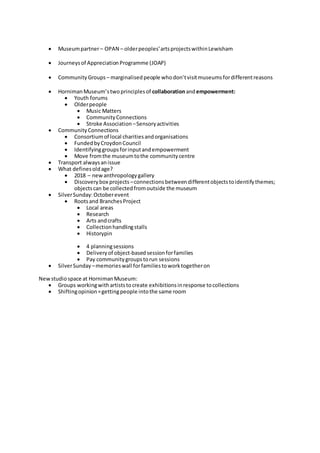
Breakout Session:Co-producingwith olderpeople byHorniman Museumsand Gardens
 Goingbeyond the medical paradigm
 Civicparticipationmore important
 Co-production –developinganddeliveringprojecttogether
 Intergenerational
 Museumpartner– OPAN – olderpeoples’artsprojectswithinLewisham
 Journeysof AppreciationProgramme (JOAP)
 Community Groups – marginalisedpeople whodon’tvisitmuseumsfordifferentreasons
 HornimanMuseum’stwoprinciplesof collaborationandempowerment:
 Youth forums
 Olderpeople
 Music Matters
 CommunityConnections
 Stroke Association –Sensoryactivities
 Community Connections
 Consortiumof local charitiesandorganisations
 FundedbyCroydonCouncil
 Identifyinggroupsforinputandempowerment
 Move fromthe museumtothe communitycentre
 Transport alwaysanissue
 What definesoldage?
 2018 – newanthropologygallery
 Discoverybox projects –connectionsbetweendifferentobjectstoidentifythemes;
objectscan be collectedfromoutside the museum
 SilverSunday:Octoberevent
 Rootsand BranchesProject
 Local areas
 Research
 Arts andcrafts
 Collectionhandlingstalls
 Historypin
 4 planningsessions
 Deliveryof object-basedsessionforfamilies
 Pay communitygroupstorun sessions
 SilverSunday –memorieswall forfamiliestoworktogetheron
Newstudiospace at HornimanMuseum:
 Groups workingwithartiststocreate exhibitionsinresponse tocollections
 Shiftingopinion=gettingpeople intothe same room
Moving beyond the memory box

Moving beyond the memory box

  • 1.
    Age Friendly MuseumsNetwork Cross Sector Conference: Thursday 16th February 2017, British Museum 9.30am-4.30pm Notesmade by Mary B (Marette) Hickford – marette.hickford@gmail.com NOTE: I have not captured all information givenby the speakers; Please alsoaccept my sincere apologiesifthese noteshave misconstruedthe messagesmade through the speechesgivenbythe speakers. Creative Ageingby Sadler’sWellsand RoehamptonInstitute Parkinson’sDiseaseandDance – Why the condition?:  Capacityto be able to do something  Contextforpeople tomove  Structuredwayof trainingandexpandedoffertopeople tojoin  Demand-led Sadler’sWellsCompanyof EldersandEnglishNational Ballet’sEldersGroup:  Bringingage intothe mainstream  Sadler’sWells15years involvementwith60yearswho are now 75 yearsold Why Dance?  Sense of feelinglovelyagain  Sadler’sWells –to challenge stereotypes  Feelingsexy  Expressive  Empowerment  Freedom  Sense of risk – doingsomethingtheydon’tnormallydoandfeel  Givinga performance,especiallyatthe ENB Sector:  2014 – ElixirFestival started  2017 – itis nowa generational show witha92 year oldchoreographer;journeyfromtrained dancerto performer  Parkinsonssuffererssetupowndance group  Arts → Therapeutic  Arts projectwithdementia–importantrole of carer for the project’ssuccesswiththe carer as the dance partner PartnershipFunding –howandwhere to getit:  Spreadof classeswithseveral organisations,dance,charities,independentartists  Thinkregionallyandlocally  Robustresearchcan leadto NHS CommissioningFunds –GPs interestcanbe high  Arts Council fundingformuseumswillbeginovernextcouple of years(audience announcementduringpresentation)
  • 2.
    Issuesforinvolvement:  Gatekeepers  Access– transport,especiallyinrural areas  Certainpartnersandsettingsmayhave differentinfluences  Initial contactto people notinvolvedindance –tastersessionsoffer?  Beyondthe middle classes(videoshowndepictsdance participantswhowere frommiddle- classwhite backgroundsandwho’dinitiallyhadsome dance experience fromyouth)  Projectsneedtobe representative thoughindependentcompaniesalreadyworkingwith workingclasses –lowprofile  Ballroomclassestopchoice amongstmanyparticipants  Hip Hopprojectin SouthLondon(specificclasses?ethnicgroups?)  GreenwichDance – Olddance hall usedfor bothballroomandcontemporary How can we use recentresearch exploringpopulationchange to informour practice?By Oxford Institute of PopulationAgeing and Centre for AgeingWell Centre for AgeingWell Routesto bringaboutbetterlaterlife:  Exercises  Neighbourhoodsandlivelihoods  Communitycontributionsthroughvolunteering VolunteeringActivities: Neighbourliness ↓ → individual Informal/Semi-formal ↓ → donations Formal ↓ → volunteering Civic→ magistrate,councillor = Evidence limitedtoformal involvements Benefits?  Social interactions  Isolation  Loneliness –retirementandbereavement Associationbetweenhelpingothersandsocial interactionsandrelationships Formal/informalvolunteeringhealthmeasures: ↑ walkingactivities
  • 3.
    ↑ strength– grip ↓fewerdepressivesymptoms ↓fewerfunctional limitations ↑improvedcognitiveskills –memoryandbrainactivity ↓reductioninmortalityratesfor volunteers Volunteers:  Well-beingandsense of purpose  Dignity  Independence  Pleasure  Happiness Give and take of interactionimportantforelderlypeople:  Task satisfaction  Self-esteem Feelinglife hasmeaningassociatedwithlowercancerrates,heartdisease andcognitive decline Project– ‘Men’sSheds’beganinAustralia;Now 350 in the UK:  Greatermental stimulation  Meaningful role Legacy of volunteeringfromyounglifevariesbetweenpeoplenotacrosstime Those inexcellenthealth –40% volunteering;40% richestincome groupin50+years Volunteering=white classactivity Who are the people whobenefit?  Those whohave most to gain: o Low-level education o Mildmental healthproblems o Unmaterialistic(?) households Institute of PopulationAgeing Researchintomuseumvisitors,volunteers,trusteesandmembers:  Visitors–45-74 yearsoldsmore likelytovisit  Volunteers –45% over65 yearsand decline over75 years Demography – compressedfertilityandincreasedlongevity 2014 - medianage = 40 years 2037 – disproportionate populationover65 years(rich,rural areas?) Noteveryone livinglonger Healthlife expectancynotinline withlife expectancyrates Change inoldage:  Changesto retirement
  • 4.
     Extendingworkinglives  Carersofgrandchildrenand/orparents  Over75 yearsfastestgrowingage groupbut not all seeingsame increasesinhealth expectanciesanddisabilities Seeingelderlypeopleasassets:  Manchester– ambassadorsforradiostation;2011-12 – 80 reached1,500+ people Adaptations:  Outreach – ‘memoryboxes’  Trainingto carers  Pop-upexhibitionsforresidential care settings  Partnerships Creative digital engagements:  Apps  Intergenerational work Issues:  Transport  Expenses  Fear  Unvalued  Personal circumstances  Bureaucracy Participationbreedsparticipation:  Grandparentslookingaftergrand-childrenalso volunteer Informal volunteering:  75 years+ stayinvolvedinthistype ratherthanformal volunteering Whydo age—friendlymuseumsmatter?ByMartin GreenOBE, AgeingWell inWales,Universityof Leicesterand National MuseumsLiverpool Martin GreenOBE Demographicchange – olderpeople reflectiveof Society Museums:  Intergenerational space  Contributors  Addrichnesse.g.warexperiences/memories  Projectswithyouth,relationshipscontinue beyondsuchactivities  Those withdementiacancentre themselves  Wellbeingpartof the Care Act National MuseumsLiverpool
  • 5.
    Museumsare communities’cultural heritage Livewell =opportunity,choice andhealth  Don’tmisspeople by givingthemlabels AgeingWell inWales  Age-friendlycommunities  Partnershipsandsmall projectstocascade intomuseums,librariesetc  Proactive! UniversityofLeicester  Categorisingpeople  How projectscanreach more people aspopulationshiftsto olderpeople  How societythinksof olderpeople:  Burdens= challenge the deficitmodel  Museums – debatingenvironmenttochallenge thinking  To age well Issues:  Engagementwithleadersof local authorities,leisurecompanies,social care networks  Gap betweenmuseumsandhealthservices  Questionaboutstructuringservicestoolderpeopleaswithchildrenandthe young  Leadersneedtobe advocates  Leadershipappearingindifferentorganisationsbutnotinmuseums  Childrenseeingageingasa natural process – 50 years+now seenasold  Treatmentof people aspeople  Where are the sharedexperiences?  Stopcategorisingandstart findingoutwhatpeople are interestedin  Fundingorno funding,don’thinge workonabid Inspiringthrough objects: The Portable AntiquitiesScheme andEncounteringthe Unexpectedby the BritishMuseum and UniversityofLeicester British Museum  FindsLiaisonOfficerssupportedbyBritishMuseum  82,000 objectsof archaeological significance  Communityfindingscheme:  On the jobtraining  Workshops  Acrossthe UK – expensescovereddue totravel beingabarrier  200+ volunteerswhichinvolves70-80 yearswhichisdifferentfrommostmuseum volunteeringschemeswherethisage groupdoesn’tappear  Includesstudents,metal detectoristsand retirees  Flexible opportunities:  Recording  Photography  Rallies  Blogging  Outreach  Olderpeople –identifyandrecord-checking  Academics
  • 6.
    Volunteercase studies:  VolunteerOne–to be himself,breakfromcaringandhas a fixedsocial point  VolunteerTwo – learnedhowtouse a database whichimprovedhishome computeruse  VolunteerThree –gainedcertifiedqualifications  VolunteerFour– metal detectoristwhobecame interestedinflintsandhasbecome an expert  ColunteerFive –became interestedinmedieval coins,neverhadanypreviousknowledge aboutnow an expert Benefits:  Local programmes  Trainingsupport  Wide range of rolesincreasing  Remote volunteering  Differentcommunities  Safe and familiar  Definedroles  Rehabilitation  Newskills  Anothersocial circle UniversityofLeicester Encounteringthe Unexpected:  Natural heritage andnature  Two yearsproject  By 2020, 65years+ will outnumberchildrenunder5years+  To have a positive understandingof ageingprocess:  Self-worth  Autonomy  Presentandfuture ↓ Museums’projectssurroundingmemoryhave become adefaultsetting.  ‘7 MillionWonders’byHenryMagee (?)  Physical energy  Positive outlookonlife  Projectteam:  Museumscollections  Specialists  Values  Ageing  Nature/Wildlife  Engagement = Tradingzones – equitable environments = Nomodels,noblueprints = intersectionof practice  Collectionsinvisiblewitholderpeople = internal museummanagementandpractice Breakout Session:Co-producingwith olderpeople byHorniman Museumsand Gardens  Goingbeyond the medical paradigm  Civicparticipationmore important  Co-production –developinganddeliveringprojecttogether  Intergenerational
  • 7.
     Museumpartner– OPAN– olderpeoples’artsprojectswithinLewisham  Journeysof AppreciationProgramme (JOAP)  Community Groups – marginalisedpeople whodon’tvisitmuseumsfordifferentreasons  HornimanMuseum’stwoprinciplesof collaborationandempowerment:  Youth forums  Olderpeople  Music Matters  CommunityConnections  Stroke Association –Sensoryactivities  Community Connections  Consortiumof local charitiesandorganisations  FundedbyCroydonCouncil  Identifyinggroupsforinputandempowerment  Move fromthe museumtothe communitycentre  Transport alwaysanissue  What definesoldage?  2018 – newanthropologygallery  Discoverybox projects –connectionsbetweendifferentobjectstoidentifythemes; objectscan be collectedfromoutside the museum  SilverSunday:Octoberevent  Rootsand BranchesProject  Local areas  Research  Arts andcrafts  Collectionhandlingstalls  Historypin  4 planningsessions  Deliveryof object-basedsessionforfamilies  Pay communitygroupstorun sessions  SilverSunday –memorieswall forfamiliestoworktogetheron Newstudiospace at HornimanMuseum:  Groups workingwithartiststocreate exhibitionsinresponse tocollections  Shiftingopinion=gettingpeople intothe same room