The Deaf Glocal Circuit:
Moral dimensions
Erin Moriarty, PhD
Gallaudet University & Heriot-
How it all began…from Cambodia to Bali
• Fieldwork: Cambodia 2012-2016
• Participant observation: Deaf tourists kept popping up at NGOs
• Interviews : Deaf Cambodian narratives about guiding tourists,
conflicts between NGO administrators (deaf and hearing) and
tourists demanding access
• An active social enterprise sector all over Cambodia: Every
single thing was made by people with disabilities!
• MobileDeaf fieldwork in Bali for 7 months in 2018
Tourism theory in a nutshell
• Early work: a typology of tourism and tourists (e.g. mass tourism, solo traveler,
backpacker, etc.)
• Motivation: pursuit of the exotic and the Other, conceptualized as a quest for
authenticity (MacCannell 1976)
• But! It’s not that simple…(Bruner 2005)
• The tourist gaze (Urry 1990)
• Expectations that tourists impose on local people/things in their search for
an "authentic" experience
• Tourist imaginaries (Salazar 2010)
• Assemblages of ideas, images and discourses about a place/people
• Commodification of places and languages for tourist consumption
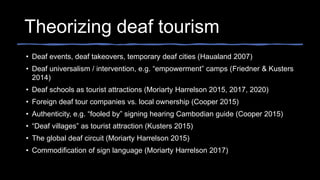
Theorizing deaf tourism
• Deaf events, deaf takeovers, temporary deaf cities (Haualand 2007)
• Deaf universalism / intervention, e.g. “empowerment” camps (Friedner & Kusters
2014)
• Deaf schools as tourist attractions (Moriarty Harrelson 2015, 2017, 2020)
• Foreign deaf tour companies vs. local ownership (Cooper 2015)
• Authenticity, e.g. “fooled by” signing hearing Cambodian guide (Cooper 2015)
• “Deaf villages” as tourist attraction (Kusters 2015)
• The global deaf circuit (Moriarty Harrelson 2015)
• Commodification of sign language (Moriarty Harrelson 2017)
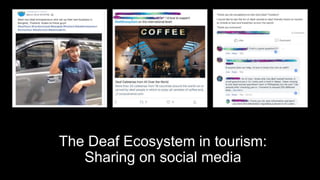
The Deaf Ecosystem in tourism:
Sharing on social media
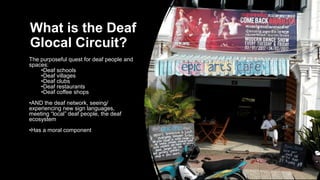
What is the Deaf
Glocal Circuit?
The purposeful quest for deaf people and
spaces:
•Deaf schools
•Deaf villages
•Deaf clubs
•Deaf restaurants
•Deaf coffee shops
•AND the deaf network, seeing/
experiencing new sign languages,
meeting “local” deaf people, the deaf
ecosystem
•Has a moral component
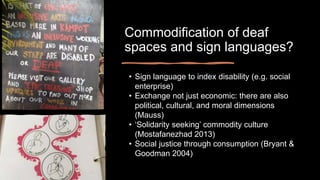
Commodification of deaf
spaces and sign languages?
• Sign language to index disability (e.g. social
enterprise)
• Exchange not just economic: there are also
political, cultural, and moral dimensions
(Mauss)
• ‘Solidarity seeking’ commodity culture
(Mostafanezhad 2013)
• Social justice through consumption (Bryant &
Goodman 2004)
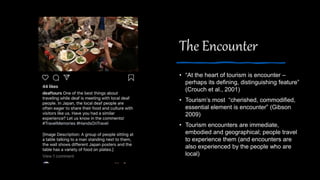
The Encounter
• “At the heart of tourism is encounter –
perhaps its defining, distinguishing feature”
(Crouch et al., 2001)
• Tourism’s most “cherished, commodified,
essential element is encounter” (Gibson
2009)
• Tourism encounters are immediate,
embodied and geographical; people travel
to experience them (and encounters are
also experienced by the people who are
local)
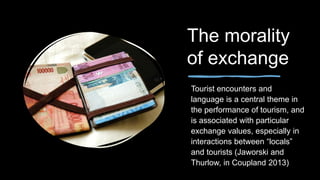
The morality
of exchange
Tourist encounters and
language is a central theme in
the performance of tourism, and
is associated with particular
exchange values, especially in
interactions between “locals”
and tourists (Jaworski and
Thurlow, in Coupland 2013)
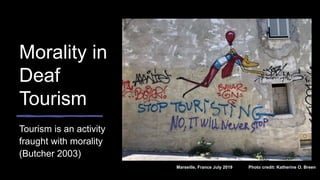
Morality in
Deaf
Tourism
Tourism is an activity
fraught with morality
(Butcher 2003)
Marseille, France July 2019 Photo credit: Katherine O. Breen
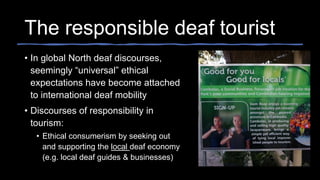
The responsible deaf tourist
• In global North deaf discourses,
seemingly “universal” ethical
expectations have become attached
to international deaf mobility
• Discourses of responsibility in
tourism:
• Ethical consumerism by seeking out
and supporting the local deaf economy
(e.g. local deaf guides & businesses)
Deaf eco-
consciousness
• “Responsible consumption” & “responsible
tourism” involves an awareness of and
participation in the local deaf ecosystem:
• Meeting “local” deaf people
• “Local” deaf guides and other businesses
• Giving back to “local” deaf communities
• Learning the “local” sign language (and/or
refusing to use ASL or BSL)
Glocal deaf guides
• Different aspects of working with deaf guides
• Linguistic authenticity (Cooper 2015)
• Supporting local deaf economy (e.g. Hands on Tours use of local
guides)
• However, deaf value systems may clash sometimes:
• Expectation of discounts or free services
• Unclear expectations of who pays for what (situation with French deaf group in
Cambodia)
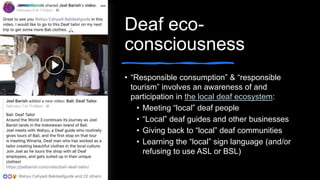
Video: Gio
The Deaf Ecosystem as a Network
• “We were lucky because deaf people have contacts all over.We got some contacts and now we
are able to give on our contacts, we are all connected.”
• “InAsia we would pay for petrol and get food or places to sleep in return.Then we would ask for
some contact information and recommendations in another city.When we had gotten some we
would keep traveling. Deaf people would share contact details of others and that would be a
guide on our path.”
• “There are deaf people with big hearts and there are deaf people that are poor and see it as an
opportunity. I can understand that and I don’t mind paying.They see us as coming from Europe
and being lucky to travel so I don’t mind paying for food. If communication is not going well, we
may stay for 2-3 days but if we have good chats with hosts we stay longer.”
Video: Wahyu
The end

The deaf glocal circuit: Moral dimensions

  • 1.
    The Deaf GlocalCircuit: Moral dimensions Erin Moriarty, PhD Gallaudet University & Heriot-
  • 2.
    How it allbegan…from Cambodia to Bali • Fieldwork: Cambodia 2012-2016 • Participant observation: Deaf tourists kept popping up at NGOs • Interviews : Deaf Cambodian narratives about guiding tourists, conflicts between NGO administrators (deaf and hearing) and tourists demanding access • An active social enterprise sector all over Cambodia: Every single thing was made by people with disabilities! • MobileDeaf fieldwork in Bali for 7 months in 2018
  • 3.
    Tourism theory ina nutshell • Early work: a typology of tourism and tourists (e.g. mass tourism, solo traveler, backpacker, etc.) • Motivation: pursuit of the exotic and the Other, conceptualized as a quest for authenticity (MacCannell 1976) • But! It’s not that simple…(Bruner 2005) • The tourist gaze (Urry 1990) • Expectations that tourists impose on local people/things in their search for an "authentic" experience • Tourist imaginaries (Salazar 2010) • Assemblages of ideas, images and discourses about a place/people • Commodification of places and languages for tourist consumption
  • 4.
    Theorizing deaf tourism •Deaf events, deaf takeovers, temporary deaf cities (Haualand 2007) • Deaf universalism / intervention, e.g. “empowerment” camps (Friedner & Kusters 2014) • Deaf schools as tourist attractions (Moriarty Harrelson 2015, 2017, 2020) • Foreign deaf tour companies vs. local ownership (Cooper 2015) • Authenticity, e.g. “fooled by” signing hearing Cambodian guide (Cooper 2015) • “Deaf villages” as tourist attraction (Kusters 2015) • The global deaf circuit (Moriarty Harrelson 2015) • Commodification of sign language (Moriarty Harrelson 2017)
  • 5.
    The Deaf Ecosystemin tourism: Sharing on social media
  • 6.
    What is theDeaf Glocal Circuit? The purposeful quest for deaf people and spaces: •Deaf schools •Deaf villages •Deaf clubs •Deaf restaurants •Deaf coffee shops •AND the deaf network, seeing/ experiencing new sign languages, meeting “local” deaf people, the deaf ecosystem •Has a moral component
  • 7.
    Commodification of deaf spacesand sign languages? • Sign language to index disability (e.g. social enterprise) • Exchange not just economic: there are also political, cultural, and moral dimensions (Mauss) • ‘Solidarity seeking’ commodity culture (Mostafanezhad 2013) • Social justice through consumption (Bryant & Goodman 2004)
  • 8.
    The Encounter • “Atthe heart of tourism is encounter – perhaps its defining, distinguishing feature” (Crouch et al., 2001) • Tourism’s most “cherished, commodified, essential element is encounter” (Gibson 2009) • Tourism encounters are immediate, embodied and geographical; people travel to experience them (and encounters are also experienced by the people who are local)
  • 9.
    The morality of exchange Touristencounters and language is a central theme in the performance of tourism, and is associated with particular exchange values, especially in interactions between “locals” and tourists (Jaworski and Thurlow, in Coupland 2013)
  • 10.
    Morality in Deaf Tourism Tourism isan activity fraught with morality (Butcher 2003) Marseille, France July 2019 Photo credit: Katherine O. Breen
  • 11.
    The responsible deaftourist • In global North deaf discourses, seemingly “universal” ethical expectations have become attached to international deaf mobility • Discourses of responsibility in tourism: • Ethical consumerism by seeking out and supporting the local deaf economy (e.g. local deaf guides & businesses)
  • 12.
    Deaf eco- consciousness • “Responsibleconsumption” & “responsible tourism” involves an awareness of and participation in the local deaf ecosystem: • Meeting “local” deaf people • “Local” deaf guides and other businesses • Giving back to “local” deaf communities • Learning the “local” sign language (and/or refusing to use ASL or BSL)
  • 13.
    Glocal deaf guides •Different aspects of working with deaf guides • Linguistic authenticity (Cooper 2015) • Supporting local deaf economy (e.g. Hands on Tours use of local guides) • However, deaf value systems may clash sometimes: • Expectation of discounts or free services • Unclear expectations of who pays for what (situation with French deaf group in Cambodia)
  • 14.
  • 15.
    The Deaf Ecosystemas a Network • “We were lucky because deaf people have contacts all over.We got some contacts and now we are able to give on our contacts, we are all connected.” • “InAsia we would pay for petrol and get food or places to sleep in return.Then we would ask for some contact information and recommendations in another city.When we had gotten some we would keep traveling. Deaf people would share contact details of others and that would be a guide on our path.” • “There are deaf people with big hearts and there are deaf people that are poor and see it as an opportunity. I can understand that and I don’t mind paying.They see us as coming from Europe and being lucky to travel so I don’t mind paying for food. If communication is not going well, we may stay for 2-3 days but if we have good chats with hosts we stay longer.”
  • 16.
  • 17.

Editor's Notes

  • #2 data on two deaf tour guides in Bali and their different objectives, styles and ways of tying in to the "deaf glocal circuit," as well as the deaf eco-system Dimensions can mean physical location, consciousness,
  • #6 As a part of this project, I did digital ethnography on social media, observing how people talked about deaf travel and a big part of deaf travel is supporting deaf businesses through tourism; the economy of tourism is huge, or at least it was before covid.
  • #10 Traveling for free (Gio
  • #11 Deaf tourists—like tourists more generally—embody a whole range of socially constructed mobilities, embodying the ways in which “the global” gets constituted through “the local.” Thus, we would argue that any “moral turn” in tourism, including volunteer tourism, must be premised on a spatial approach that is prepared to view questions of morality, responsibility, and ethics, as place-based and contingent.
  • #12 Assumption of universal codes of responsibility, including “eco” consciousness, “giving back” to communities, and treating others as people rather than exotic objects.
  • #15  Vimeo: https://vimeo.com/488290831
  • #17 https://vimeo.com/488335322