DAF survey
May-15
Learning material produced by RDMRose
http://www.sheffield.ac.uk/is/research/projects/rdmrose
Research Data Management
Workshop 3.1
Sesion 3.1 overview
• Data Asset Framework (DAF)
• The Sheffield DAF survey
May-15
Learning material produced by RDMRose
http://www.sheffield.ac.uk/is/research/projects/rdmrose
Value of an organisational survey
• Vital information about what researchers think and are
doing
– How much data they have; how often they back things up
– Awareness of policy
– Attitudes to data sharing; training
• Identify people and groups who are pathfinders or
problem areas
• First step in raising awareness and making contacts
• Valuable material for advocacy at a strategic level:
research leaders do not know about the practices in
their areas
• Benchmark against comparable institutions
Learning material produced by RDMRose
http://www.sheffield.ac.uk/is/research/projects/rdmroseMay-15
Data Asset Framework (DAF)
• “A framework developed by the JISC-funded DAFD
project to identify data assets held within Higher
and Further Educational institutions and to
explore how they are managed. The framework is
structured around audit at departmental or unit
level with results being amassed to obtain an
institutional or national perspective.” (Jones,
Ross, and Ruusalepp, 2009, p. 6)
• http://www.data-audit.eu/documents.html
• http://www.data-
audit.eu/docs/DAF_Implementation_Guide.pdf
May-15
Learning material produced by RDMRose
http://www.sheffield.ac.uk/is/research/projects/rdmrose
Four stages of DAF
• Stage 1 Plan the audit
– Appoint an auditor
– Establish a business case
– Conduct initial research
– Set up audit
• Stage 2 Identify and classify data assets
– Analysis of documentary sources
– Conduct a written survey
– Interviews
– Prepare the data asset inventory
• Vital, important and minor
– Approve and finalise the asset classification
May-15
Learning material produced by RDMRose
http://www.sheffield.ac.uk/is/research/projects/rdmrose
DAF 4 stages
• Stage 3 Assess the management of data assets
– Collect data on each data asset (Audit form 3: Jones,
Ross, & Ruusalepp, 2009, pp. 45-51)
• Description, provenance, ownership, location, retention,
management
• Stage 4 Reporting results and making
recommendations
– Produce audit report
• Brief overview of the organisation
• Profile of data holdings
• Recommendations for improved asset management
– Meet with management and finalise report
May-15
Learning material produced by RDMRose
http://www.sheffield.ac.uk/is/research/projects/rdmrose
Choose your questions!
• What are the key questions you would want to
ask and why?
• Are there things from your own interviews
that you want to ask more people about?
Learning material produced by RDMRose
http://www.sheffield.ac.uk/is/research/projects/rdmrose
May-15
The Sheffield DAF survey
• January 2014
• 432 responses
• Analysis by role and faculty
Learning material produced by RDMRose
http://www.sheffield.ac.uk/is/research/projects/rdmrose
May-15
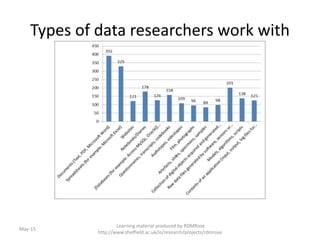
Types of data researchers work with
Learning material produced by RDMRose
http://www.sheffield.ac.uk/is/research/projects/rdmrose
May-15
Volume of research data they were
expecting to create during their
current research activities
10%
29%
8%
6%
9%
13%
1%
1%
24%
<1 GB
1-50 GB
50 -100 GB
100-500 GB
500 GB - 1 TB
1-50 TB
50-100 TB
>100 TB
I don't know
Learning material produced by RDMRose
http://www.sheffield.ac.uk/is/research/projects/rdmrose
May-15
Awareness of data policy
• Sheffield RDM policy published July 2012
• Survey in January 2014 found 33% were aware
• 38% of all respondents said they were aware
of their Funders’ requirements; 47% said they
were not aware.
Learning material produced by RDMRose
http://www.sheffield.ac.uk/is/research/projects/rdmrose
May-15
Attitudes to data sharing
Agree
strongly
Agree
somewhat
All those
agreeing
All those
actively
disagreeing
Tenopir et
al. (2010)
– strongly
agree
I would use other researchers'
datasets if their datasets were easily
accessible.
23% 41% 64% 14% 43%
I would be willing to place at least
some of my data into a central data
repository with no restrictions.
19% 37% 56% 22% 42%
I would be willing to place all of my
data into a central data repository
with no restrictions.
4% 17% 21% 59% 15%
I would be willing to share data across
a broad group of researchers.
19% 43% 62% 13% 37%
It is important that my data is cited
when used by other researchers
64% 23% 87% 4% 69%
Learning material produced by RDMRose
http://www.sheffield.ac.uk/is/research/projects/rdmrose
May-15
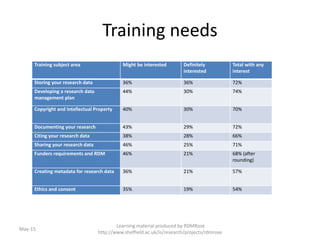
Training needs
Training subject area Might be interested Definitely
interested
Total with any
interest
Storing your research data 36% 36% 72%
Developing a research data
management plan
44% 30% 74%
Copyright and Intellectual Property 40% 30% 70%
Documenting your research 43% 29% 72%
Citing your research data 38% 28% 66%
Sharing your research data 46% 25% 71%
Funders requirements and RDM 46% 21% 68% (after
rounding)
Creating metadata for research data 36% 21% 57%
Ethics and consent 35% 19% 54%
Learning material produced by RDMRose
http://www.sheffield.ac.uk/is/research/projects/rdmrose
May-15
Comparing responses across
institutions
Sheffield Nottingham Essex
Top answer Developing a research data
management plan (74%)
Developing a research data
management plan (c60%)
Planning for data management
and sharing (50%)
Second Storing your research data (72%) Storing your research data (c46%) Storage and back up of data and
files (44%)
Third Documenting your research
(72%)
Copyright and Intellectual
Property (c40%)
Ethical and legal aspects of data
sharing and reuse (34%)
Fourth Sharing your research data (71%) Documenting your data (c38%) Costing data management,
preservation and sharing * (32%)
Fifth / joint fifth Copyright and Intellectual
Property (70%)
Sharing your data (c29%)
Data repositories and open access
*(c29%)
Freedom of information and
research data * (28%)
Data copyright and intellectual
property (28%)
Learning material produced by RDMRose
http://www.sheffield.ac.uk/is/research/projects/rdmrose
May-15
A comment on DAF surveys:
Read with caution
• Obstacles to comparability
– Failure to publish data at all
– Failure to publish data/results by role and department
– Failure to publish response rates
– Variations in questions asked
– Institutional differences
– Usual provisos about survey data
Learning material produced by RDMRose
http://www.sheffield.ac.uk/is/research/projects/rdmrose
May-15
University of Hertfordshire data asset
survey results
• Another useful example to explore is http://research-
data-toolkit.herts.ac.uk/2012/08/data-asset-survey-
results/
• Used it to estimate total data storage across institution
– But also to show concentration of this in a few research
groups (who are typically among the most well organised)
– Showed that FTP services still in use
– Use of email for storage (not secure)
– Evidence of lack of trust in central services; shows a
significant demand for long term storage
• Reveals ambiguities about beliefs around data
ownership
May-15
Learning material produced by RDMRose
http://www.sheffield.ac.uk/is/research/projects/rdmrose
REFERENCES
May-15
Learning material produced by RDMRose
http://www.sheffield.ac.uk/is/research/projects/rdmrose
References
• Cox, A.M. & Williamson, L. (2015). The 2014
DAF survey at the University of Sheffield,
International Digital Curation Conference,
London, 9th-12th February.
• Jones, S., Ross, S., & Ruusalepp, R. (2009).
Data Audit Framework Methodology (draft for
discussion, version 1.8). Glasgow: HATII.
Retrieved from http://www.data-
audit.eu/DAF_Methodology.pdf
May-15
Learning material produced by RDMRose
http://www.sheffield.ac.uk/is/research/projects/rdmrose

RDMRose 3.1 Data Asset Framewok surveys

  • 1.
    DAF survey May-15 Learning materialproduced by RDMRose http://www.sheffield.ac.uk/is/research/projects/rdmrose Research Data Management Workshop 3.1
  • 2.
    Sesion 3.1 overview •Data Asset Framework (DAF) • The Sheffield DAF survey May-15 Learning material produced by RDMRose http://www.sheffield.ac.uk/is/research/projects/rdmrose
  • 3.
    Value of anorganisational survey • Vital information about what researchers think and are doing – How much data they have; how often they back things up – Awareness of policy – Attitudes to data sharing; training • Identify people and groups who are pathfinders or problem areas • First step in raising awareness and making contacts • Valuable material for advocacy at a strategic level: research leaders do not know about the practices in their areas • Benchmark against comparable institutions Learning material produced by RDMRose http://www.sheffield.ac.uk/is/research/projects/rdmroseMay-15
  • 4.
    Data Asset Framework(DAF) • “A framework developed by the JISC-funded DAFD project to identify data assets held within Higher and Further Educational institutions and to explore how they are managed. The framework is structured around audit at departmental or unit level with results being amassed to obtain an institutional or national perspective.” (Jones, Ross, and Ruusalepp, 2009, p. 6) • http://www.data-audit.eu/documents.html • http://www.data- audit.eu/docs/DAF_Implementation_Guide.pdf May-15 Learning material produced by RDMRose http://www.sheffield.ac.uk/is/research/projects/rdmrose
  • 5.
    Four stages ofDAF • Stage 1 Plan the audit – Appoint an auditor – Establish a business case – Conduct initial research – Set up audit • Stage 2 Identify and classify data assets – Analysis of documentary sources – Conduct a written survey – Interviews – Prepare the data asset inventory • Vital, important and minor – Approve and finalise the asset classification May-15 Learning material produced by RDMRose http://www.sheffield.ac.uk/is/research/projects/rdmrose
  • 6.
    DAF 4 stages •Stage 3 Assess the management of data assets – Collect data on each data asset (Audit form 3: Jones, Ross, & Ruusalepp, 2009, pp. 45-51) • Description, provenance, ownership, location, retention, management • Stage 4 Reporting results and making recommendations – Produce audit report • Brief overview of the organisation • Profile of data holdings • Recommendations for improved asset management – Meet with management and finalise report May-15 Learning material produced by RDMRose http://www.sheffield.ac.uk/is/research/projects/rdmrose
  • 7.
    Choose your questions! •What are the key questions you would want to ask and why? • Are there things from your own interviews that you want to ask more people about? Learning material produced by RDMRose http://www.sheffield.ac.uk/is/research/projects/rdmrose May-15
  • 8.
    The Sheffield DAFsurvey • January 2014 • 432 responses • Analysis by role and faculty Learning material produced by RDMRose http://www.sheffield.ac.uk/is/research/projects/rdmrose May-15
  • 9.
    Types of dataresearchers work with Learning material produced by RDMRose http://www.sheffield.ac.uk/is/research/projects/rdmrose May-15
  • 10.
    Volume of researchdata they were expecting to create during their current research activities 10% 29% 8% 6% 9% 13% 1% 1% 24% <1 GB 1-50 GB 50 -100 GB 100-500 GB 500 GB - 1 TB 1-50 TB 50-100 TB >100 TB I don't know Learning material produced by RDMRose http://www.sheffield.ac.uk/is/research/projects/rdmrose May-15
  • 11.
    Awareness of datapolicy • Sheffield RDM policy published July 2012 • Survey in January 2014 found 33% were aware • 38% of all respondents said they were aware of their Funders’ requirements; 47% said they were not aware. Learning material produced by RDMRose http://www.sheffield.ac.uk/is/research/projects/rdmrose May-15
  • 12.
    Attitudes to datasharing Agree strongly Agree somewhat All those agreeing All those actively disagreeing Tenopir et al. (2010) – strongly agree I would use other researchers' datasets if their datasets were easily accessible. 23% 41% 64% 14% 43% I would be willing to place at least some of my data into a central data repository with no restrictions. 19% 37% 56% 22% 42% I would be willing to place all of my data into a central data repository with no restrictions. 4% 17% 21% 59% 15% I would be willing to share data across a broad group of researchers. 19% 43% 62% 13% 37% It is important that my data is cited when used by other researchers 64% 23% 87% 4% 69% Learning material produced by RDMRose http://www.sheffield.ac.uk/is/research/projects/rdmrose May-15
  • 13.
    Training needs Training subjectarea Might be interested Definitely interested Total with any interest Storing your research data 36% 36% 72% Developing a research data management plan 44% 30% 74% Copyright and Intellectual Property 40% 30% 70% Documenting your research 43% 29% 72% Citing your research data 38% 28% 66% Sharing your research data 46% 25% 71% Funders requirements and RDM 46% 21% 68% (after rounding) Creating metadata for research data 36% 21% 57% Ethics and consent 35% 19% 54% Learning material produced by RDMRose http://www.sheffield.ac.uk/is/research/projects/rdmrose May-15
  • 14.
    Comparing responses across institutions SheffieldNottingham Essex Top answer Developing a research data management plan (74%) Developing a research data management plan (c60%) Planning for data management and sharing (50%) Second Storing your research data (72%) Storing your research data (c46%) Storage and back up of data and files (44%) Third Documenting your research (72%) Copyright and Intellectual Property (c40%) Ethical and legal aspects of data sharing and reuse (34%) Fourth Sharing your research data (71%) Documenting your data (c38%) Costing data management, preservation and sharing * (32%) Fifth / joint fifth Copyright and Intellectual Property (70%) Sharing your data (c29%) Data repositories and open access *(c29%) Freedom of information and research data * (28%) Data copyright and intellectual property (28%) Learning material produced by RDMRose http://www.sheffield.ac.uk/is/research/projects/rdmrose May-15
  • 15.
    A comment onDAF surveys: Read with caution • Obstacles to comparability – Failure to publish data at all – Failure to publish data/results by role and department – Failure to publish response rates – Variations in questions asked – Institutional differences – Usual provisos about survey data Learning material produced by RDMRose http://www.sheffield.ac.uk/is/research/projects/rdmrose May-15
  • 16.
    University of Hertfordshiredata asset survey results • Another useful example to explore is http://research- data-toolkit.herts.ac.uk/2012/08/data-asset-survey- results/ • Used it to estimate total data storage across institution – But also to show concentration of this in a few research groups (who are typically among the most well organised) – Showed that FTP services still in use – Use of email for storage (not secure) – Evidence of lack of trust in central services; shows a significant demand for long term storage • Reveals ambiguities about beliefs around data ownership May-15 Learning material produced by RDMRose http://www.sheffield.ac.uk/is/research/projects/rdmrose
  • 17.
    REFERENCES May-15 Learning material producedby RDMRose http://www.sheffield.ac.uk/is/research/projects/rdmrose
  • 18.
    References • Cox, A.M.& Williamson, L. (2015). The 2014 DAF survey at the University of Sheffield, International Digital Curation Conference, London, 9th-12th February. • Jones, S., Ross, S., & Ruusalepp, R. (2009). Data Audit Framework Methodology (draft for discussion, version 1.8). Glasgow: HATII. Retrieved from http://www.data- audit.eu/DAF_Methodology.pdf May-15 Learning material produced by RDMRose http://www.sheffield.ac.uk/is/research/projects/rdmrose