Materials published here have a working paper character. They can be subject to further publi-cation. 
The views and opinions expressed here reflect the author(s) point of view and not neces-sarily 
those of CASE Network. 
This work has been prepared within the framework of the ENEPO project (EU Eastern 
Neighbourhood: Economic Potential and Future Development), financed within the Sixth Frame-work 
Programme of the European Commission. 
Keywords: EU countries, CIS, ENP 
Jel codes: P36, P45, P48, P51, P52 
© CASE – Center for Social and Economic Research, Warsaw, 2008 
Graphic Design: Agnieszka Natalia Bury 
EAN 9788371784668 
Publisher: 
CASE-Center for Social and Economic Research on behalf of CASE Network 
12 Sienkiewicza, 00-010 Warsaw, Poland 
tel.: (48 22) 622 66 27, 828 61 33, fax: (48 22) 828 60 69 
e-mail: case@case-research.eu 
http://www.case-research.eu
The CASE Network is a group of economic and social research centers in Poland, Kyrgyzstan, 
Ukraine, Georgia, Moldova, and Belarus. Organizations in the network regularly conduct joint re-search 
and advisory projects. The research covers a wide spectrum of economic and social issues, 
including economic effects of the European integration process, economic relations between the 
EU and CIS, monetary policy and euro-accession, innovation and competitiveness, and labour 
markets and social policy. The network aims to increase the range and quality of economic re-search 
and information available to policy-makers and civil society, and takes an active role in on-going 
debates on how to meet the economic challenges facing the EU, post-transition countries 
and the global economy. 
The CASE network consists of: 
• CASE – Center for Social and Economic Research, Warsaw, est. 1991, 
www.case-research.eu 
• CASE – Center for Social and Economic Research – Kyrgyzstan, est. 1998, 
www.case.elcat.kg 
• Center for Social and Economic Research - CASE Ukraine, est. 1999, 
www.case-ukraine.kiev.ua 
• CASE – Transcaucasus Center for Social and Economic Research, est. 2000, 
www.case-transcaucasus.org.ge 
• Foundation for Social and Economic Research CASE Moldova, est. 2003, 
www.case.com.md 
• CASE Belarus - Center for Social and Economic Research Belarus, est. 2007.
George Dura 
Contents 
Introduction ....................................................................................................................................... 7 
PART I – Russia ............................................................................................................................... 9 
I.1. EU relations with Russia ......................................................................................................... 9 
I.2. Interests in political and security cooperation........................................................................ 10 
a. Russia as a foreign policy priority? ...................................................................................... 10 
b. The choice of foreign policy type and bilateral disputes ...................................................... 10 
c. Influencing the EU-Russia agenda ...................................................................................... 14 
d. Bilateral visa regime and the effects of EU accession......................................................... 15 
e. Cross-border cooperation. ................................................................................................... 16 
f. Cultural relations................................................................................................................... 17 
I.3. Interests in economic and energy cooperation...................................................................... 17 
a. Trade volume, investments and the importance of Russia in bilateral trade ....................... 17 
b. Bilateral economic cooperation............................................................................................ 18 
c. Energy cooperation and investments................................................................................... 20 
PART II – The Eastern ENP region ................................................................................................ 24 
II.1. The EU’s relations with the EENP region............................................................................. 24 
II.2. Interests in political and security cooperation....................................................................... 24 
a. The EENP region as a foreign policy priority? ..................................................................... 24 
b. Influencing the EU agenda on the ENP East and promoting regional cooperation ............. 25 
c. Specific bilateral interests in political and security cooperation ........................................... 27 
d. Bilateral visa regime and the effects of EU accession......................................................... 32 
е. Cross-border cooperation .................................................................................................... 34 
II.3. Interests in economic and energy cooperation..................................................................... 35 
a. Trade volume and the relative importance of the region ..................................................... 35 
b. Energy cooperation and investments .................................................................................. 35 
PART III – Central Asia................................................................................................................... 36 
III.1. The EU’s relations with Central Asia ................................................................................... 36 
III.2. Interests in political and security cooperation...................................................................... 36 
III.3. Interests in economic and energy cooperation.................................................................... 40 
a. Trade volume and relative importance of the region ........................................................... 40 
b. Energy cooperation and investments .................................................................................. 41 
Conclusion ...................................................................................................................................... 42 
Annexes.......................................................................................................................................... 47 
4 CASE Network Studies & Analyses No. 368
THE EU AND ITS MEMBER STATES: PURSUING DIVERSE INTERESTS IN THE CIS REGION 
Author 
George Dura is a researcher at the Centre for European Policy Studies in Brussels and a 
Ph.D candidate in Political Science at the Catholic University of Louvain in Belgium. He studied 
Political Science at the University of Kent, in the United Kingdom, and at the Free University of 
Brussels and graduated in 2002. He acquired work experience at the European Commission and 
at the EU Institute for Security Studies in Paris. He joined the Centre for European Policy Studies 
in 2005 and his research interests include EU enlargement, the European Neighbourhood policy 
and conflict resolution in Moldova. In March 2008, he was awarded a scholarship within the pro-gramme 
on “European Foreign and Security Policy Studies”, jointly developed by the Compagnia 
di San Paolo, Turin/Italy, the Riksbankens Jubileumsfond, Stockholm/Sweden, and the Volks-wagenStiftung, 
Hanover/Germany. Since 2004, he has collaborated with Freedom House, a US-based 
non-profit organisation, by co-authoring the chapters on Moldova on a yearly basis for the 
Freedom House annual publication “Nations in Transit”. 
CASE Network Studies & Analyses No. 368 5
George Dura 
Abstract 
The CIS region is of vital importance for the EU countries considering that both are intercon-nected 
through cooperation or membership in supranational political and economic institutions 
(OSCE, WTO, OECD, NATO, etc.), through transport and energy corridors, through investment, 
trade and migration trends. The interests of EU member states in the region are very diverse and 
are sometimes pursued in contradiction to one another. The overarching interest is of an economic 
nature, given the large reserves of natural resources (particularly gas and oil) and due to the size 
of the CIS market of 277 million consumers. Security and immigration issues also rank high on the 
list, whereas EU countries are less concerned with democratisation trends in the CIS. Russia is the 
most important CIS partner for a majority of EU countries. Energy plays a disproportionally high 
role in EU member states (MS) – Russia relations and is also a strong determinant of the overall 
heterogeneity of EU MS policies towards Russia. The type of bilateral relations which the EU MS 
maintain with one sub-region of the CIS (particularly the EENP, but increasingly also Central Asia) 
also affects their relations with Russia. Cultural closeness and a common history still play a large 
part in the development of bilateral relations. The accession to the EU of Central and Eastern 
European states has altered the existing relations between them and their eastern CIS neighbours, 
thereby also modifying their interests in the region. Regrettably, the EU’s policies towards Russia 
and the EENP region have not yet been able to provide a playing field able to compensate for this 
alteration. Thus, the present report studies the various interests (political, security, economic, cul-tural) 
which underpin relations between the EU member states and the CIS countries and also dis-cusses 
the latest developments in EU policies towards a specific CIS sub-region (Russia, the 
Eastern ENP and Central Asia), thereby providing a broad picture of the type of interests, how they 
are pursued by the EU member states and where these intersect or clash. 
6 CASE Network Studies & Analyses No. 368
THE EU AND ITS MEMBER STATES: PURSUING DIVERSE INTERESTS IN THE CIS REGION 
Introduction 
The establishment of the Commonwealth of Independent States (CIS) in December 1991 
marked the end of the Soviet Union. Created with the purpose of preventing the total disintegration 
of the post-Soviet space, it was initially formed by a nucleus of states: the Russian Federation, 
Ukraine and Belarus. The five Central Asian states subsequently joined without much hesitation. 
The three Baltic States, Estonia, Latvia and Lithuania, refused to join the CIS altogether and opted 
for European and Euro-Atlantic integration instead. All the other former Soviet republics joined the 
CIS more reluctantly and mainly out of economic considerations. 
Most of the CIS states embarked on political1 and economic2 reforms after independence, but 
in some of them such reforms have experienced a reversal or have stagnated, particularly in the 
field of democratisation. Some of the group is heavily industrialised and/or has vast energy re-sources 
at its disposal, while others have remained largely agricultural and economically underde-veloped. 
The region is still affected by separatist and interstate conflicts, a politically unstable 
neighbourhood, the threat of terrorist attacks, Islamic radicalism and other security threats (drugs 
and human trafficking). 
The CIS is not a homogenous region but consists of countries which are diverse politically, 
economically and culturally. Some of them have rediscovered their shared historical, cultural and 
linguistic affinities with countries lying further westward, notably in the EU. The four European CIS 
states border the EU and their problems affect EU member states (EU MS) more directly than the 
more distant countries (for instance in Central Asia). 
Taking into consideration the above mentioned CIS heterogeneity, the EU has also applied a 
certain degree of differentiation in the formulation of its policy towards the CIS. Initially, the EU 
signed and ratified the Partnership and Cooperation Agreements (PCAs) with all the CIS states in 
the 1990s (with the exception of Belarus and Turkmenistan, due their poor human rights record). 
Later, however, the EU introduced a measure of differentiation by adopting common strategies on 
Russia (June 1999) and Ukraine (December 1999), which were a sign of recognition of their politi-cal 
and economic importance, and an expression of a more ambitious agenda towards them in 
comparison with other CIS states. 
In the years preceding its Eastern Enlargement (in 2004 and 2007), the EU further increased 
its degree of policy differentiation to the point that one could distinguish between three different 
groups of countries: Russia, the EU’s immediate neighbours and Central Asian states. For the 
latter two groups of states, the EU adopted the European Neighbourhood Policy (ENP) (European 
Commission, 2004) in 2003-2004 and the EU-Central Asia Strategy (European Council, 2007) in 
2007. In addition, within these two EU policy frameworks (the ENP and Central Asian Strategy) 
additional differentiation is possible, allowing each country to establish a closer partnership with the 
EU on the basis of its own capabilities and ambitions. Russia rejected participation in the ENP and 
the EU and Russia established the four common spaces in May 2003 as the framework for closer 
relations3. 
The EU has also had to take into account the myriad and complex web of political, economic, 
security and cultural interests which individual EU member states (EU MS) have in the CIS region. 
The incremental strengthening of EU policies (for instance of the ENP in 2007) (European 
Commission, 2007) is a way of accommodating to these diverging interests. For instance, some 
EU MS may favour stronger ties with Russia without wishing to burden this relationship with talks 
on human rights, whereas other EU MS may insist on including such issues. Some EU MS are 
lobbying for Ukraine’s accession to the EU, whereas others prefer to put this on hold for the time 
being. This paper seeks to shed light on the main interests of the EU MS with regard to CIS states 
and present its findings against the background of the EU’s policies towards the CIS region. The 
companion study (Menkiszak, Konończuk and Kaczmarski, 2008) provides an analysis of the 
heterogeneity of CIS countries’ interests and policies towards the EU. 
This report follows the EU’s categorisation, which divides the CIS into three parts: Russia, the 
Eastern ENP states (EENP) and the Central Asian states (CAS). The first part deals with Russia, 
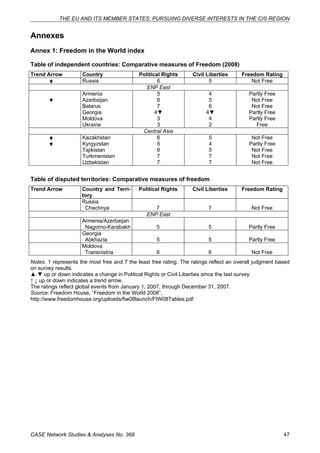
1 See annex 1: “Freedom in the world” index. 
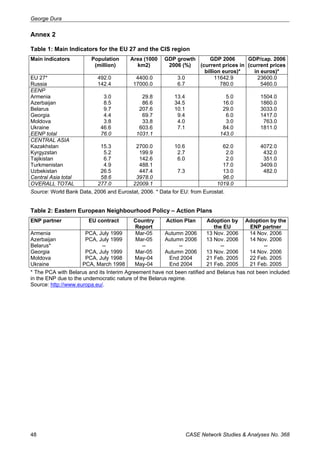
2 See annex 2, Table 1: Main Indicators for the EU 27 and the CIS region. 
3 European Commission’s webpage on EU-Russia relations: 
http://ec.europa.eu/external_relations/russia/intro/index.htm. 
CASE Network Studies & Analyses No. 368 7
George Dura 
the second part with the EENP and the third part with Central Asia. Political interests include 
political cooperation and dialogue (including issues of human rights and good governance), 
cooperation in the field of security and foreign policy, cooperation in justice and home affairs, 
cultural cooperation and cross-border cooperation. Economic interests include a review of the level 
of trade (the proportion of EU MS trade conducted with the three CIS sub-regions), trade disputes, 
bilateral investments, energy dependence and energy cooperation and investments. Each part will 
be preceded with a few paragraphs on the latest developments in EU policies towards a specific 
CIS sub-region. 
The report is based on existing literature in the field (policy papers, books and reports) as well 
as official press releases, statements and speeches. In addition, press articles and information 
from the websites of the ministries of foreign affairs of the EU MS and CIS countries have proven 
to be valuable research tools. With regard to statistical data, the report has used the existing and 
freely available online databases (Eurostat, the World Bank database, the International Trade Cen-tre 
statistics, the United Nations Commodity Trade Statistics Database and the CIA World Fact 
Book). The report is also based on a number of face-to-face interviews with EU MS diplomats in 
Brussels and EU officials, as well as experts and it incorporates the findings of questionnaires sent 
out to the embassies of the EU MS in all 12 CIS states. Work on this paper was finished prior to 
the outbreak of the Russian-Georgian conflict in August 2008 and hence does not take into ac-count 
its repercussions. 
8 CASE Network Studies & Analyses No. 368
THE EU AND ITS MEMBER STATES: PURSUING DIVERSE INTERESTS IN THE CIS REGION 
PART I – Russia 
I.1. EU relations with Russia 
Russia has always been a rather odd partner for the EU and despite the declared ambition to 
build a strategic partnership the results have fallen short of expectations. Russia has to date not 
expressed its intention to join the EU, but does aspire to close and privileged relations between 
equals. The PCA has not brought any closer the EU’s ambitions and Russia’s expectations of 
building a solid partnership. The EU and Russia agreed on four common spaces at the Saint Pe-tersburg 
summit in May 2003, composed of a common economic space, a common space of free-dom, 
security and justice, a common space in the field of external security and a common space in 
the field of research and education. The pace of the implementation process of the common 
spaces has been rather slow, in particular in the field of external security and freedom, security and 
justice (despite the signature of a visa facilitation and readmission agreement at the Sochi EU-Russia 
summit in May 2006)4. 
As Russia became stronger economically and more assertive on the international scene in 
President Putin’s second term, Russia showed visible signs of irritation towards EU criticism (on 
the second war in Chechnya, on the general human rights situation there and in other parts of 
Russia, on the level of state control over the economy and in the press and media and on the re-versal 
of the democratisation trend), while Russia claimed it was merely implementing its own 
model of ‘sovereign democracy’5. The EU’s 2004 enlargement also caused frictions with Russia, 
notably on trade issues and with regard to the Russian exclave of Kaliningrad, which became sur-rounded 
by the EU after the accession of Poland and Lithuania. The EU’s regional initiatives, such 
as the Northern Dimension and the Black Sea Synergy, which involve Russia, the EU MS and non- 
EU states, have not been received with great enthusiasm by Russia. Russia has in general viewed 
the EU’s increasing involvement in its ‘shared neighbourhood’, through the ENP and the Central 
Asia Strategy, with mistrust. 
However, political disagreements have not prevented bilateral trade from flourishing. The EU’s 
exports to Russia more than tripled and its imports more than doubled in 2006 compared to 2000 
and Russia had a trade surplus of €68 billion in 2006, according to Eurostat data. Today, Russia 
conducts 50% of its foreign trade with the EU. In addition, the EU’s foreign direct investment in 
Russia reached €10.6 billion in 2006 and €17.1 billion in 2007. Russia accounted for close to 40% 
of the EU 27’s natural gas imports and more than 30% of its crude oil imports in 2007. As such, 
about 80% of Russia’s energy exports go towards the EU. This growing dependence on Russian 
energy supplies and the gas disputes between Russia and its neighbours, Ukraine and Belarus, in 
2006 and 2007 has prompted EU attempts to develop a “coherent external energy policy”6 and to 
promote energy projects such as the Nabucco pipeline, which should decrease its dependence on 
Russian energy. In addition, the EU has also insisted that Russia ratify the Energy Charter Treaty 
and that it agrees to some form of its Transit Protocol (Behrens and Egenhofer, 2008; p. 23). 
The EU and Russia agreed to develop a strategic partnership at the bilateral summit in Sochi 
in May 2006, but despite the expiration of the PCA in December 2007 (which was automatically 
extended for another year), there has been opposition within the EU to the terms of a new frame-work 
agreement following strained bilateral relations between Russia and certain EU MS (notably, 
Poland, Lithuania and also the UK), as well as a general dissatisfaction in Brussels with Russia’s 
internal and external policies. The list is long but includes dissatisfaction with the Russia’s ‘sover-eign 
democracy’, suspicious circumstances surrounding the murders of ex-KBD agent Alexandr 
Litvinenko and Russian journalist Anna Politkovskaia, the only partially free parliamentary and 
presidential elections in December 2007 and March 2008 and the limitation on OSCE election ob-servers, 
the aggressive commercial tactics of Gazprom in certain EU countries, Russia’s high-handed 
energy tactics in Ukraine and Belarus, Russia’s uncooperative attitude towards resolving 
4 European Commission Delegation to Russia, http://www.delrus.ec.europa.eu/en/p_507.htm. 
5 This paper was finalised before the outbreak of the Russian-Georgian conflict in August 2008 and 
hence does not incorporate the very recent changes in the EU MS and EU policies towards Russia, Georgia 
and other parts of CIS. 
6 European Commission’s webpage on “External Energy Policy”, 
http://ec.europa.eu/external_relations/energy/index.htm. 
CASE Network Studies & Analyses No. 368 9
George Dura 
the frozen conflicts in the post-Soviet region and various trade disputes and diplomatic rows with 
several EU MS. 
I.2. Interests in political and security cooperation 
a. Russia as a foreign policy priority? 
All 27 EU MS have embassies in Russia. However, they represent different political and eco-nomic 
interests vis-à-vis Russia and hence not all of them aspire to the same level of bilateral rela-tions. 
A limited number of EU MS (the big ones), such as France, Germany and Italy, view their 
bilateral relations with Russia as strategic (both politically and economically), as that between 
equal powers in the international arena, which must be maintained at a good level at all cost. Shifts 
in the domestic power-structure in these countries may temporarily affect the declaratory diplo-macy 
on Russia, but without leading to major policy shifts or a marked worsening of relations with 
Russia. One EU MS missing from this group is the UK, which fits into a different category. Three 
EU MS, Cyprus, Greece and Bulgaria, have very strong political relations, based on historical and 
close cultural ties (including religious), which are also visible in strong cooperation over the full 
spectrum of political and security issues (including on foreign policy) and in the economic and en-ergy 
field. Other EU MS, such as Austria, Belgium, Finland, Hungary, the Netherlands, Slovenia 
and Sweden, have established friendly (at least at a declaratory level) and pragmatic political rela-tions, 
which are underpinned by strong economic cooperation, including in the field of energy. 
Spain also fits into this category, also mentioning that, due to its size, Russia treats Spain more on 
a par with France or Italy, although Spain itself does not aspire to the kind of political relations 
which France, Germany or Italy maintain with Russia. Some EU MS, such as the Czech Republic, 
Denmark and Slovakia, have relations which fluctuate between a more friendly and a more con-frontational 
attitude towards Russia, depending on domestic politics and foreign policy orientation. 
However, economic relations remain very pragmatic and developed. Another category of EU MS, 
such as the Baltic States, Poland, Romania and the United Kingdom, have (at times) strained po-litical 
relations with Russia, which does not impede strong cooperation in the economic and energy 
fields. However, strained political relations may impact negatively on trade, economic and energy 
cooperation, but also on cooperation in the security and the cultural field (the UK particularly). Fi-nally, 
a limited number of EU MS, such as Ireland, Luxembourg, Malta and Portugal, do not con-sider 
Russia as a foreign policy priority and do not aspire to strong political relations with Russia, 
due to its geographic distance or size, but they may nevertheless have strong economic or finan-cial 
interests. 
An alternative classification is provided by Leonard and Popescu (2007), who divide the EU 
MS into the following categories: ‘Trojan Horses’ (Cyprus and Greece), who often defend Russian 
interests in the EU, and are willing to veto common EU positions; ‘Strategic Partners’ (France, 
Germany, Italy and Spain), who enjoy a ‘special relationship’ with Russia that occasionally under-mines 
common EU policies; ‘Friendly Pragmatists’ (Austria, Belgium, Bulgaria, Finland, Hungary, 
Luxembourg, Malta, Portugal, Slovakia and Slovenia), who maintain a close relationship with Rus-sia 
and tend to put their business interests above political goals; ‘Frosty Pragmatists’ (Czech Re-public, 
Denmark, Estonia, Ireland, Latvia, the Netherlands, Romania, Sweden and the United 
Kingdom) who also focus on business interests but are less afraid than others to speak out against 
Russian behaviour on human rights or other issues; and ‘New Cold Warriors’ (Lithuania and Po-land). 
b. The choice of foreign policy type and bilateral disputes 
The level of ambition in bilateral relations with Russia tends also to determine the type of for-eign 
policy towards Russia. Many EU MS refrain from issuing strong public criticism of Russia’s 
democratisation process, human rights record and governance and give priority to developing 
strong economic relations. This is the case with Austria, Belgium, Bulgaria, Cyprus, Finland, 
France, Germany, Greece, Hungary, Italy, Luxembourg, Malta, Portugal, Romania, Slovakia, Slo-venia, 
and Spain. However, concerns on human rights and democratisation in Russia may have 
been expressed during bilateral contact or in a multilateral setting, through international organisa-tions 
(the UN, the EU, the OSCE, the Council of Europe). Germany or France, which maintain 
10 CASE Network Studies & Analyses No. 368
THE EU AND ITS MEMBER STATES: PURSUING DIVERSE INTERESTS IN THE CIS REGION 
strong relations with Russia based on trust, feel confident enough to confront Russia on these is-sues 
(underpinned by a strong civil society and activist press), but officials also tend to know where 
to draw the line on such criticism. 
Other EU MS states, such as the Czech Republic, Denmark, Ireland, the Netherlands and 
Sweden are very vocal in their criticism of the domestic situation in Russia (in the field of human 
rights, notably in Chechnya, and on aspects of democratisation). This is due to the fact that these 
EU MS have traditionally developed a strong normative-driven foreign policy and raising such is-sues 
is part of the promotion of the national interests of these EU MS in Russia. Other EU MS, 
such as the Baltic States, Poland, and the United Kingdom, have also used normative arguments 
in their various disputes with Russia. Not surprisingly, those EU MS (Denmark, Ireland and Swe-den) 
with a more value-driven foreign policy still provide substantial bilateral development assis-tance 
or economic and technical assistance to Russia. 
Does value-driven foreign policy tend to induce bilateral disputes? In most cases, there is a di-rect 
link, provided that such a value-driven foreign policy is the result of a broader confrontational 
foreign policy vis-à-vis Russia. Bilateral disputes often emerge when EU MS foreign policy con-fronts 
Russian foreign policy and economic interests, rather than accommodates them, in addition 
to criticism of Russia’s domestic politics. In other words, an EU MS can conduct a value-driven 
(critical) foreign policy towards Russia, but one which at the same time also accommodates Rus-sian 
foreign policy interests. Additionally, Russia makes a distinction between states which defend 
their own foreign policy interests (for instance in the EU neighbourhood, such as Hungary), and 
those EU MS who do this with the additional intention of diminishing Russia’s influence (in a zero-sum 
game scenario), such as for instance Poland. Certain EU MS, such as the Baltic States, the 
Czech Republic, Poland, Romania and the United Kingdom, maintain a foreign policy which con-fronts 
Russia’s foreign policy interests in the EU, by calling for increased intra-EU solidarity, by fa-vouring 
a stronger ENP or outright EU enlargement to the EENP region7, and by favouring a 
stronger and expanded NATO (notably a comprehensive NATO missile shield and NATO enlarge-ment 
to the EENP region). Most of these EU MS have paid the price for conducting confrontational 
foreign policy which hurts Russian political, economic and energy interests by becoming entangled 
in (or having only recently resolved) disputes with Russia. 
The Baltic States have criticised Russia for undermining intra-EU solidarity, for not living up to 
its international commitments of withdrawing its troops from Georgia and Moldova, for not imple-menting 
the Energy Charter Treaty, for acting as a monopolistic energy exporter and for not hon-ouring 
its obligations as a member of the Council of Europe and the OSCE8. Estonia has still not 
signed a border treaty with Russia and Latvia only signed it in 2007, after more than nine years of 
negotiations. The relocation of the “bronze soldier”, a Soviet war memorial, from the centre of Tal-linn 
in April 2007 by the Estonian authorities9 also heightened tensions with Russia. Political fric-tions 
also stem from the unequal treatment of Russian minorities in Estonia and Latvia, which have 
created many “non-citizens” amongst ethnic Russians. The problem is more acute in Latvia, where 
the Russian community numbers 650,000 or 29% of the total population, of whom 54% have been 
unable to obtain Latvian citizenship (and hence the right to vote). In Estonia, the Russian minority 
numbers 300,000 people and represents 26% of Estonia’s total population, of which 35% do not 
have any defined citizenship. In Lithuania, Lithuanian citizenship was immediately offered to all 
residents, irrespective of their ethnic origin, including the 245,000 Russians (7% of the total popula-tion). 
The poor state of Polish-Russian relations results, to a large extent, from Poland’s political ac-tiveness 
in Russia’s ‘near abroad’, particularly in Ukraine and Belarus (Unge et al., 2006). In the 
years preceding Poland’s accession to the EU in 2004 Poland established the concept of the East- 
7 See more on this in the next section on the EENP region. 
8 “Completing Europe: Integration with Neighbours and Engagement with Russia”, Speech by Valdas 
Adamkus, President of the Republic of Lithuania in the London School of Economics and Political Science, 
15 February 2008, http://www.euro.lt. 
9 The Estonian embassy in Moscow was attacked and the Estonian authorities even claimed their gov-ernmental 
websites and websites of major Estonian companies were subjected to a cyber-attacks emanating 
from Russia. 
CASE Network Studies & Analyses No. 368 11
George Dura 
ern Dimension10 in a non-paper in 2003 (building upon its Eastern policy of the 1990s, which 
sought to promote democratisation and human rights in countries such as Belarus and Ukraine and 
bring them closer to the EU). Russia vehemently criticised Poland’s (but also the EU’s and Lithua-nia’s) 
mediator role during the ‘Orange Revolution’ in November 2004. After its accession to the 
EU, Poland (together with Sweden) has also sought ways to increase the EU’s role in the region 
and has proposed an ‘Eastern Dimension’ policy at the EU level, which was adopted by the Euro-pean 
Council in June 2008, on the proviso that the new initiative should respect the character of 
the ENP as a single and coherent policy framework and that it should bring added-value and be 
complementary to the Black Sea Synergy and the Northern Dimension11. This has been seen as a 
challenge to Russia’s leading role in the region. Further frictions have been caused by Russia’s 
(Gazprom’s) energy policies, through the construction of the Russian-German Nord Stream gas 
pipeline, which bypasses Poland. 
Romania’s relations with Russia have not been very cordial since the fall of the Berlin Wall, 
due to the historical dispute over Bessarabia (roughly, the present-day Republic of Moldova), a 
former Romanian province. Romania has repeatedly called for the withdrawal of Russian troops 
from Moldova. Romania also views the Russian influence in the EENP region and in particular in 
the Black Sea region as opposing its own regional ambitions, accusing Russia of treating the Black 
Sea as a Russian lake12. 
Poland and the Czech Republic have also experienced rocky relations with Russia due to their 
cooperation with the US and NATO on security-related matters, notably the US missile defence 
shield. To a more limited extent this has also been the case for Romania and Bulgaria, who ac-cepted 
the hosting of US bases on their territory, a move which was strongly denounced by Rus-sia. 
The United Kingdom is the only one big EU member state that has had strained relations with 
Russia in recent years, despite attempts to develop a ‘strategic partnership’ under former Prime 
Minister Tony Blair. The former UK Ambassador to Russia, Anthony Brenton, was an outspoken 
critic of Russia’s domestic policy. Political relations worsened after BP and Shell were forced to sell 
(below their estimated value) their controlling stakes in exploration of the Sakhalin II and Kovykta 
gas fields to Gazprom. The trend continued after the November 2006 assassination of Alexander 
Litvinenko, a former FSB officer, in November 2006 in London. On 25 October 2007 Russia an-nounced 
that it would close down two offices of the British Council (BC) in Saint Petersburg and 
Yekaterinburg13. The UK and Russia have also been at odds on major international security issues, 
notably due the UK’s strong partnership with the US in the global anti-terrorist efforts, insistence on 
the ratification of the Conventional Forces in Europe (CFE) Treaty and NATO’s expansion efforts. 
A number of EU MS such as Austria, Belgium, Bulgaria, Cyprus, Finland, France, Germany, 
Greece, Ireland, Italy, Luxembourg, Malta, Portugal, Spain have given priority to accommodating 
Russia’s foreign policy interests and its economic and energy interests in the EU and the EENP 
region and their foreign policy is not conducted in confrontation to Russia’s on these issues. These 
countries do not favour the accession of EENP states to the EU and only push for a strengthening 
of the ENP insofar as it meets their own foreign policy goals, while giving due consideration to 
Russian concerns (the best example is Germany’s ‘New Ostpolitik’ in which a strengthened ENP is 
meant to replace an EU accession perspective for EENP states) (Kempe, 2007). Additionally, 
these EU MS are also more reluctant with regard to the enlargement of NATO to include Ukraine 
and Georgia. Nevertheless, France has softened its stance on Ukraine, and more recently seems 
to favour the signature of the Enhanced Agreement with Ukraine that would recognise Ukraine’s 
accession prospects14. 
10 "The Eastern Dimension of the European Union. The Polish View" Speech by Włodzimierz Cimosze-wicz, 
Polish Minister of Foreign Affairs, at the Conference "The EU Enlargement and Neighbourhood Policy" 
Warsaw, 20 February 2003, http://www.msz.gov.pl. 
11 Presidency Conclusions on the Eastern Partnership, Brussels European Council, 19-20 June 2008. 
12 “Traian Basescu wants to do business with the Russia lake”, Cotidianul (Romanian daily newspaper), 
4 April 2008. 
13 Yury Fedotov, Ambassador of the Russian Federation to the United Kingdom, Oral Evidence to the 
EU Sub-Committee C, House of Lords, on “Russia-EU relations”, 7 February 2008, http://www.great-britain. 
mid.ru/speech/016.htm. 
14 “La France regarde vers l’Est et plaide pour l’Ucraine en Europe”, Le Monde, 29 April 2008. 
12 CASE Network Studies & Analyses No. 368
THE EU AND ITS MEMBER STATES: PURSUING DIVERSE INTERESTS IN THE CIS REGION 
Certain EU MS (the Baltic States, Poland and Romania) but also Sweden maintain a foreign 
policy that is confrontational to Russia’s economic or energy interests (for instance on the con-struction 
of the Nord or South Stream pipelines) in the EU and in the CIS (by favouring stronger 
energy links with the Caspian region). Sweden has rejected the application for permission to con-struct 
the Nord Stream pipeline through its territorial waters in the Baltic Sea on the grounds that 
the application lacks a substantial environmental consequence analysis15. Romania may follow 
Sweden’s example with regard to the South Stream in the Black Sea. Romania strongly backs the 
EU’s Nabucco project and has rejected the offer to join Russia’s rival South Stream project. Roma-nia 
also pays one of the highest prices in Europe for Russian gas. In contrast, Austria, Bulgaria, 
Greece, Germany, Hungary and Italy have made important energy deals with Russia and cooper-ate 
either on the Nord Stream or the South Stream projects with Gazprom, projects that are con-sidered 
by some EU MS to undermine EU efforts at diversifying gas supply through projects such 
as Nabucco (Leonard and Popescu, 2007). 
Finland has been involved in a commercial dispute with Russia due to Russia’s intention to 
raise export tariffs on unprocessed timber to about 25% in April 2008 and to 80% in 2009 in order 
to develop its domestic wood processing and manufacturing, as opposed to exporting the raw ma-terial16. 
This could affect the Finnish pulp and paper industry. Despite this, Finland has sought a 
negotiated way out of this dispute and has not involved the EU (in contrast to Poland, for instance, 
in its dispute on the Russian embargo on Polish meat). The raising of tariffs on Russian wood has 
also angered Sweden, which has cast doubts at EU level about Russia’s commitment to join the 
WTO17. 
Hungary also seems to have a dual approach towards Russia. Hungary aspires to friendly and 
pragmatic relations with Russia, due to its heavy dependence on Russian energy and the strong 
presence of Russian capital in its economy. However, Hungary is divided along political lines, with 
the current socialist government seeking closer economic and political ties with Russia, whereas 
the main opposition party Fidesz is constantly denouncing the growing influence of Russia in Hun-gary. 
Hungary’s energy deals with Russia and cooperation on the South Stream pipeline have un-dermined 
its commitment to the Nabucco pipeline and the Prime Minster even remarked that the 
Nabucco pipeline is a “dream one cannot use for heating” 18. On the other hand, Hungary remains 
a strong supporter of greater EU involvement in the EENP region. For instance, Hungary has been 
in favour of sending an EU peace support operation mission to Moldova, which Russia opposes 
(Leonard and Popescu, 2007). 
Russia is also considered as a very important player on the international arena and some 
states promote Russia’s interests in the hope that Russia will return the favour. For instance, Cy-prus 
has received Russian support on the UN Security Council in its rejection of the Annan Peace 
Plan in 2004. Greece has traditionally also called on Russian support in its foreign policy over Cy-prus 
and Turkey. France and Germany considered Russia’s support on the UN Security Council 
crucial in opposing the US-led invasion of Iraq in 2003. They have also coordinated their positions 
with Russia on Iran and on the Middle East. France also has strong cooperation on intelligence 
and anti-terrorism with Russia, whereas the UK broke off such cooperation due to worsening dip-lomatic 
relations in 2007. Germany considers Russia essential for cooperation on international 
matters (energy security, arms control, the fight against terrorism, stability in the Western Balkans). 
Russia’s support is also crucial for EU MS that are members of NATO and which have troops sta-tioned 
in Afghanistan. At the NATO-Russia Council on 4 April 2008, Russia agreed to provide ac-cess 
through its territory for the supply of non-military equipment and food for NATO forces sta-tioned 
in Afghanistan. Further, many EU MS also engage with Russia in various regional organisa-tions, 
such as the Council of the Baltic Sea States, the Black Sea Economic Cooperation, etc. In-terestingly 
though, France and the UK called in March 2008, in a letter addressed to the EU Presi- 
15 “Swedish government rejects pipeline application”, Stockholm News, 17 February 2008. 
16 Ibid. 
17 “Russian wood tariff angers Sweden”, The Financial Times, 7 May 2008. 
18 “Geopolitical realities - Foreign Minister Kinga Göncz on Hungary’s new foreign policy”, Interview, Fi-gyelő, 
Hungarian weekly, 12 April 2007. 
CASE Network Studies & Analyses No. 368 13
George Dura 
dency, for the right collective response to a more assertive Russia, whose foreign, security, eco-nomic 
and internal policies have given many EU MS cause for concern over recent years19. 
c. Influencing the EU-Russia agenda 
Certain EU MS are considered the main ‘speaking-partners’ for Russia in the EU, such as 
France, Germany, Italy and to a lesser extent Austria, Bulgaria, Cyprus, Finland, Greece, Hungary 
and Slovenia, which at times defend Russian interests when shaping EU policy towards Russia or 
the EENP region. Such policies of smaller EU MS may sometimes be related to economic reasons 
or be linked to Russian political support in the international arena (Greece and Cyprus), and in the 
case of larger EU MS may stem from strong economic relations and a prioritisation of bilateral rela-tions 
with Russia. A number of EU MS, such as Austria, Cyprus, France (due to its EU Presidency 
in the second half of 2008), Greece and Slovenia (due to its EU Presidency in the first half of 2008) 
strongly favour an early conclusion of the new EU-Russia partnership agreement without holding it 
hostage to bilateral disputes between certain EU MS and Russia. 
France, under President Sarkozy and Foreign Affairs Minister Kouchner, has also adopted a 
more realistic approach towards Russia. However, France is still considered a 'locomotive' for EU-Russia 
relations20. It is expected to conduct the negotiations on a new EU-Russia partnership 
agreement under its Presidency of the EU in the second half of 2008. In Italy, with the return of Sil-vio 
Berlusconi (a well-known defender of Russian interests in the EU and close friend of Putin) to 
power in April 2008, Russia will regain a great ally in the EU. Germany has traditionally been Rus-sia’s 
strongest ally within the EU with very close political ties based on personal relationships (H. 
Kohl and B. Yeltsin; G. Schröder and V. Putin). Germany considers Russia as an indispensable 
strategic partner of the EU and, along with France, has been the initiator and promoter of the four 
common spaces in EU-Russia relations. However, as part of its new ‘Ostpolitik’, Germany, under 
Chancellor Angela Merkel, has dropped its ‘Russia-first’ approach and chosen a more balanced 
policy which also takes into consideration the interests of EENP states (Kempe, 2007; p.3) 21. 
Merkel called for “intra-EU solidarity” with Poland and Lithuania (in their respective diplomatic rows 
with Russia) at the EU-Russia summit in Samara in May 2007. However, the presence of Frank- 
Walter Steinmeier, the former chief of staff of Chancellor Schröder, as the foreign affairs minister, 
provides continuity in Germany’s relations with Russia. 
Lithuania, Poland and the United Kingdom have also tried to influence the agenda of EU-Russia 
relations by uploading problems onto it that have appeared at a bilateral level with Russia, 
with the effect of burdening EU-Russia relations with additional strains. Lithuania has conditioned 
the launch of negotiations over the new EU-Russia partnership agreement on the inclusion of a 
number of provisions, notably on common values or energy security and solidarity and on the reso-lution 
of frozen conflicts in Moldova and Georgia. An agreement was reached in May 2008 be-tween 
Lithuania and the EU, whereby Lithuania’s interests have been taken into account “in the 
context of the general interests of the EU”22. Poland has in the past linked its acceptance of such 
an agreement on the resolution of a trade dispute over its meat exports to Russia. Poland blocked 
negotiations (alongside Lithuania) on a new Strategic Partnership Agreement between the EU and 
Russia in advance of the EU-Russia summit in Samara on 18 May, 2007 in retaliation against the 
Russian ban (on sanitary grounds) in November 2005 on Polish meat and poultry imports. On 19 
December 2007 Poland and Russia signed a memorandum lifting the two-year Russian ban. Po-land 
lifted its veto on EU-Russia talks but insisted on attaching a declaration on energy security 
19 “Address by the Foreign Affairs Minister of Slovenia Dimitrij Rupel to the Committee on Foreign Af-fairs 
of the European Parliament - Briefing on the Conclusions of the Gymnich Meeting”, website of the 
Slovenian Presidency of the EU, 1 April 2008. 
20 "Putin congratulates Sarkozy on his election as President of the French Republic", RIA Novosti, 8 
May 2007. 
21 See also a speech by Frank-Walter Steinmeier on 4 March 2008 entitled “Towards a European ‘Ost-politik’”, 
which underlines the need for strong relations with Russia for a stable, secure and prosperous Euro-pean 
continent, http://www.auswaertiges-amt.de/diplo/en/Infoservice/Presse/Rede/2008/080304-BM-Ostpolitik. 
html. 
22 Slovenian Presidency of the EU, “Agreement on start of negotiations for a new Partnership and Co-operation 
Agreement with Russian Federation”, press release, 11 May 2008. 
14 CASE Network Studies & Analyses No. 368
THE EU AND ITS MEMBER STATES: PURSUING DIVERSE INTERESTS IN THE CIS REGION 
and solidarity to the agreement23. The UK has received political support from the EU in the Lit-vinenko 
affair (see EU Presidency statements)24 and the EU-Russia Ministerial Council in Novem-ber 
2007 raised the issue of the threatened closure of the British Council offices in Russia. The UK 
also supported the Polish and Lithuanian positions in the Russian-imposed trade blockades and 
has urged Russia to lift its bans25 and the UK has been putting pressure on EU member states to 
adopt a common, united approach towards Russia, when dealing in matters of energy. The UK has 
not tied any conditions to opening negotiations on a new EU-Russia agreement26. 
Certain EU MS such as the Netherlands and Sweden have been pushing for a more critical 
EU approach towards Russia in the field of human rights and democratisation and new EU-Russia 
partnership agreement that is based both on respect for European values, including respect for 
human rights, and on common interests. Hungary would like a new strategic partnership agree-ment 
to be based on the four common spaces with increased attention paid to energy, environ-mental 
protection and human rights (EU-Russia Centre, 2007; p. 63). A special case is Finland, 
which despite a trade dispute with Russia over export tariffs, is eager to see the early conclusion of 
a new EU-Russia partnership agreement. This would open the way to an EU-Russia free trade 
agreement once Russia joins the WTO, thereby removing excessive tariff barriers on certain sensi-tive 
goods (which wood is in the case of Finland). Other states, such as Cyprus, support a new EU 
agreement with Russia without any new additions on human rights (EU-Russia Centre, 2007; p. 
111). Sweden also intends to push for the adoption of a Baltic Sea Strategy at EU level (compara-ble 
to the EU Black Sea Synergy), when it takes over the EU Presidency during the second half of 
200927, meant to address regional challenges, related to the environment and to competitiveness. 
d. Bilateral visa regime and the effects of EU accession 
France, Germany and Italy had signed separate bilateral visa facilitation deals with Russia, in 
breach of Schengen rules, which were suspended by the EU, but which prompted the EU to 
conclude an EU-Russia visa facilitation and readmission agreement in October 2005 (Leonard and 
Popescu, 2007; p. 16). This agreement entered into force in June 2007. However, this visa regime 
does not apply to Ireland and the United Kingdom, who are not part of the EU common visa policy. 
The UK, which was planning to negotiate a bilateral agreement on visa facilitation with Russia, has 
suspended bilateral negotiations on these issues due to worsening relations with Russia through-out 
2007 (EU-Russia Centre, 2007; p. 21). Visas for Russians cost from £50 to £85 for long-term 
stays. Lithuania participated in the EU-Russia negotiations in 2002 on a transit regime with Kalin-ingrad, 
which established a Facilitated (Rail) Transit Document enabling Russian citizens to transit 
Lithuanian territory without a visa. Lithuania has expressed concern that the EU-Russia visa facili-tation 
regime which entered into force in June 2007 may strengthen the position of the secessionist 
entities in the EENP region with regard to Moldova and Georgia, considering that many of the in-habitants 
of these secessionist regions have Russian citizenship. The introduction of visas by Cy-prus 
following its adoption of the Schengen acquis upon its EU accession has prompted Russian 
demands to return to a visa-free regime. These demands have even been brought to the attention 
of the EU by Russia. The new visa regime may affect business and discourage Russian tourists, 
who may opt to sojourn in the Turkish part of the island, which has a more liberal visa policy (a 
stamp at the border for US$ 20-25). Around 40,000 Russians live in Cyprus (5% of the total popu-lation) 
(EU-Russia Centre, 2007; p. 112). 
23 “Poland interested in lifting veto on EU-Russia talks”, Xinhua news agency, 19 February 2008, Poland 
had previously also insisted that the Energy Charter Treaty and its Transit Protocol should be included in the 
new EU-Russia Agreement. 
24 Under the Portuguese EU Presidency: http://www.eu2007.pt/UE/vEN/Noticias_Documentos/- 
Declaracoes_PESC/declaracao_by_presidency_eu_litvenko.htm, Under the German EU Presidency: 
http://www.eu2007.de/en/News/CFSP_Statements/June/0601Litwinenko.html. 
25 Second Report from the Foreign Affairs Committee, Session 2007-08, “Global Security: Russia – Re-sponse 
of the Secretary of State for Foreign and Commonwealth Affairs”, presented to Parliament in Febru-ary 
2008, p. 19. http://www.official-documents.gov.uk/document/cm73/7305/7305.asp. 
26 Ibid., p. 18. 
27 "EU of today and tomorrow", Speech by Cecilia Malmström, Swedish Minister for EU Affairs, at the 
Sieps och SITEs seminar "The priorities of the Czech republic and Sweden for the EU presidency", 4 March 
2008, www.sweden.gov.se/. 
CASE Network Studies & Analyses No. 368 15
George Dura 
e. Cross-border cooperation 
The EU’s Northern Dimension (ND) provides one framework for cross-border cooperation be-tween 
some EU MS and Russia, which includes the facilitation of people-to-people contacts, the 
development of border management, judicial cooperation, the fight against organised crime, traf-ficking 
in human beings, drugs, illegal immigration and other cross-border crime. Since the acces-sion 
of the Baltic States and Poland to the EU in 2004, the ND has mainly focused on Russia and 
the Kaliningrad region in particular. Other regional institutions such as the Council of Baltic Sea 
States (CBSS), which includes Germany, the five Nordic countries, the three Baltic states, Poland 
and Russia have also sought to integrate Russia into the wider processes of democratisation, 
modernisation and reform, through cross-border cooperation in various fields28. 
The core policy objectives of EU cross-border cooperation (CBC) are to support sustainable 
development along both sides of the EU’s external borders, to reduce differences in living stan-dards 
and to address the challenges and opportunities following EU enlargement or otherwise aris-ing 
from the geographic proximity of cross-border regions29. EU-funded CBC programmes in which 
the Baltic States and Poland are involved are the Estonia-Latvia-Russia CBC programme and the 
Lithuania-Poland-Russia CBC programme30. The Baltic Sea Region Programme (BSRP) 2007- 
2013 (which falls under the EU ENPI CBC Sea Basin Programmes) includes the three Baltic 
States, Finland, Sweden, Denmark, parts of north-eastern Germany, Norway, Belarus and parts of 
north-western Russia, including the Kaliningrad region. Other ENPI CBC programmes in which 
both Finland and Russia are involved, include, the “Kolarctic” (Finland-Sweden-Norway-Russia), 
the “Republic of Karelia” programme and the “South-East Finland-Russia” Programme. 
Cross-border cooperation with Kaliningrad is of particular importance to Lithuania (see discus-sion 
in the previous section). A council on long-term cooperation between Lithuania and Kalinin-grad 
was established in June 2000 which deals with a wide spectrum of issues such as border 
check-points, transports, cross-border cooperation and Euroregions, economic cooperation and 
trade, environmental protection, culture, education, etc31. Poland also has strong interests in coop-eration 
with Russia on cross-border issues as it borders Kaliningrad. Poland is among Kalinin-grad’s 
most important trade partners and tourist destinations32, but Poland eventually introduced a 
visa regime for citizens of Kaliningrad in October 200333. 
Finland is the main EU destination and transit country for Russian visitors and hence the CBC 
with Russia is very important. In 2006, Finland issued 505,000 visas to Russian citizens (Leonard 
and Popescu, 2007). The amount of goods imported through Finland has doubled since 2002 to 
about three million tons in 2006, and the Russian Transport Ministry acknowledges that its officials 
cannot handle the growing number of vehicles crossing the border34. While Bulgaria and Romania 
are part of the EU’s Black Sea Synergy together with Russia, neither Bulgaria nor Romania con-sider 
it a forum through which to engage in cross-border cooperation with Russia, but rather with 
the EENP countries. Russia has itself been very reluctant to get involved in any regional coopera-tion 
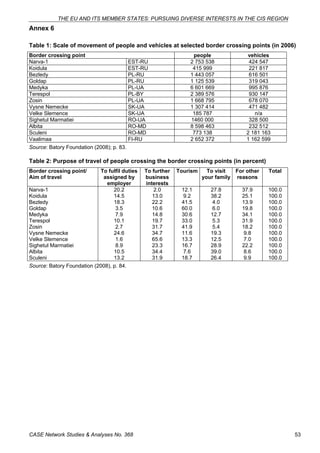
processes in the Black Sea region. Annex 6 provides a picture of the scale and nature of the 
phenomenon of cross-border movement across the EU’s eastern external land borders. 
28 Website of the Council of the Baltic Sea States, http://www.cbss.st/history/. 
29 “Black Sea Basin – Joint Operational Programme 2007-2013”, Black Sea Cross-border Cooperation, 
Novermber 2007, www.blacksea-cbc.net. 
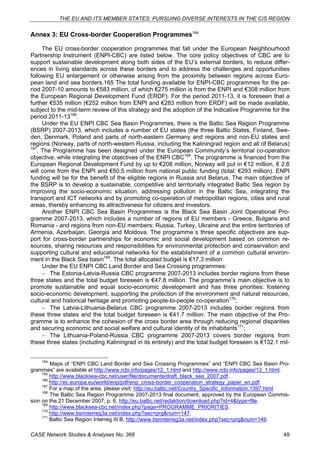
30 See Annex 3: EU Cross-border Cooperation Programmes (and maps). 
31 Website of the Lithuanian Ministry of Foreign Affairs, http://www.urm.lt. 
32 European Commission’s webpage on the Northern Dimension: 
http://ec.europa.eu/external_relations/north_dim/kalin/index.htm. 
33 “Kaliningrad’s Borders and Transit to Mainland Russia: Practicalities and Remaining Bottlenecks”, 
CEPS Commentary, 19 February 2007. 
34 “Russia's economy booms, and cargo traffic piles up at Finnish border”, The International Herald 
Tribune, 10 October 2007. 
16 CASE Network Studies & Analyses No. 368
THE EU AND ITS MEMBER STATES: PURSUING DIVERSE INTERESTS IN THE CIS REGION 
f. Cultural relations35 
A number of EU MS, such as the Baltic States, Bulgaria, Cyprus, France, Germany and 
Greece, have close cultural links due either to the existence of a sizeable Russian minority on their 
territory or due to a shared cultural and religious heritage. The Russian minority in Estonia and 
Latvia has been a cause for friction with Russia, but in general the presence of minorities leads to 
closer cultural relations and affinity between the EU MS and Russia. Bulgaria has traditionally 
close cultural links with Russia, both being Slavic and largely Christian Orthodox nations. Cultural 
relations between France and Russia are also very strong, with an estimated 200,000-400,000 
Russians residing in France. France is also promoting the French language in Russia, which is the 
third most widely spoken foreign language in Russia (after English and German). German-Russian 
cultural relations are also strong due to an estimated 3.6% (2.9 million) German population that is 
believed to be Russian speaking (ethnic Russian, Russian-Kazakh or Jewish-Russian). The Greek 
community in Russia numbers about 128,000 and is mainly located around the Black Sea in 
Southern Russia or in Moscow. In addition, the Russian community in Greece numbers around 
300,000 people and is mostly made up of Greeks who emigrated from the Soviet Union. The Greek 
Orthodox and the Russian Orthodox Churches maintain close and friendly ties. The only national 
Orthodox Church in the EU that maintains a strained relation with the Moscow Patriarchate is the 
Romanian Orthodox Church, after it reactivated the Bessarabian Metropolitanate in the Republic of 
Moldova, where the Russian Orthodox Church has its own church structure in place dating back to 
the Soviet period. 
I.3. Interests in economic and energy cooperation 
a. Trade volume, investments and the importance of Russia in bilateral trade 
Russia is a very important trade partner for the EU as it absorbs 6% of its external exports 
(compared to 9% for the CIS as a whole) and provides 10% of its external imports (compared to 
13% for the CIS)36. The EU’s trade with Russia has been growing dynamically since 2000, reach-ing 
€192 billion in 2006. Over this period EU exports to Russia grew much faster that imports, but 
given the starting imbalance, the EU27 trade deficit grew from €41 billion in 2000 to €69 billion in 
2006, mainly on the back of rising energy prices. Mineral products were the most important com-modity, 
accounting for just above 50% of total EU imports. Road vehicles and machinery were the 
EU’s most important export products37. 
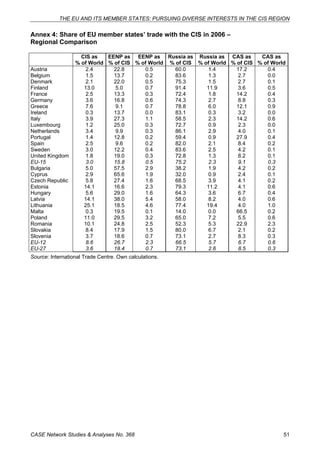
The share of CIS and in particular Russia in trade turnover varies greatly among EU MS38. In 
2006, the average share of Russia in the trade turnover of the EU 27 was 2.6%, for the EU 15 
2.3% and for the EU 12 5.7%. CIS countries are particularly important trade partners for Lithuania 
(19.4% share in total trade in 2006), Finland (11.9%), Estonia (11.2%), Latvia (8.2%), Poland 
(7.2%), Slovakia (6.7%) and Greece (6%). Russia accounted for more than 90% of Finnish foreign 
trade with the CIS region, compared to the EU 12 average of 66% and EU 15 average of 75%. The 
old EU MS (EU 15) accounted for 78%, whereas the new EU MS (EU 12) accounted for only 22% 
of total EU-Russia trade volume. Germany’s trade with Russia alone accounted for 23.3% and Po-land 
accounted for 7% of total EU-Russia trade. In general, the new EU MS have more diversified 
trade patterns with the entire CIS region (in particular the EENP states) as opposed to the old EU 
MS, which mostly trade with Russia. This wide heterogeneity in trade intensity can be largely ex-plained 
by typical economic factors (size of respective EU economies, distance from Russia, etc.). 
The large majority of EU MS have significant trade deficits with Russia39: the Netherlands 
(€11.5 billion in 2006), although this is mainly due to the ‘Rotterdam effect’ (when goods destined 
for other EU states enter the EU through the port of Rotterdam), Germany (€5.9 billion), Poland 
(€5.9 billion), the United Kingdom (€5 billion), France (€4.7 billion), Romania (€3.6 billion), Hungary 
(€3.5 billion), and only 4 countries had a positive balance (Austria (€0.4 billion), Denmark (€0.4 bil- 
35 This subsection is based on EU-Russia Centre (2007). 
36 Eurostat, “EU-27 trade with CIS countries, 2006”, 21 September 2007. 
37 Eurostat, “EU-27 trade with CIS countries, 2006”, 21 September 2007. 
38 See annex 4: Share of EU MS trade with the CIS – Regional Comparison. 
39 Eurostat. 
CASE Network Studies & Analyses No. 368 17
George Dura 
lion), Ireland (€0.1 billion) and Slovenia (€0.4 billion)). Italy and Finland had broadly balanced 
trade. In the latter case this is due to the fact that Russia is its most important trade partner outside 
the EU and it has traditionally developed a very diversified trade pattern in both imports and ex-ports. 
EU Foreign Direct Investment (FDI) in Russia has also been growing in recent years, from 
€2.4 billion in 2002, to €17.1 billion in 200740. Investments have been mainly concentrated in the 
energy sector (electricity), the banking sector, mining and quarrying. 
b. Bilateral economic cooperation 
This section discusses the volume of bilateral trade between the individual EU MS and Russia. 
The table below provides the figures for bilateral trade volume between the EU 27 and Russia for 
2006. Subsequently, the type of bilateral cooperation between the EU MS and Russia is presented. 
According to Table 1, Germany with €52 billion worth of bilateral trade, accounts for almost 25% of 
EU-Russia trade turnover. The Netherlands and Italy account each for around 10%, followed by 
France, Finland and Poland (around 6.5% each), the United Kingdom (5%), Spain (4%), the Baltic 
States (3.9%), Belgium (3.5%), Hungary (3.2%), the Czech Republic and Sweden (each 2.7 %), 
Austria and Slovakia (each 2.1%), Greece (1.9%), Romania (1.6%), Denmark (1%), Slovenia 
(0.5%), Portugal (0.4%), Bulgaria (0.3%), Ireland (0.2%), Luxembourg (0.1). Cyprus and Malta 
with, respectively €60 million and €4 million, account for an insignificant share of EU-Russia trade. 
Table 1: EU MS – Russia trade value in 2006 (billion euros) 
Russia 
exports imports total trade balance % EU 27 
Austria 2.5 2.1 4.5 0.4 2.1% 
Belgium 2.8 4.7 7.4 -1.9 3.5% 
Denmark 1.3 0.8 2.1 0.4 1.0% 
Finland 6.2 7.7 13.9 -1.5 6.5% 
France 4.7 9.4 14.1 -4.7 6.6% 
Germany 23.1 29.0 52.2 -5.9 24.5% 
Greece 0.4 3.5 4.0 -3.1 1.9% 
Ireland 0.3 0.1 0.4 0.2 0.2% 
Italy 7.6 13.6 21.2 -6.0 10.0% 
Luxembourg 0.1 0.1 0.2 0.0 0.1% 
Netherlands 5.6 17.0 22.6 -11.4 10.6% 
Portugal 0.1 0.6 0.8 -0.5 0.4% 
Spain 1.5 7.2 8.6 -5.7 4.0% 
Sweden 1.9 3.8 5.7 -0.2 2.7% 
United Kingdom 3.0 8.0 11.0 -5.1 5.2% 
EU 15 total 61.1 107.7 168.7 -46.6 79.2% 
Bulgaria 0.2 0.4 0.6 -0.2 0.3% 
Cyprus 0.0 0.0 0.1 0.0 0.0% 
Czech Republic 1.5 4.2 5.7 -0.3 2.7% 
Estonia 0.6 1.4 2.0 -0.8 0.9% 
Hungary 1.6 5.1 6.7 -3.5 3.2% 
Latvia 0.6 0.7 1.3 -0.2 0.6% 
Lithuania 1.4 3.8 5.2 -2.3 2.4% 
Malta 0.0 0.0 0.0 0.0 0.0% 
Poland 3.8 9.7 13.4 -5.9 6.3% 
Romania 0.3 3.2 3.5 -2.9 1.6% 
Slovakia 0.5 4.0 4.6 -0.3 2.1% 
Slovenia 0.8 0.4 1.1 0.4 0.5% 
EU 12 total 11.3 32.9 44.2 -21.6 20.8% 
EU 27 total 72.4 140.6 212.9 -68.2 100.0% 
Source: Eurostat (COMEXT). 
40 Eurostat. 
18 CASE Network Studies & Analyses No. 368
THE EU AND ITS MEMBER STATES: PURSUING DIVERSE INTERESTS IN THE CIS REGION 
In order to facilitate deeper analysis, the EU MS are subdivided into four groups in accordance 
with the share of their bilateral trade in the total EU-Russia trade. The first group includes EU MS 
with trade volumes above €10 billion in 2006 and includes the biggest three EU MS, Poland and a 
few smaller EU MS. 
Germany imports mainly raw materials and energy products and Russia’s main imports from 
Germany include manufactured goods (machines, chemical products, cars and communications 
equipment). German investments in Russia totalled US$5 billion in 2006 (9.1% of all foreign in-vestments) 
41. Germany and Russia cooperate on a number of joint projects in the field of high-tech, 
energy, aviation and space, car manufacturing, transport and telecoms. Major German companies 
such as E.ON. and BASF are present in Russia. Tourism was also an important bilateral economic 
activity as in 2006: 753,500 Russians visited Germany (EU-Russia Centre, 2007). 
The Netherlands has a very strong economic relationship with Russia. In 2006, the Nether-lands 
was the fourth biggest EU exporter to Russia (behind Germany, Italy and Finland) and the 
second biggest importer (behind Germany – this is partly due to the above mentioned ‘Rotterdam 
effect’). More than three-quarters of Russian exports to the Netherlands are fuel and energy prod-ucts 
and 16% metals. Russian imports consist of agricultural products (37%), machinery (28%), 
and chemical products (24%). Dutch FDI into Russia stood at US$6.6 billion in 2006 (12% of all 
foreign investments) 42. 
Italy is Russia’s third biggest trading partner globally, after Germany and China. Italy is also 
the second biggest importer of Russian gas (after Germany) and energy cooperation is very impor-tant 
in bilateral economic relations (see next section). The close political partnership between 
France and Russia is not reflected in the total trade volume, which stood at €14.1 billion in 2006 
(EU-Russia Centre, 2007; p. 15), representing 0.9% of France's foreign trade and putting Russia 
as France’s 9th largest trade partner (Leonard and Popescu, 2007; p. 31). French exports mainly 
consist of luxury products, machinery and cars, whereas the main imports products are oil and gas: 
88% in 2005 (EU-Russia Centre, 2007; p. 16). French FDI into Russia equalled US$ 3 billion in 
200643. 
Russia is a very important trade partner for Finland, which ranks as its second largest import 
partner after Germany (14% of imports) and third export partner after Germany and Sweden (10% 
of exports). Finland is an important transit country, particularly for Russian imports, a quarter of 
which go through the country (Leonard and Popescu, 2007; p. 37). More than 80% of Finnish im-ports 
from Russia consist of crude oil, natural gas, electricity, wood and other raw materials. 
Finland mainly exports paper products, food, furniture, consumer goods and transport equipment. 
Finland is also important as a tourist destination or transit country for Russian tourists. There were 
more than 2.3 million visits from Russia to Finland, the highest number of Russian visitors in any 
EU country (EU-Russia Centre, 2007; p. 124). 
Poland is Russia’s sixth largest trading partner among EU MS, mainly due to high Polish im-ports 
from Russia (10% of total imports in 2006, second only to Germany – 24%). During 2006- 
2008 the trade dispute over Russia’s ban on Polish meat exports attracted substantial public atten-tion, 
although it did not affect overall trade values in any significant way. The main Russian com-panies 
investing in Poland are Gazprom and Lukoil. However, Russia was only the 21st largest 
investment partner in Poland in 2006. 
Troubled political relations have not affected the flourishing trade relations between Russia 
and the United Kingdom, mostly UK imports from Russia. UK investments reached US$7 billion in 
2006, accounting for 12.7% of all foreign investment in Russia, second only after Cyprus44. In sen-sitive 
areas such as energy, investments by UK companies have not been protected by a legal 
framework, as was the case for BP and Shell, which were subject to arbitrary treatment by Rus-sia’s 
gas monopoly, Gazprom. The main areas of economic exchange are metallurgy, oil refining, 
tourism, investment projects, transport and roads, agriculture and food processing (EU-Russia 
Centre, 2007; p. 21). The official numbers of the Russian Federal Agency for Tourism, show that 
233,300 UK citizens travelled to Russia and 120,000 Russian citizens travelled to the UK in 200645. 
41 Russian Federal State Statistics Service, “Volume of foreign investments in the economy of the Rus-sian 
Federation in 2006”, http://www.gks.ru/. 
42 Ibid. 
43 Ibid. 
44 Ibid. 
45 Second Report from the Foreign Affairs Committee, Session 2007-08, op.cit. 
CASE Network Studies & Analyses No. 368 19
George Dura 
The second group includes a number of smaller EU MS plus Spain, whose trade with Russia 
ranges from €5 billion to €9 billion. The three Baltic countries have been grouped together for pur-pose 
of this analysis. Russia and Spain both account for approximately 1% of each other’s trade. 
Russia supplies about 13% of Spain’s oil needs but no gas (Leonard and Popescu, 2007; p. 33). 
Spanish Repsol and Tambeyneftegas are planning to construct a plant capable of producing liquid 
natural gas on the Yamal peninsula. Amongst the Baltic States, Lithuania has the largest trade val-ues 
with Russia, €4.1 billion in 2006 (of which €3 billion were Lithuanian imports) 46. Energy domi-nates 
the Baltic countries’ imports from Russia. Belgian imports from Russia mainly consist of min-eral 
products (above 50%) and diamonds and other precious stones account for another 23%. 
There are many joint ventures in the Russian food industry, construction and pharmaceuticals. In 
April 2007, Belgian bank KBC also entered an agreement with Absolut Bank, a leading Russian 
credit institution, to acquire 92.5% of its shares (EU-Russia Centre, 2007; p. 55). Russia is a very 
important trade partner for Hungary, accounting for 8% of total Hungarian imports47. Gazprom in-vested 
in Hungary’s strategic gas storage and transport business and Russian business has a 
stake in Malev, the national air carrier. The Czech Republic (CR) has experienced a strong in-crease 
in bilateral trade, reaching €5.7 billion in 2006, up from €2.7 billion in 2000, mostly due to 
buoyant imports. Sweden had the same volume of trade as the Czech Republic in 2006, but 
slightly higher exports. About 84% of imports consist of crude oil (EU-Russia Centre, 2007; pp. 69, 
123). Sweden’s main exports to Russia are telecom equipment, cars and chemicals. 
A third group of EU MS are countries whose trade turnover with Russia ranges between €1 
and €5 billion. In this group Austria, Denmark and Slovenia stand out given their trade surpluses 
with Russia. Romania, Greece and Slovakia in contrast, are characterised by relatively very large 
trade deficits (mainly on the import of energy commodities account). In these countries there are 
many Russian investments in heavy industry and the energy sector. 
The last group is constituted by states whose trade with Russia does not exceed €1 billion 
(except for Latvia, reviewed above). For Portugal, Ireland, Luxembourg, Malta and Cyprus Russia 
is not a significant trade partner, due to the distance and economic structure (in the case of Lux-embourg). 
Russia is Bulgaria’s third most important trade partner after Germany and Italy. There is 
an agreement for Russian assistance in the construction of a nuclear reactor in Belene. There are 
Russian investments in finance, trade and tourism and wine-making. Bulgaria is an important tour-ist 
destination for Russians, receiving 209,000 visitors from Russia in 2006 (EU-Russia Centre, 
2007; p. 124). Luxembourg and Cyprus are believed to be a haven for Russian capital (Leonard 
and Popescu, 2007; p. 37). Both countries are amongst Russia’s main foreign investors, account-ing, 
respectively, for 10.7% and 17.9% of all foreign investments in Russia48. The majority of these 
investments represent repatriation of Russian capital. Cyprus is the most important hub for Rus-sian 
off-shore companies. 
c. Energy cooperation and investments 
Oil and gas are the most important commodities imported by the EU from Russia with a share 
of a little over 50% of total EU imports from Russia in 2005. Mineral products strongly dominate 
imports from Russia (with a share of above 70%) of EU MS such as Romania (90%), Bulgaria 
(90%), Slovakia (90%), France (89.4%), Hungary (89%), Austria (85%), Sweden (84%), Finland 
(80%), the Netherlands (75%), Lithuania (75%), Italy (74%) and Poland (73%). Germany is Rus-sia’s 
biggest market for energy commodities, despite the fact that ‘only’ 53% of German imports 
from Russia are accounted for by mineral products. The Baltic States, despite their strong depend-ence 
on Russian energy, have quite a diversified structure of imports from Russia. 
EU 27 strongly depends on imported oil and gas, which currently account, respectively, for 
around 83% and close to 60% of domestic consumption with a clear upward trend. Russia is the 
single most important supplier of both gas and oil to the EU, accounting for around 33% of total 
extra-EU oil imports and 38% of gas imports, as of 2007. This figure masks major differences in 
46 See annex 4: Share of EU MS trade with the CIS – Regional Comparison. 
47 CIA World Fact Book, “Hungary” Country Sheet, https://www.cia.gov/. 
48 Federal State Statistics Service, “Volume of foreign investments in the economy of the Russian Fed-eration 
in 2006”, http://www.gks.ru/. 
20 CASE Network Studies & Analyses No. 368
THE EU AND ITS MEMBER STATES: PURSUING DIVERSE INTERESTS IN THE CIS REGION 
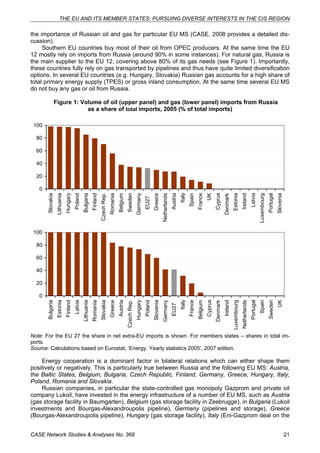
the importance of Russian oil and gas for particular EU MS (CASE, 2008 provides a detailed dis-cussion). 
Southern EU countries buy most of their oil from OPEC producers. At the same time the EU 
12 mostly rely on imports from Russia (around 90% in some instances). For natural gas, Russia is 
the main supplier to the EU 12, covering above 80% of its gas needs (see Figure 1). Importantly, 
these countries fully rely on gas transported by pipelines and thus have quite limited diversification 
options. In several EU countries (e.g. Hungary, Slovakia) Russian gas accounts for a high share of 
total primary energy supply (TPES) or gross inland consumption. At the same time several EU MS 
do not buy any gas or oil from Russia. 
Figure 1: Volume of oil (upper panel) and gas (lower panel) imports from Russia 
as a share of total imports, 2005 (% of total imports) 
100 
80 
60 
40 
20 
0 
Slovakia 
Lithuania 
Hungary 
Poland 
Bulgaria 
Finland 
Czech Rep. 
Romania 
Belgium 
Sweden 
Germany 
EU27 
Greece 
Netherlands 
Austria 
Italy 
Spain 
France 
UK 
Cyprus 
Denmark 
Estonia 
Ireland 
Latvia 
Luxembourg 
Portugal 
Slovenia 
100 
80 
60 
40 
20 
0 
Bulgaria 
Estonia 
Finland 
Latvia 
Lithuania 
Romania 
Slovakia 
Greece 
Austria 
Czech Rep. 
Hungary 
Poland 
Slovenia 
Germany 
EU27 
Italy 
France 
Belgium 
Cyprus 
Denmark 
Ireland 
Luxembourg 
Netherlands 
Portugal 
Spain 
Sweden 
UK 
Note: For the EU 27 the share in net extra-EU imports is shown. For members states – shares in total im-ports. 
Source: Calculations based on Eurostat, ‘Energy. Yearly statistics 2005’, 2007 edition. 
Energy cooperation is a dominant factor in bilateral relations which can either shape them 
positively or negatively. This is particularly true between Russia and the following EU MS: Austria, 
the Baltic States, Belgium, Bulgaria, Czech Republic, Finland, Germany, Greece, Hungary, Italy, 
Poland, Romania and Slovakia. 
Russian companies, in particular the state-controlled gas monopoly Gazprom and private oil 
company Lukoil, have invested in the energy infrastructure of a number of EU MS, such as Austria 
(gas storage facility in Baumgarten), Belgium (gas storage facility in Zeebrugge), in Bulgaria (Lukoil 
investments and Bourgas-Alexandroupolis pipeline), Germany (pipelines and storage), Greece 
(Bourgas-Alexandroupolis pipeline), Hungary (gas storage facility), Italy (Eni-Gazprom deal on the 
CASE Network Studies & Analyses No. 368 21
George Dura 
South Stream), the Netherlands (Gasunie-Gazprom deal, Gazprom participation in BBL pipeline), 
Romania (Lukoil investments, gas storage facility), Slovakia (important Russian take-over of oil and 
gas pipeline networks). Slovakia, the Baltic States, and Poland are important transit countries for 
Russian oil and gas that is transported westwards (CASE, 2008 provides further details). 
A number of EU MS, such as Austria, Bulgaria, France, Germany, Greece, Hungary, Italy, 
Slovakia and to a lesser extent the Netherlands, Belgium, Luxembourg, have concluded major 
(long-term) energy supply deals with Russia, committing their involvement in major Russian energy 
infrastructure projects or committing to sell a part of their energy assets (distribution networks and 
storage facilities) to Gazprom in return for access to Russian oil and gas deposits. These deals 
have sometimes been seen as complicating the implementation of EU-backed energy projects 
(such as the Nabucco pipeline) or undermining the EU’s attempts to create a common energy pol-icy 
(including unbundling and the access of energy companies of third countries to the EU market). 
Looking at the character of energy relations between Russia and EU MS, several groupings 
emerge. First, some very large EU gas importing countries (primarily Germany and Italy and possi-bly 
also France) that have a well diversified import structure have been trying to intensify their rela-tions 
with Gazprom, securing long-term supply contracts and trying to limit their reliance on transit 
countries. For this group of EU MS, increasing gas supplies from Russia is seen to be improving 
their overall energy security. Gazprom gas sales to the three countries listed above (67 billion cu-bic 
meters in 2006, according to Gazprom data)49 are roughly equal to sales to all other EU MS 
combined (around 70 billion cubic meters), illustrating the importance of these particular markets to 
Gazprom. 
Among the three EU MS, Germany and Italy have the strongest link with Gazprom. Germany 
and Russia have gone ahead with plans to build a new pipeline to transport Russian gas directly to 
Germany under the Baltic Sea, known as the Nord Stream. The total investment for the offshore 
pipeline is estimated by the Nord Stream company to be around €7.4 billion. The company is 
chaired by former German Chancellor G. Schröder. Gazprom has a 51% stake in the project and 
the rest is divided between E.ON Ruhrgas, BASF subsidiary Wintershall and Dutch gas company 
Gasunie. Other EU states have been left out of the project, causing political frictions in particular 
between Germany and Poland, but also between Germany on the one hand and the Baltic and 
some Scandinavian states on the other. 
In 2006 Italy’s main energy company ENI and Gazprom signed a long-term supply deal lasting 
until 2035. In June 2007, ENI agreed with Gazprom on the construction of a gas pipeline under the 
Black Sea (South Stream) at a total cost of €10 billion. ENI has, together with Gazprom, also con-structed 
another gas pipeline under the Black Sea, the so-called Blue Stream. 
Cooperation between Gaz de France (GDF) and Gazprom dates back to 1975, and relates to 
gas supply, transmission, storage, LNG production etc.50 A 2006 contract between Gazprom and 
GDF foresees the supply of gas until 2030, including through the Nord Stream pipeline from 
201051, so France has a common interest with Germany in building the Nord Stream pipeline. 
French company Total signed an agreement with Gazprom on 13 July 2007 giving Total a 25% 
stake in the Shtokman Development company, which will develop the first phase of the Shtokman 
gas field (to feed the planned Nord Stream pipeline). 
The second group comprises EU MS that are either important transit countries for Russian en-ergy 
or already now heavily rely on gas imports from Russia, but do not see viable alternative 
sources of supply and/or believe that strengthened cooperation and joint projects with Russia could 
improve their long term energy security. Bulgaria, Hungary, Austria can be considered as belong-ing 
to this group. Austria’s OMV national energy company has welcomed Hungary’s accession to 
the South Stream project bringing gas from Russia to Italy and which will branch off northwards, in 
the expectation of larger deliveries from Gazprom via Hungary to Austria. OMV is also the initiator 
of the Nabucco project and has proposed bringing Gazprom in as an additional partner, which 
would undercut the rationale of the project, namely becoming less dependent on Russian energy 
supplies. Bulgaria and Greece have also signed into the South Stream project, which is considered 
a rival project to the EU’s Nabucco. Slovakia is an important transit country for Russian energy 
49 See 2006 Annual report of Gazprom, http://www.gazprom.ru/documents/Report_Eng.pdf. 
50 "Gazprom and Gaz de France sign agreement on Sci-Tech cooperation", OilVoice, 7 December 
2007.. 
51 Ibid. 
22 CASE Network Studies & Analyses No. 368
THE EU AND ITS MEMBER STATES: PURSUING DIVERSE INTERESTS IN THE CIS REGION 
(through the southern section of the “Druzhba” oil pipeline and Transgas natural gas pipeline, 
which supply the Czech Republic and Germany), with 50.3 bcm of Russian gas transiting Slovakia 
towards Western Europe in 200752. Russian oil company Promneftstroi bought a 49% stake in Slo-vak 
oil-pipeline operator Transpetrol after taking over the foreign assets of bankrupt oil company 
Yukos. 
Some other EU MS have been more or less actively trying to diversify their import sources in 
order to decrease dependence on Russia, although the degree of success has been rather limited 
in most cases, owing partly to geography, existing pipeline infrastructure and European gas price 
developments. Alternatively, when gas import diversification has not been an option some EU MS 
have tried to increase security of their supplies by demanding a firmer international legal structure 
regulating international trade in energy resources (the discussion concentrates mainly on the En-ergy 
Charter Treaty) and supporting the development of the EU joint energy policy that would in-crease 
its bargaining power in relation to major suppliers such as Russia. Poland, Baltic States, 
Romania, and to a lesser extent Sweden, Denmark, Finland and the United Kingdom can be con-sidered 
as belonging to this group. Poland and the Baltic States strongly oppose the Nord Stream 
project, which reduces their importance as transit countries and their security of supply. Gazprom 
also invited Romania to join the South Stream project, but Romania refused53, since it is a strong 
supporter of the EU’s rival project – Nabucco54. Romania may also impede the construction of the 
South Stream project (which would cross Romania’s continental shelf in the Black Sea) under arti-cle 
79 of the UN Convention on maritime law, thereby increasing the costs and reducing the rele-vance 
of the project.55 
The Nord Stream runs through the Exclusive Economic Zones of Russia, Finland, Sweden, 
Denmark and Germany as well as through the territorial waters of Russia and Germany. Sweden 
has already made use of article 79 of the UN Convention on maritime law and rejected an applica-tion 
by Russia of the Nord Stream project on environmental grounds. Finland insists that the Nord 
Stream consortium conduct a thorough environmental impact study of an alternative, southern, 
route for its planned gas pipeline under the Baltic Sea56. Environmental concerns have also been 
expressed by Denmark. 
The UK is a staunch supporter of formulating a strong EU external energy policy and also 
supports the Nabucco project. The UK continues to press Russia to create transparent and stable 
conditions for foreign investment in the energy sector based on the G8’s energy security principles 
agreed at the Saint Petersburg summit in July 2006 (regarding market access, transparency of 
markets and favourable investment climate), especially after the forced sale of shares by Shell in 
the Sakhalin II oil and gas fields and BP in Kovykta condensate gas field57. 
Other EU MS have taken a more nuanced and varied position on different questions of energy 
cooperation with Russia or are less interested in the issue given that their gas supply sources are 
elsewhere. 
52 “Jahnatek: Russia represents reliable partner for Slovakia”, Slovakia Today, 19 Febuary 2008. 
53 “Romania did not join South Stream”, Ziare, 29 February 2008, http://www.ziare.com/. 
54 Currently, five states are associated to the project (Turkey, Romania, Bulgaria, Hungary and Austria), 
which has the backing of the European Union. The project has an estimated cost of €5 billion and foresees 
the construction of gas pipeline that would transport Central Asian and Middle East gas and would run from 
the Caspian Sea through Turkey and the Balkans towards Austria. 
55 “Ukraine and Romania may block South Stream project”, Unian, 3 March 2008. 
56 “Finland tells Nord Stream to study alternative routes”, Environmental News Network, 21 January 
2008. 
57 “Global Energy Security”, Document adopted at the G8 Summit in Saint Petersburg, 16 July 2006, 
http://en.g8russia.ru/docs/11.html. 
CASE Network Studies & Analyses No. 368 23
George Dura 
PART II – The Eastern ENP region 
II.1. The EU’s relations with the EENP region 
In the run-up to the 2004 and 2007 accessions of 12 new member states the EU set up a 
framework through which it wanted to conduct relations with its new neighbours to the east and 
south: the European Neighbourhood Policy (ENP). The main aims of the ENP are to “share the 
benefits of the EU’s 2004 [and 2007] enlargement with neighbouring countries and to prevent the 
emergence of new dividing lines between the enlarged EU and its neighbours and to promote sta-bility 
and prosperity by offering them greater political, security, economic and cultural cooperation, 
but stopping short of membership. However, the Commission’s 2003 conceptual document on the 
Wider Europe specified that “for those European countries who have clearly expressed their wish 
to join the EU, the prospect of membership remains open” (European Commission, 2003, p. 5). 
Already at the conceptual stage of the ENP the EU needed to reconcile the heterogeneous in-terests 
of its northern/eastern and southern/western member states. Initially, the ENP was only 
conceived to include the EU’s Eastern neighbours as a response to the EU’s eastward expansion 
(Belarus, Moldova, Ukraine). However, after intense lobbying by France, Spain and Italy, the 
southern Mediterranean states of the Barcelona Process were also included in the ENP. The EU 
initially also excluded the three states of the southern Caucasus (Armenia, Azerbaijan and Geor-gia) 
from the ENP, but eventually included them following calls from Austria, Finland and other EU 
MS58. The EU also wanted to add a regional dimension to the EU-ENP framework and following 
the accession of two Black Sea littoral states, Bulgaria and Romania in 2007, both having obvious 
interests in the Black Sea region, the EU adopted the Black Sea Synergy (BSS)59. The BSS in-cludes 
the EENP states, Russia and Turkey and serves to tackle issues with wider regional impli-cations 
such as transport, environment, energy, migration and security issues, etc. 
The ENP is implemented by bilateral action plans between the EU and each ENP state and 
are concluded for a period of between three and five years, providing for differentiation on a coun-try- 
by-country basis. The action plans provide comprehensive lists of priority areas and actions to 
be undertaken, mainly by given ENP states, but also by the EU, and include the establishment of 
political dialogue, economic cooperation, cooperation in the field of security, justice and home af-fairs, 
cooperation on the frozen conflicts in Moldova and the Southern Caucasus, amongst others. 
The EENP states most advanced with implementation of their Action Plans (APs) are Ukraine 
and Moldova. The Southern Caucasus states started implementing their AP almost two years later 
(end 2006). Ukraine is currently in the process of negotiating a new enhanced agreement with the 
EU to replace its PCA and is also negotiating a deep free trade agreement in parallel. A similar 
agreement will also be negotiated with Moldova in the foreseeable future and later also with the 
countries of the Southern Caucasus. Moldova also benefits from a new trade regime with the EU, 
known as Autonomous Trade Preferences, since 1 March 2008. On 1 January 2008 the visa facili-tation 
agreements between Moldova and Ukraine, on the one hand, and the EU, on the other, have 
also entered into force. 
II.2. Interests in political and security cooperation 
a. The EENP region as a foreign policy priority? 
Only six EU MS have embassies in all six EENP states60. These are France, Germany, the 
United Kingdom, Bulgaria, Poland and Romania. Italy and Latvia have embassies in all EENP 
states except Moldova. The Czech Republic and Lithuania have an embassy in all EENP states 
but Armenia and Azerbaijan. Greece has an embassy in all EENP states except Belarus and 
Moldova. Austria and Hungary have embassies only in Moldova and Ukraine. Belgium has an em-bassy 
in Azerbaijan and Ukraine. The Netherlands and Estonia have embassies in Georgia and 
Ukraine. Slovakia has an embassy in Belarus and Ukraine. Slovenia opened its embassy in 
58 See Annex 2, Table 2: Eastern European Neighbourhood Policy – Action Plans. 
59 European Commission communication, “Black Sea synergy – a new regional cooperation initiative”, 
14 April 2007. 
60 See Annex 5: The presence of EU MS embassies in CIS countries. 
24 CASE Network Studies & Analyses No. 368
THE EU AND ITS MEMBER STATES: PURSUING DIVERSE INTERESTS IN THE CIS REGION 
Ukraine in 2004 as the only one in the EENP region. Most EU MS have at least an embassy in 
Ukraine, the largest of the EENP countries, except for Ireland, Luxembourg, Cyprus and Malta, 
which do not have a single embassy in this region. In the discussion below, the three Baltic States 
(Estonia, Latvia and Lithuania) will be treated as a homogenous group. However, whenever nec-essary 
the author will focus separately on certain specific interests of each Baltic country. 
The EENP region is a major foreign policy priority for the Baltic States, Bulgaria, the Czech 
Republic, Hungary, Poland, Slovakia, Romania and Sweden. These EU MS are usually direct 
neighbours of EENP countries or have strong political, historical or economic relations with them. 
Austria, Denmark, Finland, Greece (in the Southern Caucasus) and Slovenia and, to a lesser de-gree, 
Belgium and the Netherlands, are keenly interested in the EENP region, which is not, how-ever, 
their major foreign policy priority in terms of political and security cooperation. 
The larger EU MS such as France, Germany, Italy and the United Kingdom may have estab-lished 
diplomatic relations with (almost) all EENP countries but are not involved to the same de-gree 
in each of them. However, they usually maintain strong relations by virtue of their greater ad-ministrative 
capacity and resources. For France and the UK, this region is less of a priority area in 
foreign policy than for Germany, whereas for Italy it figures rather low on the foreign policy agenda 
(after the Balkans and the Southern Mediterranean region). 
A number of small EU MS and those which are the most remote geographically have the least 
political interests in cooperating with the EENP region and it therefore does not figure very high on 
their foreign policy agenda. These are Portugal and Spain, as well as Cyprus, Ireland, Luxembourg 
and Malta. 
b. Influencing the EU agenda on the ENP East and promoting regional cooperation 
The same group of EU MS that see the EENP region as a national foreign policy priority (see 
previous section) also tries to positively influence the EU agenda towards its Eastern neighbours. 
This group of EU MS has been pushing for stronger EU involvement in the EENP region, including 
involvement related to ‘frozen conflicts’. Generally, these countries also support the future EU 
membership of the EENP states and believe the EU should adopt an open-door enlargement pol-icy. 
Individual EU MS are more outspoken in respect to the potential EU accession of one or more 
EENP states. Poland and Sweden support the accession of Ukraine and Moldova, but also of Bela-rus 
(if it democratises). Both countries have put forward a proposal for establishing an Eastern 
Partnership with the EENP countries61. The Eastern Partnership foresees the establishment of an 
EU27+EENP forum, aiming to negotiate visa-free travel regimes, free trade zones and strategic 
partnership agreements between the EU 27 and the EENP countries. Hungary lobbies in favour of 
Ukraine’s and Moldova’s accession. Romania mainly supports the accession of Moldova and 
Finland that of Ukraine. The Baltic States agree that the ENP needs to offer membership prospects 
for all EENP states, whereas Bulgaria, Slovakia and the Czech Republic favour the accession of 
EENP states to the EU, but only in the long term. 
All these EU MS are also in favour of strengthening the ENP offer so it can become an inter-mediary 
step towards the future EU accession of EENP countries. They do not want a stronger 
ENP as a substitute for enlargement policy. The ENP offer should provide for the introduction of 
facilitated visa regimes (this already is the case for Ukraine and Moldova), the introduction of deep 
free trade agreements and integrating transport and energy networks of EENP states into the 
European system. Poland also strongly favours a more active dialogue between the EU and Bela-rus. 
Bulgaria and Romania have been pushing for the development of a Black Sea regional dimen-sion 
(the EU’s Black Sea Synergy). Finland was instrumental in extending the ENP to the states of 
the Southern Caucasus (during the Finnish Presidency, Action Plans were signed between the EU 
and the three Southern Caucasus states) 62. A priority of the Swedish Presidency of the EU in the 
second half of 2009 will be the further strengthening of the ENP63. In addition, these EU MS favour 
61 “Poland and Sweden to pitch ‘Eastern Partnership’ Idea”, EUObserver, 22 May 2008. 
62 “Finland's EU Presidency goal to increase cooperation with the countries of Southern Caucasus and 
Central Asia”, Finnish Ministry of Foreign Affairs, press release, 20 January 2006, http://formin.finland.fi/. 
63 "The priorities of the Czech republic and Sweden for the EU presidency", Speech by Cecilia Malm-ström, 
Minister for EU Affairsat the Sieps och SITEs seminar, 4 March 2008, http://www.sweden.gov.se/. 
CASE Network Studies & Analyses No. 368 25
George Dura 
a stronger involvement of the EU in the resolution processes of the ‘frozen’ conflicts in the EU’s 
neighbourhood (in Moldova and the Southern Caucasus), even if this confronts Russia’s interests 
in the region. Finland remains reticent about greater EU involvement in the EENP region in terms 
of conflict resolution, precisely for fear of antagonising Russia in the region (Leonard and Popescu, 
2007; p. 36). 
The UK, through its then Foreign Secretary Jack Straw, launched the EU’s “Wider Europe” 
concept in 2002, which later became the European Neighbourhood Policy (ENP) in 2004, and the 
UK remains a staunch advocate of strengthening the ENP, together with Ireland, which64 has also 
welcomed the ENP’s extension to the Southern Caucasus, as did Austria. Additionally, the UK 
supports an EU open-door policy towards Ukraine, in particular65. Other EU MS, such as Austria, 
Belgium, France, Germany, Greece, Ireland, the Netherlands, Slovenia and the United Kingdom, 
are strong supporters of the ENP. However, they tend to consider the ENP as a policy in its own 
right and not as a stepping-stone towards EU accession. Some of these states even favour a 
strong ENP in order to prevent calls for EU membership from EENP countries. 
Germany has been a supporter of a strong Eastern dimension to the ENP (‘Ostpolitik’) and has 
lobbied in favour of including the Southern Caucasus in the ENP. Germany pushed during its EU 
Presidency in the first half of 2007 for the adoption of an ENP Plus, aiming at re-packaging the 
ENP offer into a more attractive, visible and clearly delineated offer that could provide better incen-tives 
for reform in ENP states. Italy favours the EU’s enlargement into the Western Balkans and 
Turkey, after which the limits of the EU’s borders would be reached for the foreseeable future. Ac-cordingly, 
the ENP needs to be reinforced, particularly with regard to Ukraine66. Denmark does not 
oppose further enlargement to the EENP region, but wants due consideration to be given to the 
EU’s absorption capacity, as does the Netherlands, which has adopted an active position within the 
EU on the ENP, and favours reinforcement of the policy as a real alternative to EU accession. Bel-gium 
is potentially in favour of possible membership prospects in the longer term, in particular for 
Ukraine, Moldova and Belarus, and therefore supports a stronger ENP. 
A third group of EU MS, including Cyprus, Greece, France, Portugal and Spain, does not view 
the development of a strong Eastern dimension to the ENP very favourably, fearing that it may di-vert 
the EU’s attention away from its relations with the Southern Mediterranean. France and other 
EU Mediterranean countries are in favour of a balance between the ENP’s eastern and southern 
dimensions. France has focused its efforts on reinforcing the Southern dimension by launching the 
Union for the Mediterranean in July 2008. France, traditionally opposed to further EU enlargement, 
is favouring the conclusion of an Association Agreement with Ukraine (theoretically opening the 
door to Ukraine’s EU membership perceived by some as a possible means to delay Turkey’s ac-cession 
talks). France has also led the opposition to stronger EU involvement in the EENP region’s 
‘frozen conflicts’. Greece has strongly welcomed the inclusion of the Southern Caucasus in the 
ENP67. When holding the EU’s rotating Presidency in the second half of 2007, Portugal made a 
point of refocusing the EU’s attention from the ENP East to the ENP South, after the German 
Presidency of the EU focused on enhancing the ENP offer. Spain also opposes greater EU in-volvement 
in the EENP region, including in the settlement of ‘frozen’ conflicts, principally for two 
reasons. Firstly, it does not wish to see a further shift in ENP priorities and resources from the 
Southern Mediterranean region to the EENP region. Secondly, Spain is also reluctant to confront 
Russia in the shared EU-Russia neighbourhood. 
A number of EU MS have been strong supporters of the Black Sea Synergy and other regional 
initiatives in the wider Black Sea area and the EENP region, due to strong economic or historical 
links to the region. The most prominent of these EU MS are Austria, the Baltic States, Bulgaria, 
Greece and Romania, which have all been active in framing the EU Black Sea Synergy. Other re-gional 
initiatives are supported by EU MS on the basis of their own experience of regional coopera-tion 
(the Northern Dimension, Baltic Sea Council, Black Sea Economic Cooperation, Central Euro-pean 
Free Trade Area, Visegrad Group, Baltic cooperation, etc.). Regional cooperation is encour- 
64 “Minister Cowen discusses forthcoming GAERC Luxembourg, 13-14 Oct. 2003”, Irish Department of 
Foreign Affairs, 8 October 2003,http://www.dfa.ie/. 
65 “UK supports Ukraine’s eventual membership to EU and NATO”, UK Embassy in Ukraine, press re-lease, 
5 May 2008. 
66 Website of the Italian Ministry of Foreign Affairs, http://www.esteri.it/. 
67 Interview with Karolos Papoulias, President of Greece, Hayastany Hanrapetutyun Armenian Daily, 26 
June 2007, http://www.hhpress.am/?&flag=en. 
26 CASE Network Studies & Analyses No. 368
THE EU AND ITS MEMBER STATES: PURSUING DIVERSE INTERESTS IN THE CIS REGION 
aged because it strengthens the EENP states’ position vis-à-vis Russia’s interference in the region 
and also assists with democratisation and economic reform, thereby enhancing the EENP states’ 
European integration efforts. Cooperation among EU MS, by forming ad hoc or longer-term alli-ances 
(e.g. the Visegrad Group), also helps to lobby the EU in favour of strengthening the ENP or 
in favour of granting membership prospects to certain EENP states. In addition, the French initia-tive 
with the Union for the Mediterranean has an obvious knock-on effect, by prompting initiatives 
(from Poland, notably) to strengthen the Eastern ENP dimension. 
The Baltic States favour regional initiatives in the EENP region and are very supportive of the 
EU Black Sea Synergy and of other regional organisations, such as GUAM, the Community of 
Democratic Choice (of which the three Baltic states are co-initiators). All three Baltic States are 
members of the New Group of Friends of Georgia, together with Poland, Romania and Bulgaria 
(founded in 2005). This group consists of former communist countries that have completed the 
Euro-Atlantic integration process and wish to assist Georgia's internal reforms in order to help it 
qualify for eventual NATO and EU membership68. Poland is a strong supporter of multilateral co-operation 
initiatives in the EENP region. As such it is an observer in the Community of Democratic 
Choice and has been involved in the activities of GUAM, via its participation in Poland-GUAM 
meetings69. Through these meetings, Poland has offered its assistance in the implementation of 
the EU Action Plans of the four GUAM members and pledged political support to Ukraine in its ne-gotiations 
over a new enhanced agreement with the EU. A core foreign policy priority for Bulgaria 
and Romania in the EENP region is to develop regional cooperation in the Black Sea region (nota-bly 
through the Black Sea Synergy). Romania is a strong supporter of other regional initiatives in 
the Black Sea region, such as GUAM, and is a member of the Community of Democratic Choice 
and the Organisation for Black Sea Economic Cooperation (BSEC) BSEC. Austria has been a 
strong supporter of the EU Black Sea Synergy and is an observer (along with six other non-littoral 
EU MS) in BSEC70. Austria is also interested in Black Sea regional cooperation, due to the region’s 
importance as a transit zone for Russian and Caspian energy. Greece’s political efforts within 
BSEC and the EU were instrumental in bringing about the Black Sea Synergy, operating on the 
organisational structure of BSEC71. Greece is promoting the idea of creating a regional ‘ring-road’ 
around the Black Sea - the “Road of the Argonauts”, furthering regional communication and 
trade72. Greece is also interested in the Black Sea region for historical and cultural reasons, due to 
the presence of Greeks around the Black Sea basin since antiquity. Bulgaria, Greece and Romania 
consider the Black Sea region as strategic for the transit and supply of energy resources, which 
impacts on their energy security. 
c. Specific bilateral interests in political and security cooperation 
Ukraine, Moldova and Belarus attract more political attention than the states of the Southern 
Caucasus and therefore have closer links with a larger number of EU MS. Due to its size, Ukraine 
has a priority importance for most EU MS and is often considered as a model for other EENP 
countries. Austria, the Baltic States, Finland, France, Germany, Hungary, Italy, Poland, Romania, 
Slovakia and Sweden are most prominently involved in Ukraine. The Baltic States, Bulgaria, Hun-gary 
and Romania have visible political interests in Moldova. The Baltic States, Germany, Poland 
and Sweden are strongly involved in Belarus. The Southern Caucasus receives most attention 
from Austria, the Baltic States, Finland, France, Greece and the United Kingdom. Certain states 
have special bilateral relations with EENP states, such as Poland with Ukraine, and Romania with 
Moldova. 
68 V. Socor, “New Group of Georgia’s Friends Founded”, Eurasia Daily Monitor, Vol. 2, N. 26, 7 Febru-ary 
2005.. 
69 Press release on the first meeting of National Coordinators between Poland and GUAM in Warsaw on 
21 February 2008, Polish Ministry of Foreign Affairs, 22 February 2008. 
70 “Regional cooperation and energy security are mutually dependent”, Speech by State Secretary Hans 
Winkler at the summit of Black Sea Economic Cooperation countries, 25 June 2007, http://www.bmeia.gv.at/. 
71 “The European Neighbourhood Policy”, webpage of the Greek Ministry of Foreign Affairs, 
http://www.mfa.gr/. 
72 “The Foreign Ministry’s Strategy in the Balkans and the Black Sea Countries” Speech by Greek For-eign 
Affairs Minister Dora Bakogiannis at Money Show Athens 2007, 22 January 2007, 
http://www.greekembassy.org/. 
CASE Network Studies & Analyses No. 368 27
George Dura 
Amongst the Baltic States, Lithuania maintains very close relations with Ukraine despite not 
sharing a common border. In December 2004, the Lithuanian President, together with other inter-national 
mediators (Poland, the EU), took part in the talks on finding a solution to the post-electoral 
crisis which led to the ‘Orange Revolution’ in Ukraine. Lithuania also signed an agreement in Octo-ber 
2006 on providing assistance to Ukraine in implementing the Ukraine-EU Action Plan under the 
ENP. Lithuania and Georgia also signed a Joint Declaration on Regional Cooperation Assistance 
in European and Euro-Atlantic Integration. With regard to Belarus, Lithuania and Latvia - due to 
their proximity - have developed close cooperation with civil society. Vilnius hosts the European 
Humanities University, which is in effect exiled from Minsk. Estonia favours an increase in EU 
funds for the development of a free civil society in Belarus. However, political relations with Belarus 
have remained at a modest level without high-level contact. 
Armenia and Azerbaijan receive comparatively less political attention and assistance from the 
BS. Lithuania was the initiator of EUJUST THEMIS, the EU rule-of-law mission that was launched 
in July on 2004 in Georgia. Lithuania is looking forward to making a more dynamic contribution to 
resolving the ‘frozen’ conflicts in Moldova and the Southern Caucasus when it holds the OSCE 
chairmanship in 2011 and is already providing development aid in this regard. Estonia calls for 
strengthening the mandate of the EU Special Representative to the Caucasus, Peter Semneby. 
Georgia, Moldova and Ukraine and, to a lesser extent Belarus (in the field of civil society projects), 
are the main beneficiaries of BS development assistance73. 
For Bulgaria, Ukraine is a priority EENP country, with which it also has close cooperation on 
international issues such as the Transnistrian conflict74. Moldova is included in its priority area of 
South-East Europe and remains distinct from Bulgaria’s cooperation with other regions75. Bulgaria 
pays less attention to Belarus or the Southern Caucasus. The Czech Republic has developed ex-pertise 
in promoting democratisation and human rights issues in the EENP region. Czech bilateral 
development assistance has grown in recent years, reaching €7.2 million in 2005, of which €4.37 
million was allotted to Ukraine (Kratochvil and Tulmets, 2007; p. 7). In 2007, only Moldova re-mained 
a priority country in the EENP region for Czech development aid76. Czech NGOs are very 
active in Belarus in the field of democratisation and the development of a free civil society (EU-Russia 
Centre, 2007; p. 59). In 2005, the CR opened an embassy in Chisinau, one of the few new 
EU MS to have a diplomatic presence in Moldova. Hungary has been particularly active in its bilat-eral 
relations with Ukraine (which hosts a sizeable Hungarian minority) and in Moldova (particularly 
in resolving the Transnistrian conflict). The current EU Special Representative for Moldova (who 
coordinates the EU’s policy on Moldova, notably with regard to the Transnistrian conflict) is the 
Hungarian diplomat Kalman Mizsei and the head of the EU’s Border Assistance Mission is a Hun-garian 
brigadier-general, Ferenc Banfi. The Hungarian embassy in Moldova hosts a Common Visa 
Application Centre on its premises. In November 2007, Hungary released a non-paper on Moldova 
together with Austria and Sweden that calls for increasing EU support for and involvement in 
Moldova. Ukraine is very important as a transit country for the supply of the Russian energy which 
Hungary is dependent on. Azerbaijan is also important to Hungary due to potential cooperation on 
energy projects that decrease Hungary’s dependence on Russian energy77. 
For obvious historical and cultural reasons, Poland seeks to develop a strategic partnership 
with Ukraine. Ukraine is considered a key EENP country that should receive the strongest possible 
EU ‘carrot’, i.e. that of EU membership, in order to stimulate a difficult reform process. Poland has 
been Ukraine’s strongest advocate with regard to EU and NATO membership. Former Polish 
President Kwasniewski’s intervention during the ‘Orange Revolution’ helped defuse the political 
crisis after the 2004 parliamentary elections, which set Ukraine on a pro-European course. Poland 
and Ukraine have also been discussing the situation on the ‘frozen’ conflict in Transnistria, attest- 
73 See for example the list of development assistance projects implemented by Lithuania in 2006, 
http://www.urm.lt/index.php?-785566554. Out of 40 projects, 9 were implemented in Belarus, 7 in Moldova, 7 
in Ukraine, 6 in Georgia, 1 in Armenia and 1 in Azerbaijan (in total 31 out of 40). 
74 “Political consultations between MFA of Bulgaria and Ukraine”, Bulgarian Ministry of Foreign Affairs, 
21 December 2007, http://www.mfa.bg/. 
75 Bulgarian Ministry of Foreign Affairs on “Regional Cooperation”, http://www.mfa.bg. 
76 Plan of Bilateral Development Cooperation for 2007, Czech Ministry of Foreign Affairs, 
http://www.mzv.cz/. 
77 “András Bársony negotiated in Azerbaijan”, Hungarian Ministry of Foreign Affairs, 25 January 2006, 
http://www.mfa.gov.hu/ 
28 CASE Network Studies & Analyses No. 368
THE EU AND ITS MEMBER STATES: PURSUING DIVERSE INTERESTS IN THE CIS REGION 
ing to common security concerns in the EENP region78. Poland has been calling for deeper en-gagement 
between the EU and Belarus, in particular on support of its civil society. Poland has also 
called on the EU to set up a (critical) dialogue with Belarusian President Lukashenko, who, to-gether 
with a number of high-ranking officials, is under an EU visa ban. Improvement in the situa-tion 
of the Polish minority in Belarus (4% of the total population) is a key issue in Poland’s bilateral 
relations with the country. Poland has also been urging the Belarusian authorities to take into ac-count 
the EU’s conditions on democratisation and human rights, in order to achieve closer coop-eration 
with the EU79. Poland provides bilateral development assistance primarily to Armenia, 
Azerbaijan, Georgia, Moldova, apart from Belarus and Ukraine80. 
Relations with Moldova are a clear priority for Romania, due to the strong cultural and histori-cal 
ties. Romania lobbies in favour of Moldova’s EU accession. However, bilateral relations have 
deteriorated since Romania’s accession to the EU, partly due President Basescu’s repeated decla-rations 
of offering fast-track Romanian citizenship to an alleged 800,000 Moldovan applicants (or 1 
out of every 5 Moldovans). However, despite the rhetoric, the process of issuing Romanian pass-ports 
has virtually ground to a halt since 2002. Another contentious issue is Moldova’s insistence 
on the signature of a bilateral treaty and a border treaty with Romania, which Romania has so far 
delayed. Romania provides limited assistance to Moldova, notably in the field of culture and stu-dent 
scholarships. Romania’s relations with Ukraine, while friendly, are far from satisfactory, due to 
certain ongoing disputes (the opening by Ukraine of the Bistroe canal on the Danube river81, the 
status of the Serpent Island in the Black Sea82 and the treatment of the Romanian community in 
Ukraine83. President Basescu also publicly regretted the signature of the 1997 bilateral treaty with 
Ukraine (under the pressure of Romania’s EU accession), which, according to him, has been det-rimental 
for Romania. Relations with Belarus are not very developed and the Southern Caucasus 
is important mainly as a transit area for Caspian energy resources. 
Without any doubt, Ukraine is the most important country for Slovakia in the EENP region. The 
development of strong economic and cross-border cooperation with Ukraine are one of the main 
objectives of Slovakia’s foreign policy84. Slovakia assists in implementing the EU-Ukraine Action 
Plan by means of a bilateral plan of assistance for Ukraine. Slovakia supports the Visegrad Schol-arship 
sub-programme for Ukraine and projects aimed at enhancement of the ENP with Belarus, 
Moldova, Ukraine and other countries of the CIS. Belarus is not an immediate foreign policy prior-ity, 
but Slovakia generally supports the democratic forces in this country. Slovakia favours greater 
involvement of the EU in ‘frozen’ conflicts, particularly in Moldova. 
Sweden, was together with Poland the co-initiator of the “Eastern Partnership” initiative in 
2008, which aims to strengthen the EU’s policy towards the EENP countries but which was 
prompted by the wish to strengthen the EU’s offer to Ukraine. Sweden, together with Austria and 
Hungary, also released a non-paper on EU-Moldova relations on 15 November 2007 that calls for 
increasing the EU’s support for and involvement in Moldova, particularly by offering the country a 
forward-looking new type of agreement to replace the PCA. Sweden will increase aid to support 
democracy and human rights in Belarus and the forthcoming opening of a Swedish embassy in 
Minsk can be be seen in this context. Regarding the Southern Caucasus, Sweden also supports 
democratisation efforts there85. Sweden favours a stronger EU involvement in settling the ‘frozen’ 
78 Press release on the talks between the Polish Minister of Foreign Affairs and the Ukrainian Minister of 
Foreign Affairs on 29 January 2008, Polish Ministry of Foreign Affairs, 30 January 2008. 
79 Press release on the meeting between the Polish Minister of Foreign Affairs and the Ambassador of 
Belarus to Poland on 14 January 2008, Polish Ministry of Foreign Affairs, 21 January 2008. 
80 Polish Aid, http://www.polishaid.gov.pl/. 
81 The Bastroe canal is on one of the branches of the Danube delta on the Black Sea coast, which at the 
same time also forms the natural border between Romania and Ukraine. 
82 “Romania and Ukraine depoliticise the Bastroe Canal and the Island of Serpents”, Romania Libera, 
25 September 2007. 
83 The Romanian community in Ukraine is estimated at between 400,000- 500,000. Romania also ac-cuses 
Ukraine of artificially dividing the community into ethnic Romanians and ethnic Moldovans to reduce 
the community’s numerical importance. Taken together, these two groups constitute the largest ethnic group 
in Ukraine after Ukrainians and Russians. 
84 “2006 Slovak Republic’s Foreign Policy Report”, Slovakian Ministry of Foreign Affairs, , p. 28. 
85 “Government Policy on Foreign Affairs”, Government Offices of Sweden, 14 February 2007. 
http://www.sweden.gov.se. 
CASE Network Studies & Analyses No. 368 29
George Dura 
conflicts in the EENP region. Sweden is one of the main providers of development assistance to 
Ukraine86, Moldova87, Georgia88 and Belarus, which will increase in the coming years89. 
Austria has a keen interest in developing its political relations in the EENP region, based on its 
strong economic interests. Ukraine is Austria’s most important political partner in the region90, due 
to Ukraine’s importance as a key EENP state, an energy transit country and common interests in 
the Danube basin. Prior to the establishment of the Common Visa Application Centre in Moldova, 
hosted by the Hungarian embassy, Hungary was issuing visas for Austria through a joint visa ap-plication 
office in Chisinau91. Austria provides support to Moldova through the Austrian Develop-ment 
Cooperation programme92. 
Denmark’s foreign policy in the EENP region is very active from the point of view of promoting 
democratisation, good governance and human rights, strengthening civil society and an independ-ent 
media93. Denmark favours free trade regimes with the EENP states aiming to move towards 
setting up a pan-European Economic Area. Denmark also considers enhanced people-to-people 
contacts, including student exchanges and support for reform efforts, as other key issues in the 
EU’s neighbourhood policy94. Denmark is a very important donor of development assistance to the 
EENP region, with aid pledges amounting to €233.5 million over the period 2004-201295. 
Ukraine is clearly a priority country for Finland in the EENP region, as a potential democratic 
example. During Finland's EU Presidency (in the second half of 2006), the EU agreed on a man-date 
to negotiate a new Enhanced Agreement with Ukraine and visa facilitation and readmission 
agreements with Ukraine96. Relations with the rest of the EENP region are less developed. Finland 
has used its OSCE Chairmanship in 2008 to focus on the situation in Azerbaijan, Armenia and 
Belarus. Finland provides limited support for neighbouring area (Russia, Belarus, but also Ukraine) 
cooperation projects. 
Greece has strong political and economic interests in the EENP region. Ukraine is considered 
an important partner for Greece due to the large Greek community (100,000 concentrated mainly 
in the Odessa region). This presence has spurred development of bilateral relations based and 
joint projects in the cultural and educational field. In the period of 1997-2003, Greece granted 
€12.2 million of development aid to Ukraine for this goal. The Greek community in Moldova cur-rently 
numbers between 3,000 and 4,000 (down from 25,000 in the interwar period) to whom 
Greece provides cultural and educational support. There are no official high-level contacts with 
Belarus. Greece considers the Southern Caucasus as a strategic region between Europe and Asia 
and encourages the political and economic reforms in the region. Greece has traditionally close 
ties with Armenia and has officially recognised the Armenian genocide. The Greek community in 
Armenia has dwindled to 1,800 due to migration after 1991 and the Greeks in Georgia currently 
number between 15,000 and 20,000. Greece is in the process of building an energy partnership 
with Azerbaijan. 
Under the Slovenian Presidency of the EU, on 18 February 2008, negotiations started on a 
deep and comprehensive Free Trade Area as a core element of the new Enhanced Agreement 
between the EU and Ukraine97. As regards a more favourable visa regime between the EU and 
Ukraine, Slovenia favours local cross-border agreements, in addition to the EU-Ukraine visa facili- 
86 “Why does Sweden provide support to Ukraine?”, SIDA, http://www.sida.se/. 
87 “Why does Sweden provide support to Moldova?” , SIDA, http://www.sida.se. 
88 “Why does Sweden provide support to Georgia?” , SIDA, http://www.sida.se. 
89 “Europe and Central Asia”, SIDA, http://www.sida.se. 
90 “Foreign Minister Plassnik meets Ukrainian Foreign Minister Arseniy Yatsenyuk”, Austrian Ministry of 
Foreign Affairs, press release, 26 April 2007, http://www.bmeia.gv.at/. 
91 Ibid. 
92 Ibid. 
93 A detailed overview of Denmark European Neighbourhood development programmes can be found at 
http://www.um.dk/en/. 
94 “The EU as a Global Player”, http://www.denmark.dk/. 
95 “The European Neighbourhood Programme”, Danish Ministry of Foreign Affairs, Development Policy 
– Bilateral Assistance. 
96 “Finland, the EU and Ukraine”, Speech by Foreign Minister Kanerva at STETE Seminar on Ukraine's 
European Perspective, 11 August 2007, http://formin.finland.fi/. 
97 “EU-Ukraine Cooperation Council, Twelfth Meeting, Brussels, 11 March 2008”, Slovenian Presidency 
of the EU, press release, http://www.eu2008.si/. 
30 CASE Network Studies & Analyses No. 368
THE EU AND ITS MEMBER STATES: PURSUING DIVERSE INTERESTS IN THE CIS REGION 
tated regime, which entered into force on 1 January 200898. There is no particular Slovenian inter-est 
in Belarus. Slovenia has joined the Common Visa Application Centre in Chisinau. 
Belgian and Dutch political relations with the EENP countries are not strong. The Netherlands 
has provided development assistance to Ukraine, Moldova and the states of the Southern Cauca-sus 
through its Matra programme99. The Netherlands has also provided a limited amount of schol-arships 
since 2006 to Belarusian students expelled from their universities due to their political ac-tivities. 
The Netherlands is a member of the OSCE Minsk Group100. 
France considers Ukraine’s stability as important for Europe and was willing to enhance the 
EU’s offer to Ukraine ahead of taking over the EU Presidency on 1 July 2008101. Moldova is con-sidered 
a Francophile country (French is still the most-taught foreign language in secondary edu-cation) 
and an important cultural partner of France as a member of the International Organisation 
of Francophony. France is not very involved in Belarus, but has condemned the human rights 
abuses there102. It has close relations with Armenia, providing this country political support in the 
international arena; it has recognised the Armenian genocide and hosts a sizeable Armenian 
community in France (around 0.5 million). France is as a member of the OSCE Minsk Group and 
has mostly sided with Armenia (see, for instance, France’s veto of a non-binding UN resolution of 
14 March 2008 on the “immediate, complete and unconditional” withdrawal of Armenian troops 
from Nagorno-Karabakh)103. France’s relations with Azerbaijan are characterised mainly by dia-logue 
on economic and energy cooperation (diversification of oil and gas supply routes). France 
has traditionally close relations with Georgia and is involved in the resolution of Georgia’s ‘frozen’ 
conflict in Abkhazia through its membership of the UN Secretary General’s Group of Friends of 
Georgia. It participated in the OSCE border mission to Georgia but opposed setting up a EU border 
mission to replace the OSCE one in 2005 after Russia vetoed the renewal of its mandate104. How-ever, 
it established a domestic security attaché in Tbilisi, responsible for Georgia, Armenia and 
Azerbaijan. It provides limited assistance to the EENP region, mainly in training future elites and 
promoting the French language and culture. 
Germany considers Ukraine as the key country in the EENP and there are intensive high-level 
contacts. Under the German Presidency of the EU, on 5 March 2007, negotiations were initiated 
between Ukraine and the EU on a new Enhanced Agreement. There is no high level political con-tact 
with Belarus in accordance with EU policy, but there exists a strong lobby in Berlin in favour of 
promoting democratisation in Belarus (Kempe, 2006; pp. 26-33). German civil society is also very 
active in Belarus (around 800 German NGOs) covering a vast spectrum of activities and Germany 
is the largest international donor, with annual aid of €20 million (Kempe, 2006; pp. 26-33). Moldova 
falls within Germany’s ‘Ostpolitik’, although ties are not as close as with Ukraine or Belarus. Ger-many 
is directly involved in the settlement of Georgia’s secessionist conflict with Abkhazia as the 
coordinator of the United Nations Secretary-General’s Group of Friends of Georgia. It has also 
provided 15 soldiers to the UN Observer Mission in Georgia (UNOMIG) and an additional four po-lice 
officers. Germany has no major interests in Armenia and Azerbaijan and is not a mediator in 
the Nagorno-Karabakh conflict. Germany provides substantial development assistance to the 
EENP region105 on strengthening democracy, the rule of law, economic development, resolving 
‘frozen’ conflicts, etc. 
98 “Troika EU – Ukraine”, Slovenian Presidency of the EU, press release, 14 February 2008. 
99 “Matra Project Programmes”, Embassy of the Kingdom of the Netherlands to Ukraine and Moldova, 
http://www.netherlands-embassy.com.ua/matra_information.html#mpp. 
100 The Minsk Group is headed by a Co-Chairmanship consisting of France, Russia and the United 
States. Furthermore, the Minsk Group also includes the following participating States: Belarus, Germany, 
Italy, Portugal, the Netherlands, Sweden, Finland, Turkey as well as Armenia and Azerbaijan. 
101 “La France regarde vers l'Est et plaide pour l'Ukraine en Europe”, Le Monde, 29 April 2008. 
102 “French embassy urges to release Alyaksandr Kazulin”, Office for a Democratic Belarus, 25 February 
2008. 
103 “Azerbaijan criticises France, Russia, US over Karabakh resolution”, RadioFreeEurope/RadioLiberty, 
15 March 2008. 
104 V. Socor, “France leads EU’s nyet to Georgia border monitoring”, Eurasia Daily Monitor, Vol. 2, N. 
76, 19 April 2005, The Jamestown Foundation. 
105 “Development and Cooperation: Central; Eastern and Southeast Europe”, German Federal Ministry for 
Economic Cooperation and Development, http://www.bmz.de/de/laender/regionen/europa_udssr/index.html. 
CASE Network Studies & Analyses No. 368 31
George Dura 
The UK has friendly relations with the EENP countries (except Belarus) and is a major donor 
of development assistance to the region. DFID assistance to Ukraine totals €4 million in 2007-2008 
and is mainly geared towards reducing poverty. The UK assistance related to the Chernobyl disas-ter 
exceeds €130 million106. The UK has continuously condemned the Belarusian regime for its 
human rights abuses and channels its assistance to projects in the field of human rights, democra-tisation, 
development and an independent media. The UK is also very concerned with the security 
situation in the EENP region, in particular with ‘frozen’ conflicts. The country is a member of the UN 
Secretary General’s Group of Friends of Georgia. The UK is also a generous donor of assistance 
in the field of conflict resolution, peace building, good governance and poverty reduction. The DFID 
annually provides assistance worth €1.6 million to Georgia and €2 million to Moldova. 
Italy, while maintaining friendly relations with all countries except Belarus107, has no major po-litical 
or security interests in the EENP countries. In more recent years it has received many labour 
migrants from Ukraine and Moldova. About 7% of Ukrainian labour migrants (estimated at between 
one and two million) work in Italy (Ryabchuk, 2006; p. 23). In 2005, around 2.7 % of legal immi-grants 
in Italy were from Moldova (almost 100,000 people)108. Ireland strengthened its relations 
with Ukraine after the Orange revolution at the end of 2004, resulting in the first high level bilateral 
visits since Ukraine’s independence109. The Irish Aid Partnership Programme for Europe and Cen-tral 
Asia focuses mainly on poverty alleviation, human rights, governance, strengthening civil soci-ety 
and democratic transition and is active in, among other places, Ukraine and Georgia. Luxem-bourg 
provides technical and economic assistance to Ukraine110 and to Moldova (notably in the 
field of financial training)111. Portugal does not have major interests in the EENP region and, as a 
result, its relations with these countries remain weak. Spain, as the 5th largest EU member state, 
provides very little development assistance to the EENP region112. An estimated 7% of Ukrainian 
migrant labourers are believed to be working in Spain (between 100,000 and 200,000 people) and 
a smaller number of Moldovan labour migrants. Cyprus’ and Malta’s relations with the EENP region 
remain underdeveloped. 
The Baltic States, Poland, Romania, Slovakia and Slovenia are among the EU MS that 
strongly support Ukraine’s and Georgia’s NATO membership aspirations. France (along with Ger-many) 
led the opposition to extending a membership action plan to Georgia and Ukraine at the 
NATO summit in Bucharest on 2-4 April 2008, out of concern of not antagonising Russia, and were 
joined by several other countries such as Italy, the UK and the Benelux. However, NATO eventu-ally 
stated in its Bucharest Summit Declaration that Ukraine and Georgia will become members of 
NATO113. 
d. Bilateral visa regime and the effects of EU accession 
Prior to accession to the EU, travel to the new EU MS was visa-free for citizens of most EENP 
countries, and open border policies were an important part of maintaining good neighbourly rela-tions 
for several now-EU members. Upon accession the new EU MS had to adopt the Schengen 
acquis, resulting in a tightening of their border controls and the introduction of a visa regime to-wards 
countries on the so-called EU ‘black visa list’ (i.e. all EENP countries) (Trauner and Kruse, 
2008; p. 4). However, as long as the new EU MS had not joined the Schengen Area they had the 
possibility of waiving fees for processing short stay visas for citizens of EENP states (Trauner and 
Kruse, 2008; p. 20). The accession of a number of new EU MS (all except Cyprus, Bulgaria and 
106 “15 Facts about British-Ukrainian relations to mark the establishment of diplomatic relations”, British 
Foreign and Commonwealth Office, http://www.fco.gov.uk. 
107 Italy closed down its embassy in Belarus in 2003. 
108 “In the last two years the number of Moldovan citizens who work in Italy and who obtained residence 
permits has increased substantially”, Centru Informativ, 7 December 2007, www.migratie.md. 
109 Parliamentary Question on Ireland's relations with Ukraine, 28 March 2007, Irish Department of For-eign 
Affairs, http://foreignaffairs.gov.ie/. 
110 “Technical and Economic assistance”, Luxembourg Ministry of Foreign Affairs, http://www.mae.lu/. 
111 “Working Visit of Jean Asselborn in the Republic of Moldova”, Luxembourg Ministry of Foreign Af-fairs, 
press release, 12 July 2007, http://www.mae.lu. 
112 “Cultural and Humanitarian cooperation”, webpage of the Ukrainian embassy in Spain, 
http://www.mfa.gov.ua/spain. 
113 Nato Bucharest Summit Declaration, 3 April 2008, http://www.nato.int/docu/pr/2008/p08-049e.html. 
32 CASE Network Studies & Analyses No. 368
THE EU AND ITS MEMBER STATES: PURSUING DIVERSE INTERESTS IN THE CIS REGION 
Romania) on 21 December 2007 further enforced the barriers between countries which had had 
traditionally close relations (like Poland and Ukraine) or with sizeable minorities in EENP states 
(like Hungary) and affected cross-border movement between new EU MS and EENP countries, as 
the new EU MS were put in charge of protecting the EU’s external borders. This has spurred coop-eration 
on justice and home affairs matters between new EU MS and EENP states, particularly for 
those with a common border. The most noteworthy developments in this field are reviewed below. 
Upon their EU accession, which required the introduction of a visa regime, certain EU MS kept 
the visas free of charge (Latvia and Romania towards Moldova, Poland towards Ukraine and 
Moldova) whereas others (Poland towards Belarus and Russia, Lithuania, Hungary, Slovakia and 
the Czech Republic) charged a small fee between €5-15 (Batory Foundation, 2008). The Czech 
Republic withdrew from a visa-free regime with Ukraine in 2000, four years ahead of its accession 
to the EU (Kratochvil and Tulmets, 2007; p. 6). Amongst the old EU MS, Germany put in place a 
very relaxed visa policy towards EENP states such as Belarus and Ukraine since 2000, which, 
however, led to a ‘visa scandal’ after the German embassy in Kyiv issued over 300,000 tourist vi-sas 
without appropriate verification of visa applications114. A substantial tightening of the visa policy 
ensued. France also initiated what resulted in the EU Council Decision on 1 June 2006 foreseeing 
an increase in the price for a Schengen visa from €35 to €60. While this move was justified on the 
grounds that it covered the additional costs prompted by the introduction of biometrics and the Visa 
Information System (exchange of data between EU MS), the move was perceived by its opponents 
as playing to domestic fears in certain EU MS of a massive influx of labour migrants from the 
EENP region. 
Poland’s accession to the EU on 1 May 2004 meant the introduction of visa requirements for 
citizens from the EENP states, in October 2003. This has impacted negatively on bilateral rela-tions, 
particularly with Belarus and Ukraine (Poland’s immediate neighbours), as it heavily re-stricted 
the possibility of travelling for the citizens of these countries. In the case of Ukraine, the 
visas were made available free of charge. At the time Ukraine also scrapped the visa requirement 
for Polish citizens. This move was extended to the entire EU in 2005 and then extended to Roma-nia 
and Bulgaria upon the entry into force of the EU-Ukraine facilitated visa regime on 1 January 
2008115. 
Prior to entering the Schengen area Poland issued 560,000 visas to Ukrainians, compared to 
290,000 issued by all Schengen states (Trauner and Kruse, 2008; p. 22). Latvia and Lithuania held 
negotiations with Ukraine in order to offset the negative effects of their accession to the Schengen 
Area by implementing bilateral facilitated visa regimes116. Latvia has started implementing (in Feb-ruary 
2008) the bilateral visa facilitated regime with Ukraine, issuing long-term visas free of charge 
and allowing for visa-free travel for bearers of Ukrainian service passports. The visa facilitation 
agreement between EU and Ukraine is aimed at partly counterbalancing the negative conse-quences 
of the new situation. 
Upon its accession to the EU, Romania introduced visas for Moldovan citizens. On 1 July 
2001, Romania had already introduced the requirement for Moldovans to hold a valid passport for 
crossing into Romania. Prior to this, Moldovans could enter on the basis of an ID card. Romania 
delayed the introduction of visas for Moldovan citizens as much as possible, despite introducing 
such a requirement for other post-Soviet states, including Ukraine in 2001. After accession, the 
Romanian consulate in Moldova could not cope with the demand for visas (as Romanian visas 
were also required for picking up Schengen visas in Bucharest, where the nearest EU MS embas-sies 
were located) resulting in long queues. In addition, this led to a surge in demand for Romanian 
citizenship, which worsened bilateral relations as Moldova views Romania’s intention of issuing 
passports en masse as undermining its statehood (Boniface and Wesseling, 2008; p. 17). Bulgaria 
also issued passports to Moldovans, due to the existence of a Bulgarian minority of 60,000-70,000. 
Between 2002 and 2007, Bulgaria issued over 10,000 passports to Moldovans, more than Roma-nia 
in the same period (around 2,000) (Trauner and Kruse, 2008; p. 23). The situation came to the 
EU’s attention, which supported the opening of the Common Visa Application Centre (CVAC) in 
114 “German visa policy sparks furore”, BBC News, 14 February 2005, 
http://news.bbc.co.uk/2/hi/europe/4264793.stm. 
115 “Ukraine introduces visa-free regime with Bulgaria and Romania”, Unian press agency, 21 November 
2007, http://www.unian.net/. 
116 “Ukraine holds negotiations on easing visa regime with Latvia and Lithuania”, Söderköping Process, 
10 October 2007. 
CASE Network Studies & Analyses No. 368 33
George Dura 
Chisinau (see above), which issues Schengen visas for a number of EU MS, such as Austria, 
Denmark, Estonia, Latvia, Luxembourg and Slovenia. The CVAC is a pilot project of the European 
Union (Boniface and Wesseling, 2008; p. 18). 
The accession to the Schengen zone of Latvia, Lithuania and Poland has had a negative im-pact 
on the number of border-crossings by Belarusians since the EU does not have a facilitated 
visa regime with Belarus, as it currently has with Moldova and Ukraine117. The costs for a Schen-gen 
visa varies between €35-60. Prior to their accession to the Schengen area, Poland, Lithuania 
and Latvia issued, in total, more than 400,000 visas every year to Belarusian citizens. That is three 
times more than all the visas granted to them by the old Schengen countries combined (before the 
last enlargement) (Batory Foundation, 2008). 
The Belarusian authorities have made it easier for Latvians to cross into Belarus, by extending 
the validity period of visas from 90 to 180 days and by abolishing registration requirements if their 
stay does not exceed 30 days, a move which is expected to facilitate business contacts118. 
е. Cross-border cooperation 
Different modes of bilateral cross-border cooperation (CBC) between the new EU MS and 
EENP countries, in particular Belarus, Moldova and Ukraine, have been introduced since the 2004 
and 2007 EU enlargements. They seek to maintain existing links in the areas of human contacts, 
cultural exchanges, trade and seasonal migration Their main objectives are to “support sustainable 
development on both sides of the EU’s external borders, to help decrease differences in living 
standards across these borders and to address the challenges and opportunities following EU 
enlargement or otherwise arising from the proximity between regions across the EU’s land and sea 
borders”119. 
The Baltic States and Belarus are included in the Baltic Sea Region Programme, which falls 
under the EU ENPI CBC Sea Basin Programmes120. Another such cross-border cooperation pro-gramme 
is the Latvia-Lithuania-Belarus CBC programme. There are also Euroregions that include 
border regions from Lithuania, Latvia and Belarus. The “Nemunas” Euroregion comprises border 
districts in Lithuania, Poland, Belarus and Russia (Kaliningrad) and the “Ezeru krastas” Euroregion 
comprises border districts in Lithuania, Latvia and Belarus.121 In November 2007, Lithuania and 
Belarus held consultations ahead of Lithuania’s planned accession to the Schengen zone on 21 
December 2007 on facilitated visa travel for people living near the border122. 
Bulgaria shares no land borders with EENP countries, but in terms of cross-border cooperation 
it is included in the Black Sea Basin Joint Operational Programme together with Romania. Roma-nia 
is also included in the Romania-Moldova-Ukraine programme. With Ukraine, there are two Eu-roregions, 
to the north and south of the Republic of Moldova, where Romanian communities are 
mostly concentrated. 
Hungary supports the Hungarian communities who live in Ukraine through a special visa re-gime 
that allows them to visit Hungary regularly, for longer periods of time (up to five years) for cul-tural 
or family-related reasons. Hungary is also included in a CBC programme together with Slova-kia, 
Romania and Ukraine. Slovakia supports the establishment of working contacts between local 
and regional governments in Slovakia and similar authorities in Ukraine. Slovakia also puts special 
emphasis on the improvement of conditions for the development of culture and education of per-sons 
belonging to the Slovak minority in Ukraine, particularly in the Trans-Carpathian region. Po-land 
is included in the Baltic Sea Region Programme (BSRP) 2007-2013123 and in the Poland- 
117 “Accession of Latvia to the Schengen Area”, Latvian Ministry of Foreign Affairs, 
http://www.mfa.gov.lv/. Together with Latvia, the following states acceded to the Schengen area on 21 De-cember 
2007: Czech Republic, Estonia, Lithuania, Malta, Poland, Slovenia, Slovakia, Hungary. 
118 “Inter-governmental agreement to ease travel to Belarus for residents of Latvia”, Latvian Ministry of 
Foreign Affairs, 5 February 2008. 
119 European Commission, “ENPI Cross-border cooperation – Strategy Paper 2007-2013 and Indicative 
Programme 2007-2010”, p. 5. 
120 See annex 3: EU Cross-border Cooperation Programmes. 
121 Website of the Lithuanian Ministry of Foreign Affairs, http://www.urm.lt. 
122 “Lithuania and Belarus discuss visa issues as Lithuania accedes to Schengen agreement”, 
Söderköping Process, 13 November 2003. 
123 EU Cross-border Cooperation Programmes. 
34 CASE Network Studies & Analyses No. 368
THE EU AND ITS MEMBER STATES: PURSUING DIVERSE INTERESTS IN THE CIS REGION 
Belarus-Ukraine CBC programme 2007-2013. Border traffic between Poland and Ukraine has not 
decreased since Poland’s accession to the EU124. 
The new EU MS have used the possibility granted by EC Regulation No 1931/2006 to estab-lish 
a system of local border traffic, to partially offset the effects of their accession to the EU and to 
the Schengen zone (Trauner and Kruse, 2008; p. 20). For instance, Hungary, Poland, Romania 
and Slovakia are considering setting up a local border traffic regime with Ukraine (Trauner and 
Kruse, 2008; p. 20), Romania started negotiations with Moldova on this issue in May 2008 and 
Lithuania has done so with Belarus (see above) and Poland and Belarus have held talks on the 
possibility of concluding a bilateral agreement on local border traffic. The local border traffic regime 
can only affect citizens in EENP countries who live up to 50 km away from the EU border. See an-nex 
6 for an indication of the scale of cross-border movement in 2006. 
II.3. Interests in economic and energy cooperation 
a. Trade volume and the relative importance of the region125 
Until the accession of the new EU MS to the EU in 2004 and 2007, the economic importance 
of the EENP states for the EU was quite limited (Dabrowski, 2007; p. 9). In 2006, EU-EENP trade 
reached €38 billion, representing less than one fifth (18.4 %) of EU-CIS trade and only 0.7% of the 
EU MS total trade with the world. The EU 27 recorded a trade surplus of €4.6 billion with the EENP 
region. The largest trade partners on the EU side were Germany (21% of total EU 27-EENP trade), 
followed by Italy (15%) and Poland (13%). 
New EU MS accounted for a substantial share (35%) of overall EU trade with the EENP coun-tries. 
Latvia had, in comparison to the other EU MS, the highest percentage of trade with the EENP 
in proportion to its trade with the world (5.4 %), followed by Lithuania (4.6%), Poland (3.2%), Bul-garia 
(2.9%) and Romania (2.5%). For Italy, EENP accounted for 1.1% of its total foreign trade and 
this was the highest figure in the EU 15 group. Clearly, from a trade perspective, the EENP region 
is relatively much more important for the EU 12 than for the EU 15. Given its size and geographical 
proximity, Ukraine alone accounted for close to 60% of total EU-ENP trade value, followed by Bela-rus 
(19%) and Azerbaijan (15%), due to its oil exports. 
b. Energy cooperation and investments 
The importance of the EENP region in energy relations with the EU MS is primarily related to 
the fact that Ukraine, and to a lesser extent also Belarus and Georgia, are transit countries for 
Russian and Caspian gas and oil. Azerbaijan has been gradually increasing its crude oil exports to 
European markets, with the prospect of further increases and also potential natural gas supplies 
(via Turkey). Belarus and, to a lesser extent also Ukraine and Azerbaijan, export oil products 
(mainly diesel) to EU markets. 
While Azerbaijani crude oil and Belarusian, Ukrainian and Azerbaijani oil products have been 
reaching various EU MS, the elasticity of the oil market in the EU implies that this does not lead to 
any important differences in EU MS interests or specific policies implemented towards the respec-tive 
CIS countries. The Azerbaijani oil and gas sectors have attracted sizeable investments from 
energy companies with headquarters in various EU MS. BP is a particularly important player there, 
being the leading investor in the Baku-Tbilisi-Ceyhan (BTC) pipeline and operator of the ACG oil 
fields and Shah Deniz gas field and the largest investor in the South Caucasus gas pipeline. 
Azerbaijani natural gas has a chance of reaching the EU via Turkey, with Italy and Greece 
being the key potential markets. 
124 A. Legucka, “Polish-Belarusian and Polish-Ukrainian relationship as part of the new neighbourhood 
policy of the European Union”, http://www.uclm.es/lamusa/. 
125 Unless otherwise indicated this sub-section is based on the International Trade Centre dataset. 
CASE Network Studies & Analyses No. 368 35
George Dura 
PART III – Central Asia 
III.1. The EU’s relations with Central Asia 
After completing the 2007 enlargement and with gradual advances of the ENP, the EU took 
steps to develop a framework for relations with the five countries in Central Asia (Kazakhstan, Kyr-gyzstan, 
Tajikistan, Turkmenistan and Uzbekistan). Building on the 2002 European Commission’s 
strategy paper126 the EU adopted a new strategy for Central Asia127 in June 2007, arguing that “the 
time has come for a new partnership” due to the fact that “the EU’s strong commitment towards its 
eastern neighbours within the ENP will also bring Europe and Central Asia closer to each other, 
both in terms of political cooperation and economic development.” The strategy foresees the estab-lishment 
of a regional political dialogue at foreign ministerial level and a human rights dialogue with 
each Central Asian country. It also takes a strong differentiated approach towards individual coun-tries, 
supported by the fact that 80% of the earmarked funds go towards bilateral projects. In addi-tion, 
the strategy encourages EU member states to “study specific bilateral partnership pro-grammes 
with individual states and to support Community programmes to contribute to a more co-herent 
and visible EU policy in the region”. 
The EU is interested in encouraging democratic development, good governance and improve 
the human rights situation by insisting on the rule of law. The Tulip revolution in Kyrgyzstan in 
March 2005 and the violent crackdown on protestors in Andijan, Uzbekistan, in May 2005 spurred 
the EU’s interest in promoting democratisation and human rights, where previously the focus was 
mainly put on alleviating poverty. It appears, however, that the EU-Central Asia Strategy will not 
condition any increase in high level political cooperation and cooperation in the field of energy on 
progress in democratisation and human rights128. 
The EU’s accrued interest in the region stems in part from its wish to diversify its energy sup-plies 
and reduce its dependence on Russian energy imports. Central Asia disposes of substantial 
energy resources, with the possibility of supplying gas to EU markets (Turkmen gas is particularly 
important for the EU’s Nabucco project)129. However, there is competition for these resources no-tably 
from Russia, which seeks to maintain its control over the exports routes for Caspian energy. 
Other competitors in the region are China, the US and Japan130. 
Central Asia has also become a strategically more important region as a result of NATO’s in-volvement 
in neighbouring Afghanistan. Several Central Asian countries (Uzbekistan and Kyr-gyzstan) 
host rear bases supporting the military operations of several EU countries. The EU is also 
interested in the stability of Central Asia as a buffer against regional security threats emanating 
from its southern neighbours (Afghanistan, Pakistan and Iran). These threats include trafficking in 
weapons, drugs and human beings, terrorism and the spread of Islamist radicalism. A stable Cen-tral 
Asia will also be a more secure supplier of energy for the EU. Other problems the EU wishes to 
address are migration, environmental protection and water management. 
III.2. Interests in political and security cooperation 
Only Germany has an embassy in all five CAS. France and the United Kingdom have embas-sies 
in all CAS except in Kyrgyzstan. Poland and Romania have embassies in three CAS (Kazakh-stan, 
Turkmenistan and Uzbekistan). Twelve other countries have at least an embassy in Kazakh-stan, 
the largest economy in Central Asia. Denmark, Finland, Ireland, Luxembourg, Portugal, Swe-den, 
Cyprus, Estonia, Malta and Slovenia have no embassies in Central Asia. 
While still not a priority in the foreign policy agenda of most EU MS, Central Asia is becoming 
increasingly important, as attested by the recent or planned opening of embassies throughout the 
region. The EU MS can be divided in four groups, according to how developed their political coop- 
126 European Commission, “Strategy Paper 2002-2006 and Indicative Programme 2002-2004 for Central 
Asia”, 30 October 2002. 
127 Council of the EU, “The EU and Central Asia: Strategy for a New Partnership”, 31 May 2007. 
128 Ahto Lobjakas, “Central Asia: A watershed in EU human rights policy?”, Radio Free Europe/Radio 
Liberty, 20 November 2007. 
129 “Deal to ease EU reliance on Russian gas”, The Financial Times, 13 April 2008. 
130 “Rivals vie for position in Turkmenistan reserves race”, The Financial Times, 13 November 2007. 
36 CASE Network Studies & Analyses No. 368
THE EU AND ITS MEMBER STATES: PURSUING DIVERSE INTERESTS IN THE CIS REGION 
eration is and according to the nature of their interests. The first group consist of some large EU 
MS (France, Germany, Poland and the UK), who have developed relations over the full spectrum 
of cooperation (political dialogue, security, energy, development assistance, etc.). Amongst these 
states, Germany stands out as having the most developed relations in the region. A second group 
includes most EU MS (Austria, the Baltic States, Belgium, Bulgaria, Greece, Hungary, Italy and 
Slovakia) who are in the process of upgrading their relations with the region due to its growing stra-tegic 
importance (especially for commercial and energy interests). A third group of EU MS includes 
states with less developed relations with the region and with a focus on human rights and democ-ratisation 
issues in the region and which provide development assistance (the Czech Republic, Ire-land, 
Finland, the Netherlands and Sweden). The fourth group includes Cyprus, Denmark, Malta, 
Portugal, Slovenia and Spain, whose political relations with the region are not very developed. 
Group 1: 
Germany has substantial economic interests in CAS that are primarily centred on Central 
Asia’s vast energy resources, regional security issues, support for German minorities and protec-tion 
of German investments. As a region practising a moderate form of Islam, Germany sees it as a 
bulwark against the more fundamentalist forms of Islam present in neighbouring states (Iran, Paki-stan, 
Afghanistan) and therefore considers that these countries must be supported politically. In 
addition, the region is strategically well-placed to support NATO-led efforts in Afghanistan, where 
Germany is also involved. Germany raises the issue of human rights, democratisation and good 
governance, but not to the point of endangering cooperation. The EU-Central Asia Strategy, which 
was adopted during the German Presidency of the EU, includes some of these elements. 
Germany has established a political partnership with Kazakhstan, including close cooperation 
on international issues131. There are 230,000 ethnic Germans living in Kazakhstan, who receive 
cultural support in order to counter the growing process of assimilation. Germany has since 1993 
provided €115 million in development assistance and is the fourth largest bilateral aid donor to Ka-zakhstan 
(the first among the EU MS). 
Germany has close relations with Kyrgyzstan particularly due to the German minority living 
there (which declined from over 100,000 in the 1990s to 15,000 today) and it has provided them 
with support in the social, cultural and educational spheres. Total German development aid since 
1991 reached €215 million, making it the largest EU and the third largest donor globally. 
Germany has supported the inner-Tajik peace and democratisation process aimed at fostering 
dialogue between the various ethnic groups and at upholding the rule of law and human rights. 
Since 1992, it has offered €100 million in development aid, including emergency relief, particularly 
in areas hard hit by the 1992-1997 civil war. It also has an interest in Tajikistan’s security, which, 
due to its 1,200-kilometer border with Afghanistan, is a key country in the fight against human and 
drug trafficking. 
Uzbekistan is very important in terms of regional security and the German army uses the 
Uzbek air base in Termez as a rear base for its troops in Afghanistan. Germany was the only EU 
MS allowed by the Uzbek authorities to continue using its air space and territory after the EU im-posed 
an arms embargo on Uzbekistan and a visa ban on the Uzbek leadership. Germany had 
sought to eliminate the EU sanctions, excluding the arms embargo, with support from France, Po-land 
and Spain, claiming that they were ineffective and were preventing the resumption of a low-level 
human rights dialogue between the EU and the Uzbek authorities. The UK, the Netherlands, 
Denmark, Sweden and Finland opposed the relaxation of the sanctions. Germany has been pro-moting 
its business interests in Turkmenistan, but has been less convincing at encouraging de-mocratisation 
and the respect for human rights in this country132. 
France considers the region strategically important from a security (logistical support for its 
troops in Afghanistan and overflight rights) and an energy point of view and is engaging with all 
countries in the region133. Following the terrorist attacks of 9/11, France reinforced its security dia- 
131 Most information and facts on Germany in this section are extracted from the website of the German 
Ministry of Foreign Affairs, (except where otherwise indicated). 
132 “Letter to German Economic Minister Gloss on Turkmenistan by Human Rights Watch”, 21 February 
2008, http://hrw.org/english/docs/2008/02/21/turkme18483.htm. 
133 Most information and facts on France in this section are extracted from the website of the French 
Ministry of Foreign Affairs (except where otherwise indicated). 
CASE Network Studies & Analyses No. 368 37
George Dura 
logue with Kazakhstan notably with regard to France’s military efforts in Afghanistan and other re-gional 
security issues and showed support for Kazakhstan’s presidency of the OSCE in 2010134. 
France re-launched bilateral relations with Kyrgyzstan following the 9/11 terrorist attacks and 
opened diplomatic representation in Bishkek in 2004. France (and Italy) were allowed in January 
2008 to make use of the Manas air base (for one year) in view of operations in Afghanistan. France 
offers support in domestic security, including border management, combating drug trafficking and 
training police forces. Political dialogue with Uzbekistan intensified after the terrorist attacks of 
9/11, with a focus mainly on regional security issues. Since 2005 France has had a domestic secu-rity 
attaché in Tashkent (Uzbekistan) which covers the entire Central Asian region and provides 
assistance (€4.4 million in 2003-2004) for border management, combating drug trafficking and 
training police forces in Central Asia. Political cooperation with Tajikistan has been prompted by 
France’s military involvement in Afghanistan and a bilateral agreement was signed on 8 December 
2001 allowing French military forces to use the Dushanbe airport, followed by the opening of a 
French embassy in December 2002. France offered humanitarian assistance during the harsh win-ter 
in Tajikistan of 2007-2008135. 
Poland pays special attention to developing its cooperation with Central Asian countries136, 
which is a part of its broader strategy of enhanced bilateral relations with CIS countries. A dialogue 
on security, trade, energy, democratisation and on the Polish minority in Kazakhstan has been par-ticularly 
developed. Cooperation on anti-terrorism with Kazakhstan is spurred by Poland’s partici-pation 
in NATO’s ISAF in Afghanistan. Poland’s bilateral dialogue with Kyrgyzstan focuses on anti-terrorism 
(Polish soldiers use the Kyrgyz Manas Air Base supporting their efforts in Afghanistan)137. 
There is a 800-strong Polish minority in Kyrgyzstan. Polish relations with Tajikistan also focus on 
anti-terrorism issues and on fighting drug trafficking. Due to Turkmenistan’s role as a gas supplier, 
its geo-strategic location and the presence of a Polish minority, Poland has opened an embassy in 
Ashgabat. Poland cooperates with Uzbekistan on security issues (anti-terrorism), democratisation 
and cultural issues (there is a 3,000-strong Polish community) 138. It offers development assistance 
to all five CAS139 and is eager to share its transition experience. 
The United Kingdom140 has established a regular dialogue on energy, democratisation, human 
rights, good governance and investment and views Kazakhstan as a strategic partner with which it 
consults on regional security issues (Afghanistan, anti-terrorism, drug trafficking, water manage-ment, 
etc.). Kazakhstan, for instance, has opened up its airspace and bases for delivering supplies 
to Afghanistan. In addition, the UK is training a battalion of Kazakh peacekeeping forces (Kazbat). 
The UK has in the last two years provided €3 million in aid for democracy building, educational, 
energy and nuclear (decommissioning) projects. The British Ministry of Defence provides assis-tance 
and training for the Kyrgyz army, with a view to strengthening control at Kyrgyzstan’s border 
and combating the trafficking of arms and drugs, complemented by €7.86 million annually from 
DfID. In Tajikistan, the UK provides assistance for conflict prevention in the Ferghana valley and 
the Khatlon region. The UK also assists with border management, through training and infrastruc-ture, 
at the Tajik-Afghan border, with the aim of combating drug trafficking (in 2007, € 1.3 million). 
The UK has regularly criticised the Uzbek government on human rights abuses and the DfID 
ceased its bilateral aid programme in November 2005 after the Uzbek authorities crushed popular 
protests at Andijan. The UK is also concerned at the threat of terrorism and Islamic radicalism and 
the porosity of the Uzbek border with its neighbours. 
134 Meeting between Bernard Kouchner with the Minister of Foreign Affairs of Kazakhstan, M. Marat Ta-jine, 
Paris, 6 March 2008, http://www.diplomatie.gouv.fr. 
135 French humanitarian aid to Tajikistan, 22 February 2008, http://www.diplomatie.gouv.fr. 
136 Information comes from the interview with Polish foreign minister Wlodzimierz Cimoszewicz before 
his visit in Kazakhstan in 2002 (http://www.msz.gov.pl/podstrona,18,1236.html) published on the website of 
Polish Ministry of Foreign Affairs. 
137Lecture on Polish foreign policy towards Central Asia by Prime Minister Wlodzimierz Cimoszewicz at 
the University in Bishkek, http://www.msz.gov.pl/podstrona,16,1234.html 
138 Meeting of Uzbek delegation with Polish prime minister Leszek Miller in 2004, 
http://www.premier.gov.pl/archiwum/2130_11149.htm 
139 Polish Aid, http://www.polishaid.gov.pl/. 
140 Data in this section are mainly extracted from the website of the Foreign & Commonwealth Office of 
the United Kingdom, http://www.fco.gov.uk (except where otherwise indicated). 
38 CASE Network Studies & Analyses No. 368
THE EU AND ITS MEMBER STATES: PURSUING DIVERSE INTERESTS IN THE CIS REGION 
Group 2: 
Due to the region’s links with the Black Sea region and vast energy resources, Central Asia is 
gaining in strategic importance for Austria. Austria’s only embassy in Central Asia was opened in 
Astana, Kazakhstan, in 2007 and can be viewed as a clear sign of the intensification of bilateral 
relations. Austria has welcomed the Kazakh Chairmanship of the OSCE in 2010, believing that it 
can have a positive impact in the region141. Belgium’s political relations with CAS are not very de-veloped. 
It is increasingly aware of the vast reserves of oil and gas in Kazakhstan and Turkmeni-stan 
and a Belgian embassy was opened in Kazakhstan in late 2005142. The Baltic States’ interests 
in Central Asia have been rather low-profile, in part due to overstretched diplomatic resources. 
However, it is becoming a region of strategic importance due to its energy reserves, which repre-sent 
an alternative to Russian energy. In particular, Lithuania is openly worried about Russia’s at-tempt 
to take control over the export routes for Caspian and Central Asian oil and gas and sup-ports 
stronger EU-Central Asia energy relations. 
Bulgaria considers Central Asia as a strategic region, due to its interconnectedness with the 
Black Sea region in terms of energy, which could enhance Bulgaria’s role as a transit country. Bul-garia’s 
main partners in Central Asia are Kazakhstan and Turkmenistan. Greece’s trade interests 
are also more important in Central Asia than in the EENP region (in particular energy imports from 
Kazakhstan). Greece has received assurances from Kazakhstan and Kyrgyzstan that they will re-spect 
UN resolutions on Cyprus. The Greek community in Kazakhstan numbers between 10,000- 
12,000 and Greece provides educational and cultural support to them. There remain around 6,000 
Greeks in Uzbekistan. There is little contact with Tajikistan and Turkmenistan. Central Asia is not 
very prominent in Hungary’s foreign policy, but it is gaining in importance due to the vast energy 
reserves in the region and Hungary is developing its economic relations with Kazakhstan, Turk-menistan 
and Uzbekistan. 
Italy’s interests in the region are mainly of an economic nature, particularly in Kazakhstan, 
where ENI/Agip has been involved in the Kashagan oil field. Other fields of economic cooperation 
include infrastructure, IT, agriculture, constructions and textiles. A diplomatic mission to all five 
CAS by a sub-secretary of state for foreign affairs in May 2007 served to consolidate bilateral po-litical 
and economic relations. Italy is also involved in combating terrorism and drug trafficking. 
Romania considers the Central Asian region as strategically important in energy-terms, an alterna-tive 
to Russian energy, for instance through the Nabucco project, which requires Turkmen gas. It 
considers the development of political and economic relations with Kazakhstan, Turkmenistan and 
Uzbekistan as a clear priority143. It does not focus particularly on human rights or democratisation 
in its bilateral relations with CAS. Slovakia’s relations with CAS focus mainly on developing closer 
economic ties, in particular in the field of energy. As a major transit country in Europe, it is explor-ing 
the future possibility of connecting its pipeline network to oil and gas originating in the Caspian 
basin. Since June 2003, Slovakia has provided assistance to Kazakhstan, Kyrgyzstan, Tajikistan 
and Uzbekistan144. 
Group 3: 
Relations between the Czech Republic (CR) and CAS are mainly related to trade and eco-nomic 
issues. The CR is implementing projects in the field of healthcare and the environment in 
Kazakhstan145 and water management in Uzbekistan146. The CR has also provided humanitarian 
141 "OSCE election monitoring must continue to play a strong and independent role", Austrian Foreign 
Ministry, press release, 29 November 2009, http://www.bmeia.gv.at/. 
142 “Old and new Belgian embassies”, Radio Flanders International, 14 October 2005, http://www.rvi.be/. 
143 “Priorities of Romanian foreign policy in 2008”, Romanian Ministry of Foreign Affairs, 
http://www.mae.ro/. 
144“Slovakia helps Uzbekistan deal with waste”, Slovakaid, 26 October 2004, 
http://www.slovakaid.mfa.sk/. 
145 Report on the Foreign Policy of the Czech Republic 2006, Czech Ministry of Foreign Affairs, 
http://www.mzv.cz, p. 338. 
146 Ibid., p. 351. 
CASE Network Studies & Analyses No. 368 39
George Dura 
aid to Tajikistan147. Central Asia is not a region that holds particular interest for Finland, despite a 
limited amount of energy imports from Kazakhstan. Finland’s presidency of the EU in the second 
half of 2006 was instrumental in pushing for the adoption of the EU-Central Asia Strategy, which 
occurred under the subsequent German Presidency148. Finland provides some assistance for 
management of the Tajik-Afghan border149 and in the field of health to Kyrgyzstan150. Relations be-tween 
Ireland and Central Asia focus on trade and investment. The Irish Aid Partnership Pro-gramme 
for Europe and Central Asia focuses on fighting poverty and supporting democratic reform 
in the region. The Netherlands is closely following political reforms, the human rights situation and 
the democratisation processes in Kazakhstan, Kyrgyzstan and Tajikistan and provides assistance 
in this regard151. The Netherlands is part of NATO’s ISAF and has made use of the Manas air base 
in Kyrgyzstan152. Sweden’s policy focuses on providing development assistance to Tajikistan and 
Kyrgyzstan, mainly in the field of democratic governance and human rights, economic develop-ment, 
health, and improving public financial management (Kyrgyzstan) 153. Its assistance to the 
Central Asian region reached €20 million in 2007154. 
Group 4: 
Cyprus, Denmark, Luxembourg, Malta and Portugal do not have any meaningful bilateral rela-tions 
in the region. Luxembourg provides technical and economic assistance to Kazakhstan155. 
Slovenia actively engaged in the region during its Presidency of the EU in 2008156. Spain’s rela-tions 
with CAS are underdeveloped (except for Kazakhstan)157 and focus mainly on economic co-operation. 
Spain welcomed Kazakhstan’s 2010 OSCE Chairmanship158. Spain also provided hu-manitarian 
assistance to Tajikistan during the cold winter of 2007-2008. 
III.3. Interests in economic and energy cooperation 
a. Trade volume and relative importance of the region 
The total value of trade between the EU and CAS reached €18 billion in 2006 and EU 27 had 
a deficit of €7.7 billion. The old EU MS (EU 15) accounted for 81% of total EU-CAS exchange. 
Germany alone accounted for a higher share of the EU-CAS trade (24%) than the EU 12 (19%). 
Other EU MS with large trade values with CAS included Italy (a 17% share of EU trade with the 
region), France (13%), Romania (7%), the United Kingdom (6%) and Poland (5%). Trade balances 
differ widely, from negligible exports relative to imports in the case of Portugal, Greece, Ireland, 
147 “Overview of humanitarian aid granted to other countries by the Czech Republic in 2005”, Czech 
Ministry of Foreign Affairs, http://www.mzv.cz/. 
148 “Opening statement by Secretary of State, Mr. Torstila at the EU Ambassadors’ Regional Conference 
in Kazakhstan on &” October 2006” and “Finland's EU Presidency goal to increase cooperation with the 
countries of Southern Caucasus and Central Asia”, 20 January 2006, Finnish Ministry of Foreign Affairs, 
http://formin.finland.fi/. 
149 “Finland supports OSCE projects to promote border security and management between Tajikistan 
and Afghanistan”, Finnish Ministry of Foreign Affairs, 27 February 2007, 
http://formin.finland.fi/. 
150 “Tarjouskilpailu: Kyrgyzstan–Finland Lung Health Programme”, Finnish Ministry of Foreign Affairs, 24 
June 2002, http://formin.finland.fi/. 
151 “Central Asia Human Rights and Peace-Building Program”, Embassy of the Netherlands to Kazakh-stan, 
http://www.netherlands-embassy.kz/. 
152 “Manas Air Base”, American Air Force, http://www.manas.afnews.af.mil/. 
153 “Strategy for Development Cooperation with Central Asia: January 2006 – December 2009”, The 
Swedish Government, http://www.sweden.gov.se/. 
154 Ibid. 
155 “Technical and Economic Assistance”, Luxembourg Ministry of Foreign Affairs, http://www.mae.lu/. 
156 “Slovenian Foreign Minister Rupel to lead the EU-Central Asia Troika – information”, Slovenian 
Presidency of the EU, press release, 3 April 2008, http://www.eu2008.si/ . 
157 “Kazakhstan”, Spanish Ministry of Foreign Affairs, Monograph, July 2007, http://www.maec.es/. 
158 “Statement by the Acting Chairman of the OSCE at the Closing Session of the Organisation’s 15th 
Ministerial Council”, Madrid, 30 November 2007, Spanish Ministry of Foreign Affairs, http://www.maec.es/. 
40 CASE Network Studies & Analyses No. 368
THE EU AND ITS MEMBER STATES: PURSUING DIVERSE INTERESTS IN THE CIS REGION 
Romania and Spain to trade surpluses vis-à-vis the CAS recorded by Malta, Luxembourg, Belgium, 
Sweden and Lithuania. 
EU-CAS trade represented only 0.3 % of EU MS total trade with the world. The share for the 
EU 15 was 0.3 % and for the EU 12 it stood at 0.6 %. The CAS region is therefore a more impor-tant 
region in terms of trade for the EU 12 than for the EU 15. In terms of shares in total trade, Ro-mania 
had the strongest involvement in CAS (2.3 % share 2006), followed by Lithuania (1 %) and 
Greece (0.9 %). 
Kazakhstan clearly dominates EU-CAS trade, accounting for over 85% of the total in 2006. 
b. Energy cooperation and investments 
Crude oil imports from Kazakhstan accounted for around 4% of total EU oil imports in 2006- 
2007159. Only minimal volumes of natural gas from the CAS region have been reaching EU mar-kets, 
with Uzbekistan accounting for around 1% of EU gas imports in 2006-2007. Varying levels of 
exposure to oil imports from CAS have not been conducive for diversified EU MS policies towards 
the region. Given that gas supplies have been realised via Russia, this has also not impacted on 
any specific diversification of EU MS policies towards CAS. 
Several EU MS consider the CAS region as a potentially important source of oil and gas and 
have been supporting investments made by EU energy companies in the region. In September 
2007, the UK’s Energy Minister visited Turkmenistan and signed a memorandum of understanding 
on British access to Turkmenistan’s huge gas reserves160, after BP had expressed an interest in 
investing in oil and gas a month earlier161. British Gas, Shell and BP are present in Kazakhstan. In 
October 2007, Italian Prime Minister Prodi met with President Nazarbayev in Astana with the aim 
of defusing tensions around the involvement of ENI/Agip in the Kashagan oil field. 
German-Turkmeni energy relations have resulted in the Turkmen President Berdymuhamme-dov 
offering the German side participation in development of gas fields on the Caspian shelf on the 
basis of a production sharing agreement162. German companies have invested in energy infrastruc-ture 
(refineries in Turkmenbashi and gas compressor stations). 
159 See Eurostat, “Oil economy 2007” and “Statistical aspects of the natural gas economy in 2007”, Data 
in focus, 16 & 17/2008. 
160 “UK secures energy deal with regime in Turkmenistan”, The Times, 6 November 2007. 
161 “BP eyes ‘unique’ energy resources of Turkmenistan”, Reuters, 24 August 2007. 
162 “Germany amplifies economic cooperation with Turkmenistan and Uzbekistan”, Ferghana Informa-tion 
Agency, 28 February 2008. 
CASE Network Studies & Analyses No. 368 41
George Dura 
Conclusion 
The CIS region is of vital importance for the EU considering that both sides (the EU and the 
CIS) are becoming increasingly interconnected through cooperation or membership in suprana-tional 
political and economic institutions (OSCE, WTO, OECD, NATO, etc.), through transport and 
energy corridors, through investment and trade, as well as through migration trends. This results in 
increasing exchanges in the political, cultural and economic fields. The EU is increasingly becom-ing 
a pole of attraction for many CIS countries, particularly in economic terms, and also by setting 
the pace politically and normatively (through membership of EU MS in various institutions, such as 
the EU itself, but also NATO, the Council of Europe and the OSCE), with which the different CIS 
countries cooperate at various levels (some are even members or seek to accede to these organi-sations). 
Within the CIS itself, Russia provides an alternative model of development for the other 
CIS countries and the EU and Russia are currently locked in a soft form of competition. Several 
EENP countries, for instance, still face the choice of whether to adopt the EU’s or Russia’s model 
of development. However, the CIS itself has tended to lose its relevance as an integration structure 
and Russia has alienated some EENP countries, due to its coercive foreign policy in the CIS re-gion. 
Instead, the EU is increasingly making inroads in the region, through the development of its 
policies (the European Neighbourhood Policy, the EU Strategy on Central Asia), which provide for 
closer forms of cooperation and integration with the EU. 
The heterogeneity of EU MS interests towards the CIS region and CIS countries can be ob-served 
at several different levels. Firstly, the interests are very heterogeneous when it comes to 
the CIS as a region. As explained above, the CIS region is very important for the EU, but the ques-tion 
is whether this is also the case for individual EU member states. The findings of the report 
suggest that EU MS tend to disaggregate the region into several groups and subgroups and do not 
treat it as a homogenous entity (nor does the EU for that matter). The country clearly topping the 
list as a foreign policy priority for the EU MS is Russia and this is very logical considering its size, 
political clout and economic weight (and natural resources). Within the EENP and Central Asia 
sub-regions, most EU MS also tend to prioritise their relations with the bigger countries, notably 
Ukraine and Kazakhstan. The presence of EU MS embassies in the CIS countries may be indica-tive 
of the priority attached to the region as a whole in the foreign policy of EU MS and may also 
indicate where EU MS’s political and economic interests lie in particular within the CIS. 
The nature of EU MS interests in the CIS is very diverse. However, the overarching interest is 
of an economic nature and especially due to the large reserves of natural resources (gas and oil, 
but also wood, iron, precious metals and stones) and due to the fact that with 277 million consum-ers, 
CIS countries constitute an attractive market for EU MS manufactured goods. On average, 
however, EU MS only conduct 3.6% of their overall trade with the CIS region. There are some no-table 
exceptions, such as Lithuania (where the CIS accounts for 25% of its total trade), Estonia 
(14%), Latvia (14%), Finland (13%), Poland (11%) and Romania (10%), where proximity and tradi-tional 
trade links still shape bilateral trade patterns. The CIS region is also seen as offering great 
investment opportunities, due to the very high growth levels in several sectors (construction, en-ergy, 
banking sectors). However, EU investors are still too often dissuaded due to excessive red 
tape, corruption and state intervention in the economy. 
Security issues also rank high on the list (in particular cooperation on anti-terrorism and com-bating 
all sorts of trafficking and organised crime), particularly for the larger EU MS. Migration is a 
prominent concern both at the EU level (through the conclusion of visa facilitated and readmission 
agreements)163 as at the bilateral level (to offset the negative effects of accession to the EU). A 
handful of EU MS (the Netherlands, Denmark, Sweden and to some extent the United Kingdom) 
also maintain a strongly principled foreign policy (based on promoting human rights and democra-tisation) 
towards the entire region. Unsurprisingly, these countries are also amongst the principal 
donors of foreign aid to the region. 
Russia is by far the number one partner in the CIS for the EU and its member states and even 
the smallest EU MS have embassies in Moscow. The diversity of interests of EU MS in the CIS re-gion 
is very well reflected in the varied bilateral relations that the EU MS maintain with Russia. 
163 Trauner and Kruse (2008) argue that the EU’s main concern was initially to sign readmission agree-ments 
with certain CIS states and only gradually tied it to the signature of a visa facilitation agreement, which 
was used as a sweetener. 
42 CASE Network Studies & Analyses No. 368
THE EU AND ITS MEMBER STATES: PURSUING DIVERSE INTERESTS IN THE CIS REGION 
The heterogeneity of EU MS interests towards Russia is primarily driven by long-established 
factors such as geography and the history of relations. Some new EU MS fully or partly belonged 
to the Russian Tsarist empire and to the Soviet Union/Soviet Bloc. Only with their accession to 
NATO and the EU have these states emancipated themselves from Russia’s influence. This does 
not mean, however, that Russia does not continue to exercise some form of “droit de regard” (right 
to monitor) aspects of their policies. Upon their EU accession, Russia has sought ways to re-legitimise 
its say over the policies of certain new EU MS, using bilateral issues arising from com-mon 
borders, Russian minorities (in the Baltic States), energy connections via existing pipelines 
and the structure of trade (Russia remains an important trade partner of many new EU MS). A very 
telling example of the fact that Russia refuses to relinquish its hold on these new EU MS is seen in 
the various bilateral disputes it has had with several new EU MS (Estonia, Lithuania and Poland): 
Russia has blamed these states for seeking EU-wide solidarity on these disputes and for delaying 
progress on a new strategic partnership between the EU and Russia. 
Economic cooperation is the overriding element in bilateral relations for most EU MS. On av-erage, 
for the EU MS, Russia accounts for 2.6% of their overall trade (and 73.1% of their trade with 
the CIS region). Political relations usually serve to advance economic interests and in cases of po-litical 
relations not being in good shape, this can affect trade. However, so far the importance of 
economic interests in the bilateral relations of EU MS towards Russia has not led to a more unified 
position within the EU towards Russia. Some EU MS put economic interests first in their relations 
with Russia, at the expense of promoting human rights and democratisation. Others EU MS try to 
strike a balance between these two issues, whereas another group conducts a principled foreign 
policy towards Russia. 
However, the heterogeneity of EU MS interests is also partly driven by the specific attitudes of 
the ruling political camps in EU MS, which determine the type of foreign policy pursued towards 
Russia. The states that have adopted a more confrontational foreign policy with regard to Russia 
(on human rights and democratisation, on limiting Russia’s influence in the EENP region, on 
thwarting its energy projects) have also usually paid the price in the form of retaliatory measures 
undertaken by Russia, either in the economic or political sphere (good examples are Poland, 
Lithuania, but also the United Kingdom). Finland follows a distinctly different pattern and despite 
complicated trade relations at present, it does not want to jeopardize its very important economic 
relations with Russia for the sake of scoring political points. 
The strategic considerations of the bigger EU MS also increase the heterogeneity of interests 
within the EU. France and Germany have developed a strategic partnership with Russia on the in-ternational 
scene (on Iran, on the Middle East, on the military efforts in Afghanistan, etc.) and are 
not willing to sacrifice cooperation in the sphere of ‘high politics’ for the pursuit of a normative for-eign 
policy. Smaller EU MS (such as Greece and Cyprus) may also seek to enlist Russian support 
on the international scene. In addition, EU MS may tend to prioritise relations with Russia at the 
expense of relations with EENP countries, thereby preferring to leave a free hand to Russia in its 
dealings with the CIS region. This also has the effect of weakening the EU’s policies towards the 
EENP region. Ironically, while Russia encourages such divisions in national policies (which weaken 
decision-making at the EU level), it often regrets the fact that the EU has difficulties in reaching a 
consensus on policies towards Russia. 
Energy plays a disproportionally large role in EU MS – Russia relations and is also a strong 
determinant of the overall heterogeneity of EM MS policies towards Russia. This stems from major 
differences in EU MS reliance on gas imports from Russia (in some EU MS, Russia supplies prac-tically 
100% of gas consumed and in other EU MS no gas at all). The EU MS adopt various strate-gies 
in securing their energy supplies from Russia. Germany and Italy have succeeded in develop-ing 
a strong energy partnership, by cooperating on a number of sizeable energy projects (Nord and 
South Stream, for instance). In order to secure their access to Russia’s vast energy reserves, 
many EU MS welcome investments by Russian state-owned companies in their energy assets 
(Austria, Belgium, Bulgaria and Hungary) in return. However, increasing energy prices, increasing 
overall EU gas import dependency, and Russia’s use of energy as a foreign policy tool has 
prompted several EU MS (the Baltic States, Poland, but also Germany and even more recently 
France) to call for greater intra-EU solidarity when dealing with Russia. 
The impact of cross-border cooperation, whilst beneficial at a local level for border communi-ties 
and for cultural and administrative exchanges, has failed to have an impact on bilateral rela-tions 
at the national level. Practically all EU MS involved in cross-border cooperation with Russia 
CASE Network Studies & Analyses No. 368 43
George Dura 
have some form of strained relations with their neighbour. Cultural affinities remain an important 
factor in shaping the quality of the bilateral relations with Bulgaria, Greece, Cyprus, but also with 
France and Germany, serving to advance their political and economic interests. 
Overall, the heterogeneity of EU MS approaches has prevented the emergence of a solid EU 
“common policy” on important matters related to Russia (whether on trade disputes, energy, the 
EENP region, human rights and democratisation). This has also resulted in delays with regard to 
negotiations on a new EU-Russia partnership agreement. However, Russia has also deliberately 
pursued a policy that pits certain EU MS interests in a particular field (for instance, energy) against 
other EU MS interests in other fields (for instance, human rights or the EENP region), thereby pre-empting 
the timely development of a common EU policy on Russia. 
The EENP region ranks second in the CIS in terms of foreign policy priorities for the EU MS 
that tend to have developed bilateral relations with only a selected few and not with all of the six 
EENP states, except for some larger EU MS (Germany, France, Poland, Romania). A differentia-tion 
already exists in bilateral relations between the Western Newly Independent States (Belarus, 
Moldova and Ukraine) and the Southern Caucasus (Armenia, Azerbaijan and Georgia). 
Many EU MS share similar political interests in the EENP region and alliances are formed 
within the EU (the Visegrad states, the Baltic States and other ad hoc alliances) in order to pursue 
a certain agenda with regard to EENP countries. In particular, the new EU MS are lobbying for a 
stronger ENP and for greater integration of the EENP countries with the EU or even their eventual 
accession to the EU. On the other hand, the EU’s Mediterranean states and smaller, Western 
European member states oppose such moves for fear that this may divert the EU’s political atten-tion 
and resources from other regions (notably the Southern Mediterranean) where these states 
have bigger interests. 
Ukraine receives most attention from the EU MS. This is the major trade partner in the EENP 
region for almost all EU MS. Bulgaria and Cyprus stand out, as for them EENP account for more 
than half of total trade with the CIS region. Taken together, the EENP region accounts for only 0.7 
% of the total trade value of EU MS. 
The EENP region is not very important in terms of the volume of energy it supplies (despite 
Azerbaijan’s rising oil exports to the EU), but some EU MS still have strong energy interests there. 
The region is of strategic importance for Bulgaria, the Baltic States, Greece, Hungary, Poland, 
Romania and Slovakia due to the EENP’s role in transit of energy from Russia (Belarus, Ukraine) 
and the Caspian Sea basin (Azerbaijan, Georgia). 
Cross-border cooperation is a means of offseting the negative effects of the accession of the 
new EU MS to the EU, which put an end to their open-border policy with regard to EENP states. 
The introduction of local border traffic regimes between the new EU MS and Belarus, Moldova and 
Ukraine is becoming the established practice now that most new EU MS have joined the Schengen 
Area. 
Central Asia attracts relatively less interest from the EU MS and not many EU MS have well 
developed bilateral relations with this region. Bilateral relations are mainly concentrated in the eco-nomic 
field, in order to protect investments or to conclude contracts (particularly in the energy 
sphere). Given the distance, trade relations are significantly weaker than with Russia or EENP. 
Mineral products dominate import structure, especially from Kazakhstan, Uzbekistan and Turk-menistan. 
Germany stands out as the EU MS with the strongest interests in the region (including cultural 
interests due to existence of German communities in Central Asia), but France, the UK, Italy and 
several other EU MS also have strong political and economic interests in the region. The larger EU 
MS also consider Central Asia a strategic region from a security point of view, which they want to 
keep stable in order to secure alternative energy supplies and in order to contain Islamic funda-mentalism 
and the spread of terrorist networks from countries such as Afghanistan or Pakistan. 
Security concerns comes also from the role of Central Asia as a transit zone for drugs and human 
beings who are trafficked towards Russia, the EENP region and into the EU. Human rights issues 
and good governance do not figure very high on the list of bilateral interests (Germany has for in-stance 
lobbied for putting an end to the EU’s sanctions on Uzbekistan). Instead, some EU MS pro-vide 
assistance focused on poverty alleviation, water management and similar issues. 
It is worth ackowledging that the EU MS are mainly guided by their economic interests in con-ducting 
relations with the CIS region. However, many factors shape the quality of economic coop-eration. 
One striking fact is that cultural affinity and the role of history still play a large part in the 
44 CASE Network Studies & Analyses No. 368
THE EU AND ITS MEMBER STATES: PURSUING DIVERSE INTERESTS IN THE CIS REGION 
development of bilateral relations. A second finding is that accession to the EU of Central and 
Eastern European states has altered the existing relations between them and their eastern CIS 
neighbours, thereby also modifying the interests of these new EU MS in the region and the ways in 
which their interests are pursued. The EU’s policies, particularly towards Russia and the EENP re-gion, 
have not yet been able to provide a playing field able to compensate for this alteration. The 
EU’s visa policies are not far-reaching enough, whilst the Schengen acquis is too constraining and 
rigid. Similarly, the EU has not yet negotiated deep free trade agreements with the most advanced 
CIS countries (Ukraine, Moldova, Georgia or Armenia) and Russia (the most important state from 
the trade point of view) is still not a member of the WTO, a necessary prerequisite. 
EU membership has not reduced the heterogeneity of interests towards the CIS region among 
current EU MS and the EU’s various policies towards the region have not been strong enough to 
iron out any major differences between EU MS in their approach towards various CIS states. Fi-nally, 
it is also necessary to note that the type of bilateral relations that the EU MS maintain with 
one sub-region of the CIS (particularly the EENP, but increasingly also Central Asia) also affects 
their relations with Russia, which in turn further increases the heterogeneity of EU MS interests in 
the CIS region. 
CASE Network Studies & Analyses No. 368 45
George Dura 
References 
Behrens, A. and C. Egenhofer (2008), “Energy Policy for Europe: Identifying the European 
Added-Value”, CEPS Task Force Report, Centre for European Policy Studies, Brussels. 
Boniface, J. and Wesseling, M. (2008), “Visa facilitation versus tightening of control: key as-pects 
of the ENP”, study commissioned by the European Parliament’s Committee on Foreign Af-fairs. 
CASE (2008), “The economic aspects of the energy sector in CIS countries”, European Econ-omy, 
Economic Papers 327, European Commission, Brussels. 
Dabrowski, M. (2007) “Economic relations between the EU and CIS (an overview)”, CASE 
Network Studies and Analyses, No. 352, Warsaw. 
European Commission (2003), “Neighbourhood: A new framework for relations with our East-ern 
and Southern neighbours, Brussels. 
- (2004), “European Neighbourhood Policy Strategy Paper”, Brussels. 
- (2007), “A strong European Neighbourhood Policy”, Brussels. 
European Council (2007), “The EU and Central Asia: Strategy for a New Partnership”, Brus-sels. 
EU-Russia Centre (2007), “The Bilateral Relations of EU Member States with Russia”, Review 
V, Brussels. 
Kempe, I. (20006), “The German impact on the European Neighbourhood Policy”, in: Foreign 
Policy in Dialogue, “The New Neighbourhood Policy of the European Union – Perspectives from 
the European Commission, France, Germany, Poland, Ukraine and Moldova”, Volume 7 – Issue 
19, www.deutsche-aussenpolitik.de. 
Kempe, I. (2007), “A New Ostpolitik? Priorities and Realities of Germany’s EU Council Presi-dency”, 
CAP, Policy Analysis, N. 4, Munich. 
Kratochvil, P. and Tulmets. E (2007), “Checking the Czech role in the European Neighbour-hood”, 
Institute of International Relations, No. 2, Prague. 
Leonard, M. and Popescu, N. (2007), “A power audit of EU-Russia relations”, European Coun-cil 
on Foreign Relations, ECFR/02, London. 
Menkiszak, M., Konończuk, W. and Kaczmarski M. (2008), “CIS Countries’ Interests vis-à-vis 
the European Union and Its Eastern Policy”, CASE Network Studies and Analyses, No. 365, War-saw 
2008. 
Ryabchuk M. (2006), “The European Neighbourhood Policy and Beyond: Facilitating the free 
movement of people within the framework of EU-Ukraine ‘post-revolutionary’ relations”, Open So-ciety 
Institute. 
Second Report from the Foreign Affairs Committee - Session 2007-08 (2008), “Global Secu-rity: 
Russia – Response of the Secretary of State for Foreign and Commonwealth Affairs”, pre-sented 
to the Parliament of the United Kingdom, London. 
Stefan Batory Foundation and the Association for International Affairs (2008), “How to avoid 
the iron curtain between the EU and Belarus”, Policy Brief, January 2008, Prague. 
Trauner, F. and Kruse, I. (2008), “EC Visa Facilitation and Readmission Agreements: Imple-menting 
a new EU Security Approach in the Neighbourhood”, CEPS Working Document, No. 290, 
Brussels. 
Unge, W. et. al. (2006), “Polish-Russian relations in an Eastern Dimension context”, FOI 
Swedish Defence Research Agency, Stockholm. 
. 
46 CASE Network Studies & Analyses No. 368
THE EU AND ITS MEMBER STATES: PURSUING DIVERSE INTERESTS IN THE CIS REGION 
Annexes 
Annex 1: Freedom in the World index 
Table of independent countries: Comparative measures of Freedom (2008) 
Trend Arrow Country Political Rights Civil Liberties Freedom Rating 
Russia 6 5 Not Free 
ENP East 
Armenia 5 4 Partly Free 
Azerbaijan 6 5 Not Free 
Belarus 7 6 Not Free 
Georgia 4▼ 4▼ Partly Free 
Moldova 3 4 Partly Free 
Ukraine 3 2 Free 
Central Asia 
Kazakhstan 6 5 Not Free 
Kyrgyzstan 5 4 Partly Free 
Tajikistan 6 5 Not Free 
Turkmenistan 7 7 Not Free 
Uzbekistan 7 7 Not Free 
Table of disputed territories: Comparative measures of freedom 
Trend Arrow Country and Terri-tory 
Political Rights Civil Liberties Freedom Rating 
Russia 
Chechnya 
7 
7 
Not Free 
ENP East 
Armenia/Azerbaijan 
Nagorno-Karabakh 
5 
5 
Partly Free 
Georgia 
Abkhazia 
5 
5 
Partly Free 
Moldova 
Transnistria 
6 
6 
Not Free 
Notes. 1 represents the most free and 7 the least free rating. The ratings reflect an overall judgment based 
on survey results. 
▲ ▼ up or down indicates a change in Political Rights or Civil Liberties since the last survey. 
↑ ↓ up or down indicates a trend arrow. 
The ratings reflect global events from January 1, 2007, through December 31, 2007. 
Source: Freedom House, “Freedom in the World 2008”, 
http://www.freedomhouse.org/uploads/fiw08launch/FIW08Tables.pdf 
CASE Network Studies & Analyses No. 368 47
George Dura 
Annex 2 
Table 1: Main Indicators for the EU 27 and the CIS region 
Main indicators Population 
(million) 
Area (1000 
km2) 
GDP growth 
2006 (%) 
GDP 2006 
(current prices in 
billion euros)* 
GDP/cap. 2006 
(current prices 
in euros)* 
EU 27* 492.0 4400.0 3.0 11642.9 23600.0 
Russia 142.4 17000.0 6.7 780.0 5460.0 
EENP 
Armenia 3.0 29.8 13.4 5.0 1504.0 
Azerbaijan 8.5 86.6 34.5 16.0 1860.0 
Belarus 9.7 207.6 10.1 29.0 3033.0 
Georgia 4.4 69.7 9.4 6.0 1417.0 
Moldova 3.8 33.8 4.0 3.0 763.0 
Ukraine 46.6 603.6 7.1 84.0 1811.0 
EENP total 76.0 1031.1 143.0 
CENTRAL ASIA 
Kazakhstan 15.3 2700.0 10.6 62.0 4072.0 
Kyrgyzstan 5.2 199.9 2.7 2.0 432.0 
Tajikistan 6.7 142.6 6.0 2.0 351.0 
Turkmenistan 4.9 488.1 17.0 3409.0 
Uzbekistan 26.5 447.4 7.3 13.0 482.0 
Central Asia total 58.6 3978.0 96.0 
OVERALL TOTAL 277.0 22009.1 1019.0 
Source: World Bank Data, 2006 and Eurostat, 2006. * Data for EU: from Eurostat. 
Table 2: Eastern European Neighbourhood Policy – Action Plans 
ENP partner EU contract Country 
Report 
Action Plan Adoption by 
the EU 
Adoption by the 
ENP partner 
Armenia PCA, July 1999 Mar-05 Autumn 2006 13 Nov. 2006 14 Nov. 2006 
Azerbaijan PCA, July 1999 Mar-05 Autumn 2006 13 Nov. 2006 14 Nov. 2006 
Belarus* -- -- -- -- -- 
Georgia PCA, July 1999 Mar-05 Autumn 2006 13 Nov. 2006 14 Nov. 2006 
Moldova PCA, July 1998 May-04 End 2004 21 Feb. 2005 22 Feb. 2005 
Ukraine PCA, March 1998 May-04 End 2004 21 Feb. 2005 21 Feb. 2005 
* The PCA with Belarus and its Interim Agreement have not been ratified and Belarus has not been included 
in the ENP due to the undemocratic nature of the Belarus regime. 
Source: http://www.europa.eu/. 
48 CASE Network Studies & Analyses No. 368
THE EU AND ITS MEMBER STATES: PURSUING DIVERSE INTERESTS IN THE CIS REGION 
Annex 3: EU Cross-border Cooperation Programmes164 
The EU cross-border cooperation programmes that fall under the European Neighbourhood 
Partnership Instrument (ENPI-CBC) are listed below. The core policy objectives of CBC are to 
support sustainable development along both sides of the EU’s external borders, to reduce differ-ences 
in living standards across these borders and to address the challenges and opportunities 
following EU enlargement or otherwise arising from the proximity between regions across Euro-pean 
land and sea borders.165 The total funding available for ENPI-CBC programmes for the pe-riod 
2007-10 amounts to €583 million, of which €275 million is from the ENPI and €308 million from 
the European Regional Development Fund (ERDF). For the period 2011-13, it is foreseen that a 
further €535 million (€252 million from ENPI and €283 million from ERDF) will be made available, 
subject to the mid-term review of this strategy and the adoption of the Indicative Programme for the 
period 2011-13166. 
Under the EU ENPI CBC Sea Basin Programmes, there is the Baltic Sea Region Programme 
(BSRP) 2007-2013, which includes a number of EU states (the three Baltic States, Finland, Swe-den, 
Denmark, Poland and parts of north-eastern Germany and regions and non-EU states and 
regions (Norway, parts of north-western Russia, including the Kaliningrad region and all of Belarus) 
167. The Programme has been designed under the European Community’s territorial co-operation 
objective, while integrating the objectives of the ENPI CBC168. The programme is financed from the 
European Regional Development Fund by up to €208 million, Norway will put in €12 million, € 2.6 
will come from the ENPI and €50.5 million from national public funding (total: €293 million). ENPI 
funding will be for the benefit of the eligible regions in Russia and Belarus. The main objective of 
the BSRP is to develop a sustainable, competitive and territorially integrated Baltic Sea region by 
improving the socio-economic situation, addressing pollution in the Baltic Sea, integrating the 
transport and ICT networks and by promoting co-operation of metropolitan regions, cities and rural 
areas, thereby enhancing its attractiveness for citizens and investors. 
Another ENPI CBC Sea Basin Programmes is the Black Sea Basin Joint Operational Pro-gramme 
2007-2013, which includes a number of regions of EU members - Greece, Bulgaria and 
Romania - and regions from non-EU members: Russia, Turkey, Ukraine and the entire territories of 
Armenia, Azerbaijan, Georgia and Moldova. The programme´s three specific objectives are sup-port 
for cross-border partnerships for economic and social development based on common re-sources, 
sharing resources and responsibilities for environmental protection and conservation and 
supporting cultural and educational networks for the establishment of a common cultural environ-ment 
in the Black Sea basin169. The total allocated budget is €17.3 million 
Under the EU ENPI CBC Land Border and Sea Crossing programmes: 
− The Estonia-Latvia-Russia CBC programme 2007-2013 includes border regions from these 
three states and the total budget foreseen is €47.8 million. The programme’s main objective is to 
promote sustainable and equal socio-economic development and has three priorities: fostering 
socio-economic development, supporting the protection of the environment and natural resources, 
cultural and historical heritage and promoting people-to-people co-operation170; 
− The Latvia-Lithuania-Belarus CBC programme 2007-2013 includes border regions from 
these three states and the total budget foreseen is €41.7 million. The main objective of the Pro-gramme 
is to enhance the cohesion of the cross border area through reducing regional disparities 
and securing economic and social welfare and cultural identity of its inhabitants171; 
− The Lithuania-Poland-Russia CBC programme 2007-2013 covers border regions from 
these three states (including Kaliningrad in its entirety) and the total budget foreseen is €132.1 mil- 
164 Maps of “ENPI CBC Land Border and Sea Crossing Programmes” and “ENPI CBC Sea Basin Pro-grammes” 
are available at http://www.rcbi.info/pages/12_1.html and http://www.rcbi.info/pages/13_1.html. 
165 http://www.blacksea-cbc.net/user/file/documente/draft_black_sea_2007.pdf. 
166 http://ec.europa.eu/world/enp/pdf/enp_cross-border_cooperation_strategy_paper_en.pdf. 
167 For a map of the area, please visit: http://eu.baltic.net/Country_Specific_Information.1397.html. 
168 The Baltic Sea Region Programme 2007-2013 final document, approved by the European Commis-sion 
on the 21 December 2007, p. 6, http://eu.baltic.net/redaktion/download.php?id=4&type=file. 
169 http://www.blacksea-cbc.net/index.php?page=PROGRAMME_PRIORITIES. 
170 http://www.bsrinterreg3a.net/index.php?sec=prg&num=147. 
171 Baltic Sea Region Interreg III B, http://www.bsrinterreg3a.net/index.php?sec=prg&num=149. 
CASE Network Studies & Analyses No. 368 49
George Dura 
lion and aims to stimulate local and regional economic development through co-operation and bet-ter 
communications, thereby removing barriers to integration and mutual understanding; 
− The Poland-Belarus-Ukraine CBC programme 2007-2013 includes border regions from 
these three states and the total budget foreseen is €68.6 million; 
− The Hungary-Slovakia-Romania-Ukraine programme 2007-2013 includes border regions 
from these states and the total budget foreseen is €186.2 million. The main objective is to intensify 
and deepen cooperation in an environmentally, socially and economically sustainable way between 
the eligible border regions172. The four priorities include economic and social development (develop 
tourism, supports SME’s), protect the environment (sustainable management of resources and 
natural disaster prevention), increase border efficiency and support people-to-people cooperation. 
It also foresees technical assistance in support of programme implementation; 
− The Romania-Moldova-Ukraine programme 2007-2013 includes border regions from Ro-mania 
and Ukraine and covers the entire territory of Moldova. The total budget foreseen is €126.7 
million. The main objective is to improve the economic, social and environmental situation in the 
Programme area, in the context of safe and secure borders, through increased contact of partners 
on both sides of the borders. There are three priorities: the diversification and modernisation, in a 
sustainable manner, of the border economy, environmental challenges and emergency prepared-ness 
and people-to-people co-operation. It also foresees technical assistance in support of pro-gramme 
implementation173. 
172 Romanian Ministry of Development, Public Works and Housing, 
http://www.mdlpl.ro/_documente/coop_teritoriala/granite_externe/hu_sk_ro_uk/presentation_march2008.pdf. 
173 Romanian Ministry of Development, Public Works and Housing, 
http://www.mdlpl.ro/_documente/coop_teritoriala/granite_externe/ro_uk_mo/JOP%20Ro-Ua-Md12feb.pdf, p 
6. 
50 CASE Network Studies & Analyses No. 368
THE EU AND ITS MEMBER STATES: PURSUING DIVERSE INTERESTS IN THE CIS REGION 
Annex 4: Share of EU member states’ trade with the CIS in 2006 – 
Regional Comparison 
CIS as 
% of World 
EENP as 
% of CIS 
EENP as 
% of World 
Russia as 
% of CIS 
Russia as 
% of World 
CAS as 
% of CIS 
CAS as 
% of World 
Austria 2.4 22.8 0.5 60.0 1.4 17.2 0.4 
Belgium 1.5 13.7 0.2 83.6 1.3 2.7 0.0 
Denmark 2.1 22.0 0.5 75.3 1.5 2.7 0.1 
Finland 13.0 5.0 0.7 91.4 11.9 3.6 0.5 
France 2.5 13.3 0.3 72.4 1.8 14.2 0.4 
Germany 3.6 16.8 0.6 74.3 2.7 8.8 0.3 
Greece 7.6 9.1 0.7 78.8 6.0 12.1 0.9 
Ireland 0.3 13.7 0.0 83.1 0.3 3.2 0.0 
Italy 3.9 27.3 1.1 58.5 2.3 14.2 0.6 
Luxembourg 1.2 25.0 0.3 72.7 0.9 2.3 0.0 
Netherlands 3.4 9.9 0.3 86.1 2.9 4.0 0.1 
Portugal 1.4 12.8 0.2 59.4 0.9 27.9 0.4 
Spain 2.5 9.6 0.2 82.0 2.1 8.4 0.2 
Sweden 3.0 12.2 0.4 83.6 2.5 4.2 0.1 
United Kingdom 1.8 19.0 0.3 72.8 1.3 8.2 0.1 
EU-15 3.0 15.8 0.5 75.2 2.3 9.1 0.3 
Bulgaria 5.0 57.5 2.9 38.2 1.9 4.2 0.2 
Cyprus 2.9 65.6 1.9 32.0 0.9 2.4 0.1 
Czech Republic 5.8 27.4 1.6 68.5 3.9 4.1 0.2 
Estonia 14.1 16.6 2.3 79.3 11.2 4.1 0.6 
Hungary 5.6 29.0 1.6 64.3 3.6 6.7 0.4 
Latvia 14.1 38.0 5.4 58.0 8.2 4.0 0.6 
Lithuania 25.1 18.5 4.6 77.4 19.4 4.0 1.0 
Malta 0.3 19.5 0.1 14.0 0.0 66.5 0.2 
Poland 11.0 29.5 3.2 65.0 7.2 5.5 0.6 
Romania 10.1 24.8 2.5 52.3 5.3 22.9 2.3 
Slovakia 8.4 17.9 1.5 80.0 6.7 2.1 0.2 
Slovenia 3.7 18.6 0.7 73.1 2.7 8.3 0.3 
EU-12 8.6 26.7 2.3 66.5 5.7 6.7 0.6 
EU-27 3.6 18.4 0.7 73.1 2.6 8.5 0.3 
Source: International Trade Centre. Own calculations. 
CASE Network Studies & Analyses No. 368 51
George Dura 
Annex 5: Table: The presence of EU members state embassies in CIS countries by September 2008 
EU MS em-bassies 
in Russia Armenia Azerbai-jan 
Belarus Georgia Moldova Ukraine Kazakh-stan 
Kyrgyz-stan 
Tajikistan Turk-menistan 
Uzbeki-stan 
Austria x 0 0 Russia 0 x x x Kaz Kaz Kaz 0 
Belgium x 0 x 0 0 0 x x Kaz Kaz 0 0 
Denmark x 0 0 0 0 0 x 0 0 0 0 0 
Finland x 0 0 Lithuania 0 Romania x 0 0 0 0 0 
France x x x x x x x x Kaz x x X 
Germany x x x x x x x x x x x X 
Greece x x x until 2003 x Ukraine x x Kaz Russia Russia opening 
Ireland x Bulgaria Turkey Russia Bulgaria Romania Czech 
Rep Russia Russia Russia 0 Russia 
Italy x x x x x Romania x x Kaz Uzbek Russia X 
Luxembourg x 0 0 0 Russia 0 Czech 
Rep Russia 0 0 0 0 
Netherlands x Georgia 0 0 x Ukraine x x Kaz Kaz Russia Russia 
Portugal x Russia Turkey Russia Russia Romania x Russia Russia Russia Turkey Russia 
Spain x Russia Turkey Russia Russia Romania x x Kaz Kaz Russia Russia 
Sweden x 0 0 Russia 0 Romania x 0 0 0 0 0 
United King-dom 
x x x x xx x x x Kaz x x X 
Bulgaria x x x x x x x x 0 0 0 X 
Cyprus x Russia 0 Russia Russia Hungary 0 Russia Russia 0 0 Russia 
Czech Repub-lic 
x 0 0 x x x x x Kaz 0 0 X 
Estonia x Greece Turkey x Ukraine x Russia Russia Russia Russia Russia 
Hungary x Russia Russia Ukraine x x x Kaz Kaz Kaz 0 
Latvia x x x x x Ukraine x x Belarus Uzb Uzb X 
Lithuania x Russia Turkey x x x x x Kaz Kaz 0 Ankara 
Malta x 0 0 Russia 0 0 0 0 0 0 0 0 
Poland x x x x x x x x Kaz Uzb x X 
Romania x x x x x x x x Kaz Kaz x x 
Slovakia x 0 0 x 0 0 x x 0 0 0 x 
Slovenia x 0 0 Russia Ukraine Ukraine x Russia Russia Russia Russia Russia 
Note: An “x” in the box denotes the presence of an EU member state’s embassy in a particular CIS country. Where the name of a country is present instead of an 
“x”, this means that the given CIS country is served by the embassy from a particular EU member state in the country from which the name is inserted. Where there 
is a “0” in the cell this means that a given EU member state does not have an embassy in a particular CIS country, or that it is not obviously stated by the Ministry of 
Foreign Affairs of that particular EU member state. The table only refers to diplomatic representations of EU member states at the level of embassies, i.e. not consu-lates 
or honorary consuls. 
Source: Websites of the Ministries of Foreign Affairs of the EU member states. 
52 CASE Network Studies & Analyses No. 368
THE EU AND ITS MEMBER STATES: PURSUING DIVERSE INTERESTS IN THE CIS REGION 
Annex 6 
Table 1: Scale of movement of people and vehicles at selected border crossing points (in 2006) 
Border crossing point people vehicles 
Narva-1 EST-RU 2 753 538 424 547 
Koidula EST-RU 415 999 221 817 
Bezledy PL-RU 1 443 057 616 501 
Goldap PL-RU 1 125 539 319 043 
Medyka PL-UA 6 601 669 995 876 
Terespol PL-BY 2 389 576 930 147 
Zosin PL-UA 1 668 795 678 070 
Vysne Nemecke SK-UA 1 307 414 471 482 
Velke Slemence SK-UA 185 787 n/a 
Sighetul Marmatiei RO-UA 1460 000 328 500 
Albita RO-MD 8 598 463 232 512 
Sculeni RO-MD 773 138 2 181 163 
Vaalimaa FI-RU 2 652 372 1 162 599 
Source: Batory Foundation (2008); p. 83. 
Table 2: Purpose of travel of people crossing the border crossing points (in percent) 
Border crossing point/ 
Aim of travel 
To fulfil duties 
assigned by 
employer 
To further 
business 
interests 
Tourism To visit 
your family 
For other 
reasons 
Total 
Narva-1 20.2 2.0 12.1 27.8 37.9 100.0 
Koidula 14.5 13.0 9.2 38.2 25.1 100.0 
Bezledy 18.3 22.2 41.5 4.0 13.9 100.0 
Goldap 3.5 10.6 60.0 6.0 19.8 100.0 
Medyka 7.9 14.8 30.6 12.7 34.1 100.0 
Terespol 10.1 19.7 33.0 5.3 31.9 100.0 
Zosin 2.7 31.7 41.9 5.4 18.2 100.0 
Vysne Nemecke 24.6 34.7 11.6 19.3 9.8 100.0 
Velke Slemence 1.6 65.6 13.3 12.5 7.0 100.0 
Sighetul Marmatiei 8.9 23.3 16.7 28.9 22.2 100.0 
Albita 10.5 34.4 7.6 39.0 8.6 100.0 
Sculeni 13.2 31.9 18.7 26.4 9.9 100.0 
Source: Batory Foundation (2008), p. 84. 
CASE Network Studies & Analyses No. 368 53

CASE Network Studies and Analyses 368 - The EU and Its Member States: Pursuing Diverse Interests in the CIS Region

  • 2.
    Materials published herehave a working paper character. They can be subject to further publi-cation. The views and opinions expressed here reflect the author(s) point of view and not neces-sarily those of CASE Network. This work has been prepared within the framework of the ENEPO project (EU Eastern Neighbourhood: Economic Potential and Future Development), financed within the Sixth Frame-work Programme of the European Commission. Keywords: EU countries, CIS, ENP Jel codes: P36, P45, P48, P51, P52 © CASE – Center for Social and Economic Research, Warsaw, 2008 Graphic Design: Agnieszka Natalia Bury EAN 9788371784668 Publisher: CASE-Center for Social and Economic Research on behalf of CASE Network 12 Sienkiewicza, 00-010 Warsaw, Poland tel.: (48 22) 622 66 27, 828 61 33, fax: (48 22) 828 60 69 e-mail: case@case-research.eu http://www.case-research.eu
  • 3.
    The CASE Networkis a group of economic and social research centers in Poland, Kyrgyzstan, Ukraine, Georgia, Moldova, and Belarus. Organizations in the network regularly conduct joint re-search and advisory projects. The research covers a wide spectrum of economic and social issues, including economic effects of the European integration process, economic relations between the EU and CIS, monetary policy and euro-accession, innovation and competitiveness, and labour markets and social policy. The network aims to increase the range and quality of economic re-search and information available to policy-makers and civil society, and takes an active role in on-going debates on how to meet the economic challenges facing the EU, post-transition countries and the global economy. The CASE network consists of: • CASE – Center for Social and Economic Research, Warsaw, est. 1991, www.case-research.eu • CASE – Center for Social and Economic Research – Kyrgyzstan, est. 1998, www.case.elcat.kg • Center for Social and Economic Research - CASE Ukraine, est. 1999, www.case-ukraine.kiev.ua • CASE – Transcaucasus Center for Social and Economic Research, est. 2000, www.case-transcaucasus.org.ge • Foundation for Social and Economic Research CASE Moldova, est. 2003, www.case.com.md • CASE Belarus - Center for Social and Economic Research Belarus, est. 2007.
  • 4.
    George Dura Contents Introduction ....................................................................................................................................... 7 PART I – Russia ............................................................................................................................... 9 I.1. EU relations with Russia ......................................................................................................... 9 I.2. Interests in political and security cooperation........................................................................ 10 a. Russia as a foreign policy priority? ...................................................................................... 10 b. The choice of foreign policy type and bilateral disputes ...................................................... 10 c. Influencing the EU-Russia agenda ...................................................................................... 14 d. Bilateral visa regime and the effects of EU accession......................................................... 15 e. Cross-border cooperation. ................................................................................................... 16 f. Cultural relations................................................................................................................... 17 I.3. Interests in economic and energy cooperation...................................................................... 17 a. Trade volume, investments and the importance of Russia in bilateral trade ....................... 17 b. Bilateral economic cooperation............................................................................................ 18 c. Energy cooperation and investments................................................................................... 20 PART II – The Eastern ENP region ................................................................................................ 24 II.1. The EU’s relations with the EENP region............................................................................. 24 II.2. Interests in political and security cooperation....................................................................... 24 a. The EENP region as a foreign policy priority? ..................................................................... 24 b. Influencing the EU agenda on the ENP East and promoting regional cooperation ............. 25 c. Specific bilateral interests in political and security cooperation ........................................... 27 d. Bilateral visa regime and the effects of EU accession......................................................... 32 е. Cross-border cooperation .................................................................................................... 34 II.3. Interests in economic and energy cooperation..................................................................... 35 a. Trade volume and the relative importance of the region ..................................................... 35 b. Energy cooperation and investments .................................................................................. 35 PART III – Central Asia................................................................................................................... 36 III.1. The EU’s relations with Central Asia ................................................................................... 36 III.2. Interests in political and security cooperation...................................................................... 36 III.3. Interests in economic and energy cooperation.................................................................... 40 a. Trade volume and relative importance of the region ........................................................... 40 b. Energy cooperation and investments .................................................................................. 41 Conclusion ...................................................................................................................................... 42 Annexes.......................................................................................................................................... 47 4 CASE Network Studies & Analyses No. 368
  • 5.
    THE EU ANDITS MEMBER STATES: PURSUING DIVERSE INTERESTS IN THE CIS REGION Author George Dura is a researcher at the Centre for European Policy Studies in Brussels and a Ph.D candidate in Political Science at the Catholic University of Louvain in Belgium. He studied Political Science at the University of Kent, in the United Kingdom, and at the Free University of Brussels and graduated in 2002. He acquired work experience at the European Commission and at the EU Institute for Security Studies in Paris. He joined the Centre for European Policy Studies in 2005 and his research interests include EU enlargement, the European Neighbourhood policy and conflict resolution in Moldova. In March 2008, he was awarded a scholarship within the pro-gramme on “European Foreign and Security Policy Studies”, jointly developed by the Compagnia di San Paolo, Turin/Italy, the Riksbankens Jubileumsfond, Stockholm/Sweden, and the Volks-wagenStiftung, Hanover/Germany. Since 2004, he has collaborated with Freedom House, a US-based non-profit organisation, by co-authoring the chapters on Moldova on a yearly basis for the Freedom House annual publication “Nations in Transit”. CASE Network Studies & Analyses No. 368 5
  • 6.
    George Dura Abstract The CIS region is of vital importance for the EU countries considering that both are intercon-nected through cooperation or membership in supranational political and economic institutions (OSCE, WTO, OECD, NATO, etc.), through transport and energy corridors, through investment, trade and migration trends. The interests of EU member states in the region are very diverse and are sometimes pursued in contradiction to one another. The overarching interest is of an economic nature, given the large reserves of natural resources (particularly gas and oil) and due to the size of the CIS market of 277 million consumers. Security and immigration issues also rank high on the list, whereas EU countries are less concerned with democratisation trends in the CIS. Russia is the most important CIS partner for a majority of EU countries. Energy plays a disproportionally high role in EU member states (MS) – Russia relations and is also a strong determinant of the overall heterogeneity of EU MS policies towards Russia. The type of bilateral relations which the EU MS maintain with one sub-region of the CIS (particularly the EENP, but increasingly also Central Asia) also affects their relations with Russia. Cultural closeness and a common history still play a large part in the development of bilateral relations. The accession to the EU of Central and Eastern European states has altered the existing relations between them and their eastern CIS neighbours, thereby also modifying their interests in the region. Regrettably, the EU’s policies towards Russia and the EENP region have not yet been able to provide a playing field able to compensate for this alteration. Thus, the present report studies the various interests (political, security, economic, cul-tural) which underpin relations between the EU member states and the CIS countries and also dis-cusses the latest developments in EU policies towards a specific CIS sub-region (Russia, the Eastern ENP and Central Asia), thereby providing a broad picture of the type of interests, how they are pursued by the EU member states and where these intersect or clash. 6 CASE Network Studies & Analyses No. 368
  • 7.
    THE EU ANDITS MEMBER STATES: PURSUING DIVERSE INTERESTS IN THE CIS REGION Introduction The establishment of the Commonwealth of Independent States (CIS) in December 1991 marked the end of the Soviet Union. Created with the purpose of preventing the total disintegration of the post-Soviet space, it was initially formed by a nucleus of states: the Russian Federation, Ukraine and Belarus. The five Central Asian states subsequently joined without much hesitation. The three Baltic States, Estonia, Latvia and Lithuania, refused to join the CIS altogether and opted for European and Euro-Atlantic integration instead. All the other former Soviet republics joined the CIS more reluctantly and mainly out of economic considerations. Most of the CIS states embarked on political1 and economic2 reforms after independence, but in some of them such reforms have experienced a reversal or have stagnated, particularly in the field of democratisation. Some of the group is heavily industrialised and/or has vast energy re-sources at its disposal, while others have remained largely agricultural and economically underde-veloped. The region is still affected by separatist and interstate conflicts, a politically unstable neighbourhood, the threat of terrorist attacks, Islamic radicalism and other security threats (drugs and human trafficking). The CIS is not a homogenous region but consists of countries which are diverse politically, economically and culturally. Some of them have rediscovered their shared historical, cultural and linguistic affinities with countries lying further westward, notably in the EU. The four European CIS states border the EU and their problems affect EU member states (EU MS) more directly than the more distant countries (for instance in Central Asia). Taking into consideration the above mentioned CIS heterogeneity, the EU has also applied a certain degree of differentiation in the formulation of its policy towards the CIS. Initially, the EU signed and ratified the Partnership and Cooperation Agreements (PCAs) with all the CIS states in the 1990s (with the exception of Belarus and Turkmenistan, due their poor human rights record). Later, however, the EU introduced a measure of differentiation by adopting common strategies on Russia (June 1999) and Ukraine (December 1999), which were a sign of recognition of their politi-cal and economic importance, and an expression of a more ambitious agenda towards them in comparison with other CIS states. In the years preceding its Eastern Enlargement (in 2004 and 2007), the EU further increased its degree of policy differentiation to the point that one could distinguish between three different groups of countries: Russia, the EU’s immediate neighbours and Central Asian states. For the latter two groups of states, the EU adopted the European Neighbourhood Policy (ENP) (European Commission, 2004) in 2003-2004 and the EU-Central Asia Strategy (European Council, 2007) in 2007. In addition, within these two EU policy frameworks (the ENP and Central Asian Strategy) additional differentiation is possible, allowing each country to establish a closer partnership with the EU on the basis of its own capabilities and ambitions. Russia rejected participation in the ENP and the EU and Russia established the four common spaces in May 2003 as the framework for closer relations3. The EU has also had to take into account the myriad and complex web of political, economic, security and cultural interests which individual EU member states (EU MS) have in the CIS region. The incremental strengthening of EU policies (for instance of the ENP in 2007) (European Commission, 2007) is a way of accommodating to these diverging interests. For instance, some EU MS may favour stronger ties with Russia without wishing to burden this relationship with talks on human rights, whereas other EU MS may insist on including such issues. Some EU MS are lobbying for Ukraine’s accession to the EU, whereas others prefer to put this on hold for the time being. This paper seeks to shed light on the main interests of the EU MS with regard to CIS states and present its findings against the background of the EU’s policies towards the CIS region. The companion study (Menkiszak, Konończuk and Kaczmarski, 2008) provides an analysis of the heterogeneity of CIS countries’ interests and policies towards the EU. This report follows the EU’s categorisation, which divides the CIS into three parts: Russia, the Eastern ENP states (EENP) and the Central Asian states (CAS). The first part deals with Russia, 1 See annex 1: “Freedom in the world” index. 2 See annex 2, Table 1: Main Indicators for the EU 27 and the CIS region. 3 European Commission’s webpage on EU-Russia relations: http://ec.europa.eu/external_relations/russia/intro/index.htm. CASE Network Studies & Analyses No. 368 7
  • 8.
    George Dura thesecond part with the EENP and the third part with Central Asia. Political interests include political cooperation and dialogue (including issues of human rights and good governance), cooperation in the field of security and foreign policy, cooperation in justice and home affairs, cultural cooperation and cross-border cooperation. Economic interests include a review of the level of trade (the proportion of EU MS trade conducted with the three CIS sub-regions), trade disputes, bilateral investments, energy dependence and energy cooperation and investments. Each part will be preceded with a few paragraphs on the latest developments in EU policies towards a specific CIS sub-region. The report is based on existing literature in the field (policy papers, books and reports) as well as official press releases, statements and speeches. In addition, press articles and information from the websites of the ministries of foreign affairs of the EU MS and CIS countries have proven to be valuable research tools. With regard to statistical data, the report has used the existing and freely available online databases (Eurostat, the World Bank database, the International Trade Cen-tre statistics, the United Nations Commodity Trade Statistics Database and the CIA World Fact Book). The report is also based on a number of face-to-face interviews with EU MS diplomats in Brussels and EU officials, as well as experts and it incorporates the findings of questionnaires sent out to the embassies of the EU MS in all 12 CIS states. Work on this paper was finished prior to the outbreak of the Russian-Georgian conflict in August 2008 and hence does not take into ac-count its repercussions. 8 CASE Network Studies & Analyses No. 368
  • 9.
    THE EU ANDITS MEMBER STATES: PURSUING DIVERSE INTERESTS IN THE CIS REGION PART I – Russia I.1. EU relations with Russia Russia has always been a rather odd partner for the EU and despite the declared ambition to build a strategic partnership the results have fallen short of expectations. Russia has to date not expressed its intention to join the EU, but does aspire to close and privileged relations between equals. The PCA has not brought any closer the EU’s ambitions and Russia’s expectations of building a solid partnership. The EU and Russia agreed on four common spaces at the Saint Pe-tersburg summit in May 2003, composed of a common economic space, a common space of free-dom, security and justice, a common space in the field of external security and a common space in the field of research and education. The pace of the implementation process of the common spaces has been rather slow, in particular in the field of external security and freedom, security and justice (despite the signature of a visa facilitation and readmission agreement at the Sochi EU-Russia summit in May 2006)4. As Russia became stronger economically and more assertive on the international scene in President Putin’s second term, Russia showed visible signs of irritation towards EU criticism (on the second war in Chechnya, on the general human rights situation there and in other parts of Russia, on the level of state control over the economy and in the press and media and on the re-versal of the democratisation trend), while Russia claimed it was merely implementing its own model of ‘sovereign democracy’5. The EU’s 2004 enlargement also caused frictions with Russia, notably on trade issues and with regard to the Russian exclave of Kaliningrad, which became sur-rounded by the EU after the accession of Poland and Lithuania. The EU’s regional initiatives, such as the Northern Dimension and the Black Sea Synergy, which involve Russia, the EU MS and non- EU states, have not been received with great enthusiasm by Russia. Russia has in general viewed the EU’s increasing involvement in its ‘shared neighbourhood’, through the ENP and the Central Asia Strategy, with mistrust. However, political disagreements have not prevented bilateral trade from flourishing. The EU’s exports to Russia more than tripled and its imports more than doubled in 2006 compared to 2000 and Russia had a trade surplus of €68 billion in 2006, according to Eurostat data. Today, Russia conducts 50% of its foreign trade with the EU. In addition, the EU’s foreign direct investment in Russia reached €10.6 billion in 2006 and €17.1 billion in 2007. Russia accounted for close to 40% of the EU 27’s natural gas imports and more than 30% of its crude oil imports in 2007. As such, about 80% of Russia’s energy exports go towards the EU. This growing dependence on Russian energy supplies and the gas disputes between Russia and its neighbours, Ukraine and Belarus, in 2006 and 2007 has prompted EU attempts to develop a “coherent external energy policy”6 and to promote energy projects such as the Nabucco pipeline, which should decrease its dependence on Russian energy. In addition, the EU has also insisted that Russia ratify the Energy Charter Treaty and that it agrees to some form of its Transit Protocol (Behrens and Egenhofer, 2008; p. 23). The EU and Russia agreed to develop a strategic partnership at the bilateral summit in Sochi in May 2006, but despite the expiration of the PCA in December 2007 (which was automatically extended for another year), there has been opposition within the EU to the terms of a new frame-work agreement following strained bilateral relations between Russia and certain EU MS (notably, Poland, Lithuania and also the UK), as well as a general dissatisfaction in Brussels with Russia’s internal and external policies. The list is long but includes dissatisfaction with the Russia’s ‘sover-eign democracy’, suspicious circumstances surrounding the murders of ex-KBD agent Alexandr Litvinenko and Russian journalist Anna Politkovskaia, the only partially free parliamentary and presidential elections in December 2007 and March 2008 and the limitation on OSCE election ob-servers, the aggressive commercial tactics of Gazprom in certain EU countries, Russia’s high-handed energy tactics in Ukraine and Belarus, Russia’s uncooperative attitude towards resolving 4 European Commission Delegation to Russia, http://www.delrus.ec.europa.eu/en/p_507.htm. 5 This paper was finalised before the outbreak of the Russian-Georgian conflict in August 2008 and hence does not incorporate the very recent changes in the EU MS and EU policies towards Russia, Georgia and other parts of CIS. 6 European Commission’s webpage on “External Energy Policy”, http://ec.europa.eu/external_relations/energy/index.htm. CASE Network Studies & Analyses No. 368 9
  • 10.
    George Dura thefrozen conflicts in the post-Soviet region and various trade disputes and diplomatic rows with several EU MS. I.2. Interests in political and security cooperation a. Russia as a foreign policy priority? All 27 EU MS have embassies in Russia. However, they represent different political and eco-nomic interests vis-à-vis Russia and hence not all of them aspire to the same level of bilateral rela-tions. A limited number of EU MS (the big ones), such as France, Germany and Italy, view their bilateral relations with Russia as strategic (both politically and economically), as that between equal powers in the international arena, which must be maintained at a good level at all cost. Shifts in the domestic power-structure in these countries may temporarily affect the declaratory diplo-macy on Russia, but without leading to major policy shifts or a marked worsening of relations with Russia. One EU MS missing from this group is the UK, which fits into a different category. Three EU MS, Cyprus, Greece and Bulgaria, have very strong political relations, based on historical and close cultural ties (including religious), which are also visible in strong cooperation over the full spectrum of political and security issues (including on foreign policy) and in the economic and en-ergy field. Other EU MS, such as Austria, Belgium, Finland, Hungary, the Netherlands, Slovenia and Sweden, have established friendly (at least at a declaratory level) and pragmatic political rela-tions, which are underpinned by strong economic cooperation, including in the field of energy. Spain also fits into this category, also mentioning that, due to its size, Russia treats Spain more on a par with France or Italy, although Spain itself does not aspire to the kind of political relations which France, Germany or Italy maintain with Russia. Some EU MS, such as the Czech Republic, Denmark and Slovakia, have relations which fluctuate between a more friendly and a more con-frontational attitude towards Russia, depending on domestic politics and foreign policy orientation. However, economic relations remain very pragmatic and developed. Another category of EU MS, such as the Baltic States, Poland, Romania and the United Kingdom, have (at times) strained po-litical relations with Russia, which does not impede strong cooperation in the economic and energy fields. However, strained political relations may impact negatively on trade, economic and energy cooperation, but also on cooperation in the security and the cultural field (the UK particularly). Fi-nally, a limited number of EU MS, such as Ireland, Luxembourg, Malta and Portugal, do not con-sider Russia as a foreign policy priority and do not aspire to strong political relations with Russia, due to its geographic distance or size, but they may nevertheless have strong economic or finan-cial interests. An alternative classification is provided by Leonard and Popescu (2007), who divide the EU MS into the following categories: ‘Trojan Horses’ (Cyprus and Greece), who often defend Russian interests in the EU, and are willing to veto common EU positions; ‘Strategic Partners’ (France, Germany, Italy and Spain), who enjoy a ‘special relationship’ with Russia that occasionally under-mines common EU policies; ‘Friendly Pragmatists’ (Austria, Belgium, Bulgaria, Finland, Hungary, Luxembourg, Malta, Portugal, Slovakia and Slovenia), who maintain a close relationship with Rus-sia and tend to put their business interests above political goals; ‘Frosty Pragmatists’ (Czech Re-public, Denmark, Estonia, Ireland, Latvia, the Netherlands, Romania, Sweden and the United Kingdom) who also focus on business interests but are less afraid than others to speak out against Russian behaviour on human rights or other issues; and ‘New Cold Warriors’ (Lithuania and Po-land). b. The choice of foreign policy type and bilateral disputes The level of ambition in bilateral relations with Russia tends also to determine the type of for-eign policy towards Russia. Many EU MS refrain from issuing strong public criticism of Russia’s democratisation process, human rights record and governance and give priority to developing strong economic relations. This is the case with Austria, Belgium, Bulgaria, Cyprus, Finland, France, Germany, Greece, Hungary, Italy, Luxembourg, Malta, Portugal, Romania, Slovakia, Slo-venia, and Spain. However, concerns on human rights and democratisation in Russia may have been expressed during bilateral contact or in a multilateral setting, through international organisa-tions (the UN, the EU, the OSCE, the Council of Europe). Germany or France, which maintain 10 CASE Network Studies & Analyses No. 368
  • 11.
    THE EU ANDITS MEMBER STATES: PURSUING DIVERSE INTERESTS IN THE CIS REGION strong relations with Russia based on trust, feel confident enough to confront Russia on these is-sues (underpinned by a strong civil society and activist press), but officials also tend to know where to draw the line on such criticism. Other EU MS states, such as the Czech Republic, Denmark, Ireland, the Netherlands and Sweden are very vocal in their criticism of the domestic situation in Russia (in the field of human rights, notably in Chechnya, and on aspects of democratisation). This is due to the fact that these EU MS have traditionally developed a strong normative-driven foreign policy and raising such is-sues is part of the promotion of the national interests of these EU MS in Russia. Other EU MS, such as the Baltic States, Poland, and the United Kingdom, have also used normative arguments in their various disputes with Russia. Not surprisingly, those EU MS (Denmark, Ireland and Swe-den) with a more value-driven foreign policy still provide substantial bilateral development assis-tance or economic and technical assistance to Russia. Does value-driven foreign policy tend to induce bilateral disputes? In most cases, there is a di-rect link, provided that such a value-driven foreign policy is the result of a broader confrontational foreign policy vis-à-vis Russia. Bilateral disputes often emerge when EU MS foreign policy con-fronts Russian foreign policy and economic interests, rather than accommodates them, in addition to criticism of Russia’s domestic politics. In other words, an EU MS can conduct a value-driven (critical) foreign policy towards Russia, but one which at the same time also accommodates Rus-sian foreign policy interests. Additionally, Russia makes a distinction between states which defend their own foreign policy interests (for instance in the EU neighbourhood, such as Hungary), and those EU MS who do this with the additional intention of diminishing Russia’s influence (in a zero-sum game scenario), such as for instance Poland. Certain EU MS, such as the Baltic States, the Czech Republic, Poland, Romania and the United Kingdom, maintain a foreign policy which con-fronts Russia’s foreign policy interests in the EU, by calling for increased intra-EU solidarity, by fa-vouring a stronger ENP or outright EU enlargement to the EENP region7, and by favouring a stronger and expanded NATO (notably a comprehensive NATO missile shield and NATO enlarge-ment to the EENP region). Most of these EU MS have paid the price for conducting confrontational foreign policy which hurts Russian political, economic and energy interests by becoming entangled in (or having only recently resolved) disputes with Russia. The Baltic States have criticised Russia for undermining intra-EU solidarity, for not living up to its international commitments of withdrawing its troops from Georgia and Moldova, for not imple-menting the Energy Charter Treaty, for acting as a monopolistic energy exporter and for not hon-ouring its obligations as a member of the Council of Europe and the OSCE8. Estonia has still not signed a border treaty with Russia and Latvia only signed it in 2007, after more than nine years of negotiations. The relocation of the “bronze soldier”, a Soviet war memorial, from the centre of Tal-linn in April 2007 by the Estonian authorities9 also heightened tensions with Russia. Political fric-tions also stem from the unequal treatment of Russian minorities in Estonia and Latvia, which have created many “non-citizens” amongst ethnic Russians. The problem is more acute in Latvia, where the Russian community numbers 650,000 or 29% of the total population, of whom 54% have been unable to obtain Latvian citizenship (and hence the right to vote). In Estonia, the Russian minority numbers 300,000 people and represents 26% of Estonia’s total population, of which 35% do not have any defined citizenship. In Lithuania, Lithuanian citizenship was immediately offered to all residents, irrespective of their ethnic origin, including the 245,000 Russians (7% of the total popula-tion). The poor state of Polish-Russian relations results, to a large extent, from Poland’s political ac-tiveness in Russia’s ‘near abroad’, particularly in Ukraine and Belarus (Unge et al., 2006). In the years preceding Poland’s accession to the EU in 2004 Poland established the concept of the East- 7 See more on this in the next section on the EENP region. 8 “Completing Europe: Integration with Neighbours and Engagement with Russia”, Speech by Valdas Adamkus, President of the Republic of Lithuania in the London School of Economics and Political Science, 15 February 2008, http://www.euro.lt. 9 The Estonian embassy in Moscow was attacked and the Estonian authorities even claimed their gov-ernmental websites and websites of major Estonian companies were subjected to a cyber-attacks emanating from Russia. CASE Network Studies & Analyses No. 368 11
  • 12.
    George Dura ernDimension10 in a non-paper in 2003 (building upon its Eastern policy of the 1990s, which sought to promote democratisation and human rights in countries such as Belarus and Ukraine and bring them closer to the EU). Russia vehemently criticised Poland’s (but also the EU’s and Lithua-nia’s) mediator role during the ‘Orange Revolution’ in November 2004. After its accession to the EU, Poland (together with Sweden) has also sought ways to increase the EU’s role in the region and has proposed an ‘Eastern Dimension’ policy at the EU level, which was adopted by the Euro-pean Council in June 2008, on the proviso that the new initiative should respect the character of the ENP as a single and coherent policy framework and that it should bring added-value and be complementary to the Black Sea Synergy and the Northern Dimension11. This has been seen as a challenge to Russia’s leading role in the region. Further frictions have been caused by Russia’s (Gazprom’s) energy policies, through the construction of the Russian-German Nord Stream gas pipeline, which bypasses Poland. Romania’s relations with Russia have not been very cordial since the fall of the Berlin Wall, due to the historical dispute over Bessarabia (roughly, the present-day Republic of Moldova), a former Romanian province. Romania has repeatedly called for the withdrawal of Russian troops from Moldova. Romania also views the Russian influence in the EENP region and in particular in the Black Sea region as opposing its own regional ambitions, accusing Russia of treating the Black Sea as a Russian lake12. Poland and the Czech Republic have also experienced rocky relations with Russia due to their cooperation with the US and NATO on security-related matters, notably the US missile defence shield. To a more limited extent this has also been the case for Romania and Bulgaria, who ac-cepted the hosting of US bases on their territory, a move which was strongly denounced by Rus-sia. The United Kingdom is the only one big EU member state that has had strained relations with Russia in recent years, despite attempts to develop a ‘strategic partnership’ under former Prime Minister Tony Blair. The former UK Ambassador to Russia, Anthony Brenton, was an outspoken critic of Russia’s domestic policy. Political relations worsened after BP and Shell were forced to sell (below their estimated value) their controlling stakes in exploration of the Sakhalin II and Kovykta gas fields to Gazprom. The trend continued after the November 2006 assassination of Alexander Litvinenko, a former FSB officer, in November 2006 in London. On 25 October 2007 Russia an-nounced that it would close down two offices of the British Council (BC) in Saint Petersburg and Yekaterinburg13. The UK and Russia have also been at odds on major international security issues, notably due the UK’s strong partnership with the US in the global anti-terrorist efforts, insistence on the ratification of the Conventional Forces in Europe (CFE) Treaty and NATO’s expansion efforts. A number of EU MS such as Austria, Belgium, Bulgaria, Cyprus, Finland, France, Germany, Greece, Ireland, Italy, Luxembourg, Malta, Portugal, Spain have given priority to accommodating Russia’s foreign policy interests and its economic and energy interests in the EU and the EENP region and their foreign policy is not conducted in confrontation to Russia’s on these issues. These countries do not favour the accession of EENP states to the EU and only push for a strengthening of the ENP insofar as it meets their own foreign policy goals, while giving due consideration to Russian concerns (the best example is Germany’s ‘New Ostpolitik’ in which a strengthened ENP is meant to replace an EU accession perspective for EENP states) (Kempe, 2007). Additionally, these EU MS are also more reluctant with regard to the enlargement of NATO to include Ukraine and Georgia. Nevertheless, France has softened its stance on Ukraine, and more recently seems to favour the signature of the Enhanced Agreement with Ukraine that would recognise Ukraine’s accession prospects14. 10 "The Eastern Dimension of the European Union. The Polish View" Speech by Włodzimierz Cimosze-wicz, Polish Minister of Foreign Affairs, at the Conference "The EU Enlargement and Neighbourhood Policy" Warsaw, 20 February 2003, http://www.msz.gov.pl. 11 Presidency Conclusions on the Eastern Partnership, Brussels European Council, 19-20 June 2008. 12 “Traian Basescu wants to do business with the Russia lake”, Cotidianul (Romanian daily newspaper), 4 April 2008. 13 Yury Fedotov, Ambassador of the Russian Federation to the United Kingdom, Oral Evidence to the EU Sub-Committee C, House of Lords, on “Russia-EU relations”, 7 February 2008, http://www.great-britain. mid.ru/speech/016.htm. 14 “La France regarde vers l’Est et plaide pour l’Ucraine en Europe”, Le Monde, 29 April 2008. 12 CASE Network Studies & Analyses No. 368
  • 13.
    THE EU ANDITS MEMBER STATES: PURSUING DIVERSE INTERESTS IN THE CIS REGION Certain EU MS (the Baltic States, Poland and Romania) but also Sweden maintain a foreign policy that is confrontational to Russia’s economic or energy interests (for instance on the con-struction of the Nord or South Stream pipelines) in the EU and in the CIS (by favouring stronger energy links with the Caspian region). Sweden has rejected the application for permission to con-struct the Nord Stream pipeline through its territorial waters in the Baltic Sea on the grounds that the application lacks a substantial environmental consequence analysis15. Romania may follow Sweden’s example with regard to the South Stream in the Black Sea. Romania strongly backs the EU’s Nabucco project and has rejected the offer to join Russia’s rival South Stream project. Roma-nia also pays one of the highest prices in Europe for Russian gas. In contrast, Austria, Bulgaria, Greece, Germany, Hungary and Italy have made important energy deals with Russia and cooper-ate either on the Nord Stream or the South Stream projects with Gazprom, projects that are con-sidered by some EU MS to undermine EU efforts at diversifying gas supply through projects such as Nabucco (Leonard and Popescu, 2007). Finland has been involved in a commercial dispute with Russia due to Russia’s intention to raise export tariffs on unprocessed timber to about 25% in April 2008 and to 80% in 2009 in order to develop its domestic wood processing and manufacturing, as opposed to exporting the raw ma-terial16. This could affect the Finnish pulp and paper industry. Despite this, Finland has sought a negotiated way out of this dispute and has not involved the EU (in contrast to Poland, for instance, in its dispute on the Russian embargo on Polish meat). The raising of tariffs on Russian wood has also angered Sweden, which has cast doubts at EU level about Russia’s commitment to join the WTO17. Hungary also seems to have a dual approach towards Russia. Hungary aspires to friendly and pragmatic relations with Russia, due to its heavy dependence on Russian energy and the strong presence of Russian capital in its economy. However, Hungary is divided along political lines, with the current socialist government seeking closer economic and political ties with Russia, whereas the main opposition party Fidesz is constantly denouncing the growing influence of Russia in Hun-gary. Hungary’s energy deals with Russia and cooperation on the South Stream pipeline have un-dermined its commitment to the Nabucco pipeline and the Prime Minster even remarked that the Nabucco pipeline is a “dream one cannot use for heating” 18. On the other hand, Hungary remains a strong supporter of greater EU involvement in the EENP region. For instance, Hungary has been in favour of sending an EU peace support operation mission to Moldova, which Russia opposes (Leonard and Popescu, 2007). Russia is also considered as a very important player on the international arena and some states promote Russia’s interests in the hope that Russia will return the favour. For instance, Cy-prus has received Russian support on the UN Security Council in its rejection of the Annan Peace Plan in 2004. Greece has traditionally also called on Russian support in its foreign policy over Cy-prus and Turkey. France and Germany considered Russia’s support on the UN Security Council crucial in opposing the US-led invasion of Iraq in 2003. They have also coordinated their positions with Russia on Iran and on the Middle East. France also has strong cooperation on intelligence and anti-terrorism with Russia, whereas the UK broke off such cooperation due to worsening dip-lomatic relations in 2007. Germany considers Russia essential for cooperation on international matters (energy security, arms control, the fight against terrorism, stability in the Western Balkans). Russia’s support is also crucial for EU MS that are members of NATO and which have troops sta-tioned in Afghanistan. At the NATO-Russia Council on 4 April 2008, Russia agreed to provide ac-cess through its territory for the supply of non-military equipment and food for NATO forces sta-tioned in Afghanistan. Further, many EU MS also engage with Russia in various regional organisa-tions, such as the Council of the Baltic Sea States, the Black Sea Economic Cooperation, etc. In-terestingly though, France and the UK called in March 2008, in a letter addressed to the EU Presi- 15 “Swedish government rejects pipeline application”, Stockholm News, 17 February 2008. 16 Ibid. 17 “Russian wood tariff angers Sweden”, The Financial Times, 7 May 2008. 18 “Geopolitical realities - Foreign Minister Kinga Göncz on Hungary’s new foreign policy”, Interview, Fi-gyelő, Hungarian weekly, 12 April 2007. CASE Network Studies & Analyses No. 368 13
  • 14.
    George Dura dency,for the right collective response to a more assertive Russia, whose foreign, security, eco-nomic and internal policies have given many EU MS cause for concern over recent years19. c. Influencing the EU-Russia agenda Certain EU MS are considered the main ‘speaking-partners’ for Russia in the EU, such as France, Germany, Italy and to a lesser extent Austria, Bulgaria, Cyprus, Finland, Greece, Hungary and Slovenia, which at times defend Russian interests when shaping EU policy towards Russia or the EENP region. Such policies of smaller EU MS may sometimes be related to economic reasons or be linked to Russian political support in the international arena (Greece and Cyprus), and in the case of larger EU MS may stem from strong economic relations and a prioritisation of bilateral rela-tions with Russia. A number of EU MS, such as Austria, Cyprus, France (due to its EU Presidency in the second half of 2008), Greece and Slovenia (due to its EU Presidency in the first half of 2008) strongly favour an early conclusion of the new EU-Russia partnership agreement without holding it hostage to bilateral disputes between certain EU MS and Russia. France, under President Sarkozy and Foreign Affairs Minister Kouchner, has also adopted a more realistic approach towards Russia. However, France is still considered a 'locomotive' for EU-Russia relations20. It is expected to conduct the negotiations on a new EU-Russia partnership agreement under its Presidency of the EU in the second half of 2008. In Italy, with the return of Sil-vio Berlusconi (a well-known defender of Russian interests in the EU and close friend of Putin) to power in April 2008, Russia will regain a great ally in the EU. Germany has traditionally been Rus-sia’s strongest ally within the EU with very close political ties based on personal relationships (H. Kohl and B. Yeltsin; G. Schröder and V. Putin). Germany considers Russia as an indispensable strategic partner of the EU and, along with France, has been the initiator and promoter of the four common spaces in EU-Russia relations. However, as part of its new ‘Ostpolitik’, Germany, under Chancellor Angela Merkel, has dropped its ‘Russia-first’ approach and chosen a more balanced policy which also takes into consideration the interests of EENP states (Kempe, 2007; p.3) 21. Merkel called for “intra-EU solidarity” with Poland and Lithuania (in their respective diplomatic rows with Russia) at the EU-Russia summit in Samara in May 2007. However, the presence of Frank- Walter Steinmeier, the former chief of staff of Chancellor Schröder, as the foreign affairs minister, provides continuity in Germany’s relations with Russia. Lithuania, Poland and the United Kingdom have also tried to influence the agenda of EU-Russia relations by uploading problems onto it that have appeared at a bilateral level with Russia, with the effect of burdening EU-Russia relations with additional strains. Lithuania has conditioned the launch of negotiations over the new EU-Russia partnership agreement on the inclusion of a number of provisions, notably on common values or energy security and solidarity and on the reso-lution of frozen conflicts in Moldova and Georgia. An agreement was reached in May 2008 be-tween Lithuania and the EU, whereby Lithuania’s interests have been taken into account “in the context of the general interests of the EU”22. Poland has in the past linked its acceptance of such an agreement on the resolution of a trade dispute over its meat exports to Russia. Poland blocked negotiations (alongside Lithuania) on a new Strategic Partnership Agreement between the EU and Russia in advance of the EU-Russia summit in Samara on 18 May, 2007 in retaliation against the Russian ban (on sanitary grounds) in November 2005 on Polish meat and poultry imports. On 19 December 2007 Poland and Russia signed a memorandum lifting the two-year Russian ban. Po-land lifted its veto on EU-Russia talks but insisted on attaching a declaration on energy security 19 “Address by the Foreign Affairs Minister of Slovenia Dimitrij Rupel to the Committee on Foreign Af-fairs of the European Parliament - Briefing on the Conclusions of the Gymnich Meeting”, website of the Slovenian Presidency of the EU, 1 April 2008. 20 "Putin congratulates Sarkozy on his election as President of the French Republic", RIA Novosti, 8 May 2007. 21 See also a speech by Frank-Walter Steinmeier on 4 March 2008 entitled “Towards a European ‘Ost-politik’”, which underlines the need for strong relations with Russia for a stable, secure and prosperous Euro-pean continent, http://www.auswaertiges-amt.de/diplo/en/Infoservice/Presse/Rede/2008/080304-BM-Ostpolitik. html. 22 Slovenian Presidency of the EU, “Agreement on start of negotiations for a new Partnership and Co-operation Agreement with Russian Federation”, press release, 11 May 2008. 14 CASE Network Studies & Analyses No. 368
  • 15.
    THE EU ANDITS MEMBER STATES: PURSUING DIVERSE INTERESTS IN THE CIS REGION and solidarity to the agreement23. The UK has received political support from the EU in the Lit-vinenko affair (see EU Presidency statements)24 and the EU-Russia Ministerial Council in Novem-ber 2007 raised the issue of the threatened closure of the British Council offices in Russia. The UK also supported the Polish and Lithuanian positions in the Russian-imposed trade blockades and has urged Russia to lift its bans25 and the UK has been putting pressure on EU member states to adopt a common, united approach towards Russia, when dealing in matters of energy. The UK has not tied any conditions to opening negotiations on a new EU-Russia agreement26. Certain EU MS such as the Netherlands and Sweden have been pushing for a more critical EU approach towards Russia in the field of human rights and democratisation and new EU-Russia partnership agreement that is based both on respect for European values, including respect for human rights, and on common interests. Hungary would like a new strategic partnership agree-ment to be based on the four common spaces with increased attention paid to energy, environ-mental protection and human rights (EU-Russia Centre, 2007; p. 63). A special case is Finland, which despite a trade dispute with Russia over export tariffs, is eager to see the early conclusion of a new EU-Russia partnership agreement. This would open the way to an EU-Russia free trade agreement once Russia joins the WTO, thereby removing excessive tariff barriers on certain sensi-tive goods (which wood is in the case of Finland). Other states, such as Cyprus, support a new EU agreement with Russia without any new additions on human rights (EU-Russia Centre, 2007; p. 111). Sweden also intends to push for the adoption of a Baltic Sea Strategy at EU level (compara-ble to the EU Black Sea Synergy), when it takes over the EU Presidency during the second half of 200927, meant to address regional challenges, related to the environment and to competitiveness. d. Bilateral visa regime and the effects of EU accession France, Germany and Italy had signed separate bilateral visa facilitation deals with Russia, in breach of Schengen rules, which were suspended by the EU, but which prompted the EU to conclude an EU-Russia visa facilitation and readmission agreement in October 2005 (Leonard and Popescu, 2007; p. 16). This agreement entered into force in June 2007. However, this visa regime does not apply to Ireland and the United Kingdom, who are not part of the EU common visa policy. The UK, which was planning to negotiate a bilateral agreement on visa facilitation with Russia, has suspended bilateral negotiations on these issues due to worsening relations with Russia through-out 2007 (EU-Russia Centre, 2007; p. 21). Visas for Russians cost from £50 to £85 for long-term stays. Lithuania participated in the EU-Russia negotiations in 2002 on a transit regime with Kalin-ingrad, which established a Facilitated (Rail) Transit Document enabling Russian citizens to transit Lithuanian territory without a visa. Lithuania has expressed concern that the EU-Russia visa facili-tation regime which entered into force in June 2007 may strengthen the position of the secessionist entities in the EENP region with regard to Moldova and Georgia, considering that many of the in-habitants of these secessionist regions have Russian citizenship. The introduction of visas by Cy-prus following its adoption of the Schengen acquis upon its EU accession has prompted Russian demands to return to a visa-free regime. These demands have even been brought to the attention of the EU by Russia. The new visa regime may affect business and discourage Russian tourists, who may opt to sojourn in the Turkish part of the island, which has a more liberal visa policy (a stamp at the border for US$ 20-25). Around 40,000 Russians live in Cyprus (5% of the total popu-lation) (EU-Russia Centre, 2007; p. 112). 23 “Poland interested in lifting veto on EU-Russia talks”, Xinhua news agency, 19 February 2008, Poland had previously also insisted that the Energy Charter Treaty and its Transit Protocol should be included in the new EU-Russia Agreement. 24 Under the Portuguese EU Presidency: http://www.eu2007.pt/UE/vEN/Noticias_Documentos/- Declaracoes_PESC/declaracao_by_presidency_eu_litvenko.htm, Under the German EU Presidency: http://www.eu2007.de/en/News/CFSP_Statements/June/0601Litwinenko.html. 25 Second Report from the Foreign Affairs Committee, Session 2007-08, “Global Security: Russia – Re-sponse of the Secretary of State for Foreign and Commonwealth Affairs”, presented to Parliament in Febru-ary 2008, p. 19. http://www.official-documents.gov.uk/document/cm73/7305/7305.asp. 26 Ibid., p. 18. 27 "EU of today and tomorrow", Speech by Cecilia Malmström, Swedish Minister for EU Affairs, at the Sieps och SITEs seminar "The priorities of the Czech republic and Sweden for the EU presidency", 4 March 2008, www.sweden.gov.se/. CASE Network Studies & Analyses No. 368 15
  • 16.
    George Dura e.Cross-border cooperation The EU’s Northern Dimension (ND) provides one framework for cross-border cooperation be-tween some EU MS and Russia, which includes the facilitation of people-to-people contacts, the development of border management, judicial cooperation, the fight against organised crime, traf-ficking in human beings, drugs, illegal immigration and other cross-border crime. Since the acces-sion of the Baltic States and Poland to the EU in 2004, the ND has mainly focused on Russia and the Kaliningrad region in particular. Other regional institutions such as the Council of Baltic Sea States (CBSS), which includes Germany, the five Nordic countries, the three Baltic states, Poland and Russia have also sought to integrate Russia into the wider processes of democratisation, modernisation and reform, through cross-border cooperation in various fields28. The core policy objectives of EU cross-border cooperation (CBC) are to support sustainable development along both sides of the EU’s external borders, to reduce differences in living stan-dards and to address the challenges and opportunities following EU enlargement or otherwise aris-ing from the geographic proximity of cross-border regions29. EU-funded CBC programmes in which the Baltic States and Poland are involved are the Estonia-Latvia-Russia CBC programme and the Lithuania-Poland-Russia CBC programme30. The Baltic Sea Region Programme (BSRP) 2007- 2013 (which falls under the EU ENPI CBC Sea Basin Programmes) includes the three Baltic States, Finland, Sweden, Denmark, parts of north-eastern Germany, Norway, Belarus and parts of north-western Russia, including the Kaliningrad region. Other ENPI CBC programmes in which both Finland and Russia are involved, include, the “Kolarctic” (Finland-Sweden-Norway-Russia), the “Republic of Karelia” programme and the “South-East Finland-Russia” Programme. Cross-border cooperation with Kaliningrad is of particular importance to Lithuania (see discus-sion in the previous section). A council on long-term cooperation between Lithuania and Kalinin-grad was established in June 2000 which deals with a wide spectrum of issues such as border check-points, transports, cross-border cooperation and Euroregions, economic cooperation and trade, environmental protection, culture, education, etc31. Poland also has strong interests in coop-eration with Russia on cross-border issues as it borders Kaliningrad. Poland is among Kalinin-grad’s most important trade partners and tourist destinations32, but Poland eventually introduced a visa regime for citizens of Kaliningrad in October 200333. Finland is the main EU destination and transit country for Russian visitors and hence the CBC with Russia is very important. In 2006, Finland issued 505,000 visas to Russian citizens (Leonard and Popescu, 2007). The amount of goods imported through Finland has doubled since 2002 to about three million tons in 2006, and the Russian Transport Ministry acknowledges that its officials cannot handle the growing number of vehicles crossing the border34. While Bulgaria and Romania are part of the EU’s Black Sea Synergy together with Russia, neither Bulgaria nor Romania con-sider it a forum through which to engage in cross-border cooperation with Russia, but rather with the EENP countries. Russia has itself been very reluctant to get involved in any regional coopera-tion processes in the Black Sea region. Annex 6 provides a picture of the scale and nature of the phenomenon of cross-border movement across the EU’s eastern external land borders. 28 Website of the Council of the Baltic Sea States, http://www.cbss.st/history/. 29 “Black Sea Basin – Joint Operational Programme 2007-2013”, Black Sea Cross-border Cooperation, Novermber 2007, www.blacksea-cbc.net. 30 See Annex 3: EU Cross-border Cooperation Programmes (and maps). 31 Website of the Lithuanian Ministry of Foreign Affairs, http://www.urm.lt. 32 European Commission’s webpage on the Northern Dimension: http://ec.europa.eu/external_relations/north_dim/kalin/index.htm. 33 “Kaliningrad’s Borders and Transit to Mainland Russia: Practicalities and Remaining Bottlenecks”, CEPS Commentary, 19 February 2007. 34 “Russia's economy booms, and cargo traffic piles up at Finnish border”, The International Herald Tribune, 10 October 2007. 16 CASE Network Studies & Analyses No. 368
  • 17.
    THE EU ANDITS MEMBER STATES: PURSUING DIVERSE INTERESTS IN THE CIS REGION f. Cultural relations35 A number of EU MS, such as the Baltic States, Bulgaria, Cyprus, France, Germany and Greece, have close cultural links due either to the existence of a sizeable Russian minority on their territory or due to a shared cultural and religious heritage. The Russian minority in Estonia and Latvia has been a cause for friction with Russia, but in general the presence of minorities leads to closer cultural relations and affinity between the EU MS and Russia. Bulgaria has traditionally close cultural links with Russia, both being Slavic and largely Christian Orthodox nations. Cultural relations between France and Russia are also very strong, with an estimated 200,000-400,000 Russians residing in France. France is also promoting the French language in Russia, which is the third most widely spoken foreign language in Russia (after English and German). German-Russian cultural relations are also strong due to an estimated 3.6% (2.9 million) German population that is believed to be Russian speaking (ethnic Russian, Russian-Kazakh or Jewish-Russian). The Greek community in Russia numbers about 128,000 and is mainly located around the Black Sea in Southern Russia or in Moscow. In addition, the Russian community in Greece numbers around 300,000 people and is mostly made up of Greeks who emigrated from the Soviet Union. The Greek Orthodox and the Russian Orthodox Churches maintain close and friendly ties. The only national Orthodox Church in the EU that maintains a strained relation with the Moscow Patriarchate is the Romanian Orthodox Church, after it reactivated the Bessarabian Metropolitanate in the Republic of Moldova, where the Russian Orthodox Church has its own church structure in place dating back to the Soviet period. I.3. Interests in economic and energy cooperation a. Trade volume, investments and the importance of Russia in bilateral trade Russia is a very important trade partner for the EU as it absorbs 6% of its external exports (compared to 9% for the CIS as a whole) and provides 10% of its external imports (compared to 13% for the CIS)36. The EU’s trade with Russia has been growing dynamically since 2000, reach-ing €192 billion in 2006. Over this period EU exports to Russia grew much faster that imports, but given the starting imbalance, the EU27 trade deficit grew from €41 billion in 2000 to €69 billion in 2006, mainly on the back of rising energy prices. Mineral products were the most important com-modity, accounting for just above 50% of total EU imports. Road vehicles and machinery were the EU’s most important export products37. The share of CIS and in particular Russia in trade turnover varies greatly among EU MS38. In 2006, the average share of Russia in the trade turnover of the EU 27 was 2.6%, for the EU 15 2.3% and for the EU 12 5.7%. CIS countries are particularly important trade partners for Lithuania (19.4% share in total trade in 2006), Finland (11.9%), Estonia (11.2%), Latvia (8.2%), Poland (7.2%), Slovakia (6.7%) and Greece (6%). Russia accounted for more than 90% of Finnish foreign trade with the CIS region, compared to the EU 12 average of 66% and EU 15 average of 75%. The old EU MS (EU 15) accounted for 78%, whereas the new EU MS (EU 12) accounted for only 22% of total EU-Russia trade volume. Germany’s trade with Russia alone accounted for 23.3% and Po-land accounted for 7% of total EU-Russia trade. In general, the new EU MS have more diversified trade patterns with the entire CIS region (in particular the EENP states) as opposed to the old EU MS, which mostly trade with Russia. This wide heterogeneity in trade intensity can be largely ex-plained by typical economic factors (size of respective EU economies, distance from Russia, etc.). The large majority of EU MS have significant trade deficits with Russia39: the Netherlands (€11.5 billion in 2006), although this is mainly due to the ‘Rotterdam effect’ (when goods destined for other EU states enter the EU through the port of Rotterdam), Germany (€5.9 billion), Poland (€5.9 billion), the United Kingdom (€5 billion), France (€4.7 billion), Romania (€3.6 billion), Hungary (€3.5 billion), and only 4 countries had a positive balance (Austria (€0.4 billion), Denmark (€0.4 bil- 35 This subsection is based on EU-Russia Centre (2007). 36 Eurostat, “EU-27 trade with CIS countries, 2006”, 21 September 2007. 37 Eurostat, “EU-27 trade with CIS countries, 2006”, 21 September 2007. 38 See annex 4: Share of EU MS trade with the CIS – Regional Comparison. 39 Eurostat. CASE Network Studies & Analyses No. 368 17
  • 18.
    George Dura lion),Ireland (€0.1 billion) and Slovenia (€0.4 billion)). Italy and Finland had broadly balanced trade. In the latter case this is due to the fact that Russia is its most important trade partner outside the EU and it has traditionally developed a very diversified trade pattern in both imports and ex-ports. EU Foreign Direct Investment (FDI) in Russia has also been growing in recent years, from €2.4 billion in 2002, to €17.1 billion in 200740. Investments have been mainly concentrated in the energy sector (electricity), the banking sector, mining and quarrying. b. Bilateral economic cooperation This section discusses the volume of bilateral trade between the individual EU MS and Russia. The table below provides the figures for bilateral trade volume between the EU 27 and Russia for 2006. Subsequently, the type of bilateral cooperation between the EU MS and Russia is presented. According to Table 1, Germany with €52 billion worth of bilateral trade, accounts for almost 25% of EU-Russia trade turnover. The Netherlands and Italy account each for around 10%, followed by France, Finland and Poland (around 6.5% each), the United Kingdom (5%), Spain (4%), the Baltic States (3.9%), Belgium (3.5%), Hungary (3.2%), the Czech Republic and Sweden (each 2.7 %), Austria and Slovakia (each 2.1%), Greece (1.9%), Romania (1.6%), Denmark (1%), Slovenia (0.5%), Portugal (0.4%), Bulgaria (0.3%), Ireland (0.2%), Luxembourg (0.1). Cyprus and Malta with, respectively €60 million and €4 million, account for an insignificant share of EU-Russia trade. Table 1: EU MS – Russia trade value in 2006 (billion euros) Russia exports imports total trade balance % EU 27 Austria 2.5 2.1 4.5 0.4 2.1% Belgium 2.8 4.7 7.4 -1.9 3.5% Denmark 1.3 0.8 2.1 0.4 1.0% Finland 6.2 7.7 13.9 -1.5 6.5% France 4.7 9.4 14.1 -4.7 6.6% Germany 23.1 29.0 52.2 -5.9 24.5% Greece 0.4 3.5 4.0 -3.1 1.9% Ireland 0.3 0.1 0.4 0.2 0.2% Italy 7.6 13.6 21.2 -6.0 10.0% Luxembourg 0.1 0.1 0.2 0.0 0.1% Netherlands 5.6 17.0 22.6 -11.4 10.6% Portugal 0.1 0.6 0.8 -0.5 0.4% Spain 1.5 7.2 8.6 -5.7 4.0% Sweden 1.9 3.8 5.7 -0.2 2.7% United Kingdom 3.0 8.0 11.0 -5.1 5.2% EU 15 total 61.1 107.7 168.7 -46.6 79.2% Bulgaria 0.2 0.4 0.6 -0.2 0.3% Cyprus 0.0 0.0 0.1 0.0 0.0% Czech Republic 1.5 4.2 5.7 -0.3 2.7% Estonia 0.6 1.4 2.0 -0.8 0.9% Hungary 1.6 5.1 6.7 -3.5 3.2% Latvia 0.6 0.7 1.3 -0.2 0.6% Lithuania 1.4 3.8 5.2 -2.3 2.4% Malta 0.0 0.0 0.0 0.0 0.0% Poland 3.8 9.7 13.4 -5.9 6.3% Romania 0.3 3.2 3.5 -2.9 1.6% Slovakia 0.5 4.0 4.6 -0.3 2.1% Slovenia 0.8 0.4 1.1 0.4 0.5% EU 12 total 11.3 32.9 44.2 -21.6 20.8% EU 27 total 72.4 140.6 212.9 -68.2 100.0% Source: Eurostat (COMEXT). 40 Eurostat. 18 CASE Network Studies & Analyses No. 368
  • 19.
    THE EU ANDITS MEMBER STATES: PURSUING DIVERSE INTERESTS IN THE CIS REGION In order to facilitate deeper analysis, the EU MS are subdivided into four groups in accordance with the share of their bilateral trade in the total EU-Russia trade. The first group includes EU MS with trade volumes above €10 billion in 2006 and includes the biggest three EU MS, Poland and a few smaller EU MS. Germany imports mainly raw materials and energy products and Russia’s main imports from Germany include manufactured goods (machines, chemical products, cars and communications equipment). German investments in Russia totalled US$5 billion in 2006 (9.1% of all foreign in-vestments) 41. Germany and Russia cooperate on a number of joint projects in the field of high-tech, energy, aviation and space, car manufacturing, transport and telecoms. Major German companies such as E.ON. and BASF are present in Russia. Tourism was also an important bilateral economic activity as in 2006: 753,500 Russians visited Germany (EU-Russia Centre, 2007). The Netherlands has a very strong economic relationship with Russia. In 2006, the Nether-lands was the fourth biggest EU exporter to Russia (behind Germany, Italy and Finland) and the second biggest importer (behind Germany – this is partly due to the above mentioned ‘Rotterdam effect’). More than three-quarters of Russian exports to the Netherlands are fuel and energy prod-ucts and 16% metals. Russian imports consist of agricultural products (37%), machinery (28%), and chemical products (24%). Dutch FDI into Russia stood at US$6.6 billion in 2006 (12% of all foreign investments) 42. Italy is Russia’s third biggest trading partner globally, after Germany and China. Italy is also the second biggest importer of Russian gas (after Germany) and energy cooperation is very impor-tant in bilateral economic relations (see next section). The close political partnership between France and Russia is not reflected in the total trade volume, which stood at €14.1 billion in 2006 (EU-Russia Centre, 2007; p. 15), representing 0.9% of France's foreign trade and putting Russia as France’s 9th largest trade partner (Leonard and Popescu, 2007; p. 31). French exports mainly consist of luxury products, machinery and cars, whereas the main imports products are oil and gas: 88% in 2005 (EU-Russia Centre, 2007; p. 16). French FDI into Russia equalled US$ 3 billion in 200643. Russia is a very important trade partner for Finland, which ranks as its second largest import partner after Germany (14% of imports) and third export partner after Germany and Sweden (10% of exports). Finland is an important transit country, particularly for Russian imports, a quarter of which go through the country (Leonard and Popescu, 2007; p. 37). More than 80% of Finnish im-ports from Russia consist of crude oil, natural gas, electricity, wood and other raw materials. Finland mainly exports paper products, food, furniture, consumer goods and transport equipment. Finland is also important as a tourist destination or transit country for Russian tourists. There were more than 2.3 million visits from Russia to Finland, the highest number of Russian visitors in any EU country (EU-Russia Centre, 2007; p. 124). Poland is Russia’s sixth largest trading partner among EU MS, mainly due to high Polish im-ports from Russia (10% of total imports in 2006, second only to Germany – 24%). During 2006- 2008 the trade dispute over Russia’s ban on Polish meat exports attracted substantial public atten-tion, although it did not affect overall trade values in any significant way. The main Russian com-panies investing in Poland are Gazprom and Lukoil. However, Russia was only the 21st largest investment partner in Poland in 2006. Troubled political relations have not affected the flourishing trade relations between Russia and the United Kingdom, mostly UK imports from Russia. UK investments reached US$7 billion in 2006, accounting for 12.7% of all foreign investment in Russia, second only after Cyprus44. In sen-sitive areas such as energy, investments by UK companies have not been protected by a legal framework, as was the case for BP and Shell, which were subject to arbitrary treatment by Rus-sia’s gas monopoly, Gazprom. The main areas of economic exchange are metallurgy, oil refining, tourism, investment projects, transport and roads, agriculture and food processing (EU-Russia Centre, 2007; p. 21). The official numbers of the Russian Federal Agency for Tourism, show that 233,300 UK citizens travelled to Russia and 120,000 Russian citizens travelled to the UK in 200645. 41 Russian Federal State Statistics Service, “Volume of foreign investments in the economy of the Rus-sian Federation in 2006”, http://www.gks.ru/. 42 Ibid. 43 Ibid. 44 Ibid. 45 Second Report from the Foreign Affairs Committee, Session 2007-08, op.cit. CASE Network Studies & Analyses No. 368 19
  • 20.
    George Dura Thesecond group includes a number of smaller EU MS plus Spain, whose trade with Russia ranges from €5 billion to €9 billion. The three Baltic countries have been grouped together for pur-pose of this analysis. Russia and Spain both account for approximately 1% of each other’s trade. Russia supplies about 13% of Spain’s oil needs but no gas (Leonard and Popescu, 2007; p. 33). Spanish Repsol and Tambeyneftegas are planning to construct a plant capable of producing liquid natural gas on the Yamal peninsula. Amongst the Baltic States, Lithuania has the largest trade val-ues with Russia, €4.1 billion in 2006 (of which €3 billion were Lithuanian imports) 46. Energy domi-nates the Baltic countries’ imports from Russia. Belgian imports from Russia mainly consist of min-eral products (above 50%) and diamonds and other precious stones account for another 23%. There are many joint ventures in the Russian food industry, construction and pharmaceuticals. In April 2007, Belgian bank KBC also entered an agreement with Absolut Bank, a leading Russian credit institution, to acquire 92.5% of its shares (EU-Russia Centre, 2007; p. 55). Russia is a very important trade partner for Hungary, accounting for 8% of total Hungarian imports47. Gazprom in-vested in Hungary’s strategic gas storage and transport business and Russian business has a stake in Malev, the national air carrier. The Czech Republic (CR) has experienced a strong in-crease in bilateral trade, reaching €5.7 billion in 2006, up from €2.7 billion in 2000, mostly due to buoyant imports. Sweden had the same volume of trade as the Czech Republic in 2006, but slightly higher exports. About 84% of imports consist of crude oil (EU-Russia Centre, 2007; pp. 69, 123). Sweden’s main exports to Russia are telecom equipment, cars and chemicals. A third group of EU MS are countries whose trade turnover with Russia ranges between €1 and €5 billion. In this group Austria, Denmark and Slovenia stand out given their trade surpluses with Russia. Romania, Greece and Slovakia in contrast, are characterised by relatively very large trade deficits (mainly on the import of energy commodities account). In these countries there are many Russian investments in heavy industry and the energy sector. The last group is constituted by states whose trade with Russia does not exceed €1 billion (except for Latvia, reviewed above). For Portugal, Ireland, Luxembourg, Malta and Cyprus Russia is not a significant trade partner, due to the distance and economic structure (in the case of Lux-embourg). Russia is Bulgaria’s third most important trade partner after Germany and Italy. There is an agreement for Russian assistance in the construction of a nuclear reactor in Belene. There are Russian investments in finance, trade and tourism and wine-making. Bulgaria is an important tour-ist destination for Russians, receiving 209,000 visitors from Russia in 2006 (EU-Russia Centre, 2007; p. 124). Luxembourg and Cyprus are believed to be a haven for Russian capital (Leonard and Popescu, 2007; p. 37). Both countries are amongst Russia’s main foreign investors, account-ing, respectively, for 10.7% and 17.9% of all foreign investments in Russia48. The majority of these investments represent repatriation of Russian capital. Cyprus is the most important hub for Rus-sian off-shore companies. c. Energy cooperation and investments Oil and gas are the most important commodities imported by the EU from Russia with a share of a little over 50% of total EU imports from Russia in 2005. Mineral products strongly dominate imports from Russia (with a share of above 70%) of EU MS such as Romania (90%), Bulgaria (90%), Slovakia (90%), France (89.4%), Hungary (89%), Austria (85%), Sweden (84%), Finland (80%), the Netherlands (75%), Lithuania (75%), Italy (74%) and Poland (73%). Germany is Rus-sia’s biggest market for energy commodities, despite the fact that ‘only’ 53% of German imports from Russia are accounted for by mineral products. The Baltic States, despite their strong depend-ence on Russian energy, have quite a diversified structure of imports from Russia. EU 27 strongly depends on imported oil and gas, which currently account, respectively, for around 83% and close to 60% of domestic consumption with a clear upward trend. Russia is the single most important supplier of both gas and oil to the EU, accounting for around 33% of total extra-EU oil imports and 38% of gas imports, as of 2007. This figure masks major differences in 46 See annex 4: Share of EU MS trade with the CIS – Regional Comparison. 47 CIA World Fact Book, “Hungary” Country Sheet, https://www.cia.gov/. 48 Federal State Statistics Service, “Volume of foreign investments in the economy of the Russian Fed-eration in 2006”, http://www.gks.ru/. 20 CASE Network Studies & Analyses No. 368
  • 21.
    THE EU ANDITS MEMBER STATES: PURSUING DIVERSE INTERESTS IN THE CIS REGION the importance of Russian oil and gas for particular EU MS (CASE, 2008 provides a detailed dis-cussion). Southern EU countries buy most of their oil from OPEC producers. At the same time the EU 12 mostly rely on imports from Russia (around 90% in some instances). For natural gas, Russia is the main supplier to the EU 12, covering above 80% of its gas needs (see Figure 1). Importantly, these countries fully rely on gas transported by pipelines and thus have quite limited diversification options. In several EU countries (e.g. Hungary, Slovakia) Russian gas accounts for a high share of total primary energy supply (TPES) or gross inland consumption. At the same time several EU MS do not buy any gas or oil from Russia. Figure 1: Volume of oil (upper panel) and gas (lower panel) imports from Russia as a share of total imports, 2005 (% of total imports) 100 80 60 40 20 0 Slovakia Lithuania Hungary Poland Bulgaria Finland Czech Rep. Romania Belgium Sweden Germany EU27 Greece Netherlands Austria Italy Spain France UK Cyprus Denmark Estonia Ireland Latvia Luxembourg Portugal Slovenia 100 80 60 40 20 0 Bulgaria Estonia Finland Latvia Lithuania Romania Slovakia Greece Austria Czech Rep. Hungary Poland Slovenia Germany EU27 Italy France Belgium Cyprus Denmark Ireland Luxembourg Netherlands Portugal Spain Sweden UK Note: For the EU 27 the share in net extra-EU imports is shown. For members states – shares in total im-ports. Source: Calculations based on Eurostat, ‘Energy. Yearly statistics 2005’, 2007 edition. Energy cooperation is a dominant factor in bilateral relations which can either shape them positively or negatively. This is particularly true between Russia and the following EU MS: Austria, the Baltic States, Belgium, Bulgaria, Czech Republic, Finland, Germany, Greece, Hungary, Italy, Poland, Romania and Slovakia. Russian companies, in particular the state-controlled gas monopoly Gazprom and private oil company Lukoil, have invested in the energy infrastructure of a number of EU MS, such as Austria (gas storage facility in Baumgarten), Belgium (gas storage facility in Zeebrugge), in Bulgaria (Lukoil investments and Bourgas-Alexandroupolis pipeline), Germany (pipelines and storage), Greece (Bourgas-Alexandroupolis pipeline), Hungary (gas storage facility), Italy (Eni-Gazprom deal on the CASE Network Studies & Analyses No. 368 21
  • 22.
    George Dura SouthStream), the Netherlands (Gasunie-Gazprom deal, Gazprom participation in BBL pipeline), Romania (Lukoil investments, gas storage facility), Slovakia (important Russian take-over of oil and gas pipeline networks). Slovakia, the Baltic States, and Poland are important transit countries for Russian oil and gas that is transported westwards (CASE, 2008 provides further details). A number of EU MS, such as Austria, Bulgaria, France, Germany, Greece, Hungary, Italy, Slovakia and to a lesser extent the Netherlands, Belgium, Luxembourg, have concluded major (long-term) energy supply deals with Russia, committing their involvement in major Russian energy infrastructure projects or committing to sell a part of their energy assets (distribution networks and storage facilities) to Gazprom in return for access to Russian oil and gas deposits. These deals have sometimes been seen as complicating the implementation of EU-backed energy projects (such as the Nabucco pipeline) or undermining the EU’s attempts to create a common energy pol-icy (including unbundling and the access of energy companies of third countries to the EU market). Looking at the character of energy relations between Russia and EU MS, several groupings emerge. First, some very large EU gas importing countries (primarily Germany and Italy and possi-bly also France) that have a well diversified import structure have been trying to intensify their rela-tions with Gazprom, securing long-term supply contracts and trying to limit their reliance on transit countries. For this group of EU MS, increasing gas supplies from Russia is seen to be improving their overall energy security. Gazprom gas sales to the three countries listed above (67 billion cu-bic meters in 2006, according to Gazprom data)49 are roughly equal to sales to all other EU MS combined (around 70 billion cubic meters), illustrating the importance of these particular markets to Gazprom. Among the three EU MS, Germany and Italy have the strongest link with Gazprom. Germany and Russia have gone ahead with plans to build a new pipeline to transport Russian gas directly to Germany under the Baltic Sea, known as the Nord Stream. The total investment for the offshore pipeline is estimated by the Nord Stream company to be around €7.4 billion. The company is chaired by former German Chancellor G. Schröder. Gazprom has a 51% stake in the project and the rest is divided between E.ON Ruhrgas, BASF subsidiary Wintershall and Dutch gas company Gasunie. Other EU states have been left out of the project, causing political frictions in particular between Germany and Poland, but also between Germany on the one hand and the Baltic and some Scandinavian states on the other. In 2006 Italy’s main energy company ENI and Gazprom signed a long-term supply deal lasting until 2035. In June 2007, ENI agreed with Gazprom on the construction of a gas pipeline under the Black Sea (South Stream) at a total cost of €10 billion. ENI has, together with Gazprom, also con-structed another gas pipeline under the Black Sea, the so-called Blue Stream. Cooperation between Gaz de France (GDF) and Gazprom dates back to 1975, and relates to gas supply, transmission, storage, LNG production etc.50 A 2006 contract between Gazprom and GDF foresees the supply of gas until 2030, including through the Nord Stream pipeline from 201051, so France has a common interest with Germany in building the Nord Stream pipeline. French company Total signed an agreement with Gazprom on 13 July 2007 giving Total a 25% stake in the Shtokman Development company, which will develop the first phase of the Shtokman gas field (to feed the planned Nord Stream pipeline). The second group comprises EU MS that are either important transit countries for Russian en-ergy or already now heavily rely on gas imports from Russia, but do not see viable alternative sources of supply and/or believe that strengthened cooperation and joint projects with Russia could improve their long term energy security. Bulgaria, Hungary, Austria can be considered as belong-ing to this group. Austria’s OMV national energy company has welcomed Hungary’s accession to the South Stream project bringing gas from Russia to Italy and which will branch off northwards, in the expectation of larger deliveries from Gazprom via Hungary to Austria. OMV is also the initiator of the Nabucco project and has proposed bringing Gazprom in as an additional partner, which would undercut the rationale of the project, namely becoming less dependent on Russian energy supplies. Bulgaria and Greece have also signed into the South Stream project, which is considered a rival project to the EU’s Nabucco. Slovakia is an important transit country for Russian energy 49 See 2006 Annual report of Gazprom, http://www.gazprom.ru/documents/Report_Eng.pdf. 50 "Gazprom and Gaz de France sign agreement on Sci-Tech cooperation", OilVoice, 7 December 2007.. 51 Ibid. 22 CASE Network Studies & Analyses No. 368
  • 23.
    THE EU ANDITS MEMBER STATES: PURSUING DIVERSE INTERESTS IN THE CIS REGION (through the southern section of the “Druzhba” oil pipeline and Transgas natural gas pipeline, which supply the Czech Republic and Germany), with 50.3 bcm of Russian gas transiting Slovakia towards Western Europe in 200752. Russian oil company Promneftstroi bought a 49% stake in Slo-vak oil-pipeline operator Transpetrol after taking over the foreign assets of bankrupt oil company Yukos. Some other EU MS have been more or less actively trying to diversify their import sources in order to decrease dependence on Russia, although the degree of success has been rather limited in most cases, owing partly to geography, existing pipeline infrastructure and European gas price developments. Alternatively, when gas import diversification has not been an option some EU MS have tried to increase security of their supplies by demanding a firmer international legal structure regulating international trade in energy resources (the discussion concentrates mainly on the En-ergy Charter Treaty) and supporting the development of the EU joint energy policy that would in-crease its bargaining power in relation to major suppliers such as Russia. Poland, Baltic States, Romania, and to a lesser extent Sweden, Denmark, Finland and the United Kingdom can be con-sidered as belonging to this group. Poland and the Baltic States strongly oppose the Nord Stream project, which reduces their importance as transit countries and their security of supply. Gazprom also invited Romania to join the South Stream project, but Romania refused53, since it is a strong supporter of the EU’s rival project – Nabucco54. Romania may also impede the construction of the South Stream project (which would cross Romania’s continental shelf in the Black Sea) under arti-cle 79 of the UN Convention on maritime law, thereby increasing the costs and reducing the rele-vance of the project.55 The Nord Stream runs through the Exclusive Economic Zones of Russia, Finland, Sweden, Denmark and Germany as well as through the territorial waters of Russia and Germany. Sweden has already made use of article 79 of the UN Convention on maritime law and rejected an applica-tion by Russia of the Nord Stream project on environmental grounds. Finland insists that the Nord Stream consortium conduct a thorough environmental impact study of an alternative, southern, route for its planned gas pipeline under the Baltic Sea56. Environmental concerns have also been expressed by Denmark. The UK is a staunch supporter of formulating a strong EU external energy policy and also supports the Nabucco project. The UK continues to press Russia to create transparent and stable conditions for foreign investment in the energy sector based on the G8’s energy security principles agreed at the Saint Petersburg summit in July 2006 (regarding market access, transparency of markets and favourable investment climate), especially after the forced sale of shares by Shell in the Sakhalin II oil and gas fields and BP in Kovykta condensate gas field57. Other EU MS have taken a more nuanced and varied position on different questions of energy cooperation with Russia or are less interested in the issue given that their gas supply sources are elsewhere. 52 “Jahnatek: Russia represents reliable partner for Slovakia”, Slovakia Today, 19 Febuary 2008. 53 “Romania did not join South Stream”, Ziare, 29 February 2008, http://www.ziare.com/. 54 Currently, five states are associated to the project (Turkey, Romania, Bulgaria, Hungary and Austria), which has the backing of the European Union. The project has an estimated cost of €5 billion and foresees the construction of gas pipeline that would transport Central Asian and Middle East gas and would run from the Caspian Sea through Turkey and the Balkans towards Austria. 55 “Ukraine and Romania may block South Stream project”, Unian, 3 March 2008. 56 “Finland tells Nord Stream to study alternative routes”, Environmental News Network, 21 January 2008. 57 “Global Energy Security”, Document adopted at the G8 Summit in Saint Petersburg, 16 July 2006, http://en.g8russia.ru/docs/11.html. CASE Network Studies & Analyses No. 368 23
  • 24.
    George Dura PARTII – The Eastern ENP region II.1. The EU’s relations with the EENP region In the run-up to the 2004 and 2007 accessions of 12 new member states the EU set up a framework through which it wanted to conduct relations with its new neighbours to the east and south: the European Neighbourhood Policy (ENP). The main aims of the ENP are to “share the benefits of the EU’s 2004 [and 2007] enlargement with neighbouring countries and to prevent the emergence of new dividing lines between the enlarged EU and its neighbours and to promote sta-bility and prosperity by offering them greater political, security, economic and cultural cooperation, but stopping short of membership. However, the Commission’s 2003 conceptual document on the Wider Europe specified that “for those European countries who have clearly expressed their wish to join the EU, the prospect of membership remains open” (European Commission, 2003, p. 5). Already at the conceptual stage of the ENP the EU needed to reconcile the heterogeneous in-terests of its northern/eastern and southern/western member states. Initially, the ENP was only conceived to include the EU’s Eastern neighbours as a response to the EU’s eastward expansion (Belarus, Moldova, Ukraine). However, after intense lobbying by France, Spain and Italy, the southern Mediterranean states of the Barcelona Process were also included in the ENP. The EU initially also excluded the three states of the southern Caucasus (Armenia, Azerbaijan and Geor-gia) from the ENP, but eventually included them following calls from Austria, Finland and other EU MS58. The EU also wanted to add a regional dimension to the EU-ENP framework and following the accession of two Black Sea littoral states, Bulgaria and Romania in 2007, both having obvious interests in the Black Sea region, the EU adopted the Black Sea Synergy (BSS)59. The BSS in-cludes the EENP states, Russia and Turkey and serves to tackle issues with wider regional impli-cations such as transport, environment, energy, migration and security issues, etc. The ENP is implemented by bilateral action plans between the EU and each ENP state and are concluded for a period of between three and five years, providing for differentiation on a coun-try- by-country basis. The action plans provide comprehensive lists of priority areas and actions to be undertaken, mainly by given ENP states, but also by the EU, and include the establishment of political dialogue, economic cooperation, cooperation in the field of security, justice and home af-fairs, cooperation on the frozen conflicts in Moldova and the Southern Caucasus, amongst others. The EENP states most advanced with implementation of their Action Plans (APs) are Ukraine and Moldova. The Southern Caucasus states started implementing their AP almost two years later (end 2006). Ukraine is currently in the process of negotiating a new enhanced agreement with the EU to replace its PCA and is also negotiating a deep free trade agreement in parallel. A similar agreement will also be negotiated with Moldova in the foreseeable future and later also with the countries of the Southern Caucasus. Moldova also benefits from a new trade regime with the EU, known as Autonomous Trade Preferences, since 1 March 2008. On 1 January 2008 the visa facili-tation agreements between Moldova and Ukraine, on the one hand, and the EU, on the other, have also entered into force. II.2. Interests in political and security cooperation a. The EENP region as a foreign policy priority? Only six EU MS have embassies in all six EENP states60. These are France, Germany, the United Kingdom, Bulgaria, Poland and Romania. Italy and Latvia have embassies in all EENP states except Moldova. The Czech Republic and Lithuania have an embassy in all EENP states but Armenia and Azerbaijan. Greece has an embassy in all EENP states except Belarus and Moldova. Austria and Hungary have embassies only in Moldova and Ukraine. Belgium has an em-bassy in Azerbaijan and Ukraine. The Netherlands and Estonia have embassies in Georgia and Ukraine. Slovakia has an embassy in Belarus and Ukraine. Slovenia opened its embassy in 58 See Annex 2, Table 2: Eastern European Neighbourhood Policy – Action Plans. 59 European Commission communication, “Black Sea synergy – a new regional cooperation initiative”, 14 April 2007. 60 See Annex 5: The presence of EU MS embassies in CIS countries. 24 CASE Network Studies & Analyses No. 368
  • 25.
    THE EU ANDITS MEMBER STATES: PURSUING DIVERSE INTERESTS IN THE CIS REGION Ukraine in 2004 as the only one in the EENP region. Most EU MS have at least an embassy in Ukraine, the largest of the EENP countries, except for Ireland, Luxembourg, Cyprus and Malta, which do not have a single embassy in this region. In the discussion below, the three Baltic States (Estonia, Latvia and Lithuania) will be treated as a homogenous group. However, whenever nec-essary the author will focus separately on certain specific interests of each Baltic country. The EENP region is a major foreign policy priority for the Baltic States, Bulgaria, the Czech Republic, Hungary, Poland, Slovakia, Romania and Sweden. These EU MS are usually direct neighbours of EENP countries or have strong political, historical or economic relations with them. Austria, Denmark, Finland, Greece (in the Southern Caucasus) and Slovenia and, to a lesser de-gree, Belgium and the Netherlands, are keenly interested in the EENP region, which is not, how-ever, their major foreign policy priority in terms of political and security cooperation. The larger EU MS such as France, Germany, Italy and the United Kingdom may have estab-lished diplomatic relations with (almost) all EENP countries but are not involved to the same de-gree in each of them. However, they usually maintain strong relations by virtue of their greater ad-ministrative capacity and resources. For France and the UK, this region is less of a priority area in foreign policy than for Germany, whereas for Italy it figures rather low on the foreign policy agenda (after the Balkans and the Southern Mediterranean region). A number of small EU MS and those which are the most remote geographically have the least political interests in cooperating with the EENP region and it therefore does not figure very high on their foreign policy agenda. These are Portugal and Spain, as well as Cyprus, Ireland, Luxembourg and Malta. b. Influencing the EU agenda on the ENP East and promoting regional cooperation The same group of EU MS that see the EENP region as a national foreign policy priority (see previous section) also tries to positively influence the EU agenda towards its Eastern neighbours. This group of EU MS has been pushing for stronger EU involvement in the EENP region, including involvement related to ‘frozen conflicts’. Generally, these countries also support the future EU membership of the EENP states and believe the EU should adopt an open-door enlargement pol-icy. Individual EU MS are more outspoken in respect to the potential EU accession of one or more EENP states. Poland and Sweden support the accession of Ukraine and Moldova, but also of Bela-rus (if it democratises). Both countries have put forward a proposal for establishing an Eastern Partnership with the EENP countries61. The Eastern Partnership foresees the establishment of an EU27+EENP forum, aiming to negotiate visa-free travel regimes, free trade zones and strategic partnership agreements between the EU 27 and the EENP countries. Hungary lobbies in favour of Ukraine’s and Moldova’s accession. Romania mainly supports the accession of Moldova and Finland that of Ukraine. The Baltic States agree that the ENP needs to offer membership prospects for all EENP states, whereas Bulgaria, Slovakia and the Czech Republic favour the accession of EENP states to the EU, but only in the long term. All these EU MS are also in favour of strengthening the ENP offer so it can become an inter-mediary step towards the future EU accession of EENP countries. They do not want a stronger ENP as a substitute for enlargement policy. The ENP offer should provide for the introduction of facilitated visa regimes (this already is the case for Ukraine and Moldova), the introduction of deep free trade agreements and integrating transport and energy networks of EENP states into the European system. Poland also strongly favours a more active dialogue between the EU and Bela-rus. Bulgaria and Romania have been pushing for the development of a Black Sea regional dimen-sion (the EU’s Black Sea Synergy). Finland was instrumental in extending the ENP to the states of the Southern Caucasus (during the Finnish Presidency, Action Plans were signed between the EU and the three Southern Caucasus states) 62. A priority of the Swedish Presidency of the EU in the second half of 2009 will be the further strengthening of the ENP63. In addition, these EU MS favour 61 “Poland and Sweden to pitch ‘Eastern Partnership’ Idea”, EUObserver, 22 May 2008. 62 “Finland's EU Presidency goal to increase cooperation with the countries of Southern Caucasus and Central Asia”, Finnish Ministry of Foreign Affairs, press release, 20 January 2006, http://formin.finland.fi/. 63 "The priorities of the Czech republic and Sweden for the EU presidency", Speech by Cecilia Malm-ström, Minister for EU Affairsat the Sieps och SITEs seminar, 4 March 2008, http://www.sweden.gov.se/. CASE Network Studies & Analyses No. 368 25
  • 26.
    George Dura astronger involvement of the EU in the resolution processes of the ‘frozen’ conflicts in the EU’s neighbourhood (in Moldova and the Southern Caucasus), even if this confronts Russia’s interests in the region. Finland remains reticent about greater EU involvement in the EENP region in terms of conflict resolution, precisely for fear of antagonising Russia in the region (Leonard and Popescu, 2007; p. 36). The UK, through its then Foreign Secretary Jack Straw, launched the EU’s “Wider Europe” concept in 2002, which later became the European Neighbourhood Policy (ENP) in 2004, and the UK remains a staunch advocate of strengthening the ENP, together with Ireland, which64 has also welcomed the ENP’s extension to the Southern Caucasus, as did Austria. Additionally, the UK supports an EU open-door policy towards Ukraine, in particular65. Other EU MS, such as Austria, Belgium, France, Germany, Greece, Ireland, the Netherlands, Slovenia and the United Kingdom, are strong supporters of the ENP. However, they tend to consider the ENP as a policy in its own right and not as a stepping-stone towards EU accession. Some of these states even favour a strong ENP in order to prevent calls for EU membership from EENP countries. Germany has been a supporter of a strong Eastern dimension to the ENP (‘Ostpolitik’) and has lobbied in favour of including the Southern Caucasus in the ENP. Germany pushed during its EU Presidency in the first half of 2007 for the adoption of an ENP Plus, aiming at re-packaging the ENP offer into a more attractive, visible and clearly delineated offer that could provide better incen-tives for reform in ENP states. Italy favours the EU’s enlargement into the Western Balkans and Turkey, after which the limits of the EU’s borders would be reached for the foreseeable future. Ac-cordingly, the ENP needs to be reinforced, particularly with regard to Ukraine66. Denmark does not oppose further enlargement to the EENP region, but wants due consideration to be given to the EU’s absorption capacity, as does the Netherlands, which has adopted an active position within the EU on the ENP, and favours reinforcement of the policy as a real alternative to EU accession. Bel-gium is potentially in favour of possible membership prospects in the longer term, in particular for Ukraine, Moldova and Belarus, and therefore supports a stronger ENP. A third group of EU MS, including Cyprus, Greece, France, Portugal and Spain, does not view the development of a strong Eastern dimension to the ENP very favourably, fearing that it may di-vert the EU’s attention away from its relations with the Southern Mediterranean. France and other EU Mediterranean countries are in favour of a balance between the ENP’s eastern and southern dimensions. France has focused its efforts on reinforcing the Southern dimension by launching the Union for the Mediterranean in July 2008. France, traditionally opposed to further EU enlargement, is favouring the conclusion of an Association Agreement with Ukraine (theoretically opening the door to Ukraine’s EU membership perceived by some as a possible means to delay Turkey’s ac-cession talks). France has also led the opposition to stronger EU involvement in the EENP region’s ‘frozen conflicts’. Greece has strongly welcomed the inclusion of the Southern Caucasus in the ENP67. When holding the EU’s rotating Presidency in the second half of 2007, Portugal made a point of refocusing the EU’s attention from the ENP East to the ENP South, after the German Presidency of the EU focused on enhancing the ENP offer. Spain also opposes greater EU in-volvement in the EENP region, including in the settlement of ‘frozen’ conflicts, principally for two reasons. Firstly, it does not wish to see a further shift in ENP priorities and resources from the Southern Mediterranean region to the EENP region. Secondly, Spain is also reluctant to confront Russia in the shared EU-Russia neighbourhood. A number of EU MS have been strong supporters of the Black Sea Synergy and other regional initiatives in the wider Black Sea area and the EENP region, due to strong economic or historical links to the region. The most prominent of these EU MS are Austria, the Baltic States, Bulgaria, Greece and Romania, which have all been active in framing the EU Black Sea Synergy. Other re-gional initiatives are supported by EU MS on the basis of their own experience of regional coopera-tion (the Northern Dimension, Baltic Sea Council, Black Sea Economic Cooperation, Central Euro-pean Free Trade Area, Visegrad Group, Baltic cooperation, etc.). Regional cooperation is encour- 64 “Minister Cowen discusses forthcoming GAERC Luxembourg, 13-14 Oct. 2003”, Irish Department of Foreign Affairs, 8 October 2003,http://www.dfa.ie/. 65 “UK supports Ukraine’s eventual membership to EU and NATO”, UK Embassy in Ukraine, press re-lease, 5 May 2008. 66 Website of the Italian Ministry of Foreign Affairs, http://www.esteri.it/. 67 Interview with Karolos Papoulias, President of Greece, Hayastany Hanrapetutyun Armenian Daily, 26 June 2007, http://www.hhpress.am/?&flag=en. 26 CASE Network Studies & Analyses No. 368
  • 27.
    THE EU ANDITS MEMBER STATES: PURSUING DIVERSE INTERESTS IN THE CIS REGION aged because it strengthens the EENP states’ position vis-à-vis Russia’s interference in the region and also assists with democratisation and economic reform, thereby enhancing the EENP states’ European integration efforts. Cooperation among EU MS, by forming ad hoc or longer-term alli-ances (e.g. the Visegrad Group), also helps to lobby the EU in favour of strengthening the ENP or in favour of granting membership prospects to certain EENP states. In addition, the French initia-tive with the Union for the Mediterranean has an obvious knock-on effect, by prompting initiatives (from Poland, notably) to strengthen the Eastern ENP dimension. The Baltic States favour regional initiatives in the EENP region and are very supportive of the EU Black Sea Synergy and of other regional organisations, such as GUAM, the Community of Democratic Choice (of which the three Baltic states are co-initiators). All three Baltic States are members of the New Group of Friends of Georgia, together with Poland, Romania and Bulgaria (founded in 2005). This group consists of former communist countries that have completed the Euro-Atlantic integration process and wish to assist Georgia's internal reforms in order to help it qualify for eventual NATO and EU membership68. Poland is a strong supporter of multilateral co-operation initiatives in the EENP region. As such it is an observer in the Community of Democratic Choice and has been involved in the activities of GUAM, via its participation in Poland-GUAM meetings69. Through these meetings, Poland has offered its assistance in the implementation of the EU Action Plans of the four GUAM members and pledged political support to Ukraine in its ne-gotiations over a new enhanced agreement with the EU. A core foreign policy priority for Bulgaria and Romania in the EENP region is to develop regional cooperation in the Black Sea region (nota-bly through the Black Sea Synergy). Romania is a strong supporter of other regional initiatives in the Black Sea region, such as GUAM, and is a member of the Community of Democratic Choice and the Organisation for Black Sea Economic Cooperation (BSEC) BSEC. Austria has been a strong supporter of the EU Black Sea Synergy and is an observer (along with six other non-littoral EU MS) in BSEC70. Austria is also interested in Black Sea regional cooperation, due to the region’s importance as a transit zone for Russian and Caspian energy. Greece’s political efforts within BSEC and the EU were instrumental in bringing about the Black Sea Synergy, operating on the organisational structure of BSEC71. Greece is promoting the idea of creating a regional ‘ring-road’ around the Black Sea - the “Road of the Argonauts”, furthering regional communication and trade72. Greece is also interested in the Black Sea region for historical and cultural reasons, due to the presence of Greeks around the Black Sea basin since antiquity. Bulgaria, Greece and Romania consider the Black Sea region as strategic for the transit and supply of energy resources, which impacts on their energy security. c. Specific bilateral interests in political and security cooperation Ukraine, Moldova and Belarus attract more political attention than the states of the Southern Caucasus and therefore have closer links with a larger number of EU MS. Due to its size, Ukraine has a priority importance for most EU MS and is often considered as a model for other EENP countries. Austria, the Baltic States, Finland, France, Germany, Hungary, Italy, Poland, Romania, Slovakia and Sweden are most prominently involved in Ukraine. The Baltic States, Bulgaria, Hun-gary and Romania have visible political interests in Moldova. The Baltic States, Germany, Poland and Sweden are strongly involved in Belarus. The Southern Caucasus receives most attention from Austria, the Baltic States, Finland, France, Greece and the United Kingdom. Certain states have special bilateral relations with EENP states, such as Poland with Ukraine, and Romania with Moldova. 68 V. Socor, “New Group of Georgia’s Friends Founded”, Eurasia Daily Monitor, Vol. 2, N. 26, 7 Febru-ary 2005.. 69 Press release on the first meeting of National Coordinators between Poland and GUAM in Warsaw on 21 February 2008, Polish Ministry of Foreign Affairs, 22 February 2008. 70 “Regional cooperation and energy security are mutually dependent”, Speech by State Secretary Hans Winkler at the summit of Black Sea Economic Cooperation countries, 25 June 2007, http://www.bmeia.gv.at/. 71 “The European Neighbourhood Policy”, webpage of the Greek Ministry of Foreign Affairs, http://www.mfa.gr/. 72 “The Foreign Ministry’s Strategy in the Balkans and the Black Sea Countries” Speech by Greek For-eign Affairs Minister Dora Bakogiannis at Money Show Athens 2007, 22 January 2007, http://www.greekembassy.org/. CASE Network Studies & Analyses No. 368 27
  • 28.
    George Dura Amongstthe Baltic States, Lithuania maintains very close relations with Ukraine despite not sharing a common border. In December 2004, the Lithuanian President, together with other inter-national mediators (Poland, the EU), took part in the talks on finding a solution to the post-electoral crisis which led to the ‘Orange Revolution’ in Ukraine. Lithuania also signed an agreement in Octo-ber 2006 on providing assistance to Ukraine in implementing the Ukraine-EU Action Plan under the ENP. Lithuania and Georgia also signed a Joint Declaration on Regional Cooperation Assistance in European and Euro-Atlantic Integration. With regard to Belarus, Lithuania and Latvia - due to their proximity - have developed close cooperation with civil society. Vilnius hosts the European Humanities University, which is in effect exiled from Minsk. Estonia favours an increase in EU funds for the development of a free civil society in Belarus. However, political relations with Belarus have remained at a modest level without high-level contact. Armenia and Azerbaijan receive comparatively less political attention and assistance from the BS. Lithuania was the initiator of EUJUST THEMIS, the EU rule-of-law mission that was launched in July on 2004 in Georgia. Lithuania is looking forward to making a more dynamic contribution to resolving the ‘frozen’ conflicts in Moldova and the Southern Caucasus when it holds the OSCE chairmanship in 2011 and is already providing development aid in this regard. Estonia calls for strengthening the mandate of the EU Special Representative to the Caucasus, Peter Semneby. Georgia, Moldova and Ukraine and, to a lesser extent Belarus (in the field of civil society projects), are the main beneficiaries of BS development assistance73. For Bulgaria, Ukraine is a priority EENP country, with which it also has close cooperation on international issues such as the Transnistrian conflict74. Moldova is included in its priority area of South-East Europe and remains distinct from Bulgaria’s cooperation with other regions75. Bulgaria pays less attention to Belarus or the Southern Caucasus. The Czech Republic has developed ex-pertise in promoting democratisation and human rights issues in the EENP region. Czech bilateral development assistance has grown in recent years, reaching €7.2 million in 2005, of which €4.37 million was allotted to Ukraine (Kratochvil and Tulmets, 2007; p. 7). In 2007, only Moldova re-mained a priority country in the EENP region for Czech development aid76. Czech NGOs are very active in Belarus in the field of democratisation and the development of a free civil society (EU-Russia Centre, 2007; p. 59). In 2005, the CR opened an embassy in Chisinau, one of the few new EU MS to have a diplomatic presence in Moldova. Hungary has been particularly active in its bilat-eral relations with Ukraine (which hosts a sizeable Hungarian minority) and in Moldova (particularly in resolving the Transnistrian conflict). The current EU Special Representative for Moldova (who coordinates the EU’s policy on Moldova, notably with regard to the Transnistrian conflict) is the Hungarian diplomat Kalman Mizsei and the head of the EU’s Border Assistance Mission is a Hun-garian brigadier-general, Ferenc Banfi. The Hungarian embassy in Moldova hosts a Common Visa Application Centre on its premises. In November 2007, Hungary released a non-paper on Moldova together with Austria and Sweden that calls for increasing EU support for and involvement in Moldova. Ukraine is very important as a transit country for the supply of the Russian energy which Hungary is dependent on. Azerbaijan is also important to Hungary due to potential cooperation on energy projects that decrease Hungary’s dependence on Russian energy77. For obvious historical and cultural reasons, Poland seeks to develop a strategic partnership with Ukraine. Ukraine is considered a key EENP country that should receive the strongest possible EU ‘carrot’, i.e. that of EU membership, in order to stimulate a difficult reform process. Poland has been Ukraine’s strongest advocate with regard to EU and NATO membership. Former Polish President Kwasniewski’s intervention during the ‘Orange Revolution’ helped defuse the political crisis after the 2004 parliamentary elections, which set Ukraine on a pro-European course. Poland and Ukraine have also been discussing the situation on the ‘frozen’ conflict in Transnistria, attest- 73 See for example the list of development assistance projects implemented by Lithuania in 2006, http://www.urm.lt/index.php?-785566554. Out of 40 projects, 9 were implemented in Belarus, 7 in Moldova, 7 in Ukraine, 6 in Georgia, 1 in Armenia and 1 in Azerbaijan (in total 31 out of 40). 74 “Political consultations between MFA of Bulgaria and Ukraine”, Bulgarian Ministry of Foreign Affairs, 21 December 2007, http://www.mfa.bg/. 75 Bulgarian Ministry of Foreign Affairs on “Regional Cooperation”, http://www.mfa.bg. 76 Plan of Bilateral Development Cooperation for 2007, Czech Ministry of Foreign Affairs, http://www.mzv.cz/. 77 “András Bársony negotiated in Azerbaijan”, Hungarian Ministry of Foreign Affairs, 25 January 2006, http://www.mfa.gov.hu/ 28 CASE Network Studies & Analyses No. 368
  • 29.
    THE EU ANDITS MEMBER STATES: PURSUING DIVERSE INTERESTS IN THE CIS REGION ing to common security concerns in the EENP region78. Poland has been calling for deeper en-gagement between the EU and Belarus, in particular on support of its civil society. Poland has also called on the EU to set up a (critical) dialogue with Belarusian President Lukashenko, who, to-gether with a number of high-ranking officials, is under an EU visa ban. Improvement in the situa-tion of the Polish minority in Belarus (4% of the total population) is a key issue in Poland’s bilateral relations with the country. Poland has also been urging the Belarusian authorities to take into ac-count the EU’s conditions on democratisation and human rights, in order to achieve closer coop-eration with the EU79. Poland provides bilateral development assistance primarily to Armenia, Azerbaijan, Georgia, Moldova, apart from Belarus and Ukraine80. Relations with Moldova are a clear priority for Romania, due to the strong cultural and histori-cal ties. Romania lobbies in favour of Moldova’s EU accession. However, bilateral relations have deteriorated since Romania’s accession to the EU, partly due President Basescu’s repeated decla-rations of offering fast-track Romanian citizenship to an alleged 800,000 Moldovan applicants (or 1 out of every 5 Moldovans). However, despite the rhetoric, the process of issuing Romanian pass-ports has virtually ground to a halt since 2002. Another contentious issue is Moldova’s insistence on the signature of a bilateral treaty and a border treaty with Romania, which Romania has so far delayed. Romania provides limited assistance to Moldova, notably in the field of culture and stu-dent scholarships. Romania’s relations with Ukraine, while friendly, are far from satisfactory, due to certain ongoing disputes (the opening by Ukraine of the Bistroe canal on the Danube river81, the status of the Serpent Island in the Black Sea82 and the treatment of the Romanian community in Ukraine83. President Basescu also publicly regretted the signature of the 1997 bilateral treaty with Ukraine (under the pressure of Romania’s EU accession), which, according to him, has been det-rimental for Romania. Relations with Belarus are not very developed and the Southern Caucasus is important mainly as a transit area for Caspian energy resources. Without any doubt, Ukraine is the most important country for Slovakia in the EENP region. The development of strong economic and cross-border cooperation with Ukraine are one of the main objectives of Slovakia’s foreign policy84. Slovakia assists in implementing the EU-Ukraine Action Plan by means of a bilateral plan of assistance for Ukraine. Slovakia supports the Visegrad Schol-arship sub-programme for Ukraine and projects aimed at enhancement of the ENP with Belarus, Moldova, Ukraine and other countries of the CIS. Belarus is not an immediate foreign policy prior-ity, but Slovakia generally supports the democratic forces in this country. Slovakia favours greater involvement of the EU in ‘frozen’ conflicts, particularly in Moldova. Sweden, was together with Poland the co-initiator of the “Eastern Partnership” initiative in 2008, which aims to strengthen the EU’s policy towards the EENP countries but which was prompted by the wish to strengthen the EU’s offer to Ukraine. Sweden, together with Austria and Hungary, also released a non-paper on EU-Moldova relations on 15 November 2007 that calls for increasing the EU’s support for and involvement in Moldova, particularly by offering the country a forward-looking new type of agreement to replace the PCA. Sweden will increase aid to support democracy and human rights in Belarus and the forthcoming opening of a Swedish embassy in Minsk can be be seen in this context. Regarding the Southern Caucasus, Sweden also supports democratisation efforts there85. Sweden favours a stronger EU involvement in settling the ‘frozen’ 78 Press release on the talks between the Polish Minister of Foreign Affairs and the Ukrainian Minister of Foreign Affairs on 29 January 2008, Polish Ministry of Foreign Affairs, 30 January 2008. 79 Press release on the meeting between the Polish Minister of Foreign Affairs and the Ambassador of Belarus to Poland on 14 January 2008, Polish Ministry of Foreign Affairs, 21 January 2008. 80 Polish Aid, http://www.polishaid.gov.pl/. 81 The Bastroe canal is on one of the branches of the Danube delta on the Black Sea coast, which at the same time also forms the natural border between Romania and Ukraine. 82 “Romania and Ukraine depoliticise the Bastroe Canal and the Island of Serpents”, Romania Libera, 25 September 2007. 83 The Romanian community in Ukraine is estimated at between 400,000- 500,000. Romania also ac-cuses Ukraine of artificially dividing the community into ethnic Romanians and ethnic Moldovans to reduce the community’s numerical importance. Taken together, these two groups constitute the largest ethnic group in Ukraine after Ukrainians and Russians. 84 “2006 Slovak Republic’s Foreign Policy Report”, Slovakian Ministry of Foreign Affairs, , p. 28. 85 “Government Policy on Foreign Affairs”, Government Offices of Sweden, 14 February 2007. http://www.sweden.gov.se. CASE Network Studies & Analyses No. 368 29
  • 30.
    George Dura conflictsin the EENP region. Sweden is one of the main providers of development assistance to Ukraine86, Moldova87, Georgia88 and Belarus, which will increase in the coming years89. Austria has a keen interest in developing its political relations in the EENP region, based on its strong economic interests. Ukraine is Austria’s most important political partner in the region90, due to Ukraine’s importance as a key EENP state, an energy transit country and common interests in the Danube basin. Prior to the establishment of the Common Visa Application Centre in Moldova, hosted by the Hungarian embassy, Hungary was issuing visas for Austria through a joint visa ap-plication office in Chisinau91. Austria provides support to Moldova through the Austrian Develop-ment Cooperation programme92. Denmark’s foreign policy in the EENP region is very active from the point of view of promoting democratisation, good governance and human rights, strengthening civil society and an independ-ent media93. Denmark favours free trade regimes with the EENP states aiming to move towards setting up a pan-European Economic Area. Denmark also considers enhanced people-to-people contacts, including student exchanges and support for reform efforts, as other key issues in the EU’s neighbourhood policy94. Denmark is a very important donor of development assistance to the EENP region, with aid pledges amounting to €233.5 million over the period 2004-201295. Ukraine is clearly a priority country for Finland in the EENP region, as a potential democratic example. During Finland's EU Presidency (in the second half of 2006), the EU agreed on a man-date to negotiate a new Enhanced Agreement with Ukraine and visa facilitation and readmission agreements with Ukraine96. Relations with the rest of the EENP region are less developed. Finland has used its OSCE Chairmanship in 2008 to focus on the situation in Azerbaijan, Armenia and Belarus. Finland provides limited support for neighbouring area (Russia, Belarus, but also Ukraine) cooperation projects. Greece has strong political and economic interests in the EENP region. Ukraine is considered an important partner for Greece due to the large Greek community (100,000 concentrated mainly in the Odessa region). This presence has spurred development of bilateral relations based and joint projects in the cultural and educational field. In the period of 1997-2003, Greece granted €12.2 million of development aid to Ukraine for this goal. The Greek community in Moldova cur-rently numbers between 3,000 and 4,000 (down from 25,000 in the interwar period) to whom Greece provides cultural and educational support. There are no official high-level contacts with Belarus. Greece considers the Southern Caucasus as a strategic region between Europe and Asia and encourages the political and economic reforms in the region. Greece has traditionally close ties with Armenia and has officially recognised the Armenian genocide. The Greek community in Armenia has dwindled to 1,800 due to migration after 1991 and the Greeks in Georgia currently number between 15,000 and 20,000. Greece is in the process of building an energy partnership with Azerbaijan. Under the Slovenian Presidency of the EU, on 18 February 2008, negotiations started on a deep and comprehensive Free Trade Area as a core element of the new Enhanced Agreement between the EU and Ukraine97. As regards a more favourable visa regime between the EU and Ukraine, Slovenia favours local cross-border agreements, in addition to the EU-Ukraine visa facili- 86 “Why does Sweden provide support to Ukraine?”, SIDA, http://www.sida.se/. 87 “Why does Sweden provide support to Moldova?” , SIDA, http://www.sida.se. 88 “Why does Sweden provide support to Georgia?” , SIDA, http://www.sida.se. 89 “Europe and Central Asia”, SIDA, http://www.sida.se. 90 “Foreign Minister Plassnik meets Ukrainian Foreign Minister Arseniy Yatsenyuk”, Austrian Ministry of Foreign Affairs, press release, 26 April 2007, http://www.bmeia.gv.at/. 91 Ibid. 92 Ibid. 93 A detailed overview of Denmark European Neighbourhood development programmes can be found at http://www.um.dk/en/. 94 “The EU as a Global Player”, http://www.denmark.dk/. 95 “The European Neighbourhood Programme”, Danish Ministry of Foreign Affairs, Development Policy – Bilateral Assistance. 96 “Finland, the EU and Ukraine”, Speech by Foreign Minister Kanerva at STETE Seminar on Ukraine's European Perspective, 11 August 2007, http://formin.finland.fi/. 97 “EU-Ukraine Cooperation Council, Twelfth Meeting, Brussels, 11 March 2008”, Slovenian Presidency of the EU, press release, http://www.eu2008.si/. 30 CASE Network Studies & Analyses No. 368
  • 31.
    THE EU ANDITS MEMBER STATES: PURSUING DIVERSE INTERESTS IN THE CIS REGION tated regime, which entered into force on 1 January 200898. There is no particular Slovenian inter-est in Belarus. Slovenia has joined the Common Visa Application Centre in Chisinau. Belgian and Dutch political relations with the EENP countries are not strong. The Netherlands has provided development assistance to Ukraine, Moldova and the states of the Southern Cauca-sus through its Matra programme99. The Netherlands has also provided a limited amount of schol-arships since 2006 to Belarusian students expelled from their universities due to their political ac-tivities. The Netherlands is a member of the OSCE Minsk Group100. France considers Ukraine’s stability as important for Europe and was willing to enhance the EU’s offer to Ukraine ahead of taking over the EU Presidency on 1 July 2008101. Moldova is con-sidered a Francophile country (French is still the most-taught foreign language in secondary edu-cation) and an important cultural partner of France as a member of the International Organisation of Francophony. France is not very involved in Belarus, but has condemned the human rights abuses there102. It has close relations with Armenia, providing this country political support in the international arena; it has recognised the Armenian genocide and hosts a sizeable Armenian community in France (around 0.5 million). France is as a member of the OSCE Minsk Group and has mostly sided with Armenia (see, for instance, France’s veto of a non-binding UN resolution of 14 March 2008 on the “immediate, complete and unconditional” withdrawal of Armenian troops from Nagorno-Karabakh)103. France’s relations with Azerbaijan are characterised mainly by dia-logue on economic and energy cooperation (diversification of oil and gas supply routes). France has traditionally close relations with Georgia and is involved in the resolution of Georgia’s ‘frozen’ conflict in Abkhazia through its membership of the UN Secretary General’s Group of Friends of Georgia. It participated in the OSCE border mission to Georgia but opposed setting up a EU border mission to replace the OSCE one in 2005 after Russia vetoed the renewal of its mandate104. How-ever, it established a domestic security attaché in Tbilisi, responsible for Georgia, Armenia and Azerbaijan. It provides limited assistance to the EENP region, mainly in training future elites and promoting the French language and culture. Germany considers Ukraine as the key country in the EENP and there are intensive high-level contacts. Under the German Presidency of the EU, on 5 March 2007, negotiations were initiated between Ukraine and the EU on a new Enhanced Agreement. There is no high level political con-tact with Belarus in accordance with EU policy, but there exists a strong lobby in Berlin in favour of promoting democratisation in Belarus (Kempe, 2006; pp. 26-33). German civil society is also very active in Belarus (around 800 German NGOs) covering a vast spectrum of activities and Germany is the largest international donor, with annual aid of €20 million (Kempe, 2006; pp. 26-33). Moldova falls within Germany’s ‘Ostpolitik’, although ties are not as close as with Ukraine or Belarus. Ger-many is directly involved in the settlement of Georgia’s secessionist conflict with Abkhazia as the coordinator of the United Nations Secretary-General’s Group of Friends of Georgia. It has also provided 15 soldiers to the UN Observer Mission in Georgia (UNOMIG) and an additional four po-lice officers. Germany has no major interests in Armenia and Azerbaijan and is not a mediator in the Nagorno-Karabakh conflict. Germany provides substantial development assistance to the EENP region105 on strengthening democracy, the rule of law, economic development, resolving ‘frozen’ conflicts, etc. 98 “Troika EU – Ukraine”, Slovenian Presidency of the EU, press release, 14 February 2008. 99 “Matra Project Programmes”, Embassy of the Kingdom of the Netherlands to Ukraine and Moldova, http://www.netherlands-embassy.com.ua/matra_information.html#mpp. 100 The Minsk Group is headed by a Co-Chairmanship consisting of France, Russia and the United States. Furthermore, the Minsk Group also includes the following participating States: Belarus, Germany, Italy, Portugal, the Netherlands, Sweden, Finland, Turkey as well as Armenia and Azerbaijan. 101 “La France regarde vers l'Est et plaide pour l'Ukraine en Europe”, Le Monde, 29 April 2008. 102 “French embassy urges to release Alyaksandr Kazulin”, Office for a Democratic Belarus, 25 February 2008. 103 “Azerbaijan criticises France, Russia, US over Karabakh resolution”, RadioFreeEurope/RadioLiberty, 15 March 2008. 104 V. Socor, “France leads EU’s nyet to Georgia border monitoring”, Eurasia Daily Monitor, Vol. 2, N. 76, 19 April 2005, The Jamestown Foundation. 105 “Development and Cooperation: Central; Eastern and Southeast Europe”, German Federal Ministry for Economic Cooperation and Development, http://www.bmz.de/de/laender/regionen/europa_udssr/index.html. CASE Network Studies & Analyses No. 368 31
  • 32.
    George Dura TheUK has friendly relations with the EENP countries (except Belarus) and is a major donor of development assistance to the region. DFID assistance to Ukraine totals €4 million in 2007-2008 and is mainly geared towards reducing poverty. The UK assistance related to the Chernobyl disas-ter exceeds €130 million106. The UK has continuously condemned the Belarusian regime for its human rights abuses and channels its assistance to projects in the field of human rights, democra-tisation, development and an independent media. The UK is also very concerned with the security situation in the EENP region, in particular with ‘frozen’ conflicts. The country is a member of the UN Secretary General’s Group of Friends of Georgia. The UK is also a generous donor of assistance in the field of conflict resolution, peace building, good governance and poverty reduction. The DFID annually provides assistance worth €1.6 million to Georgia and €2 million to Moldova. Italy, while maintaining friendly relations with all countries except Belarus107, has no major po-litical or security interests in the EENP countries. In more recent years it has received many labour migrants from Ukraine and Moldova. About 7% of Ukrainian labour migrants (estimated at between one and two million) work in Italy (Ryabchuk, 2006; p. 23). In 2005, around 2.7 % of legal immi-grants in Italy were from Moldova (almost 100,000 people)108. Ireland strengthened its relations with Ukraine after the Orange revolution at the end of 2004, resulting in the first high level bilateral visits since Ukraine’s independence109. The Irish Aid Partnership Programme for Europe and Cen-tral Asia focuses mainly on poverty alleviation, human rights, governance, strengthening civil soci-ety and democratic transition and is active in, among other places, Ukraine and Georgia. Luxem-bourg provides technical and economic assistance to Ukraine110 and to Moldova (notably in the field of financial training)111. Portugal does not have major interests in the EENP region and, as a result, its relations with these countries remain weak. Spain, as the 5th largest EU member state, provides very little development assistance to the EENP region112. An estimated 7% of Ukrainian migrant labourers are believed to be working in Spain (between 100,000 and 200,000 people) and a smaller number of Moldovan labour migrants. Cyprus’ and Malta’s relations with the EENP region remain underdeveloped. The Baltic States, Poland, Romania, Slovakia and Slovenia are among the EU MS that strongly support Ukraine’s and Georgia’s NATO membership aspirations. France (along with Ger-many) led the opposition to extending a membership action plan to Georgia and Ukraine at the NATO summit in Bucharest on 2-4 April 2008, out of concern of not antagonising Russia, and were joined by several other countries such as Italy, the UK and the Benelux. However, NATO eventu-ally stated in its Bucharest Summit Declaration that Ukraine and Georgia will become members of NATO113. d. Bilateral visa regime and the effects of EU accession Prior to accession to the EU, travel to the new EU MS was visa-free for citizens of most EENP countries, and open border policies were an important part of maintaining good neighbourly rela-tions for several now-EU members. Upon accession the new EU MS had to adopt the Schengen acquis, resulting in a tightening of their border controls and the introduction of a visa regime to-wards countries on the so-called EU ‘black visa list’ (i.e. all EENP countries) (Trauner and Kruse, 2008; p. 4). However, as long as the new EU MS had not joined the Schengen Area they had the possibility of waiving fees for processing short stay visas for citizens of EENP states (Trauner and Kruse, 2008; p. 20). The accession of a number of new EU MS (all except Cyprus, Bulgaria and 106 “15 Facts about British-Ukrainian relations to mark the establishment of diplomatic relations”, British Foreign and Commonwealth Office, http://www.fco.gov.uk. 107 Italy closed down its embassy in Belarus in 2003. 108 “In the last two years the number of Moldovan citizens who work in Italy and who obtained residence permits has increased substantially”, Centru Informativ, 7 December 2007, www.migratie.md. 109 Parliamentary Question on Ireland's relations with Ukraine, 28 March 2007, Irish Department of For-eign Affairs, http://foreignaffairs.gov.ie/. 110 “Technical and Economic assistance”, Luxembourg Ministry of Foreign Affairs, http://www.mae.lu/. 111 “Working Visit of Jean Asselborn in the Republic of Moldova”, Luxembourg Ministry of Foreign Af-fairs, press release, 12 July 2007, http://www.mae.lu. 112 “Cultural and Humanitarian cooperation”, webpage of the Ukrainian embassy in Spain, http://www.mfa.gov.ua/spain. 113 Nato Bucharest Summit Declaration, 3 April 2008, http://www.nato.int/docu/pr/2008/p08-049e.html. 32 CASE Network Studies & Analyses No. 368
  • 33.
    THE EU ANDITS MEMBER STATES: PURSUING DIVERSE INTERESTS IN THE CIS REGION Romania) on 21 December 2007 further enforced the barriers between countries which had had traditionally close relations (like Poland and Ukraine) or with sizeable minorities in EENP states (like Hungary) and affected cross-border movement between new EU MS and EENP countries, as the new EU MS were put in charge of protecting the EU’s external borders. This has spurred coop-eration on justice and home affairs matters between new EU MS and EENP states, particularly for those with a common border. The most noteworthy developments in this field are reviewed below. Upon their EU accession, which required the introduction of a visa regime, certain EU MS kept the visas free of charge (Latvia and Romania towards Moldova, Poland towards Ukraine and Moldova) whereas others (Poland towards Belarus and Russia, Lithuania, Hungary, Slovakia and the Czech Republic) charged a small fee between €5-15 (Batory Foundation, 2008). The Czech Republic withdrew from a visa-free regime with Ukraine in 2000, four years ahead of its accession to the EU (Kratochvil and Tulmets, 2007; p. 6). Amongst the old EU MS, Germany put in place a very relaxed visa policy towards EENP states such as Belarus and Ukraine since 2000, which, however, led to a ‘visa scandal’ after the German embassy in Kyiv issued over 300,000 tourist vi-sas without appropriate verification of visa applications114. A substantial tightening of the visa policy ensued. France also initiated what resulted in the EU Council Decision on 1 June 2006 foreseeing an increase in the price for a Schengen visa from €35 to €60. While this move was justified on the grounds that it covered the additional costs prompted by the introduction of biometrics and the Visa Information System (exchange of data between EU MS), the move was perceived by its opponents as playing to domestic fears in certain EU MS of a massive influx of labour migrants from the EENP region. Poland’s accession to the EU on 1 May 2004 meant the introduction of visa requirements for citizens from the EENP states, in October 2003. This has impacted negatively on bilateral rela-tions, particularly with Belarus and Ukraine (Poland’s immediate neighbours), as it heavily re-stricted the possibility of travelling for the citizens of these countries. In the case of Ukraine, the visas were made available free of charge. At the time Ukraine also scrapped the visa requirement for Polish citizens. This move was extended to the entire EU in 2005 and then extended to Roma-nia and Bulgaria upon the entry into force of the EU-Ukraine facilitated visa regime on 1 January 2008115. Prior to entering the Schengen area Poland issued 560,000 visas to Ukrainians, compared to 290,000 issued by all Schengen states (Trauner and Kruse, 2008; p. 22). Latvia and Lithuania held negotiations with Ukraine in order to offset the negative effects of their accession to the Schengen Area by implementing bilateral facilitated visa regimes116. Latvia has started implementing (in Feb-ruary 2008) the bilateral visa facilitated regime with Ukraine, issuing long-term visas free of charge and allowing for visa-free travel for bearers of Ukrainian service passports. The visa facilitation agreement between EU and Ukraine is aimed at partly counterbalancing the negative conse-quences of the new situation. Upon its accession to the EU, Romania introduced visas for Moldovan citizens. On 1 July 2001, Romania had already introduced the requirement for Moldovans to hold a valid passport for crossing into Romania. Prior to this, Moldovans could enter on the basis of an ID card. Romania delayed the introduction of visas for Moldovan citizens as much as possible, despite introducing such a requirement for other post-Soviet states, including Ukraine in 2001. After accession, the Romanian consulate in Moldova could not cope with the demand for visas (as Romanian visas were also required for picking up Schengen visas in Bucharest, where the nearest EU MS embas-sies were located) resulting in long queues. In addition, this led to a surge in demand for Romanian citizenship, which worsened bilateral relations as Moldova views Romania’s intention of issuing passports en masse as undermining its statehood (Boniface and Wesseling, 2008; p. 17). Bulgaria also issued passports to Moldovans, due to the existence of a Bulgarian minority of 60,000-70,000. Between 2002 and 2007, Bulgaria issued over 10,000 passports to Moldovans, more than Roma-nia in the same period (around 2,000) (Trauner and Kruse, 2008; p. 23). The situation came to the EU’s attention, which supported the opening of the Common Visa Application Centre (CVAC) in 114 “German visa policy sparks furore”, BBC News, 14 February 2005, http://news.bbc.co.uk/2/hi/europe/4264793.stm. 115 “Ukraine introduces visa-free regime with Bulgaria and Romania”, Unian press agency, 21 November 2007, http://www.unian.net/. 116 “Ukraine holds negotiations on easing visa regime with Latvia and Lithuania”, Söderköping Process, 10 October 2007. CASE Network Studies & Analyses No. 368 33
  • 34.
    George Dura Chisinau(see above), which issues Schengen visas for a number of EU MS, such as Austria, Denmark, Estonia, Latvia, Luxembourg and Slovenia. The CVAC is a pilot project of the European Union (Boniface and Wesseling, 2008; p. 18). The accession to the Schengen zone of Latvia, Lithuania and Poland has had a negative im-pact on the number of border-crossings by Belarusians since the EU does not have a facilitated visa regime with Belarus, as it currently has with Moldova and Ukraine117. The costs for a Schen-gen visa varies between €35-60. Prior to their accession to the Schengen area, Poland, Lithuania and Latvia issued, in total, more than 400,000 visas every year to Belarusian citizens. That is three times more than all the visas granted to them by the old Schengen countries combined (before the last enlargement) (Batory Foundation, 2008). The Belarusian authorities have made it easier for Latvians to cross into Belarus, by extending the validity period of visas from 90 to 180 days and by abolishing registration requirements if their stay does not exceed 30 days, a move which is expected to facilitate business contacts118. е. Cross-border cooperation Different modes of bilateral cross-border cooperation (CBC) between the new EU MS and EENP countries, in particular Belarus, Moldova and Ukraine, have been introduced since the 2004 and 2007 EU enlargements. They seek to maintain existing links in the areas of human contacts, cultural exchanges, trade and seasonal migration Their main objectives are to “support sustainable development on both sides of the EU’s external borders, to help decrease differences in living standards across these borders and to address the challenges and opportunities following EU enlargement or otherwise arising from the proximity between regions across the EU’s land and sea borders”119. The Baltic States and Belarus are included in the Baltic Sea Region Programme, which falls under the EU ENPI CBC Sea Basin Programmes120. Another such cross-border cooperation pro-gramme is the Latvia-Lithuania-Belarus CBC programme. There are also Euroregions that include border regions from Lithuania, Latvia and Belarus. The “Nemunas” Euroregion comprises border districts in Lithuania, Poland, Belarus and Russia (Kaliningrad) and the “Ezeru krastas” Euroregion comprises border districts in Lithuania, Latvia and Belarus.121 In November 2007, Lithuania and Belarus held consultations ahead of Lithuania’s planned accession to the Schengen zone on 21 December 2007 on facilitated visa travel for people living near the border122. Bulgaria shares no land borders with EENP countries, but in terms of cross-border cooperation it is included in the Black Sea Basin Joint Operational Programme together with Romania. Roma-nia is also included in the Romania-Moldova-Ukraine programme. With Ukraine, there are two Eu-roregions, to the north and south of the Republic of Moldova, where Romanian communities are mostly concentrated. Hungary supports the Hungarian communities who live in Ukraine through a special visa re-gime that allows them to visit Hungary regularly, for longer periods of time (up to five years) for cul-tural or family-related reasons. Hungary is also included in a CBC programme together with Slova-kia, Romania and Ukraine. Slovakia supports the establishment of working contacts between local and regional governments in Slovakia and similar authorities in Ukraine. Slovakia also puts special emphasis on the improvement of conditions for the development of culture and education of per-sons belonging to the Slovak minority in Ukraine, particularly in the Trans-Carpathian region. Po-land is included in the Baltic Sea Region Programme (BSRP) 2007-2013123 and in the Poland- 117 “Accession of Latvia to the Schengen Area”, Latvian Ministry of Foreign Affairs, http://www.mfa.gov.lv/. Together with Latvia, the following states acceded to the Schengen area on 21 De-cember 2007: Czech Republic, Estonia, Lithuania, Malta, Poland, Slovenia, Slovakia, Hungary. 118 “Inter-governmental agreement to ease travel to Belarus for residents of Latvia”, Latvian Ministry of Foreign Affairs, 5 February 2008. 119 European Commission, “ENPI Cross-border cooperation – Strategy Paper 2007-2013 and Indicative Programme 2007-2010”, p. 5. 120 See annex 3: EU Cross-border Cooperation Programmes. 121 Website of the Lithuanian Ministry of Foreign Affairs, http://www.urm.lt. 122 “Lithuania and Belarus discuss visa issues as Lithuania accedes to Schengen agreement”, Söderköping Process, 13 November 2003. 123 EU Cross-border Cooperation Programmes. 34 CASE Network Studies & Analyses No. 368
  • 35.
    THE EU ANDITS MEMBER STATES: PURSUING DIVERSE INTERESTS IN THE CIS REGION Belarus-Ukraine CBC programme 2007-2013. Border traffic between Poland and Ukraine has not decreased since Poland’s accession to the EU124. The new EU MS have used the possibility granted by EC Regulation No 1931/2006 to estab-lish a system of local border traffic, to partially offset the effects of their accession to the EU and to the Schengen zone (Trauner and Kruse, 2008; p. 20). For instance, Hungary, Poland, Romania and Slovakia are considering setting up a local border traffic regime with Ukraine (Trauner and Kruse, 2008; p. 20), Romania started negotiations with Moldova on this issue in May 2008 and Lithuania has done so with Belarus (see above) and Poland and Belarus have held talks on the possibility of concluding a bilateral agreement on local border traffic. The local border traffic regime can only affect citizens in EENP countries who live up to 50 km away from the EU border. See an-nex 6 for an indication of the scale of cross-border movement in 2006. II.3. Interests in economic and energy cooperation a. Trade volume and the relative importance of the region125 Until the accession of the new EU MS to the EU in 2004 and 2007, the economic importance of the EENP states for the EU was quite limited (Dabrowski, 2007; p. 9). In 2006, EU-EENP trade reached €38 billion, representing less than one fifth (18.4 %) of EU-CIS trade and only 0.7% of the EU MS total trade with the world. The EU 27 recorded a trade surplus of €4.6 billion with the EENP region. The largest trade partners on the EU side were Germany (21% of total EU 27-EENP trade), followed by Italy (15%) and Poland (13%). New EU MS accounted for a substantial share (35%) of overall EU trade with the EENP coun-tries. Latvia had, in comparison to the other EU MS, the highest percentage of trade with the EENP in proportion to its trade with the world (5.4 %), followed by Lithuania (4.6%), Poland (3.2%), Bul-garia (2.9%) and Romania (2.5%). For Italy, EENP accounted for 1.1% of its total foreign trade and this was the highest figure in the EU 15 group. Clearly, from a trade perspective, the EENP region is relatively much more important for the EU 12 than for the EU 15. Given its size and geographical proximity, Ukraine alone accounted for close to 60% of total EU-ENP trade value, followed by Bela-rus (19%) and Azerbaijan (15%), due to its oil exports. b. Energy cooperation and investments The importance of the EENP region in energy relations with the EU MS is primarily related to the fact that Ukraine, and to a lesser extent also Belarus and Georgia, are transit countries for Russian and Caspian gas and oil. Azerbaijan has been gradually increasing its crude oil exports to European markets, with the prospect of further increases and also potential natural gas supplies (via Turkey). Belarus and, to a lesser extent also Ukraine and Azerbaijan, export oil products (mainly diesel) to EU markets. While Azerbaijani crude oil and Belarusian, Ukrainian and Azerbaijani oil products have been reaching various EU MS, the elasticity of the oil market in the EU implies that this does not lead to any important differences in EU MS interests or specific policies implemented towards the respec-tive CIS countries. The Azerbaijani oil and gas sectors have attracted sizeable investments from energy companies with headquarters in various EU MS. BP is a particularly important player there, being the leading investor in the Baku-Tbilisi-Ceyhan (BTC) pipeline and operator of the ACG oil fields and Shah Deniz gas field and the largest investor in the South Caucasus gas pipeline. Azerbaijani natural gas has a chance of reaching the EU via Turkey, with Italy and Greece being the key potential markets. 124 A. Legucka, “Polish-Belarusian and Polish-Ukrainian relationship as part of the new neighbourhood policy of the European Union”, http://www.uclm.es/lamusa/. 125 Unless otherwise indicated this sub-section is based on the International Trade Centre dataset. CASE Network Studies & Analyses No. 368 35
  • 36.
    George Dura PARTIII – Central Asia III.1. The EU’s relations with Central Asia After completing the 2007 enlargement and with gradual advances of the ENP, the EU took steps to develop a framework for relations with the five countries in Central Asia (Kazakhstan, Kyr-gyzstan, Tajikistan, Turkmenistan and Uzbekistan). Building on the 2002 European Commission’s strategy paper126 the EU adopted a new strategy for Central Asia127 in June 2007, arguing that “the time has come for a new partnership” due to the fact that “the EU’s strong commitment towards its eastern neighbours within the ENP will also bring Europe and Central Asia closer to each other, both in terms of political cooperation and economic development.” The strategy foresees the estab-lishment of a regional political dialogue at foreign ministerial level and a human rights dialogue with each Central Asian country. It also takes a strong differentiated approach towards individual coun-tries, supported by the fact that 80% of the earmarked funds go towards bilateral projects. In addi-tion, the strategy encourages EU member states to “study specific bilateral partnership pro-grammes with individual states and to support Community programmes to contribute to a more co-herent and visible EU policy in the region”. The EU is interested in encouraging democratic development, good governance and improve the human rights situation by insisting on the rule of law. The Tulip revolution in Kyrgyzstan in March 2005 and the violent crackdown on protestors in Andijan, Uzbekistan, in May 2005 spurred the EU’s interest in promoting democratisation and human rights, where previously the focus was mainly put on alleviating poverty. It appears, however, that the EU-Central Asia Strategy will not condition any increase in high level political cooperation and cooperation in the field of energy on progress in democratisation and human rights128. The EU’s accrued interest in the region stems in part from its wish to diversify its energy sup-plies and reduce its dependence on Russian energy imports. Central Asia disposes of substantial energy resources, with the possibility of supplying gas to EU markets (Turkmen gas is particularly important for the EU’s Nabucco project)129. However, there is competition for these resources no-tably from Russia, which seeks to maintain its control over the exports routes for Caspian energy. Other competitors in the region are China, the US and Japan130. Central Asia has also become a strategically more important region as a result of NATO’s in-volvement in neighbouring Afghanistan. Several Central Asian countries (Uzbekistan and Kyr-gyzstan) host rear bases supporting the military operations of several EU countries. The EU is also interested in the stability of Central Asia as a buffer against regional security threats emanating from its southern neighbours (Afghanistan, Pakistan and Iran). These threats include trafficking in weapons, drugs and human beings, terrorism and the spread of Islamist radicalism. A stable Cen-tral Asia will also be a more secure supplier of energy for the EU. Other problems the EU wishes to address are migration, environmental protection and water management. III.2. Interests in political and security cooperation Only Germany has an embassy in all five CAS. France and the United Kingdom have embas-sies in all CAS except in Kyrgyzstan. Poland and Romania have embassies in three CAS (Kazakh-stan, Turkmenistan and Uzbekistan). Twelve other countries have at least an embassy in Kazakh-stan, the largest economy in Central Asia. Denmark, Finland, Ireland, Luxembourg, Portugal, Swe-den, Cyprus, Estonia, Malta and Slovenia have no embassies in Central Asia. While still not a priority in the foreign policy agenda of most EU MS, Central Asia is becoming increasingly important, as attested by the recent or planned opening of embassies throughout the region. The EU MS can be divided in four groups, according to how developed their political coop- 126 European Commission, “Strategy Paper 2002-2006 and Indicative Programme 2002-2004 for Central Asia”, 30 October 2002. 127 Council of the EU, “The EU and Central Asia: Strategy for a New Partnership”, 31 May 2007. 128 Ahto Lobjakas, “Central Asia: A watershed in EU human rights policy?”, Radio Free Europe/Radio Liberty, 20 November 2007. 129 “Deal to ease EU reliance on Russian gas”, The Financial Times, 13 April 2008. 130 “Rivals vie for position in Turkmenistan reserves race”, The Financial Times, 13 November 2007. 36 CASE Network Studies & Analyses No. 368
  • 37.
    THE EU ANDITS MEMBER STATES: PURSUING DIVERSE INTERESTS IN THE CIS REGION eration is and according to the nature of their interests. The first group consist of some large EU MS (France, Germany, Poland and the UK), who have developed relations over the full spectrum of cooperation (political dialogue, security, energy, development assistance, etc.). Amongst these states, Germany stands out as having the most developed relations in the region. A second group includes most EU MS (Austria, the Baltic States, Belgium, Bulgaria, Greece, Hungary, Italy and Slovakia) who are in the process of upgrading their relations with the region due to its growing stra-tegic importance (especially for commercial and energy interests). A third group of EU MS includes states with less developed relations with the region and with a focus on human rights and democ-ratisation issues in the region and which provide development assistance (the Czech Republic, Ire-land, Finland, the Netherlands and Sweden). The fourth group includes Cyprus, Denmark, Malta, Portugal, Slovenia and Spain, whose political relations with the region are not very developed. Group 1: Germany has substantial economic interests in CAS that are primarily centred on Central Asia’s vast energy resources, regional security issues, support for German minorities and protec-tion of German investments. As a region practising a moderate form of Islam, Germany sees it as a bulwark against the more fundamentalist forms of Islam present in neighbouring states (Iran, Paki-stan, Afghanistan) and therefore considers that these countries must be supported politically. In addition, the region is strategically well-placed to support NATO-led efforts in Afghanistan, where Germany is also involved. Germany raises the issue of human rights, democratisation and good governance, but not to the point of endangering cooperation. The EU-Central Asia Strategy, which was adopted during the German Presidency of the EU, includes some of these elements. Germany has established a political partnership with Kazakhstan, including close cooperation on international issues131. There are 230,000 ethnic Germans living in Kazakhstan, who receive cultural support in order to counter the growing process of assimilation. Germany has since 1993 provided €115 million in development assistance and is the fourth largest bilateral aid donor to Ka-zakhstan (the first among the EU MS). Germany has close relations with Kyrgyzstan particularly due to the German minority living there (which declined from over 100,000 in the 1990s to 15,000 today) and it has provided them with support in the social, cultural and educational spheres. Total German development aid since 1991 reached €215 million, making it the largest EU and the third largest donor globally. Germany has supported the inner-Tajik peace and democratisation process aimed at fostering dialogue between the various ethnic groups and at upholding the rule of law and human rights. Since 1992, it has offered €100 million in development aid, including emergency relief, particularly in areas hard hit by the 1992-1997 civil war. It also has an interest in Tajikistan’s security, which, due to its 1,200-kilometer border with Afghanistan, is a key country in the fight against human and drug trafficking. Uzbekistan is very important in terms of regional security and the German army uses the Uzbek air base in Termez as a rear base for its troops in Afghanistan. Germany was the only EU MS allowed by the Uzbek authorities to continue using its air space and territory after the EU im-posed an arms embargo on Uzbekistan and a visa ban on the Uzbek leadership. Germany had sought to eliminate the EU sanctions, excluding the arms embargo, with support from France, Po-land and Spain, claiming that they were ineffective and were preventing the resumption of a low-level human rights dialogue between the EU and the Uzbek authorities. The UK, the Netherlands, Denmark, Sweden and Finland opposed the relaxation of the sanctions. Germany has been pro-moting its business interests in Turkmenistan, but has been less convincing at encouraging de-mocratisation and the respect for human rights in this country132. France considers the region strategically important from a security (logistical support for its troops in Afghanistan and overflight rights) and an energy point of view and is engaging with all countries in the region133. Following the terrorist attacks of 9/11, France reinforced its security dia- 131 Most information and facts on Germany in this section are extracted from the website of the German Ministry of Foreign Affairs, (except where otherwise indicated). 132 “Letter to German Economic Minister Gloss on Turkmenistan by Human Rights Watch”, 21 February 2008, http://hrw.org/english/docs/2008/02/21/turkme18483.htm. 133 Most information and facts on France in this section are extracted from the website of the French Ministry of Foreign Affairs (except where otherwise indicated). CASE Network Studies & Analyses No. 368 37
  • 38.
    George Dura loguewith Kazakhstan notably with regard to France’s military efforts in Afghanistan and other re-gional security issues and showed support for Kazakhstan’s presidency of the OSCE in 2010134. France re-launched bilateral relations with Kyrgyzstan following the 9/11 terrorist attacks and opened diplomatic representation in Bishkek in 2004. France (and Italy) were allowed in January 2008 to make use of the Manas air base (for one year) in view of operations in Afghanistan. France offers support in domestic security, including border management, combating drug trafficking and training police forces. Political dialogue with Uzbekistan intensified after the terrorist attacks of 9/11, with a focus mainly on regional security issues. Since 2005 France has had a domestic secu-rity attaché in Tashkent (Uzbekistan) which covers the entire Central Asian region and provides assistance (€4.4 million in 2003-2004) for border management, combating drug trafficking and training police forces in Central Asia. Political cooperation with Tajikistan has been prompted by France’s military involvement in Afghanistan and a bilateral agreement was signed on 8 December 2001 allowing French military forces to use the Dushanbe airport, followed by the opening of a French embassy in December 2002. France offered humanitarian assistance during the harsh win-ter in Tajikistan of 2007-2008135. Poland pays special attention to developing its cooperation with Central Asian countries136, which is a part of its broader strategy of enhanced bilateral relations with CIS countries. A dialogue on security, trade, energy, democratisation and on the Polish minority in Kazakhstan has been par-ticularly developed. Cooperation on anti-terrorism with Kazakhstan is spurred by Poland’s partici-pation in NATO’s ISAF in Afghanistan. Poland’s bilateral dialogue with Kyrgyzstan focuses on anti-terrorism (Polish soldiers use the Kyrgyz Manas Air Base supporting their efforts in Afghanistan)137. There is a 800-strong Polish minority in Kyrgyzstan. Polish relations with Tajikistan also focus on anti-terrorism issues and on fighting drug trafficking. Due to Turkmenistan’s role as a gas supplier, its geo-strategic location and the presence of a Polish minority, Poland has opened an embassy in Ashgabat. Poland cooperates with Uzbekistan on security issues (anti-terrorism), democratisation and cultural issues (there is a 3,000-strong Polish community) 138. It offers development assistance to all five CAS139 and is eager to share its transition experience. The United Kingdom140 has established a regular dialogue on energy, democratisation, human rights, good governance and investment and views Kazakhstan as a strategic partner with which it consults on regional security issues (Afghanistan, anti-terrorism, drug trafficking, water manage-ment, etc.). Kazakhstan, for instance, has opened up its airspace and bases for delivering supplies to Afghanistan. In addition, the UK is training a battalion of Kazakh peacekeeping forces (Kazbat). The UK has in the last two years provided €3 million in aid for democracy building, educational, energy and nuclear (decommissioning) projects. The British Ministry of Defence provides assis-tance and training for the Kyrgyz army, with a view to strengthening control at Kyrgyzstan’s border and combating the trafficking of arms and drugs, complemented by €7.86 million annually from DfID. In Tajikistan, the UK provides assistance for conflict prevention in the Ferghana valley and the Khatlon region. The UK also assists with border management, through training and infrastruc-ture, at the Tajik-Afghan border, with the aim of combating drug trafficking (in 2007, € 1.3 million). The UK has regularly criticised the Uzbek government on human rights abuses and the DfID ceased its bilateral aid programme in November 2005 after the Uzbek authorities crushed popular protests at Andijan. The UK is also concerned at the threat of terrorism and Islamic radicalism and the porosity of the Uzbek border with its neighbours. 134 Meeting between Bernard Kouchner with the Minister of Foreign Affairs of Kazakhstan, M. Marat Ta-jine, Paris, 6 March 2008, http://www.diplomatie.gouv.fr. 135 French humanitarian aid to Tajikistan, 22 February 2008, http://www.diplomatie.gouv.fr. 136 Information comes from the interview with Polish foreign minister Wlodzimierz Cimoszewicz before his visit in Kazakhstan in 2002 (http://www.msz.gov.pl/podstrona,18,1236.html) published on the website of Polish Ministry of Foreign Affairs. 137Lecture on Polish foreign policy towards Central Asia by Prime Minister Wlodzimierz Cimoszewicz at the University in Bishkek, http://www.msz.gov.pl/podstrona,16,1234.html 138 Meeting of Uzbek delegation with Polish prime minister Leszek Miller in 2004, http://www.premier.gov.pl/archiwum/2130_11149.htm 139 Polish Aid, http://www.polishaid.gov.pl/. 140 Data in this section are mainly extracted from the website of the Foreign & Commonwealth Office of the United Kingdom, http://www.fco.gov.uk (except where otherwise indicated). 38 CASE Network Studies & Analyses No. 368
  • 39.
    THE EU ANDITS MEMBER STATES: PURSUING DIVERSE INTERESTS IN THE CIS REGION Group 2: Due to the region’s links with the Black Sea region and vast energy resources, Central Asia is gaining in strategic importance for Austria. Austria’s only embassy in Central Asia was opened in Astana, Kazakhstan, in 2007 and can be viewed as a clear sign of the intensification of bilateral relations. Austria has welcomed the Kazakh Chairmanship of the OSCE in 2010, believing that it can have a positive impact in the region141. Belgium’s political relations with CAS are not very de-veloped. It is increasingly aware of the vast reserves of oil and gas in Kazakhstan and Turkmeni-stan and a Belgian embassy was opened in Kazakhstan in late 2005142. The Baltic States’ interests in Central Asia have been rather low-profile, in part due to overstretched diplomatic resources. However, it is becoming a region of strategic importance due to its energy reserves, which repre-sent an alternative to Russian energy. In particular, Lithuania is openly worried about Russia’s at-tempt to take control over the export routes for Caspian and Central Asian oil and gas and sup-ports stronger EU-Central Asia energy relations. Bulgaria considers Central Asia as a strategic region, due to its interconnectedness with the Black Sea region in terms of energy, which could enhance Bulgaria’s role as a transit country. Bul-garia’s main partners in Central Asia are Kazakhstan and Turkmenistan. Greece’s trade interests are also more important in Central Asia than in the EENP region (in particular energy imports from Kazakhstan). Greece has received assurances from Kazakhstan and Kyrgyzstan that they will re-spect UN resolutions on Cyprus. The Greek community in Kazakhstan numbers between 10,000- 12,000 and Greece provides educational and cultural support to them. There remain around 6,000 Greeks in Uzbekistan. There is little contact with Tajikistan and Turkmenistan. Central Asia is not very prominent in Hungary’s foreign policy, but it is gaining in importance due to the vast energy reserves in the region and Hungary is developing its economic relations with Kazakhstan, Turk-menistan and Uzbekistan. Italy’s interests in the region are mainly of an economic nature, particularly in Kazakhstan, where ENI/Agip has been involved in the Kashagan oil field. Other fields of economic cooperation include infrastructure, IT, agriculture, constructions and textiles. A diplomatic mission to all five CAS by a sub-secretary of state for foreign affairs in May 2007 served to consolidate bilateral po-litical and economic relations. Italy is also involved in combating terrorism and drug trafficking. Romania considers the Central Asian region as strategically important in energy-terms, an alterna-tive to Russian energy, for instance through the Nabucco project, which requires Turkmen gas. It considers the development of political and economic relations with Kazakhstan, Turkmenistan and Uzbekistan as a clear priority143. It does not focus particularly on human rights or democratisation in its bilateral relations with CAS. Slovakia’s relations with CAS focus mainly on developing closer economic ties, in particular in the field of energy. As a major transit country in Europe, it is explor-ing the future possibility of connecting its pipeline network to oil and gas originating in the Caspian basin. Since June 2003, Slovakia has provided assistance to Kazakhstan, Kyrgyzstan, Tajikistan and Uzbekistan144. Group 3: Relations between the Czech Republic (CR) and CAS are mainly related to trade and eco-nomic issues. The CR is implementing projects in the field of healthcare and the environment in Kazakhstan145 and water management in Uzbekistan146. The CR has also provided humanitarian 141 "OSCE election monitoring must continue to play a strong and independent role", Austrian Foreign Ministry, press release, 29 November 2009, http://www.bmeia.gv.at/. 142 “Old and new Belgian embassies”, Radio Flanders International, 14 October 2005, http://www.rvi.be/. 143 “Priorities of Romanian foreign policy in 2008”, Romanian Ministry of Foreign Affairs, http://www.mae.ro/. 144“Slovakia helps Uzbekistan deal with waste”, Slovakaid, 26 October 2004, http://www.slovakaid.mfa.sk/. 145 Report on the Foreign Policy of the Czech Republic 2006, Czech Ministry of Foreign Affairs, http://www.mzv.cz, p. 338. 146 Ibid., p. 351. CASE Network Studies & Analyses No. 368 39
  • 40.
    George Dura aidto Tajikistan147. Central Asia is not a region that holds particular interest for Finland, despite a limited amount of energy imports from Kazakhstan. Finland’s presidency of the EU in the second half of 2006 was instrumental in pushing for the adoption of the EU-Central Asia Strategy, which occurred under the subsequent German Presidency148. Finland provides some assistance for management of the Tajik-Afghan border149 and in the field of health to Kyrgyzstan150. Relations be-tween Ireland and Central Asia focus on trade and investment. The Irish Aid Partnership Pro-gramme for Europe and Central Asia focuses on fighting poverty and supporting democratic reform in the region. The Netherlands is closely following political reforms, the human rights situation and the democratisation processes in Kazakhstan, Kyrgyzstan and Tajikistan and provides assistance in this regard151. The Netherlands is part of NATO’s ISAF and has made use of the Manas air base in Kyrgyzstan152. Sweden’s policy focuses on providing development assistance to Tajikistan and Kyrgyzstan, mainly in the field of democratic governance and human rights, economic develop-ment, health, and improving public financial management (Kyrgyzstan) 153. Its assistance to the Central Asian region reached €20 million in 2007154. Group 4: Cyprus, Denmark, Luxembourg, Malta and Portugal do not have any meaningful bilateral rela-tions in the region. Luxembourg provides technical and economic assistance to Kazakhstan155. Slovenia actively engaged in the region during its Presidency of the EU in 2008156. Spain’s rela-tions with CAS are underdeveloped (except for Kazakhstan)157 and focus mainly on economic co-operation. Spain welcomed Kazakhstan’s 2010 OSCE Chairmanship158. Spain also provided hu-manitarian assistance to Tajikistan during the cold winter of 2007-2008. III.3. Interests in economic and energy cooperation a. Trade volume and relative importance of the region The total value of trade between the EU and CAS reached €18 billion in 2006 and EU 27 had a deficit of €7.7 billion. The old EU MS (EU 15) accounted for 81% of total EU-CAS exchange. Germany alone accounted for a higher share of the EU-CAS trade (24%) than the EU 12 (19%). Other EU MS with large trade values with CAS included Italy (a 17% share of EU trade with the region), France (13%), Romania (7%), the United Kingdom (6%) and Poland (5%). Trade balances differ widely, from negligible exports relative to imports in the case of Portugal, Greece, Ireland, 147 “Overview of humanitarian aid granted to other countries by the Czech Republic in 2005”, Czech Ministry of Foreign Affairs, http://www.mzv.cz/. 148 “Opening statement by Secretary of State, Mr. Torstila at the EU Ambassadors’ Regional Conference in Kazakhstan on &” October 2006” and “Finland's EU Presidency goal to increase cooperation with the countries of Southern Caucasus and Central Asia”, 20 January 2006, Finnish Ministry of Foreign Affairs, http://formin.finland.fi/. 149 “Finland supports OSCE projects to promote border security and management between Tajikistan and Afghanistan”, Finnish Ministry of Foreign Affairs, 27 February 2007, http://formin.finland.fi/. 150 “Tarjouskilpailu: Kyrgyzstan–Finland Lung Health Programme”, Finnish Ministry of Foreign Affairs, 24 June 2002, http://formin.finland.fi/. 151 “Central Asia Human Rights and Peace-Building Program”, Embassy of the Netherlands to Kazakh-stan, http://www.netherlands-embassy.kz/. 152 “Manas Air Base”, American Air Force, http://www.manas.afnews.af.mil/. 153 “Strategy for Development Cooperation with Central Asia: January 2006 – December 2009”, The Swedish Government, http://www.sweden.gov.se/. 154 Ibid. 155 “Technical and Economic Assistance”, Luxembourg Ministry of Foreign Affairs, http://www.mae.lu/. 156 “Slovenian Foreign Minister Rupel to lead the EU-Central Asia Troika – information”, Slovenian Presidency of the EU, press release, 3 April 2008, http://www.eu2008.si/ . 157 “Kazakhstan”, Spanish Ministry of Foreign Affairs, Monograph, July 2007, http://www.maec.es/. 158 “Statement by the Acting Chairman of the OSCE at the Closing Session of the Organisation’s 15th Ministerial Council”, Madrid, 30 November 2007, Spanish Ministry of Foreign Affairs, http://www.maec.es/. 40 CASE Network Studies & Analyses No. 368
  • 41.
    THE EU ANDITS MEMBER STATES: PURSUING DIVERSE INTERESTS IN THE CIS REGION Romania and Spain to trade surpluses vis-à-vis the CAS recorded by Malta, Luxembourg, Belgium, Sweden and Lithuania. EU-CAS trade represented only 0.3 % of EU MS total trade with the world. The share for the EU 15 was 0.3 % and for the EU 12 it stood at 0.6 %. The CAS region is therefore a more impor-tant region in terms of trade for the EU 12 than for the EU 15. In terms of shares in total trade, Ro-mania had the strongest involvement in CAS (2.3 % share 2006), followed by Lithuania (1 %) and Greece (0.9 %). Kazakhstan clearly dominates EU-CAS trade, accounting for over 85% of the total in 2006. b. Energy cooperation and investments Crude oil imports from Kazakhstan accounted for around 4% of total EU oil imports in 2006- 2007159. Only minimal volumes of natural gas from the CAS region have been reaching EU mar-kets, with Uzbekistan accounting for around 1% of EU gas imports in 2006-2007. Varying levels of exposure to oil imports from CAS have not been conducive for diversified EU MS policies towards the region. Given that gas supplies have been realised via Russia, this has also not impacted on any specific diversification of EU MS policies towards CAS. Several EU MS consider the CAS region as a potentially important source of oil and gas and have been supporting investments made by EU energy companies in the region. In September 2007, the UK’s Energy Minister visited Turkmenistan and signed a memorandum of understanding on British access to Turkmenistan’s huge gas reserves160, after BP had expressed an interest in investing in oil and gas a month earlier161. British Gas, Shell and BP are present in Kazakhstan. In October 2007, Italian Prime Minister Prodi met with President Nazarbayev in Astana with the aim of defusing tensions around the involvement of ENI/Agip in the Kashagan oil field. German-Turkmeni energy relations have resulted in the Turkmen President Berdymuhamme-dov offering the German side participation in development of gas fields on the Caspian shelf on the basis of a production sharing agreement162. German companies have invested in energy infrastruc-ture (refineries in Turkmenbashi and gas compressor stations). 159 See Eurostat, “Oil economy 2007” and “Statistical aspects of the natural gas economy in 2007”, Data in focus, 16 & 17/2008. 160 “UK secures energy deal with regime in Turkmenistan”, The Times, 6 November 2007. 161 “BP eyes ‘unique’ energy resources of Turkmenistan”, Reuters, 24 August 2007. 162 “Germany amplifies economic cooperation with Turkmenistan and Uzbekistan”, Ferghana Informa-tion Agency, 28 February 2008. CASE Network Studies & Analyses No. 368 41
  • 42.
    George Dura Conclusion The CIS region is of vital importance for the EU considering that both sides (the EU and the CIS) are becoming increasingly interconnected through cooperation or membership in suprana-tional political and economic institutions (OSCE, WTO, OECD, NATO, etc.), through transport and energy corridors, through investment and trade, as well as through migration trends. This results in increasing exchanges in the political, cultural and economic fields. The EU is increasingly becom-ing a pole of attraction for many CIS countries, particularly in economic terms, and also by setting the pace politically and normatively (through membership of EU MS in various institutions, such as the EU itself, but also NATO, the Council of Europe and the OSCE), with which the different CIS countries cooperate at various levels (some are even members or seek to accede to these organi-sations). Within the CIS itself, Russia provides an alternative model of development for the other CIS countries and the EU and Russia are currently locked in a soft form of competition. Several EENP countries, for instance, still face the choice of whether to adopt the EU’s or Russia’s model of development. However, the CIS itself has tended to lose its relevance as an integration structure and Russia has alienated some EENP countries, due to its coercive foreign policy in the CIS re-gion. Instead, the EU is increasingly making inroads in the region, through the development of its policies (the European Neighbourhood Policy, the EU Strategy on Central Asia), which provide for closer forms of cooperation and integration with the EU. The heterogeneity of EU MS interests towards the CIS region and CIS countries can be ob-served at several different levels. Firstly, the interests are very heterogeneous when it comes to the CIS as a region. As explained above, the CIS region is very important for the EU, but the ques-tion is whether this is also the case for individual EU member states. The findings of the report suggest that EU MS tend to disaggregate the region into several groups and subgroups and do not treat it as a homogenous entity (nor does the EU for that matter). The country clearly topping the list as a foreign policy priority for the EU MS is Russia and this is very logical considering its size, political clout and economic weight (and natural resources). Within the EENP and Central Asia sub-regions, most EU MS also tend to prioritise their relations with the bigger countries, notably Ukraine and Kazakhstan. The presence of EU MS embassies in the CIS countries may be indica-tive of the priority attached to the region as a whole in the foreign policy of EU MS and may also indicate where EU MS’s political and economic interests lie in particular within the CIS. The nature of EU MS interests in the CIS is very diverse. However, the overarching interest is of an economic nature and especially due to the large reserves of natural resources (gas and oil, but also wood, iron, precious metals and stones) and due to the fact that with 277 million consum-ers, CIS countries constitute an attractive market for EU MS manufactured goods. On average, however, EU MS only conduct 3.6% of their overall trade with the CIS region. There are some no-table exceptions, such as Lithuania (where the CIS accounts for 25% of its total trade), Estonia (14%), Latvia (14%), Finland (13%), Poland (11%) and Romania (10%), where proximity and tradi-tional trade links still shape bilateral trade patterns. The CIS region is also seen as offering great investment opportunities, due to the very high growth levels in several sectors (construction, en-ergy, banking sectors). However, EU investors are still too often dissuaded due to excessive red tape, corruption and state intervention in the economy. Security issues also rank high on the list (in particular cooperation on anti-terrorism and com-bating all sorts of trafficking and organised crime), particularly for the larger EU MS. Migration is a prominent concern both at the EU level (through the conclusion of visa facilitated and readmission agreements)163 as at the bilateral level (to offset the negative effects of accession to the EU). A handful of EU MS (the Netherlands, Denmark, Sweden and to some extent the United Kingdom) also maintain a strongly principled foreign policy (based on promoting human rights and democra-tisation) towards the entire region. Unsurprisingly, these countries are also amongst the principal donors of foreign aid to the region. Russia is by far the number one partner in the CIS for the EU and its member states and even the smallest EU MS have embassies in Moscow. The diversity of interests of EU MS in the CIS re-gion is very well reflected in the varied bilateral relations that the EU MS maintain with Russia. 163 Trauner and Kruse (2008) argue that the EU’s main concern was initially to sign readmission agree-ments with certain CIS states and only gradually tied it to the signature of a visa facilitation agreement, which was used as a sweetener. 42 CASE Network Studies & Analyses No. 368
  • 43.
    THE EU ANDITS MEMBER STATES: PURSUING DIVERSE INTERESTS IN THE CIS REGION The heterogeneity of EU MS interests towards Russia is primarily driven by long-established factors such as geography and the history of relations. Some new EU MS fully or partly belonged to the Russian Tsarist empire and to the Soviet Union/Soviet Bloc. Only with their accession to NATO and the EU have these states emancipated themselves from Russia’s influence. This does not mean, however, that Russia does not continue to exercise some form of “droit de regard” (right to monitor) aspects of their policies. Upon their EU accession, Russia has sought ways to re-legitimise its say over the policies of certain new EU MS, using bilateral issues arising from com-mon borders, Russian minorities (in the Baltic States), energy connections via existing pipelines and the structure of trade (Russia remains an important trade partner of many new EU MS). A very telling example of the fact that Russia refuses to relinquish its hold on these new EU MS is seen in the various bilateral disputes it has had with several new EU MS (Estonia, Lithuania and Poland): Russia has blamed these states for seeking EU-wide solidarity on these disputes and for delaying progress on a new strategic partnership between the EU and Russia. Economic cooperation is the overriding element in bilateral relations for most EU MS. On av-erage, for the EU MS, Russia accounts for 2.6% of their overall trade (and 73.1% of their trade with the CIS region). Political relations usually serve to advance economic interests and in cases of po-litical relations not being in good shape, this can affect trade. However, so far the importance of economic interests in the bilateral relations of EU MS towards Russia has not led to a more unified position within the EU towards Russia. Some EU MS put economic interests first in their relations with Russia, at the expense of promoting human rights and democratisation. Others EU MS try to strike a balance between these two issues, whereas another group conducts a principled foreign policy towards Russia. However, the heterogeneity of EU MS interests is also partly driven by the specific attitudes of the ruling political camps in EU MS, which determine the type of foreign policy pursued towards Russia. The states that have adopted a more confrontational foreign policy with regard to Russia (on human rights and democratisation, on limiting Russia’s influence in the EENP region, on thwarting its energy projects) have also usually paid the price in the form of retaliatory measures undertaken by Russia, either in the economic or political sphere (good examples are Poland, Lithuania, but also the United Kingdom). Finland follows a distinctly different pattern and despite complicated trade relations at present, it does not want to jeopardize its very important economic relations with Russia for the sake of scoring political points. The strategic considerations of the bigger EU MS also increase the heterogeneity of interests within the EU. France and Germany have developed a strategic partnership with Russia on the in-ternational scene (on Iran, on the Middle East, on the military efforts in Afghanistan, etc.) and are not willing to sacrifice cooperation in the sphere of ‘high politics’ for the pursuit of a normative for-eign policy. Smaller EU MS (such as Greece and Cyprus) may also seek to enlist Russian support on the international scene. In addition, EU MS may tend to prioritise relations with Russia at the expense of relations with EENP countries, thereby preferring to leave a free hand to Russia in its dealings with the CIS region. This also has the effect of weakening the EU’s policies towards the EENP region. Ironically, while Russia encourages such divisions in national policies (which weaken decision-making at the EU level), it often regrets the fact that the EU has difficulties in reaching a consensus on policies towards Russia. Energy plays a disproportionally large role in EU MS – Russia relations and is also a strong determinant of the overall heterogeneity of EM MS policies towards Russia. This stems from major differences in EU MS reliance on gas imports from Russia (in some EU MS, Russia supplies prac-tically 100% of gas consumed and in other EU MS no gas at all). The EU MS adopt various strate-gies in securing their energy supplies from Russia. Germany and Italy have succeeded in develop-ing a strong energy partnership, by cooperating on a number of sizeable energy projects (Nord and South Stream, for instance). In order to secure their access to Russia’s vast energy reserves, many EU MS welcome investments by Russian state-owned companies in their energy assets (Austria, Belgium, Bulgaria and Hungary) in return. However, increasing energy prices, increasing overall EU gas import dependency, and Russia’s use of energy as a foreign policy tool has prompted several EU MS (the Baltic States, Poland, but also Germany and even more recently France) to call for greater intra-EU solidarity when dealing with Russia. The impact of cross-border cooperation, whilst beneficial at a local level for border communi-ties and for cultural and administrative exchanges, has failed to have an impact on bilateral rela-tions at the national level. Practically all EU MS involved in cross-border cooperation with Russia CASE Network Studies & Analyses No. 368 43
  • 44.
    George Dura havesome form of strained relations with their neighbour. Cultural affinities remain an important factor in shaping the quality of the bilateral relations with Bulgaria, Greece, Cyprus, but also with France and Germany, serving to advance their political and economic interests. Overall, the heterogeneity of EU MS approaches has prevented the emergence of a solid EU “common policy” on important matters related to Russia (whether on trade disputes, energy, the EENP region, human rights and democratisation). This has also resulted in delays with regard to negotiations on a new EU-Russia partnership agreement. However, Russia has also deliberately pursued a policy that pits certain EU MS interests in a particular field (for instance, energy) against other EU MS interests in other fields (for instance, human rights or the EENP region), thereby pre-empting the timely development of a common EU policy on Russia. The EENP region ranks second in the CIS in terms of foreign policy priorities for the EU MS that tend to have developed bilateral relations with only a selected few and not with all of the six EENP states, except for some larger EU MS (Germany, France, Poland, Romania). A differentia-tion already exists in bilateral relations between the Western Newly Independent States (Belarus, Moldova and Ukraine) and the Southern Caucasus (Armenia, Azerbaijan and Georgia). Many EU MS share similar political interests in the EENP region and alliances are formed within the EU (the Visegrad states, the Baltic States and other ad hoc alliances) in order to pursue a certain agenda with regard to EENP countries. In particular, the new EU MS are lobbying for a stronger ENP and for greater integration of the EENP countries with the EU or even their eventual accession to the EU. On the other hand, the EU’s Mediterranean states and smaller, Western European member states oppose such moves for fear that this may divert the EU’s political atten-tion and resources from other regions (notably the Southern Mediterranean) where these states have bigger interests. Ukraine receives most attention from the EU MS. This is the major trade partner in the EENP region for almost all EU MS. Bulgaria and Cyprus stand out, as for them EENP account for more than half of total trade with the CIS region. Taken together, the EENP region accounts for only 0.7 % of the total trade value of EU MS. The EENP region is not very important in terms of the volume of energy it supplies (despite Azerbaijan’s rising oil exports to the EU), but some EU MS still have strong energy interests there. The region is of strategic importance for Bulgaria, the Baltic States, Greece, Hungary, Poland, Romania and Slovakia due to the EENP’s role in transit of energy from Russia (Belarus, Ukraine) and the Caspian Sea basin (Azerbaijan, Georgia). Cross-border cooperation is a means of offseting the negative effects of the accession of the new EU MS to the EU, which put an end to their open-border policy with regard to EENP states. The introduction of local border traffic regimes between the new EU MS and Belarus, Moldova and Ukraine is becoming the established practice now that most new EU MS have joined the Schengen Area. Central Asia attracts relatively less interest from the EU MS and not many EU MS have well developed bilateral relations with this region. Bilateral relations are mainly concentrated in the eco-nomic field, in order to protect investments or to conclude contracts (particularly in the energy sphere). Given the distance, trade relations are significantly weaker than with Russia or EENP. Mineral products dominate import structure, especially from Kazakhstan, Uzbekistan and Turk-menistan. Germany stands out as the EU MS with the strongest interests in the region (including cultural interests due to existence of German communities in Central Asia), but France, the UK, Italy and several other EU MS also have strong political and economic interests in the region. The larger EU MS also consider Central Asia a strategic region from a security point of view, which they want to keep stable in order to secure alternative energy supplies and in order to contain Islamic funda-mentalism and the spread of terrorist networks from countries such as Afghanistan or Pakistan. Security concerns comes also from the role of Central Asia as a transit zone for drugs and human beings who are trafficked towards Russia, the EENP region and into the EU. Human rights issues and good governance do not figure very high on the list of bilateral interests (Germany has for in-stance lobbied for putting an end to the EU’s sanctions on Uzbekistan). Instead, some EU MS pro-vide assistance focused on poverty alleviation, water management and similar issues. It is worth ackowledging that the EU MS are mainly guided by their economic interests in con-ducting relations with the CIS region. However, many factors shape the quality of economic coop-eration. One striking fact is that cultural affinity and the role of history still play a large part in the 44 CASE Network Studies & Analyses No. 368
  • 45.
    THE EU ANDITS MEMBER STATES: PURSUING DIVERSE INTERESTS IN THE CIS REGION development of bilateral relations. A second finding is that accession to the EU of Central and Eastern European states has altered the existing relations between them and their eastern CIS neighbours, thereby also modifying the interests of these new EU MS in the region and the ways in which their interests are pursued. The EU’s policies, particularly towards Russia and the EENP re-gion, have not yet been able to provide a playing field able to compensate for this alteration. The EU’s visa policies are not far-reaching enough, whilst the Schengen acquis is too constraining and rigid. Similarly, the EU has not yet negotiated deep free trade agreements with the most advanced CIS countries (Ukraine, Moldova, Georgia or Armenia) and Russia (the most important state from the trade point of view) is still not a member of the WTO, a necessary prerequisite. EU membership has not reduced the heterogeneity of interests towards the CIS region among current EU MS and the EU’s various policies towards the region have not been strong enough to iron out any major differences between EU MS in their approach towards various CIS states. Fi-nally, it is also necessary to note that the type of bilateral relations that the EU MS maintain with one sub-region of the CIS (particularly the EENP, but increasingly also Central Asia) also affects their relations with Russia, which in turn further increases the heterogeneity of EU MS interests in the CIS region. CASE Network Studies & Analyses No. 368 45
  • 46.
    George Dura References Behrens, A. and C. Egenhofer (2008), “Energy Policy for Europe: Identifying the European Added-Value”, CEPS Task Force Report, Centre for European Policy Studies, Brussels. Boniface, J. and Wesseling, M. (2008), “Visa facilitation versus tightening of control: key as-pects of the ENP”, study commissioned by the European Parliament’s Committee on Foreign Af-fairs. CASE (2008), “The economic aspects of the energy sector in CIS countries”, European Econ-omy, Economic Papers 327, European Commission, Brussels. Dabrowski, M. (2007) “Economic relations between the EU and CIS (an overview)”, CASE Network Studies and Analyses, No. 352, Warsaw. European Commission (2003), “Neighbourhood: A new framework for relations with our East-ern and Southern neighbours, Brussels. - (2004), “European Neighbourhood Policy Strategy Paper”, Brussels. - (2007), “A strong European Neighbourhood Policy”, Brussels. European Council (2007), “The EU and Central Asia: Strategy for a New Partnership”, Brus-sels. EU-Russia Centre (2007), “The Bilateral Relations of EU Member States with Russia”, Review V, Brussels. Kempe, I. (20006), “The German impact on the European Neighbourhood Policy”, in: Foreign Policy in Dialogue, “The New Neighbourhood Policy of the European Union – Perspectives from the European Commission, France, Germany, Poland, Ukraine and Moldova”, Volume 7 – Issue 19, www.deutsche-aussenpolitik.de. Kempe, I. (2007), “A New Ostpolitik? Priorities and Realities of Germany’s EU Council Presi-dency”, CAP, Policy Analysis, N. 4, Munich. Kratochvil, P. and Tulmets. E (2007), “Checking the Czech role in the European Neighbour-hood”, Institute of International Relations, No. 2, Prague. Leonard, M. and Popescu, N. (2007), “A power audit of EU-Russia relations”, European Coun-cil on Foreign Relations, ECFR/02, London. Menkiszak, M., Konończuk, W. and Kaczmarski M. (2008), “CIS Countries’ Interests vis-à-vis the European Union and Its Eastern Policy”, CASE Network Studies and Analyses, No. 365, War-saw 2008. Ryabchuk M. (2006), “The European Neighbourhood Policy and Beyond: Facilitating the free movement of people within the framework of EU-Ukraine ‘post-revolutionary’ relations”, Open So-ciety Institute. Second Report from the Foreign Affairs Committee - Session 2007-08 (2008), “Global Secu-rity: Russia – Response of the Secretary of State for Foreign and Commonwealth Affairs”, pre-sented to the Parliament of the United Kingdom, London. Stefan Batory Foundation and the Association for International Affairs (2008), “How to avoid the iron curtain between the EU and Belarus”, Policy Brief, January 2008, Prague. Trauner, F. and Kruse, I. (2008), “EC Visa Facilitation and Readmission Agreements: Imple-menting a new EU Security Approach in the Neighbourhood”, CEPS Working Document, No. 290, Brussels. Unge, W. et. al. (2006), “Polish-Russian relations in an Eastern Dimension context”, FOI Swedish Defence Research Agency, Stockholm. . 46 CASE Network Studies & Analyses No. 368
  • 47.
    THE EU ANDITS MEMBER STATES: PURSUING DIVERSE INTERESTS IN THE CIS REGION Annexes Annex 1: Freedom in the World index Table of independent countries: Comparative measures of Freedom (2008) Trend Arrow Country Political Rights Civil Liberties Freedom Rating Russia 6 5 Not Free ENP East Armenia 5 4 Partly Free Azerbaijan 6 5 Not Free Belarus 7 6 Not Free Georgia 4▼ 4▼ Partly Free Moldova 3 4 Partly Free Ukraine 3 2 Free Central Asia Kazakhstan 6 5 Not Free Kyrgyzstan 5 4 Partly Free Tajikistan 6 5 Not Free Turkmenistan 7 7 Not Free Uzbekistan 7 7 Not Free Table of disputed territories: Comparative measures of freedom Trend Arrow Country and Terri-tory Political Rights Civil Liberties Freedom Rating Russia Chechnya 7 7 Not Free ENP East Armenia/Azerbaijan Nagorno-Karabakh 5 5 Partly Free Georgia Abkhazia 5 5 Partly Free Moldova Transnistria 6 6 Not Free Notes. 1 represents the most free and 7 the least free rating. The ratings reflect an overall judgment based on survey results. ▲ ▼ up or down indicates a change in Political Rights or Civil Liberties since the last survey. ↑ ↓ up or down indicates a trend arrow. The ratings reflect global events from January 1, 2007, through December 31, 2007. Source: Freedom House, “Freedom in the World 2008”, http://www.freedomhouse.org/uploads/fiw08launch/FIW08Tables.pdf CASE Network Studies & Analyses No. 368 47
  • 48.
    George Dura Annex2 Table 1: Main Indicators for the EU 27 and the CIS region Main indicators Population (million) Area (1000 km2) GDP growth 2006 (%) GDP 2006 (current prices in billion euros)* GDP/cap. 2006 (current prices in euros)* EU 27* 492.0 4400.0 3.0 11642.9 23600.0 Russia 142.4 17000.0 6.7 780.0 5460.0 EENP Armenia 3.0 29.8 13.4 5.0 1504.0 Azerbaijan 8.5 86.6 34.5 16.0 1860.0 Belarus 9.7 207.6 10.1 29.0 3033.0 Georgia 4.4 69.7 9.4 6.0 1417.0 Moldova 3.8 33.8 4.0 3.0 763.0 Ukraine 46.6 603.6 7.1 84.0 1811.0 EENP total 76.0 1031.1 143.0 CENTRAL ASIA Kazakhstan 15.3 2700.0 10.6 62.0 4072.0 Kyrgyzstan 5.2 199.9 2.7 2.0 432.0 Tajikistan 6.7 142.6 6.0 2.0 351.0 Turkmenistan 4.9 488.1 17.0 3409.0 Uzbekistan 26.5 447.4 7.3 13.0 482.0 Central Asia total 58.6 3978.0 96.0 OVERALL TOTAL 277.0 22009.1 1019.0 Source: World Bank Data, 2006 and Eurostat, 2006. * Data for EU: from Eurostat. Table 2: Eastern European Neighbourhood Policy – Action Plans ENP partner EU contract Country Report Action Plan Adoption by the EU Adoption by the ENP partner Armenia PCA, July 1999 Mar-05 Autumn 2006 13 Nov. 2006 14 Nov. 2006 Azerbaijan PCA, July 1999 Mar-05 Autumn 2006 13 Nov. 2006 14 Nov. 2006 Belarus* -- -- -- -- -- Georgia PCA, July 1999 Mar-05 Autumn 2006 13 Nov. 2006 14 Nov. 2006 Moldova PCA, July 1998 May-04 End 2004 21 Feb. 2005 22 Feb. 2005 Ukraine PCA, March 1998 May-04 End 2004 21 Feb. 2005 21 Feb. 2005 * The PCA with Belarus and its Interim Agreement have not been ratified and Belarus has not been included in the ENP due to the undemocratic nature of the Belarus regime. Source: http://www.europa.eu/. 48 CASE Network Studies & Analyses No. 368
  • 49.
    THE EU ANDITS MEMBER STATES: PURSUING DIVERSE INTERESTS IN THE CIS REGION Annex 3: EU Cross-border Cooperation Programmes164 The EU cross-border cooperation programmes that fall under the European Neighbourhood Partnership Instrument (ENPI-CBC) are listed below. The core policy objectives of CBC are to support sustainable development along both sides of the EU’s external borders, to reduce differ-ences in living standards across these borders and to address the challenges and opportunities following EU enlargement or otherwise arising from the proximity between regions across Euro-pean land and sea borders.165 The total funding available for ENPI-CBC programmes for the pe-riod 2007-10 amounts to €583 million, of which €275 million is from the ENPI and €308 million from the European Regional Development Fund (ERDF). For the period 2011-13, it is foreseen that a further €535 million (€252 million from ENPI and €283 million from ERDF) will be made available, subject to the mid-term review of this strategy and the adoption of the Indicative Programme for the period 2011-13166. Under the EU ENPI CBC Sea Basin Programmes, there is the Baltic Sea Region Programme (BSRP) 2007-2013, which includes a number of EU states (the three Baltic States, Finland, Swe-den, Denmark, Poland and parts of north-eastern Germany and regions and non-EU states and regions (Norway, parts of north-western Russia, including the Kaliningrad region and all of Belarus) 167. The Programme has been designed under the European Community’s territorial co-operation objective, while integrating the objectives of the ENPI CBC168. The programme is financed from the European Regional Development Fund by up to €208 million, Norway will put in €12 million, € 2.6 will come from the ENPI and €50.5 million from national public funding (total: €293 million). ENPI funding will be for the benefit of the eligible regions in Russia and Belarus. The main objective of the BSRP is to develop a sustainable, competitive and territorially integrated Baltic Sea region by improving the socio-economic situation, addressing pollution in the Baltic Sea, integrating the transport and ICT networks and by promoting co-operation of metropolitan regions, cities and rural areas, thereby enhancing its attractiveness for citizens and investors. Another ENPI CBC Sea Basin Programmes is the Black Sea Basin Joint Operational Pro-gramme 2007-2013, which includes a number of regions of EU members - Greece, Bulgaria and Romania - and regions from non-EU members: Russia, Turkey, Ukraine and the entire territories of Armenia, Azerbaijan, Georgia and Moldova. The programme´s three specific objectives are sup-port for cross-border partnerships for economic and social development based on common re-sources, sharing resources and responsibilities for environmental protection and conservation and supporting cultural and educational networks for the establishment of a common cultural environ-ment in the Black Sea basin169. The total allocated budget is €17.3 million Under the EU ENPI CBC Land Border and Sea Crossing programmes: − The Estonia-Latvia-Russia CBC programme 2007-2013 includes border regions from these three states and the total budget foreseen is €47.8 million. The programme’s main objective is to promote sustainable and equal socio-economic development and has three priorities: fostering socio-economic development, supporting the protection of the environment and natural resources, cultural and historical heritage and promoting people-to-people co-operation170; − The Latvia-Lithuania-Belarus CBC programme 2007-2013 includes border regions from these three states and the total budget foreseen is €41.7 million. The main objective of the Pro-gramme is to enhance the cohesion of the cross border area through reducing regional disparities and securing economic and social welfare and cultural identity of its inhabitants171; − The Lithuania-Poland-Russia CBC programme 2007-2013 covers border regions from these three states (including Kaliningrad in its entirety) and the total budget foreseen is €132.1 mil- 164 Maps of “ENPI CBC Land Border and Sea Crossing Programmes” and “ENPI CBC Sea Basin Pro-grammes” are available at http://www.rcbi.info/pages/12_1.html and http://www.rcbi.info/pages/13_1.html. 165 http://www.blacksea-cbc.net/user/file/documente/draft_black_sea_2007.pdf. 166 http://ec.europa.eu/world/enp/pdf/enp_cross-border_cooperation_strategy_paper_en.pdf. 167 For a map of the area, please visit: http://eu.baltic.net/Country_Specific_Information.1397.html. 168 The Baltic Sea Region Programme 2007-2013 final document, approved by the European Commis-sion on the 21 December 2007, p. 6, http://eu.baltic.net/redaktion/download.php?id=4&type=file. 169 http://www.blacksea-cbc.net/index.php?page=PROGRAMME_PRIORITIES. 170 http://www.bsrinterreg3a.net/index.php?sec=prg&num=147. 171 Baltic Sea Region Interreg III B, http://www.bsrinterreg3a.net/index.php?sec=prg&num=149. CASE Network Studies & Analyses No. 368 49
  • 50.
    George Dura lionand aims to stimulate local and regional economic development through co-operation and bet-ter communications, thereby removing barriers to integration and mutual understanding; − The Poland-Belarus-Ukraine CBC programme 2007-2013 includes border regions from these three states and the total budget foreseen is €68.6 million; − The Hungary-Slovakia-Romania-Ukraine programme 2007-2013 includes border regions from these states and the total budget foreseen is €186.2 million. The main objective is to intensify and deepen cooperation in an environmentally, socially and economically sustainable way between the eligible border regions172. The four priorities include economic and social development (develop tourism, supports SME’s), protect the environment (sustainable management of resources and natural disaster prevention), increase border efficiency and support people-to-people cooperation. It also foresees technical assistance in support of programme implementation; − The Romania-Moldova-Ukraine programme 2007-2013 includes border regions from Ro-mania and Ukraine and covers the entire territory of Moldova. The total budget foreseen is €126.7 million. The main objective is to improve the economic, social and environmental situation in the Programme area, in the context of safe and secure borders, through increased contact of partners on both sides of the borders. There are three priorities: the diversification and modernisation, in a sustainable manner, of the border economy, environmental challenges and emergency prepared-ness and people-to-people co-operation. It also foresees technical assistance in support of pro-gramme implementation173. 172 Romanian Ministry of Development, Public Works and Housing, http://www.mdlpl.ro/_documente/coop_teritoriala/granite_externe/hu_sk_ro_uk/presentation_march2008.pdf. 173 Romanian Ministry of Development, Public Works and Housing, http://www.mdlpl.ro/_documente/coop_teritoriala/granite_externe/ro_uk_mo/JOP%20Ro-Ua-Md12feb.pdf, p 6. 50 CASE Network Studies & Analyses No. 368
  • 51.
    THE EU ANDITS MEMBER STATES: PURSUING DIVERSE INTERESTS IN THE CIS REGION Annex 4: Share of EU member states’ trade with the CIS in 2006 – Regional Comparison CIS as % of World EENP as % of CIS EENP as % of World Russia as % of CIS Russia as % of World CAS as % of CIS CAS as % of World Austria 2.4 22.8 0.5 60.0 1.4 17.2 0.4 Belgium 1.5 13.7 0.2 83.6 1.3 2.7 0.0 Denmark 2.1 22.0 0.5 75.3 1.5 2.7 0.1 Finland 13.0 5.0 0.7 91.4 11.9 3.6 0.5 France 2.5 13.3 0.3 72.4 1.8 14.2 0.4 Germany 3.6 16.8 0.6 74.3 2.7 8.8 0.3 Greece 7.6 9.1 0.7 78.8 6.0 12.1 0.9 Ireland 0.3 13.7 0.0 83.1 0.3 3.2 0.0 Italy 3.9 27.3 1.1 58.5 2.3 14.2 0.6 Luxembourg 1.2 25.0 0.3 72.7 0.9 2.3 0.0 Netherlands 3.4 9.9 0.3 86.1 2.9 4.0 0.1 Portugal 1.4 12.8 0.2 59.4 0.9 27.9 0.4 Spain 2.5 9.6 0.2 82.0 2.1 8.4 0.2 Sweden 3.0 12.2 0.4 83.6 2.5 4.2 0.1 United Kingdom 1.8 19.0 0.3 72.8 1.3 8.2 0.1 EU-15 3.0 15.8 0.5 75.2 2.3 9.1 0.3 Bulgaria 5.0 57.5 2.9 38.2 1.9 4.2 0.2 Cyprus 2.9 65.6 1.9 32.0 0.9 2.4 0.1 Czech Republic 5.8 27.4 1.6 68.5 3.9 4.1 0.2 Estonia 14.1 16.6 2.3 79.3 11.2 4.1 0.6 Hungary 5.6 29.0 1.6 64.3 3.6 6.7 0.4 Latvia 14.1 38.0 5.4 58.0 8.2 4.0 0.6 Lithuania 25.1 18.5 4.6 77.4 19.4 4.0 1.0 Malta 0.3 19.5 0.1 14.0 0.0 66.5 0.2 Poland 11.0 29.5 3.2 65.0 7.2 5.5 0.6 Romania 10.1 24.8 2.5 52.3 5.3 22.9 2.3 Slovakia 8.4 17.9 1.5 80.0 6.7 2.1 0.2 Slovenia 3.7 18.6 0.7 73.1 2.7 8.3 0.3 EU-12 8.6 26.7 2.3 66.5 5.7 6.7 0.6 EU-27 3.6 18.4 0.7 73.1 2.6 8.5 0.3 Source: International Trade Centre. Own calculations. CASE Network Studies & Analyses No. 368 51
  • 52.
    George Dura Annex5: Table: The presence of EU members state embassies in CIS countries by September 2008 EU MS em-bassies in Russia Armenia Azerbai-jan Belarus Georgia Moldova Ukraine Kazakh-stan Kyrgyz-stan Tajikistan Turk-menistan Uzbeki-stan Austria x 0 0 Russia 0 x x x Kaz Kaz Kaz 0 Belgium x 0 x 0 0 0 x x Kaz Kaz 0 0 Denmark x 0 0 0 0 0 x 0 0 0 0 0 Finland x 0 0 Lithuania 0 Romania x 0 0 0 0 0 France x x x x x x x x Kaz x x X Germany x x x x x x x x x x x X Greece x x x until 2003 x Ukraine x x Kaz Russia Russia opening Ireland x Bulgaria Turkey Russia Bulgaria Romania Czech Rep Russia Russia Russia 0 Russia Italy x x x x x Romania x x Kaz Uzbek Russia X Luxembourg x 0 0 0 Russia 0 Czech Rep Russia 0 0 0 0 Netherlands x Georgia 0 0 x Ukraine x x Kaz Kaz Russia Russia Portugal x Russia Turkey Russia Russia Romania x Russia Russia Russia Turkey Russia Spain x Russia Turkey Russia Russia Romania x x Kaz Kaz Russia Russia Sweden x 0 0 Russia 0 Romania x 0 0 0 0 0 United King-dom x x x x xx x x x Kaz x x X Bulgaria x x x x x x x x 0 0 0 X Cyprus x Russia 0 Russia Russia Hungary 0 Russia Russia 0 0 Russia Czech Repub-lic x 0 0 x x x x x Kaz 0 0 X Estonia x Greece Turkey x Ukraine x Russia Russia Russia Russia Russia Hungary x Russia Russia Ukraine x x x Kaz Kaz Kaz 0 Latvia x x x x x Ukraine x x Belarus Uzb Uzb X Lithuania x Russia Turkey x x x x x Kaz Kaz 0 Ankara Malta x 0 0 Russia 0 0 0 0 0 0 0 0 Poland x x x x x x x x Kaz Uzb x X Romania x x x x x x x x Kaz Kaz x x Slovakia x 0 0 x 0 0 x x 0 0 0 x Slovenia x 0 0 Russia Ukraine Ukraine x Russia Russia Russia Russia Russia Note: An “x” in the box denotes the presence of an EU member state’s embassy in a particular CIS country. Where the name of a country is present instead of an “x”, this means that the given CIS country is served by the embassy from a particular EU member state in the country from which the name is inserted. Where there is a “0” in the cell this means that a given EU member state does not have an embassy in a particular CIS country, or that it is not obviously stated by the Ministry of Foreign Affairs of that particular EU member state. The table only refers to diplomatic representations of EU member states at the level of embassies, i.e. not consu-lates or honorary consuls. Source: Websites of the Ministries of Foreign Affairs of the EU member states. 52 CASE Network Studies & Analyses No. 368
  • 53.
    THE EU ANDITS MEMBER STATES: PURSUING DIVERSE INTERESTS IN THE CIS REGION Annex 6 Table 1: Scale of movement of people and vehicles at selected border crossing points (in 2006) Border crossing point people vehicles Narva-1 EST-RU 2 753 538 424 547 Koidula EST-RU 415 999 221 817 Bezledy PL-RU 1 443 057 616 501 Goldap PL-RU 1 125 539 319 043 Medyka PL-UA 6 601 669 995 876 Terespol PL-BY 2 389 576 930 147 Zosin PL-UA 1 668 795 678 070 Vysne Nemecke SK-UA 1 307 414 471 482 Velke Slemence SK-UA 185 787 n/a Sighetul Marmatiei RO-UA 1460 000 328 500 Albita RO-MD 8 598 463 232 512 Sculeni RO-MD 773 138 2 181 163 Vaalimaa FI-RU 2 652 372 1 162 599 Source: Batory Foundation (2008); p. 83. Table 2: Purpose of travel of people crossing the border crossing points (in percent) Border crossing point/ Aim of travel To fulfil duties assigned by employer To further business interests Tourism To visit your family For other reasons Total Narva-1 20.2 2.0 12.1 27.8 37.9 100.0 Koidula 14.5 13.0 9.2 38.2 25.1 100.0 Bezledy 18.3 22.2 41.5 4.0 13.9 100.0 Goldap 3.5 10.6 60.0 6.0 19.8 100.0 Medyka 7.9 14.8 30.6 12.7 34.1 100.0 Terespol 10.1 19.7 33.0 5.3 31.9 100.0 Zosin 2.7 31.7 41.9 5.4 18.2 100.0 Vysne Nemecke 24.6 34.7 11.6 19.3 9.8 100.0 Velke Slemence 1.6 65.6 13.3 12.5 7.0 100.0 Sighetul Marmatiei 8.9 23.3 16.7 28.9 22.2 100.0 Albita 10.5 34.4 7.6 39.0 8.6 100.0 Sculeni 13.2 31.9 18.7 26.4 9.9 100.0 Source: Batory Foundation (2008), p. 84. CASE Network Studies & Analyses No. 368 53