Rational Emotive
Behavior Therapy
Javaria Iftikhar
REBT
 Was introduced by Albert Ellis
 Is an approach that teaches change.
 Says, our attitudes, belief and thoughts
directly affect the way we feel and behave.
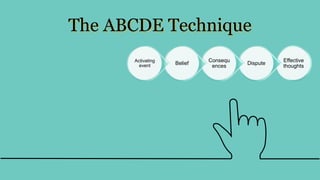
The ABCDE Technique
Effective
thoughts
Dispute
Consequ
ences
Belief
Activating
event
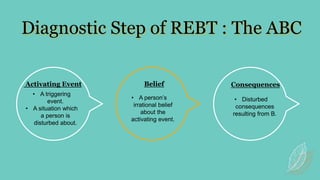
Diagnostic Step of REBT : The ABC
• A triggering
event.
• A situation which
a person is
disturbed about.
• A person’s
irrational belief
about the
activating event.
• Disturbed
consequences
resulting from B.
Activating Event Belief Consequences
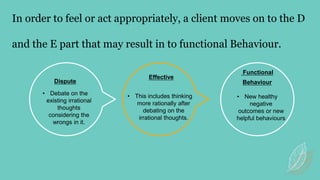
In order to feel or act appropriately, a client moves on to the D
and the E part that may result in to functional Behaviour.
Dispute
• Debate on the
existing irrational
thoughts
considering the
wrongs in it.
• This includes thinking
more rationally after
debating on the
irrational thoughts.
Effective
Functional
Behaviour
• New healthy
negative
outcomes or new
helpful behaviours
Types Of Techniques
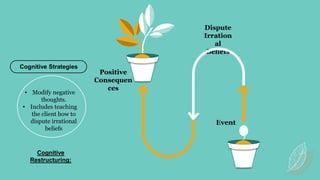
Event
Dispute
Irration
al
Beliefs
Positive
Consequen
ces
• Modify negative
thoughts.
• Includes teaching
the client how to
dispute irrational
beliefs
Cognitive Strategies
Cognitive
Restructuring:
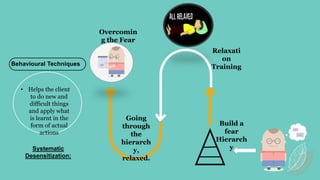
Build a
fear
Hierarch
y
Relaxati
on
Training
Overcomin
g the Fear
• Helps the client
to do new and
difficult things
and apply what
is learnt in the
form of actual
actions
Behavioural Techniques
Systematic
Desensitization:
Going
through
the
hierarch
y,
relaxed.
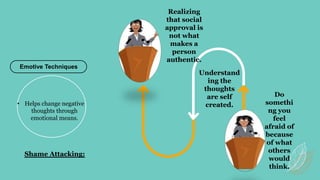
Do
somethi
ng you
feel
afraid of
because
of what
others
would
think.
Understand
ing the
thoughts
are self
created.
Emotive Techniques
Realizing
that social
approval is
not what
makes a
person
authentic.
• Helps change negative
thoughts through
emotional means.
Shame Attacking:
Applications of
REBT
The clinical
applications include
dealing with
depression, anxiety
disorders, eating
disorders, addictions,
other disorders, pain
and stress
Clinical
Non-clinical
applications include
dealing within
workplaces to aid
workers and for
managerial
effectiveness. These
applications also
Non Clinical
THANK YOU

Rational Emotive Behaviour Therapy, REBT.